

Introduction: Why CRO Selection Is a Regulatory Decision, Not Just a Scientific One
When sponsors prepare regulated bioanalytical services for NDA and BLA submissions, selecting the right CRO is far more than a purchasing decision. It is a critical component of the overall regulatory strategy. A weak bioanalytical package remains one of the leading causes of FDA Complete Response Letters (CRLs), and in many situations, the issue is not poor science. Instead, the underlying problems often involve incomplete validation records, inconsistent GLP execution, weak documentation practices, or a CRO that lacks the experience required to defend its data during regulatory review.
At ResolveMass Laboratories Inc., our regulated bioanalytical operations are built around one principle: every study should be inspection-ready from Day 1 rather than corrected months later through remediation efforts. The following sections outline the exact criteria sponsors should carefully evaluate when choosing a CRO for regulated bioanalytical work that supports NDA and BLA submissions.
To understand how to establish a strong regulatory foundation early in your development lifecycle, explore our comprehensive guide on developing an effective bioanalytical strategy for drug development.
Share via:
Article Summary:
- Bioanalytical studies supporting NDA and BLA filings must comply with rigorous FDA expectations, including ICH M10 requirements, GLP standards, and robust data integrity practices.
- Selecting an appropriate CRO involves reviewing factors such as regulatory inspection history, scientific validation capabilities, analytical technologies, biological matrix expertise, and the experience level of Study Directors.
- Important evaluation areas include compliance with 21 CFR Part 11, maintenance of inspection-ready records, effective cross-validation procedures, and properly designed incurred sample reanalysis (ISR) programs.
- Strong sponsor collaboration, proactive communication, and transparent handling of analytical data are essential for reducing regulatory risk during FDA review.
- This article highlights the key characteristics that separate genuinely submission-ready bioanalytical CROs from organizations that only advertise regulatory expertise without proven operational capability.
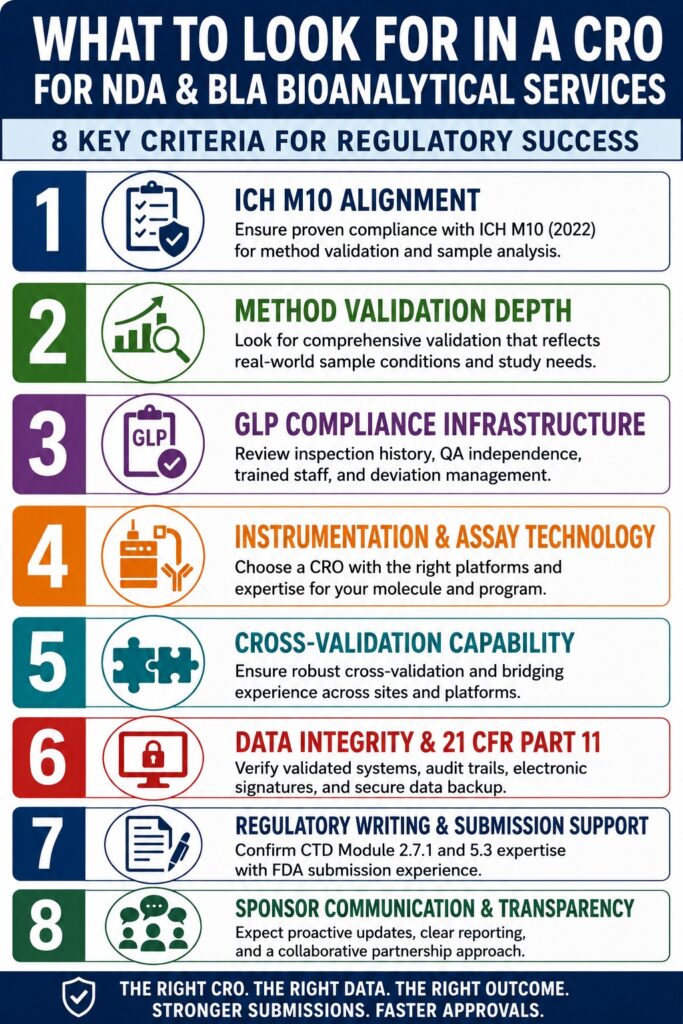
1. ICH M10 Alignment: The Essential Regulatory Foundation
A CRO must demonstrate clear and documented compliance with ICH M10 (2022) guidance rather than relying solely on general GLP compliance. ICH M10 established globally harmonized expectations for bioanalytical method validation and study sample analysis, and the FDA has made it clear that NDA and BLA submissions are expected to align with these standards.
Sponsors evaluating a CRO should ask several direct questions:
- Does the CRO’s method validation protocol template specifically reference ICH M10 parameters such as selectivity, matrix effects, carry-over, dilution integrity, and stability?
- How does the CRO distinguish between fit-for-purpose validation used for exploratory PK studies and full validation required for pivotal GLP studies?
- Can the CRO provide examples of validation reports that successfully passed FDA inspection under the current ICH M10 framework?
A CRO still relying on outdated pre-2022 validation templates, or one that inconsistently merges older FDA Guidance (2018) requirements with ICH M10 standards without addressing the differences, introduces avoidable regulatory risk into the submission process.
Read our detailed breakdown of global compliance expectations in our article on navigating the ICH M10 bioanalytical method validation guidelines.
2. Method Validation Depth: Moving Beyond Basic Compliance
For NDA and BLA submissions, high-quality method validation requires more than simply meeting minimum acceptance criteria. Scientific defensibility is equally important. Any laboratory can produce an acceptable calibration curve and declare a method validated. What truly matters is whether the validation accurately reflects how the method performs under the actual conditions clinical samples will encounter throughout the study.
Sponsors should investigate the following validation elements carefully:
| Validation Parameter | What Sponsors Should Ask the CRO |
|---|---|
| Matrix Effects | Does the CRO conduct both post-column infusion studies and matrix factor experiments across at least six donor lots per matrix? |
| Selectivity | How many matrix lots are tested? Are hemolyzed and lipemic matrices included in the assessment? |
| Stability | Do stability studies reflect clinically relevant conditions, including multiple freeze-thaw cycles and long-term storage at actual study temperatures? |
| Dilution Integrity | Is dilution integrity evaluated at concentrations realistically expected in study samples rather than at arbitrary high levels? |
| ISR (Incurred Sample Reanalysis) | Is ISR incorporated into the study design from the beginning rather than introduced later as a corrective measure? |
Sponsors should also request a redacted example of a prior validation report. Particular attention should be paid to the acceptance criteria tables, deviation logs, and the documentation surrounding reintegration or reassay decisions. These are precisely the types of records FDA reviewers examine during regulatory assessments.
Avoid common validation pitfalls by downloading our resource on overcoming common bioanalytical mistakes in regulatory submissions.
3. GLP Compliance Infrastructure: Understanding the Inspection History
GLP compliance is not simply a certification status. It represents an ongoing operational commitment that must be evaluated through actual inspection history rather than SOP documentation alone. Sponsors should request FDA inspection histories from prospective CROs, including Form 483 observations and the corresponding corrective action responses.
A CRO with no 483 observations over many years is not automatically superior to one that has received observations but implemented strong and effective corrective action plans. What matters most is whether the organization understands the root causes of compliance failures and has implemented sustainable systems to prevent recurrence.
Key compliance infrastructure elements to assess include:
- Study Director qualifications: Are Study Directors appropriately trained and experienced in the assay technologies used for the program?
- Raw data management: Does the CRO define raw data in a manner consistent with 21 CFR Part 11 and GLP requirements? Is electronic data appropriately treated as the primary record?
- QA independence: Can the CRO demonstrate that its Quality Assurance function operates independently rather than serving as a procedural formality?
- Deviation management: Is there a study-specific deviation tracking system, and are sponsors informed about deviations in real time?
A robust GLP infrastructure significantly reduces the likelihood of regulatory findings during FDA inspection or submission review.
Learn how we support regulatory compliance across complex drug development programs via our IND-enabling bioanalytical studies and services.
4. Instrumentation and Assay Technology: Aligning Technology With Molecular Complexity
The CRO’s analytical platform must be selected based on the characteristics of the molecule under investigation rather than through default laboratory preferences. For small molecule NDA submissions, validated LC-MS/MS methods using triple quadrupole systems remain the standard. However, instrument generation, sensitivity performance, and chromatographic conditions become especially important when dealing with low-dose compounds, complex biological matrices, or metabolite profiling requirements.
For large molecule BLA submissions, including monoclonal antibodies, antibody-drug conjugates (ADCs), peptides, and oligonucleotides, the technical considerations become significantly more complex.
Important areas to evaluate include:
- LBA versus LC-MS/MS capabilities: Can the CRO support both Ligand Binding Assays (LBA) and LC-MS/MS methodologies while making evidence-based recommendations tailored to the molecule? Hybrid LBA/LC-MS/MS approaches are increasingly preferred for biologic PK assessments, and CROs limited to a single platform may create methodological limitations.
- ADA assay development: Immunogenicity testing is mandatory for BLA submissions. Does the CRO maintain validated Anti-Drug Antibody (ADA) assay platforms capable of supporting tiered confirmatory testing strategies?
- Sensitivity and LLOQ performance: For oncology biologics or studies involving extremely low exposure endpoints, can the CRO demonstrate Lower Limit of Quantification (LLOQ) capability within the expected concentration ranges of the study design?
Technology selection directly influences data reliability, regulatory confidence, and ultimately the success of the submission package.
Explore our capabilities for high-complexity molecules by visiting our integrated chemistry and bioanalytical CRO services platform.
5. Cross-Validation and Bridging Study Capability
When bioanalytical data is generated across multiple laboratories, geographic regions, or analytical platforms, cross-validation becomes mandatory. A CRO unable to perform rigorous cross-validation introduces potential submission gaps that may compromise data comparability across the clinical development program.
This issue is especially important for global NDA and BLA submissions where Phase 1 and pivotal Phase 3 studies may have been conducted at different locations or under different analytical conditions.
Sponsors should confirm the following:
- Does the CRO maintain a defined cross-validation protocol aligned with ICH M10 Section 7.1?
- Has the CRO successfully performed cross-validation between different instrument platforms, such as API 5500 and API 7500 systems?
- Can the CRO serve as the coordinating laboratory for a multi-site bioanalytical program while maintaining harmonized processes across partner laboratories?
Strong cross-validation capability ensures continuity and comparability throughout the entire clinical development lifecycle.
Ensure data consistency across study sites by discovering how we manage complex bioanalytical method transfer protocols.
6. Data Integrity and 21 CFR Part 11 Compliance
The data integrity framework of a bioanalytical CRO must be completely auditable. Every analytical run, peak integration adjustment, and reanalysis event should be fully traceable through documented audit trails. FDA reviewers are increasingly focused on Laboratory Information Management Systems (LIMS) and chromatography data systems (CDS) when evaluating bioanalytical submissions.
Sponsors should evaluate the following areas carefully:
- CDS platform validation: Is the CRO operating validated chromatography software platforms such as Sciex OS, MassHunter, or Thermo Xcalibur with fully compliant 21 CFR Part 11 audit trails?
- Manual integration controls: Does the CRO maintain formal policies limiting manual reintegration while requiring scientific justification and preservation of both original and adjusted peak data?
- Electronic signature controls: Are validation reports, analytical runs, QA reviews, and critical study records signed electronically using secure role-based access controls?
- Backup and disaster recovery systems: Are raw data securely backed up to validated offsite or cloud-based systems with documented recovery procedures?
Weak data integrity systems create substantial regulatory exposure, even when the scientific data itself appears acceptable.
Read about how we safeguard your electronic records in our guide to maintaining data integrity in bioanalytical studies.
7. Regulatory Writing and Submission Support Capability
Even technically strong bioanalytical laboratories can create submission delays if they lack the ability to produce submission-ready regulatory documentation. Specifically, CROs supporting NDA and BLA submissions should be capable of preparing content suitable for CTD Module 2.7.1 and detailed Bioanalytical Study Reports for Module 5.3.
Without this expertise, sponsors are often forced to translate scientific findings into regulatory language internally, increasing the likelihood of inconsistencies, omissions, and timeline delays.
When assessing regulatory writing capabilities, sponsors should:
- Request a sample Module 2.7.1 bioanalytical methods summary prepared by the CRO.
- Confirm that the CRO understands the CTD structure and the relationship between study reports in Module 5.3.3.x and corresponding summaries in Module 2.7.1.
- Verify whether the CRO employs bioanalytical scientists with direct FDA submission experience rather than laboratory-only backgrounds.
At ResolveMass Laboratories Inc., our scientific team includes professionals with direct NDA and BLA submission preparation experience. This ensures that all generated data is documented, interpreted, and positioned appropriately for regulatory review from the earliest stages of the project rather than being reformatted later under submission pressure.
Transition smoothly from early phases to late-stage validation with our comprehensive bioanalytical CRO services for Phase II and Phase III trials.
8. Sponsor Communication and Project Transparency
A CRO should function as an active scientific collaborator rather than an isolated service provider. During long-term clinical development programs, regulatory expectations evolve, study protocols change, and bioanalytical strategies often require adjustment. Limited communication from a CRO can create cumulative operational and regulatory risks.
Minimum communication standards for regulated bioanalytical programs should include:
- Immediate or near real-time notification of study deviations, instrument failures, or critical analytical events.
- Dedicated access to a consistent Study Director and Project Manager rather than rotating support personnel.
- Milestone-based progress reporting, including draft validation and study reports before final approval and lock.
- Proactive communication regarding emerging regulatory developments, including updated FDA guidance documents or EMA reflection papers that may affect the program.
Transparent communication significantly improves regulatory readiness and reduces the risk of unexpected issues during submission preparation.
Discover how we build transparent, long-term scientific alliances through our dedicated bioanalytical CRO partnership framework.
Conclusion: CRO Selection Criteria That Safeguard Your Submission
Selecting the right partner for regulated bioanalytical services supporting NDA and BLA submissions is one of the most strategically important decisions within clinical development. The qualities that distinguish a submission-ready CRO from a merely functional laboratory are measurable, documentable, and deserving of detailed evaluation before any contract is finalized.
The criteria discussed throughout this article — including ICH M10 alignment, comprehensive method validation, GLP inspection history, advanced analytical platform capability, cross-validation expertise, data integrity infrastructure, regulatory writing proficiency, and transparent communication practices — together form a complete due diligence framework for CRO qualification.
If your organization is evaluating CRO partners for regulated bioanalytical services supporting NDA and BLA submissions, ResolveMass Laboratories Inc., welcomes rigorous evaluation and technical scrutiny. Our organization is designed to operate at the regulatory and scientific standard this work demands.
📩 Contact ResolveMass Laboratories Inc.
Frequently Asked Questions (FAQs)
Regulated bioanalytical services used in NDA and BLA submissions are primarily governed by several key FDA and international regulatory frameworks. These include 21 CFR Part 58 for Good Laboratory Practice (GLP), 21 CFR Part 11 for electronic records and electronic signatures, and ICH M10 guidance for bioanalytical method validation and study sample analysis. In addition, the FDA’s 2018 Bioanalytical Method Validation Guidance continues to provide important supporting expectations. For biologics and BLA submissions, sponsors must also comply with FDA immunogenicity guidance issued through CDER, particularly for therapeutic proteins and monoclonal antibodies.
ICH M10 introduced a globally harmonized framework that expanded and clarified many expectations previously outlined in the FDA’s 2018 guidance. While the earlier FDA guidance focused heavily on core validation principles, ICH M10 provides more detailed direction on matrix effects, stability testing, ISR requirements, and large molecule assay strategies. The FDA has formally adopted ICH M10, making it the current standard for regulated bioanalytical submissions. CROs supporting NDA and BLA programs are now expected to align their validation procedures directly with ICH M10 requirements rather than relying solely on older guidance documents.
Incurred sample reanalysis (ISR) is a quality assessment process used to confirm the reliability and reproducibility of bioanalytical data generated from clinical study samples. During ISR, a selected portion of previously analyzed samples is tested again in a separate analytical run to verify consistency in measured concentrations. Regulatory agencies, including the FDA, expect ISR to be included in pivotal studies submitted as part of NDA or BLA applications. Typically, around 10% of study samples are reassessed, focusing on samples near Cmax and elimination phases to ensure assay performance remains dependable throughout the study.
Before selecting a CRO for NDA or BLA bioanalytical support, sponsors should conduct a thorough qualification review of the laboratory’s compliance and operational systems. Important documents include FDA inspection histories, Form 483 observations with corrective action responses, GLP compliance statements, and representative validation reports from similar analytical platforms. Sponsors should also request Study Director qualifications, training records, raw data handling SOPs, and audit trail management procedures. Reviewing prior NDA or BLA project experience can also help determine whether the CRO has the regulatory depth necessary for submission-quality work.
If a bioanalytical method fails to meet an acceptance criterion during validation, the CRO must fully document the issue and investigate the scientific cause of the failure. The event should be recorded in the study deviation log, followed by corrective and preventive actions before repeating or revalidating the affected parameter. Regulatory agencies expect complete transparency, meaning failed data cannot simply be removed or ignored without scientific justification. Both the original failed results and the corrected validation data must remain preserved within the raw data archive for future inspection and regulatory review.
Fit-for-purpose validation is generally used during early exploratory studies where limited pharmacokinetic information is needed and there is no immediate regulatory submission intent. This approach validates only the parameters necessary to support the study’s objectives. In contrast, full bioanalytical method validation is required for pivotal studies included in NDA and BLA submissions and must satisfy all ICH M10 validation requirements. Any assay initially developed under a fit-for-purpose strategy must undergo a complete validation process before the resulting data can support regulatory decision-making in pivotal clinical programs.
For BLA submissions, anti-drug antibody (ADA) assays must comply with FDA guidance related to immunogenicity testing of therapeutic protein products. The assay strategy generally includes multiple testing tiers, such as screening assays, confirmatory assays, and antibody titer assessments. Validation must demonstrate acceptable sensitivity, selectivity, precision, drug tolerance, and scientifically justified cut-point determination. Depending on the biologic’s mechanism of action, sponsors may also need validated neutralizing antibody (NAb) assays to evaluate whether detected antibodies interfere with the therapeutic activity of the product.
A CRO demonstrates 21 CFR Part 11 compliance by operating validated electronic systems that maintain secure and traceable records throughout the bioanalytical workflow. This includes chromatography data systems with complete audit trails that capture user actions, data modifications, timestamps, and justifications for changes. The laboratory should also implement role-based system access, validated electronic signatures, and controlled document management procedures. In addition, all electronic records must be securely backed up and retained for the required regulatory retention period to ensure long-term data integrity and accessibility.
Reference:
- U.S. Food and Drug Administration. Bioanalytical Method Validation: Guidance for Industry. FDA, May 2018. https://www.fda.gov/media/70858/download
- International Council for Harmonisation. ICH M10: Bioanalytical Method Validation and Study Sample Analysis. ICH, May 2022. https://www.ich.org/page/multidisciplinary-guidelines
- U.S. Food and Drug Administration. Immunogenicity Testing of Therapeutic Protein Products — Developing and Validating Assays for Anti-Drug Antibody Detection: Guidance for Industry. FDA, January 2019. https://www.fda.gov/media/119788/download
- U.S. Food and Drug Administration. Guidance for Industry: Submitting Samples and Analytical Data for Methods Validation. FDA. https://www.fda.gov/regulatory-information/search-fda-guidance-documents
- European Medicines Agency. Guideline on Bioanalytical Method Validation (EMEA/CHMP/EWP/192217/2009 Rev. 1 Corr. 2). EMA, 2011. https://www.ema.europa.eu/en/bioanalytical-method-validation
- U.S. Food and Drug Administration. Data Integrity and Compliance with Drug CGMP: Guidance for Industry. FDA, December 2018. https://www.fda.gov/media/119267/download
Get In Touch With Us
About The Author


