

Introduction:
Nitrosamine Risk Assessment for Combination Oral Solid Dosage Forms is particularly important when a pharmaceutical product contains two or more active pharmaceutical ingredients (APIs), because the number of potential chemical interactions and nitrosamine formation pathways can increase substantially.
Nitrosamines are a class of impurities that have received significant regulatory attention because several members are classified as probable human carcinogens. Regulatory authorities have therefore established approaches for evaluating, testing, and controlling these impurities in medicines. FDA guidance addresses both small-molecule nitrosamines and nitrosamine drug substance-related impurities (NDSRIs), and discusses potential root causes, risk assessments, confirmatory testing, and control strategies.
For a combination oral solid dosage form — such as a tablet or capsule containing API-1 and API-2 — a conventional impurity assessment may not be sufficient. Each API must be evaluated for its own nitrosamine-forming potential, while the complete formulation must also be examined for interactions involving nitrite sources, amines, manufacturing conditions, excipients, and storage.
This case study presents an illustrative pharmaceutical development scenario showing how a structured risk assessment and analytical testing program can identify and control nitrosamine risk in a multi-API oral solid dosage form.
Summary:
- Nitrosamine Risk Assessment for Combination Oral Solid Dosage Forms must evaluate each API individually as well as the complete formulation and manufacturing process.
- A conventional single-API impurity assessment is not sufficient — each API must be evaluated individually, and the complete formulation must be examined for interactions between APIs, excipients, nitrite sources, and manufacturing conditions.
- Multiple APIs can increase the complexity of nitrosamine assessment because each API may have different structural vulnerabilities, manufacturing routes, impurity profiles, and nitrosation pathways.
- Potential sources include APIs, excipients, process reagents, solvents, water, packaging, manufacturing equipment, and storage conditions.
- Both small-molecule nitrosamines and NDSRIs need dedicated evaluation, since NDSRIs are structurally tied to the specific API and often require compound-specific data or ICH M7 vs. FDA guidance comparison to set an acceptable intake limit.
- A structured program moves from chemical risk assessment, to raw-material and process evaluation, to confirmatory analytical testing, to root-cause investigation and a documented control strategy.
- Risk assessment should precede confirmatory testing. FDA guidance describes risk assessment, testing where appropriate, and implementation of controls to prevent or reduce unacceptable nitrosamine levels.
- NDSRIs require special attention because their structures are related to the respective APIs and their acceptable intake limits may require compound-specific data, read-across, or predicted carcinogenic potency categorization.
- Sensitive analytical techniques such as LC-MS/MS, GC-MS/MS, LC-HRMS, and GC-HRMS can be selected according to the physicochemical properties of the target nitrosamines and formulation matrix.
- A scientifically justified control strategy should connect risk assessment, analytical testing, root-cause investigation, process controls, specifications, and lifecycle monitoring.
1: Why Is Nitrosamine Risk Assessment More Complex for Multiple APIs?
A combination product contains more than one chemically active component, so nitrosamine risk cannot always be evaluated by examining the APIs independently.
The assessment should consider whether either API—or their impurities, degradants, or manufacturing residues—can participate in nitrosation reactions under relevant conditions.
Important questions include:
- Does either API contain a potentially nitrosatable amine?
- Are secondary or tertiary amine functionalities present?
- Could API-related impurities form NDSRIs?
- Are nitrite-containing materials present?
- Could excipients contribute nitrite or other reactive species?
- Could nitrosamines form during granulation, drying, compression, coating, or storage?
- Are shared manufacturing equipment or processes potential contributors?
- Could packaging materials introduce additional risk?
- Does the combination change microenvironmental pH, moisture, or chemical reactivity?
FDA identifies multiple potential sources of nitrosamine impurities, including API chemistry, manufacturing processes, raw materials, and drug-product conditions — a scope that is broader still for drug-drug combination products.
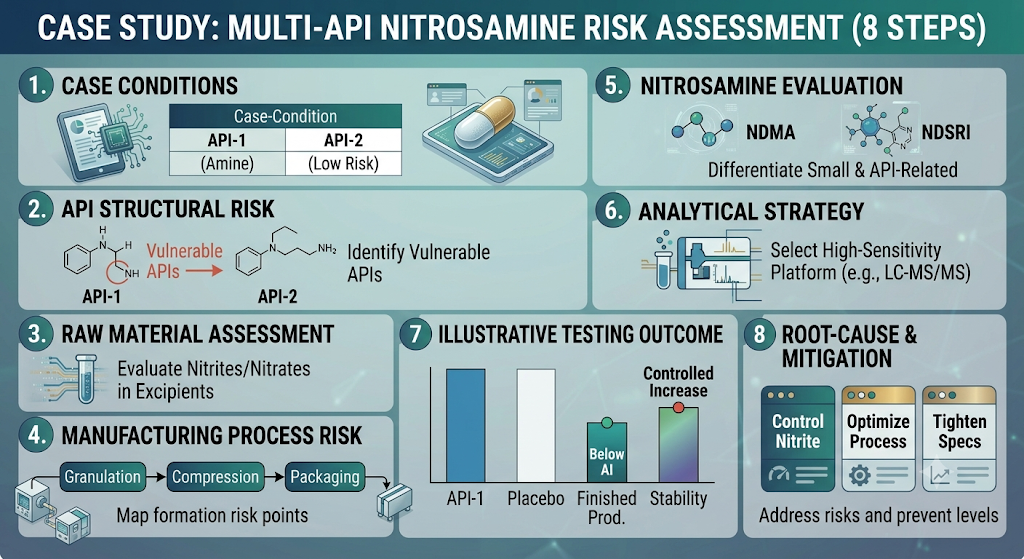
2: Illustrative Case Study: Multi-API Immediate-Release Tablet
Product Background
Consider a hypothetical immediate-release tablet containing two APIs.
| Product Characteristic | Case-Study Condition |
|---|---|
| Dosage form | Immediate-release tablet |
| Number of APIs | 2 |
| API-1 | Amine-containing small molecule |
| API-2 | Small molecule with lower theoretical nitrosation potential |
| Manufacturing | Wet granulation followed by compression |
| Excipients | Lactose, microcrystalline cellulose, crospovidone, lubricant |
| Packaging | HDPE bottle with desiccant |
| Primary concern | API-related and process-related nitrosamines |
The initial formulation development team identified no known nitrosamine impurity above the applicable reporting threshold. However, structural evaluation suggested that API-1 could potentially form an NDSRI under suitable nitrosating conditions.
Rather than relying only on routine finished-product impurity testing, the development team initiated a structured Nitrosamine Risk Assessment for Combination Oral Solid Dosage Forms.
Step 1: API Structural and Chemical Risk Assessment
The first step was to examine the molecular structures of both APIs and identify functional groups associated with potential nitrosamine formation.
The assessment considered:
- Primary, secondary, and tertiary amines
- Nitrosatable nitrogen atoms
- API-related impurities
- Degradation products
- Synthetic intermediates
- Residual reagents
- Potential NDSRI structures
- Known nitrosamine formation pathways
NDSRIs are particularly important because they are structurally related to APIs and are often unique to the specific drug substance. FDA provides a framework for evaluating their mutagenic and carcinogenic potential and establishing acceptable intake limits, informed in part by the ICH M7(R2) update.
Key Finding
API-1 was categorized as having a higher theoretical nitrosamine risk, while API-2 presented a comparatively lower structural risk.
However, the assessment did not stop at API structure, because formulation and manufacturing conditions could still influence actual nitrosamine formation — particularly for drug classes already flagged as higher risk, such as beta blockers or metformin-containing products.
Step 2: Raw Material and Excipient Risk Assessment
The next stage evaluated all major raw materials.
Particular attention was given to:
- Excipients with potential nitrite/nitrate contributions
- Water quality
- Process solvents
- Processing aids
- Lubricants
- Colorants, if applicable
- API starting materials
- Recovered solvents
- Cleaning materials
- Supplier-specific impurity information
A supplier qualification exercise was performed to determine whether incoming materials could introduce nitrosamines or nitrosating species. This step is critical because a low-risk API can still be incorporated into a formulation where another component provides a potential nitrosation source.
This step is critical because a low-risk API can still be incorporated into a formulation where another component provides a potential nitrosation source.
Step 3: Manufacturing Process Risk Assessment
Manufacturing conditions were mapped from dispensing through packaging.
The assessment considered:
Dispensing → Wet Granulation → Drying → Milling → Blending → Compression → Coating → Packaging → Storage
For each stage, the team evaluated:
| Process Stage | Potential Risk Factor |
|---|---|
| Dispensing | Raw-material variability |
| Granulation | Water, temperature, pH, processing time |
| Drying | Temperature and residence time |
| Milling | Heat and processing stress |
| Blending | Material interaction |
| Compression | Mechanical/thermal effects |
| Coating | Coating solution composition and temperature |
| Packaging | Container-closure interaction |
| Storage | Temperature, humidity, and time |
The objective was not simply to identify whether nitrosamines were present but to understand where they could potentially form or increase during the product lifecycle.
Step 4: NDSRI and Small-Molecule Nitrosamine Evaluation
A comprehensive assessment should distinguish between small-molecule nitrosamines and NDSRIs, since the two categories require different evaluation logic and often different acceptable intake justifications.
Small-Molecule Nitrosamines
These impurities do not share structural similarity with the API and may originate from process chemicals, solvents, reagents, or other sources.
Examples may include:
- NDMA
- NDEA
- NMBA
- NDBA
- Other potentially relevant nitrosamines based on the manufacturing process
The actual target list should be scientifically justified rather than automatically applying the same panel to every product.
Nitrosamine Drug Substance-Related Impurities
NDSRIs require an API-specific assessment because their structures can arise from nitrosation of vulnerable portions of the drug substance.
FDA’s framework includes approaches based on compound-specific carcinogenicity and mutagenicity data, read-across from appropriate surrogates, and predicted carcinogenic potency categorization where applicable.
Step 5: Analytical Testing Strategy
After the risk assessment identified potentially relevant nitrosamines, confirmatory analytical testing was designed around the expected nitrosamine identity, chemical properties, matrix, and applicable acceptable intake limit — the same screening-versus-confirmatory logic that applies across nitrosamine testing programs generally.
The analytical strategy should be based on:
- Expected nitrosamine identity
- Chemical properties
- Expected concentration
- API/formulation matrix
- Required reporting or quantification level
- Applicable acceptable intake limit
- Potential matrix interference
Typical analytical technologies:
| Analytical Platform | Potential Application |
|---|---|
| LC-MS/MS | Targeted quantitative nitrosamine analysis |
| LC-HRMS | Trace-level screening and high-resolution confirmation |
| GC-MS/MS | Volatile/semi-volatile nitrosamines via direct injection or headspace |
| GC-HRMS | High-selectivity characterization |
| LC-HRMS/MS | Broad screening and structural confirmation |
For complex combination products, high selectivity is particularly important because API-related components can produce significant matrix effects or chromatographic interference.
Step 6: Method Development and Validation
The analytical method was developed to provide adequate sensitivity relative to the applicable acceptable intake, often requiring an ultra-low limit of quantitation well below what routine impurity methods are built to detect.
Important method-performance characteristics include:
- Specificity/selectivity
- Sensitivity
- Linearity
- Accuracy
- Precision
- Recovery
- Carryover
- Matrix effects
- Stability
- Limit of detection
- Limit of quantification
- System suitability
The method should be demonstrated to reliably distinguish the target nitrosamine from APIs, degradation products, excipients, and other formulation components. For regulatory submissions, the analytical strategy should be scientifically justified, appropriately documented, and built around a realistic nitrosamine testing timeline — see full method development and validation services for how this is typically scoped.
For regulatory submissions, the analytical strategy should be scientifically justified and appropriately documented.
Step 7: Illustrative Testing Outcome
For this hypothetical case, initial testing showed that the principal concern was associated with an API-related nitrosamine rather than a broad panel of process-derived nitrosamines.
An illustrative result could be represented as follows:
| Testing Stage | Illustrative Observation | Action |
|---|---|---|
| API-1 testing | Trace NDSRI detected | Investigate formation pathway |
| API-2 testing | Not detected | Continue routine risk monitoring |
| Placebo testing | No target nitrosamine detected | Low formulation-background risk |
| Blend testing | Low-level signal observed | Evaluate manufacturing conditions |
| Finished product | Detectable but controlled level | Compare with applicable AI |
| Stability sample | Slight increase under stress | Strengthen control strategy |
Important: These values are illustrative and are not actual ResolveMass client data or regulatory acceptance criteria.
The investigation indicated that nitrosamine formation could potentially be influenced by the interaction between the vulnerable API functionality and nitrosating species introduced through the manufacturing environment.
Step 8: Root-Cause Investigation and Mitigation
Once a nitrosamine risk is confirmed, analytical testing should transition into root-cause investigation, drawing on a documented control strategy development process rather than one-off corrective actions.
Potential mitigation strategies may include:
- Changing a high-risk raw material supplier
- Controlling nitrite levels in excipients
- Modifying process conditions
- Reducing unnecessary processing time
- Controlling moisture
- Adjusting formulation microenvironment
- Replacing a problematic excipient where scientifically justified
- Changing API manufacturing controls
- Introducing tighter raw-material specifications
- Improving packaging controls
- Establishing appropriate in-process or finished-product testing
FDA’s current guidance discusses mitigation strategies intended to prevent or reduce unacceptable nitrosamine levels.
3: The Product: A Three-API Fixed-Dose Combination Tablet
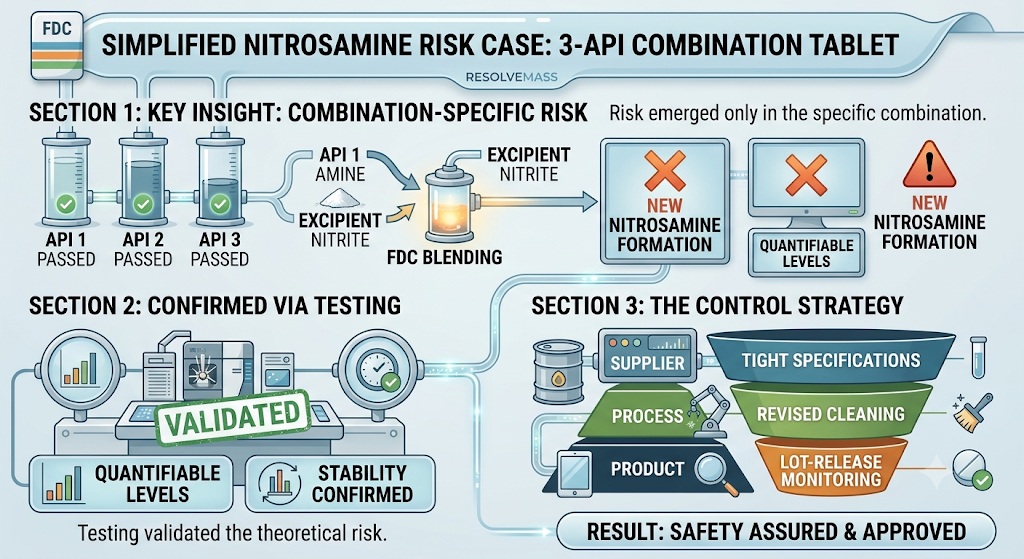
The client had submitted a generic fixed-dose combination oral solid dosage form containing three small-molecule APIs, each with its own history of nitrosamine scrutiny in single-agent products. Prior to combining them, each API had passed independent nitrosamine risk evaluations in its respective reference listed drug filings.
Why a fresh assessment was still required:
- Two of the three APIs contained secondary amine groups capable of nitrosation
- The tablet formulation introduced a shared excipient blend not used in any of the three original monotherapy products
- Manufacturing consolidated multiple steps onto shared equipment previously used for nitrite-containing products
- Regulatory guidance (Health Canada, FDA, EMA) explicitly requires a standalone nitrosamine risk assessment for combination products regardless of individual API history
Step 1: Structural and Process-Based Risk Categorization
The first question a nitrosamine risk assessment must answer is which molecules in the formulation are structurally capable of forming a nitrosamine, and the answer here was two of the three APIs plus one excipient-derived amine.
ResolveMass began with the standard three-part categorization framework used across ICH M7 and regional nitrosamine guidance:
| Risk Category | What It Evaluates | Finding for This Product |
|---|---|---|
| API structural risk | Presence of secondary/tertiary amines, amide, or other nitrosatable functional groups in each API | 2 of 3 APIs flagged for secondary amine groups |
| Process-related risk | Use of nitrite-containing reagents, nitrosating conditions, or shared equipment history | Shared blending equipment had prior exposure to nitrite-based excipient lots |
| Materials-related risk | Nitrite/nitrate contamination in excipients (starches, celluloses, coloring agents), packaging-derived nitrosamines, and cross-contamination from multi-product facilities | Elevated nitrite trace levels identified in one excipient lot |
This table format mirrors what most regulatory nitrosamine assessment templates expect, and structuring findings this way from the outset made the subsequent root cause investigation far more efficient.
Step 2: Where the Combination-Specific Risk Was Found
The unique nitrosamine risk in this case did not come from either API individually — it came from a secondary amine on one API reacting with trace nitrite carried into the blend by an excipient used to formulate the third, structurally unrelated API.
This is the central finding that distinguishes combination product risk assessments from single-API assessments, whether the product is an oral solid dosage form or an injectable drug product with a different risk profile. Neither API’s original reference filing would have flagged this pathway, because:
- The excipient in question was not used in either API’s original monotherapy product
- The nitrite contamination in that excipient lot was below the threshold that would trigger scrutiny in a single-API context
- The reaction pathway only became chemically favorable once the two components were co-processed under the combination product’s specific blending and compression conditions
Step 3: Analytical Testing and Confirmatory Method Development
Once the risk pathway was identified on paper, ResolveMass moved to confirmatory analytical testing to quantify actual nitrosamine formation rather than relying on theoretical risk alone.
Testing approach:
- Targeted LC-MS/MS method developed and validated to detect and quantify the specific nitrosamine impurity predicted by the structural assessment, at levels well below the applicable Acceptable Intake (AI) limit
- Non-targeted/suspect screening using high-resolution mass spectrometry to rule out formation of additional, unpredicted nitrosamine species
- Stress and accelerated stability testing to confirm whether nitrosamine levels increased over shelf life under recommended storage conditions
- Excipient lot-to-lot nitrite screening to determine whether the contamination was isolated to a single supplier lot or systemic across the excipient’s specification
The confirmatory testing detected low but quantifiable nitrosamine levels in batches manufactured with the implicated excipient lot, validating the theoretical risk pathway identified in Step 2.
Step 4: Root Cause Determination and Control Strategy
The root cause was traced to nitrite carryover from a raw-material intermediate used in producing the excipient, not to the API synthesis routes or the drug product manufacturing process itself.
With the root cause confirmed, the control strategy addressed the issue at three levels:
| Control Level | Action Taken |
|---|---|
| Supplier/material | Tightened excipient nitrite specification and added supplier-level nitrite testing as an incoming release criterion |
| Process | Revised equipment cleaning validation to eliminate nitrite carryover from shared blending lines |
| Product | Established periodic verification testing of the drug product using the validated LC-MS/MS method for ongoing lot-release monitoring |
4: Key Lessons for Combination Product Nitrosamine Risk Assessments
The main lesson from this case is that combination products require assessing interaction risk between components, not just summing the individually known risks of each API.
- Don’t assume prior single-API clearance transfers. A nitrosamine risk conclusion from a monotherapy filing does not automatically apply once that API is combined with others.
- Excipients deserve equal scrutiny to APIs. Nitrite contamination in “inert” excipients is a recurring root cause across nitrosamine investigations, not an edge case.
- Shared equipment history matters. Facilities manufacturing multiple product lines need documented cleaning validation specific to nitrite carryover risk.
- Build in confirmatory analytical testing early. Structural/theoretical risk assessment alone is not sufficient for regulatory submissions — quantitative testing is expected to support the conclusions.
- Plan for ongoing verification, not a one-time study. Regulators increasingly expect periodic or lot-release nitrosamine monitoring for higher-risk combination products.
5: Common Challenges in Nitrosamine Risk Assessment for Combination Oral Solid Dosage Forms
1. Multiple Potential Formation Pathways
Two or more APIs can introduce different chemical pathways, making the risk assessment more complicated than a single-API product.
2. Extremely Low Target Levels
Nitrosamines may need to be detected and quantified at very low concentrations, requiring an ultra-low LOQ and highly sensitive, selective instrumentation.
3. Complex Matrix Effects
High concentrations of APIs and excipients can interfere with trace-level nitrosamine measurement.
4. NDSRI Identification
Predicting which API-related nitrosamines could form requires chemical expertise rather than simply applying a standard analytical panel.
5. Changing Regulatory Expectations
AI limits, recommended analytical methods, and scientific approaches can evolve as additional toxicological and analytical information becomes available, including for less commonly discussed product types like veterinary drug products.
6: How ResolveMass Can Support Nitrosamine Testing Programs
A scientifically designed nitrosamine program requires more than an analytical instrument. It requires integration of pharmaceutical chemistry, analytical science, impurity assessment, method development, and regulatory interpretation — which is why many sponsors choose outsourcing nitrosamine testing to a CRO with dedicated expertise rather than building the capability in-house.
ResolveMass Laboratories can support pharmaceutical development programs through analytical strategies involving:
- Nitrosamine risk assessment
- NDSRI evaluation
- Targeted nitrosamine testing
- LC-MS/MS analysis
- LC-HRMS screening and characterization
- GC-MS/MS and GC-HRMS approaches where appropriate
- Trace-level method development and validation
- Forced-degradation and stress investigations
- Root-cause investigations
- Stability assessment
- Technical documentation and reporting
For combination products, the testing strategy can be tailored according to the APIs, formulation composition, manufacturing process, packaging configuration, and intended regulatory market.
Conclusion:
Nitrosamine Risk Assessment for Combination Oral Solid Dosage Forms requires an integrated, science-based approach that considers every API, formulation component, manufacturing step, packaging material, and potential degradation pathway.
The most effective strategy is to begin with a structured chemical and process risk assessment, identify potential small-molecule nitrosamines and NDSRIs, develop appropriately sensitive analytical methods, confirm actual risk through testing, and implement scientifically justified mitigation and lifecycle controls.
For multi-API products, the key lesson is simple: nitrosamine risk should be evaluated at the product level—not merely API by API. Combining pharmaceutical chemistry, trace-level mass spectrometry, formulation knowledge, process understanding, and current regulatory expectations provides a stronger foundation for patient safety and regulatory readiness.
Frequently Asked Questions:
Yes, each fixed-dose combination should undergo a product-specific nitrosamine risk assessment. Different APIs, excipients, manufacturing processes, and packaging can introduce different risks. The assessment should evaluate both individual APIs and the final combination product. Previous assessments may provide supporting information but should not automatically be applied to a new FDC.
Yes, nitrosamine risk can originate from excipients, raw materials, or manufacturing processes. Excipients may contain or contribute nitrites, nitrates, amines, or other reactive substances. Therefore, the complete formulation should be evaluated. The actual risk depends on the materials, concentrations, processing conditions, and potential reaction pathways.
Nitrosamine risk should be reassessed throughout the product lifecycle, rather than treated as a one-time assessment. Reassessment is particularly important after changes to APIs, suppliers, excipients, manufacturing processes, or packaging. New analytical, toxicological, or regulatory information should also trigger a review. Periodic quality reviews can help maintain ongoing control.
An exceedance should trigger confirmation and a documented root-cause investigation. The investigation should evaluate the analytical result, raw materials, manufacturing process, formulation, and storage conditions. Appropriate mitigation measures should then be implemented to reduce or prevent formation. Additional testing and regulatory assessment may also be required.
NDSRIs are important because each API can potentially form its own API-specific nitrosamine impurity. Their formation depends on the chemical structure and nitrosation susceptibility of the individual API. Therefore, each API should undergo a separate structural risk assessment. The final combination product should also be evaluated for formulation and process-related risks.
It is a systematic evaluation of potential nitrosamine formation in multi-API tablets or capsules. The assessment considers APIs, NDSRIs, excipients, raw materials, manufacturing conditions, packaging, and storage. Where a credible risk is identified, appropriate analytical testing is performed. The results support mitigation and an effective lifecycle control strategy.
Reference
- Hohl K. Nitrosamine risk management for medicinal products: WHO’s role and a case study of camzyos®. Master Drug Regul Aff. 2023.https://www.dgra.de/media/pdf/studium/masterthesis/master_hohl_kevin_2024.pdf
- Wichitnithad W, Angsuwattana P, Yu B, Thitikornpong W, Rojsitthisak P. Managing NDSRIs in Pharmaceuticals: Integrating Structural Risk Assessment and Mitigation Strategies. ACS Chemical Health & Safety. 2026 Apr 22;33(3):350-70.https://pubs.acs.org/doi/abs/10.1021/acs.chas.6c00012
- Aishwarya D, Ramakant Dhampalwar V, Pallaprolu N, Peraman R. Nitrosamine drug substance-related impurities (NDSRIs) in pharmaceuticals: formation, mitigation strategies, and emphasis on mutagenicity risks. Pharmaceutical Research. 2025 Apr;42(4):547-78.https://link.springer.com/article/10.1007/s11095-025-03857-9
- Cobice D, Mamidala V, Quick R, Iyoha K, Grayson-Gaunt D, Rowe B, Brooks J, Giuliano G. Integrating nitrosamine theoretical formation into Translational Pharmaceutics: Mitigating risks during accelerated formulation development in early phase clinical studies. Journal of Pharmaceutical Sciences. 2026 Jul 24:104434.https://www.sciencedirect.com/science/article/pii/S0022354926002832
- Charoo NA, Dharani S, Khan MA, Rahman Z. Nitroso impurities in drug products: an overview of risk assessment, regulatory milieu, and control strategy. AAPS PharmSciTech. 2023 Feb 9;24(2):60.https://link.springer.com/article/10.1208/s12249-023-02523-w
About the Author


