Introduction:
Extractable & Leachable Testing for Clinical to Commercial Scale-Up is essential because changes introduced during manufacturing scale-up can alter the chemical interaction between a drug product and its packaging or delivery system. A container closure system that performs acceptably during clinical development may require additional assessment once materials, suppliers, processing conditions, sterilization methods, or commercial packaging configurations change.
Extractables and leachables (E&L) are therefore not simply a packaging-quality checkbox. They sit inside a broader product quality, patient safety, and CMC risk-management strategy — one that regulators expect sponsors to revisit at defined points across a product’s development lifecycle, not only once at filing.
FDA’s established container-closure guidance has long addressed packaging considerations for human drugs and biologics, and the agency’s newer draft guidance, published in August 2026, provides updated recommendations for assessing container closure systems, including E&L and toxicological risk considerations. For pharmaceutical companies progressing from clinical development toward commercial launch, the challenge is to maintain scientific continuity while demonstrating that the commercial product remains appropriately controlled — and this is where an experienced GMP-licensed analytical laboratory partner becomes an extension of the CMC and quality team rather than an outside vendor brought in late.
Summary:
- E&L Testing for Clinical to Commercial Scale-Up should be treated as a lifecycle activity rather than a one-time packaging test performed shortly before launch.
- Extractables studies identify chemicals that can be released from packaging or delivery-system materials under controlled extraction conditions, while leachables studies evaluate compounds that actually migrate into the drug product.
- The transition from clinical batches to commercial manufacturing can introduce changes in materials, suppliers, manufacturing processes, sterilization, packaging configurations, and storage conditions — any of which can shift the E&L risk profile.
- USP <1663> provides a framework for extractables assessments, while USP <1664> provides a framework for drug-product leachables assessments; both favor a risk-based approach over a fixed, one-size-fits-all protocol.
- FDA’s regulatory landscape continues to emphasize scientifically justified assessment of container closure systems, including extractables, leachables, and toxicological risk — most recently reflected in a draft Container Closure Systems for Human Drugs and Biological Products guidance published in August 2026 (currently draft, not yet in effect).
- A GMP-licensed laboratory partner that supports a program continuously from clinical through commercial manufacturing helps establish scientifically justified analytical strategies, sensitive methods, compound identification, quantitation, and documentation suitable for regulated development — reducing duplication and improving comparability across development stages.
1: What Is Extractable & Leachable Testing and Why Does It Matter for Commercialization?
Extractable & Leachable testing determines what chemicals can potentially migrate from packaging or delivery-system components into a pharmaceutical product, and whether those chemicals present a meaningful quality or patient-safety concern. The two core concepts — extractables and leachables — are related but distinct, and confusing them is one of the most common missteps sponsors make during scale-up.
| Assessment | Primary Question | Typical Application |
|---|---|---|
| Extractables | What compounds can be released from a material under controlled extraction conditions? | Packaging/component characterization |
| Leachables | What compounds actually migrate into the drug product during storage or use? | Drug-product and stability assessment |
| Toxicological assessment | Is exposure to an identified compound acceptable? | Safety/risk evaluation |
| Risk assessment | Which materials, compounds, conditions, and exposure scenarios require control? | Overall E&L strategy |
USP <1663> describes a framework for designing and executing extractables assessments, while USP <1664> provides a framework for leachables assessments associated with pharmaceutical packaging and delivery systems. Importantly, neither chapter prescribes one universal test method or acceptance criterion for every product — the assessment should be scientifically justified according to the specific drug product, packaging system, route of administration, and exposure and risk profile.
2: Why Clinical-Phase E&L Data Doesn’t Automatically Cover Commercial Scale
Clinical-phase E&L data reflects the manufacturing and packaging conditions of that specific batch — it does not automatically account for the equipment, materials, and storage conditions used at commercial scale. Small-scale clinical batches are frequently produced on different equipment trains than commercial batches, often using single-use assemblies, different tubing runs, or pilot-scale mixing vessels that never appear in the commercial process.
During the clinical-to-commercial transition, E&L programs may need to be reassessed whenever a change could affect material composition, contact conditions, extraction or migration behavior, or patient exposure. Common changes include:
- Primary packaging supplier changes
- Alternative component manufacturers
- Changes in polymer or elastomer formulations
- Changes in manufacturing equipment
- Changes in cleaning or processing conditions
- Commercial-scale sterilization
- Changes in packaging configuration
- Longer commercial shelf life
- Changes in formulation or drug concentration
- Changes in storage conditions
- Changes in manufacturing location
- Introduction of combination-product or delivery-device components
- Changes to container closure systems
FDA’s guidance on specifications also notes that extractables considerations should be revisited when the container/closure system or formulation changes. Simply repeating the same clinical-stage E&L study at commercial scale is therefore not always the most scientifically appropriate strategy — the better approach is to conduct a documented change-impact and risk assessment first.
3: What Actually Changes Between Clinical and Commercial Manufacturing
The manufacturing variables that shift most during scale-up are batch size, equipment surface-area-to-volume ratio, process hold times, and the final container closure system. Each of these variables directly influences how much leachable material can migrate into the drug product over its shelf life.
| Variable | Clinical Phase | Commercial Phase | E&L Impact |
|---|---|---|---|
| Batch size | Small (kg or L scale) | Large (commercial scale) | Changes surface-area-to-volume ratio of contact materials |
| Equipment | Pilot/single-use systems | Dedicated commercial trains | Different polymer/elastomer sources |
| Process hold times | Short, tightly controlled | Extended, buffer/storage tanks | More contact time for extraction |
| Container closure system | Investigational or simplified | Final approved packaging | New leachable profile over shelf life |
| Storage duration | Short-term (trial duration) | Full shelf life (often 24–36 months) | Requires long-term leachables study |
Because of this, most regulatory frameworks treat E&L as a living risk assessment rather than a one-time study — one that gets revisited every time a material, process, or packaging element changes materially.
4: When Should Extractable & Leachable Testing Begin?
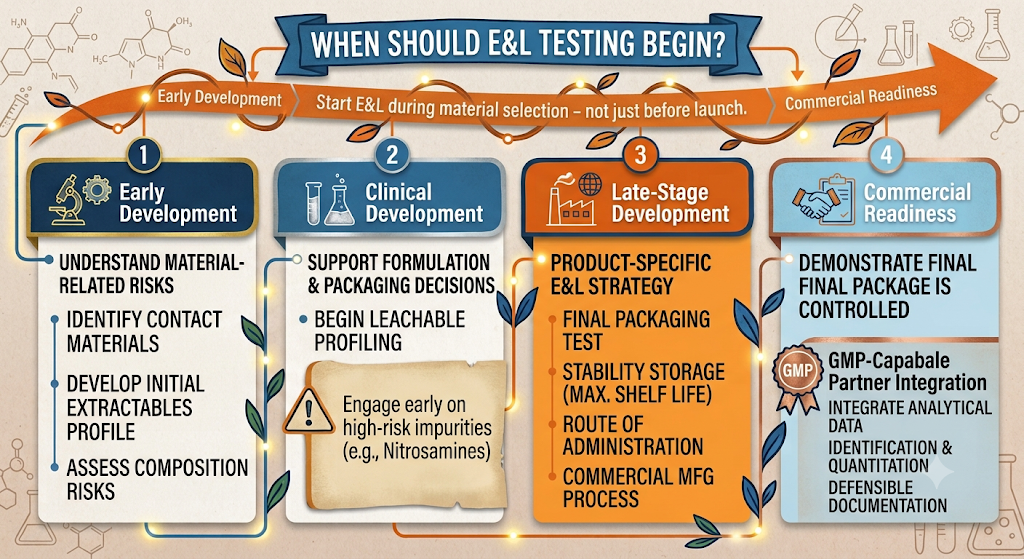
E&L planning should begin during material and container-closure selection — not immediately before commercial launch. An effective lifecycle strategy can be broken into four stages:
1. Early Development. The objective is to understand potential material-related risks: identifying product-contact materials, reviewing supplier information, evaluating material composition, screening high-risk components, developing an initial extractables profile, establishing analytical capabilities, and identifying potential compounds of concern.
2. Clinical Development. E&L information generated here can support formulation and packaging decisions while providing an initial understanding of potential leachable compounds. This is also the stage where a nitrosamine method development and validation services partner is often engaged in parallel, since nitrosamine risk and E&L risk frequently share the same packaging and process root causes.
3. Late-Stage Development. The E&L strategy should become more product-specific, factoring in the final formulation, final packaging configuration, intended storage conditions, maximum shelf life, route of administration, dose and exposure, commercial manufacturing process, and any supplier or material changes.
4. Commercial Readiness. Before launch, the objective is to demonstrate that the final commercial configuration is appropriately characterized and controlled. This is where a GMP-capable testing partner provides the most value — integrating analytical data, method performance, identification, quantitation, and documentation into a single defensible package.
5: How Does a GMP-Licensed Laboratory Support Extractable & Leachable Scale-Up?
A GMP-licensed laboratory provides the controlled analytical environment, documentation practices, and quality systems needed to generate reliable data for regulated pharmaceutical development. A capable E&L laboratory partner should be able to support multiple stages of the analytical workflow.
Material and component assessment typically covers elastomeric closures, plastic containers, syringe components, vials and stoppers, caps and liners, tubing, drug-delivery devices, single-use components, and manufacturing-contact materials.
Controlled extraction studies run under scientifically justified extraction conditions designed to challenge materials — without automatically equating extraction results with actual patient exposure. This is the core of a GMP-compliant extractables and leachables (E&L) study, where extraction conditions, solvent selection, and exposure scenarios are justified against the specific route of administration and dosage form.
Analytical screening and identification depends on the compound classes and matrix involved, and typically draws on LC-MS/MS, high-resolution mass spectrometry (HRMS), GC-MS, GC-HRMS, ICP-MS for elemental analysis, HPLC/UV, and other complementary chromatographic and spectroscopic techniques. The objective is not merely to produce a list of peaks — unknown compounds must be investigated and, where scientifically feasible, identified to a level appropriate for toxicological evaluation and regulatory decision-making.
6: Extractable & Leachable Testing Requires More Than Instrument Testing
The most valuable E&L programs combine analytical chemistry with toxicological interpretation, exposure assessment, and regulatory documentation. A typical workflow looks like this:
Risk Assessment → Material Selection → Extractables Study → Analytical Screening → Compound Identification → Leachables Study → Quantitation → Toxicological Assessment → Risk Assessment → Regulatory Documentation
Each step influences the next. Detecting an unknown peak by LC-MS does not automatically establish that a compound is unsafe — the laboratory and toxicology team need to work through what the compound is, at what concentration it is present, whether the result is reproducible, what its likely source is, whether it occurs in the actual drug product, what the patient’s potential exposure would be, whether that exposure is acceptable, and whether the finding requires additional investigation or control. This integrated approach is what prevents E&L testing from becoming a disconnected analytical exercise.
7: How Do Analytical Methods Scale from Clinical to Commercial Testing?
Analytical methods should be sufficiently sensitive, selective, and robust to detect compounds at concentrations relevant to the intended patient exposure and risk assessment. A scale-up strategy typically evolves as follows:
| Development Stage | Analytical Objective |
|---|---|
| Early development | Broad screening and risk identification |
| Clinical | Characterization of relevant materials and potential leachables |
| Late development | Product-specific leachables characterization |
| Registration | Defensible identification, quantitation, and safety assessment |
| Commercial | Lifecycle monitoring and change-control support |
The laboratory should also evaluate whether the original clinical analytical methods remain suitable at commercial scale. Commercial-scale changes may call for lower reporting limits, improved chromatographic separation, additional compound identification, matrix-specific method optimization, improved quantitative accuracy, additional confirmation studies, or entirely new analytical platforms — this is the essence of method validation for leachables testing, and it is especially important for complex pharmaceutical matrices where formulation components can interfere with detection.
This same scale-appropriate thinking applies broadly across modalities: programs moving through peptide API scale-up face an analogous challenge, where methods qualified at small scale need to be bridged and, where necessary, re-validated against commercial-scale material before they can be relied on for release testing.
8: Why Is GMP Documentation Important for Extractable & Leachable Programs?
GMP-aligned documentation provides traceability from sample receipt through testing, data review, reporting, and final conclusions. For commercial pharmaceutical development, useful documentation typically includes approved protocols, sample identification and chain of custody, analytical methods, method qualification/validation records where applicable, instrument records, raw analytical data, system suitability records, deviations and investigations, data review, compound identification rationale, quantitation calculations, toxicological assessment inputs, final reports, supporting certificates, and change-control records.
Data integrity underpins all of it. A lab operating under strong GMP data integrity for extractables and leachables testing practices ensures another qualified reviewer can understand what was tested, how it was tested, what was detected, how compounds were identified, and how conclusions were reached — which becomes particularly valuable during regulatory submission, audit preparation, and post-approval change assessment.
9: How Does Extractable & Leachable Testing Support Regulatory Submissions?
E&L data can contribute to the CMC justification that the selected container closure system and delivery system are suitable for the intended pharmaceutical product and patient exposure. FDA’s container-closure framework has long addressed packaging considerations for human drugs and biologics, while the agency’s August 2026 draft guidance provides updated recommendations for container closure systems and associated E&L and toxicological risk considerations.
For sponsors preparing NDA, ANDA, or BLA documentation, an E&L package may support discussions involving packaging component suitability, material characterization, extractables profiles, leachables profiles, safety qualification, product stability, container closure selection, manufacturing changes, and commercial packaging justification. The exact data package should always be determined according to the product, route, dosage form, regulatory pathway, and applicable requirements — this is also where GMP extractables and leachables testing services, run under one consistent quality system across phases, help keep the submission narrative coherent rather than assembled from disconnected studies.
10: The Case for Using One GMP-Licensed Lab Partner Across Phases
Using a single GMP-licensed lab across clinical and commercial phases avoids the data gaps, method inconsistencies, and re-qualification delays that come from switching labs mid-program. When a sponsor moves testing to a new lab at the commercial stage, that lab typically has to re-validate analytical methods, rebuild the compound identification library from scratch, and re-interpret prior data without full context of how it was generated.
A lab partner that supports a program continuously offers several concrete advantages:
- Method continuity. GC-MS, LC-MS, and ICP-MS methods developed and validated during clinical phases can be bridged to commercial-scale samples rather than rebuilt.
- Institutional program knowledge. The analytical team already understands the product’s chemistry, prior findings, and known extractable/leachable compounds specific to that formulation and packaging.
- Faster bridging studies. A scale-up bridging assessment can focus specifically on what changed — equipment, hold times, or packaging — rather than repeating work that hasn’t changed.
- Single point of regulatory narrative. One lab means one consistent analytical and toxicological narrative in the submission package, rather than reconciling data from multiple labs with different reporting conventions.
- GMP licensing continuity. A lab already operating under GMP for the clinical program can extend that same quality system into commercial-batch release testing without a new vendor-qualification cycle.
This same continuity logic is well established outside of E&L testing too — sponsors managing peptide technology transfer to a CDMO or scaling up under cGMP peptide manufacturing services face the same tradeoff between rebuilding institutional knowledge at a new site versus extending an existing, qualified relationship.
11: What to Look for in a GMP-Licensed Extractable & Leachable Testing Partner
A strong E&L testing partner for scale-up work combines multi-technique analytical capability, a validated toxicological assessment process, and direct experience taking programs from clinical through commercial submission.
Technical capability: LC-MS/MS, HRMS, GC-MS/HRMS, ICP-MS, chromatographic method development, unknown identification, and trace-level quantitation.
Quality systems: GMP-compliant or GMP-capable laboratory operations, controlled documentation, qualified instruments, data integrity controls, SOP-based workflows, and deviation/CAPA processes where applicable.
Pharmaceutical understanding: the laboratory should understand how E&L data connects with CMC, stability, packaging development, toxicological assessment, risk management, regulatory submissions, and change control.
Lifecycle support: ideally, the same partner can support the sponsor from clinical through registration, commercialization, and post-approval change management, which reduces unnecessary method redevelopment and improves continuity of scientific knowledge.
| Capability | Why It Matters for Scale-Up |
|---|---|
| Orthogonal analytical techniques (GC-MS, LC-MS, ICP-MS, headspace GC) | Different leachables classes (volatile, semi-volatile, non-volatile, elemental) require different detection methods |
| Established compound identification database | Speeds unknown-peak identification and reduces re-testing cycles |
| Toxicological risk assessment (Safety Concern Threshold evaluation) | Required to justify whether a detected leachable needs further action |
| GMP licensing for both clinical and commercial-batch testing | Avoids a vendor-qualification gap at the commercial transition |
| Documented scale-up/bridging methodology | Demonstrates the lab can isolate what actually changed between phases |
| Cross-border regulatory experience (FDA, Health Canada, EMA) | Supports sponsors filing in multiple jurisdictions without duplicating studies |
This is especially relevant for combination and conjugate products: a program involving GMP manufacturing of peptide-oligonucleotide conjugates, for example, often introduces delivery-device or novel excipient components that broaden the E&L risk profile beyond what a simpler small-molecule product would require.
12: Building a Lifecycle Extractable & Leachable Strategy for Commercial Success
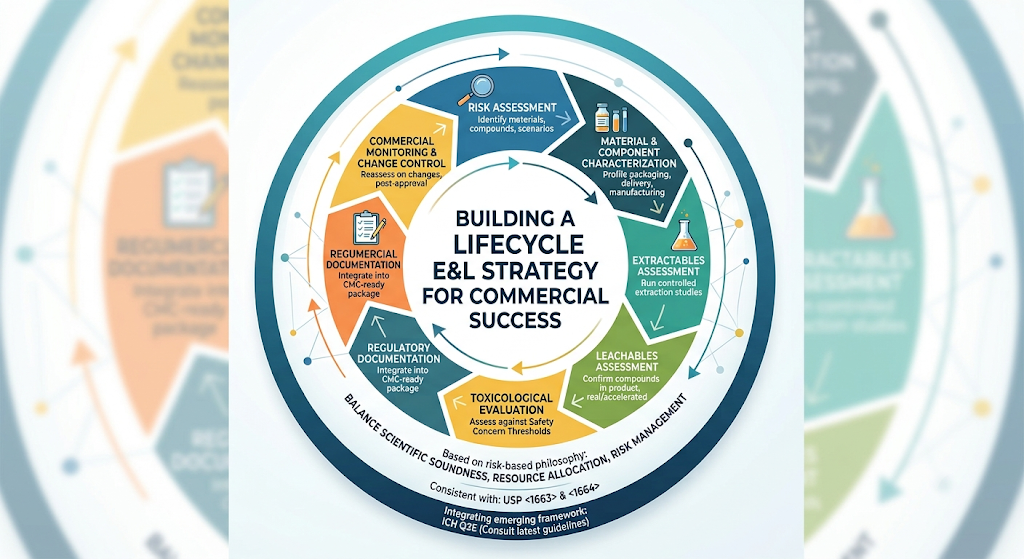
A lifecycle E&L strategy connects early material selection with clinical development, registration, commercial manufacturing, and post-approval change management:
- Risk Assessment — identify which materials, compounds, conditions, and exposure scenarios warrant evaluation.
- Material & Component Characterization — profile the packaging, delivery-device, and manufacturing-contact materials involved.
- Extractables Assessment — run controlled extraction studies on the materials identified as higher risk.
- Leachables Assessment — confirm which compounds actually migrate into the drug product under real or accelerated storage conditions.
- Toxicological Evaluation — assess identified compounds against Safety Concern Thresholds.
- Regulatory Documentation — integrate findings into a CMC-ready, audit-traceable package.
- Commercial Monitoring & Change Control — reassess the risk profile whenever a material, supplier, or process change occurs post-approval.
This approach is consistent with the risk-based philosophy reflected in USP <1663> and <1664>, which emphasize balancing scientific soundness, resource allocation, and effective risk management rather than applying identical testing to every packaging system. The emerging ICH Q3E framework reflects the same industry movement toward a more integrated, risk-based approach to E&L assessment and control; as of 2026, the Q3E material available through FDA remains in draft form and should not be treated as a final implemented requirement.
13: Common Mistakes in Clinical-to-Commercial Extractable & Leachable Programs
Sponsors can reduce delays by avoiding several recurring issues:
- Starting E&L testing too late. Waiting until registration can leave insufficient time for unknown identification, toxicological assessment, or additional studies.
- Treating extractables as leachables. Extractables are generated under controlled extraction conditions; they should not automatically be interpreted as actual drug-product exposure.
- Ignoring commercial manufacturing changes. Changes in suppliers, materials, sterilization, or processing can affect the E&L profile even when the formulation itself hasn’t changed.
- Reporting unknown peaks without adequate investigation. A peak list alone rarely provides enough information for a meaningful safety assessment.
- Failing to connect E&L data with toxicology. Analytical concentration only becomes meaningful when evaluated in the context of patient exposure and safety.
- Using a one-time testing strategy. Commercial pharmaceutical products require lifecycle thinking, particularly when packaging or manufacturing changes occur after approval.
Conclusion:
E&L Testing for Clinical to Commercial Scale-Up should be managed as a lifecycle pharmaceutical quality activity, not as a final-stage packaging exercise. Starting early, evaluating commercial changes systematically and integrating analytical results with toxicological and regulatory considerations can make the transition from clinical development to commercialization more predictable.
A qualified laboratory partner can help sponsors bridge this transition by maintaining analytical continuity while adapting testing strategies to the final commercial product.
For pharmaceutical companies evaluating packaging, container closure systems, delivery devices or manufacturing changes, ResolveMass Laboratories Inc. can provide analytical expertise and E&L testing support aligned with development and regulatory needs.
Frequently Asked Questions:
E&L planning should begin during early pharmaceutical development and container-closure selection.
Early planning helps identify potentially high-risk materials and components before they become difficult to change.
Initial extractables assessments can provide information for packaging and formulation decisions.
As clinical development progresses, the strategy can be refined using product-specific information.
Commercial packaging and manufacturing changes should be reassessed before final commercialization.
Clinical-stage E&L testing does not automatically need to be repeated in every case.
The need for additional testing should be determined through a scientific risk and change-impact assessment.
Changes in materials, suppliers, formulation, sterilization, packaging, or storage conditions may require further evaluation.
Commercial-scale manufacturing can also introduce new product-contact materials or processing conditions.
A documented assessment helps justify whether existing E&L data remain applicable.
Unknown compounds detected during E&L testing require systematic analytical investigation.
High-resolution mass spectrometry can provide accurate mass and molecular information for potential identification.
Fragmentation patterns, chromatographic behavior, spectral databases, and reference standards can provide additional evidence.
Where necessary, complementary analytical techniques may be used to strengthen the identification.
The final identification level should be appropriate for toxicological and regulatory evaluation.
A GMP laboratory provides controlled processes and quality systems for regulated pharmaceutical analytical work.
It can support documented sample handling, qualified instrumentation, controlled analytical procedures, and data review.
Traceable records help establish how samples were received, tested, analyzed, and reported.
Appropriate documentation also supports investigations, audits, and regulatory submissions where applicable.
This provides greater confidence in the reliability and traceability of E&L data.
An E&L report should clearly document the purpose, scope, materials, samples, and study conditions.
It should describe the analytical methods and provide relevant instrument and quality-control information.
Detected compounds should be presented with identification and quantitative information where applicable.
The report should explain significant findings, limitations, and the scientific interpretation of the results.
Clear conclusions help pharmaceutical teams use the data for quality, safety, and regulatory decisions.
Yes, appropriately designed E&L studies can provide supporting CMC information for regulatory submissions.
The data can help demonstrate the suitability of packaging and container closure systems for the intended drug product.
Extractables, leachables, identification, quantitation, and safety assessments may contribute to the overall justification.
The appropriate data package depends on the product, dosage form, route, and regulatory pathway.
E&L documentation should therefore be developed with the intended regulatory objective in mind.
Early E&L testing can identify potentially problematic compounds before regulatory submission or commercial launch.
It provides scientific evidence supporting packaging and container closure system selection.
Identifying unknown compounds early also allows sufficient time for additional analytical or toxicological investigation.
A well-documented E&L strategy can strengthen CMC information and regulatory responses.
This proactive approach can help reduce unexpected delays during commercialization.
Reference
- Hotha KK. Fast-to-clinic, fast-to-market in biotech innovation: Optimizing chemistry manufacturing & controls (CMC) excellence for clinical and commercial success. Advances in Chemical Engineering and Science. 2024 Jul 24;14(3):155-71.https://www.scirp.net/journal/paperinformation?paperid=134745
- Liebner R, Altınoğlu S, Selzer T. A Road Map to GMP Readiness for Protein Therapeutics–Drug Product Process Development for Clinical Supply. Journal of Pharmaceutical Sciences. 2022 Mar 1;111(3):608-17.https://www.sciencedirect.com/science/article/pii/S0022354921004846
- Bauer G, Fury B. Challenges of translating a cell therapy to GMP. InInternational Review of Neurobiology 2022 Jan 1 (Vol. 166, pp. 207-234). Academic Press.https://www.sciencedirect.com/science/article/pii/S0074774222000939
- Vas G, Fleck L, Comstock K, Cole J. Extractable and leachable testing for pharmaceutical packaging, finished pharmaceutical products, and medical devices: an analytical perspective. Curr Trend Mass Spectrom. 2020:5-14.https://www.chromatographyonline.com/view/extractable-and-leachable-testing-for-pharmaceutical-packaging-finished-pharmaceutical-products
About the Author