

Introduction
Designing a GMP-Compliant Extractables and Leachables (E&L) Study for container closure systems requires a systematic, risk-tiered analytical framework to demonstrate that chemical migrants originating from packaging materials do not adversely affect drug efficacy, therapeutic stability, product quality, or patient safety. This analytical strategy integrates controlled forced extraction studies with real-time stability monitoring conducted under Good Manufacturing Practice (cGMP) protocols to meet global regulatory submission expectations. Pharmaceutical packaging components—including primary packaging components such as rubber stoppers, glass vials, and plastic bottles, as well as secondary, tertiary, and ancillary components such as adhesives, inks, and desiccants—may contain complex chemical formulations. When these materials come into contact with pharmaceutical formulations, organic and inorganic substances can migrate from the packaging into the therapeutic matrix. Uncontrolled chemical migration may contribute to active pharmaceutical ingredient (API) degradation, therapeutic inactivation, toxicological concerns, protein aggregation, or physical deterioration of the container, including phenomena such as glass delamination. A scientifically robust study design converts broad regulatory expectations into defined analytical procedures capable of demonstrating chemical safety throughout the complete product lifecycle.
Container closure systems (CCS) serve as critical barriers against environmental degradation, oxygen and moisture ingress, and biological contamination. At the same time, modern polymer matrices may contain complex combinations of elastomeric vulcanizates, curing agents, plasticizers, light stabilizers, antioxidants, slip agents, colorants, and trace processing solvents. Under prolonged contact with pharmaceutical formulations, some of these substances may migrate from the packaging material into the drug product during its intended shelf life. Characterizing these dynamic chemical interactions requires an integrated analytical strategy that incorporates material risk assessment, controlled extraction profiling, simulation studies, targeted analytical method validation, toxicological risk assessment, and long-term cGMP stability monitoring. Together, these elements provide the scientific basis for identifying, characterizing, quantifying, and controlling potential chemical migrants from container closure systems.
Need a reliable contract testing lab to design and execute your container closure safety strategy? Learn how our team supports your regulatory submission goals by exploring our complete Extractables & Leachables (E&L) Testing Services.
Share via:
Article Summary:
- GMP-compliant E&L studies assess chemical migration from container closure systems to protect drug quality, stability, efficacy, and patient safety throughout the product lifecycle.
- Regulatory compliance relies on frameworks such as USP <1663>, USP <1664.1>, ICH Q3E, PQRI, ISO 10993-18, and USP <665>, supporting risk-based extractables and leachables evaluation.
- The study follows a five-phase workflow: material risk assessment, controlled extractables testing, simulation studies and method validation, cGMP leachables monitoring, and final risk/safety assessment.
- Controlled extraction studies use polar, semi-polar, and non-polar solvents under controlled thermal conditions to identify a broad range of potential chemical migrants from packaging materials.
- AET (Analytical Evaluation Threshold) converts toxicological safety limits into practical analytical reporting limits. Proper use of maximum daily dose, uncertainty factors, and pediatric adjustments is essential for accurate risk assessment.
- Advanced analytical techniques such as HS-GC-MS, GC-MS/MS, LC-HRMS, ICP-MS, and ion chromatography provide complementary coverage of volatile, semi-volatile, non-volatile, organic, inorganic, and elemental contaminants.
- Toxicological evaluation and Margin of Safety (MoS) connect analytical findings with patient exposure. A scientifically justified E&L program ultimately demonstrates that the container closure system remains safe, suitable, and compliant throughout the product lifecycle.
Regulatory and Normative Frameworks Governing E&L Qualification
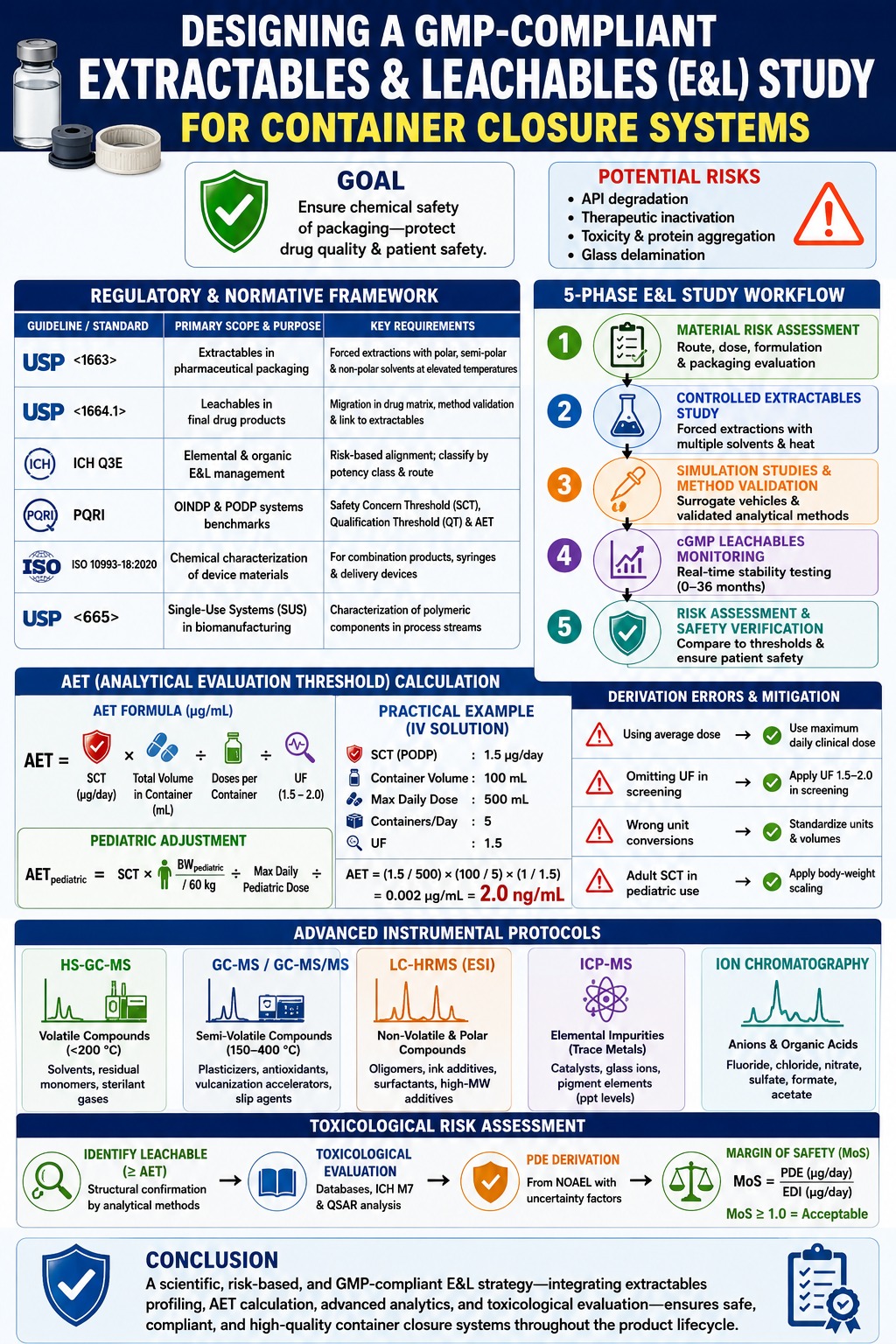
Compliance with harmonized global regulatory standards—including USP , USP , ICH Q3E, and PQRI recommendations—is essential for demonstrating the chemical safety, compatibility, and suitability of pharmaceutical container closure systems. These frameworks establish a continuous risk-management approach in which initial forced extraction findings are connected with toxicological safety thresholds and subsequently evaluated against leachables profiles generated during actual drug product storage and use. This relationship enables manufacturers and sponsors to determine whether compounds identified during extractables testing have the potential to migrate into the final pharmaceutical product at clinically relevant exposure levels.
The United States Pharmacopeia provides a fundamental compendial framework through its dual-chapter approach. USP establishes scientific principles for performing extractables assessments under controlled and exaggerated laboratory conditions to develop a comprehensive extractables profile. In parallel, USP addresses the evaluation of leachables that are present in finished drug products under actual storage and intended-use conditions. Additional compendial chapters, including USP <661.1> and <661.2> addressing plastic materials, USP addressing single-use manufacturing systems, and the developing ICH Q3E guideline, further establish risk-based characterization expectations across different drug delivery systems and manufacturing applications. In addition, recommendations issued by the Product Quality Research Institute (PQRI) provide important toxicological benchmarks, including the Safety Concern Threshold (SCT) and Analytical Evaluation Threshold (AET), which influence the sensitivity and reporting requirements of analytical methods.
Failing to meet USP or ICH standards can severely delay drug approvals. Protect your regulatory submission timelines with our fully compliant Data Integrity in Extractables & Leachables Testing Services.
| Regulatory Guideline / Standard | Primary Scope and Purpose | Mandatory Analytical Requirements |
|---|---|---|
| USP | Framework for extractables identification in pharmaceutical packaging systems. | Controlled forced extractions using polar, semi-polar, and non-polar solvents across elevated temperature regimes. |
| USP / <1664.1> | Framework for leachables assessment in final drug products. | Migration monitoring in the drug matrix throughout shelf life, analytical method validation, and correlation of leachables findings with extractables profiles. |
| ICH Q3E | International harmonized guideline for elemental and organic E&L management. | Risk-based alignment across global markets and classification of leachables according to potency class and dosage route. |
| PQRI Recommendations | Benchmarks for OINDP and Parenteral/Ophthalmic (PODP) systems. | Definition and application of Safety Concern Thresholds (SCT), Qualification Thresholds (QT), and AET mathematical formulas. |
| ISO 10993-18:2020 | Chemical characterization of medical device materials. | Chemical characterization applicable to combination products, pre-filled syringes, and delivery devices. |
| USP | Assessment of single-use systems (SUS) in biomanufacturing. | Characterization of polymeric components used in biopharmaceutical process streams. |
Core Phased Workflow of a GMP-Compliant Extractables and Leachables (E&L) Study
A GMP-Compliant Extractables and Leachables (E&L) Study follows a structured five-phase lifecycle that progresses from initial material risk profiling through controlled forced extraction, simulation testing, targeted analytical method validation, and formal cGMP stability monitoring. Each phase addresses a specific component of chemical safety assessment and contributes to the overall understanding of potential migrants associated with the container closure system. This phased strategy supports the systematic identification, characterization, quantification, and control of potential extractable and leachable entities against established safety thresholds before commercial release and throughout the product lifecycle.
Phase 1: Material Categorization and Risk Assessment
Material risk assessment determines the appropriate level of E&L testing by considering the drug delivery route, physical state of the formulation, chemical composition of the drug product, and characteristics of primary, secondary, and tertiary container closure components. High-risk dosage forms—including orally inhaled and nasal drug products (OINDP), small-volume parenterals (SVP), large-volume parenterals (LVP), and ophthalmic solutions—require comprehensive evaluation because their routes of administration can involve direct systemic or mucosal exposure. The extent and severity of potential patient exposure therefore play an important role in determining the analytical depth and toxicological rigor required for the study.
Scientists characterize the chemical composition of each packaging component by reviewing complete supplier disclosures, Safety Data Sheets (SDS), technical information sheets, and other available material documentation. Establishing an understanding of the underlying polymer chemistry—including elastomeric vulcanizates, curing agents such as zinc salts and sulfur donors, plasticizers such as phthalates, light stabilizers, and antioxidant packages such as hindered phenols and phosphites—supports appropriate selection of analytical techniques. In parallel, important physical parameters, including component surface area, filling volume, contact temperature, and intended shelf-life duration, are documented. These parameters are then considered when establishing worst-case exposure scenarios and determining the appropriate extraction and leachables testing conditions.
Phase 2: Controlled Extractables Study Execution
Controlled extractables studies expose packaging components to deliberately exaggerated solvent environments and thermal stress conditions to generate a broad profile of potential chemical migrants without intentionally destroying the polymer matrix. The objective is to maximize the recovery of chemically relevant extractable substances while maintaining the integrity of the packaging material. The resulting extractables profile serves as the chemical baseline for subsequent simulation studies and leachables investigations and provides a reference against which compounds detected in the final drug product can be evaluated.
Selection of extraction solvents is based on the physicochemical properties of the pharmaceutical formulation and the anticipated chemical composition of the packaging material. A scientifically comprehensive study design generally incorporates multiple solvent systems representing different polarity ranges:
- Polar Solvents: Purified water or buffered aqueous solutions at pH values representative of the drug matrix, including acidic, neutral, or basic conditions, are used to recover ionic and highly hydrophilic compounds.
- Semi-Polar Solvents: Ethanol/water or isopropanol/water mixtures provide intermediate solvent strength and can simulate the solubilizing characteristics of formulations containing co-solvents, surfactants, or complexing agents.
- Non-Polar Solvents: Hexane, cyclohexane, or dichloromethane can be used to recover lipophilic additives, low-molecular-weight oligomers, and processing oils that may not be efficiently extracted using aqueous or semi-polar systems.
Depending on the material and study objectives, extraction techniques may include reflux, Soxhlet extraction, sealed vessel agitation, or thermal desorption. Thermal stress cycles may involve exposure at 40 °C, 70 °C, or 121 °C for defined periods. These conditions are selected and controlled to promote extraction toward chemical equilibrium while avoiding conditions that could cause unintended synthetic polymer degradation or generate artifacts that would not be representative of potential extractables.
Phase 3: Simulation Studies and Method Validation
Simulation studies are designed to evaluate chemical migration kinetics using surrogate solvent vehicles that reproduce important physicochemical characteristics of the pharmaceutical formulation while minimizing interference from the active pharmaceutical ingredient. After key extractable compounds and relevant chemical classes have been identified, analytical screening methods can be evaluated and validated under cGMP conditions to support subsequent real-time drug product testing. This phase establishes the analytical foundation needed to distinguish packaging-derived chemical migrants from compounds originating from the formulation itself.
Simulation vehicle formulations are designed to reproduce critical characteristics of the commercial drug matrix, including pH, ionic strength, organic co-solvent content, and surfactant concentrations. Removing or minimizing chromatographic interference associated with high concentrations of active pharmaceutical ingredients allows migration behavior to be measured more precisely under controlled and accelerated conditions. Following identification of relevant target compounds, screening methods intended for formal cGMP leachables testing undergo validation according to applicable ICH Q2(R1/R2) requirements. Validation parameters include specificity, linearity, precision, accuracy, limit of detection (LOD), and limit of quantitation (LOQ), as appropriate for the intended analytical application.
Accurate quantitative leachables data requires cGMP-compliant assay validation. Discover how we perform rigorous Method Validation for Leachables Testing.
Phase 4: Formal cGMP Leachables Stability Monitoring
Formal leachables monitoring involves the quantitative evaluation of target compounds and unknown migrant species in finished drug products manufactured using registration-scale batches and packaged in the final commercial container closure configuration. These batches are stored under cGMP stability conditions over the intended product shelf life. The resulting data establish real-time accumulation patterns, identify potential changes in leachables concentrations during storage, and provide supporting evidence for the suitability and integrity of the selected container closure system.
Registration stability batches packaged in the final commercial container closure configuration are placed under long-term (25 °C / 60% RH) and accelerated (40 °C / 75% RH) stability storage conditions. Testing is conducted at predefined stability intervals, typically 0, 3, 6, 12, 18, 24, and 36 months. Quantitative leachables results are subsequently compared with the initial extractables profile to determine whether detected compounds originate from the container closure system. This correlation also assists in distinguishing true container-derived leachables from API degradation products, formulation-related substances, or synthesis impurities.
Real-time stability monitoring is essential to confirm that leachables do not build up over time. Learn more about our specialized protocols for Leachables Monitoring During Stability Studies.
Mathematical Derivation of Safety Thresholds and the Analytical Evaluation Threshold (AET)
The Analytical Evaluation Threshold (AET) represents the quantitative boundary at or above which an analytical chemist is expected to identify, quantify, and report an extractable or leachable compound for further toxicological safety evaluation. AET calculations translate toxicological Safety Concern Thresholds (SCT) into practical laboratory concentration limits by incorporating patient exposure, dosage information, container characteristics, and analytical uncertainty. Establishing an appropriate AET ensures that analytical screening is sufficiently sensitive to identify compounds that may have toxicological relevance at clinically meaningful exposure levels.
The derivation of the AET begins with the Safety Concern Threshold (SCT), which represents a daily exposure level below which a leachable is generally considered to present negligible carcinogenic or non-carcinogenic toxicity within the applicable assessment framework. Recommended SCT values include:
- Orally Inhaled and Nasal Drug Products (OINDP): 0.15 µg/day
Parenteral and Ophthalmic Drug Products (PODP): 1.5 µg/day
To account for differences in response factors when unknown compounds are quantified against surrogate reference standards, an Uncertainty Factor (UF) may be incorporated into the calculation. The UF typically ranges from 1.5 to 2.0 for universal screening techniques such as GC-MS and LC-MS. When targeted quantitative methods are fully calibrated using authentic standards for the compounds of interest, the UF is equal to 1.0.
The mathematical formula used to calculate the AET in concentration terms (µg/mL) is:
AET = (SCT / Maximum Daily Dose) × (Total Volume in Container / Doses per Container) × (1 / UF)
For pediatric formulations, body-weight scaling can be applied to adjust the safety threshold relative to an adult reference baseline of 60 kg:
AETpediatric = [SCT × (BWpediatric / BWadult)] / Maximum Daily Pediatric Dose × (1 / UF)
Practical Application Example
Consider an intravenous parenteral solution supplied in a 100 mL container and administered at a maximum daily clinical dose of 500 mL, corresponding to 5 containers per day. When the standard PODP Safety Concern Threshold of 1.5 µg/day is applied together with an Uncertainty Factor of 1.5, the AET can be calculated as follows:
AET = (1.5 µg/day / 500 mL/day) × (1 / 1.5) = 0.003 µg/mL / 1.5 = 0.002 µg/mL = 2.0 ng/mL
Therefore, any extractable or leachable peak detected in the analytical system at or above 2.0 ng/mL should undergo appropriate structural identification and toxicological evaluation.
Establishing a scientifically sound AET is key to avoiding over- or under-reporting potential migrants. Learn more about deriving the correct AET for Extractables and Leachables Studies.
| Derivation Error | Analytical Impact | Correct Scientific Mitigation |
|---|---|---|
| Using Average Daily Dose instead of Maximum Daily Dose | Artificially increases the AET and may result in clinically relevant toxic leachables being overlooked. | Always calculate the AET using the maximum labeled daily clinical dose. |
| Omitting the Uncertainty Factor (UF) in Screening Methods | May result in compounds with weak relative response factors (RRF) being overlooked during analytical screening. | Apply a UF of 1.5 – 2.0 during non-targeted screening phases. |
| Inappropriate Unit Conversions | Can create inconsistencies between analytical instrument output (µg/mL) and dose-related units (µg/device). | Standardize reporting units precisely according to extraction volumes and dosing regimens. |
| Applying Adult SCT to Pediatric Indications | May overestimate acceptable exposure thresholds for patient populations with lower body weight. | Scale the SCT proportionally using appropriate pediatric body-weight adjustments. |
Advanced Instrumental Protocols for Unbiased Chemical Profiling
Comprehensive and unbiased screening of extractables and leachables requires an orthogonal analytical platform that combines gas chromatography, high-resolution liquid chromatography, ion chromatography, and mass spectrometry techniques. Because individual analytical detectors cannot provide adequate response across the full range of chemical structures and physicochemical properties, a robust E&L program combines specialized sample introduction techniques with complementary mass spectrometry detectors. This approach increases chemical coverage and improves the probability of detecting volatile, semi-volatile, non-volatile, organic, inorganic, and highly polar compounds.
- Headspace Gas Chromatography-Mass Spectrometry (HS-GC-MS): This technique is used to isolate and characterize highly volatile organic compounds (VOCs), including compounds with boiling points below 200 °C. Important target analytes may include residual polymerization solvents, residual monomers such as butadiene and styrene, low-molecular-weight residual blowing agents, and residual sterilization gases such as ethylene oxide.
- Direct Injection Gas Chromatography-Mass Spectrometry (GC-MS / GC-MS/MS): This approach is appropriate for identifying semi-volatile organic compounds (SVOCs), including compounds with boiling points generally ranging from 150 °C to 400 °C. Important target chemical classes include phthalate and non-phthalate plasticizers, antioxidants such as BHT, Irganox 1010, and Irgafos 168, vulcanization accelerators such as 2-mercaptobenzothiazole, and fatty acid slip agents such as erucamide and oleamide.
- Liquid Chromatography High-Resolution Mass Spectrometry (LC-Esi-HRMS / Orbitrap / Q-TOF): This analytical platform is used to characterize non-volatile organic compounds (NVOCs) and polar chemical species. High-resolution accurate mass measurement with mass errors below 5 ppm, together with electrospray ionization (ESI) operated in positive and negative modes, supports identification and characterization of high-molecular-weight additives, polymer oligomers, photoinitiators originating from printing inks, and surfactant residues.
- Inductively Coupled Plasma Mass Spectrometry (ICP-MS): ICP-MS provides highly sensitive quantification of elemental impurities and trace heavy metals in accordance with USP , USP , and ICH Q3D requirements. The technique can be applied to screen for polymerization catalysts such as Platinum, Palladium, and Nickel; glass delamination-related ions such as Silicon, Boron, Aluminium, and Barium; and pigment-associated elements such as Titanium and Zinc. Detection can extend to parts-per-trillion (ppt) levels, depending on the analytical method and matrix.
- Ion Chromatography (IC): Ion Chromatography is used for detecting inorganic anions such as Fluoride, Chloride, Bromide, Nitrate, and Sulfate, as well as low-molecular-weight organic acids such as Formate and Acetate. These compounds may migrate from glass surface treatments or originate from elastomeric washing processes. Their presence may influence formulation pH and, consequently, potentially affect drug product stability or performance.
Choosing between chromatographic techniques depends on the volatility and polarity of your targets. Read our comparative analysis on GC-MS vs. LC-MS in Extractables and Leachables Testing or learn about elemental profiling via ICP-MS in E&L Studies.
Toxicological Risk Assessment and Margin of Safety Derivation
Toxicological risk assessment evaluates the potential health hazards associated with leachables detected at or above the Analytical Evaluation Threshold by establishing compound-specific Permissible Daily Exposure (PDE) limits or other applicable exposure-based safety limits. Applying Margin of Safety (MoS) calculations provides an additional quantitative assessment of whether the observed patient exposure to a leachable remains within an acceptable range over the intended treatment duration. This assessment connects analytical concentration data with patient exposure and toxicological endpoints.
After a leachable has been structurally identified, a board-certified toxicologist evaluates relevant toxicological databases, clinical literature, and Quantitative Structure-Activity Relationship (QSAR) models. Structural alerts associated with mutagenicity and carcinogenicity are assessed in accordance with ICH M7 guidelines. For non-mutagenic compounds, a Permissible Daily Exposure (PDE) or Tolerable Intake (TI) may be derived using No Observed Adverse Effect Levels (NOAEL) together with appropriate uncertainty factors. These factors account for considerations such as interspecies extrapolation, differences in study duration, and variability within human populations.
Local toxicological hazards, including ocular irritation, respiratory sensitization, and dermal corrosion, are evaluated alongside systemic toxicity endpoints when relevant to the route of administration and exposure scenario. The toxicologist determines the Margin of Safety (MoS) using the Estimated Daily Intake (EDI) calculated from the analytical concentration and applicable patient exposure parameters:
Margin of Safety (MoS) = Permissible Daily Exposure (PDE) (µg/day) / Estimated Daily Intake (EDI) (µg/day)
An MoS ≥ 1.0 indicates that the estimated exposure to the identified leachable is at or below the applicable Permissible Daily Exposure and, within the assumptions and limitations of the assessment, does not indicate an unacceptable health risk to the target patient population over the specified clinical duration.
Translating analytical peaks into biological safety requires expert toxicological review. Read about our approach to Toxicological Qualification of Leachables or learn how to prevent unexpected study failures by reviewing Root Causes of Failed Extractables and Leachables Studies.
Conclusion
Executing a GMP-Compliant Extractables and Leachables (E&L) Study is a fundamental component of establishing the safety, quality, suitability, and regulatory compliance of pharmaceutical container closure systems. By integrating comprehensive material risk assessments, controlled forced extraction studies, scientifically justified AET derivations, advanced mass spectrometry screening, and rigorous toxicological evaluation, pharmaceutical sponsors can systematically identify and manage risks associated with chemical migration. Combining these analytical and toxicological disciplines supports robust packaging qualification, strengthens regulatory submissions, and helps demonstrate that container closure systems remain suitable throughout the commercial product lifecycle while protecting patient health.
To discuss tailored study designs, analytical method validation, or regulatory consulting for container closure qualification, contact the analytical testing team at ResolveMass Contact Us.
Frequently Asked Questions
A GMP-Compliant Extractables and Leachables (E&L) Study provides a comprehensive assessment of potential chemical migration rather than simply confirming packaging specifications. It combines controlled extraction studies, advanced analytical techniques, Analytical Evaluation Threshold (AET) calculations, toxicological assessment, and cGMP stability monitoring. Routine container testing generally focuses on defined physical, chemical, or compendial requirements and may not fully characterize potential leachables throughout the product shelf life.
The Uncertainty Factor (UF) addresses possible differences in analytical response between an unknown chemical migrant and the surrogate compound or reference standard used for quantification. During non-targeted GC-MS and LC-MS screening, a UF of 1.5 to 2.0 may be applied to account for response-factor variability. When authentic reference standards are available and the analytical procedure is fully calibrated for the target compounds, a UF of 1.0 may be appropriate.
E&L study design is supported by several major regulatory and compendial frameworks, including USP for extractables, USP for leachables, ICH Q3E, and relevant PQRI recommendations. OINDP products are evaluated using considerations associated with PQRI OINDP recommendations, while parenteral and ophthalmic products are assessed using applicable PODP considerations. These frameworks help establish appropriate analytical, toxicological, and exposure-based evaluation strategies.
Non-volatile organic extractables are commonly investigated using Liquid Chromatography coupled with High-Resolution Mass Spectrometry (LC-Esi-HRMS), including platforms such as Orbitrap and Q-TOF. Electrospray ionization (ESI) in positive and negative modes enables detection across a broad range of chemical structures. Accurate mass measurements and fragmentation information can then support the identification and characterization of additives, oligomers, and other non-volatile compounds.
Multiple solvent polarities are used because packaging materials can contain chemicals with very different physicochemical properties. Polar, semi-polar, and non-polar extraction systems provide complementary coverage for hydrophilic, moderately polar, and lipophilic substances. Using these different conditions helps generate a more comprehensive extractables profile and reduces the likelihood that relevant chemical constituents will remain undetected.
Simulation studies use simplified vehicle systems designed to reproduce important properties of the pharmaceutical formulation, such as pH, ionic strength, surfactant concentration, and organic co-solvent content. Because the active pharmaceutical ingredient (API) is absent or minimized, potential migrant signals are less likely to be obscured by major formulation components. This allows investigators to study migration behavior and chemical kinetics more clearly before conducting extensive testing in the finished drug product.
Unknown leachables detected at or above the established Analytical Evaluation Threshold (AET) generally require appropriate structural identification and toxicological consideration within the applicable E&L assessment framework. Relevant Safety Concern Threshold (SCT) values include 0.15 µg/day for OINDP and 1.5 µg/day for PODP. Compounds exceeding applicable Qualification Threshold (QT) considerations may require additional safety qualification to determine whether the observed exposure is acceptable.
Inductively Coupled Plasma Mass Spectrometry (ICP-MS) is used to identify and quantify elemental impurities that may originate from packaging components, manufacturing materials, catalysts, pigments, or glass-related sources. It provides highly sensitive elemental analysis and can support evaluation of heavy metals, catalyst residues, and potential glass delamination-related elements. The technique is particularly valuable when elemental characterization is required alongside organic extractables and leachables testing.
Leachables are evaluated by analyzing drug product batches packaged in the intended commercial container closure system and stored under defined cGMP stability conditions. Samples may be tested at scheduled intervals under long-term conditions of 25 °C/60% RH and accelerated conditions of 40 °C/75% RH, with monitoring extending across the planned stability period. Validated analytical methods are used to track changes in leachable concentrations and determine whether chemical migration remains within established toxicological and quality limits throughout the product shelf life.
Reference:
- U.S. Food and Drug Administration. (2024, April 11). ANDA submission: Risk-based extractable and leachable quality information [PowerPoint slides]. U.S. Food and Drug Administration
- U.S. Pharmacopeia. (n.d.). Extractables and leachables. USP. https://www.usp.org/impurities/extractables-and-leachables
- Kuzmič, S., Zlobec, T., Sollner Dolenc, M., Roškar, R., & Trdan Lušin, T. (2026). Extractables and leachables in pharmaceutical products: Potential adverse effects and toxicological risk assessment. Toxics, 14(1), 92. https://doi.org/10.3390/toxics14010092
- Ramamoorthy, S., Chong, N. S., & Hotha, K. K. (2024). Strengthening extractable & leachable study submissions: Best practices to avoid regulatory deficiencies. American Journal of Analytical Chemistry, 15, 368–394. https://doi.org/10.4236/ajac.2024.1512025
Get In Touch With Us
About The Author


