

Introduction:
Immunogenicity testing determines whether a biosimilar monoclonal antibody triggers an unwanted immune response, and regulators require this data to be directly comparable to the reference product’s immunogenicity profile. For a biosimilar, the objective isn’t simply to determine whether antibodies are present — it’s to establish a scientifically justified strategy for detecting, characterizing, and interpreting immune responses in the context of the reference product and the overall clinical dataset.
FDA recommends a risk-based approach to immunogenicity assessment, recognizing that the appropriate strategy depends on the molecule’s characteristics, patient population, indication, route of administration, treatment duration, and the potential clinical consequences of an immune response. This is closely tied to the broader comparability exercise in biosimilar development, where immunogenicity is one of several attribute categories evaluated against the originator.
Note: the program described in this case study is a representative, scientifically constructed example illustrating an ADA testing workflow — it does not represent results from a specific client program.
Summary:
- ADA Testing for Biosimilars is a risk-based analytical and clinical strategy for characterizing anti-drug antibody responses and their potential impact on safety, efficacy, and pharmacokinetics
- A robust biosimilar mAb program uses a tiered immunogenicity approach: screening, confirmatory testing, titer assessment, and, where scientifically justified, neutralizing antibody (NAb) evaluation
- Assay development must address sensitivity, specificity, drug tolerance, precision, selectivity, cut points, robustness, and confirmatory performance
- Sample timing should align with the dosing schedule and PK profile, since circulating drug can interfere with ADA detection
- ADA results should never be interpreted in isolation — they must be integrated with PK, efficacy, safety, and exposure data
- FDA and EMA both recommend risk-based, multidisciplinary approaches to immunogenicity assessment
- Case example: a mAb biosimilar program required assay redevelopment after an initial screening assay showed inadequate drug tolerance, threatening its comparability conclusion
1: What Is ADA Testing for Biosimilars?
ADA Testing for Biosimilars detects antibodies a patient generates against a therapeutic biological product and helps determine whether that immune response has potential clinical relevance. Anti-drug antibodies fall into a few categories that shape how results are interpreted:
- Binding antibodies — recognize the therapeutic molecule but may or may not affect its biological activity
- Neutralizing antibodies (NAbs) — can interfere with the biological activity of the therapeutic protein
- Transient or persistent antibodies — distinguished by the duration and pattern of the immune response
- Exposure-relevant antibodies — associated with changes in drug exposure, PK, efficacy, or safety, depending on the product and clinical context
Importantly, an ADA-positive result does not automatically establish a clinically meaningful adverse effect. Interpretation requires weighing antibody characteristics, drug concentration, timing, patient factors, and clinical outcomes together — an assessment closely related to the immunogenicity assessment framework used across biosimilar development programs.
2: The Tiered ADA Testing Framework
A tiered testing framework answers each phase of the immunogenicity question in sequence, moving from broad detection to functional characterization:
Clinical sample → Screening assay → Confirmatory assay → ADA titer → NAb assessment (where appropriate) → Integrated clinical interpretation
| Tier | Purpose | Key Requirement |
|---|---|---|
| Screening assay | Detect samples that may contain ADA | High sensitivity, defined cut point |
| Confirmatory assay | Verify screening positives are drug-specific | Competitive inhibition with excess drug |
| Titer assay | Estimate relative magnitude of response | Serial dilution to endpoint titer |
| Neutralizing antibody (NAb) assay | Assess functional/biological impact | Cell-based or competitive ligand-binding format |
This structure helps avoid treating every sample as though it requires the same level of characterization, and it’s the backbone of FDA’s guidance on developing and validating screening, confirmatory, titration, and neutralization assays.
3: Why a Risk-Based Strategy Matters
A risk-based approach prevents an immunogenicity program from becoming a collection of disconnected lab tests — each assay and sampling decision instead ties back to a specific scientific or regulatory question. Relevant risk factors for a biosimilar mAb typically include:
| Factor | Why It Matters |
|---|---|
| Molecular structure | Structural attributes can influence immune recognition |
| Aggregates and impurities | Product-related attributes may contribute to immunogenicity risk |
| Route of administration | Exposure route can influence immune response |
| Dose and dosing frequency | Repeated exposure can influence ADA development |
| Treatment duration | Longer exposure may provide greater opportunity for antibody development |
| Patient population | Disease and patient characteristics can influence immune response |
| Reference product history | Existing clinical knowledge can inform the risk assessment |
| Drug concentration | Circulating drug can interfere with ADA detection |
| Assay characteristics | Sensitivity and drug tolerance influence ADA detectability |
Product-related risk factors like aggregates aren’t limited to the drug substance itself — container-closure interactions and process-related impurities identified through extractables and leachables testing for biosimilar drug development can also contribute to the overall immunogenicity risk profile and should feed into the same risk assessment.
4: How Should the ADA Assay Be Developed and Validated?
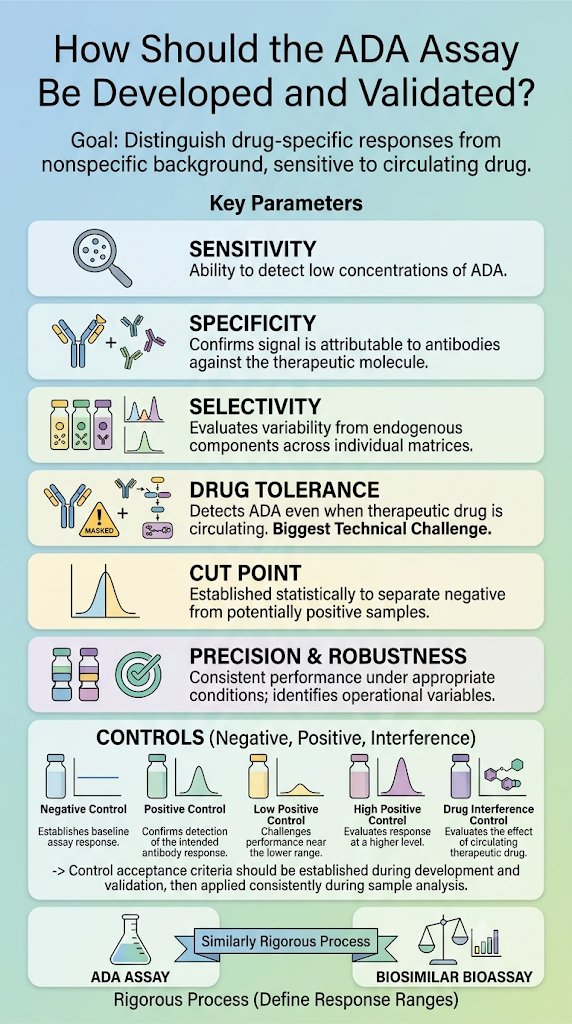
A reliable ADA assay must distinguish true drug-specific immune responses from nonspecific background while remaining sensitive in the presence of biological matrix and circulating drug. Key parameters include:
- Sensitivity — the assay’s ability to detect relatively low concentrations of ADA; low-level responses can otherwise go undetected
- Specificity — confirms the signal is attributable to antibodies against the therapeutic molecule, not nonspecific matrix components
- Selectivity — evaluated across representative individual matrices to identify variability from endogenous components
- Drug tolerance — the assay’s ability to detect ADA even when therapeutic drug is circulating in the sample
- Cut point — separates negative from potentially positive samples, established statistically
- Precision and robustness — consistent performance under appropriate conditions, with operational variables identified
Why Drug Tolerance Is the Biggest Technical Challenge
Drug tolerance is one of the most important considerations in ADA testing because residual therapeutic drug in a clinical sample can mask ADA:
High drug concentration → ADA-drug complexes form → reduced ADA availability → potentially reduced assay signal
Strategies to improve drug tolerance include optimizing sample treatment, assay format, reagent concentrations, incubation conditions, detection system, and — where scientifically appropriate — acid-dissociation or related sample-treatment approaches. The right strategy depends on the molecule and assay architecture and should be demonstrated experimentally rather than assumed.
The Role of Controls
Controls confirm that each analytical run performs as expected. A representative ADA assay typically incorporates:
- Negative control — establishes baseline assay response
- Positive control — confirms detection of the intended antibody response
- Low positive control — challenges performance near the lower response range
- High positive control — evaluates response at a higher level
- Drug interference controls — evaluate the effect of circulating therapeutic drug
Control acceptance criteria should be established during development and validation, then applied consistently during sample analysis — a process similar in rigor to the qualification steps used in functional bioassay development for biosimilars, where potency-relevant response ranges must also be defined and validated.
5: How Should Clinical Sampling Be Designed?
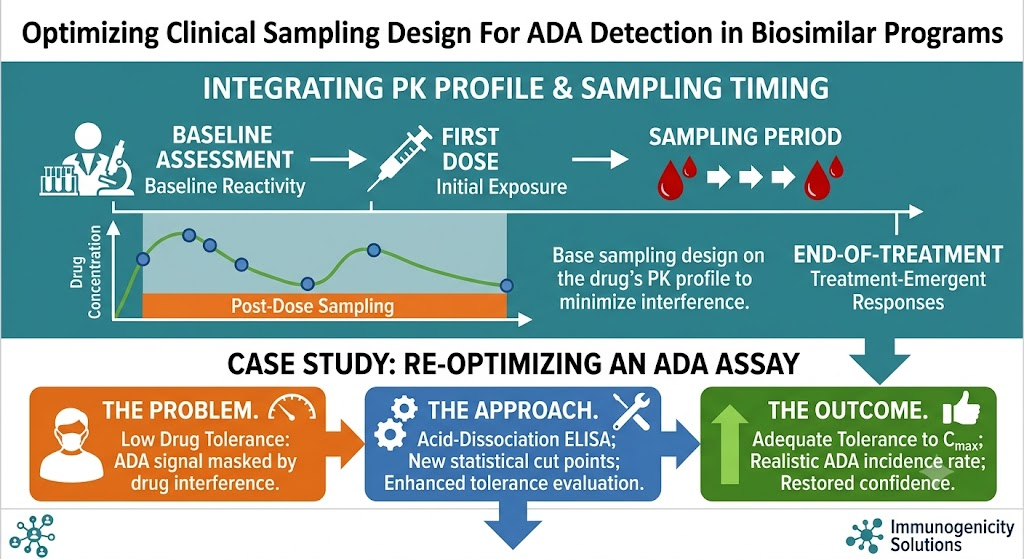
Clinical sample timing can substantially affect ADA detection because drug concentrations change following administration. A useful sampling strategy considers baseline ADA status, first-dose timing, post-dose sampling, steady-state exposure, treatment duration, and end-of-treatment or follow-up collection — all coordinated with the drug’s PK profile.
Baseline samples matter because naturally occurring or pre-existing reactivity can sometimes be detected before treatment begins, and post-treatment samples help identify treatment-emergent responses. This is where ADA sampling design should be built directly alongside the PK/PD study design used in biosimilar development, since drug exposure data determines when circulating drug is most likely to interfere with detection.
Case Study: Assay Redevelopment for a Biosimilar mAb Program
A sponsor developing a biosimilar monoclonal antibody for an inflammatory disease indication needed an ADA strategy capable of answering four questions: Can ADA responses be detected reliably? Are detected antibodies drug-specific? What is the magnitude of the response? Do the antibodies affect biological activity or clinical outcomes?
The Problem
The sponsor’s initial Phase I bridging assay, developed by a prior vendor, showed a drug tolerance ceiling too low to reliably detect ADA in the presence of therapeutic drug concentrations found in patient serum. Nearly all samples returned ADA-negative, an outcome inconsistent with the known immunogenicity profile of the reference product’s drug class — a classic signature of drug interference masking true ADA signal.
The Approach
ResolveMass redeveloped the assay using an acid-dissociation bridging ELISA format optimized for high drug tolerance, and paired it with:
- A formal drug tolerance evaluation, spiking positive control serum with clinically relevant drug concentrations
- A re-established statistically derived cut point using a minimum of 50 individual drug-naïve donor samples, consistent with FDA/EMA recommendations
- Sensitivity validation against a low-positive control antibody
- Parallel development of a cell-based NAb assay, since the mAb’s mechanism of action made a competitive ligand-binding NAb format insufficiently representative of biological neutralization
The Outcome
The redeveloped assay demonstrated adequate drug tolerance up to therapeutic Cmax levels, and re-testing of banked Phase I samples produced an ADA incidence rate consistent with published reference product data — restoring confidence in the comparability conclusion.
6: From Sample Collection to ADA Interpretation
Consider a hypothetical Phase III biosimilar mAb study receiving serum samples at baseline, early treatment, mid-treatment, late treatment, and follow-up. Each sample moves through: Serum → Screening → Confirmatory testing → Titration → NAb testing where applicable → PK/clinical correlation.
| Sample Category | Screening | Confirmatory | Interpretation Pathway |
|---|---|---|---|
| ADA negative | Negative | Not required | Report as negative |
| Potential ADA positive | Positive | Positive | ADA-positive; proceed to characterization |
| Screening reactive but unconfirmed | Positive | Negative | Considered non-confirmed/nonspecific |
For confirmed ADA-positive samples, the lab evaluates persistence and magnitude and, where scientifically appropriate, assesses neutralizing activity. This resulting dataset is then integrated with clinical information rather than treated as an isolated laboratory endpoint.
7: Comparing ADA Results Between a Biosimilar and Reference Product
The objective of comparative immunogenicity assessment is to determine whether the observed immune-response profile is consistent with the overall biosimilarity conclusion. Relevant comparisons include ADA incidence, treatment-emergent ADA, persistence, titers, time to ADA development, NAb incidence, and the relationship between ADA and drug exposure, safety, and efficacy.
| Immunogenicity Parameter | Biosimilar | Reference | Interpretation |
|---|---|---|---|
| ADA incidence | Evaluated | Evaluated | Compare patterns |
| Treatment-emergent ADA | Evaluated | Evaluated | Assess distribution |
| ADA persistence | Evaluated | Evaluated | Examine longitudinal pattern |
| ADA titer | Evaluated | Evaluated | Characterize response |
| NAb | If applicable | If applicable | Assess functional activity |
| PK relationship | Evaluated | Evaluated | Examine potential impact |
| Safety relationship | Evaluated | Evaluated | Integrate clinical findings |
The comparison should be interpreted using the totality of evidence rather than a single ADA percentage — and product attributes upstream of clinical testing, from cell line development for biosimilars through formulation development and stability, can all influence the immunogenicity profile that shows up in this comparison.
8: Common Challenges in ADA Testing for Biosimilars
- False-positive signals — nonspecific binding or matrix interference can create responses that aren’t true ADA; optimize specificity and confirmatory inhibition criteria
- Drug interference — high circulating mAb concentrations can mask ADA; characterize and optimize drug tolerance early
- Low-level ADA responses — very low concentrations may approach detection limits; validate sensitivity around clinically relevant response levels
- Inconsistent sample timing — poorly synchronized sampling complicates longitudinal interpretation; align with dosing and PK schedules
- Overinterpretation of ADA positivity — a positive result doesn’t automatically mean a clinically meaningful effect; integrate with PK, efficacy, safety, and NAb data
- Inadequate assay validation — an assay that performs well in development but lacks proper validation can compromise clinical conclusions
9: Integrating ADA Data With PK, Efficacy, and Safety
ADA data should be interpreted as one component of an integrated immunogenicity assessment, not an isolated endpoint. For ADA-positive patients, investigators typically examine whether antibody development coincides with reduced drug exposure, altered PK parameters, reduced pharmacodynamic response, changes in efficacy, infusion-related reactions, or other treatment-emergent adverse events:
ADA → NAb status → Drug exposure → Pharmacodynamics → Efficacy/Safety
An association alone doesn’t establish causality — patient characteristics, disease progression, and concomitant therapies can also contribute to outcomes. EMA specifically recommends an integrated analysis of immunogenicity’s clinical significance, incorporating safety, efficacy, pharmacokinetics, and risk management as core components.
10: Regulatory Considerations for ADA Testing for Biosimilars
FDA’s 2014 immunogenicity guidance recommends a risk-based approach to evaluating and mitigating immune responses to therapeutic proteins, while FDA’s 2019 guidance focuses specifically on developing and validating assays for anti-drug antibody detection, covering screening, confirmatory, titration, and neutralization strategies. In Europe, EMA’s current immunogenicity guideline emphasizes risk assessment, assay strategy, integrated clinical interpretation, and multidisciplinary evaluation, with a specific companion guideline addressing immunogenicity assessment of monoclonal antibodies for in-vivo clinical use.
Because regulatory expectations vary by molecule, indication, development stage, and jurisdiction, the final ADA strategy should be built against the applicable regulatory framework and current scientific advice — the same principle that underpins broader biosimilar CDMO support in Canada for programs navigating both Health Canada and FDA expectations.
Conclusion:
ADA Testing for Biosimilars should be designed as an integrated, risk-based program rather than a single laboratory assay. That means starting with a product-specific immunogenicity risk assessment, building a tiered testing strategy, evaluating drug tolerance early, using confirmatory testing to rule out nonspecific signals, coordinating sample collection with dosing and PK, and integrating every ADA finding with PK, efficacy, and safety data — all documented clearly against applicable regulatory expectations.
ResolveMass Laboratories Inc. supports biosimilar monoclonal antibody programs through immunogenicity assay strategy development, ADA screening/confirmatory/titer workflows, neutralizing antibody strategy where applicable, method optimization and validation, clinical sample analysis, data interpretation, and technical documentation — scoped around the molecule, study design, and applicable regulatory pathway. For sponsors building a complete analytical package, our biosimilar development guide walks through how immunogenicity fits alongside the broader characterization and comparability program.
Frequently Asked Questions:
For an ADA screening assay, FDA guidance recommends using around 50 treatment-naïve samples from the relevant subject population for cut-point determination. The samples should be tested in a balanced design, including multiple analysts and days; FDA describes a design involving at least two analysts on at least three different days, producing at least six measurements per sample.
The exact number can depend on the population and study context. For rare diseases or populations where 50 suitable samples cannot be obtained, the sponsor should provide a scientific justification and may need to supplement with appropriate samples.
Not necessarily in exactly the same format or scope, but neutralizing antibody assessment is an important component to consider in a biosimilar mAb immunogenicity strategy. FDA describes NAbs as a subset of ADAs that can interfere with the biological activity of a therapeutic protein and recommends characterizing ADA responses with neutralization assays when appropriate based on the product’s immunogenicity risk.
For biosimilar programs, confirmed ADA-positive samples may be evaluated for neutralizing activity, with the specific assay approach influenced by the molecule’s mechanism of action and the intended clinical interpretation.
Drug tolerance is the ability of an ADA assay to detect antibodies despite the presence of circulating therapeutic drug in the sample. This is important because ADA can form complexes with the therapeutic molecule, potentially preventing the assay from detecting the ADA.
Target tolerance refers to the assay’s ability to detect the intended antibody response in the presence of the therapeutic target or other target-related interfering components, depending on the assay format. In practice, the specific interference mechanism should be defined for the assay because “target tolerance” is not simply interchangeable with drug tolerance.
An ADA-positive result alone does not automatically mean that a biosimilar program should be stopped. ADA findings need to be characterized and interpreted in relation to factors such as ADA titer, persistence, neutralizing activity, drug exposure, PK, efficacy, and safety. FDA recommends a risk-based approach to immunogenicity assessment rather than relying on ADA incidence alone.
For a biosimilar, the key question is whether the overall immunogenicity profile shows a clinically meaningful difference from the reference product. FDA’s biosimilar framework evaluates the totality of comparative evidence, including immunogenicity, rather than treating a single positive ADA finding as determinative.
Reference
- Schiestl M, Roy N, Trieb M, Park JP, Guillen E, Woollett G, Wolff-Holz E. Analytical Data and Single-Dose PK are Sufficient to Conclude Comparable Immunogenicity for Biosimilars: An Ustekinumab Case Study: M. Schiestl et al. BioDrugs. 2025 Sep;39(5):769-76.https://link.springer.com/article/10.1007/s40259-025-00733-1
- Kurki P, Barry S, Bourges I, Tsantili P, Wolff-Holz E. Safety, immunogenicity and interchangeability of biosimilar monoclonal antibodies and fusion proteins: a regulatory perspective. Drugs. 2021 Nov;81(16):1881-96.https://link.springer.com/article/10.1007/s40265-021-01601-2
- Chamberlain P, Kurki P. Immunogenicity assessment of biosimilars: a multidisciplinary perspective. InBiosimilars: Regulatory, Clinical, and Biopharmaceutical Development 2018 Dec 14 (pp. 489-542). Cham: Springer International Publishing.https://link.springer.com/chapter/10.1007/978-3-319-99680-6_19
- Cheng CA, Jiang AL, Liu YR, Chang LC. Investigation of immunogenicity assessment of biosimilar monoclonal antibodies in the United States. Clinical Pharmacology & Therapeutics. 2023 Dec;114(6):1274-84.https://ascpt.onlinelibrary.wiley.com/doi/abs/10.1002/cpt.3033
- Chamberlain PD. Multidisciplinary approach to evaluating immunogenicity of biosimilars: lessons learnt and open questions based on 10 years’ experience of the European Union regulatory pathway. Biosimilars. 2014 Jun 25:23-43.https://www.tandfonline.com/doi/abs/10.2147/BS.S50012
About the Author


