

Introduction
Extractables & Leachables (E&L) Testing for Biosimilar Drug Development is a highly specialized, risk-based analytical approach developed to detect, quantify, and toxicologically assess trace chemical migrants that may affect the safety, efficacy, or structural integrity of large-molecule therapeutics. In contrast to conventional generic small-molecule pharmaceuticals, biosimilars consist of large, structurally complex proteins with intricate three-dimensional conformations and highly specific post-translational modifications, including glycosylation. Owing to their biological complexity, these therapeutic molecules are extremely sensitive to changes in their chemical environment. Even trace levels of leachables originating from primary packaging, container closure systems (CCS), or single-use biomanufacturing components can trigger significant structural modifications, resulting in protein aggregation, chemical oxidation, or product-related toxicity.
The regulatory framework governing E&L assessments continues to evolve rapidly, transitioning from isolated regional guidance documents toward comprehensive, lifecycle-based risk management strategies. With the upcoming implementation of the United States Pharmacopeia (USP) chapters targeting polymeric manufacturing components, together with the global harmonization initiatives outlined in the International Council for Harmonisation (ICH) Q3E guidelines, biopharmaceutical manufacturers are facing increasingly stringent regulatory expectations. As a result, successfully managing both the analytical and regulatory complexities of E&L testing requires the support of highly experienced Contract Research Organizations (CROs). Organizations such as ResolveMass Laboratories Inc., operating under rigorous Health Canada, US FDA, and ISO 9001:2015 quality frameworks, provide advanced high-resolution mass spectrometry capabilities and sophisticated toxicological modeling required to identify ultra-trace chemical migrants. This report provides a comprehensive examination of the mechanisms responsible for leachable-induced degradation, the analytical capabilities necessary to control these risks, and the strategic timelines required to implement a fully compliant E&L testing program.
Article Summary:
- Extractables & Leachables (E&L) testing is critical for biosimilars because trace chemicals from packaging or manufacturing materials can affect protein stability, safety, and therapeutic performance.
- Leachables may cause protein aggregation, oxidation, and chemical modifications, leading to reduced efficacy, product instability, and increased immunogenicity.
- Comprehensive E&L studies rely on advanced analytical techniques such as GC-MS, LC-HRMS, and ICP-MS to detect organic compounds and trace metals at ultra-low levels.
- Proper sample preparation and scientifically established Analytical Evaluation Thresholds (AETs) ensure accurate detection of contaminants and identify compounds that require toxicological assessment.
- Regulatory requirements are evolving through USP standards and ICH Q3E, emphasizing lifecycle-based risk management and stronger control of packaging-related impurities.
- Implementing E&L testing early in biosimilar development supports regulatory compliance, minimizes development risks, accelerates approvals, and helps ensure long-term product quality and patient safety.
Mechanisms of E&L-Induced Degradation in Biosimilars
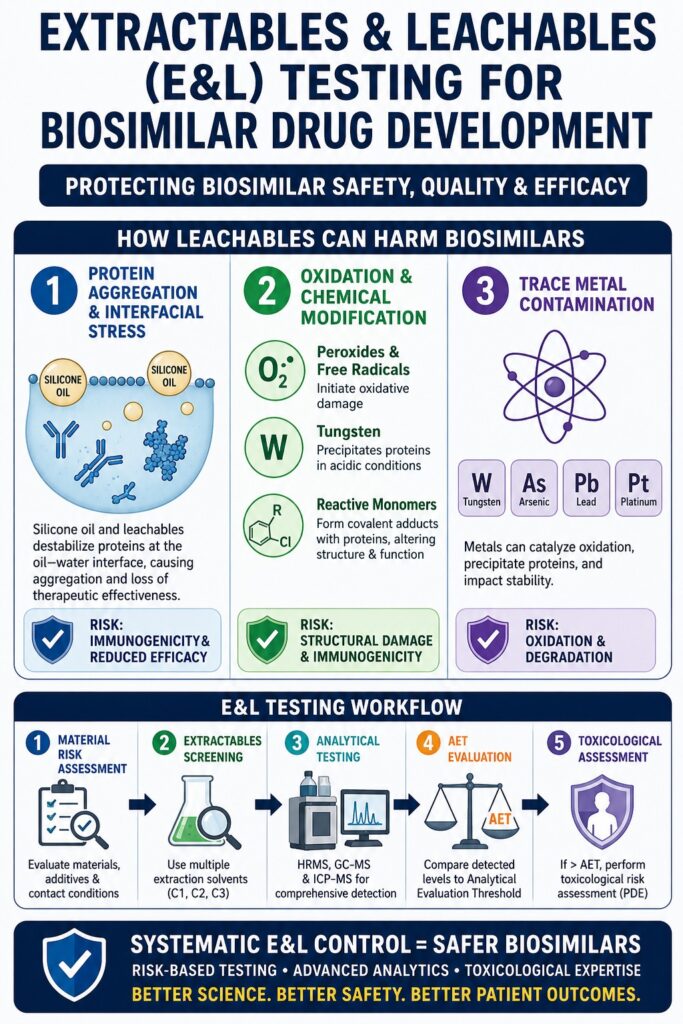
Leachables contribute to biosimilar degradation through several key mechanisms, including protein aggregation, chemical oxidation, and direct adduct formation. Because biosimilars possess highly intricate three-dimensional structures, even extremely low concentrations of migrating chemical species can destabilize their native conformation, thereby increasing the likelihood of undesirable immunogenic responses in patients. A comprehensive understanding of these biochemical degradation pathways is essential for developing robust analytical strategies capable of identifying high-risk leachables before they compromise product quality.
Protein Aggregation and Interfacial Stress
Protein aggregation is broadly regarded as one of the most significant risks associated with leachable contamination in biologic products because aggregated proteins exhibit high immunogenic potential and can substantially reduce therapeutic effectiveness. Among the most common contributors to protein aggregation is silicone oil (polydimethylsiloxane), which is routinely used as a lubricant in prefilled glass syringes to achieve acceptable break-loose and extrusion forces during administration.
When a biosimilar formulation comes into contact with the silicone oil coating or suspended silicone oil droplets, the hydrophobic domains of the therapeutic protein may partially unfold and subsequently adsorb onto the oil-water interface. Mechanical agitation during transportation and handling further intensifies this process. Capillary forces generated at the three-phase interface consisting of silicone oil, water, and air detach gelled protein aggregates from the interface and redistribute them throughout the bulk formulation. To minimize this risk, formulation scientists commonly incorporate nonionic surfactants such as polysorbate 20 or polysorbate 80. However, these surfactants are themselves susceptible to degradation initiated by leachables. Trace metals or residual peroxides released from elastomeric materials can rapidly oxidize polysorbates, leading to the formation of free fatty acids, followed by precipitation and secondary particulate generation.
Learn more about our Extractables & Leachables E&L Testing Services for Prefilled Syringes to mitigate aggregation and material compatibility risks.
Oxidation and Chemical Modification
Chemical oxidation in biosimilars is commonly initiated by inorganic and organic leachables migrating from primary packaging materials or manufacturing equipment. Several amino acid residues, including methionine, cysteine, histidine, tyrosine, and tryptophan, are particularly vulnerable to oxidative modifications that may adversely affect protein stability and biological function.
Different categories of leachables promote distinct oxidative degradation mechanisms:
Tungsten: Soluble tungsten polyanions introduced during the pin-forming process used to manufacture glass syringe barrels can rapidly precipitate monoclonal antibodies, particularly in formulations with slightly acidic conditions (pH < 6.0).
Peroxides and Free Radicals: Polymerization initiators such as Luperox 101, utilized during the production of rubber stoppers, may migrate into the drug formulation and function as highly reactive oxidizing agents. Likewise, gamma-sterilized polymer syringes are capable of generating free radicals that significantly accelerate oxidative degradation of therapeutic proteins.
Reactive Monomers: Residual monomers migrating from UV-cured adhesives, including acrylic acid used to secure staked needles in prefilled syringes, are capable of forming direct covalent adducts with the protein backbone. These reactive species primarily target lysine side chains and the N-terminus through Michael addition reactions, altering the protein’s surface charge distribution as well as its isoelectric point.
Read about our Extractables and Leachables Testing for Autoinjectors to safeguard advanced combination products against oxidative degradation.
Evaluating CRO Capabilities in Extractables & Leachables (E&L) Testing for Biosimilar Drug Development
Leading Contract Research Organizations (CROs) perform Extractables & Leachables (E&L) Testing for Biosimilar Drug Development by integrating orthogonal high-resolution mass spectrometry technologies with advanced toxicological modeling. This combined analytical capability enables the accurate identification and characterization of ultra-trace chemical migrants within highly complex biological matrices while ensuring compliance with increasingly demanding international regulatory standards.
Advanced Mass Spectrometry Platforms
Since no single analytical technique is capable of detecting the full spectrum of potential extractables and leachables, advanced CROs employ multiple orthogonal analytical methodologies to achieve comprehensive characterization. Modern toxicological requirements demand analytical sensitivity at sub-parts-per-million (ppm) or even parts-per-billion (ppb) concentrations.
| Analytical Platform | Target Migrant Classification | Application in Biosimilar E&L Testing |
|---|---|---|
| Headspace GC-MS (HS-GC-MS) | Volatile Organic Compounds (VOCs) | Quantifies outgassing monomers, residual solvents, and low-molecular-weight degradation products that migrate from adhesives and elastomeric stoppers. |
| Direct Injection GC-MS | Semi-Volatile Organic Compounds (SVOCs) | Identifies plasticizers, slip agents, lubricants, and vulcanization accelerators such as 2-mercaptobenzothiazole commonly present in complex container closure systems. |
| UPLC-HRMS (Orbitrap / Q-TOF) | Non-Volatile Organic Compounds (NVOCs) | Characterizes complex antioxidants, including Irganox degradants, curing agents, and oligomers. High-Resolution Accurate Mass (HRAM) enables precise structural elucidation of unknown leachable compounds. |
| ICP-MS | Trace Metals and Elemental Impurities | Detects catalytic metals such as tungsten, arsenic, lead, and platinum that may migrate from glass delamination, catalyst residues, or stainless-steel manufacturing equipment. |
The use of High-Resolution Accurate Mass (HRAM) instrumentation is indispensable for comprehensive non-targeted screening. Q-TOF (Quadrupole Time-of-Flight) systems provide exceptionally rapid data acquisition, making them well suited for the analysis of highly complex biological matrices. In comparison, Orbitrap platforms deliver outstanding mass stability and superior mass resolution, allowing highly accurate structural fingerprinting and confident identification of previously unknown organic leachable compounds.
To understand how to select the right platform for organic screening, review our technical guide on GC-MS vs LC-MS in Extractables and Leachables Testing.
Matrix Complexity and Sample Preparation
One of the primary analytical challenges associated with biosimilar E&L testing is the complexity of the biological matrix. Biosimilars are generally formulated as highly concentrated protein solutions, typically ranging from 100 to 200 mg/mL, and are stabilized using a combination of salts, sugars, and surfactants. Direct injection of these formulations into LC-MS or GC-MS systems is not feasible because the proteins and formulation excipients can cause substantial ion suppression. This phenomenon masks the signals of trace-level leachables while simultaneously contaminating and fouling sensitive analytical instrumentation, ultimately compromising data quality and instrument performance.
To overcome these challenges, experienced Contract Research Organizations (CROs) employ sophisticated sample preparation strategies designed to efficiently isolate trace leachables from complex biological matrices. Commonly used techniques include liquid-liquid extraction (LLE), solid-phase extraction (SPE), and specialized protein precipitation procedures. Each extraction method must undergo rigorous validation to demonstrate consistent and quantitative recovery of target leachables while ensuring that no analytes are unintentionally removed, chemically altered, or degraded during sample preparation. Robust extraction protocols are essential for producing reliable analytical data and ensuring accurate characterization of trace contaminants.
For a deeper look at detecting inorganic migrants and tungsten residues, explore ICP-MS in Extractables and Leachables Testing.
Applying the Analytical Evaluation Threshold (AET)
The Analytical Evaluation Threshold (AET) represents the toxicologically derived concentration limit above which an identified leachable must be chemically characterized and subjected to a formal safety assessment. The AET is established by translating the Safety Concern Threshold (SCT) into an analytical concentration limit based on the biosimilar’s dosage regimen and packaging configuration while incorporating an adjustment for inherent analytical uncertainty.
A scientifically justified AET serves an important purpose by preventing unnecessary reporting of insignificant background signals while ensuring that every chemically meaningful impurity receives an appropriate toxicological evaluation. The calculation of the AET depends on three principal variables:
- Safety Concern Threshold (SCT): This represents the maximum daily exposure level below which leachables are considered to present negligible carcinogenic or systemic toxicity risk. For parenteral biologic products, the SCT is defined as 1.5 µg/day for each individual leachable.
- Clinical Dosing Parameters: These include the maximum number of doses administered per day together with the total volume or number of doses contained within a single container closure system (CCS).
- Uncertainty Factor (UF): This analytical safety factor compensates for variations in mass spectrometry ionization efficiency among different known and unknown chemical compounds. The uncertainty factor typically ranges from 2 to 10, although it may also be statistically derived using internal standard response factor databases, such as a 50% relative standard deviation approach.
The standard Analytical Evaluation Threshold equation is expressed as:
AET = (SCT × Doses per CCS) ÷ (Maximum Doses per Day × Uncertainty Factor)
Whenever a detected compound exceeds the established AET during an Extractables & Leachables study, a comprehensive toxicological risk assessment becomes necessary. Toxicologists evaluate the compound using advanced in silico prediction platforms, including Derek Nexus, together with established toxicological databases to determine a compound-specific Permitted Daily Exposure (PDE) value. If the measured concentration of the leachable during real-time stability studies remains below the assigned PDE, the packaging system is considered to satisfy the required safety criteria.
Discover how to establish correct thresholds by reading our guide on AET for Extractables and Leachables Studies.
Regulatory Frameworks: USP, USP, and ICH Q3E
Regulatory expectations for biosimilar Extractables & Leachables testing continue to evolve from region-specific guidance documents toward globally harmonized quality standards. Biopharmaceutical manufacturers are now expected to comply with newly introduced USP requirements governing single-use manufacturing systems while simultaneously aligning their risk assessment strategies with the emerging ICH Q3E guideline.
Single-Use Systems and USP
Scheduled for mandatory implementation on May 1, 2026, USP Chapter (Plastic Components and Systems Used to Manufacture Pharmaceutical Drug Products and Biopharmaceutical Drug Substances and Products) establishes comprehensive requirements for extractables characterization of polymeric manufacturing components. Single-use systems (SUS), including bioreactor bags, flexible tubing, and sterile filtration assemblies, are widely adopted throughout biosimilar manufacturing because they reduce cross-contamination risks while improving manufacturing flexibility and operational efficiency. However, these polymeric materials contain numerous additives, including plasticizers, antioxidants, lubricants, and slip agents, that have the potential to migrate into manufacturing streams as Process Equipment-Related Leachables (PERLs).
The companion USP chapter provides a structured risk assessment framework that determines the extent of testing required for each manufacturing component by evaluating four primary risk factors:
- Duration of Contact: Short-term (<24 hours), intermediate (1–7 days), or long-term (>7 days).
- Temperature of Contact: Refrigerated, ambient, or elevated temperatures (>30°C).
- Process Stream Composition: Aqueous, partially organic, or highly organic/extreme pH process conditions.
- Material Composition: Assessment of additive content within the polymer together with consideration of highly reactive sterilization techniques such as gamma irradiation.
Components classified as High Risk require comprehensive organic extractables profiling using multiple standardized extraction solvents, including Solutions C1, C2, and C3, to thoroughly evaluate their chemical safety characteristics.
Learn about establishing Permitted Daily Exposure (PDE) limits with our resource on the Toxicological Qualification of Leachables.
The ICH Q3E Harmonization
Historically, Extractables & Leachables testing has been guided by a combination of regional pharmacopeial standards and recommendations developed by industry organizations such as BPOG and PQRI. The ICH Q3E guideline, currently progressing through Step 2b public consultation, seeks to unify these previously fragmented approaches into a single internationally accepted framework.
One of the defining principles of ICH Q3E is its emphasis on a lifecycle-based approach to leachable risk management. Rather than treating Extractables & Leachables testing as an isolated packaging qualification exercise, the guideline requires developers to provide scientific justification for every aspect of their study design. This includes establishing a transparent relationship between Analytical Evaluation Threshold calculations, toxicological exposure limits, analytical methodologies, and the intended route of product administration. As a result, leachable control becomes a continuous quality attribute extending from raw material selection and manufacturing through commercial production and long-term post-market stability monitoring.
Learn how to select proper matrix mimics by reading our technical breakdown on Solvents for Extractables Studies.
Strategic Timelines for Extractables & Leachables (E&L) Testing for Biosimilar Drug Development
A comprehensive Extractables & Leachables (E&L) Testing for Biosimilar Drug Development program generally requires 8 to 12 weeks for initial extractables characterization, followed by 6 to 36 months of ongoing leachables monitoring throughout product stability studies. Careful integration of these analytical activities into the overall biosimilar development program is essential for avoiding costly delays during regulatory review and product approval.
Because biosimilars must demonstrate structural and functional comparability to an approved reference biologic, the late discovery of problematic leachables has the potential to trigger extensive additional comparability studies, significantly increasing both development timelines and project costs. To reduce this risk, E&L testing should be incorporated into the development strategy from the earliest stages and maintained throughout the product lifecycle.
| Biosimilar Development Phase | E&L Testing Objective | Typical Duration | Regulatory Deliverable |
|---|---|---|---|
| Pre-Clinical / Formulation Development | Material Risk Assessment | 2 to 4 Weeks | Documentation covering supplier information, polymer characterization, and theoretical extractables risk assessments. |
| Phase I / IND Application | Controlled Extractables Profiling | 8 to 12 Weeks | Submission of worst-case extractables profiles generated using aggressive extraction solvents and elevated temperatures, accompanied by preliminary toxicological evaluations. |
| Phase III / Process Validation | Method Development & Validation | 4 to 8 Weeks | Development and validation of highly sensitive, product-specific LC-MS and GC-MS analytical methods capable of accurately quantifying targeted leachables within the biosimilar matrix. |
| Registration / BLA Submission | Real-Time & Accelerated Leachables Monitoring | 6 to 36 Months | Comprehensive analysis of the biosimilar within its commercial container closure system at predefined intervals (0, 6, 12, 18, 24, and 36 months) under both standard and accelerated ICH stability conditions. |
Experienced Contract Research Organizations such as ResolveMass Laboratories Inc. can further optimize these timelines by synchronizing targeted leachables analyses with the sponsor’s existing stability study schedule. This coordinated approach ensures that all analytical data are generated in a format suitable for immediate inclusion within BLA or NDA regulatory submissions.
To ensure a smooth submission process, read about the Root Causes of Failed Extractables and Leachables EL Studies.
Conclusion
The successful implementation of Extractables & Leachables (E&L) Testing for Biosimilar Drug Development is essential for preserving the structural integrity, therapeutic performance, and clinical safety of highly sensitive large-molecule biologic therapies. The inherent biological complexity of biosimilars makes them particularly susceptible to trace environmental contaminants. Consequently, failure to thoroughly characterize primary packaging materials and single-use manufacturing systems may result in protein aggregation, oxidative degradation, and potentially serious immunogenic responses in patients.
As global regulatory authorities implement increasingly stringent requirements through USP standards while transitioning toward the harmonized risk management principles established by ICH Q3E, biopharmaceutical organizations must adapt to a more demanding regulatory environment. Collaborating with an experienced Contract Research Organization that offers advanced high-resolution mass spectrometry capabilities, comprehensive toxicological expertise, and robust ISO 9001:2015 quality systems has become increasingly important for ensuring regulatory compliance. Through the establishment of scientifically justified Analytical Evaluation Thresholds (AETs) and the integration of validated leachables monitoring into long-term stability programs, developers can strengthen regulatory confidence, accelerate product approvals, and ultimately enhance patient safety.
To learn more about implementing a comprehensive, submission-ready Extractables & Leachables testing strategy for your biosimilar development program, please visit https://resolvemass.ca/contact/.
Frequently Asked Questions
Silicone oil is commonly applied to the inner surface of prefilled syringes to reduce friction and ensure smooth injection performance. Over time, microscopic silicone oil droplets may migrate into the drug formulation, where therapeutic proteins can adsorb onto their hydrophobic surfaces. This interaction may cause the proteins to lose their native structure, resulting in aggregate formation and the generation of sub-visible particles that can negatively affect product quality and patient safety.
The requirements outlined in USP, together with the companion informational chapter USP, are scheduled to become mandatory on May 1, 2026. These standards establish comprehensive expectations for evaluating plastic components and single-use manufacturing systems used during pharmaceutical and biopharmaceutical production. Compliance helps ensure that potential extractables and leachables originating from manufacturing materials are properly identified and controlled.
A complete Extractables & Leachables assessment requires multiple complementary analytical techniques because no single method can detect every type of chemical migrant. Headspace GC-MS is typically used for volatile organic compounds, while Direct Injection GC-MS analyzes semi-volatile compounds. High-resolution LC-MS platforms such as Orbitrap or Q-TOF characterize non-volatile organic compounds, whereas ICP-MS is employed to detect elemental impurities and trace metals with exceptional sensitivity.
Leachables are evaluated by storing the biosimilar in its final commercial container closure system under established ICH stability conditions. Samples are collected at predefined intervals, including baseline and multiple long-term time points, and analyzed using validated mass spectrometry methods. This ongoing monitoring allows scientists to identify, quantify, and evaluate any chemical migrants that may accumulate during the product’s shelf life while confirming continued product safety and stability.
Trace metals, including tungsten residues introduced during the manufacturing of glass syringes, can significantly influence the stability of protein-based therapeutics. Tungsten may promote oxidative degradation of sensitive amino acid residues and, under mildly acidic conditions, soluble tungsten species can trigger precipitation of monoclonal antibodies. These chemical interactions have the potential to reduce product quality and compromise therapeutic performance.
The ICH Q3E guideline introduces a globally harmonized approach for managing extractables and leachables throughout the pharmaceutical product lifecycle. Rather than relying on multiple regional recommendations, it establishes consistent scientific principles for risk assessment, safety evaluation, and regulatory reporting. This unified framework supports standardized global compliance while encouraging a lifecycle-based strategy for controlling leachable-related risks.
Process Equipment-Related Leachables (PERLs) are chemical compounds that originate from manufacturing equipment instead of the finished product’s primary packaging. Materials such as bioreactor bags, silicone tubing, sterile filters, and other single-use processing components may release these substances into the manufacturing stream. Regulatory guidance, including USP standards, requires manufacturers to evaluate PERLs carefully to ensure they do not adversely affect the safety, quality, or stability of biopharmaceutical products.
Reference:
- den Engelsman, J., Garidel, P., Smulders, R., Koll, H., Smith, B., Bassarab, S., Seidl, A., Hainzl, O., & Jiskoot, W. (2011). Strategies for the assessment of protein aggregates in pharmaceutical biotech product development. Pharmaceutical Research, 28(4), 920–933. https://doi.org/10.1007/s11095-010-0297-1
- Joubert, M. K., Hokom, M., Eakin, C., Zhou, L., Deshpande, M., Baker, M. P., Goletz, T. J., Kerwin, B. A., Chirmule, N., Narhi, L. O., & Jawa, V. (2014). Protein comparability assessments and potential applicability of high-throughput biophysical methods and data visualization tools to compare physical stability profiles. mAbs, 6(1), 95–108. https://doi.org/10.4161/mabs.27033
- Bee, J. S., Randolph, T. W., Carpenter, J. F., Bishop, S. M., & Dimitrova, M. N. (2011). Effects of surfaces and leachables on the stability of biopharmaceuticals. Journal of Pharmaceutical Sciences, 100(10), 4158–4170. https://doi.org/10.1002/jps.22597
- Cleland, J. L., Powell, M. F., & Shire, S. J. (1993). The development of stable protein formulations: A close look at protein aggregation, deamidation, and oxidation. Critical Reviews in Therapeutic Drug Carrier Systems, 10(4), 307–377. https://www.researchgate.net/publication/15073981_The_development_of_stable_protein_formulations_A_close_look_at_protein_aggregation_deamidation_and_oxidation
Get In Touch With Us
About The Author


