

Introduction:
PLA nanoparticles for targeted cancer delivery are nanoscale polymeric carriers in which an anticancer compound is incorporated into biodegradable poly(lactic acid) (PLA), changing how the drug is distributed, protected, and released. Conventional systemic chemotherapy exposes healthy tissue as well as the tumour, which narrows the therapeutic window. Nanoparticles are being investigated to modify pharmacokinetics, protect payloads, and provide controlled release.
At ResolveMass Laboratories Inc., a Canadian analytical CRO/CDMO, our scientists work at the interface of polymer science, mass spectrometry, and drug delivery characterization. This case study follows a representative PLA nanoparticle program for solid tumours, from design goals through formulation, analytical control, and regulatory readiness. For a deeper look at this topic, see our resource on PLA nanoparticle formulation for targeted oncology.
Summary
- PLA nanoparticles for targeted cancer delivery are a biodegradable platform for controlled delivery of oncology drugs to solid tumours.
- Key formulation attributes are particle size, polydispersity (PDI), zeta potential, morphology, drug loading, encapsulation efficiency, and release profile.
- Passive accumulation through the enhanced permeability and retention (EPR) effect varies substantially between tumour types and patients, so it must be tested, not assumed.
- Active targeting uses ligands (antibodies, peptides, aptamers) that recognize tumour-associated receptors, but only works if the receptor is sufficiently expressed and accessible.
- A robust program links nanoparticle attributes to drug release, cellular uptake, cytotoxicity, stability, and therapeutic performance.
- Regulatory development requires detailed control of nanomaterial-related critical quality attributes (CQAs), manufacturing consistency, impurities, and stability.
- Orthogonal analytical testing is what shows a formulation is reproducible, stable, and fit for preclinical or clinical development.
Note: This is a representative case study of a typical development workflow. It is not a report of results from a specific client program.
1: What Are PLA Nanoparticles for Targeted Cancer Delivery?
PLA nanoparticles for targeted cancer delivery are nanoscale drug-delivery systems in which an anticancer compound is encapsulated in or associated with biodegradable PLA, allowing the formulation to modify drug distribution, protection, and release.
PLA can be processed into nanoparticles with tunable physicochemical properties. Depending on the strategy, the particles can carry hydrophobic or other suitable therapeutic molecules within a controlled-release matrix.
Nanoparticle development should not rely on particle size alone. FDA guidance on nanomaterials emphasizes that nanoscale characteristics can influence product quality, safety, and effectiveness, and should be evaluated in the context of the final drug product.
2: Why Use PLA Nanoparticles for Solid Tumour Delivery?
PLA is attractive because its biodegradable matrix can be engineered to control drug encapsulation, circulation behaviour, and release kinetics, while offering opportunities for surface functionalization. It hydrolyzes into lactic acid, which the body metabolizes through normal pathways.
Key formulation objectives include:
- Increasing apparent solubility of poorly soluble drugs
- Protecting the drug from premature degradation
- Extending drug residence time and controlling release
- Modifying biodistribution and increasing tumour-associated exposure
- Reducing unnecessary exposure of healthy tissue
- Enabling surface modification for active targeting
Nanoparticle delivery should not automatically be read as tumour-specific delivery. Tumour biology, vascular permeability, stromal barriers, immune clearance, particle properties, and administration route all influence distribution.
| Property | Relevance to Oncology Delivery |
|---|---|
| Biodegradability | Breaks down into lactic acid, metabolized naturally |
| Tunable molecular weight | Controls degradation rate and release kinetics |
| Hydrophobic matrix | Suited to poorly water-soluble drugs |
| Surface chemistry | End groups allow PEGylation or ligand conjugation |
| Slower degradation than PLGA | Suits longer release windows |
Polymer choice matters. Our comparison of PLA vs PLGA vs PCL and our data on PLGA, PLA and PCL degradation rates explain how each polymer behaves. Because PLA stereochemistry (PLLA vs PDLA vs PDLLA) affects crystallinity and degradation, it should be specified early.
3: Representative Case Study: How Was the PLA Nanoparticle Formulation Developed?
The case begins with a poorly soluble anticancer compound selected for PLA nanoparticles, with a strategy that links formulation variables to measurable CQAs and biological performance.
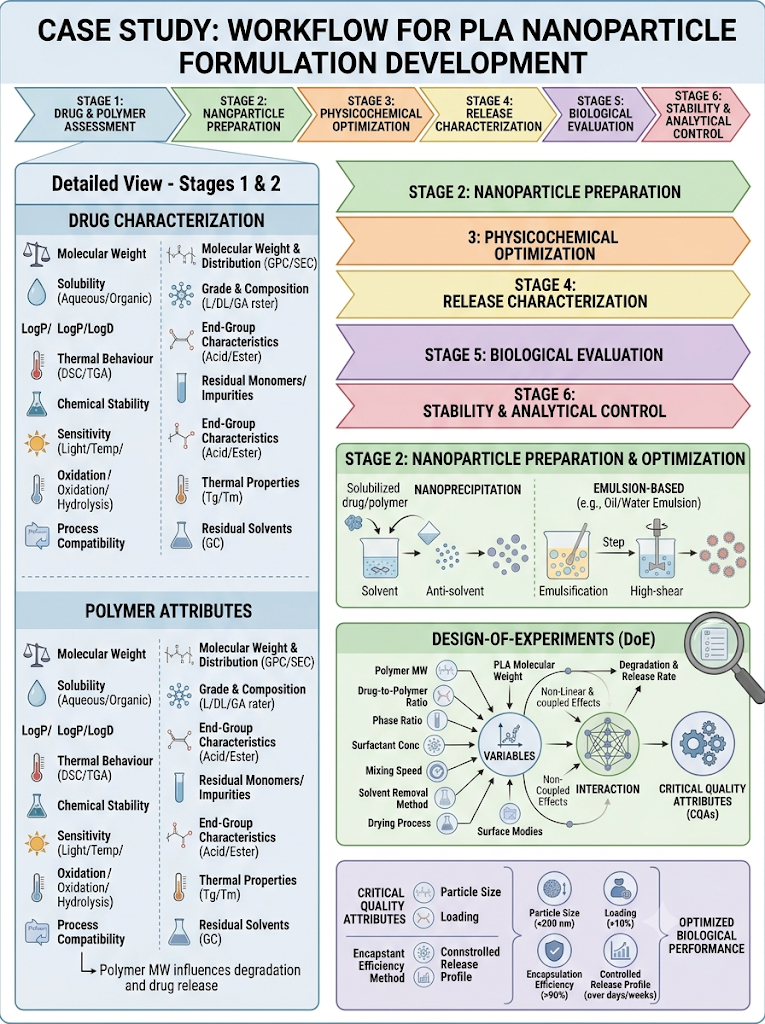
The workflow has six stages:
Drug and polymer assessment → nanoparticle preparation → physicochemical optimization → release characterization → biological evaluation → stability and analytical control
Stage 1: Drug and Polymer Assessment
Before preparing nanoparticles, characterize both components.
Drug parameters: molecular weight, solubility, LogP/logD, thermal behaviour, chemical stability, sensitivity to light, oxidation, hydrolysis or temperature, and compatibility with the formulation process.
PLA attributes: molecular weight and distribution, grade and composition, end-group characteristics, residual monomer or process impurities, thermal properties, and residual solvent profile. Polymer molecular weight directly influences degradation and release, so polymer characterization is a core part of development. If you are sourcing material, see our PLA excipient supplier information.
Stage 2: Nanoparticle Preparation and Optimization
The process should be optimized for reproducible particle size, narrow size distribution, adequate drug loading, high encapsulation efficiency, and acceptable physical stability. Nanoprecipitation and emulsion-based techniques are common starting points.
| Formulation Variable | Potential Impact |
|---|---|
| PLA molecular weight | Degradation and release rate |
| Drug-to-polymer ratio | Loading and encapsulation |
| Organic-to-aqueous phase ratio | Particle formation |
| Surfactant concentration | Particle size and stability |
| Mixing conditions | Size distribution |
| Solvent removal | Residual solvent and particle structure |
| Drying process | Redispersion and aggregation |
| Surface modification | Targeting and biological interactions |
A design-of-experiments (DoE) approach identifies which variables most influence CQAs, rather than optimizing each one independently.
4: What Critical Quality Attributes Should Be Evaluated?
The most important CQAs are particle size, PDI, surface charge, morphology, drug content, encapsulation efficiency, residual solvents, polymer properties, release profile, and physical and chemical stability.
| CQA | Typical Method |
|---|---|
| Particle size and PDI | DLS (with NTA as an orthogonal check) |
| Zeta potential | Electrophoretic light scattering |
| Morphology | SEM or TEM |
| Drug content | HPLC/UPLC (validated) |
| Encapsulation efficiency | Separation of free and encapsulated drug, then quantitation |
| Polymer molecular weight | SEC/GPC |
| Thermal properties | DSC/TGA |
| Chemical structure | FTIR/NMR |
| Residual solvents | GC-based analysis |
| Drug release | In vitro release testing |
FDA specifically highlights particle size and distribution, morphology, solid state, and aggregation or agglomeration as attributes to understand for nanomaterial-containing products.
5: How Can PLA Nanoparticles Target Solid Tumours?
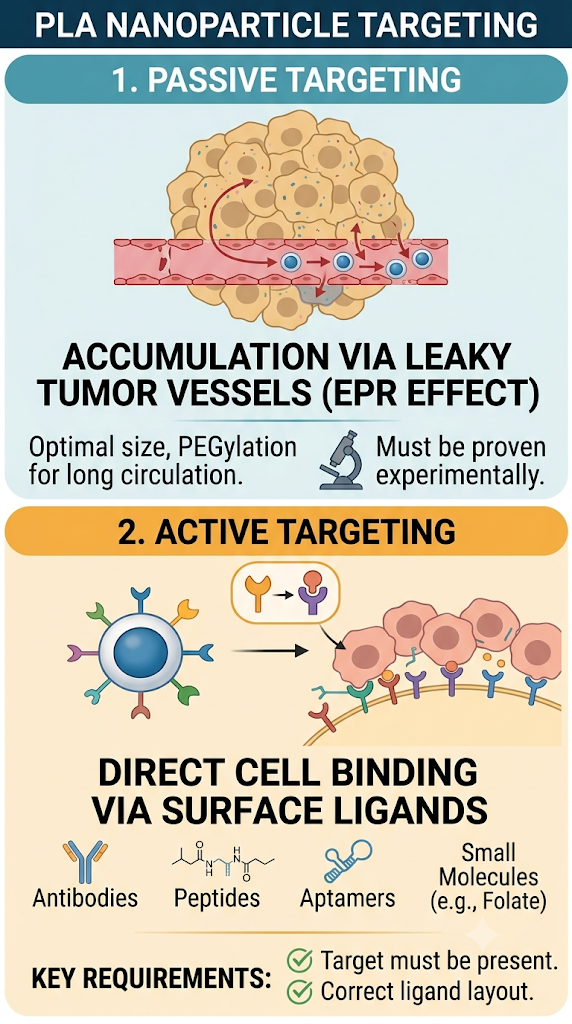
PLA nanoparticles can support tumour delivery through passive accumulation, active targeting, or both, but targeting performance must be demonstrated experimentally, not assumed from particle size.
Passive Targeting With PLA Nanoparticles for Targeted Cancer Delivery
Passive targeting exploits tumour vascular and drainage characteristics, including the EPR effect. Tumour vasculature can differ from normal vasculature, and impaired lymphatic drainage may contribute to accumulation in certain models. However, the EPR effect varies considerably across tumour types and biological systems. Particles of roughly 100–200 nm with near-neutral or slightly negative surface charge tend to circulate longer, and PEGylation can reduce opsonization. A development program should assess tumour distribution experimentally.
Active Targeting
Active targeting modifies the nanoparticle surface with a ligand that interacts with a receptor or biomarker on tumour cells or in the tumour microenvironment. Options include:
- Monoclonal antibodies and antibody fragments
- Peptides
- Aptamers
- Small-molecule ligands (such as folate)
- Carbohydrate-based ligands
Recent research describes ligand-receptor interactions as a way to increase cellular association and uptake in receptor-expressing tumour models. A ligand is only useful when the receptor is sufficiently expressed and accessible in the intended tumour population. Ligand density, orientation, and stability also become CQAs.
6: How Was Drug Release Evaluated in the Case Study?
Release testing shows whether the PLA system delivers the intended profile and connects polymer properties to delivery performance.
A representative study compares free drug, non-targeted PLA nanoparticles, surface-functionalized nanoparticles, different PLA molecular-weight grades, and different drug-to-polymer ratios. Validated chromatographic methods measure:
- Parent drug and degradation products
- Cumulative release and initial burst release
- Release rate
- Drug remaining in the nanoparticles
Rapid initial release may indicate drug near the particle surface, while slower release may reflect stronger drug-polymer interactions or diffusion through the matrix. The goal is not the slowest possible release. The profile should match the intended pharmacological and dosing strategy. Testing in acidic media (about pH 5–6.5) alongside pH 7.4 helps approximate the tumour microenvironment.
7: How Was Targeting Performance Characterized?
Targeting should be shown through complementary analytical and biological experiments that distinguish accumulation, cellular uptake, and actual drug exposure.
A representative evaluation includes:
- Receptor-expression analysis
- Fluorescent nanoparticle uptake studies
- Flow cytometry and confocal microscopy
- Cellular internalization and cytotoxicity assays
- Comparative drug-exposure measurements
- Tumour-versus-normal tissue distribution in appropriate preclinical models
Greater cellular uptake does not automatically mean better efficacy. The most meaningful strategy connects the full chain:
Nanoparticle properties → cellular interaction → drug release → pharmacokinetics → tumour exposure → pharmacodynamic response
8: What Analytical Challenges Must Be Addressed?
The central challenge is establishing a reliable relationship between nanoscale physicochemical properties and drug-product performance. Nanoparticle attributes are interdependent:
- Polymer molecular weight changes can alter degradation.
- Degradation can change particle structure, which alters release and exposure.
- Surface modifications can change protein adsorption and uptake.
- Storage can cause aggregation or size changes.
This is why orthogonal characterization matters. FDA notes that nanomaterials can be sensitive to manufacturing conditions and scale-up, and recommends identifying CQAs and controls early.
| Challenge | Typical Cause | Mitigation |
|---|---|---|
| High burst release | Surface-adsorbed drug | Adjust polymer MW, wash steps, drug-polymer ratio |
| Broad size distribution | Inconsistent mixing | Controlled mixing, microfluidics, tighter DoE ranges |
| Poor reproducibility | Uncontrolled process variables | QbD, defined critical process parameters |
| Aggregation on storage | Insufficient stabilization | Optimized surfactant and lyoprotectant |
| Ligand loss or inactivation | Unstable conjugation chemistry | Orthogonal confirmation of ligand density |
Mass spectrometry is especially valuable for confirming ligand conjugation and detecting degradation products or leachables that simpler assays miss.
9: Stability Testing of PLA Nanoparticles
Stability testing must evaluate both the nanoparticle carrier and the encapsulated drug, because physical instability can occur even when drug assay remains acceptable.
| Stability Attribute | Example Evaluation |
|---|---|
| Particle size and PDI | DLS |
| Aggregation | Size distribution, morphology |
| Drug assay | HPLC/UPLC |
| Degradation products | HPLC/LC-MS |
| Drug release | In vitro release |
| Polymer molecular weight | SEC/GPC |
| Residual solvent | GC |
| Surface properties | Zeta potential |
| Morphology | SEM/TEM |
Planning storage conditions and shelf-life claims early helps. See our guidance on the shelf life of PLGA, PLA and PCL.
10: Regulatory Considerations for PLA Nanoparticle Development
Regulatory development requires a product-specific understanding of quality, safety, effectiveness, manufacturing controls, and nanomaterial-related characteristics.
FDA’s 2022 guidance on drug products containing nanomaterials explains that these products may have attributes that differ from conventional products and may need particular examination. The same fundamental expectations for safety, effectiveness, and quality still apply. A development package should address:
- Identity, composition, and polymer characterization
- Particle-size distribution and morphology
- Drug loading and encapsulation efficiency
- Residual solvents and impurity profile
- Manufacturing reproducibility and process controls
- Release characteristics and stability
- Biological performance
Moving from lab formulation to preclinical readiness means defining CQAs early, validating or qualifying methods, and running multiple engineering batches to show consistency. Our overview of IND-enabling studies and supply for PLGA, PLA and PCL outlines what this stage involves. Sponsors should also review applicable FDA and Health Canada guidance. PLA’s utility extends beyond human oncology, as seen in PLGA and PLA veterinary long-acting injectables.
How Can ResolveMass Support PLA Nanoparticle Analytical Development?
ResolveMass Laboratories Inc. supports nanoparticle development with analytical strategies that connect material properties, formulation performance, degradation, and stability. Our focus areas include PLGA-based drug delivery, biosimilar characterization, mass spectrometry, and nitrosamine testing.
A fit-for-purpose program may include:
- SEC/GPC for PLA molecular weight
- HPLC/UPLC for assay and related substances
- LC-MS/HRMS for degradation-product investigation
- FTIR/NMR for structural characterization
- DSC/TGA for thermal characterization
- GC-based residual-solvent analysis
- Forced-degradation and stability-indicating method development
- Comparative characterization of prototypes and scale-up support
The strategy should be built around your specific drug substance, polymer, administration route, and development stage, not a one-size-fits-all package.
Conclusion:
PLA nanoparticles for targeted cancer delivery offer a flexible platform for controlled release and tumour-directed delivery, but success requires much more than achieving a nanoscale particle size. A defensible program connects polymer characteristics, particle properties, drug loading, release kinetics, targeting behaviour, stability, and biological performance:
Drug + PLA → nanoparticle formulation → physicochemical characterization → release testing → targeting assessment → stability → biological evaluation → development readiness
Passive accumulation and active targeting are both useful strategies, but each must be demonstrated for the intended tumour model and application. The value of this platform ultimately depends on reproducibly manufacturing and characterizing a formulation whose CQAs are meaningfully linked to release, safety, and therapeutic performance.
Frequently Asked Questions:
Passive targeting uses biological characteristics such as tumour-associated vascular permeability and impaired drainage to promote nanoparticle accumulation. Active targeting adds a ligand intended to interact with a specific receptor or biomarker on tumour cells or within the tumour microenvironment.
PLA-based nanoparticle systems are an active area of pharmaceutical and oncology research, but the suitability of a specific formulation for clinical use depends on its demonstrated quality, safety, efficacy, manufacturing consistency, and regulatory requirements. A research formulation should not be considered clinically validated solely because it demonstrates promising laboratory or animal results.
There is no single universally ideal particle size for every cancer application. Particle size should be optimized according to the drug, administration route, tumour model, targeting mechanism, biodistribution requirements, and desired biological performance.
Particle size can influence biodistribution, cellular uptake, aggregation, clearance, and drug-release behaviour. Monitoring both mean particle size and size distribution is therefore important for formulation optimization and batch-to-batch consistency.
Polydispersity index (PDI) describes the distribution of particle sizes within a nanoparticle preparation. A lower and reproducible PDI generally indicates a more uniform particle population, although acceptable limits should be established based on the specific formulation and analytical method.
Encapsulation efficiency is determined by measuring the amount of drug incorporated into the nanoparticles relative to the total amount of drug used during formulation. Separation of free drug from nanoparticle-associated drug can be followed by quantitative HPLC, UPLC, or another validated analytical technique.
Reference
- Zhu D, Tao W, Zhang H, Liu G, Wang T, Zhang L, Zeng X, Mei L. Docetaxel (DTX)-loaded polydopamine-modified TPGS-PLA nanoparticles as a targeted drug delivery system for the treatment of liver cancer. Acta biomaterialia. 2016 Jan 15;30:144-54.https://www.sciencedirect.com/science/article/pii/S1742706115302063
- Hu Q, Gao X, Gu G, Kang T, Tu Y, Liu Z, Song Q, Yao L, Pang Z, Jiang X, Chen H. Glioma therapy using tumor homing and penetrating peptide-functionalized PEG–PLA nanoparticles loaded with paclitaxel. Biomaterials. 2013 Jul 1;34(22):5640-50.https://www.sciencedirect.com/science/article/pii/S0142961213004699
- Pulkkinen M, Pikkarainen J, Wirth T, Tarvainen T, Haapa-Aho V, Korhonen H, Seppälä J, Järvinen K. Three-step tumor targeting of paclitaxel using biotinylated PLA-PEG nanoparticles and avidin–biotin technology: formulation development and in vitro anticancer activity. European journal of pharmaceutics and biopharmaceutics. 2008 Sep 1;70(1):66-74.https://www.sciencedirect.com/science/article/pii/S0939641108001574
- Schadlich A, Caysa H, Mueller T, Tenambergen F, Rose C, Gopferich A, Kuntsche J, Mader K. Tumor accumulation of NIR fluorescent PEG–PLA nanoparticles: impact of particle size and human xenograft tumor model. ACS nano. 2011 Nov 22;5(11):8710-20.https://pubs.acs.org/doi/abs/10.1021/nn2026353
- Jain D, Bajaj A, Athawale R, Shrikhande S, Goel PN, Nikam Y, Gude R, Patil S, Prashant Raut P. Surface-coated PLA nanoparticles loaded with temozolomide for improved brain deposition and potential treatment of gliomas: development, characterization and in vivo studies. Drug delivery. 2016 Mar 23;23(3):989-1006.https://www.tandfonline.com/doi/abs/10.3109/10717544.2014.926574
- Madej M, Kurowska N, Strzalka-Mrozik B. Polymeric nanoparticles—tools in a drug delivery system in selected cancer therapies. Applied Sciences. 2022 Sep 21;12(19):9479.https://www.mdpi.com/2076-3417/12/19/9479
About the Author


