

Introduction
The execution of GMP Release and ICH Stability Testing establishes the comprehensive analytical framework necessary to demonstrate that therapeutic peptide drug substances and drug products meet stringent regulatory requirements for identity, strength, purity, potency, and safety before clinical distribution or commercial marketing. This rigorous quality control approach supports compliance with internationally harmonized expectations established by the U.S. Food and Drug Administration (FDA), European Medicines Agency (EMA), and Health Canada.
Therapeutic peptides represent a specialized structural class positioned between conventional small-molecule pharmaceuticals and large biopharmaceutical proteins. These molecules may be manufactured through solid-phase peptide synthesis (SPPS), liquid-phase synthesis, or recombinant DNA technology and exhibit distinctive physical and chemical properties. Their conformational flexibility, tendency toward self-association, and vulnerability to chemical degradation mechanisms—including deamidation, oxidation, racemization, and N-terminal cyclization—create significant analytical challenges. Therefore, validated lot-release procedures and stability-indicating methodologies consistent with International Council for Harmonisation (ICH) Q6B and ICH Q5C guidelines are essential for demonstrating batch-to-batch consistency and maintaining shelf-life integrity.
Learn more about GLP-1 peptide characterization by CROs and analytical strategies used for therapeutic peptide programs.
Share via:
Quick Summary:
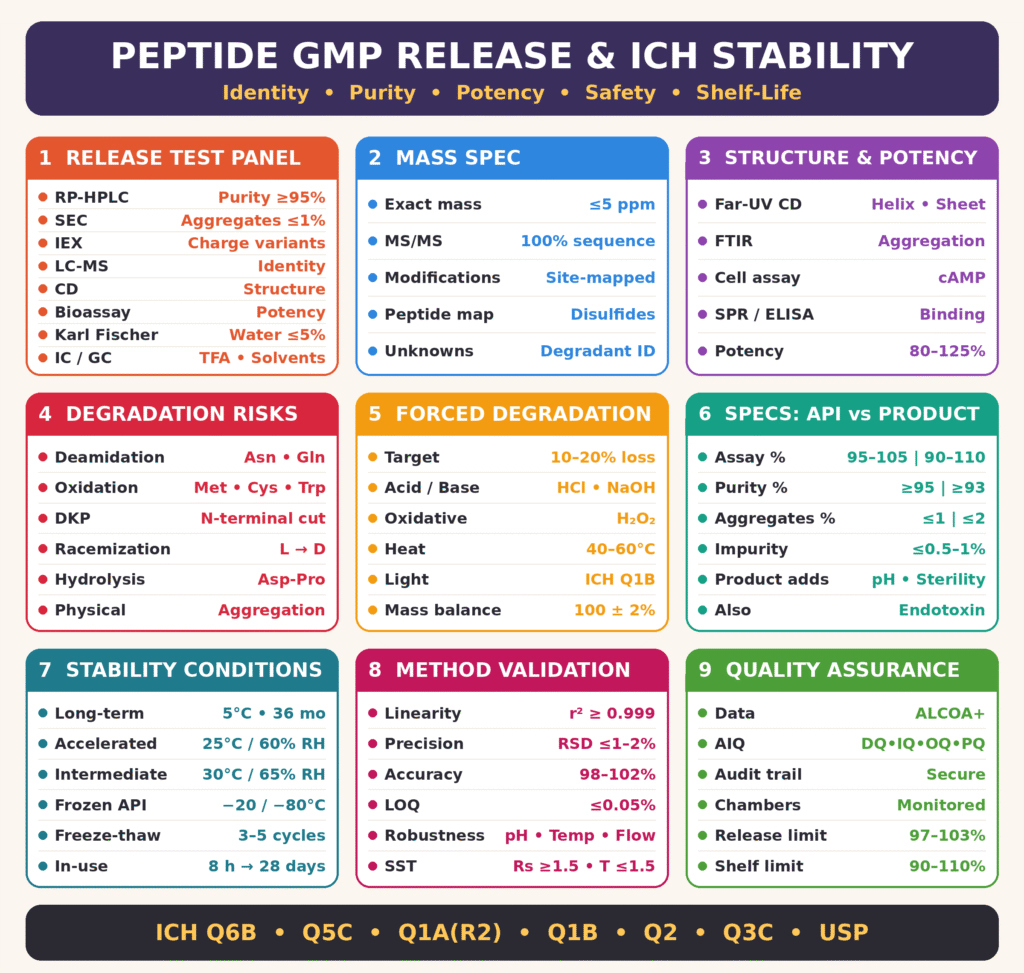
- Purpose: GMP release and ICH stability testing show that peptide drug substances and products meet FDA, EMA and Health Canada requirements for identity, strength, purity, potency and safety. They are necessary because peptides are prone to deamidation, oxidation, racemization and aggregation.
- Orthogonal analytical panel: RP-HPLC/UHPLC measures purity and impurities, SEC measures aggregates and IEX measures charge variants. LC-MS/MS and HRMS confirm sequence and exact mass (≤5 ppm), CD and FTIR check secondary structure, and cell-based or binding bioassays confirm potency (typically 80–125% of reference). Karl Fischer, IC and GC cover water, counterions and residual solvents.
- Degradation pathways: Chemical risks include deamidation (Asn/Gln), oxidation (Met, Cys, Trp, His), diketopiperazine formation, racemization and hydrolysis at Asp-Pro/Asp-Gly sites. Physical risks are unfolding and aggregation.
- Forced degradation: Acid, base, peroxide, heat, light (ICH Q1B), freeze-thaw and agitation stress aim for about 10–20% degradation. This proves the methods are stability-indicating, with mass balance close to 100% ± 2%.
- Specifications: API specifications focus on purity, impurities, counterions and net peptide content. Drug product specifications add pH, osmolality, particles, sterility and endotoxins. Release limits (e.g., potency 97–103%) are set tighter than shelf-life limits (90–110%).
- Stability program design: Under ICH Q1A(R2) and Q5C, studies cover:
- long-term at 5°C (up to 36 months)
- accelerated at 25°C/60% RH
- intermediate at 30°C/65% RH
- frozen storage (−20/−80°C)
- freeze-thaw, photostability and in-use testing
- Quality assurance: Methods are validated per ICH Q2 for specificity, linearity, precision, accuracy, LOD/LOQ and robustness, with system suitability checks before each run. Instruments are qualified (DQ/IQ/OQ/PQ), and ALCOA+ data integrity applies throughout. Together these support global regulatory approval, including for newer modalities like macrocycles and peptide-drug conjugates.
Analytical Methodologies for GMP Release and ICH Stability Testing
Analytical methodologies used for GMP Release and ICH Stability Testing incorporate an orthogonal combination of chromatographic, mass spectrometric, biophysical, and bioanalytical techniques to characterize the critical quality attributes (CQAs) of peptide active pharmaceutical ingredients (APIs) and finished drug products. These validated analytical procedures distinguish the intact drug molecule from process-related impurities, counterions, structural isomers, and degradation products that may form during storage.
Developing a comprehensive specification panel requires each analytical technique to be appropriately aligned with the molecular attribute being investigated. The principal parameters assessed during quality control lot release and long-term stability programs include chemical identity, amino acid sequence, peptide content, chromatographic purity, process impurities, product-related degradants, higher-order conformation, microbial safety, and functional biological activity.
| Analytical Method | Targeted Critical Quality Attribute (CQA) | Regulatory Guidance / Compendial Reference | Primary Application & Acceptance Criteria |
|---|---|---|---|
| Reversed-Phase HPLC / UHPLC (RP-HPLC) | Chromatographic purity, product-related impurities, identity | ICH Q6B, USP | Quantitative assay; typical purity acceptance criteria ≥ 95.0% to ≥ 98.0% main peak area. |
| Size-Exclusion Chromatography (SEC) | Soluble aggregates, oligomeric forms, high-molecular-weight species (HMWS) | ICH Q6B, ICH Q5C, USP | Physical stability monitoring; aggregate limits typically ≤ 1.0% total peak area. |
| Ion-Exchange Chromatography (IEX) | Charge variants, acidic/basic degradants, deamidation products | ICH Q6B, USP | Quantification of charge heterogeneity; specified limits for individual charge variants. |
| LC-MS/MS & HRMS | Primary sequence verification, molecular weight, mass balance, degradant ID | ICH Q6B | Structural confirmation; monoisotopic mass verification within tight mass tolerance (≤ 5 ppm). |
| Circular Dichroism (CD) Spectroscopy | Secondary structure conformation (α-helix, β-sheet, random coil) | ICH Q6B | Higher-order structure comparability; spectral matching against reference standard. |
| Cell-Based Potency Bioassay / Binding Assay | Biological activity, functional potency, receptor affinity | ICH Q6B | Functional lot release; relative potency typically 80%–125% of qualified reference standard. |
| Karl Fischer Titration / Water Content | Residual moisture content | USP | Moisture determination; critical for solid-state stability, typically ≤ 5.0% w/w. |
| Ion Chromatography (IC) / Gas Chromatography (GC) | Counterion content (e.g., TFA, acetate), residual organic solvents | ICH Q3C, USP | Stoichiometric balance and safety; solvent limits per ICH guidelines. |
Explore peptide physicochemical characterization services for orthogonal analytical evaluation of therapeutic peptides.
Chromatographic Protocols: RP-HPLC, SEC, and IEX
Chromatographic protocols based on RP-HPLC, SEC, and IEX provide the separation capabilities required to resolve, quantify, and characterize structurally related peptide impurities, charge variants, and aggregate species. These liquid chromatography methods are operated under validated conditions designed to satisfy applicable pharmacopeial system suitability requirements.
Reversed-Phase High-Performance Liquid Chromatography (RP-HPLC) is widely used as a primary stability-indicating technique for determining chromatographic purity and monitoring product-related impurities. Modern chromatographic separations commonly use silica or polymeric stationary phases with 100 Å to 300 Å pore sizes, together with binary mobile-phase gradients containing acidic ion-pairing agents such as 0.05%–0.1% trifluoroacetic acid (TFA) or formic acid. Ultra-High Performance Liquid Chromatography (UHPLC), which uses sub-2 μm particle columns under elevated system pressures, provides increased peak capacity and improved resolution of closely eluting diastereomers, deletion sequences, and oxidized variants.
Size-Exclusion Chromatography (SEC) is used to evaluate physical stability by measuring soluble high-molecular-weight species (HMWS) and non-covalent aggregates. To maintain native self-association states, SEC procedures generally employ non-denaturing aqueous mobile phases at physiological or formulation-specific pH. Ion-Exchange Chromatography (IEX), including cation-exchange (CEX) and anion-exchange (AEX), characterizes charge heterogeneity associated with acidic deamidation or basic modifications and provides an orthogonal assessment of purity.
Review approaches for peptide aggregation analysis to support evaluation of soluble aggregates and other physical instability attributes.
Mass Spectrometry and Structural Characterization
High-resolution mass spectrometry (HRMS) combined with liquid chromatography provides detailed structural confirmation of the primary amino acid sequence, exact monoisotopic mass, and post-translational or synthetic modifications. LC-MS/MS methods can verify intact peptide identity during lot release while also enabling characterization of unknown degradants that develop during ICH stability studies.
Electrospray Ionization (ESI) and Matrix-Assisted Laser Desorption/Ionization (MALDI) mass spectrometry are used to confirm intact molecular mass with mass accuracy tolerances of ≤ 5 ppm. Tandem mass spectrometry (MS/MS), using collision-induced dissociation (CID) or electron-transfer dissociation (ETD), produces diagnostic b and y fragment ion spectra and can provide 100% sequence coverage. MS/MS fragmentation can identify the precise locations of chemical modifications, including methionine oxidation, asparagine deamidation, tryptophan hydroxylation, and disulfide bond scrambling. For peptides containing multiple cysteine residues, peptide mapping through enzymatic digestion (e.g., trypsin, endoproteinase Lys-C), followed by LC-MS/MS analysis, can verify appropriate disulfide connectivity.
Learn more about peptide sequencing of GLP-1 peptides and sequence-confirmation strategies using advanced mass spectrometry.
Spectroscopic and Bioassay Evaluations
Spectroscopic methods and cell-based bioassays provide complementary assessments of higher-order secondary structure and functional potency in peptide drug substances and drug products. These evaluations help demonstrate that secondary folding and receptor-binding mechanisms remain consistent across manufacturing batches and throughout the intended storage period.
Far-Ultraviolet Circular Dichroism (CD) spectroscopy (190 nm–250 nm) measures secondary structural characteristics and can quantify the relative fractions of α-helices, β-sheets, turns, and unordered random coils. Far-UV CD spectra obtained from released lots are compared with a qualified primary reference standard to assess conformational comparability. Fourier-Transform Infrared (FTIR) spectroscopy complements CD by evaluating Amide I (1600 cm⁻¹–1700 cm⁻¹) and Amide II vibrational bands. This provides sensitive monitoring of intermolecular β-sheet structures that may indicate early-stage aggregation.
Functional biological potency is evaluated using quantitative bioassays consistent with ICH Q6B guidance. Depending on the peptide’s mechanism of action, these assays may include cell-based reporter gene assays, second-messenger signal transduction assays (e.g., intracellular cAMP accumulation), surface plasmon resonance (SPR), and Enzyme-Linked Immunosorbent Assays (ELISA). Potency measurements are expressed relative to an established reference standard, with acceptance limits defined using appropriate statistical confidence intervals, such as 80%–125%.
Explore CD spectroscopy for peptide secondary-structure characterization to learn how biophysical methods support peptide characterization.
Degradation Pathways and Forced Degradation Profiling
Peptide degradation can occur through specific chemical reaction pathways and physical transformation mechanisms that may reduce therapeutic performance or contribute to clinical immunogenicity. Forced degradation stress testing deliberately exposes peptide materials to accelerated environmental conditions to generate degradation products, investigate degradation behavior, and demonstrate the suitability of stability-indicating analytical methods.
Chemical and Physical Degradation Mechanisms
Chemical degradation pathways involve changes to the covalent primary structure of the peptide chain, whereas physical degradation mechanisms primarily affect higher-order spatial organization without necessarily causing covalent bond cleavage.
Chemical instability pathways include:
- Deamidation: Formation of a succinimide intermediate under neutral-to-alkaline pH conditions can convert asparagine (Asn) and glutamine (Gln) residues into aspartic acid, isoaspartic acid, glutamic acid, and pyroglutamic acid isomers.
- Oxidation: Reactive oxygen species and trace peroxides can oxidize methionine (Met) to methionine sulfoxide and sulfone. Cysteine (Cys) may undergo oxidation to disulfide dimers or cysteic acid. Tryptophan (Trp) and histidine (His) can also undergo photo-oxidation, producing kynurenine and hydroxylated species.
- Diketopiperazine (DKP) Formation: Nucleophilic attack from the N-terminal amine on the peptide bond between residues 2 and 3 can result in cleavage, producing a cyclic diketopiperazine and a truncated peptide.
- Racemization: Base-catalyzed removal of the α-proton produces a planar carbanion intermediate that can generate L-to-D diastereomers, potentially changing biological activity and chromatographic retention.
- Hydrolysis: Acid- or base-catalyzed cleavage of peptide bonds can occur, particularly at Asp-Pro and Asp-Gly motifs.
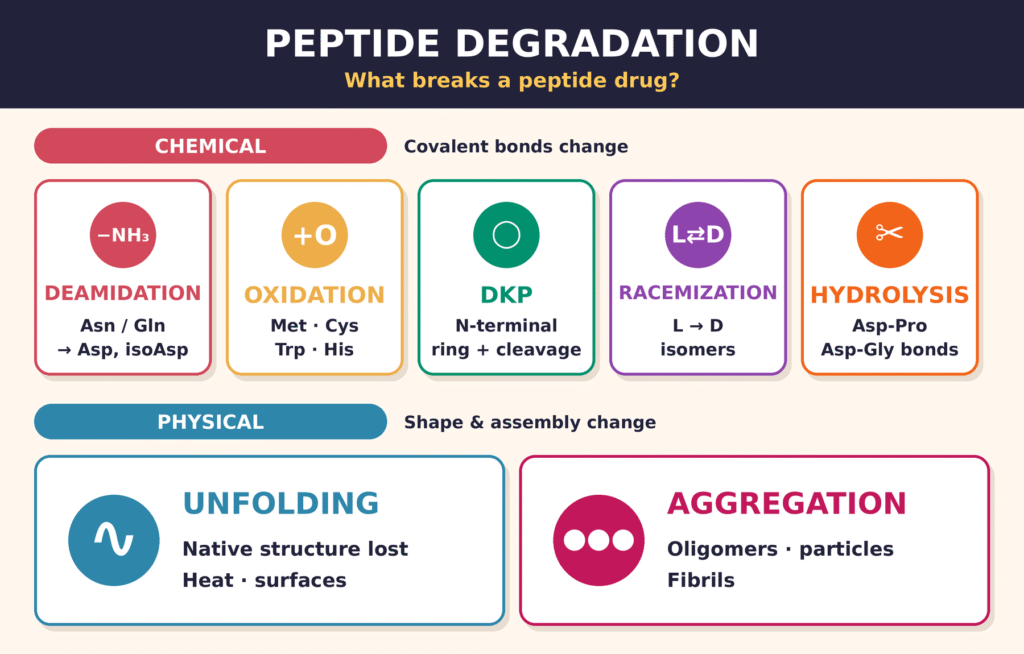
Physical instability pathways encompass:
- Conformational Unfolding: Thermal or surface-induced disruption of the native secondary structure.
- Self-Assembly and Aggregation: Non-covalent association of unfolded peptide chains driven by hydrophobic and electrostatic interactions, resulting in soluble oligomers, sub-visible particles, and insoluble amyloid fibrils.
| Degradation Pathway | Primary Chemical/Physical Mechanism | Susceptible Amino Acid Residues / Sites | Primary Trigger Factors | Analytical Detection Methodology |
|---|---|---|---|---|
| Deamidation | Succinimide intermediate formation yielding Asp/isoAsp | Asn-Gly, Asn-Ser, Gln-X sequences | Alkaline pH, elevated temperature, aqueous buffer | RP-HPLC, IEX, LC-MS/MS peptide mapping |
| Oxidation | Oxygen transfer forming sulfoxides, sulfones, hydroxides | Met, Cys, Trp, His residues | Peroxides, trace metals, light exposure, oxygen | RP-HPLC, Peptide Mapping, HRMS |
| DKP Formation | Intramolecular nucleophilic attack by N-terminal amine | Dipeptides with Pro or Gly at position 2 | Neutral/basic pH, elevated temperature | RP-HPLC, LC-MS/MS |
| Racemization | Base-catalyzed carbanion intermediate formation | Cys, Ser, Phe, Asp residues | High pH, thermal stress, synthesis defects | Chiral HPLC, RP-HPLC, MS/MS |
| Aggregation | Hydrophobic self-assembly, cross-β-sheet fibrillization | Hydrophobic patches, aromatic clusters | Agitation, freeze-thaw, heat, hydrophobic surfaces | SEC, DLS, Thioflavin T assay, Micro-Flow Imaging |
For GLP-1 programs, see the analytical approaches described in GLP-1 peptide impurity characterization for evaluation of product- and process-related impurities.
Forced Degradation Protocols and Mass Balance
Forced degradation protocols expose the peptide drug substance to controlled stress conditions designed to produce approximately 10%–20% degradation of the parent molecule. This level of degradation helps avoid excessive breakdown and the formation of secondary artifacts. Typical stress conditions include acid hydrolysis (0.1 M to 1.0 M HCl), base hydrolysis (0.1 M to 1.0 M NaOH), oxidative stress (0.3% to 3.0% H₂O₂), thermal exposure (40°C to 60°C), photolysis (ICH Q1B light exposure: ≥ 1.2 million lux hours and ≥ 200 watt hours/m²), freeze-thaw stress, and mechanical agitation.
Demonstrating mass balance helps establish that the stability-indicating chromatographic procedure detects and quantifies the relevant degradation products generated during stress testing. Mass balance is calculated using the following relationship:
Mass Balance (%) = Assay Value of Stressed Sample (%) + Σ Total Degradation Products (%) ≈ 100% ± 2%
Explore GLP-1 peptide stability analytical methods for additional information on stability-indicating analytical strategies.
Specifications and Acceptance Criteria for Peptide Drug Substance vs Drug Product
Specifications define the numerical limits, analytical procedures, and acceptance criteria necessary to demonstrate batch consistency and shelf-life compliance for peptide drug substances and drug products. Although drug substance (API) specifications primarily address purity, synthetic impurities, counterion content, and physical characterization, drug product specifications place greater emphasis on dose uniformity, formulation stability, and sterility assurance.
Drug substance specifications assess the quality of the active bulk peptide. Essential quality-control testing may include appearance, solubility, specific optical rotation, amino acid analysis, exact mass, and net peptide content. Net peptide content considers the contribution of non-peptide material present in the bulk solid:
Net Peptide Content (%) = Peptide Content (%) × [100 − Water (%) − Residual Solvents (%) − Counterions (%)] / 100
Impurities are classified according to ICH Q6B as either process-related or product-related. Process-related impurities can include coupling agents (e.g., HOBt, DIC), cleavage scavengers (e.g., EDT, TIS), residual solvents (e.g., DMF, NMP, piperidine within ICH Q3C limits), heavy metals (ICH Q3D), and elemental impurities. Product-related impurities include deletion sequences, insertion sequences, diastereomers, and truncated fragments. Release limits for individual specified product-related impurities are commonly established at ≤ 0.5%–1.0%, unspecified impurities at ≤ 0.10%, and total product-related impurities at ≤ 3.0%.
Drug product specifications apply to finished liquid, reconstituted, or pre-filled parenteral products. Additional testing parameters may include pH, osmolality, reconstitution time, extractable volume, sub-visible particles (USP), container closure integrity, sterility (USP), and bacterial endotoxins (USP).
Release limits and shelf-life limits are established according to the applicable ICH framework. Release limits are generally tighter internal specifications applied during batch manufacturing, such as potency of 97.0%–103.0%, to help ensure that the product remains within regulatory shelf-life requirements, such as potency of 90.0%–110.0% and total degradants ≤ 3.0%, throughout the commercial shelf-life.
Compare analytical considerations for peptide drug substance versus drug product characterization when developing release and stability testing strategies.
| Specification Parameter | Peptide Drug Substance (API) Criteria | Peptide Drug Product (Finished Dosage) Criteria | Analytical Regulatory Reference |
|---|---|---|---|
| Appearance & Clarity | White to off-white powder; clear solution upon reconstitution | Clear, colorless solution; free from visible particulate matter | Visual inspection, USP |
| Assay / Potency | 95.0%–105.0% (anhydrous, solvent-free basis) | 90.0%–110.0% of nominal label claim | RP-HPLC, UHPLC, Potency Bioassay |
| Peptide Purity | ≥ 95.0% to ≥ 98.0% main peak area | ≥ 93.0% to ≥ 95.0% main peak area (shelf-life limit) | Stability-Indicating RP-HPLC / UHPLC |
| Specified Degradants | Individual specified impurities ≤ 0.5%–1.0% | Individual specified degradants ≤ 1.0%–2.0% | LC-MS/MS, RP-HPLC |
| High-MW Aggregates | ≤ 0.5%–1.0% total aggregate peak area | ≤ 1.0%–2.0% total aggregate peak area | Isocratic SEC-HPLC |
| Counterion Content | Stoichiometric quantification (e.g., TFA ≤ 1.0% w/w, Acetate 2.0%–12.0%) | N/A (controlled in API step or buffer matrix) | Ion Chromatography (IC), RP-HPLC |
| Uniformity of Units | N/A | Meets USP requirements (Acceptance Value AV ≤ 15.0) | HPLC Assay, Weight Variation |
| Sterility & Endotoxins | Bioburden ≤ 100 CFU/g; Endotoxins ≤ 10 EU/mg | Sterile (USP); Bacterial Endotoxins (USP) | Membrane filtration, LAL assay |
Protocol Execution for GMP Release and ICH Stability Testing
Protocol execution for GMP Release and ICH Stability Testing establishes the controlled environmental storage conditions, sampling timepoints, container closure configurations, and testing intervals required to determine formal shelf-life and retest periods. Stability study designs are aligned with ICH Q1A(R2) for active substances and ICH Q5C for biological and biotechnological products.
Stability programs are performed under real-time long-term, accelerated, and stress storage conditions. Environmental stability chambers must incorporate continuous automated temperature and humidity monitoring systems that are appropriately qualified to cGMP standards.
| Study Type | Environmental Storage Condition | Minimum Testing Frequencies | Strategic Regulatory Purpose |
|---|---|---|---|
| Long-Term (Refrigerated) | 5°C ± 3°C | 0, 3, 6, 9, 12, 18, 24, 36 months | Establishes formal commercial shelf-life and real-time storage period. |
| Accelerated (Refrigerated) | 25°C ± 2°C / 60% RH ± 5% RH | 0, 1, 2, 3, 6 months | Evaluates short-term temperature excursions and provides early degradation profiles. |
| Long-Term (Frozen) | −20°C ± 5°C or −80°C ± 5°C | 0, 3, 6, 9, 12, 18, 24, 36 months | Establishes retest periods for bulk peptide drug substances stored frozen. |
| Intermediate | 30°C ± 2°C / 65% RH ± 5% RH | 0, 3, 6, 9, 12 months | Mandatory if significant change occurs during accelerated 25°C testing. |
| Freeze-Thaw Stability | −20°C / −80°C to 25°C (3 to 5 cycles) | Baseline, Cycle 1, Cycle 3, Cycle 5 | Evaluates physical aggregation and cryo-stability during transport and storage. |
| In-Use Stability | Controlled room temperature (20°C–25°C) or 2°C–8°C | Multiple pulls across 8 h, 24 h, 7 days, 28 days | Simulates dose preparation, reconstitution, or multi-dose administration. |
Photostability testing according to ICH Q1B exposes the drug substance and drug product to ≥ 1.2 million lux hours of visible light and ≥ 200 watt hours/m² of near-UV light. In-use stability testing assesses reconstituted or multi-dose liquid formulations under controlled ambient light and temperature conditions at multiple timepoints, such as 8 hours to 28 days, to confirm stability throughout patient administration.
Review regulatory requirements for GLP-1 peptide characterization for considerations that can support regulatory-oriented analytical planning.
Quality Assurance, Method Validation, and Regulatory Compliance
Quality assurance systems provide the compliance controls, data integrity safeguards, and analytical validation frameworks necessary to support regulatory submissions and product release testing. Analytical method validation protocols follow ICH Q2(R1) and applicable USP parameters, while equipment qualification is performed according to relevant USP requirements.
Analytical method validation establishes method performance across critical criteria, including:
- Specificity: Demonstration that the intact peptide can be adequately distinguished from degradation products, synthetic impurities, counterions, and formulation excipients, supported by MS peak purity analysis.
- Linearity and Range: Established across 50%–150% of the target assay concentration, with an expected r² ≥ 0.999.
- Precision: Repeatability (% RSD ≤ 1.0%) and intermediate precision (% RSD ≤ 2.0%) assessed across multiple days, instruments, and analysts.
- Accuracy: Mean recovery of 98.0%–102.0% across spiked samples covering 80%–120% of the target concentration.
- LOD and LOQ: Determined using signal-to-noise assessment (S/N ≥ 3:1 for LOD and S/N ≥ 10:1 for LOQ), with LOQ limits reaching ≤ 0.05% for impurities.
- Robustness: Assessment of deliberate variations in mobile-phase pH (± 0.2), column temperature (± 5°C), organic solvent composition (± 2%), and flow rate (± 10%).
- System Suitability Testing (SST): Verification of resolution (Rₛ ≥ 1.5), tailing factor (T ≤ 1.5), and area precision (% RSD ≤ 1.0%) before sample analysis according to USP requirements.
Analytical Instrument Qualification (AIQ) is performed in accordance with USP requirements and encompasses Design Qualification (DQ), Installation Qualification (IQ), Operational Qualification (OQ), and Performance Qualification (PQ). Data Integrity practices implement ALCOA+ principles to ensure that electronic chromatographic and mass spectrometric data are maintained with secure audit trails, controlled permission levels, and validated archival systems.
See the peptide characterization CRO deliverables checklist for key analytical outputs to consider when planning a characterization program.
Conclusion: The Strategic Imperative of GMP Release and ICH Stability Testing
Developing comprehensive GMP Release and ICH Stability Testing programs is essential for the development and commercialization of therapeutic peptides and for supporting regulatory approval across global markets. Validated release methods and appropriately designed stability programs provide critical evidence of product safety, efficacy, quality, and batch comparability throughout the commercial product lifecycle.
As therapeutic peptide development expands into increasingly complex modalities, including macrocycles, lipopeptides, and peptide-drug conjugates (PDCs), analytical testing strategies must continue to evolve. The integration of orthogonal liquid chromatography, high-resolution mass spectrometry, and validated biophysical assays supports alignment with ICH Q6B, ICH Q5C, and cGMP standards. ResolveMass Laboratories Inc. provides technical expertise and regulatory-focused analytical capabilities to support biopharmaceutical drug substance and drug product programs from early clinical development through commercial release.
Explore multi-attribute monitoring (MAM) for peptide characterization to learn how multi-attribute analytical approaches can complement conventional peptide characterization strategies.
For technical consultations or to initiate analytical testing services, contact the expert team directly through the ResolveMass Laboratories Inc. Contact Page.
Frequently Asked Questions
Peptide stability programs and specification development are supported by several ICH guidelines, with ICH Q6B addressing specifications for biotechnological/biological products and ICH Q5C covering their stability evaluation. ICH Q1A(R2) also provides principles for stability testing of new drug substances and drug products.
Mass balance helps demonstrate that the stability-indicating analytical procedure adequately accounts for the degradation occurring during forced degradation studies. It is assessed by comparing the remaining parent peptide assay with the quantified degradation products, with the combined value generally expected to approach 100% ± 2% relative to the non-degraded control.
Chromatographic purity represents the proportion of the intact peptide relative to the total peptide-related peak area detected by HPLC. Net peptide content instead estimates the actual peptide mass present in the bulk material after accounting for moisture, residual solvents, counterions, and other non-peptide components.
Size-Exclusion Chromatography (SEC) is commonly used to quantitatively measure soluble oligomers and high-molecular-weight species associated with peptide aggregation. Dynamic Light Scattering (DLS), Thioflavin T fluorescence, and Micro-Flow Imaging (MFI) provide complementary information about particle size, fibrillar structures, and sub-visible aggregates.
Release limits are generally established as tighter criteria for newly manufactured batches to provide an appropriate margin for changes that may occur during storage. Shelf-life limits define the acceptable quality range that the product must maintain throughout its approved storage period, such as potency ranges of 97.0%–103.0% at release versus 90.0%–110.0% during shelf life.
Synthetic peptides are frequently isolated in salt forms containing counterions such as trifluoroacetate (TFA), acetate, or hydrochloride. Counterion quantification using Ion Chromatography or RP-HPLC helps establish salt stoichiometry, support accurate mass balance calculations, and control the composition of the peptide drug substance.
Common chemical degradation pathways in peptide stability studies include deamidation, oxidation, N-terminal diketopiperazine formation, racemization, and disulfide exchange. These reactions can alter peptide structure, chromatographic behavior, molecular integrity, and potentially biological activity during storage.
USP provides a framework for qualifying analytical equipment through Design Qualification (DQ), Installation Qualification (IQ), Operational Qualification (OQ), and Performance Qualification (PQ). Together, these stages establish documented evidence that chromatography and mass spectrometry systems consistently operate according to predetermined specifications.
Reconstituted lyophilized peptide products are evaluated through in-use stability studies under defined storage conditions, commonly including 2°C–8°C and controlled room temperature. Testing at predetermined intervals, such as 8 hours through 28 days, can assess chemical purity, degradation, appearance, visual clarity, and sterility following reconstitution.
Reference:
- Elsayed, Y. Y., Kühl, T., & Imhof, D. (2025). Regulatory guidelines for the analysis of therapeutic peptides and proteins. Journal of Peptide Science, 31(3), e70001. https://doi.org/10.1002/psc.70001
- International Council for Harmonisation of Technical Requirements for Pharmaceuticals for Human Use. (1999). Specifications: Test procedures and acceptance criteria for biotechnological/biological products (Q6B). ICH Q6B Guideline
- European Medicines Agency, & U.S. Food and Drug Administration. (2023). EMA–FDA joint Q&As on quality and GMP aspects of PRIME/Breakthrough therapy applications. FDA document
- International Council for Harmonisation of Technical Requirements for Pharmaceuticals for Human Use. (1995). Q5C: Quality of biotechnological products: Stability testing of biotechnological/biological products. European Medicines Agency. EMA guideline
- U.S. Food and Drug Administration. (1999). Q6B specifications: Test procedures and acceptance criteria for biotechnological/biological products. FDA Guidance Document
Get In Touch With Us
About The Author


