


Introduction
Contract Development and Manufacturing Organizations (CDMOs) implement ICH Q2(R2) and ICH Q14 as an integrated, lifecycle-oriented framework that brings analytical procedure development, quality risk management, and formal validation together within one continuous workflow. The formal implementation of the revised ICH Q2(R2) guideline, together with the newly established ICH Q14 guideline, represents a regulatory shift from empirical analytical validation toward a systematic Analytical Quality by Design (AQbD) approach. Issued by the International Council for Harmonisation (ICH) and implemented by global health authorities, including the FDA and EMA, these complementary guidelines establish updated expectations for how analytical procedures are developed, validated, and maintained throughout the commercial lifecycle of a drug product. By integrating science-based method development under ICH Q14 with the updated validation principles of ICH Q2(R2), analytical testing facilities can connect early-stage method optimization with commercial quality control, reducing analytical failures and supporting more efficient global regulatory submissions.
Explore our peptide analytical testing services to support scientifically robust analytical workflows across the drug development lifecycle.
Share via:
Quick Summary:
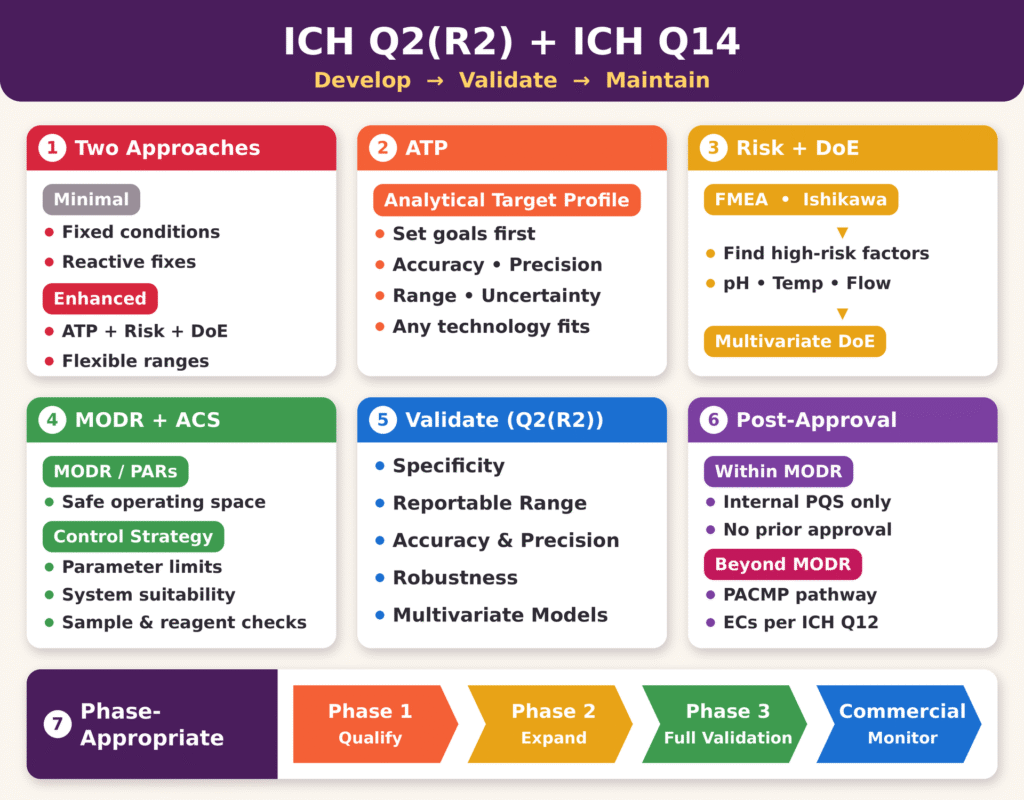
Harmonizing Development and Validation Under ICH Q2(R2) and ICH Q14
Aligning analytical development under ICH Q14 with formal validation under ICH Q2(R2) establishes a continuous feedback process in which scientific knowledge directly informs validation protocols and routine operating limits. This integrated framework enables analytical laboratories to use prior scientific knowledge, risk assessments, and development data to support targeted validation parameters. As a result, traditional trial-and-error experimentation can be replaced with a more systematic approach based on predictable and scientifically justified performance metrics.
Within the analytical procedure lifecycle, contract facilities can adopt either a minimal (traditional) development approach or an enhanced development approach. The minimal approach generally depends on univariable parameter adjustments and fixed, single-point operating conditions, whereas the enhanced approach incorporates Quality Risk Management (QRM) and multivariate experimentation to establish flexible, risk-based operational ranges.
| Lifecycle Dimension | Minimal Development Approach | Enhanced Lifecycle Approach (ICH Q2(R2) and ICH Q14) |
|---|---|---|
| Primary Objective | Demonstrate method suitability under a defined set of fixed operating conditions. | Establish method understanding, identify interaction effects, and define a robust operable design region. |
| Performance Criteria | Established retrospectively according to initial empirical chromatographic performance. | Defined prospectively through a formal Analytical Target Profile (ATP). |
| Risk Management | Informal and reactive troubleshooting performed when method failures occur. | Systematic Quality Risk Management (QRM per ICH Q9) using FMEA and Ishikawa analysis. |
| Operational Boundaries | Narrow, single-point operating conditions with limited flexibility during routine use. | Proven Acceptable Ranges (PARs) or Method Operable Design Regions (MODRs). |
| Post-Approval Flexibility | Minor procedural modifications may require formal regulatory variations. | Operational changes within an approved MODR can be managed without prior regulatory submission. |
| Control Strategy | Standard System Suitability Testing (SST) parameters. | Comprehensive Analytical Control Strategy (ACS) incorporating risk-based SST and sample controls. |
Learn how effective technology transfer to a GMP CDMO can help maintain analytical consistency when methods move between development and manufacturing environments.
Operationalizing AQbD and ATP in CDMO Workflows
Contract development facilities implement Analytical Quality by Design (AQbD) by defining objective performance requirements early in drug development and systematically assessing the variables that can influence measurement accuracy. This structured approach connects the critical quality attributes (CQAs) of drug substances and drug products with defined analytical measurement capabilities, helping ensure that analytical procedures remain robust during technology transfers and clinical scale-up.
Discover how custom peptide synthesis services can support development programs that require controlled and well-characterized analytical processes.
Establishing the Analytical Target Profile (ATP)
An Analytical Target Profile (ATP) establishes the required performance characteristics for an analytical procedure, including acceptable measurement uncertainty, precision, and reportable range, when quantifying a specific critical quality attribute. Functioning as a technology-independent performance specification, the ATP defines what the analytical procedure must measure and how accurately it needs to perform without requiring a specific instrument or chromatographic column chemistry to be selected at the outset. This approach allows analytical scientists to adopt, replace, or update analytical technologies throughout the product lifecycle as long as the selected technique satisfies the predefined ATP acceptance criteria.
For peptide programs requiring comprehensive analytical characterization, review our peptide analytical testing services and available analytical support.
Risk Assessment and Design of Experiments (DoE)
Risk assessment procedures use Failure Mode and Effects Analysis (FMEA) and Ishikawa (Fishbone) diagrams to systematically identify high-risk analytical variables that require focused Design of Experiments (DoE) investigations. Before experimental studies are performed, analysts assess critical factors such as mobile phase pH, organic modifier ratio, gradient steepness, column temperature, flow rate, and sample extraction times. Parameters identified as high risk can then be investigated using multivariate DoE approaches, which evaluate main effects and interactions among multiple variables that may remain undetected when using traditional One-Factor-At-A-Time (OFAAT) experiments.
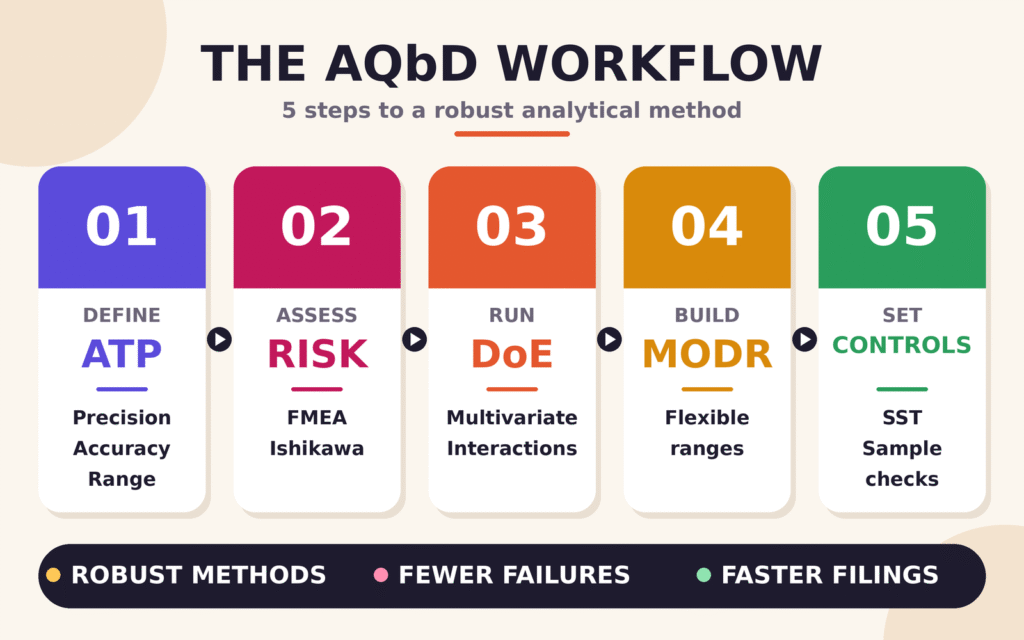
Explore our impurity control strategies under ICH Q3A for additional support in managing impurity-related analytical considerations.
Establishing the Method Operable Design Region (MODR) and Analytical Control Strategy
A Method Operable Design Region (MODR) defines the validated multidimensional operational space in which changes in analytical parameters do not significantly affect measurement results. Establishing an MODR or Proven Acceptable Ranges (PARs) provides analytical testing laboratories with greater operational flexibility, enabling routine adjustments to address column lot variability or minor instrument differences while maintaining reliable results and data integrity.
The Analytical Control Strategy (ACS) brings together the parameter limits, instrument checks, and procedural controls required to maintain consistent method performance across commercial manufacturing locations. A comprehensive ACS developed under ICH Q14 incorporates the following elements:
- Parameter Controls: Verified operating boundaries established from DoE interaction models, including clearly defined PARs and MODR boundaries.
- System Suitability Testing (SST): On-line performance assessments, including peak resolution, tailing factors, injection precision, and signal-to-noise ratios, designed to confirm critical parameter controls before sample analysis.
- Sample and Reagent Controls: Defined requirements for sample preparation stability, extraction efficiency limits, reagent purity grades, and stationary phase lot qualification.
Learn more about GMP peptide API manufacturing services designed to support controlled manufacturing and analytical requirements.
Advanced Validation Framework According to ICH Q2(R2) and ICH Q14
The revised validation framework under ICH Q2(R2) incorporates modern evaluation approaches for complex analytical technologies, including cell-based bioassays, spectroscopic techniques, and multivariate quantitative models. When validation protocols are aligned with the scientific understanding generated through ICH Q14, analytical scientists can assess method capability using statistical total error approaches and appropriately defined reportable ranges.
| Validation Characteristic | Technical Objective per ICH Q2(R2) | Evaluation Methodology & Metrics |
|---|---|---|
| Specificity / Selectivity | Demonstrate that the analyte can be measured accurately in the presence of expected matrices and degradation products. | Spiking experiments, orthogonal testing, diode-array peak purity, and forced degradation studies. |
| Reportable Range | Establish that accuracy, precision, and linearity remain acceptable throughout the complete operational concentration range. | Integrated assessment of precision and accuracy across upper and lower specification limits. |
| Accuracy and Precision | Quantify systematic bias and random variability under normal operating conditions and intermediate precision conditions. | Total Error concept, recovery studies at low/mid/high levels, and intermediate precision variances. |
| Robustness | Demonstrate the ability of the analytical procedure to remain unaffected by small, deliberate changes in operating parameters. | Statistical assessment of deliberate parameter shifts, such as pH ± 0.2 and temperature ± 2°C, during DoE studies. |
| Multivariate Validation | Validate quantitative prediction algorithms, including Near-Infrared or Process Analytical Technology models. | Root Mean Square Error of Prediction (RMSEP) and testing with independent calibration/validation datasets. |
Review our peptide stability testing services to support analytical evaluation of peptide products throughout development and manufacturing.
Phase-Appropriate Implementation of ICH Q2(R2) and ICH Q14 Across Clinical Lifecycle
Phase-appropriate implementation balances the required depth of technical validation with the pace of drug development by aligning analytical requirements with individual clinical development milestones. Testing organizations can use a progressive execution framework that moves analytical procedures from early phase-appropriate qualification toward complete cGMP commercial validation.
| Development Phase | Analytical Focus (ICH Q14) | Validation Scope (ICH Q2(R2)) | Regulatory Documentation (CTD Module 3) |
|---|---|---|---|
| Phase 1 / IND | Method selection, basic feasibility testing, and preliminary ATP draft. | Phase-appropriate qualification, including linearity, specificity, and repeatability. | Concise method summaries, basic validation protocols, and fitness rationale. |
| Phase 2 | Risk evaluation (FMEA), univariate optimization, and ATP refinement. | Expanded qualification, intermediate precision, and preliminary robustness. | Detailed assay descriptions, provisional acceptance criteria, and risk assessments. |
| Phase 3 / BLA / NDA | Full DoE studies, MODR derivation, and formal ACS finalization. | Comprehensive cGMP validation meeting complete ICH Q2(R2) performance criteria. | Complete ICH Q14 development report, validated reportable ranges, and EC/PACMP proposals. |
| Commercial Lifecycle | Continuous performance verification, control charting, and trend analysis. | Re-validation when significant method or facility changes occur. | Post-approval change execution through Annual Reports or PACMP notifications. |
For programs advancing toward regulatory submission, explore our CMC documentation support at a CDMO for ANDA to strengthen development and submission documentation.
Post-Approval Lifecycle Management and Change Control
Post-approval change control uses Established Conditions (ECs) and Post-Approval Change Management Protocols (PACMPs) to implement analytical procedure updates efficiently while avoiding unnecessary regulatory delays. Combining ICH Q14 with ICH Q12 principles allows pharmaceutical developers to classify analytical parameters according to their criticality and establish predefined pathways for managing post-approval modifications.
Explore our peptide drug master file (DMF) preparation services for structured regulatory documentation and product-specific development support.
When a commercial analytical procedure requires optimization, such as a transition from traditional HPLC to modern UHPLC column technology, the applicable reporting pathway depends on whether the Established Conditions are affected. When an MODR has been approved as part of the original submission, changes that remain within the approved design space can be managed through the internal Pharmaceutical Quality System (PQS) without prior health authority approval. For modifications that extend beyond established boundaries, an approved PACMP can provide a predefined bridging strategy that combines comparative equivalency testing with targeted validation, thereby supporting a more efficient regulatory review process.
For peptide injectable programs requiring additional product and process considerations, learn more about sterile fill-finish services for peptide injectables.
Conclusion
The practical implementation of ICH Q2(R2) and ICH Q14 provides a rigorous, science-based framework that connects analytical development, formal validation, and commercial change control throughout the analytical procedure lifecycle. Incorporating Analytical Quality by Design (AQbD), Design of Experiments (DoE), and Method Operable Design Regions (MODRs) into routine analytical operations can help laboratories control technical variability, reduce routine testing failures, and support more efficient global regulatory submissions. Working with an experienced contract analytical partner can help ensure that analytical procedures are developed, validated, and maintained in accordance with international regulatory expectations. To consult with senior analytical scientists and explore customized method lifecycle strategies for your drug pipeline, contact our technical team through the ResolveMass Laboratories Inc. Contact Us portal.
Frequently Asked Questions
An Analytical Target Profile (ATP) specifies the performance requirements an analytical procedure must achieve, including accuracy, precision, and reportable range. It provides a technology-neutral framework that defines the intended measurement outcome rather than prescribing a particular analytical technique. This allows suitable technologies to be adopted or modified while maintaining the required performance objectives.
A Method Operable Design Region (MODR) defines a multidimensional operating space in which combinations and interactions between analytical parameters have been evaluated. Proven Acceptable Ranges (PARs), by comparison, establish acceptable limits for specific individual parameters. An MODR therefore provides a broader representation of method robustness across multiple variables.
Multivariate analytical procedures are assessed by demonstrating that the analytical model provides reliable and consistent predictions across the intended measurement range. Evaluation can include Root Mean Square Error of Prediction (RMSEP), specificity assessments, calibration performance, and independent dataset verification. These assessments help demonstrate that the model performs appropriately for its intended analytical purpose.
An Analytical Control Strategy (ACS) integrates the controls required to maintain consistent analytical procedure performance during routine testing. It can include defined PARs or MODR boundaries, System Suitability Testing (SST), reagent requirements, and sample preparation controls. Together, these measures help maintain reliable analytical results throughout routine operations.
Established Conditions (ECs) identify the elements of an analytical procedure that are considered necessary to maintain the quality and performance described in the regulatory submission. Clearly defining these conditions helps distinguish parameters that require regulatory oversight from those that can be managed through the Pharmaceutical Quality System (PQS). This supports structured and controlled post-approval method management.
Post-Approval Change Management Protocols (PACMPs) establish an agreed framework for managing a planned future change after approval. The protocol can define the studies, analytical comparisons, and acceptance criteria that will be used to demonstrate successful implementation. Having these requirements established in advance can make the regulatory pathway for the planned change more predictable.
The enhanced approach uses scientific risk assessment and Design of Experiments (DoE) to understand how analytical parameters influence method performance. By evaluating parameter effects and interactions during development, laboratories can establish operating ranges that provide greater robustness. This proactive understanding can help reduce failures associated with normal variations in analytical conditions.
Phase-appropriate validation aligns analytical qualification and validation activities with the development stage of the drug product. During early clinical phases, studies may emphasize characteristics such as specificity, linearity, and repeatability that are appropriate for the intended use. As development progresses toward Phase 3 and registration, the validation program can expand to include broader precision, robustness, and reportable range assessments.
CTD Module 3 generally includes analytical procedure descriptions, validation information, specifications, and supporting scientific justifications appropriate to the regulatory submission. For enhanced development under ICH Q14, relevant development knowledge, risk assessments, and information supporting the analytical control strategy may also be documented. The submitted information should clearly demonstrate that the analytical procedure is suitable for its intended purpose.
Reference:
- International Council for Harmonisation of Technical Requirements for Pharmaceuticals for Human Use. (2023). ICH harmonised guideline Q2(R2): Validation of analytical procedures. ICH Q2(R2) Guideline PDF
- International Council for Harmonisation of Technical Requirements for Pharmaceuticals for Human Use. (2023). ICH Q2(R2) and Q14: Presentation of the final guidelines. ICH Q2(R2) and Q14 presentation
- European Medicines Agency. (2024). ICH Q2(R2) validation of analytical procedures—Scientific guideline. EMA guideline
- U.S. Food and Drug Administration. (2024, March). Q14 analytical procedure development: Guidance for industry. U.S. Department of Health and Human Services. FDA guidance document
- International Council for Harmonisation of Technical Requirements for Pharmaceuticals for Human Use. (2023). ICH harmonised guideline Q14: Analytical procedure development. ICH Q14 Guideline PDF
- International Council for Harmonisation of Technical Requirements for Pharmaceuticals for Human Use. (2022). ICH Q14 analytical procedure development: Step 2 draft guideline. ICH Q14 Step 2 Draft Guideline
Get In Touch With Us
About The Author


