

Introduction
CDMO Quality Agreements function as legally binding quality management frameworks established under Current Good Manufacturing Practice (CGMP) regulations to clearly define the quality and operational responsibilities shared between drug sponsors and contract manufacturers. Formal CDMO Quality Agreements are an essential prerequisite when pharmaceutical companies outsource drug development, analytical testing, API synthesis, packaging activities, and commercial drug manufacturing under Food and Drug Administration (FDA) regulations and applicable international quality standards.
The biopharmaceutical industry depends extensively on Contract Development and Manufacturing Organizations (CDMOs) to accelerate clinical development timelines and support manufacturing scale-up. Nevertheless, regulatory authorities make it clear that outsourcing operational activities does not transfer quality oversight or the sponsor’s ultimate legal responsibility. The FDA guidance document, Contract Manufacturing Arrangements for Drugs: Quality Agreements, together with 21 CFR 211.22(a) and 21 CFR 211.22(d), establishes specific expectations for these relationships. The sponsor’s Quality Unit maintains non-delegable authority over final drug release, while the contract facility remains legally responsible for CGMP compliance associated with the operations it performs.
Failure to develop a comprehensive quality agreement—or depending on vague, standardized legal contracts—can expose biopharmaceutical companies to regulatory enforcement measures, including Form FDA 483 observations, Warning Letters, import alerts, and disruptions within the supply chain. Specialized contract analytical laboratories and quality oversight organizations recognize structured quality agreements as practical operational blueprints. These agreements establish alignment between sponsors and contract facilities regarding analytical validation, batch release, deviation management, and change control procedures, thereby supporting product quality, regulatory compliance, and patient safety.
Learn how specialized analytical and pharmaceutical testing support can strengthen quality oversight across outsourced development and manufacturing activities: Explore Peptide Analytical Testing Services
Share via:
Quick Summary:
- What they are: CDMO Quality Agreements are legally binding documents, required under CGMP, that spell out which quality and operational duties belong to the drug sponsor and which belong to the contract manufacturer.
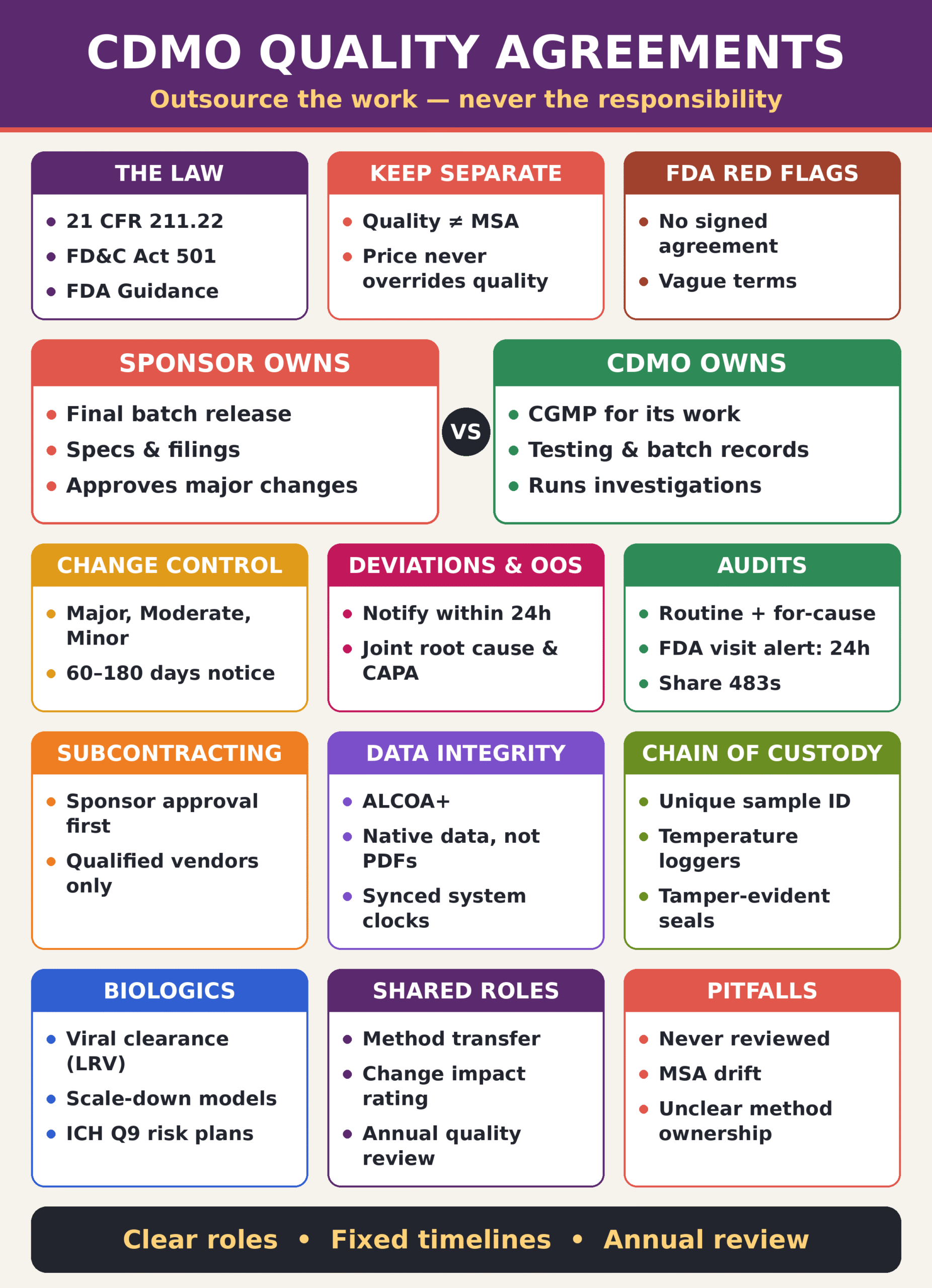
- Legal basis and sponsor accountability: Under 21 CFR 211.22, Section 501 of the FD&C Act, and FDA guidance, the sponsor keeps non-delegable authority over final batch release. The CDMO stays responsible for CGMP compliance in the work it performs.
- Separate from commercial contracts: The quality agreement should stand apart from the Master Services Agreement, so that pricing, volume, or liability terms can never override quality requirements. FDA reviews these agreements during inspections.
- Common FDA findings: Enforcement problems usually come from either having no written agreement at all or using vague wording like “as appropriate” or “promptly.” Clear, time-bound commitments are expected instead.
- Essential clauses: A strong agreement covers:
- scope and sponsor-approved subcontracting;
- tiered change control with 60–180 days’ notice for major changes;
- 24-hour notification for major deviations, OOS results, and regulatory inspections;
- routine and for-cause audit rights;
- a detailed matrix assigning responsibilities to the sponsor, the CDMO, or both.
- Advanced oversight: Modern agreements should require:
- ALCOA+ data integrity;
- sponsor access to native electronic data, not just PDFs;
- synchronized system clocks;
- strict sample chain-of-custody controls.
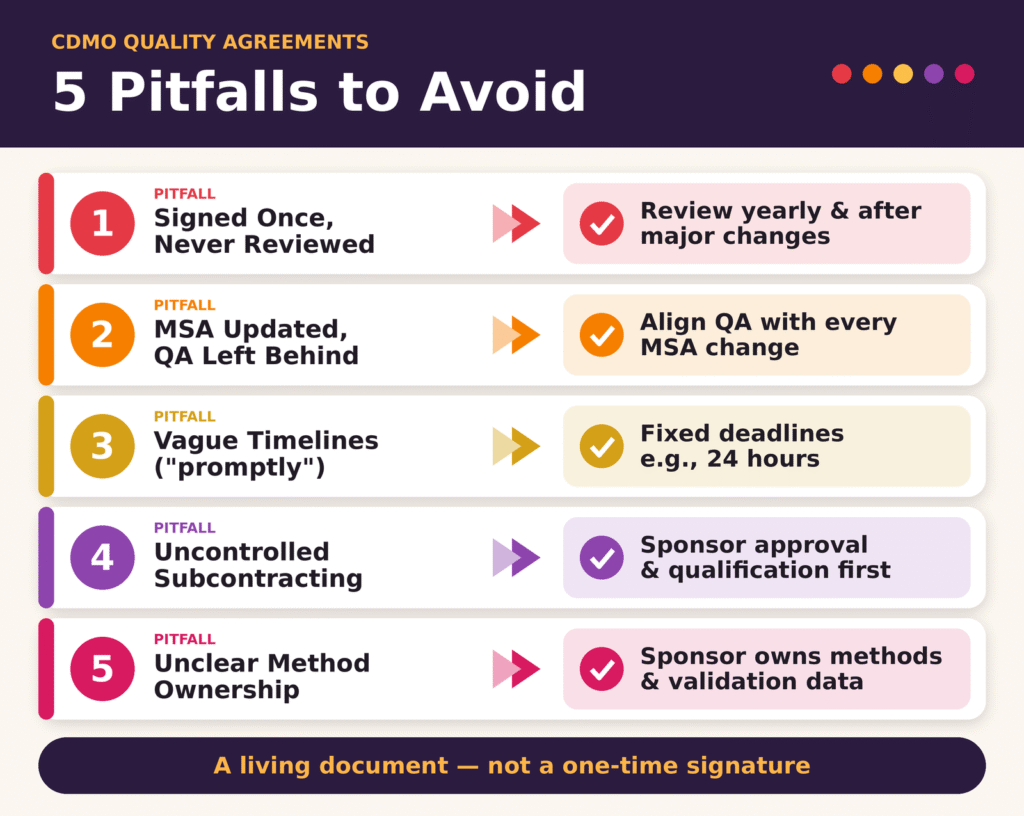
- Pitfalls to avoid: Agreements fail when they are treated as one-time paperwork. Typical failures are never reviewing the agreement, letting it drift out of line with the MSA, leaving subcontractors uncontrolled, and leaving ownership of methods and tech transfer unclear. Annual reviews and precise timelines keep the partnership compliant and protect patient safety.
Regulatory Requirements for CDMO Quality Agreements Under FDA Guidance
FDA guidance requires CDMO Quality Agreements to clearly identify and document the CGMP-related responsibilities, activities, and manufacturing decisions assigned to every party participating in drug production. Under this regulatory framework, operational activities may be outsourced, but the drug sponsor, referred to as the “owner,” continues to hold legal responsibility for approving or rejecting manufactured products, components, and analytical results.
Statutory Basis and Sponsor Responsibilities
The statutory basis for quality agreements is established under Section 501(a)(2)(B) of the Federal Food, Drug, and Cosmetic Act (FD&C Act) and 21 CFR Part 211. According to 21 CFR 211.22(a), the sponsor’s Quality Unit is legally responsible for approving or rejecting raw materials, in-process intermediates, packaging, labeling, and finished drug products.
FDA guidance establishes several important structural and legal expectations for these arrangements:
- Non-Delegable Legal Authority: A sponsor cannot transfer its statutory responsibility for final batch release or CGMP compliance to a contract facility through either a quality agreement or a commercial contract.
- Contract Facility CGMP Obligations: Contract facilities have independent CGMP responsibilities for approving or rejecting the immediate results generated by their operational activities, including in-process testing, environmental monitoring, and intermediate manufacturing steps.
- Document Severability: FDA strongly recommends that quality agreements be maintained as standalone documents or remain strictly severable from commercial supply agreements such as Master Services Agreements (MSAs). Commercial provisions addressing pricing, delivery schedules, or liability caps must not weaken, supersede, or conflict with quality requirements.
- Regulatory Inspection Transparency: FDA investigators routinely review quality agreements during facility inspections to determine whether actual operational practices correspond with documented procedures in accordance with 21 CFR 211.22(d).
Document Structure: Commercial Contract vs. Quality Agreement
Maintaining a distinct structural separation between commercial supply contracts and technical quality agreements is essential for preventing commercial considerations from influencing or compromising quality-related decisions.
| Operational Domain | Master Services Agreement (MSA) / Commercial Contract | CDMO Quality Agreement |
|---|---|---|
| Primary Oversight Team | Legal, Corporate Development, and Procurement Units | Quality Assurance and Regulatory Compliance Units |
| Core Scope | Commercial pricing, payment milestones, volume commitments, and delivery schedules | CGMP role allocations, technical specifications, and regulatory compliance standards |
| Risk & Liability Management | Liability caps, commercial indemnification, intellectual property rights, and breach remedies | Deviation escalation, Out-of-Specification (OOS) workflows, and root cause investigations |
| Change Oversight | Business term amendments, volume adjustments, and termination protocols | Major/minor technical change control classifications and regulatory filing notifications |
| Regulatory Standing | Commercial contract enforceable in court; not evaluated for CGMP compliance | Formally audited by FDA inspectors during CGMP compliance evaluations |
For projects involving abbreviated new drug applications, review the role of structured CMC documentation in supporting regulatory submissions: Explore CMC Documentation at a CDMO for ANDA
FDA Enforcement Trends: Absence vs. Vagueness
Reviews of FDA inspection findings and Warning Letters identify two major categories of compliance failures associated with CDMO Quality Agreements: the absence of a written agreement and inadequate operational specificity.
- Pattern 1: Absence of Written Agreements: Performing CGMP manufacturing or analytical testing without a signed quality agreement in place can constitute a failure of the quality oversight system under 21 CFR 211.22. FDA inspectors may regard the absence of an agreement as evidence of a systemic quality oversight deficiency, and such observations can contribute to further regulatory enforcement, including Warning Letters.
- Pattern 2: Operational Vagueness: A frequently encountered inspection concern arises when an agreement exists but contains imprecise expressions such as “as mutually agreed,” “as appropriate,” or “according to standard timelines.” Unclear requirements concerning batch record review, deviation notification periods, or OOS investigations can prevent timely and consistent execution. Such ambiguity may leave both parties inadequately prepared to manage critical quality events and demonstrate compliance.
Essential Sections and Clauses Sponsors Must Include in CDMO Quality Agreements
Comprehensive CDMO Quality Agreements should contain clearly defined provisions addressing scope, lifecycle stage, quality unit workflows, change control classifications, deviation escalation, analytical testing, and regulatory audit rights. Establishing detailed responsibility matrices minimizes operational uncertainty and helps demonstrate that both quality units are fulfilling applicable international regulatory expectations, including FDA, EMA, and ICH Q10 guidelines.
Critical Operational Clauses
- Scope and Subcontracting Oversight: The agreement should clearly identify the facility locations, drug products, and specific manufacturing or testing activities covered by the arrangement. It should expressly prohibit the CDMO from subcontracting manufacturing, testing, or storage activities to third parties unless prior written approval has been obtained from the sponsor and the applicable third party has undergone formal qualification.
- Change Control Protocols: Change control is a fundamental component of a quality agreement. Proposed changes should be categorized as Major, requiring sponsor QA approval and potentially regulatory filing updates before implementation, Moderate, or Minor, which may be reportable through annual reviews. Advance notification periods for major operational or facility modifications commonly range from 60 to 180 days, depending on the nature and impact of the proposed change.
- Deviation and OOS Handling: Documented procedures should establish defined and rapid escalation requirements. CDMOs should be required to notify the sponsor within 24 hours after initiating an investigation associated with a major deviation, unexpected batch failure, or OOS analytical result. The agreement should also establish joint review rights for investigation plans, root-cause analyses, and Corrective and Preventive Action (CAPA) implementation.
- Audit Rights and Inspection Sharing: Sponsors should obtain both scheduled routine quality audit rights and unannounced “for-cause” audit rights. In addition, the agreement should require the CDMO to notify the sponsor within 24 hours of any regulatory agency inspection, such as an FDA Form 482 issuance, that affects the sponsor’s product. The CDMO should also provide copies of applicable regulatory observations, including Form FDA 483s and Warning Letters, together with proposed response documents for sponsor review before submission to the agency.
Need support with impurity assessment and control during pharmaceutical development? Explore Impurity Control Strategies Under ICH Q3A.
Comprehensive CGMP Responsibility Allocation Matrix
The following matrix presents a standard regulatory-aligned framework for allocating responsibilities between drug sponsors and CDMOs across major pharmaceutical manufacturing activities:
| CGMP Domain / Operational Task | Sponsor Responsibility | CDMO Responsibility | Shared / Collaborative Role |
|---|---|---|---|
| Product Specifications & Regulatory Submissions | Establishes and approves overall drug product, raw material, and analytical specifications; files IND/NDA/BLA documentation. | Reviews specifications for facility compatibility and strictly follows approved parameters during execution. | Jointly verifies method transfer feasibility and scale-up parameters. |
| Vendor & Component Qualification | Approves master raw material and primary packaging supplier lists. | Conducts sampling, receiving testing, physical quarantine, and inventory control of components. | Defines component testing criteria and vendor audit schedules. |
| Master Batch Record (MBR) Approval | Reviews and approves MBRs and significant operational batch changes. | Authors, validates, and maintains Executed Batch Records (EBRs) and standard operating procedures. | Ensures alignment between regulatory filings and executed plant records. |
| In-Process & Release Testing | Reviews certified testing summaries and conducts confirmatory characterization where applicable. | Performs in-process controls, finished product testing, and method execution under CGMP. | Aligns analytical reference standards and method validation protocols. |
| Deviation & OOS Investigation | Reviews and approves major deviation reports, root cause analyses, and proposed CAPAs. | Initiates immediate investigations, executes root cause analysis, and provides written reports within defined windows. | Conducts joint technical reviews for critical non-conformances. |
| Final Batch Disposition & Release | Retains sole, non-delegable authority for final commercial lot release to market. | Approves operational disposition, including release of intermediate stages within the CDMO facility. | Exchanges fully signed batch record packages and Certificates of Analysis (CoA). |
| Change Control Approval | Reviews and approves all major/moderate facility, process, or equipment changes. | Proposes operational changes and implements minor changes according to agreed QMS procedures. | Categorizes change impact level and determines regulatory filing requirements. |
| Stability Testing & Chain of Custody | Establishes stability protocols and evaluates trend data for expiration/retest dating. | Stores stability samples in qualified chambers and executes pull schedules and testing. | Audits temperature logs, chamber telemetry, and sample chain of custody records. |
| Annual Product Quality Review (APQR) | Compiles and maintains master APQR/PQR reports across all manufacturing sites. | Provides site-specific operational, analytical, trending, and deviation data annually. | Reviews multi-batch performance trends to support continuous improvement. |
Advanced Quality Oversight: Data Integrity, Chain of Custody, and Technical Transfer in CDMO Quality Agreements
Advanced CDMO Quality Agreements should incorporate explicit requirements for data integrity, synchronized audit trail management, and rigorous sample chain of custody controls to meet the expectations of global health authorities. Modern pharmaceutical manufacturing operations and sophisticated analytical testing programs generate substantial quantities of electronic data. Without contractual provisions governing access to native files and electronic data management, sponsors may face significant compliance vulnerabilities under 21 CFR Part 11 and EU Annex 11 regulations.
Data Integrity Protocols and Electronic Governance
Data generated by a contract facility must remain attributable, legible, contemporaneously recorded, original, and accurate in accordance with established ALCOA+ principles. Quality agreements should establish precise electronic data management responsibilities to prevent unauthorized data modifications, inappropriate data manipulation, or analytical aborts that have not been properly investigated.
The agreement should guarantee the sponsor unrestricted access to original native electronic data files, including Chromatography Data System (CDS) sequences, Laboratory Information Management System (LIMS) audit records, and raw spectral files, rather than limiting access to static PDF summaries. The quality agreement should additionally require CDMO Quality Assurance to perform second-person reviews of electronic audit trails associated with critical processing and testing activities before results are certified. To minimize temporal inconsistencies during investigations of failures or discrepancies, quality agreements should require synchronization of instrument controllers, analytical workstations, and environmental monitoring systems through an enterprise Network Time Protocol (NTP). A time drift greater than 30 seconds should generate a quality alert, while drift exceeding 60 seconds should initiate a formal investigation.
For peptide programs requiring specialized analytical characterization and testing, explore Peptide Analytical Testing Services.
Chain of Custody and Sample Controls
Maintaining physical sample integrity during handling, stability pulls, and transportation between sites requires explicit contractual controls. Breaks in sample custody or uncontrolled temperature excursions can compromise analytical data and potentially affect the reliability of regulatory submissions.
Quality agreements should require every sample to be associated with a persistent Study–Lot–Condition–TimePoint (SLCT) identifier generated within LIMS. This identifier should remain consistent across physical sample labels, shipping manifests, and instrument sequence headers. Physical controls should include scan-to-open interlocks for environmental storage chambers and tamper-evident secondary packaging. When samples are transported between facilities, the agreement should specify calibrated temperature loggers positioned according to worst-case locations within qualified shipping containers, with synchronized logger files directly attached to the corresponding receipt records.
Learn more about managing packaging-related risks for peptide injectable products through Extractables and Leachables Testing for Peptide Injectables.
Biologic and Advanced Modality Oversight
The outsourcing of complex biopharmaceutical products, monoclonal antibodies (mAbs), or cell and gene therapies requires specialized technical provisions within the quality agreement. Biological manufacturing processes inherently demonstrate variability, making it necessary for oversight provisions to address technical requirements specific to advanced therapeutic modalities.
For biologic products, quality agreements should establish expectations for scale-down model validation, viral clearance challenge studies, and Log Reduction Value (LRV) determinations. Scale-down models used during viral validation studies should accurately reproduce relevant full-scale bioreactor flow rates, column heights, and pressure limits to support regulatory validity. Furthermore, consistent with ICH Q9 principles, quality agreements governing advanced modalities should incorporate Quality Risk Management (QRM) framework requirements. The contract should require the CDMO to maintain proactive risk mitigation plans, backup processing equipment strategies, and strategic raw material reserves designed to reduce operational bottlenecks and help prevent drug shortages.
For projects requiring peptide API development and manufacturing under GMP conditions, explore GMP Peptide API Manufacturing Services.
Key Pitfalls in Drafting and Managing CDMO Quality Agreements
Drug sponsors and contract facilities regularly encounter regulatory and operational challenges when quality agreements are treated as static legal documents instead of functioning as active tools for operational governance. Identifying these recurring structural weaknesses enables quality teams to develop stronger oversight systems that can withstand regulatory review and inspection.
- Treating the Agreement as a Static Legal Formality: Signing a quality agreement during initial vendor onboarding and then failing to reassess it can create significant compliance deficiencies. Quality agreements should remain dynamic documents and include mandatory annual review requirements or defined review triggers associated with material facility, process, or operational changes.
- Commercial MSA Drift: Modifying business terms, production volumes, or facility locations within a Master Services Agreement without making corresponding updates to the quality agreement can result in document divergence. Such inconsistencies may create conflicting operational requirements and can contribute to 21 CFR 211.22 observations during FDA inspections.
- Ambiguous Escalation Timelines: Dependence on subjective contractual expressions such as “promptly notify” or “notify as appropriate” can cause delays when critical deviations or OOS events occur. Quality agreements should establish specific calendar-day or hour-based notification requirements, such as written notification within 24 hours.
- Omission of Subcontractor Management: Failure to control third-party subcontracting can introduce poorly defined supply chain risks. Quality agreements should specifically require sponsor approval and formal qualification before external testing laboratories, calibration vendors, secondary packagers, or other subcontractors are engaged.
- Unclear Method Ownership and Tech Transfer Rights: Unclear provisions concerning ownership of analytical validation protocols, source code, or tech transfer packages can create significant obstacles if the CDMO relationship ends. The quality agreement should establish clear sponsor ownership of applicable validation data and methodology files to support continuity and future technical activities.
For development programs that depend on reference product evaluation and regulatory benchmarking, review Reference Listed Drug (RLD) Sourcing and Reverse Engineering.
Conclusion
CDMO Quality Agreements represent essential, legally binding frameworks that connect operational workflows between drug sponsors and contract manufacturers while supporting strict CGMP compliance. By defining explicit responsibility matrices, implementing comprehensive change control procedures, and maintaining robust data integrity oversight, biopharmaceutical companies can reduce operational ambiguity and address FDA regulatory expectations.
A carefully structured quality agreement can transform an outsourcing arrangement into a coordinated and compliant partnership capable of managing complex technical transfers, analytical validations, and commercial batch releases. Maintaining clear responsibilities, conducting regular document reviews, and establishing precise notification and action timelines enables both quality units to support product quality and patient safety throughout the product lifecycle.
For peptide development programs requiring manufacturing support from early synthesis through regulated production, explore Custom Peptide Synthesis Services.
For assistance with establishing regulatory-compliant quality agreements, developing analytical testing protocols, or managing complex technical transfers, contact the expert team through the ResolveMass Contact Page.
Frequently Asked Questions
FDA guidance recommends maintaining quality agreements separately from commercial documents such as MSAs or ensuring that the quality provisions are clearly severable. This separation prevents commercial matters, including pricing, liability provisions, and delivery commitments, from affecting quality-related decisions. It also preserves clear authority for CGMP oversight and batch release activities.
No. Under 21 CFR 211.22(a) and applicable FDA guidance, the sponsor’s Quality Unit retains the legal authority to approve or reject finished drug products. A CDMO may make quality decisions concerning the operations it performs, but ultimate responsibility for final commercial lot release remains with the drug sponsor.
Common compliance concerns include operating without a documented quality agreement and using agreements that lack sufficient operational detail. Problems may arise when responsibilities or notification periods are expressed using vague language such as “as appropriate.” Unclear requirements for deviations, change controls, and investigations can weaken effective quality oversight.
The required notification period depends on the classification and potential impact of the proposed change. Quality agreements commonly categorize changes as major, moderate, or minor, with major changes requiring greater advance notice. Depending on the change, notification periods may commonly fall within a 60- to 180-day range.
The quality agreement should establish clearly defined escalation and notification requirements for major deviations and OOS results. It should specify when the CDMO must provide written notification to the sponsor, such as within 24 hours of the applicable event. The agreement should also provide mechanisms for reviewing investigations, root-cause analyses, and CAPA activities.
Yes. Quality agreements should establish the sponsor’s rights to conduct quality audits of the contracted facility. These provisions can cover planned routine CGMP audits as well as “for-cause” audits initiated in response to significant quality concerns, non-conformances, or regulatory developments. Such rights support ongoing oversight of outsourced operations.
Requirements under 21 CFR Part 11 and EU Annex 11 make electronic data governance an important component of CDMO Quality Agreements. Agreements should define sponsor access to original electronic data, appropriate audit trail review, and controls for maintaining reliable records. They may also specify time synchronization requirements for instruments and computerized systems.
Quality agreements should undergo periodic review, commonly on an annual basis, and should also be reassessed when significant operational or regulatory changes occur. Updates may be necessary following changes to facilities, manufacturing processes, product specifications, commercial agreements, or applicable regulations. Regular reviews help prevent discrepancies between current operations and documented responsibilities.
Quality agreements for biologics, cell therapies, and gene therapies require provisions tailored to the technical and operational characteristics of these products. Relevant areas may include viral clearance validation, scale-down model validation, temperature-controlled handling, and Quality Risk Management (QRM). These controls help address process variability and support reliable manufacturing and supply continuity.
Reference:
- U.S. Food and Drug Administration. (2016). Contract manufacturing arrangements for drugs: Quality agreements: Guidance for industry. U.S. Department of Health and Human Services. FDA guidance document
- Kurata, H., Ishino, T., Ohshima, Y., & Yohda, M. (2022). CDMOs play a critical role in the biopharmaceutical ecosystem. Frontiers in Bioengineering and Biotechnology, 10, 841420. https://doi.org/10.3389/fbioe.2022.841420
- Sayeed-Desta, N., Pazhayattil, A., & Spes, J. (2017). Quality metrics and CMO agreement. Pharmaceutical Technology, 41(2), S40–S42. ResearchGate
- Wilhelm, M. E., Pire-Smerkanich, N., & Richmond, F. J. (2024). Standalone regulatory agreements for product-development collaborations in the medical products industry. Therapeutic Innovation & Regulatory Science, 58(5), 897–909. https://doi.org/10.1007/s43441-024-00646-1
Get In Touch With Us
About The Author


