

Introduction
Ion Mobility Mass Spectrometry enables the resolution of co-eluting isomeric peptide impurities by distinguishing gas-phase peptide ions according to differences in their orientation-averaged collision cross section (CCS) before mass-to-charge (m/z) analysis. This physical separation in the gas phase addresses a major analytical challenge in biopharmaceutical quality control, where isomeric species—including D-amino acid epimers, aspartic acid (Asp) to isoaspartic acid (isoAsp) conversions, and sequence inversions—can exhibit identical mass-to-charge ratios and may co-elute during liquid chromatography. Because these isomeric impurities have the potential to affect therapeutic efficacy, modify pharmacokinetic behavior, or trigger undesirable immunogenic responses, comprehensive analytical characterization is critical.
Regulatory frameworks, including ICH Q6A/Q6B and current FDA and EMA guidelines applicable to synthetic and recombinant peptide therapeutics, require comprehensive assessment of product-related impurities that exceed established threshold limits. ResolveMass Laboratories Inc. applies advanced analytical methodologies incorporating Ion Mobility Mass Spectrometry to support definitive structural elucidation and accurate quantitation of trace-level isomeric variants within complex biopharmaceutical matrices.
For a broader understanding of regulatory expectations surrounding peptide characterization, see our guide on regulatory requirements for GLP-1 peptide characterization.
Regulatory Requirements for GLP-1 Peptide Characterization
Share via:
Quick Summary:
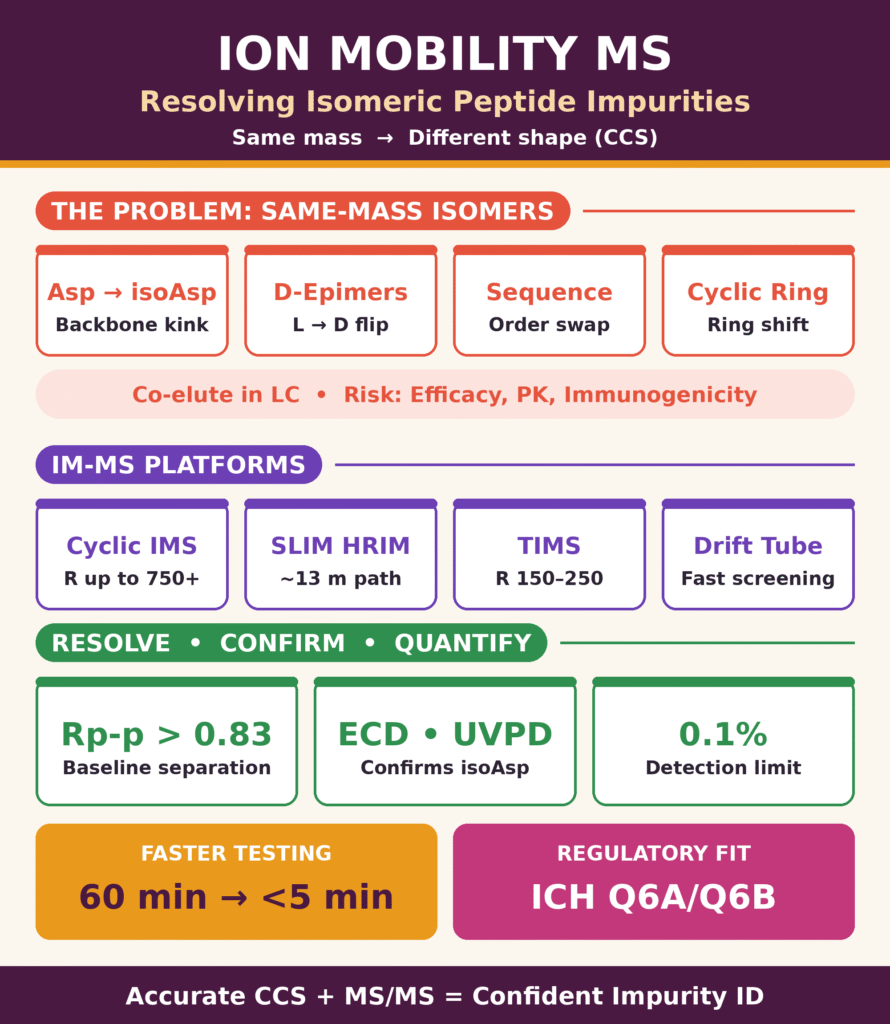
- Ion mobility separates same-mass isomers. Ion Mobility MS tells apart co-eluting peptide isomers by their gas-phase shape, measured as collision cross section (CCS), before m/z analysis. This solves a problem that standard LC-MS cannot.
- The isomers that matter are Asp/isoAsp variants (from Asn deamidation or Asp rearrangement through a succinimide intermediate), D-amino acid epimers (from racemization during SPPS), sequence positional isomers and cyclic ring isomers. All have identical mass but can affect efficacy, pharmacokinetics and immunogenicity.
- Regulators expect these impurities to be characterized. ICH Q6A/Q6B and FDA/EMA guidelines require thorough assessment of product-related impurities above threshold limits, which makes isomer characterization essential.
- Three main high-resolution platforms are used.
- Cyclic IMS uses multiple passes to reach resolving power above 750 and supports IMSⁿ for isolating and fragmenting individual conformers.
- SLIM-based HRIM uses a serpentine path of about 13 m for high-throughput monitoring of critical quality attributes.
- TIMS traps ions against a gas flow and gives accurate CCS values with high sensitivity.
- Asp/isoAsp resolution needs both separation and fragmentation. Peak separation is judged with the Rp-p equation, where a value above 0.83 means baseline separation. ECD and 193 nm UVPD then confirm and locate isoAsp more reliably than conventional CID.
- The approach is sensitive and fast. It can detect impurities down to 0.1% relative abundance across 3–4 orders of magnitude. Flow-injection or fast-gradient workflows cut analysis from about 60 minutes to under 5 minutes per sample, which supports batch release and in-line PAT monitoring.
- Bottom line: accurate CCS measurement combined with advanced MS/MS enables confident identification and quantitation of trace-level stereochemical and regiochemical impurities, in line with global regulatory expectations.
Isomeric Peptide Impurities in Synthetic and Recombinant Therapeutics
Isomeric peptide impurities are structural variants that may arise during synthesis, purification, handling, or storage. Although these species possess the same molecular weight as the intended peptide, they differ in stereochemical configuration, molecular connectivity, or structural arrangement. Such isobaric species can negatively affect the safety, quality, and efficacy of biopharmaceutical products while remaining difficult to resolve using conventional reverse-phase liquid chromatography (RPLC).
During solid-phase peptide synthesis (SPPS) and subsequent storage, peptides can undergo several chemical degradation pathways that contribute to isomeric heterogeneity. One important pathway involves the spontaneous deamidation of asparagine (Asn) or the rearrangement of aspartic acid (Asp) through a five-membered cyclic succinimide intermediate. Subsequent nucleophilic ring opening of this succinimide intermediate generates a mixture containing L-Asp and L-isoAsp, together with their racemized D-amino acid forms, including D-Asp and D-isoAsp. In isoaspartic acid, the side-chain β-carboxyl group becomes incorporated into the peptide backbone. This rearrangement effectively introduces a methylene (CH2) unit into the main chain and produces a structural kink that can substantially reduce or eliminate receptor binding affinity.
Racemization occurring during peptide synthesis can produce D-amino acid epimers that retain the same primary sequence connectivity but differ in the three-dimensional orientation of their side chains. Because D-epimers can exhibit increased resistance to proteolytic degradation, their formation may influence in vivo half-life and bioactivity profiles. Other forms of isomeric heterogeneity include sequence positional inversions, regioisomeric side-chain modifications, and variations in cyclic peptide ring closure.
For analytical approaches specifically addressing stereochemical differences in therapeutic peptide APIs, see our resource on chiral analysis of therapeutic peptide APIs Chiral Analysis of Therapeutic Peptide APIs
| Isomeric Impurity Class | Degradation / Synthesis Mechanism | Structural Modification | Impact on Analytical Separation |
|---|---|---|---|
| Aspartic / Isoaspartic Acid (Asp/isoAsp) | Deamidation of Asn or rearrangement of Asp via succinimide ring | Incorporation of β-carboxyl group into primary backbone | Identical m/z; subtle change in gas-phase packing (CCS) |
| D-Amino Acid Epimers | Racemization during SPPS coupling or thermal degradation | Inversion of stereocenters (L → D) at specific residues | Co-elution in non-chiral LC; distinct collisional cross section |
| Sequence Positional Isomers | Transpeptidation or incorrect residue addition order | Altered amino acid order along the primary sequence | Identical mass; requires gas-phase conformer differentiation |
| Cyclic Ring Positional Isomers | Regioisomeric cyclization or enzymatic soft-spot cleavage | Inverted or shifted ring-closure sites in macrocycles | Identical molecular weight; distinct 3D spatial envelope |
Ion Mobility Mass Spectrometry Architectures for Isomeric Resolution
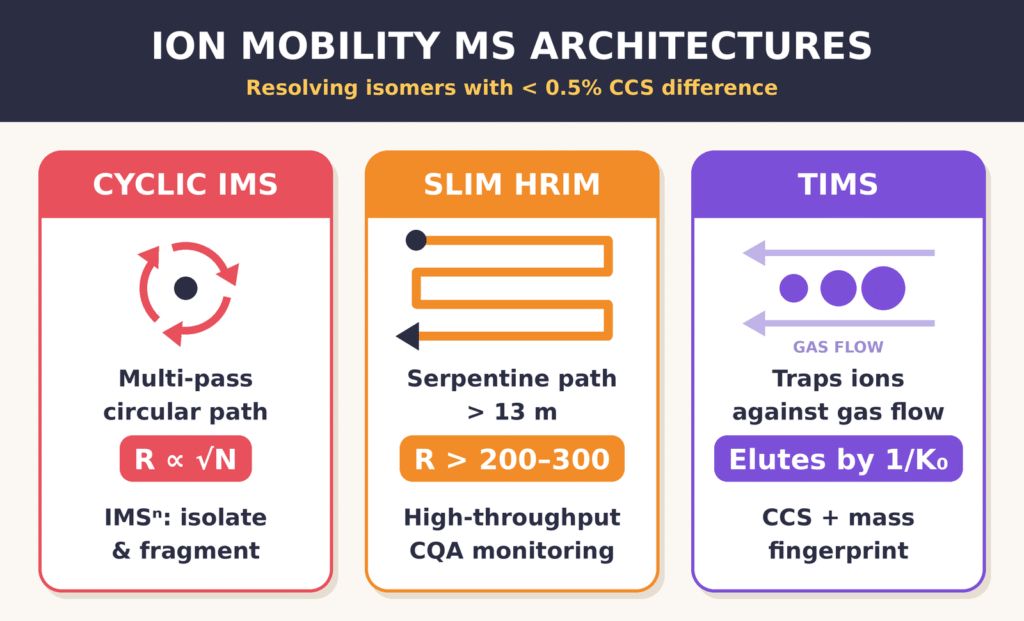
Advanced Ion Mobility Mass Spectrometry architectures provide an additional separation dimension for isomeric peptide impurities by transporting ions through neutral gas buffers or trapping ions against gas flows to distinguish subtle differences in collision cross section (CCS). Modern instrument configurations can achieve resolving powers (R > 200–750) that are sufficient to differentiate spatial conformers with collision cross sections differing by less than 0.5%.
Cyclic Ion Mobility Mass Spectrometry
Cyclic Ion Mobility Mass Spectrometry employs a circular, multi-pass ion path that dynamically increases the effective drift distance and thereby improves mobility resolution. The mobility resolving power scales approximately according to R ∝ √N, where N represents the number of passes through the mobility path. By directing selected ion populations through the cyclic separation region multiple times, the system can progressively increase analytical resolution and distinguish closely migrating isomeric ion populations.
For complementary analytical strategies used to characterize cyclic peptide structures and confirm ring-related structural features, see our resource on cyclic peptide characterization. Cyclic Peptide Characterization
Instruments such as the SELECT SERIES Cyclic IMS incorporate multifunctional collision cells positioned before and after the mobility circuit. This configuration supports multiple stages of ion mobility separation and activation (IMSn), allowing individual isomeric conformers to be isolated and subsequently fragmented for structural characterization.
High-Resolution Ion Mobility Mass Spectrometry via SLIM Platforms
High-Resolution Ion Mobility Mass Spectrometry based on Structures for Lossless Ion Manipulation (SLIM) technology transports ions through extended serpentine drift pathways that can exceed 13 meters in effective path length. This configuration provides high resolving power (R > 200–300) while minimizing ion transmission losses. SLIM-based architectures can provide high-resolution separation of challenging biotherapeutic impurities, including Asp/isoAsp variants and D-amino acid epimers.
Platforms such as the MOBILion MOBIE combine SLIM high-resolution ion mobility with high-resolution mass spectrometry to support high-throughput monitoring of critical quality attributes (CQA). This approach can improve the characterization of structurally similar impurities without relying on excessively long chromatographic separation methods.
To understand how multiple analytical attributes can be monitored together for comprehensive peptide characterization, see our resource on multi-attribute monitoring (MAM) for peptide characterization. Multi-Attribute Monitoring (MAM) for Peptide Characterization
Trapped Ion Mobility Mass Spectrometry
Trapped Ion Mobility Mass Spectrometry confines ions within an electrodynamic field gradient while a continuous neutral gas flow moves in the opposing direction. Ions are sequentially released according to their reduced mobility (1/K0). Precise control over the voltage ramp rate in TIMS enables targeted, high-resolution measurements across selected m/z ranges, providing both high resolving power (R > 200) and sensitivity for low-abundance isomeric impurities.
TIMS platforms can simultaneously provide accurate Collision Cross Section (CCS) measurements and mass spectral information. The resulting combination of mobility and mass information generates a robust structural fingerprint that can be particularly valuable for characterizing complex biotherapeutic molecules and their closely related variants.
For broader analytical strategies covering complementary techniques for peptide identity, structure, purity, and other physicochemical attributes, see our peptide physicochemical characterization services. Peptide Physicochemical Characterization Services
Analytical Methodologies for Resolving Aspartic and Isoaspartic Acid Isomers
The resolution of aspartic and isoaspartic acid isomeric peptides requires the detection of very small gas-phase spatial differences in CCSN2, complemented by diagnostic tandem mass spectrometry fragmentation. Conversion of L-Asp to L-isoAsp introduces a methylene unit into the peptide backbone, resulting in a change in backbone geometry and, consequently, a measurable difference in gas-phase packing efficiency.
The separation of isomeric peaks in ion mobility spectrometry can be evaluated using the peak-to-peak resolution equation (Rp-p):
Rp-p = 1.18 × (|CCSapex1 − CCSapex2| / (FWHM1 + FWHM2))
where CCSapex1 and CCSapex2 denote the centroid collision cross section values of the two isomeric species, while FWHM1 and FWHM2 represent the full width at half maximum intensity of their respective arrival time distributions. Values of Rp-p > 0.83 correspond to complete baseline separation, representing greater than 50% valley resolution. Values between 0.61 and 0.83 indicate partial separation of the isomeric species.
Following gas-phase separation, complementary fragmentation techniques are used to confirm the identity and structural assignment of the separated isomers. Conventional Collision-Induced Dissociation (CID) may sometimes promote gas-phase rearrangement or generate fragment ions that are insufficiently diagnostic for distinguishing closely related isomers. Alternative fragmentation strategies, including Electron Capture Dissociation (ECD) and 193 nm Ultraviolet Photodissociation (UVPD), can provide backbone cleavage while maintaining important structural features associated with the modification.
For more information on LC-MS/MS-based sequence determination and structural characterization of therapeutic GLP-1 peptides, see our complete guide to peptide sequencing of GLP-1 peptides Peptide Sequencing of GLP-1 Peptide
UVPD of deprotonated [M − H]− ions can generate characteristic diagnostic fragment ions and neutral-loss patterns, including H2O, CO2, and NH3 losses from b and y ions. These fragmentation characteristics can support confirmation and localization of isoAsp without the need for lengthy enzymatic digestion protocols.
For orthogonal structural characterization that can complement mass spectrometric analysis, see our resource on 2D NMR for peptide characterization 2D NMR for Peptide Characterization
Quantitative Impurity Profiling and Critical Quality Attribute Monitoring
Quantitative profiling of isomeric peptide impurities using Ion Mobility Mass Spectrometry can achieve limits of detection as low as 0.1% relative abundance across linear dynamic ranges extending beyond three to four orders of magnitude. Integrating ion mobility separation with mass spectrometry introduces an additional separation dimension and increases multidimensional peak capacity. This enhanced separation can reduce chemical background and improve the accuracy of peak integration for low-level impurities.
For additional information on analytical strategies used to monitor peptide degradation pathways and stability-related changes, see our resource on GLP-1 peptide stability and analytical methods GLP-1 Peptide Stability and Analytical Methods
High-throughput screening workflows can incorporate flow injection analysis coupled with high-resolution ion mobility (FIA-HRIM-MS) or accelerated liquid chromatography gradients. These approaches can reduce analytical duty cycles from approximately 60 minutes to less than 5 minutes per sample, supporting rapid batch release testing as well as in-line process analytical technology (PAT) monitoring.
| IM-MS Architecture | Path Length / Separation Mode | Resolving Power (R=Ω/ΔΩ) | Isomeric Application Focus | Typical Quantitation Threshold |
|---|---|---|---|---|
| Cyclic IMS (cIMS) | Circular multipass path (N passes) | R > 100–750+ | Multi-pass resolution of D-amino acid epimers and GLP-1 impurities | Down to 0.1% relative abundance |
| SLIM High-Resolution IM (HRIM) | Extended planar serpentine (~13 m) | R ≈ 200–300+ | High-throughput Asp/isoAsp mapping and CQA monitoring | Down to 0.1% relative impurity content |
| Trapped Ion Mobility (TIMS) | Dynamic gas-flow trapping potential | R ≈ 150–250+ | Single-cell/micro-scale epimer characterization & CCS libraries | Sub-percent detection in complex digests |
| Drift Tube IMS (DTIMS + HRdm) | Linear uniform field + demultiplexing | R ≈ 60–150+ | Rapid screening of deamidation & Asp/isoAsp variants | 0.5%–1.0% relative abundance |
Conclusion
Ion Mobility Mass Spectrometry provides an important multidimensional separation capability for the identification, differentiation, and quantification of co-eluting isomeric peptide impurities encountered during therapeutic development. Through accurate collision cross section (CCS) measurements combined with advanced gas-phase dissociation techniques, biopharmaceutical developers can more effectively characterize stereochemical and regiochemical impurities and support compliance with global regulatory expectations.
Advanced architectures, including cyclic IMS, SLIM-based HRIM, and TIMS, provide the resolving power (R) and quantitative sensitivity required for detecting trace-level impurities at relative abundances as low as 0.1%. These capabilities support comprehensive impurity characterization in alignment with regulatory expectations under ICH Q6A/Q6B and relevant FDA directives.
For a structured overview of the analytical information and documentation that can be included in a comprehensive peptide characterization package, see our peptide characterization CRO deliverables checklist Peptide Characterization CRO Deliverables Checklist
ResolveMass Laboratories Inc. provides specialized analytical testing methodologies, high-resolution analytical platforms, and expert characterization services to support biotherapeutic purity, structural integrity, and regulatory compliance. For customized testing protocols, assay development, or biotherapeutic analytical inquiries, contact the scientific experts at ResolveMass Laboratories Inc. through the contact page.
Frequently Asked Questions
The conversion of aspartic acid (Asp) to isoaspartic acid (isoAsp) changes the connectivity of the peptide backbone by incorporating the side-chain carboxyl group into the main chain. This rearrangement introduces a methylene group into the backbone and modifies the peptide’s three-dimensional structure. The resulting conformational difference can produce measurable changes in collision cross section (CCS<sub>N2</sub>), allowing high-resolution ion mobility systems to distinguish Asp and isoAsp variants.
High-resolution Ion Mobility Mass Spectrometry can differentiate peptide epimers containing D-amino acids without requiring chiral reagents or chemical derivatization. Conversion of a residue from the L to D configuration changes its stereochemical arrangement and can influence the peptide’s overall gas-phase conformation. These structural differences may generate distinct collision cross sections and mobility profiles, providing an additional approach for characterizing epimeric impurities.
Collision Cross Section (CCS) describes the effective gas-phase cross-sectional area occupied by an ion as it moves through a buffer gas. It is commonly expressed in square Angstroms (Ų) and can provide a reproducible structural descriptor when experimental conditions are controlled. Comparing measured CCS values with characterized reference materials or established databases can support peptide identification, conformational assessment, and differentiation of closely related isomeric species.
The resolving power required depends on the structural similarity and mobility difference between the peptide isomers being investigated. Resolving powers above approximately 100–200 can provide improved separation of closely related species, while particularly challenging epimers or conformational variants may require resolving powers above 300. Advanced platforms such as cyclic IMS and SLIM-based HRIM can provide substantially higher mobility resolution than conventional drift tube systems.
Combining liquid chromatography with Ion Mobility Mass Spectrometry adds complementary separation dimensions to peptide analysis. LC separates components according to solution-phase properties such as hydrophobicity, while ion mobility differentiates ions according to their gas-phase characteristics and CCS, followed by mass spectrometry separation according to m/z. This multidimensional workflow increases effective peak capacity and can improve detection of impurities that overlap during conventional chromatographic analysis.
Electron Capture Dissociation (ECD), Electron Transfer Dissociation (ETD), and 193 nm Ultraviolet Photodissociation (UVPD) can provide valuable complementary information following ion mobility separation. These techniques can generate structurally informative backbone fragments that help distinguish closely related peptide variants. When combined with mobility data, the resulting fragmentation patterns can support localization of modifications such as Asp/isoAsp conversion or D-amino acid substitutions.
High-resolution ion mobility can be applied to the characterization of cyclic peptide ring positional isomers when changes in ring closure produce measurable differences in gas-phase conformation. Although these isomers can have identical molecular compositions and masses, relocating the cyclization site can alter their three-dimensional structural arrangement. These conformational differences may result in distinct mobility behavior, enabling differentiation when the instrument provides sufficient resolving power.
SLIM-based high-resolution ion mobility uses Structures for Lossless Ion Manipulation to guide ions through extended, serpentine pathways that can provide substantially longer separation distances than conventional drift tubes. Traditional Drift Tube Ion Mobility Spectrometry (DTIMS) generally uses a linear drift region, whereas SLIM architectures use extended ion-routing paths to increase separation efficiency. The longer effective path can significantly improve resolving power and enable more detailed characterization of closely related peptide conformers.
ICH Q6A and ICH Q6B provide important quality frameworks for impurity characterization in chemical and biotechnological products, respectively. FDA and EMA expectations for peptide therapeutics also emphasize appropriate identification, characterization, and control of product-related impurities and degradation products. Depending on the product and applicable regulatory requirements, stereoisomers, deamidation products, and other relevant variants may therefore require appropriate identification and quantitative monitoring against established acceptance or reporting criteria.
Reference:
- Morris, C. B., Poland, J. C., May, J. C., & McLean, J. A. (2020). Fundamentals of ion mobility-mass spectrometry for the analysis of biomolecules. Methods in Molecular Biology, 2084, 1–31. https://doi.org/10.1007/978-1-0716-0030-6_1
- Butler, K. E., Dodds, J. N., Flick, T., Campuzano, I. D. G., & Baker, E. S. (2022). High-resolution demultiplexing (HRdm) ion mobility spectrometry–mass spectrometry for aspartic and isoaspartic acid determination and screening. Analytical Chemistry, 94(16), 6191–6199. https://doi.org/10.1021/acs.analchem.1c05533
- Kartowikromo, K. Y., Olajide, O. E., & Hamid, A. M. (2023). Collision cross section (CCS) measurement and prediction methods in omics. Journal of Mass Spectrometry, 58(9), e4973. https://doi.org/10.1002/jms.4973
Get In Touch With Us
About The Author


