

Introduction
CDMO services for Lipid Nanoparticle (LNP) Formulation and Characterization offer specialized contract development, scalable microfluidic manufacturing, and orthogonal analytical testing to transform novel genetic payloads into clinically viable drug products. Through the establishment of rigorous Quality by Design (QbD) parameters, CDMOs help biopharmaceutical sponsors address the technical challenges associated with non-viral vector development while maintaining compliance with global regulatory frameworks.
The rapid advancement of genetic medicines—including messenger RNA (mRNA), small interfering RNA (siRNA), circular RNA (circRNA), and gene-editing complexes—has created a need for delivery vehicles that can protect fragile nucleic acid payloads against enzymatic degradation while enabling efficient intracellular delivery. Lipid nanoparticles have become the leading non-viral vector technology because of their clinical versatility, tuneable bio-distribution, and effective endosomal escape capabilities. However, LNPs are complex, multi-component colloidal systems consisting of ionizable lipids, helper phospholipids, structural sterols, and PEGylated lipids, meaning that minor variations in raw materials or processing conditions can significantly affect particle performance. Experienced CDMOs address these challenges through advanced process development, stringent critical quality attribute (CQA) control, scalable unit operations, and validated analytical methodologies. ResolveMass Laboratories Inc. provides advanced analytical testing and process support, helping pharmaceutical sponsors achieve regulatory readiness, reduce scale-up risks, and meet international quality standards.
Explore specialized CDMO development and analytical support for complex pharmaceutical programs.
Share via:
Quick Summary:
- Why LNPs matter: Lipid nanoparticles are the leading non-viral way to deliver fragile genetic payloads such as mRNA, siRNA, circRNA and gene-editing complexes. They protect the cargo from degradation and help it escape into cells.
- Complexity is the challenge: Each LNP combines four lipids: an ionizable lipid, a helper phospholipid, cholesterol and a PEG-lipid. Small changes in raw materials or processing can noticeably shift particle performance, which is why experienced CDMO support matters.
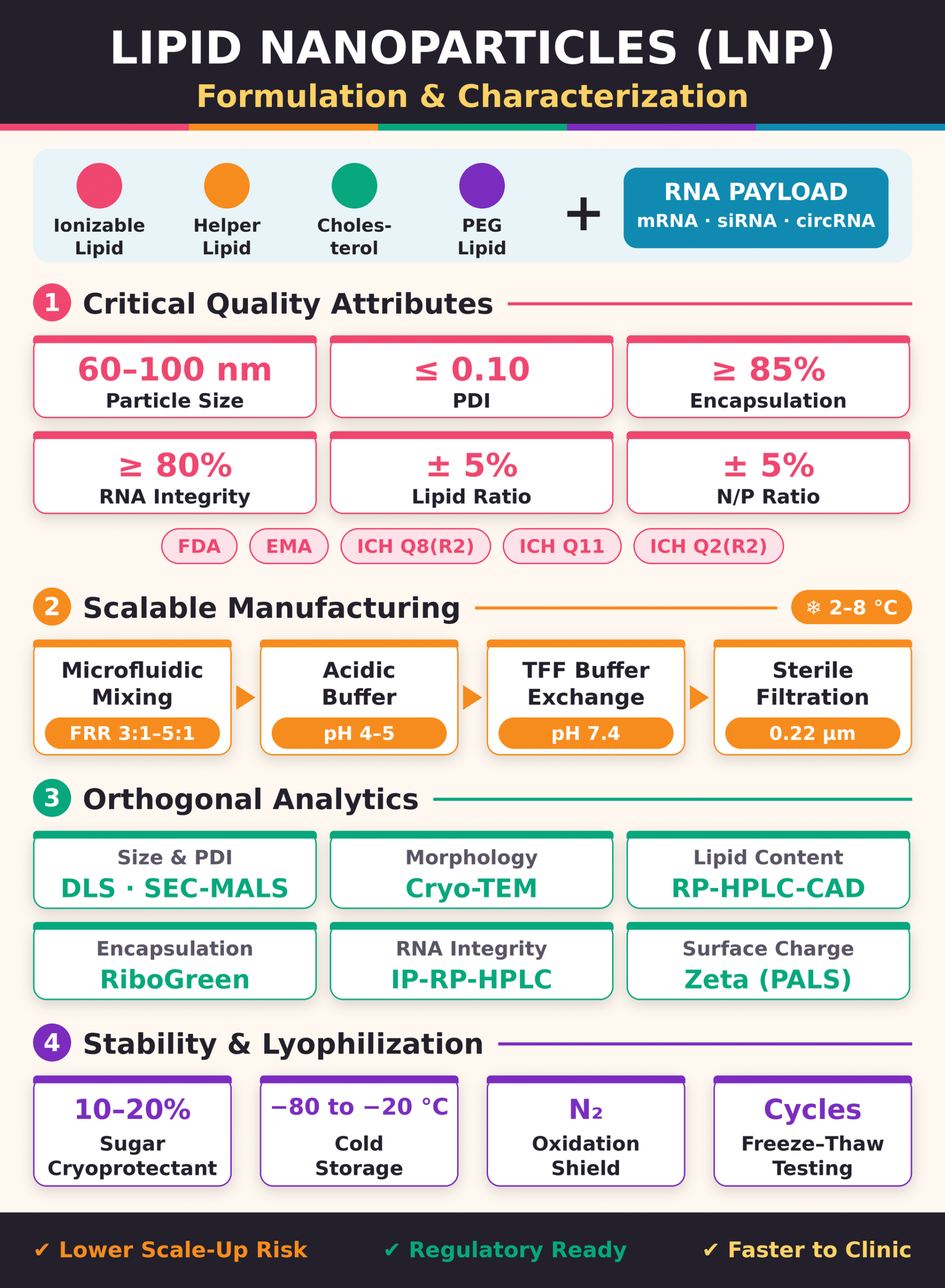
- Critical Quality Attributes (CQAs): FDA, EMA and ICH Q8(R2)/Q11 expect defined limits on key attributes. Typical targets are 60–100 nm size, PDI ≤ 0.10, encapsulation efficiency ≥ 85%, RNA integrity ≥ 80%, lipid ratios and N/P ratio within ±5%, and a dense core morphology.
- Scalable manufacturing: LNPs are formed by microfluidic mixing at controlled flow rates, with an aqueous-to-organic ratio of 3:1–5:1 and an acidic buffer at pH 4–5. Tangential flow filtration then exchanges the buffer to pH 7.4, and 0.22 µm sterile filtration follows, all at 2–8 °C.
- Orthogonal analytics: Complementary methods confirm each attribute, as ICH Q2(R2) expects:
- DLS and SEC-MALS for size
- Cryo-TEM for morphology
- RP-HPLC-CAD for lipid content
- RiboGreen for encapsulation
- IP-RP-HPLC for RNA integrity
- Zeta potential for surface charge
- Stability and lyophilization: Sugar cryoprotectants (sucrose or trehalose at 10–20%), storage at −80 to −20 °C, nitrogen headspacing and antioxidants protect against aggregation, leakage and degradation. Freeze-thaw stress testing defines safe cold-chain limits.
- Bottom line: Combining process engineering with advanced analytics reduces scale-up risk, supports regulatory compliance and speeds nucleic acid therapies to the clinic.
Critical Quality Attributes in Lipid Nanoparticle (LNP) Formulation and Characterization
Critical Quality Attributes (CQAs) for lipid nanoparticles encompass the physical, chemical, and biological properties that must be maintained within defined quantitative limits to ensure therapeutic efficacy, safety, and physical stability. Defining CQAs at an early stage of development supports formulation optimization, process scaling, and batch release criteria while maintaining compliance with applicable regulatory standards.
Learn more about integrated CDMO analytical services supporting characterization and quality requirements throughout drug development.
Regulatory Frameworks and Critical Quality Attributes Mapping
Regulatory oversight from the FDA and European Medicines Agency (EMA) requires nanomaterial-containing drug products to undergo comprehensive CQA definition based on the principles outlined in ICH Q8(R2) (Pharmaceutical Development) and ICH Q11 (Development and Manufacture of Drug Substances). The FDA Guidance on Drug Products Containing Nanomaterials specifically highlights that subtle changes in particle size distribution, surface charge, lipid degradation, or free payload ratios can directly influence systemic clearance, organ tropism, cellular uptake, and immunogenicity profiles.
To meet regulatory expectations, CDMOs develop comprehensive quality control strategies that establish direct relationships between raw material Critical Material Attributes (CMAs), manufacturing Critical Process Parameters (CPPs), and drug product CQAs. The principal CQAs for nucleic acid LNP formulations include particle diameter, polydispersity, surface charge, encapsulation efficiency, nitrogen-to-phosphate ratio, individual lipid content, mRNA payload integrity, and structural morphology.
| Critical Quality Attribute (CQA) | Target Specification | Impact on Biological Performance & Safety | Primary Analytical Method |
|---|---|---|---|
| Particle Size (Z-Average) | 60 – 100 nm (application dependent) | Determines hepatic clearance, tissue penetration, and cellular uptake kinetics. | Dynamic Light Scattering (DLS) / SEC-MALS |
| Polydispersity Index (PDI) | ≤ 0.10 (narrow monodisperse) | Reflects colloidal uniformity; elevated PDI indicates aggregation or batch heterogeneity. | Dynamic Light Scattering (DLS) |
| Encapsulation Efficiency (EE%) | ≥ 85% – 95% | Unencapsulated nucleic acid is rapidly degraded by serum nucleases and can induce reactogenicity. | RiboGreen Assay / IP-RP-HPLC |
| N/P Molar Ratio | Formulated stoichiometric ratio (± 5%) | Governs electrostatic payload complexation, core density, and transfection efficiency. | Assayed via Lipid RP-HPLC-CAD and Payload Quantitation |
| Lipid Content & Molar Ratios | ± 5% of target mol% for each lipid class | Controls nanoparticle assembly, endosomal escape, and particle stability. | Reversed-Phase HPLC with Charged Aerosol Detection (RP-HPLC-CAD) |
| RNA Payload Integrity | ≥ 80% full-length transcript | Abortive or degraded RNA species reduce therapeutic protein expression and can alter potency. | Denaturing IP-RP-HPLC / Capillary Gel Electrophoresis |
| Core Morphology | Electron-dense core structure | Confirms appropriate supramolecular self-assembly versus defective empty or blebbed vesicles. | Cryogenic Transmission Electron Microscopy (cryo-TEM) |
Process Development and Scalable Manufacturing Technologies for Lipid Nanoparticles
Scalable manufacturing of lipid nanoparticles depends on continuous microfluidic or impingement jet mixing to achieve controlled particle nucleation and reproducible core self-assembly under precisely managed hydrodynamic conditions. Optimization of Critical Process Parameters (CPPs), including flow rates and mixing ratios, directly influences nanoparticle size distribution, encapsulation efficiency, and batch-to-batch consistency.
Explore CDMO scale-up services designed to support reproducible manufacturing as development programs progress toward larger production volumes.
Critical Process Parameters in Continuous Flow Assembly
Lipid nanoparticle self-assembly takes place when an organic solvent phase containing the dissolved lipid mixture (ionizable lipid, helper lipid, cholesterol, PEG-lipid) rapidly combines with an acidic aqueous phase containing the anionic nucleic acid payload. The mixing kinetic rate must remain faster than the lipid self-assembly rate to promote uniform and monodisperse nanoparticle nucleation.
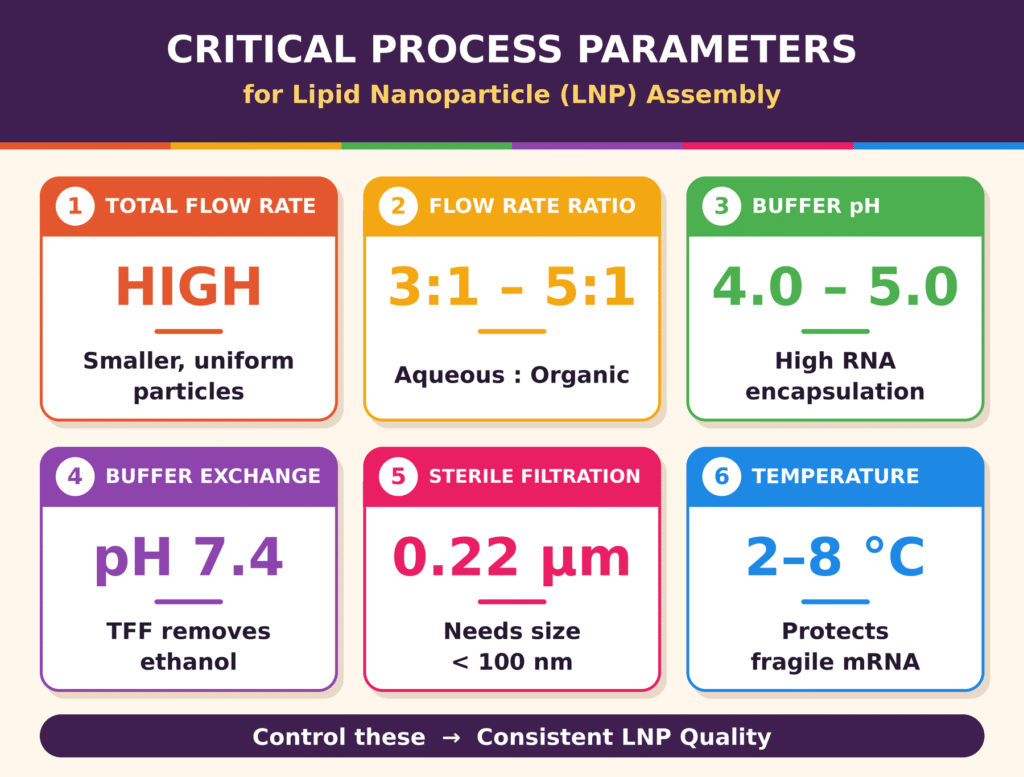
- Total Flow Rate (TFR) and Flow Rate Ratio (FRR): Operating at elevated total flow rates generates substantial fluidic mixing energy within microfluidic channels or T-junction geometries, which can reduce mean particle size and narrow the polydispersity index. The aqueous-to-organic flow rate ratio, generally maintained between 3:1 and 5:1, regulates organic solvent displacement and drives the transition from hydrophobic lipid droplets into structured core-shell nanoparticles.
- Buffer pH and Ionic Strength: Acidic aqueous buffers, typically citrate or acetate at pH 4.0–5.0, protonate the tertiary amine headgroups of the ionizable lipid. This produces positive electrostatic charges that interact efficiently with the negatively charged phosphate backbone of the nucleic acid, supporting high encapsulation efficiencies.
- Downstream Solvent Removal and Buffer Exchange: Tangential Flow Filtration (TFF), using ultrafiltration/diafiltration (UF/DF) cassettes, removes organic solvents such as ethanol and transfers the nanoparticle suspension into a physiological storage buffer at pH 7.4. This process neutralizes the ionizable lipid and eliminates net positive surface charge, thereby reducing toxicity before administration.
- Sterile Filtration and Thermal Management: Manufacturing operations are performed under controlled low-temperature conditions (2°C–8°C) to minimize thermal degradation of sensitive mRNA payloads. Sub-micron sterile filtration (0.22 µm) is conducted as the final processing step, requiring strict particle size control (<100 nm) to minimize filter fouling and membrane yield loss.
See how peptide API scale-up strategies address process development and manufacturing challenges during scale-up.
Orthogonal Analytical Protocols for Lipid Nanoparticle (LNP) Characterization
Orthogonal analytical protocols for lipid nanoparticle characterization integrate complementary physical, chemical, and structural testing techniques to independently verify particle size, payload integrity, lipid content, and morphology. This multi-dimensional analytical testing approach provides the comprehensive product characterization required for regulatory submissions under ICH Q2(R2) guidelines.
Explore advanced analytical characterization services for complex pharmaceutical products.
Physical and Morphological Characterization Workflows
Physical characterization evaluates the hydrodynamic radius, surface charge, and internal structural geometry of LNPs to verify uniform particle architecture and physical stability. Dynamic Light Scattering (DLS) and Cryogenic Transmission Electron Microscopy (cryo-TEM) are key complementary techniques used for particle sizing and morphological assessment.
DLS measures the intensity-weighted hydrodynamic diameter and polydispersity of particles in bulk suspension, but it is inherently more sensitive to larger particles and trace aggregates. SEC-MALS (Size Exclusion Chromatography paired with Multi-Angle Light Scattering) addresses this limitation by fractionating the LNP population and determining absolute molar mass and particle concentration independently of particle shape or chromatographic retention time. Cryo-TEM enables direct visualization of individual LNP morphologies at sub-nanometer resolution, allowing differentiation between appropriately assembled electron-dense lipid cores and defective structures, including empty liposomes, multilamellar vesicles, or lipid blebs.
Review a peptide characterization case study to see how advanced analytical characterization can be applied to complex therapeutic products.
Chemical Quantification and Payload Integrity Analysis
Chemical analysis of LNPs evaluates raw lipid stoichiometry, individual lipid purity, degradation products, and nucleic acid encapsulation integrity through high-resolution chromatographic and spectroscopic techniques. Reversed-Phase High-Performance Liquid Chromatography with Charged Aerosol Detection (RP-HPLC-CAD) and Ion-Pair Reversed-Phase HPLC (IP-RP-HPLC) are widely used analytical standards for lipid and RNA profiling, respectively.
Because standard lipids generally lack UV-chromophores, RP-HPLC-CAD is important for separating and quantifying all four lipid components—ionizable lipid, helper phospholipid, cholesterol, and PEGylated lipid—within a single gradient run. The CAD detector nebulizes the mobile phase effluent and measures charged analyte particles, providing response factors that are comparatively independent of chemical structure. This enables accurate determination of total lipid content and supports the detection of oxidative or hydrolytic lipid degradants.
For payload characterization, IP-RP-HPLC under denaturing conditions separates intact mRNA from truncated or degraded fragments and determines the percentage of payload integrity. Encapsulation efficiency is measured fluorometrically using a RiboGreen RNA assay by comparing dye accessibility in unlysed LNPs, representing free payload, with surfactant-lysed LNPs, representing total payload.
Learn more about CDMO versus CMO models when evaluating external development and analytical capabilities.
| Analytical Parameter | Primary Technology | Secondary / Orthogonal Technology | Information Provided & Characterization Depth |
|---|---|---|---|
| Particle Size & PDI | Dynamic Light Scattering (DLS) | SEC-MALS / Nanoparticle Tracking Analysis (NTA) | Hydrodynamic size distribution, aggregation detection, and absolute particle concentration. |
| Particle Morphology | Cryo-TEM | Small-Angle X-ray Scattering (SAXS) | Visual verification of internal core density, lamellar structure, and vesicular defects. |
| Lipid Identification & Content | RP-HPLC-CAD | LC-MS/MS | Individual lipid concentrations, molar ratios, lipid identification, and degradation product monitoring. |
| Encapsulation Efficiency (EE%) | RiboGreen Fluorometric Assay | SEC-UV / Asymmetric Flow Field-Flow Fractionation (AF4) | Quantifies the ratio of encapsulated versus unencapsulated nucleic acid cargo. |
| Nucleic Acid Integrity | IP-RP-HPLC | Capillary Gel Electrophoresis (CGE) | Measures the percentage of full-length RNA transcript and identifies early cleavage fragments. |
| Surface Charge Dynamics | Phase Analysis Light Scattering (PALS) | Micro-Electrophoresis | Zeta potential measurements across physiological pH ranges to verify surface neutralization. |
Technology Transfer and Stability Protocols in CDMO Workflows
Technology transfer and stability protocols define validated operational parameters that maintain LNP physical structure and nucleic acid integrity throughout scale-up, fill-finish, and long-term storage. Implementing controlled freeze-drying (lyophilization) or sub-zero liquid storage approaches helps mitigate hydrolytic and oxidative degradation pathways throughout the product lifecycle.
Explore lyophilized peptide injectable formulation strategies for insights into formulation and stability considerations.
Formulation Stability and Lyophilization Strategies
Maintaining LNP physical structure and mRNA chemical integrity requires specialized cryoprotectant screening and controlled storage conditions to minimize aggregation and premature payload leakage. Lyophilization (freeze-drying) and ultra-cold liquid storage (-80°C to -20°C) are the primary industrial approaches used for long-term product preservation.
- Cryoprotectant Optimization: Non-reducing disaccharides, including sucrose or trehalose, are incorporated at optimized weight-to-volume ratios, typically 10–20%. During freezing, these sugars form an amorphous glassy matrix that limits ice crystal growth, which could otherwise disrupt the lipid bilayer and cause payload leakage.
- Hydrolytic and Oxidative Protection: Ionizable lipids and helper phospholipids containing unsaturated fatty acid tails are vulnerable to oxidation, while mRNA can undergo auto-hydrolysis. CDMO stability programs therefore incorporate chelating agents, inert gas purging through nitrogen headspacing, and antioxidant buffers to protect chemical integrity.
- Freeze-Thaw Stress Testing: Formulations undergo repeated thermal cycles to evaluate their physical stability under stress conditions. Post-thaw analytical testing evaluates changes in Z-average size, PDI broadening, free mRNA accumulation, and in vitro potency to establish reliable cold-chain operational boundaries.
Conclusion
Addressing the complexities of Lipid Nanoparticle (LNP) Formulation and Characterization requires an integrated CDMO platform that can combine microfluidic process engineering with advanced orthogonal analytical technologies. By working with experienced analytical and development laboratories, biopharmaceutical developers can reduce clinical scaling risks, meet stringent FDA and EMA regulatory requirements, and accelerate the development of life-changing nucleic acid therapies.
Learn the key factors for choosing a CDMO in the US when evaluating development and manufacturing partners.
Advanced genetic medicines require highly sophisticated delivery systems, making experienced CDMO partnerships essential for drug developers working through complex formulation science and regulatory requirements. By integrating continuous-flow microfluidics with orthogonal analytical characterization methods—including RP-HPLC-CAD, IP-RP-HPLC, cryo-TEM, and SEC-MALS—ResolveMass Laboratories Inc. provides comprehensive analytical testing and development support for LNP drug candidates. Drug sponsors can streamline their progression toward clinical trials by utilizing validated analytical infrastructure and specialized technical expertise. To strengthen your LNP drug product development and regulatory testing strategy, contact the specialized team at ResolveMass Laboratories Inc. directly at https://resolvemass.ca/contact/.
Frequently Asked Questions
A conventional LNP formulation contains four major lipid classes: an ionizable lipid, a helper phospholipid, cholesterol, and a PEGylated lipid, each used at a defined molar ratio. The ionizable lipid supports nucleic acid encapsulation and pH-dependent endosomal escape. Helper phospholipids provide structural support, cholesterol influences membrane properties, and PEGylated lipids regulate particle size and circulation behavior.
Dynamic Light Scattering (DLS) measures bulk hydrodynamic particle size and is particularly responsive to larger particles or low levels of aggregation. However, it cannot reliably differentiate individual structural populations, determine absolute molecular weight, or provide detailed morphological information. Combining DLS with orthogonal methods such as SEC-MALS and cryo-TEM provides a more comprehensive characterization of LNPs.
The N/P ratio defines the molar relationship between protonatable amine groups (N) present on the ionizable lipid and phosphate groups (P) within the nucleic acid backbone. It influences electrostatic complexation, nucleic acid encapsulation, particle characteristics, surface charge, and transfection performance. Accurate N/P ratio determination therefore depends on reliable measurement of both lipid and nucleic acid concentrations.
Reversed-Phase High-Performance Liquid Chromatography with Charged Aerosol Detection (RP-HPLC-CAD) separates lipid components according to their chromatographic properties and detects compounds without relying on UV-active chromophores. Following nebulization and solvent evaporation, analyte particles receive an electrical charge that generates a measurable response. This enables quantitative analysis of ionizable lipids, helper lipids, cholesterol, PEG-lipids, and relevant degradation products.
Microfluidic parameters such as Total Flow Rate (TFR) and Flow Rate Ratio (FRR) directly affect mixing conditions and the kinetics of LNP self-assembly. Higher TFR can increase mixing intensity and generally promote smaller particles with tighter PDI, while FRR controls the relative dilution of the organic phase. Together, these parameters influence particle size, polydispersity, and nucleic acid encapsulation efficiency.
Analytical procedures used for LNP release testing and stability studies are generally validated according to ICH Q2(R2) (Validation of Analytical Procedures). LNP development also considers ICH Q8(R2) (Pharmaceutical Development), ICH Q11 (Drug Substance Development), and applicable FDA expectations for drug products containing nanomaterials. These frameworks support scientifically justified, reliable, and reproducible analytical testing strategies.
CDMOs typically assess mRNA integrity by first releasing the nucleic acid payload from the LNP matrix through an appropriate extraction or lysis procedure. The recovered RNA is then analyzed using techniques such as Ion-Pair Reversed-Phase HPLC (IP-RP-HPLC) or Capillary Gel Electrophoresis (CGE) under denaturing conditions. These methods distinguish full-length mRNA from truncated or degraded species and enable determination of the intact transcript percentage.
LNP scale-up can introduce challenges involving mixing kinetics, shear conditions, heat transfer, sterile filtration, and process reproducibility. Maintaining comparable mixing conditions between development-scale and larger manufacturing systems is essential for controlling particle size and encapsulation efficiency. Tangential Flow Filtration (TFF) must also be appropriately optimized at larger volumes to minimize membrane fouling and potential particle aggregation.
Cryogenic Transmission Electron Microscopy (cryo-TEM) provides direct visualization of LNP morphology while maintaining particles in a near-native hydrated state. It can reveal internal structural characteristics and help distinguish properly assembled LNPs from hollow vesicles, multilamellar structures, and free lipid aggregates. This structural information complements particle sizing and chemical assays, providing deeper insight into LNP architecture and product quality.
Reference:
- Ramos, T. M., Alencar, L. M. R., Ricci-Junior, E., Fechine, P. B. A., & Santos-Oliveira, R. (2026). Enhancing the safety of nanoparticles in medicine: Highlights of progress and critical objectives. International Journal of Nanomedicine, 21, 559584. https://doi.org/10.2147/IJN.S559584
- Ma, Y., VanKeulen-Miller, R., & Fenton, O. S. (2025). mRNA lipid nanoparticle formulation, characterization and evaluation. Nature Protocols, 20(9), 2618–2651. https://doi.org/10.1038/s41596-024-01134-4
- Bauer, N., Dierks, A., & Huber, J. (2024). RP-CAD for lipid quantification: Systematic method development and intensified LNP process characterization. Pharmaceutics, 16. https://pmc.ncbi.nlm.nih.gov/articles/PMC11435201/
Get In Touch With Us
About The Author


