


Introduction
CDMO Contract Models Explained: Contract Development and Manufacturing Organization (CDMO) contract models establish the legal, operational, and financial frameworks that determine how biopharmaceutical sponsors and contract facilities distribute scientific risk, allocate laboratory capacity, and organize payments. When examining CDMO contract models explained within modern drug development, the selection between Fee-for-Service (FFS), Full-Time Equivalent (FTE), and Milestone-Based pricing determines how financial risk is distributed between the two parties throughout the product lifecycle.
The biopharmaceutical industry depends extensively on external development and manufacturing partners, with more than 73% of FDA-approved drugs in 2025 utilizing outsourced active pharmaceutical ingredient (API) manufacturing infrastructure. However, choosing an engagement model solely according to baseline proposal pricing can expose sponsors to considerable financial risk. Hidden expenses—including technology transfer reconstruction, raw material administrative markups, long-term stability storage, and scope-change order inflation—can increase the Total Cost of Ownership (TCO) by 35% to 50% beyond the initially contracted values. Proper evaluation of these contract structures requires a detailed understanding of scientific risk allocation, intellectual property (IP) default provisions, cGMP compliance requirements, and clinical delivery timelines.
Explore peptide outsourcing strategies: Outsource Peptide Manufacturing to a CDMO
Share via:
Quick Summary:
- Why the contract model matters: Over 73% of FDA-approved drugs in 2025 used outsourced API manufacturing. Picking a CDMO model on quoted price alone is risky, because hidden costs can push total spend 35–50% above the contract value.
- Fee-for-Service (FFS): Sponsors pay a fixed fee for set deliverables or batches, which keeps budgets predictable. But CDMOs build in a 20–30% risk premium, and unexpected scientific problems lead to change orders that add delays and cost.
- IP risk under FFS: Unless the agreement clearly assigns new process inventions to the sponsor, they may belong to the CDMO by default. This can create freedom-to-operate issues and cut asset value by 5–15% NPV.
- Full-Time Equivalent (FTE): Sponsors pay a fixed rate for dedicated scientists. This gives them the flexibility to change direction without change orders, which suits early-stage work. Idle hours are still billed, though. Rates range from USD 320–420K per year in the US to 80–140K offshore, and offshore oversight adds 8–10% in management costs.
- Milestone-based models: Payments are tied to specific achievements, which lowers the sponsor’s upfront cost and shares the risk. They only work when targets are measurable, such as yield, HPLC purity, Cpk ≥ 1.33, or PPQ success. CDMOs may also charge premium rates in return.
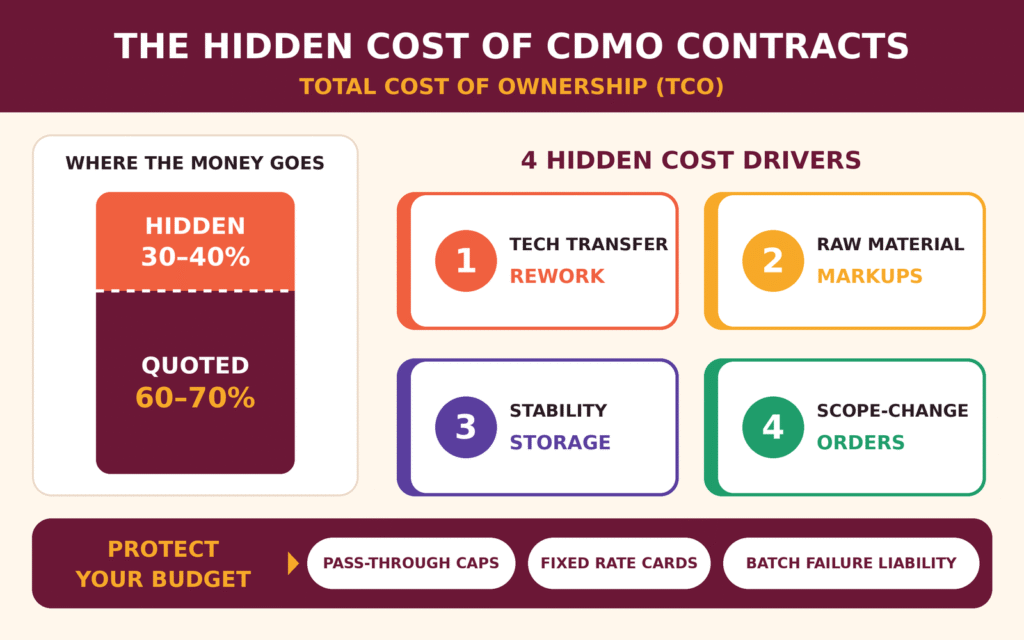
- Total Cost of Ownership (TCO): Initial quotes cover only 60–70% of what sponsors end up spending. The rest comes from tech transfer, material markups, stability storage and scope changes. Cost caps, rate cards and batch-failure liability terms in the MSA help keep this under control.
- Matching model to stage and modality: Small molecules and biologics/ADCs are best started under FTE during early development. Once processes are established or validated, they can move to FFS or Milestone pricing. Analytical work can use FTE for method development and FFS for routine QC and stability testing.
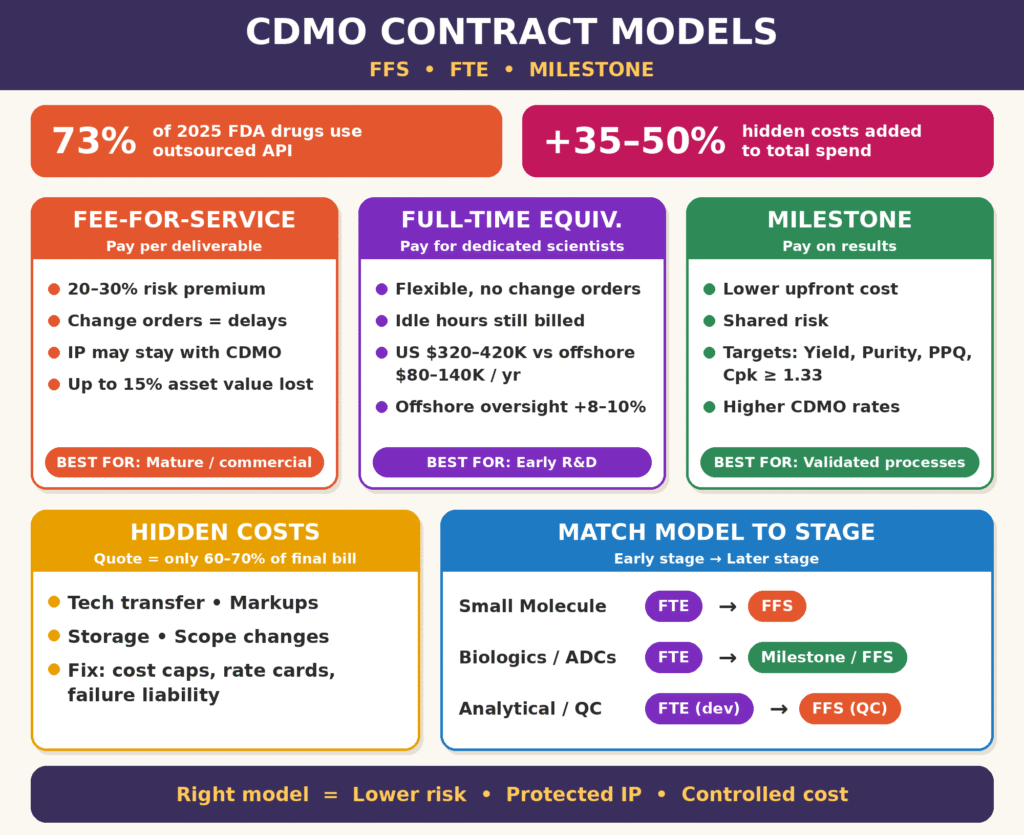
Strategic Comparison of CDMO Contract Models Explained
CDMO contract models distribute operational responsibilities, scientific risk, and budget predictability across different stages of the drug development lifecycle. A comprehensive understanding of CDMO contract models explained requires assessing how Fee-for-Service (FFS), Full-Time Equivalent (FTE), and Milestone-Based pricing approaches handle scope modifications, capacity allocation, and intellectual property.
The commercial contract structure determines whether a sponsor is purchasing defined scientific outputs, dedicated laboratory labor capacity, or outcome-dependent milestone achievements. The comparison below outlines the mechanical, risk-related, and operational differences among the three primary engagement models:
The structural differences highlighted in the matrix demonstrate that no individual pricing model is appropriate for every stage of the drug development pathway. Early-stage exploratory programs generally benefit from the flexibility offered by FTE capacity, while mature, commercial-scale manufacturing typically requires the defined pricing boundaries associated with FFS structures.
Compare different peptide partnership structures: Peptide CDMO vs. CMO
The Fee-for-Service (FFS) Pricing Model Mechanics and Risks
The Fee-for-Service (FFS) pricing model requires biopharmaceutical sponsors to pay a fixed fee for specific, predefined scientific deliverables or manufacturing batches. Although FFS arrangements provide clear initial budget visibility for routine activities, they can transfer financial and timeline risks back to the sponsor whenever technical complications require modifications to the agreed scope.
Cost-Plus Economics and Embedded Risk Premiums
Under FFS contracts, CDMOs commonly incorporate an embedded risk premium of 20% to 30% into baseline pricing to account for scientific uncertainty. This risk buffer compensates the vendor for assuming execution risk but can also contribute to frequent change orders and administrative friction when unexpected analytical or synthetic issues arise.
When a program encounters unforeseen scientific challenges—such as an unexpected impurity profile during API scale-up or dissolution failures in solid dose formulation—the original Statement of Work (SOW) boundary condition may no longer be adequate. The CDMO may pause the work or issue a formal change order to modify the associated fees and timelines. The administrative process of negotiating, reviewing, and approving change orders can create project bottlenecks, potentially delaying clinical trial supply schedules and increasing total contract expenditures substantially beyond the original estimates.
See how peptide API programs can be managed during scale-up: Peptide API Scale-Up
Intellectual Property Exposure in Transactional FFS Agreements
IP allocation under FFS contracts may default to the CDMO for novel process inventions unless specific assignment provisions are clearly negotiated and incorporated into the agreement. Without explicit foreground IP transfer clauses, process improvements generated during development may remain with the contractor. This can create freedom-to-operate risks and potentially reduce drug asset valuation by 5% to 15% NPV.
Under standard legal inventorship doctrines, when contract scientists develop novel crystallization techniques, reaction optimizations, or analytical procedures while fulfilling an FFS contract, default inventorship rights may belong to their employer—the CDMO. If the Master Services Agreement (MSA) does not contain comprehensive foreground IP assignment provisions, the CDMO may retain title to process-related patents. This IP imbalance can require biopharmaceutical sponsors to negotiate expensive license-back provisions or accept restricted field-of-use rights when transferring programs to secondary manufacturing sites.
Learn more about selecting an appropriate peptide development partner: How to Choose a Peptide CDMO in the US
The Full-Time Equivalent (FTE) Engagement Architecture
The Full-Time Equivalent (FTE) engagement architecture provides sponsors with dedicated scientific personnel who are charged at a fixed rate per scientist for an established period. This model effectively transforms the CDMO into an adaptable extension of the sponsor’s workforce, making it particularly suitable for iterative, early-stage research in which scientific outcomes cannot be precisely predicted in advance.
Operational Agility and Capacity Management in FTE Programs
FTE agreements enable sponsors to modify experimental strategies, reprioritize activities, and adjust synthetic routes without repeatedly negotiating change orders. By purchasing dedicated labor capacity instead of a predetermined scientific output, biopharmaceutical sponsors can maintain project momentum, retain institutional knowledge, and improve turnaround times over the long term.
Dedicated FTE arrangements reduce the administrative burden associated with scope changes and allow research teams to redirect efforts quickly when experimental findings indicate a different technical direction. Maintaining the same dedicated scientists on a project also promotes familiarity with the molecule’s unique chemical profile, which can reduce human error and enhance troubleshooting efficiency. However, sponsors must carefully manage workload allocation. During periods of inactivity—such as when teams are waiting for long-term stability data or external raw material shipments—unused FTE hours may still generate charges. This makes structured resource planning across multiple internal pipeline assets essential.
Geographic Rate Structures and Total Management Costs
Annual FTE rates can differ substantially depending on geography, ranging from USD 320,000–420,000 for senior scientists at Tier-1 U.S. facilities to USD 80,000–140,000 in offshore regions. However, some of the apparent offshore savings can be reduced by an internal management oversight cost that may add 8% to 10% in secondary governance expenses.
Selecting FTE capacity therefore requires consideration beyond the basic hourly or annual labor rate. Although offshore facilities can provide lower labor costs, sponsors must account for the additional “shadow budget” required to manage geographically dispersed scientific teams. This shadow budget can include internal technical project managers, more frequent on-site quality audits, cross-border shipping delays, and legal oversight associated with international IP enforcement. Once these governance-related factors are incorporated, the effective cost difference between domestic and offshore FTE arrangements may become considerably narrower.
Compare geographic options for peptide outsourcing: Canadian vs. US Peptide CDMOs
Milestone-Based and Performance-Linked CDMO Structures
Milestone-Based CDMO contract structures connect vendor payments directly to the successful completion of predetermined technical, regulatory, or manufacturing achievements. This approach aligns the commercial interests of both parties by reducing the sponsor’s upfront capital exposure while compensating the CDMO for assuming technical execution risk.
Objective Performance Metrics and Dispute Prevention
Successful implementation of milestone-based contracts requires clear, quantitative acceptance criteria to be established before the project begins. Misalignment can arise when milestone definitions depend on subjective interpretations rather than measurable analytical specifications, potentially resulting in disputes concerning rebate eligibility or payment triggers.
Milestone-based structures perform most effectively when performance thresholds are tied to specific scientific outcomes. Relevant metrics may include achieving predetermined reaction yield percentages, meeting defined purity thresholds by HPLC, demonstrating process capability indices (Cpk ≥ 1.33), or completing successful Process Performance Qualification (PPQ) runs. Linking payments to vague milestones such as “successful process optimization” can create disagreements about whether the contracted deliverables have actually been achieved. In addition, because CDMOs assume a greater portion of operational failure risk under milestone contracts, they may charge premium rates or negotiate shared platform IP licenses to compensate for potential financial losses.
Explore dedicated scale-up capabilities for peptide programs: Peptide CDMO Scale-Up Services
Evaluating Total Cost of Ownership (TCO) and Hidden Financial Drivers
Assessing the Total Cost of Ownership (TCO) in CDMO contracting requires consideration of all direct, indirect, and pass-through expenditures throughout the entire outsourcing lifecycle. Initial proposal prices often account for only 60% to 70% of eventual expenditures, while secondary and unbudgeted costs can contribute substantially to overall cost overruns.
Comprehensive Breakdown of TCO Cost Components
The difference between initial proposal quotations and final invoice totals can result from structural cost drivers embedded within Master Services Agreements and Quality Technical Agreements. Understanding these components is essential for developing accurate clinical burn-rate models and making appropriate capital allocation decisions.
Unmanaged TCO variables can place substantial pressure on drug development budgets. Establishing clear pass-through caps, predefined rate cards, and structured batch failure liability provisions during initial MSA negotiations can help prevent unexpected expenses from destabilizing project budgets.
Modality and Stage-Specific Alignment for CDMO Contract Models Explained
Choosing the most appropriate contract framework when evaluating CDMO contract models explained requires aligning the commercial pricing structure with both the molecular modality and the clinical development phase of the drug candidate. Matching pricing mechanisms to chemical complexity and regulatory requirements can improve financial predictability while helping protect critical program timelines.
Different therapeutic modalities present unique technical risks and regulatory challenges throughout their development lifecycle:
- Small Molecule R&D and Early Process Chemistry: Synthetic route scouting, polymorphism screening, and early process optimization are associated with high failure rates and frequent operational modifications. Using a Full-Time Equivalent (FTE) model during pre-clinical and Phase 1 stages gives process chemists the flexibility to evaluate alternative synthetic routes without continuously initiating change orders. Once the synthetic process becomes more established during Phase 2, transitioning to a Fee-for-Service (FFS) model can provide defined costs for campaign batch execution.
- Biologics, ADCs, and Advanced Modalities: Large molecules, Antibody-Drug Conjugates (ADCs), and cell or gene therapies require specialized process development, sophisticated analytical characterization, and high-potency containment facilities. These complex modalities are well suited to a hybrid engagement structure. Early cell line development, vector construction, and formulation optimization are generally more effectively managed under an FTE framework because these activities often require technical refinement. Once manufacturing protocols have achieved cGMP validation, programs can transition to Milestone or FFS pricing to establish commercial unit batch costs and secure facility production capacity.
- Analytical Method Validation and Routine Quality Control (QC): Analytical support progresses from method development and optimization to routine cGMP lot release and stability testing. A dual-track contract structure can apply FTE arrangements to exploratory analytical method development and troubleshooting while using FFS rate cards for standardized, high-volume release testing and ICH stability pulls.
Explore analytical support for peptide programs, including GLP-1 characterization: GLP-1 Peptide Analytical Characterization
Conclusion: Optimizing Strategic Outsourcing Frameworks
Mastering CDMO contract models explained across FFS, FTE, and Milestone pricing structures allows biopharmaceutical leaders to align financial risk with the scientific realities of their development programs. Selecting the appropriate engagement model can protect intellectual property, control Total Cost of Ownership, and establish sustainable partnerships that help accelerate drug candidates toward commercialization.
Learn more about CDMO options and strategic outsourcing: Peptide CDMO in Canada
Aligning commercial contract structures with the technical maturity of the underlying therapeutic program ensures that development capital is utilized efficiently and strategically. To optimize your drug development, analytical testing, and contract manufacturing strategies with technical precision, connect with the experts at ResolveMass Laboratories Inc. Contact Us.
Frequently Asked Questions (FAQs)
The Total Cost of Ownership (TCO) can rise substantially above the original CDMO proposal because several indirect and additional expenses may emerge during the project. Technology transfer activities, raw material markups, API handling, stability programs, and scope-related change orders can contribute significantly to the final expenditure. These costs should be evaluated before finalizing the commercial agreement.
Fee-for-Service (FFS) agreements can create IP concerns when the contract does not clearly define ownership of foreground IP generated during the engagement. Process improvements, analytical procedures, or manufacturing innovations developed by CDMO personnel may otherwise remain subject to the contractor’s rights. Explicit IP assignment provisions in the agreement help protect the sponsor’s interests.
Milestone-Based pricing is particularly useful when project achievements can be defined through measurable technical, analytical, or regulatory criteria. It can be appropriate for technology transfer, process validation, scale-up, and other development stages involving clearly verifiable outcomes. Payments are then linked to the successful completion of agreed milestones.
CDMOs may apply administrative markups to third-party raw materials, specialized reagents, chromatography media, and single-use processing materials. These charges are commonly structured as a percentage above the supplier’s direct cost and may range from 15% to 25%. Sponsors can manage this expense by negotiating markup limits or establishing direct procurement arrangements.
Master Services Agreements should clearly establish financial responsibility when a cGMP batch fails because of a CDMO-related deviation or manufacturing error. A negotiated framework may require the CDMO to absorb certain processing and labor costs associated with a replacement batch. Responsibility for raw materials, downtime, and other expenses should also be defined in advance.
Senior FTE scientists at Tier-1 North American facilities can cost approximately USD 320,000 to 420,000 annually, while comparable offshore resources may range from USD 80,000 to 140,000. However, the apparent savings can be reduced by project management, quality oversight, international logistics, and other governance expenses. Sponsors should therefore compare the fully loaded cost rather than salary alone.
A Quality Technical Agreement (QTA) establishes the respective quality and cGMP responsibilities of the sponsor and CDMO. It can define analytical release requirements, audit rights, deviation management, and out-of-specification (OOS) investigation responsibilities. These quality provisions complement the commercial terms established through the primary CDMO contract.
Sponsors can limit unexpected change order expenses by developing detailed Scopes of Work (SOWs) before initiating the campaign. The SOW should identify technical assumptions, deliverables, acceptance criteria, responsibilities, and formal change-control procedures. Clearly defining these elements reduces ambiguity and helps prevent repeated renegotiation of project scope.
The FTE model provides the flexibility needed when early-stage scientific work involves frequent experimentation and changing research priorities. Scientists can modify reaction conditions, investigate alternative synthetic routes, and evaluate different approaches without repeatedly initiating formal change orders. This flexibility makes FTE particularly suitable for exploratory process chemistry and synthetic R&D.
Reference:
- Kurata, H., Ishino, T., Ohshima, Y., & Yohda, M. (2022). CDMOs play a critical role in the biopharmaceutical ecosystem. Frontiers in Bioengineering and Biotechnology, 10, 841420. https://doi.org/10.3389/fbioe.2022.841420
- Iezzi, D. (2014). Contract development and manufacturing organizations (CDMO): Are they needed in Brazil. BMC Proceedings, 8(Suppl 4), O3. https://doi.org/10.1186/1753-6561-8-S4-O3
- Toumi, A. (2026, June 5). Staying competitive within the evolving CDMO model. European Pharmaceutical Review. https://www.europeanpharmaceuticalreview.com/staying-competitive-within-the-evolving-cdmo-model/2135643.article
- Iezzi, D. (2014). Contract development and manufacturing organizations (CDMO): Are they needed in Brazil? BMC Proceedings, 8(Suppl 4), O3. https://doi.org/10.1186/1753-6561-8-S4-O3
Get In Touch With Us
About The Author


