

Introduction
Assessing a Contract Development and Manufacturing Organization (CDMO) demands a systematic review of its technical capabilities, regulatory compliance, quality management systems, and operational governance. Defining the right Questions To Ask a CDMO Before Signing a Master Services Agreement (MSA) or Quality Agreement helps pharmaceutical sponsors reduce the risks associated with technology transfer delays, unexpected batch failures, and regulatory non-compliance.
The biopharmaceutical outsourcing environment has evolved beyond simple capacity procurement toward integrated co-development relationships supported by increasingly complex molecular pipelines. Contemporary drug candidates, including high-potency active pharmaceutical ingredients (HPAPIs), sensitive biological products, and complex solid oral or parenteral formulations, require specialized manufacturing environments and comprehensive analytical characterization. Reviewing technical capabilities in isolation is not adequate; sponsors must also evaluate quality management systems, supply chain visibility, corporate governance, and previous regulatory audit performance. Developing a reliable partnership therefore requires structured evaluation frameworks, such as those applied by technical organizations like ResolveMass Laboratories Inc., to confirm that data integrity, analytical precision, and process validation requirements are consistently addressed before entering into a commercial commitment.
Share via:
Quick Summary:
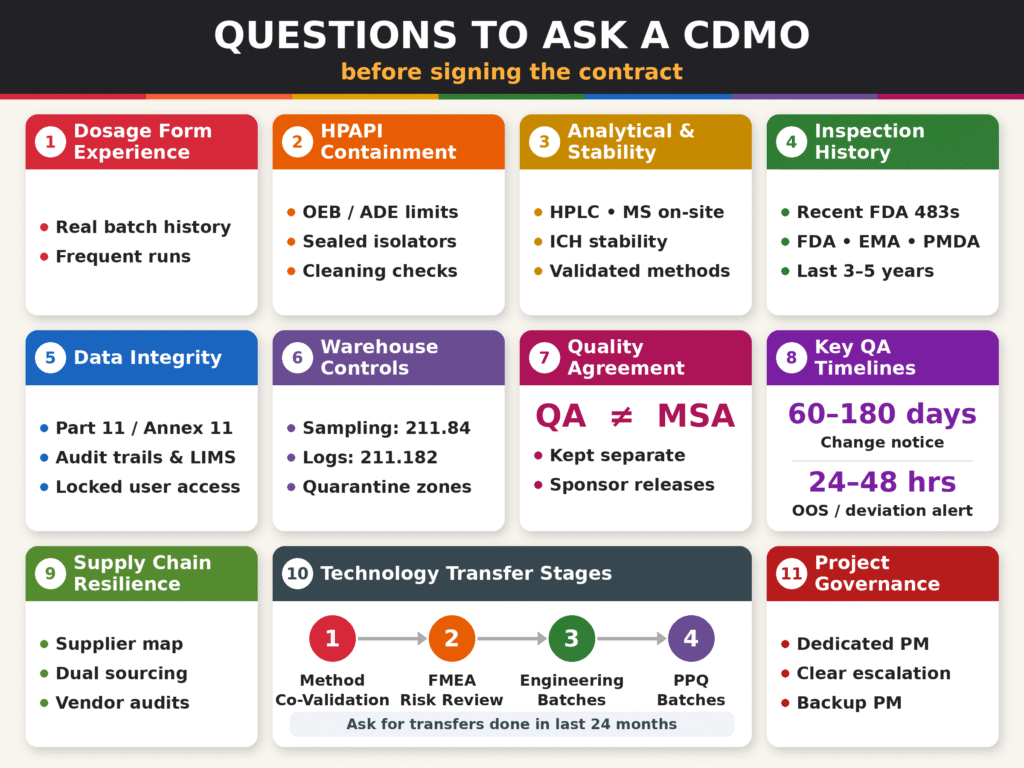
- Prove real capability: Ask how often the CDMO actually runs your dosage form and its batch history. Check HPAPI containment (OEB/ADE limits, isolators, cleaning verification) and confirm on-site analytical and ICH stability testing.
- Review regulatory track record: Request 3–5 years of FDA, EMA and PMDA inspection history, including Form 483s and warning letters. Also check how well the CAPA system works.
- Check data integrity and warehouse controls: Confirm 21 CFR Part 11/Annex 11 compliance, controlled audit trails, LIMS user access, and proper sampling and status logging under 21 CFR 211.84 and 211.182.
- Keep the Quality Agreement separate from the MSA: The Quality Agreement should stand alone so quality duties aren’t diluted by commercial terms. The sponsor keeps final batch release authority. It should define change-control notice (60–180 days) and OOS/deviation alerts (24–48 hours).
- Assess supply chain resilience: Ask for an upstream supplier map covering APIs, KSMs, excipients and packaging. Check dual-sourcing, safety stock and formal vendor qualification, including cold-chain monitoring.
- Evaluate technology transfer discipline: Look for a stage-gate approach: method co-validation, FMEA risk assessment, engineering batches, then PPQ batches. Ask how many transfers the site completed in the last 24 months and whether they met timelines.
- Confirm project governance: Ask for a dedicated senior project manager, clear escalation and deviation-notification paths, and backup staff and archives to handle turnover. A structured due diligence matrix across all these areas lets sponsors score CDMOs objectively before signing.
Technical Expertise and Dosage Form Capabilities: Questions To Ask a CDMO Before Signing
Reviewing technical capabilities requires sponsors to confirm a CDMO’s actual operating frequency, historical batch experience, and analytical capabilities for the specific dosage form instead of depending solely on broad marketing statements. Sponsors should ask detailed questions about historical batch volumes, containment systems, and method validation activities to establish whether the provider’s capabilities genuinely match the project requirements.
Assessing technological preparedness means examining evidence of actual manufacturing experience rather than relying exclusively on general facility brochures. Drug sponsors should determine how regularly a manufacturing site performs production runs for the specific delivery format involved, including oral solids, lyophilisates, semi-solids, or sterile injectables. A provider that routinely manufactures a specialized dosage form is generally better positioned to offer consistent operations and reduce technology transfer risks compared with a facility that operates the relevant production line only occasionally.
Explore how to choose a peptide CDMO in the US:
Peptide CDMO Selection Guide
Potent Compound Handling and High-Potency Containment
Assessment of potent compound manufacturing should include verification of a facility’s Occupational Exposure Band (OEB) ratings, Acceptable Daily Exposure (ADE) limits, and engineered isolation controls. High-potency active pharmaceutical ingredients (HPAPIs) require dedicated air-handling systems, closed-transfer mechanisms, and negative-pressure isolators to minimize the possibility of cross-contamination. Sponsors should request documented cleaning verification procedures, details regarding Acceptable Daily Exposure assessment methodologies, and historical swab testing limits used between manufacturing campaigns.
Analytical Method Development and Stability Testing
A capable CDMO should provide comprehensive on-site analytical services, including method development, force degradation studies, and ICH-compliant stability storage to support regulatory submissions. Having analytical testing capabilities located close to manufacturing operations can reduce inter-laboratory transfer delays and minimize analytical discrepancies. Sponsors should confirm the availability of high-performance liquid chromatography (HPLC), mass spectrometry, and spectroscopic instrumentation and verify that these analytical activities are performed according to established validation protocols.
Learn more about GLP-1 peptide analytical characterization:
GLP-1 Peptide Analytical Characterization
Regulatory Audit History and Quality Management Systems
Assessing a CDMO’s Quality Management System (QMS) requires a detailed review of its health authority inspection history, Corrective and Preventive Action (CAPA) management, and data integrity controls. Direct questions concerning recent FDA Form 483s, warning letters, and audit findings can provide a more accurate understanding of the site’s compliance culture.
A CDMO’s regulatory track record offers important evidence of its operational discipline and commitment to Current Good Manufacturing Practice (cGMP). Sponsors should request information regarding inspections performed by major international regulatory authorities, including the US Food and Drug Administration (FDA), the European Medicines Agency (EMA), and Japan’s Pharmaceuticals and Medical Devices Agency (PMDA), covering approximately the previous three to five years.
Understand the differences between a peptide CDMO and CMO:
Peptide CDMO vs CMO
| Quality & Regulatory Metric | Key Verification Criteria | Primary Risk Mitigated |
|---|---|---|
| Health Authority Inspections | Review FDA Form 483s, Warning Letters, and EMA EudraGMP entries. | Import alerts, clinical holds, and regulatory delays. |
| CAPA System Maturity | Root-cause analysis frameworks and historical resolution timelines. | Recurring process deviations and systemic quality failures. |
| Data Integrity Controls | 21 CFR Part 11 and Annex 11 compliance for LIMS and manufacturing software. | Audit observations, unrecorded re-testing, and data manipulation. |
| Warehouse cGMP Controls | Sampling protocols under 21 CFR 211.84 and status logging under 21 CFR 211.182. | Raw material cross-contamination and container misidentification. |
Data Integrity and Electronic System Oversight
Current regulatory expectations place significant emphasis on data integrity throughout laboratory and manufacturing environments. Sponsors should determine how the CDMO controls audit trails, user privilege levels, and electronic batch records within its Laboratory Information Management Systems (LIMS). Confirming that automated analytical instruments operate through appropriately controlled and non-delegable user access levels helps prevent unauthorized deletion of data, selective sample integration, or undocumented re-testing.
Component Sampling and Warehouse Operations
Under cGMP requirements such as 21 CFR 211.84 and 21 CFR 211.182, raw material receipt and status sampling processes must protect component purity while maintaining complete traceability. Sponsors should evaluate incoming material inspection procedures and determine whether raw materials are subjected to complete container testing or validated supplier Certificate of Analysis (CoA) verification. Warehouse procedures should also demonstrate controlled environmental storage, physical separation of quarantined materials, and unambiguous equipment status identification.
Quality Agreements versus Commercial Contracts: Essential Structural Delineations
Quality Agreements should be established as independent, standalone contracts that remain separate from commercial Master Services Agreements so that cGMP responsibilities are not weakened or obscured by business provisions. Regulatory expectations require drug sponsors to maintain ultimate quality authority over final batch release while the contract facility performs the delegated manufacturing activities.
The FDA’s guidance, Contract Manufacturing Arrangements for Drugs: Quality Agreements, together with EU GMP Chapter 7, establishes that although manufacturing responsibilities may be outsourced, the sponsor’s Quality Unit remains accountable for final drug product disposition. Combining quality governance with commercial contractual terms can introduce ambiguity regarding responsibilities and may create circumstances in which financial considerations could conflict with patient safety and quality obligations.
| Operational Attribute | Master Services Agreement (MSA) | Quality Agreement (QA) |
|---|---|---|
| Primary Focus | Commercial terms, pricing, payment schedules, and liability limits. | cGMP compliance, quality roles, and technical execution standards. |
| Managing Governance | Legal, Procurement, and Business Operations teams. | Quality Assurance and Regulatory Affairs departments. |
| Key Provisions | IP rights, termination clauses, capacity reservations, supply terms. | Change control timelines, OOS protocols, audit rights, batch disposition. |
| Regulatory Status | Private commercial contract. | Mandatory document inspected during FDA and EMA regulatory audits. |
| Revision Triggers | Financial restructuring, scope changes, annual price indexations. | Process modifications, regulatory updates, manufacturing site updates. |
Essential Quality Agreement Responsibilities
A well-developed Quality Agreement should establish clearly defined operational timelines and assign responsibility to specific accountable parties. Change control provisions should identify advance notification periods, commonly ranging from 60 to 180 days for significant process, facility, or analytical method changes, giving sponsors sufficient time to determine and complete any required regulatory filings. Procedures governing Out-of-Specification (OOS) laboratory results and manufacturing deviations should establish mandatory sponsor notification periods, generally within 24 to 48 hours, and should require coordinated investigation procedures before decisions regarding batch disposition are made.
Supply Chain Resilience and Raw Material Management
Confirming supply chain reliability requires a detailed assessment of vendor qualification systems, upstream supplier mapping, and dual-sourcing strategies covering active ingredients and primary packaging materials. Sponsors should determine how prospective CDMO partners address single-source dependencies and maintain appropriate logistics for cold-chain materials.
Geopolitical disruptions and shortages of critical materials demonstrate why supply chain visibility is essential. Sponsors should require CDMO candidates to provide an upstream supplier map covering Active Pharmaceutical Ingredients (APIs), key starting materials (KSMs), excipients, and primary contact packaging components.
Explore peptide CDMO scale-up services:
Peptide CDMO Scale-Up Services
Dual-Sourcing Strategies and Risk Mitigation
Sponsors should determine whether critical raw materials depend on single-source vendors or suppliers concentrated within specific geographical regions. Qualified CDMOs should be able to demonstrate practical risk-reduction measures, including established dual-sourcing arrangements, scheduled vendor audits, and safety stock strategies for materials with extended lead times.
Vendor Qualification and Component Verification
A mature CDMO should operate a formal and documented vendor qualification program. Due diligence should assess the methods used to audit component suppliers, establish incoming material specifications, and maintain cold-chain or environmental monitoring throughout raw material transportation.
Technology Transfer Methodology and Scale-Up Discipline
Effective technology transfer depends on a documented stage-gate approach, structured failure mode risk assessments, and clearly established scale-up parameters. Asking a CDMO how it controls process scale-up between pilot manufacturing suites and commercial production trains can reveal whether the organization is capable of maintaining established process validation limits.
Moving a drug formulation from laboratory bench scale into clinical production, or transitioning a Phase III manufacturing process into commercial production, can introduce both chemical and physical risks. Technology transfer should therefore be treated as a structured engineering discipline supported by collaborative risk management between the sponsor and CDMO.
- Stage 1: Analytical Method Co-Validation: Transfer analytical procedures and establish method equivalency between the sponsor’s laboratory and the CDMO’s laboratory through appropriate validation activities.
- Stage 2: Process Gap Analysis and Risk Assessment: Apply Failure Mode and Effects Analysis (FMEA) to identify Critical Process Parameters (CPPs) and Critical Quality Attributes (CQAs).
- Stage 3: Engineering and Scale-Up Batches: Conduct non-cGMP or pilot-scale manufacturing runs to assess equipment train comparability, fluid dynamics, and shear mixing kinetics.
- Stage 4: Validation and Commercial Execution: Complete formal process performance qualification (PPQ) batches under controlled cGMP manufacturing conditions.
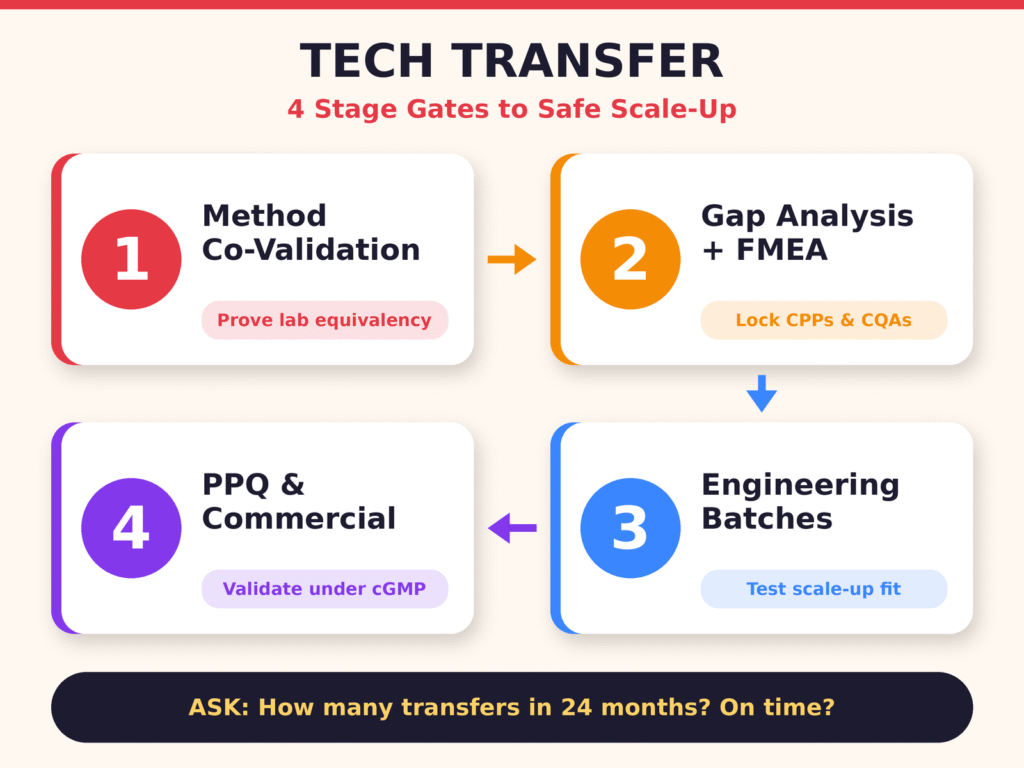
Reviewing the number of technology transfers completed by a CDMO site during the preceding 24 months, together with comparisons between planned and actual completion timelines, provides meaningful evidence of the site’s operational reliability and execution capability.
Review peptide API scale-up considerations:
Peptide API Scale-Up
Project Governance, Escalation Protocols, and Institutional Continuity
Effective project governance requires a dedicated Project Manager who functions as the primary accountability point, clearly defined communication channels, and systems for preserving institutional knowledge. Questions concerning employee turnover mitigation and deviation escalation SLAs can help sponsors determine whether project execution will remain stable when unexpected operational challenges arise.
Technical expertise must be supported by strong operational transparency. Drug development programs may encounter significant difficulties not because of technical deficiencies, but because of communication gaps, inadequate escalation processes, or delayed reporting of deviations.
Sponsors should investigate the CDMO’s project management structure:
- Does the CDMO provide a dedicated, senior Project Manager (PM) who has direct cross-functional authority over quality, analytical, and manufacturing teams?
- Are project developments communicated through real-time digital platforms and organized weekly technical review meetings?
- What specific escalation procedure is activated when batch deviations or schedule delays occur?
A key indicator of a CDMO’s organizational culture is its approach to communicating adverse events. Evaluators should ask: When an out-of-specification result or batch deviation occurs, who notifies the sponsor, what preliminary information is communicated, and are technical root-cause recommendations provided together with the issue notification? In addition, because pharmaceutical development programs can continue for several years, CDMOs should demonstrate adequate employee turnover resilience by maintaining backup project managers and comprehensive program archives.
Learn more about outsourcing peptide manufacturing to a CDMO:
Outsource Peptide Manufacturing to a CDMO
Strategic Due Diligence Matrix: Essential Questions To Ask a CDMO Before Signing
A structured evaluation matrix brings together the most important due diligence questions across technical, regulatory, contractual, and operational areas and converts them into practical verification criteria. Applying such a framework enables drug sponsors to evaluate and score potential CDMO partners systematically before executing contractual agreements.
| Category / Domain | Specific Question To Ask | Technical Verification Metric | Primary Risk Mitigated |
|---|---|---|---|
| Potency & Containment | What containment strategy governs OEB and ADE limits for potent compounds? | Review isolator designs, negative-pressure suites, and cleaning verification limits. | Cross-contamination and operator exposure. |
| Regulatory History | What were the findings of health authority inspections over the last 36 months? | Review FDA Form 483s, EIR reports, EMA certificates, and CAPA resolution records. | Regulatory delays and facility import alerts. |
| Quality Oversight | Is the Quality Agreement separate from the MSA, and how are changes classified? | Draft Quality Agreement evaluation, 60–180 day change notification clauses. | Subordination of quality to commercial terms. |
| Data Integrity | How are electronic audit trails, user access privileges, and LIMS governed? | 21 CFR Part 11 / Annex 11 compliance audits, automated data backup verification. | Data manipulation and compliance citations. |
| Tech Transfer | What stage-gate methodologies govern technology transfer and co-validation? | Review executed transfer reports, FMEA risk assessments, and gate reviews. | Technology transfer delays and batch failures. |
| Supply Resilience | What dual-sourcing strategies and vendor qualification protocols exist? | Mapping API/raw material upstream dependencies, safety stock policies. | Supply chain bottlenecks and raw material shortages. |
| Governance | What is the escalation pathway for deviations, and how is staff turnover managed? | Organizational charts, PM redundancy structures, OOS notification SLAs. | Communication breakdowns and program delays. |
Conclusion
Systematically addressing the essential Questions To Ask a CDMO Before Signing creates a strong foundation for technical transparency, regulatory compliance, and operational confidence between drug sponsors and contract manufacturers.
Thoroughly evaluating prospective partners across technical capabilities, regulatory inspection records, independent Quality Agreements, technology transfer practices, and supply chain redundancy can transform contract manufacturing from a potential operational weakness into a strategic advantage. Specialized analytical and technical organizations, including ResolveMass Laboratories Inc., demonstrate the importance of data integrity, methodology validation, and quality oversight in building reliable outsourcing partnerships. Coordinating technical supervision, risk governance, and regulatory expectations before contract execution helps ensure that life-saving therapeutic products can progress toward commercial markets safely, consistently, and efficiently.
Explore peptide CDMO services in the United States:
Peptide CDMO in the United States
For expert guidance on analytical characterization, technical due diligence, and regulatory compliance strategies, visit the official Contact Us Page.
Frequently Asked Questions
Keeping the Quality Agreement separate from the commercial Master Services Agreement helps protect cGMP responsibilities from commercial negotiations. It clearly establishes quality responsibilities, batch release authority, change control procedures, and compliance obligations. This structure also supports the principles outlined in applicable FDA guidance and prevents business terms from creating uncertainty around quality decisions.
A sponsor should examine the CDMO’s history with health authority inspections, including relevant FDA Form 483s, Warning Letters, and other inspection outcomes. Reviewing CAPA effectiveness, recurring deviations, and the site’s data integrity practices can provide additional insight into compliance maturity. Sponsors should also assess controls governing LIMS and other computerized systems.
For high-potency drug manufacturing, sponsors should verify the facility’s Occupational Exposure Band (OEB) classifications and Acceptable Daily Exposure (ADE) limits. They should also assess negative-pressure isolators, dedicated air-handling systems, closed-transfer controls, and cleaning verification procedures. These controls are essential for limiting operator exposure and preventing cross-contamination.
Change control procedures should categorize proposed modifications according to their potential impact, such as major, moderate, or minor changes. Significant changes should generally require advance written notification, with major modifications often requiring 60 to 180 days of notice. The process should also define appropriate Quality Unit review and approval before implementation.
The sponsor or drug owner retains ultimate responsibility for final drug product disposition, even when testing and manufacturing activities are performed by a CDMO. Under FDA cGMP requirements, including 21 CFR 211.22, quality responsibilities must remain clearly defined. EU GMP Annex 16 also establishes expectations for certification and release responsibilities within the pharmaceutical quality system.
Technology transfer capability can be assessed by reviewing the CDMO’s recent transfer history, including the number of projects completed during the previous 24 months. Sponsors should compare planned and actual transfer timelines and examine FMEA-based risk assessments. Analytical co-validation procedures and documented stage-gate reviews also provide evidence of transfer maturity.
Data integrity is supported through validated computerized systems that comply with applicable requirements such as 21 CFR Part 11 and Annex 11. Important controls include electronic audit trails, controlled user privileges, centralized LIMS platforms, secure data backups, and validated analytical instruments. These measures help protect records from unauthorized alteration, deletion, or undocumented re-testing.
CDMOs can reduce raw material supply risks by qualifying alternative suppliers for critical starting materials and maintaining appropriate dual-sourcing strategies. Formal vendor audits, safety stock levels, and ongoing supplier monitoring provide additional protection against unexpected shortages. Transport validation and appropriate environmental controls are also important for materials requiring controlled shipping conditions.
A CDMO should appoint a dedicated Project Manager who serves as the primary communication and accountability point throughout the program. Clearly defined Service Level Agreements (SLAs) should establish notification requirements for deviations, delays, and other critical events, commonly within 24 to 48 hours. A defined escalation hierarchy should also identify when unresolved issues must be elevated to senior management.
Reference:
- U.S. Food and Drug Administration. (2015, June 18). Questions and answers on current good manufacturing practice regulations: Production and process controls. https://www.fda.gov/drugs/guidances-drugs/questions-and-answers-current-good-manufacturing-practice-regulations-production-and-process
- U.S. Food and Drug Administration. (2016, November). Contract manufacturing arrangements for drugs: Quality agreements: Guidance for industry. https://www.fda.gov/media/86193/download
- Zhang, L. (2024). The effects of transforming the CDMO strategy on the business performance of Porton based on financial statement analysis. In X. Li, C. Yuan, & J. Kent (Eds.), Proceedings of the 7th International Conference on Economic Management and Green Development (pp. 224–234). Springer Singapore. https://doi.org/10.1007/978-981-97-0523-8_20
- Toumi, A. (2026, June 5). Staying competitive within the evolving CDMO model. European Pharmaceutical Review. https://www.europeanpharmaceuticalreview.com/staying-competitive-within-the-evolving-cdmo-model/2135643.article
Get In Touch With Us
About The Author


