

Introduction:
An Insulin Glargine Biosimilar PK Comparability Study is a core part of the evidence showing that a proposed insulin glargine biosimilar behaves like its reference product in the body. Insulin glargine is a long-acting insulin analogue used to improve glycemic control in people with diabetes. Biological medicines come from complex manufacturing processes, so demonstrating biosimilarity takes more than confirming molecular identity. The development strategy usually starts with analytical characterization, followed by functional and clinical assessments. PK studies examine the rate and extent of systemic exposure, and PD studies assess the size and duration of glucose-lowering activity.
The goal is not to re-establish the efficacy of an approved reference product. It is to determine whether any observed differences are small enough that they are not expected to cause clinically meaningful differences in safety, purity or potency. Our biosimilar development guide outlines how these evidence layers fit into a full program.
This case study uses an illustrative scenario to show how analytical evidence, bioanalytical method development and PK/PD design can form one defensible strategy. It is a proposed framework, not a report of an actual ResolveMass client study or experimental outcome. ResolveMass Laboratories Inc. is a Canadian analytical CRO/CDMO with a focus on biosimilar characterization, mass spectrometry and regulatory-grade documentation, and teams often evaluate a biosimilar CDMO in Canada when they want analytical and development support under one roof.
Summary:
- An Insulin Glargine Biosimilar PK Comparability Study tests whether a proposed biosimilar and its reference insulin have sufficiently similar pharmacokinetic (PK) profiles to support a biosimilarity assessment.
- Analytical characterization comes first. It compares primary structure, higher-order structure, purity, impurities, biological activity and other critical quality attributes.
- PK exposure is judged on AUC and Cmax. Pharmacodynamic (PD) data from a euglycemic clamp add functional evidence.
- Study design must address assay specificity, endogenous insulin interference, immunogenicity, safety, statistical power and justified equivalence margins.
- Analytical, PK, PD and immunogenicity findings should be read together as one evidence package.
- Equivalence margins must be justified against current product-specific guidance and should not be assumed.
- ResolveMass Laboratories Inc. supports analytical characterization, impurity profiling, mass spectrometry and bioanalytical method development, with scope confirmed per project.
1: What Is an Insulin Glargine Biosimilar PK Comparability Study?
It is a controlled study that compares the PK behavior of a proposed insulin glargine biosimilar with an appropriate reference product, to see whether systemic exposure is comparable. Its reliability depends on sound analytical measurements and a prespecified statistical framework.
The study sits within a broader biosimilarity assessment that may include:
- Structural and physicochemical characterization
- Purity and impurity profiling
- Biological activity and functional assays
- Comparative PK and, where appropriate, PD assessment
- Safety and immunogenicity evaluation
- Additional clinical evidence when justified or required by the regulatory pathway
Why Is PK Comparability Important for Insulin Glargine?
PK comparability shows whether the biosimilar and reference product produce similar systemic exposure, and differences can point to changes in absorption, distribution or clearance that need investigation.
Insulin glargine has a prolonged glucose-lowering action compared with regular human insulin. Its behavior depends on its formulation and subcutaneous administration, so study design matters. A robust study answers three questions:
- Exposure: Are the rate and extent of systemic exposure comparable?
- Activity: Is the glucose-lowering profile consistent with comparable biological activity?
- Interpretation: Can observed differences be explained by normal variability, analytical limitations, or a meaningful product-related effect?
2: Case Study Overview: Bridging Analytical and Clinical Evidence
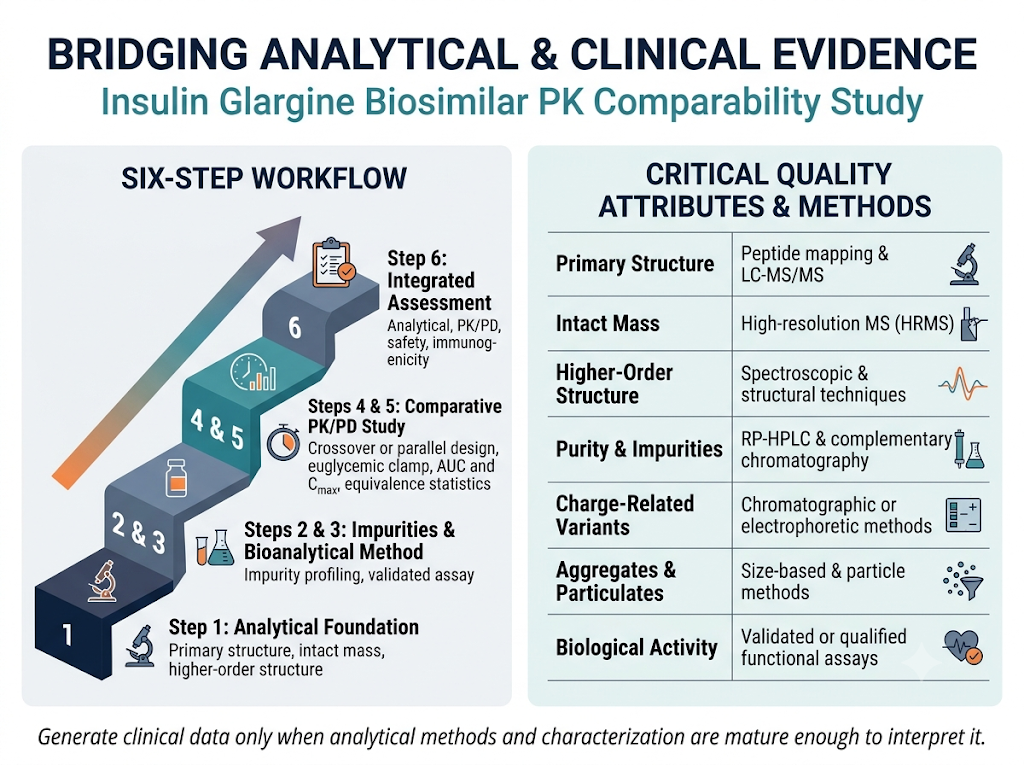
The central challenge is building a connected chain of evidence from molecular characterization to comparative PK/PD assessment.
In the illustrative case, a development team compares a proposed insulin glargine biosimilar with a suitable reference product. It identifies critical quality attributes, compares the products with orthogonal methods, judges whether any difference could affect activity, and then designs a PK/PD study to address what remains.
Illustrative Development Objectives
- Confirm sufficiently similar molecular structure and physicochemical profile
- Compare product-related and process-related impurities
- Establish a bioanalytical method that separates the administered glargine from relevant endogenous insulin-related signals
- Design a comparative PK/PD study with suitable controls, sampling and statistics
- Integrate analytical, functional, clinical, safety and immunogenicity findings into one assessment
This avoids a common problem: generating clinical data before the analytical methods and characterization strategy are mature enough to interpret it.
Step 1: How Do You Establish the Analytical Comparability Foundation?
Analytical comparability shows whether the biosimilar and reference product have sufficiently similar quality attributes before the clinical data are interpreted, and it flags differences that need further work.
For insulin glargine, the program should evaluate structural identity, purity, degradation products, physicochemical properties and biological activity.
Critical Quality Attributes for Insulin Glargine
| Quality attribute | Analytical approach | Purpose |
|---|---|---|
| Primary structure | Peptide mapping, LC-MS/MS | Confirm sequence and investigate sequence-related differences |
| Intact molecular mass | High-resolution MS (HRMS) | Support identity and detect mass-related variants |
| Higher-order structure | Suitable spectroscopic and structural techniques | Compare relevant conformational features |
| Purity and related substances | RP-HPLC and complementary chromatography | Assess product-related impurities and degradation |
| Charge-related variants | Chromatographic or electrophoretic methods | Characterize relevant variants |
| Aggregates and particulates | Size-based and particle methods | Assess physical quality and stability concerns |
| Biological activity | Validated or qualified functional assays | Compare insulin receptor-related activity |
| Stability profile | Stability-indicating methods | Identify degradation pathways and compare stability |
Method selection should follow the product presentation, regulatory expectations and demonstrated suitability for intended use.
Why Do Orthogonal Methods Matter?
Orthogonal methods matter because no single technique can characterize every attribute, and complementary evidence lowers the risk of missing a meaningful difference.
Peptide mapping supports sequence confirmation, intact-mass analysis adds molecular mass information, chromatographic purity testing finds related substances, and functional assays check retained activity. A difference seen by one method should not automatically be read as clinically meaningful dissimilarity. Its size, reproducibility, structural significance and likely functional effect all need assessment.
Key decision: Proceed to the clinical comparison only when the analytical evidence is mature enough to support it and important unresolved differences have been addressed.
Step 2: How Do You Characterize Impurities and Degradation Products?
Impurity characterization determines whether manufacturing-related or degradation-related differences could affect safety, stability or activity, and it separates product-related variants from process-related impurities and formulation effects.
Areas of investigation include:
- Oxidation and other chemical modifications
- Deamidation or related modifications, where relevant
- Aggregates and other physical forms
- Truncated or altered molecular species
- Residual process-related impurities
- Changes tied to storage, handling or formulation
LC-MS/MS and HRMS help investigate identity and characterize unexpected species, while chromatography resolves and quantifies related substances. Forced degradation testing for biosimilars helps establish degradation pathways and confirms that methods are stability-indicating. The team should ask whether each impurity appears in both products, whether levels differ meaningfully, and whether any difference calls for further toxicological, functional or stability work.
A related point is container and delivery-system compatibility. Insulin glargine is typically supplied in vials, cartridges or pens, and extractables and leachables testing for biosimilar drug development helps rule out packaging-related quality differences.
A PK study cannot replace an adequate impurity assessment. Comparable exposure alone does not show that all aspects of product quality are comparable. Formulation also affects glargine performance, so biosimilar formulation development and stability work should be aligned with the clinical lots.
Step 3: How Do You Develop a Fit-for-Purpose Bioanalytical Method?
Develop a method with proven selectivity, sensitivity, accuracy and precision, because PK conclusions are only as good as the measured insulin concentrations. For insulin glargine, the assay must account for the administered analogue, its circulating metabolites and endogenous insulin. Dedicated biosimilar bioanalysis expertise helps at this stage.
Key Bioanalytical Challenges
| Challenge | Why it matters | What to do |
|---|---|---|
| Endogenous insulin interference | May contribute to the measured signal depending on platform | Show that endogenous components do not compromise measurement of the administered product |
| Glargine and metabolite specificity | Glargine is metabolically processed after administration | Define the analyte early (parent, active metabolite, or both) with justification |
| Matrix effects | Plasma proteins and endogenous compounds can alter response | Evaluate matrix effects with appropriate samples and controls |
| Sensitivity and LLOQ | Must capture the terminal phase of a flat, long-acting profile | Set the LLOQ against expected terminal concentrations and sampling plan |
| Accuracy, precision and stability | Underpin every PK parameter | Validate selectivity, calibration, accuracy, precision, carryover, dilution integrity and analyte stability |
Selecting the Analytical Platform
A ligand-binding assay or a mass spectrometry-based method may be appropriate, depending on the analyte definition, specificity, sensitivity, throughput and intended use. LC-MS/MS can offer molecular selectivity and help distinguish among insulin-related species, but it should not be assumed superior to every ligand-binding method. The chosen assay must show fit-for-purpose performance and be validated to the extent appropriate for regulatory use, following applicable bioanalytical guidance such as ICH M10 and the study protocol. Incurred sample reanalysis adds confidence that the method performs on real study samples.
Step 4: How Should You Design the Comparative PK/PD Study?
Design the study to minimize avoidable variability while ensuring the endpoints answer the scientific questions, with the final choice depending on the reference product, route, population, jurisdiction and current product-specific guidance.
| Design element | Consideration |
|---|---|
| Study population | Choose based on safety, ethics and regulatory expectations (healthy volunteers or patients with type 1 diabetes, as justified) |
| Study products | Compare the proposed biosimilar with an appropriate reference product |
| Administration | Standardize route, dosing conditions and procedures |
| Study design | Randomized crossover or parallel-group, as scientifically justified |
| Washout | For crossover studies, base it on the relevant PK/PD behavior |
| Sampling schedule | Capture absorption, peak exposure and the terminal portion of the profile |
| PK endpoints | Prespecify AUC and Cmax, with others where justified |
| PD endpoints | Consider glucose infusion rate and related clamp-derived measures |
| Safety | Monitor adverse events and glucose-related risks |
| Immunogenicity | Assess anti-drug antibodies where appropriate to the program |
| Statistics | Prespecify estimands, analysis population, equivalence margins and handling of missing data |
A crossover design lets each participant receive both products and reduces between-subject variability. It is not universally appropriate, so carryover, washout adequacy, safety and population suitability must be weighed first.
Choosing PK Endpoints
- AUC: systemic exposure over a specified period
- Cmax: maximum observed concentration, reflecting peak exposure
- Additional parameters: included when relevant to the product and design
The AUC interval and any extra parameters should be specified in advance. For a long-acting analogue, sampling must be long enough to characterize the exposure profile without relying on an inadequately observed terminal phase. Sampling times should reflect available product data, the expected profile, assay sensitivity and practical constraints.
Why Euglycemic Clamp Studies May Matter
A euglycemic clamp measures the glucose infusion needed to keep blood glucose at a target level, which gives a quantitative read on the glucose-lowering activity of insulin.
Depending on the protocol and product-specific requirements, relevant PD endpoints may include:
- Total glucose-lowering effect, via an appropriate glucose infusion rate (GIR) summary
- Maximum GIR
- Duration and shape of the glucose-lowering response
- Other prespecified measures of the PD profile
Clamps need standardized execution, consistent glucose targets, trained staff and careful hypoglycemia management. PK describes exposure and PD assesses a biological response, so the two complement each other. Neither substitutes for the broader analytical assessment.
Step 5: What Statistical Framework Supports Comparability?
Equivalence should be tested with a justified framework, not by relying on a nonsignificant difference between treatments. For suitable PK endpoints, the analysis commonly log-transforms exposure parameters, estimates the test-to-reference geometric mean ratio and calculates its confidence interval:
Geometric mean ratio = Geometric mean (biosimilar) ÷ Geometric mean (reference)
The acceptance interval and confidence level must be justified in advance using applicable guidance and the product-specific context. The widely cited 80.00–125.00% interval is used in some PK bioequivalence settings, but it should not be assumed to apply automatically to every insulin glargine biosimilarity assessment or endpoint.
Sample Size and Power
Sample size depends on expected within- or between-subject variability, the design, target power, the significance framework and the prespecified limits. It should also allow for withdrawals and non-evaluable profiles. Clamp studies of basal insulins can show considerable variability, so conservative estimates and pilot or published data help. A larger sample does not rescue an unsuitable design, endpoint or assay.
Interpreting Results
The final analysis should address whether:
- The prespecified PK criteria were met
- PD findings support the conclusion, when applicable
- Sensitivity analyses give consistent interpretations
- Missing data, outliers or protocol deviations affect reliability
- Observed differences agree with the analytical and functional evidence
Meeting a statistical criterion still has to be read against study quality, assay performance, biological plausibility and the totality of evidence.
Step 6: How Do You Integrate Analytical, PK, PD and Immunogenicity Evidence?
Connect findings from each stage: analytical data identify quality attributes, functional studies test activity, and clinical studies ask whether any remaining differences matter for exposure, response or safety.
| Evidence layer | Key question | Contribution |
|---|---|---|
| Analytical characterization | Are molecular and quality attributes sufficiently similar? | Establishes the product-quality foundation |
| Functional assessment | Is relevant biological activity comparable? | Links attributes to function |
| PK assessment | Is systemic exposure comparable? | Evaluates rate and extent of exposure |
| PD assessment | Is glucose-lowering activity comparable? | Complementary functional evidence |
| Safety evaluation | Are there clinically relevant safety differences? | Identifies product-related safety concerns |
| Immunogenicity | Are immune responses meaningfully different? | Supports evaluation of immune-mediated consequences |
Immunogenicity assessment in biosimilar development should be planned to suit the program and applicable requirements. Anti-drug antibodies can affect exposure, efficacy or safety, but clinical significance depends on incidence, titre, persistence and neutralizing activity. The conclusion should not rest on one favorable result while contradictory evidence elsewhere is overlooked.
3: Common Challenges and How to Address Them
| Challenge | Risk | Mitigation |
|---|---|---|
| Insufficient assay specificity | Biased concentrations if endogenous insulin or metabolites are not distinguished | Define the analyte early, test interference, show the assay measures the intended species in the intended matrix |
| Inadequate sampling duration | Terminal exposure not characterized | Justify the window using product knowledge and pilot data |
| Unresolved analytical differences | Muddy clinical interpretation | Investigate each relevant difference before drawing conclusions |
| Unsupported equivalence margins | Poorly justified study | Set margins and analysis plan from the applicable regulatory framework |
| Treating PK as the whole argument | Gaps in quality, potency or immunogenicity evidence | Interpret PK alongside analytical, functional, PD and other evidence |
4: Regulatory Considerations for Insulin Glargine Biosimilar Development
Regulatory expectations depend on the jurisdiction and biosimilar pathway, so teams should check current guidance from the relevant authority, such as the FDA and EMA, before finalizing protocols. The strategy should show how analytical similarity, functional characterization, PK/PD evidence, immunogenicity and safety together support the proposed conclusion.
Points regulators typically look for:
- Scientific justification for the reference product
- Extent and sensitivity of analytical characterization
- Suitability of clinical and bioanalytical methods
- Rationale for population, design and statistical criteria
- Relevance of endpoints to the product’s known pharmacology
- Any additional evidence needed to resolve residual uncertainty
Requirements and recommendations change over time, so confirm product-specific guidance and submission requirements before locking a protocol.
5: How Can ResolveMass Laboratories Inc. Support Biosimilar Development?
ResolveMass supports pharmaceutical and biotechnology teams with analytical science and characterization relevant to complex drug products, and the exact scope is defined per project based on objectives, methods, platforms and regulatory needs.
- Molecular characterization: mass spectrometry and peptide mapping for identity and variant investigation
- Impurity profiling: chromatographic and MS investigations of product-related impurities and degradants
- Analytical method development: fit-for-purpose chromatographic and MS methods
- Stability-indicating analysis: degradation pathways under suitable stress or storage conditions
- Evidence integration: organizing characterization findings into a clear scientific interpretation of quality and comparability
Clinical PK studies, glucose clamp procedures, clinical safety monitoring and immunogenicity testing need specialized capabilities and study infrastructure. Their availability should be confirmed separately and not assumed to be part of an analytical characterization engagement. An integrated plan helps align method performance, critical quality attributes and clinical requirements before key decisions are made.
Conclusion:
An Insulin Glargine Biosimilar PK Comparability Study is most informative when designed as part of a comprehensive, evidence-based biosimilarity strategy. Analytical characterization sets the quality foundation, fit-for-purpose bioanalytical methods make exposure measurements reliable, and suitable PK/PD endpoints address the relevant pharmacology. A defensible program also needs justified statistical criteria, adequate sampling, care over endogenous insulin and metabolite interference, and proper evaluation of safety and immunogenicity.
The aim is a coherent assessment that joins analytical, functional and clinical findings. Aligning analytical development with the clinical strategy early surfaces uncertainties sooner, improves interpretability and builds a stronger package for regulatory review.
Frequently Asked Questions:
Important challenges include interference from endogenous insulin, distinguishing the administered insulin analogue from relevant metabolites, matrix effects, and quantifying low concentrations during the later stages of the PK profile. These issues can affect exposure estimates if they are not adequately controlled. A fit-for-purpose bioanalytical method and a justified sampling schedule are therefore essential.
A euglycemic clamp study evaluates insulin’s glucose-lowering activity by measuring the glucose infusion required to maintain a target blood glucose concentration under controlled conditions. Measures such as the glucose infusion rate and its time course can provide complementary pharmacodynamic evidence. The protocol must be standardized and include appropriate safeguards against hypoglycemia.
Statistical equivalence is generally assessed using prespecified acceptance criteria and confidence intervals for appropriate comparative PK endpoints. Analyses often use log-transformed exposure parameters and test-to-reference geometric mean ratios. The equivalence margins must be scientifically justified and consistent with applicable regulatory guidance; they should not be selected automatically from a generic bioequivalence framework.
Impurities are investigated using appropriate chromatographic, mass spectrometric, and other analytical techniques. The assessment may include degradation products, oxidation-related species, aggregates, altered molecular forms, and relevant process-related impurities. Differences between the biosimilar and reference product should be characterized and evaluated for their potential impact on quality, stability, safety, or biological activity.
Immunogenicity assessment investigates whether treatment induces anti-drug antibodies and whether these responses have potential clinical consequences. Depending on the product and development program, antibody responses may influence exposure, biological activity, or safety. Results should be interpreted alongside clinical findings and other relevant evidence rather than considered in isolation.
The reference product should be selected according to the applicable regulatory pathway and jurisdiction-specific requirements. Developers should consider the product’s regulatory status, formulation, route of administration, and suitability for the intended comparison. The selection should be documented and justified before the analytical and clinical comparability program begins.
Reference
- Linnebjerg H, Lam EC, Seger ME, Coutant D, Chua L, Chong CL, Ferreira MM, Soon D, Zhang X. Comparison of the pharmacokinetics and pharmacodynamics of LY2963016 insulin glargine and EU-and US-approved versions of Lantus insulin glargine in healthy subjects: three randomized euglycemic clamp studies. Diabetes Care. 2015 Dec 1;38(12):2226-33.https://diabetesjournals.org/care/article-abstract/38/12/2226/28908
- Christofides EA, Puente O, Norwood P, Denham D, Maheshwari H, Lillestol M, Hart T, Nakhle S, Chadha A, Fitz‐Patrick D, Sugimoto D. Immunogenicity, efficacy, and safety of biosimilar insulin glargine (Gan & Lee glargine) compared with originator insulin glargine (Lantus®) in patients with type 2 diabetes after 26 weeks’ treatment: A randomized open label study. Diabetes, Obesity and Metabolism. 2024 Jun;26(6):2412-21.https://dom-pubs.onlinelibrary.wiley.com/doi/abs/10.1111/dom.15560
- Tieu C, Lucas EJ, DePaola M, Rosman L, Alexander GC. Efficacy and safety of biosimilar insulins compared to their reference products: a systematic review. PLoS One. 2018 Apr 18;13(4):e0195012.https://journals.plos.org/plosone/article?id=10.1371/journal.pone.0195012
- Heinemann L, Home PD, Hompesch M. Biosimilar insulins: guidance for data interpretation by clinicians and users. Diabetes, Obesity and Metabolism. 2015 Oct;17(10):911-8.https://dom-pubs.onlinelibrary.wiley.com/doi/abs/10.1111/dom.12491
About the Author


