

Introduction
Peptide Analytical Method Development and Validation is a critical component of peptide drug development because peptide molecules present analytical challenges that conventional small-molecule workflows do not always address. Peptide therapeutics need sensitive separation and detection strategies to distinguish the desired peptide from structurally related impurities, degradation products, truncations, aggregates, and process-related components.
The final ICH Q2(R2) guideline provides a general framework for analytical procedure validation and emphasizes demonstrating that a procedure is fit for its intended purpose. ICH Q14 complements it by establishing principles for science- and risk-based procedure development and lifecycle management. Both guidelines reached ICH Step 4 in November 2023 and have since been implemented by regulatory authorities, including the U.S. FDA.
For peptide programs, the objective is not simply a chromatogram with acceptable peak separation. The strategy should show that the method can reliably measure the critical quality attributes (CQAs) relevant to the stage of development and product control.
ResolveMass Laboratories Inc. supports peptide analytical development through analytical characterization, HPLC and LC-MS workflows, impurity investigations, stability-indicating methods, forced degradation studies, and method validation. We treat Peptide Analytical Method Development and Validation as a lifecycle discipline, not a one-time exercise, so the data you submit holds up from IND through commercial release. Our peptide characterization services provide the structural and impurity knowledge that feeds directly into this process.
Summary:
- Peptide Analytical Method Development and Validation establishes analytical procedures that are scientifically sound, fit for purpose, and suitable for peptide drug development and quality control.
- ICH Q14 provides a science- and risk-based framework for analytical procedure development. ICH Q2(R2) provides the framework for demonstrating that a procedure is fit for its intended purpose.
- Peptide methods commonly need to control assay, purity, related substances, degradation products, identity, and process-related impurities.
- RP-HPLC/UHPLC, LC-MS/MS, LC-HRMS, and complementary techniques are integrated depending on the intended purpose of each method.
- Method development must address peptide-specific challenges: oxidation, deamidation, hydrolysis, truncation products, aggregation, adsorption, stereochemical impurities, and matrix interference.
- Validation may include specificity/selectivity, accuracy, precision, range, response, detection/quantitation limits where appropriate, and robustness, depending on the method’s intended use.
- A lifecycle approach connects analytical development, validation, method transfer, stability studies, and post-approval changes.
1: What Is Peptide Analytical Method Development and Validation?
Peptide Analytical Method Development and Validation is the scientific process of building a test procedure that reliably measures a peptide’s identity, purity, potency, and quality attributes, then demonstrating with documented evidence that the procedure performs as intended. Development answers “which method, and why?” Validation answers “does it work, consistently?”
Why Do ICH Q2(R2) and Q14 Matter for Peptides?
ICH Q2(R2) and Q14 matter because they replaced a validation-only mindset with a lifecycle approach, linking method development knowledge directly to validation and ongoing performance. Both guidelines reached ICH Step 4 in November 2023 and have since been implemented by regulatory authorities, including the U.S. FDA. They were designed to be used together.
| Guideline | Scope | Core Concept |
|---|---|---|
| ICH Q14 | Analytical procedure development | Analytical Target Profile (ATP), minimal vs. enhanced approach, method operable design region, established conditions, lifecycle change management |
| ICH Q2(R2) | Validation of analytical procedures | Validation characteristics, suitability of the reportable range, expanded coverage of modern and multivariate techniques |
For peptides, this matters because the molecules are structurally complex and prone to subtle variants. A method developed with documented risk assessment and a clear ATP is easier to defend, easier to transfer, and easier to improve after approval without unnecessary regulatory burden.
2: What Are Typical Analytical Objectives in Peptide Method Development?
Peptide analytical method development is the systematic design of a procedure that reliably measures a defined quality attribute for its intended purpose. Under ICH Q14, development should be scientifically justified and can use a risk-based approach to identify factors that influence performance. Typical objectives include:
- Assay of peptide content
- Purity determination and related-substances analysis
- Degradation-product monitoring and stability-indicating analysis
- Identification of impurities and identity confirmation
- Process impurity assessment
- Residual solvent or reagent assessment
- Release and stability testing
A strategy should establish the relationship between the analytical procedure, critical method parameters, critical method attributes, and performance criteria.
3: Why Is Peptide Method Development More Challenging?
Peptide methods are more challenging because peptide molecules have multiple structural features and degradation pathways that produce closely related impurities. Changes in amino-acid sequence, charge, hydrophobicity, conformation, oxidation state, or aggregation behavior can all influence chromatographic and mass-spectrometric responses.
| Challenge | Potential Analytical Impact | Typical Strategy |
|---|---|---|
| Oxidation | Formation of oxidized variants | RP-HPLC, LC-MS/HRMS |
| Deamidation | Additional related substances | Optimized chromatographic separation |
| Hydrolysis | Fragmentation/degradation products | Stability-indicating HPLC/LC-MS |
| Truncation | Closely related peptide impurities | LC-MS/HRMS and chromatographic profiling |
| Aggregation | High-molecular-weight species | SEC/GPC and complementary techniques |
| Adsorption | Recovery and precision problems | Sample-container and preparation studies |
| Stereoisomeric impurities | Difficult separation/detection | Chiral or orthogonal approaches |
| Matrix interference | Reduced specificity | Sample preparation and selective detection |
| Low-level impurities | Sensitivity limitations | Optimized detection and sample concentration |
Other quality attributes also matter: process-related impurities (deletion, insertion, and incomplete-deprotection products), non-peptide content (water, residual solvents, and counter-ions such as TFA or acetate), and carry-over. This is why peptide development benefits from chromatographic separation combined with orthogonal characterization techniques, rather than a single platform. Modified peptides add further complexity; for example, PEGylated peptide characterization requires approaches that can resolve heterogeneity introduced by the polymer chain.
4: How Does ICH Q14 Change Peptide Method Development?
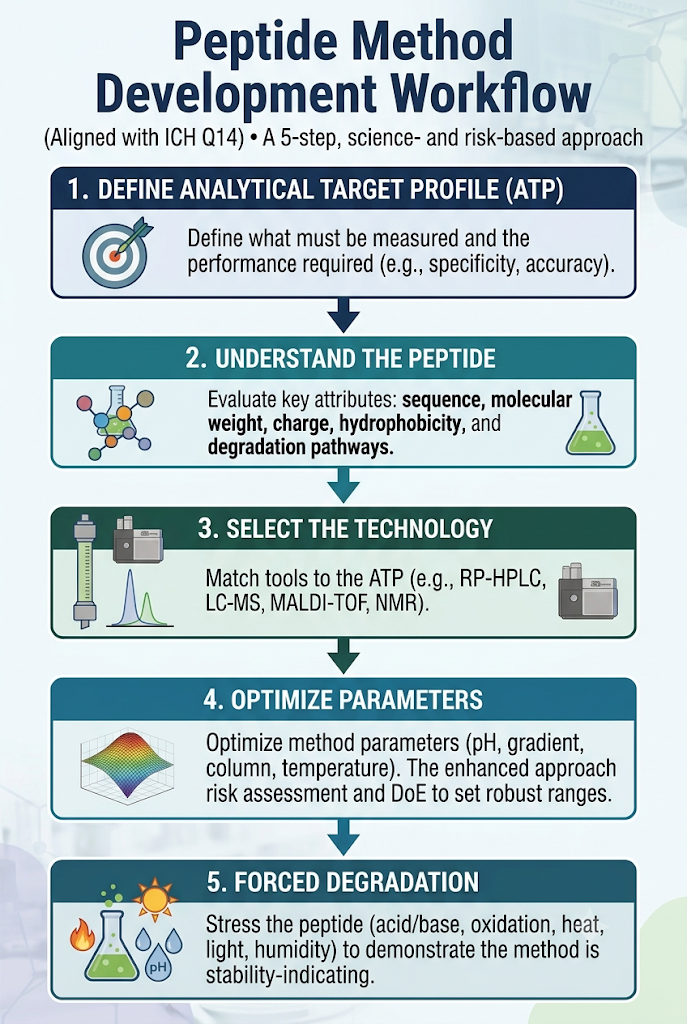
ICH Q14 changes peptide method development by asking sponsors to define what the method must achieve (the ATP) before choosing how to achieve it, and to document the scientific rationale for every key decision. A practical workflow follows five steps.
1. Define the Analytical Target Profile (ATP)
The ATP describes what the procedure must measure and the performance it requires. For example: quantitative determination of peptide assay and related substances in drug substance or drug product within a predefined reportable range, with suitable specificity, accuracy, precision, and robustness.
2. Understand the Peptide and Its Impurities
Before optimization, evaluate molecular weight, amino-acid sequence, charge characteristics, hydrophobicity, pKa-related behavior, known degradation pathways, expected process impurities, formulation components, and potential oxidation or deamidation sites.
3. Select the Analytical Technology
The core techniques are RP-HPLC/UHPLC for purity, LC-HRMS for identification, amino acid analysis for content, and orthogonal tools such as NMR, SEC, and ion-exchange chromatography for specific attributes.
| Technique | Primary Use in Peptide Methods |
|---|---|
| RP-HPLC / UHPLC | Purity, related substances, assay, stability-indicating separation |
| LC-HRMS / LC-MS/MS | Impurity identification, peptide mapping, sequence confirmation, mass accuracy |
| MALDI-TOF MS | Rapid molecular weight confirmation and identity |
| Amino acid analysis | Peptide content and composition |
| Chiral analysis (after hydrolysis) | D-amino acid impurity assessment |
| SEC / GPC | Aggregates and high-molecular-weight species |
| Ion-exchange chromatography / capillary electrophoresis | Charge variants |
| NMR | Structural confirmation and orthogonal quantitation |
| Karl Fischer, GC | Water content, residual solvents |
| Ion chromatography | Counter-ion content |
Technique choice should follow the ATP. For rapid identity and mass confirmation, MALDI-TOF mass spectrometry for peptide characterization is a useful complement to LC-based workflows. When structural questions arise, understanding the strengths of NMR vs LC-MS for peptide characterization helps teams choose the right tool, or combine both. For attribute-level tracking across batches, multi-attribute monitoring (MAM) for peptide characterization can consolidate several quality attributes into one mass-spectrometry-based workflow.
Mass spectrometry is central to our work at ResolveMass. High-resolution accurate-mass data lets our team assign unknown impurities with confidence, which is essential when a new peak appears during forced degradation or stability studies.
4. Optimize Critical Method Parameters
For an RP-HPLC method, development may investigate stationary-phase chemistry, column dimensions, mobile-phase composition, buffer type, pH, organic modifier, gradient profile, flow rate, column temperature, injection volume, detection wavelength, and sample concentration. The objective is suitable selectivity, resolution, peak shape, sensitivity, and reproducibility.
Under the enhanced approach, systematic risk assessment and Design of Experiments map how gradient slope, temperature, pH, and ion-pairing agent concentration affect critical resolution, so teams can set robust ranges rather than fixed points. The minimal approach remains acceptable for straightforward methods.
5. Use Forced Degradation to Establish Stability Indication
Forced degradation is particularly valuable for peptides because it shows whether the method can distinguish the intact peptide from its degradation products. Stress conditions may include acid and base hydrolysis, oxidative stress, thermal stress, photolytic stress, and humidity where relevant. The stressed samples are then evaluated with chromatographic and mass-spectrometric techniques to investigate degradation pathways.
5: What Does ICH Q2(R2) Require for Peptide Method Validation?
ICH Q2(R2) requires validation evidence that a procedure is fit for its intended purpose; the exact characteristics depend on the procedure and its use. The guideline applies to assay, purity, impurity testing, identity, and other quantitative or qualitative measurements.
| Validation Characteristic | Purpose |
|---|---|
| Specificity/Selectivity | Demonstrates measurement without unacceptable interference |
| Accuracy | Closeness of results to the accepted reference value |
| Precision | Variability of measurements |
| Repeatability | Precision under the same conditions |
| Intermediate Precision | Variability within the laboratory |
| Reportable Range | Interval over which the method performs appropriately |
| Response | Relationship between concentration and analytical response, where applicable |
| Detection Limit | Lowest detectable amount, when relevant |
| Quantitation Limit | Lowest quantitatively measurable amount, when relevant |
| Robustness | Sensitivity to deliberate changes in method parameters |
Q2(R2) recognizes that characteristics may be evaluated together rather than as isolated experiments. For example, specificity/selectivity, accuracy, and precision can be assessed over the reportable range when scientifically appropriate.
Specificity and Selectivity in Peptide Method Validation
Specificity is especially important for peptides because degradation products and related impurities closely resemble the target peptide. A robust assessment compares blank, placebo (where applicable), standard, sample, spiked sample, individual impurities (where available), and forced-degradation samples. LC-MS or LC-HRMS adds evidence for impurity identification and structural characterization when chromatography alone is not enough. Peak purity assessment supported by mass spectrometry helps prove the method is stability-indicating.
Accuracy and Precision
Accuracy evaluates how close results are to an accepted reference value, while precision evaluates variability among repeated measurements. The experimental design should reflect the intended reportable range and sample matrix. Precision studies may include multiple preparations and injections, different analysts, different days, and different equipment or column conditions where justified. Results are judged against predefined acceptance criteria based on the method’s intended use.
Range, Response, Detection Limit and Quantitation Limit
The reportable range should cover the concentrations relevant to the intended purpose, with detection and quantitation limits included when relevant. For impurity methods, the lower end of the range is critical because peptide-related impurities can occur at low levels. Adequate sensitivity should be established during development, before formal validation begins.
Robustness of Peptide Analytical Methods
Robustness evaluates whether performance remains suitable when deliberate, scientifically justified variations are introduced into method parameters. For RP-HPLC methods, controlled changes may include mobile-phase pH, organic-phase composition, flow rate, column temperature, gradient conditions, detection wavelength, and buffer concentration. The aim is not to prove the method works under every condition, but to identify parameters that could materially affect performance and support appropriate controls.
6: How Do You Build a Stability-Indicating Peptide Method?
A stability-indicating peptide method detects changes in the peptide and distinguishes the active peptide from relevant degradation products. A typical workflow:
- Establish initial purity and assay.
- Subject peptide samples to relevant stress conditions.
- Analyze stressed and unstressed samples.
- Monitor loss of the main peptide peak.
- Evaluate formation of new peaks.
- Characterize significant degradants using LC-MS/HRMS.
- Confirm chromatographic resolution and mass balance where appropriate.
- Optimize the method based on observed degradation behavior.
- Validate the final procedure.
ResolveMass supports forced degradation, oxidation investigations, thermal stability assessments, accelerated and long-term stability programs, and analytical characterization for peptide development.
7: How Do Q14 and Q2(R2) Work Together Across the Method Lifecycle?
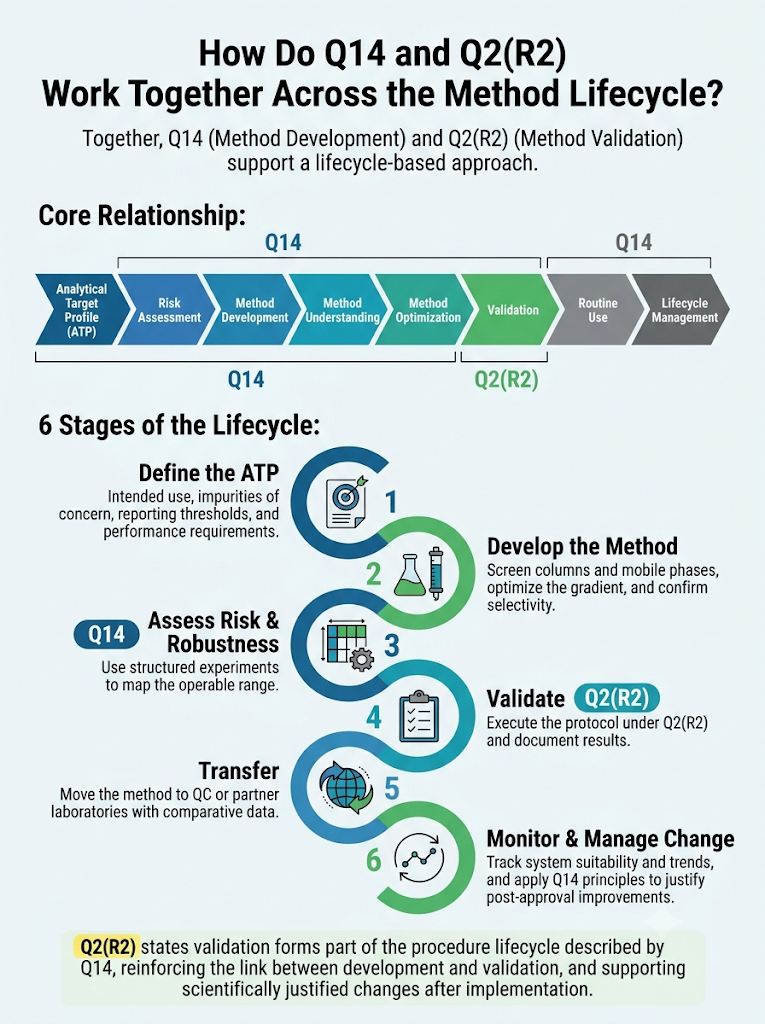
Q14 addresses how an analytical procedure is developed, while Q2(R2) addresses how its performance is demonstrated through validation; together they support a lifecycle-based approach. The relationship can be summarized as:
Analytical Target Profile → Risk Assessment → Method Development → Method Understanding → Method Optimization → Validation → Routine Use → Lifecycle Management
Q2(R2) states that validation forms part of the procedure lifecycle described by Q14, which reinforces the link between development and validation and supports scientifically justified changes after implementation. In practice, the lifecycle runs through six stages:
- Define the ATP: intended use, impurities of concern, reporting thresholds, and performance requirements.
- Develop the method: screen columns and mobile phases, optimize the gradient, and confirm selectivity.
- Assess risk and robustness: use structured experiments to map the operable range.
- Validate: execute the protocol under Q2(R2) and document results.
- Transfer: move the method to QC or partner laboratories with comparative data.
- Monitor and manage change: track system suitability and trends, and apply Q14 principles to justify post-approval improvements.
8: What Should a Peptide Method Validation Package Include?
A comprehensive validation package connects the analytical procedure, intended purpose, protocol, experimental data, calculations, deviations, conclusions, and predefined acceptance criteria. A typical package contains:
- Analytical procedure and Analytical Target Profile
- Method development report and risk assessment
- Validation protocol
- Reference-standard information
- System suitability requirements
- Validation results, chromatograms, and analytical records
- Statistical evaluation
- Deviations and investigations
- Validation report and final acceptance criteria
- Method transfer documentation, where applicable
Q2(R2) expects the relevant validation data, and the methodology used to calculate results, to be provided to demonstrate suitability for the intended purpose. Practical priorities include well-characterized reference standards, early forced degradation design, mass-spectrometric confirmation of unknown peaks, robustness built into development, and data integrity controls aligned with ALCOA+ principles.
ResolveMass Peptide Analytical Method Development and Validation Services
ResolveMass Laboratories Inc. provides peptide-focused analytical development and validation support spanning method development, impurity characterization, stability-indicating methods, and regulatory documentation. Its peptide capabilities include assay, related-substances analysis, purity determination, stability-indicating methods, release and stability testing, and method-transfer support.
Services can include:
- Peptide RP-HPLC/UHPLC and LC-MS/MS method development
- LC-HRMS impurity characterization and truncation-product identification
- Assay, purity, and related-substances methods
- Stability-indicating procedures and forced degradation studies
- Degradation pathway assessment and process impurity investigations
- Analytical method validation and method transfer support
- Stability testing and CMC analytical support
- Regulatory-ready analytical documentation
ResolveMass has also published a peptide analytical development case study describing support for HPLC and LC-MS method development, GPC aggregation analysis, extractables and leachables testing, and validated characterization protocols for an NDA-oriented peptide program. To see how method work fits into broader structural and impurity programs, explore our peptide characterization services.
Why Choose a Specialized Peptide Analytical Partner?
Peptide programs benefit from laboratories that understand both chromatographic method development and the structural complexity of peptide impurities and degradation products. A specialized partner integrates method development, forced degradation, impurity profiling, LC-MS/HRMS characterization, validation, stability testing, method transfer, and CMC documentation. This reduces the risk of building a method that performs well for routine assay but fails to resolve or characterize degradation products later in development.
What sponsors can expect from ResolveMass Laboratories Inc.:
- Science-led development: methods designed around a defined ATP and supported by risk assessment.
- Orthogonal strength: chromatography, high-resolution mass spectrometry, and complementary techniques under one roof.
- Regulatory awareness: deliverables structured to align with ICH Q2(R2), Q14, and the expectations of FDA and Health Canada.
- Transparent reporting: clear protocols, raw-data traceability, and reports written for reviewers.
- Transfer-ready outputs: methods documented so receiving laboratories can reproduce them.
Conclusion:
Peptide Analytical Method Development and Validation is most effective when development and validation are treated as connected stages of a science- and risk-based lifecycle. ICH Q14 provides the framework for systematic development, while ICH Q2(R2) establishes principles for demonstrating that the resulting procedure is fit for its intended purpose.
For peptide therapeutics, the strategy should account for molecular complexity, related substances, degradation pathways, aggregation, process impurities, and the intended use of each procedure. Combining RP-HPLC/UHPLC with LC-MS or LC-HRMS and appropriate orthogonal techniques gives a stronger understanding of peptide quality and impurity profiles.
Frequently Asked Questions:
An RP-HPLC method for peptides is developed by evaluating column chemistry, mobile-phase composition, pH, organic modifier, gradient, temperature, flow rate, and detection conditions to achieve suitable separation and peak quality. Forced degradation and impurity profiling can then be used to confirm that the method is suitable for its intended purpose.
Acetonitrile is frequently used because it provides effective reversed-phase separation for many peptides and can produce favorable chromatographic peak shapes and relatively low viscosity. It is also compatible with many LC-MS workflows when an appropriate volatile mobile-phase system is selected.
Peptide-related impurities can be investigated using chromatographic separation combined with mass spectrometric information and, where necessary, complementary structural techniques. LC-MS or LC-HRMS can help determine molecular-mass differences and support investigation of modifications such as oxidation, deamidation, truncation, or other degradation products.
Unknown peptide impurities are typically characterized through a combination of chromatographic separation, accurate-mass information, fragmentation data, and comparison with expected degradation or synthesis pathways. Orthogonal techniques may be required when LC-MS data alone are insufficient for confident structural assignment.
Peptide impurity profiling is the systematic detection, separation, identification, and evaluation of impurities associated with a peptide drug substance or product. It can include process-related impurities, degradation products, sequence variants, truncated peptides, modified peptides, and other related substances.
Truncated peptides can be detected using chromatographic separation and mass-based techniques that distinguish sequence variants from the intended peptide. LC-MS and LC-HRMS can be particularly useful for investigating mass differences associated with missing or additional residues.
Reference
- Elsayed YY, Kühl T, Imhof D. Regulatory guidelines for the analysis of therapeutic peptides and proteins. Journal of Peptide Science. 2025 Mar;31(3):e70001.https://onlinelibrary.wiley.com/doi/abs/10.1002/psc.70001
- Pohl T, Merkle PS, Hudelmaier S, Le-Minh V, Mertens D, Schmid C, Ossola R, Soenksen C, Zeiler M, Starikov A, Waterman E. Development, qualification, and application of a highly efficient and robust new peak detection workflow for the LC-MS peptide mapping multi-attribute method. InMabs 2025 Dec 31 (Vol. 17, No. 1, p. 2572411). Taylor & Francis.https://www.tandfonline.com/doi/abs/10.1080/19420862.2025.2572411
- Guideline IH. Validation of analytical procedures Q2 (R2). ICH: Geneva, Switzerland. 2022;1.https://pink.citeline.com/-/media/supporting-documents/pink-sheet/2022/04/p0422ema_21.pdf
- Eberle M, Wasylenko JT, Kostelac D, Kiehna S, Schellinger A, Zhang Z, Ehrick JD. A modern framework for analytical procedure development and lifecycle management based on ICH Q14 principles. Analytical chemistry. 2025 Jan 14;97(1):12-21.https://pubs.acs.org/ancham/article-abstract/97/1/12/3619637
About the Author


