


Introduction:
MALDI-TOF mass spectrometry for peptide characterization is widely used to determine peptide molecular mass, support identity confirmation, and evaluate peptide samples during pharmaceutical research and development. The technique combines matrix-assisted laser desorption/ionization (MALDI) with time-of-flight (TOF) mass analysis, giving researchers mass spectra from peptides with relatively straightforward sample preparation.
Peptide therapeutics are increasingly important in pharmaceutical development because they can offer high target specificity and biological activity. Their analytical characterization, however, can be challenging. Synthetic peptides may contain deletion sequences, incomplete coupling products, oxidation products, deamidated species, epimers, and other impurities that need appropriate analytical strategies.
A single technique rarely provides everything needed to characterize a complex peptide drug substance. MALDI-TOF can establish useful molecular mass evidence, but additional methods may be necessary to confirm amino acid sequence, distinguish closely related impurities, determine purity, and investigate degradation pathways.
ResolveMass Laboratories Inc., a USFDA-registered Canadian CRO/CDMO, supports pharmaceutical analytical development through specialized mass spectrometry and complementary approaches designed around each molecule and project. Our peptide characterization services combine MALDI-TOF, LC-MS/MS, HPLC and orthogonal methods so that every dataset stands up to scientific and regulatory scrutiny.
Summary:
- MALDI-TOF mass spectrometry for peptide characterization determines peptide molecular mass, supports identity confirmation, and screens selected peptide-related impurities.
- MALDI-TOF combines laser-assisted ionization with time-of-flight mass analysis to measure the mass-to-charge ratio (m/z) of ions, mostly singly charged for peptides.
- It is valuable for synthetic peptides, peptide libraries, enzymatic digestion products, peptide mapping workflows, and preliminary impurity assessment.
- Key strengths: rapid analysis, high sensitivity for suitable analytes, relatively simple sample preparation, and efficient multi-sample screening.
- Key limits: limited quantitation, difficulty distinguishing structural isomers, ion suppression, challenges with complex mixtures, and incomplete structural information.
- LC-MS/MS, high-resolution MS, and complementary chromatographic techniques are often needed for sequence confirmation, impurity identification, and regulatory characterization.
- The right method depends on peptide complexity, sample purity, molecular mass, required sensitivity, and the intended development or regulatory application.
1: What Is MALDI-TOF Mass Spectrometry for Peptide Characterization?
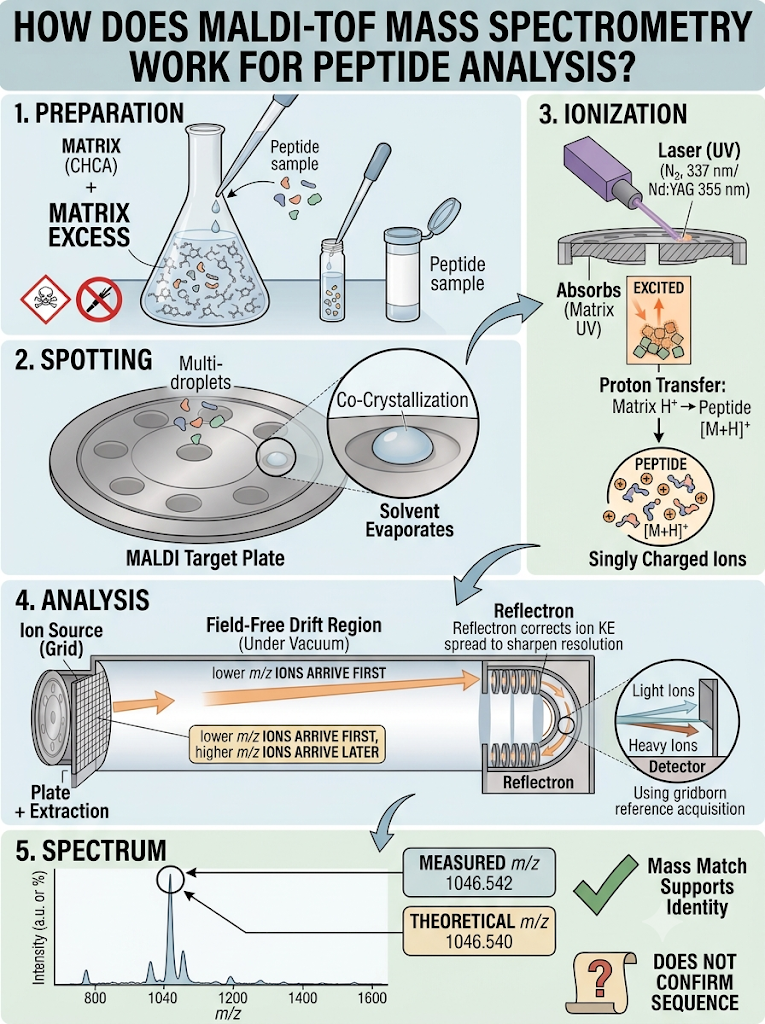
MALDI-TOF mass spectrometry is an analytical technique in which a laser excites a matrix containing the analyte, producing gas-phase ions that travel through a flight tube. Their flight times are used to calculate m/z values, which are displayed as a mass spectrum.
How Does MALDI-TOF Work?
The analysis generally involves five steps:
- Sample preparation: the peptide is mixed with a suitable matrix that absorbs laser energy (α-cyano-4-hydroxycinnamic acid, CHCA, is common for peptides).
- Sample spotting: a small volume is deposited on a MALDI target and allowed to dry and crystallize.
- Laser desorption and ionization: the matrix absorbs the laser energy, facilitating desorption and ionization of peptide molecules.
- Time-of-flight analysis: ions travel through the analyzer, and lighter ions arrive first. Reflectron mode can sharpen resolution and improve mass accuracy.
- Spectrum interpretation: measured m/z values are compared with theoretical or reference values to support peptide identification.
MALDI commonly produces singly charged peptide ions, although other charge states may occur depending on the analyte and conditions. This simplifies interpretation because the measured m/z of a singly charged ion is closely related to the peptide’s molecular mass.
For example, if a peptide produces a dominant protonated ion ([M+H]+), its measured m/z can be compared with the theoretical value. A suitable match supports the proposed molecular identity, but it does not independently establish the complete amino acid sequence or exclude every structural alternative.
2: Key Applications of MALDI-TOF Mass Spectrometry for Peptide Characterization
MALDI-TOF supports several stages of peptide research, analytical development, and quality assessment. The most appropriate application depends on whether the goal is mass confirmation, screening, sequence-related analysis, or detailed impurity characterization.
1. Peptide Molecular Mass Confirmation
MALDI-TOF checks whether the observed molecular mass of a peptide agrees with its expected mass. This is particularly valuable in synthetic peptide development, where incomplete synthesis or unintended chemical modifications can produce products with different masses.
Typical uses include:
- Confirming the expected molecular mass of synthetic peptides.
- Screening crude peptide synthesis products.
- Evaluating purified peptide fractions.
- Checking peptide identity during process development.
Mass agreement is supportive identity evidence only. Peptides with the same molecular formula may have different sequences or stereochemistry, so mass alone cannot distinguish every possible structure.
2. Peptide Sequence Verification and Peptide Mapping
MALDI-TOF can support sequence verification when combined with appropriate digestion, theoretical mass calculations, and complementary methods. In peptide mapping, a protein or larger peptide is enzymatically or chemically cleaved into smaller fragments, and their masses generate a characteristic fingerprint. That fingerprint helps assess whether expected fragments are present and whether a test sample differs from a reference.
A mass fingerprint is not equivalent to complete sequence determination. When the order of amino acids must be established or ambiguous fragments resolved, MS/MS fragmentation (including TOF/TOF) and other sequence-specific methods may be required. For programs that need broader attribute-level tracking beyond a single mass check, multi-attribute monitoring (MAM) for peptide characterization offers a complementary, LC-MS-based approach.
3. Screening for Peptide-Related Impurities
MALDI-TOF can screen for impurities that differ sufficiently in mass from the target peptide and produce detectable signals. Potential targets include:
- Deletion and truncation sequences.
- Incomplete synthesis products.
- Certain oxidation (for example, +16 Da) or other modification products.
- Some adducts and noncovalent species.
- Products of selected degradation pathways.
Deleting an amino acid residue changes peptide mass by that residue’s mass, so a suitable spectrum may reveal a signal consistent with a deletion product. However, not every impurity is detected reliably. Ionization efficiency, sample composition, matrix selection, and signal suppression all affect peak intensity, so MALDI-TOF peak abundance should not automatically be read as impurity concentration.
4. Peptide Library Screening and Research Applications
MALDI-TOF is useful for workflows involving many synthetic peptides, peptide libraries, and candidate molecules. Rapid analysis helps researchers assess whether synthesized candidates match their intended structures, supports early-stage discovery, and allows screening of purification fractions. Candidates needing definitive sequence confirmation can then move to targeted LC-MS/MS or other analyses.
5. Monitoring Peptide Stability and Degradation
MALDI-TOF can contribute to preliminary stability investigations by identifying new mass signals after exposure to stress conditions such as heat, light, oxidation, acidic or alkaline environments, and prolonged storage. It may support investigation of mass-changing modifications, selected degradation products, and differences between initial and stressed samples.
Several important degradation mechanisms do not produce a readily distinguishable mass shift. Epimerization, for example, can occur without changing molecular mass, and a new peak may represent an adduct rather than a degradant. Chromatographic separation, tandem MS, and orthogonal methods are therefore important when definitive degradation-product identification is required.
6. Modified and Complex Peptide Formats
MALDI-TOF is also applied to modified peptides, where mass shifts help confirm that a modification has occurred. For example, polymer attachment produces a distinctive mass increase and heterogeneity pattern, which is why MALDI-TOF is frequently paired with other techniques in PEGylated peptide characterization. For constrained structures, MALDI-TOF can verify intact mass and support disulfide or ring-closure assessment (for instance, by comparing reduced and non-reduced samples), while connectivity and sequence questions typically require MS/MS, as discussed in our guide to cyclic peptide characterization.
3: Major Strengths of MALDI-TOF Mass Spectrometry
The main advantages of MALDI-TOF are rapid analysis, relatively simple sample preparation, minimal fragmentation of suitable peptides under favorable conditions, and usefulness for screening multiple samples.
| Strength | Why it matters for peptide programs |
|---|---|
| High-throughput analysis | Target plates hold many samples, so candidates or fractions can be screened without a lengthy chromatographic run for each. |
| Rapid molecular mass assessment | Once the method is established, mass information is available quickly for routine screening and analytical development. |
| Suitability for many peptide analytes | Often well suited to peptides that ionize effectively under the chosen matrix and instrument conditions. |
| Relatively simple sample preparation | Many workflows need only a small sample amount plus matrix; complex or salty samples may still need cleanup or desalting. |
| Useful molecular mass information | Observed masses are compared with theoretical values to support identity and screen for mass-changing modifications. |
| Simple spectra | Predominantly singly charged ions make peaks easier to interpret than multiply charged spectra. |
4: Limitations of MALDI-TOF Mass Spectrometry for Peptide Characterization
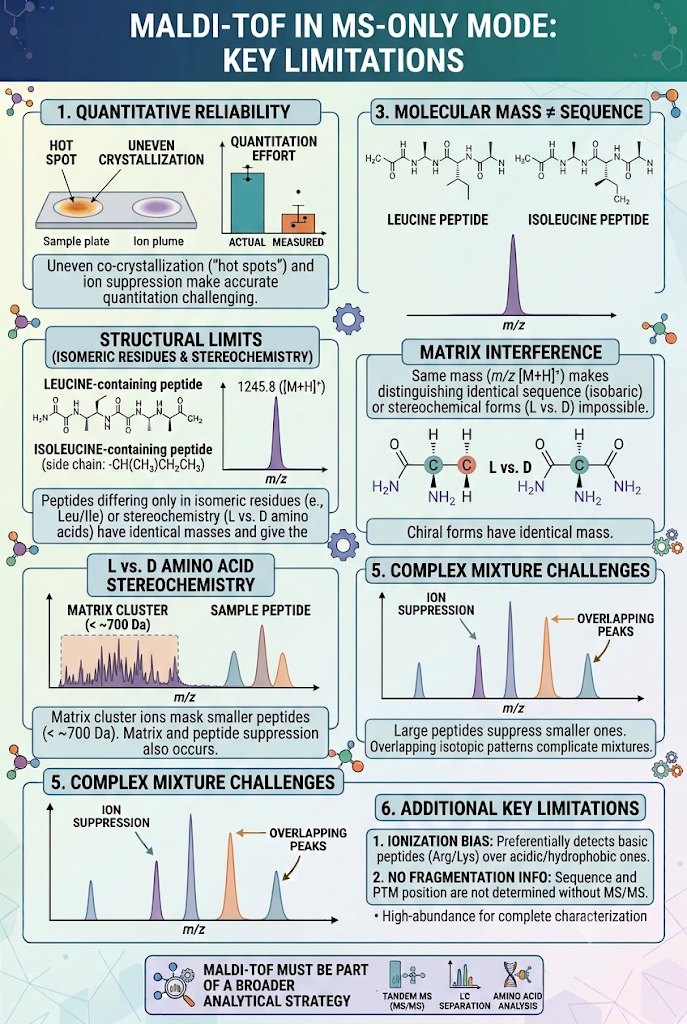
MALDI-TOF is not a universal solution. It has important limits in quantitative measurement, structural discrimination, complex mixture analysis, and definitive impurity identification.
1. Limited Quantitative Reliability
MALDI signal intensity varies with crystallization, matrix incorporation, ionization efficiency, and competition between analytes, so peak intensity does not necessarily reflect relative concentration. For validated quantitative applications, LC-MS/MS or another appropriately validated method is usually more suitable.
2. Difficulty Distinguishing Structural Isomers
Peptides with identical masses may differ in sequence, stereochemistry, or modification site, and may give the same signal in a conventional MALDI-TOF spectrum. Examples include:
- Leucine and isoleucine substitutions (identical residue mass).
- D- and L-amino acid epimers.
- Positional isomers of certain modifications.
- Different sequences with identical elemental composition.
These cases may require MS/MS, chromatographic separation, specialized fragmentation, or orthogonal techniques.
3. Ion Suppression and Matrix Effects
Salts, buffers, contaminants, and competing analytes can reduce the signal from the target or selected impurities. Matrix selection, cleanup, and sample preparation optimization help, but they do not guarantee equal detection of all components. Matrix ions can also obscure very small peptides.
4. Challenges in Complex Mixtures
When a sample contains many peptides with overlapping mass ranges, individual signals can be hard to assign confidently. Without adequate separation, MALDI-TOF may not resolve components with similar masses or overlapping isotope distributions. LC-MS/MS is more informative when separation, fragment-based identification, and investigation of multiple coexisting impurities are needed.
5. Incomplete Structural Information
An accurate molecular mass does not by itself establish complete peptide structure. It may not reveal the precise sequence, modification site, stereochemistry, or location of an isomeric impurity. MALDI-TOF should therefore be one component of an analytical strategy, not a replacement for every other method.
5: MALDI-TOF vs. LC-MS/MS for Peptide Characterization
MALDI-TOF and LC-MS/MS are complementary. MALDI-TOF is often used for rapid molecular mass screening, while LC-MS/MS is frequently preferred when chromatographic separation, detailed fragmentation, impurity identification, or quantitation is required.
| Analytical parameter | MALDI-TOF MS | LC-MS/MS |
|---|---|---|
| Primary role | Rapid molecular mass assessment and screening | Separation, identification, and detailed characterization |
| Sample preparation | Often relatively simple; matrix required | Depends on chromatography, ion source, and sample matrix |
| Chromatographic separation | Not inherent to a conventional workflow | Integrated into the workflow |
| Sequence confirmation | Possible with suitable fragmentation; fingerprinting alone is insufficient | Often well suited, through fragment ions |
| Impurity identification | Useful for detectable mass differences | Retention time plus fragment-ion evidence |
| Quantitative analysis | Needs specialized development and validation; intensity alone is insufficient | Often preferred when appropriately validated |
| Complex mixtures | May show overlapping signals and ion suppression | Separation improves selectivity and identification |
| Typical use | Screening, mass checks, selected fingerprinting | Detailed characterization, impurity analysis, targeted quantitation |
The choice should be driven by the analytical question rather than the instrument. MALDI-TOF may suffice for an initial mass check, whereas a regulatory impurity investigation may need orthogonal evidence from LC-MS/MS, chromatography, and other structural techniques. For a deeper look at how mass spectrometry compares with spectroscopic approaches, see NMR vs LC-MS for peptide characterization.
How to Select the Right Method for Peptide Characterization
The right method depends on the information required, the nature of the peptide, and the confidence needed for the intended decision. Consider:
- Molecular identity: is mass agreement sufficient, or is full sequence confirmation needed?
- Impurity profile: is the concern detecting mass-changing impurities, or identifying and quantifying individual components?
- Sample complexity: salts, buffers, excipients, biological matrices, and potentially interfering species.
- Required sensitivity: expected impurity levels and the detection capability needed.
- Structural ambiguity: whether the method must distinguish isomers, epimers, or modification sites.
- Regulatory purpose: development stage, specifications, and applicable validation requirements.
For many pharmaceutical projects, a combined approach gives stronger evidence than any single platform.
An Integrated Analytical Workflow for Peptide Characterization
A practical workflow starts with a clearly defined objective and progresses from screening to detailed identification when necessary.
- Define the analytical objective: identity confirmation, sequence verification, impurity profiling, stability assessment, or quantitation.
- Assess the sample: review molecular mass, sequence, expected modifications, solubility, purity, and potential matrix interference.
- Perform preliminary mass analysis: use MALDI-TOF where appropriate to compare observed signals with theoretical or reference values.
- Investigate unexpected signals: evaluate possible deletion products, modifications, adducts, and degradants. Do not assign an impurity from a mass difference alone.
- Apply complementary techniques: use LC-MS/MS, high-resolution MS, or chromatography to resolve ambiguous structures.
- Evaluate analytical performance: assess mass accuracy, specificity, precision, sensitivity, reproducibility, and robustness for the intended use.
- Document conclusions: record methods, reference comparisons, observed signals, interpretation, limitations, and supporting evidence in a traceable report.
Not every peptide requires every technique, and acceptance criteria should be set by the intended application rather than assumed to be universal.
The Role of Complementary Analytical Techniques
MALDI-TOF is most effective when interpreted alongside complementary evidence whenever the question exceeds simple mass assessment.
| Technique | Contribution to peptide characterization |
|---|---|
| LC-MS/MS | Separation, sequence-related fragmentation, and impurity investigation |
| High-resolution MS | Accurate-mass measurement; support for elemental composition assessment |
| HPLC or UPLC | Separation of components and chromatographic purity |
| Tandem MS | Fragment-ion evidence for sequence and localization of certain modifications |
| Amino acid analysis | Amino acid composition or content assessment |
| NMR spectroscopy | Additional structural information where quantity and properties permit |
No single technique resolves every uncertainty. Orthogonal methods supply different types of evidence, helping analysts move from a plausible interpretation to a sufficiently supported structural assignment.
Regulatory Considerations for Peptide Characterization
Regulators expect peptide identity and impurity data to come from scientifically sound, fit-for-purpose methods. MALDI-TOF contributes to the structural characterization expected under ICH Q6B, while method performance is demonstrated under ICH Q2(R2) and the lifecycle approach of ICH Q14. For generics and branded products alike, orthogonal mass spectrometry evidence strengthens submissions; see our overview of therapeutic peptide characterization for NDA and ANDA. For early clinical programs, peptide characterization CRO services for IND submission explains how fit-for-purpose data packages are assembled. Sponsors should always confirm current agency expectations for their specific product.
How ResolveMass Laboratories Inc. Can Support Peptide Characterization
ResolveMass Laboratories Inc. supports pharmaceutical analytical development through mass spectrometry, chromatographic analysis, and complementary characterization approaches. For peptide projects, a strategy may include:
- Molecular mass confirmation and identity assessment.
- LC-MS/MS-based peptide characterization.
- Investigation of peptide-related impurities and degradation products.
- Analytical method development and optimization.
- Selection of complementary techniques for challenging structural questions.
- A workflow aligned with the intended pharmaceutical application.
The choice between MALDI-TOF, LC-MS/MS, high-resolution MS, and complementary techniques should rest on the information required and the limits of each method. A rapid mass check may suit early screening, while a complex impurity investigation may need chromatographic separation and diagnostic fragment-ion data. A project-specific assessment determines which techniques will give meaningful, reproducible, and defensible results, with method suitability, validation, and reporting expectations set according to the intended use.
Conclusion:
MALDI-TOF mass spectrometry for peptide characterization is a valuable approach for rapid molecular mass assessment, peptide identity support, screening of selected impurities, and peptide mass fingerprinting. Its relatively simple sample preparation and suitability for multi-sample analysis make it useful during peptide research and early pharmaceutical development.
Its limitations must be recognized, however. Conventional MALDI-TOF analysis alone may not distinguish structural isomers, establish complete amino acid sequences, quantify impurities reliably, or resolve complex mixtures. These limits matter most when findings support pharmaceutical quality decisions or regulatory submissions.
An effective strategy matches the method to the scientific question. MALDI-TOF provides useful initial evidence, while LC-MS/MS, high-resolution MS, HPLC or UPLC, and other complementary techniques strengthen structural assignments and impurity investigations. By selecting fit-for-purpose methods and interpreting results within their limits, developers can build a more reliable understanding of peptide identity, purity, and stability throughout development.
Frequently Asked Questions:
MALDI-TOF can detect certain mass-distinguishable impurities, including deletion sequences, incomplete synthesis products, and some chemically modified peptides. Detection depends on ionization efficiency, sample composition, and the mass difference between the target and impurity. Additional techniques may be needed to identify impurities conclusively or quantify them accurately.
MALDI-TOF may distinguish an oxidized peptide when oxidation produces a detectable mass shift, such as the approximately 16 Da increase associated with the addition of one oxygen atom. However, the observed mass difference does not independently confirm the oxidation site or chemical structure. Tandem mass spectrometry can provide additional fragment-ion evidence to help localize and characterize the modification.
The matrix absorbs laser energy and facilitates the desorption and ionization of peptide molecules. Matrix selection can influence signal intensity, mass spectral quality, and the detection of particular peptide species. Common matrices for peptide analysis include α-cyano-4-hydroxycinnamic acid (CHCA) and sinapinic acid, with the appropriate choice depending on the analyte and experimental conditions.
Peptide mass fingerprinting involves analyzing the masses of peptide fragments generated by enzymatic or chemical digestion of a larger molecule. MALDI-TOF measures these fragment masses, which can be compared with theoretical fingerprints to support protein or peptide identification. Ambiguous assignments or sequence differences may require MS/MS analysis and additional evidence.
Yes, MALDI-TOF can help identify new mass signals associated with certain degradation products and compare peptide samples before and after stress exposure. It may support preliminary investigations of oxidation, cleavage, or other mass-changing reactions. However, some degradation pathways do not change molecular mass, so chromatographic separation and complementary structural techniques may be necessary.
Neither technique is universally better; the choice depends on the peptide and analytical objective. MALDI often produces predominantly singly charged ions and supports rapid sample screening, whereas electrospray ionization (ESI) commonly produces multiply charged ions and integrates well with liquid chromatography. ESI-MS/MS is frequently useful for detailed peptide sequencing, impurity profiling, and quantitative workflows.
Conventional MALDI-TOF generally cannot distinguish D- and L-amino acid epimers based on intact molecular mass alone because they have the same mass. Specialized fragmentation or separation approaches may provide additional information, depending on the peptide and method. Chiral chromatography, appropriate LC-MS/MS strategies, or other validated techniques may be needed to investigate and quantify D-amino acid impurities.
Reference
- Kafka AP, Kleffmann T, Rades T, McDowell A. The application of MALDI TOF MS in biopharmaceutical research. International journal of pharmaceutics. 2011 Sep 30;417(1-2):70-82.https://www.sciencedirect.com/science/article/pii/S0378517310009300
- Greco V, Piras C, Pieroni L, Ronci M, Putignani L, Roncada P, Urbani A. Applications of MALDI-TOF mass spectrometry in clinical proteomics. Expert Review of Proteomics. 2018 Aug 3;15(8):683-96.https://www.tandfonline.com/doi/abs/10.1080/14789450.2018.1505510
- Dave KA, Headlam MJ, Wallis TP, Gorman JJ. Preparation and analysis of proteins and peptides using MALDI TOF/TOF mass spectrometry. Current protocols in protein science. 2011 Feb;63(1):16-3.https://currentprotocols.onlinelibrary.wiley.com/doi/abs/10.1002/0471140864.ps1613s63
- Sparbier K, Wenzel T, Dihazi H, Blaschke S, Müller GA, Deelder A, Flad T, Kostrzewa M. Immuno‐MALDI‐TOF MS: new perspectives for clinical applications of mass spectrometry. Proteomics. 2009 Mar;9(6):1442-50.https://analyticalsciencejournals.onlinelibrary.wiley.com/doi/abs/10.1002/pmic.200800616
- Pütz S, Reinders J, Reinders Y, Sickmann A. Mass spectrometry-based peptide quantification: applications and limitations. Expert Review of Proteomics. 2005 Jun 1;2(3):381-92.https://www.tandfonline.com/doi/abs/10.1586/14789450.2.3.381
- Medzihradszky KF, Campbell JM, Baldwin MA, Falick AM, Juhasz P, Vestal ML, Burlingame AL. The characteristics of peptide collision-induced dissociation using a high-performance MALDI-TOF/TOF tandem mass spectrometer. Analytical chemistry. 2000 Feb 1;72(3):552-8.https://pubs.acs.org/doi/abs/10.1021/ac990809y
About the Author


