


Introduction
Higher Order Structure Analysis for Biosimilar Characterization is essential because proteins with identical primary amino acid sequences can adopt different three-dimensional conformations that influence clinical efficacy, target affinity, and immunogenicity. Although primary sequence verification confirms the linear arrangement of amino acids within polypeptide chains, minor variations in secondary, tertiary, or quaternary structures can affect biological activity, target receptor affinity, and immunogenicity profiles. Recombinant therapeutic proteins, including monoclonal antibodies (mAbs) and fusion proteins, are flexible macromolecules whose final spatial architectures are strongly influenced by expression systems, post-translational modifications (PTMs), and bioprocess conditions. Therefore, analytical comparability studies that rely exclusively on primary mass or sequence data may overlook critical structural differences that could jeopardize regulatory approval.
Demonstrating a high degree of similarity in accordance with regulatory frameworks, such as Section 351(k) of the Public Health Service (PHS) Act in the United States and the European Medicines Agency (EMA) comparability guidelines, requires evidence that the proposed biosimilar is highly similar to the reference medicinal product (RMP), despite minor differences in clinically inactive components. Higher-order structure (HOS) includes secondary structural elements, such as α-helices, β-sheets, and random coils; tertiary three-dimensional domain folding; and quaternary non-covalent subunit associations or self-association complexes. Because functional bioassays often lack the precision needed to identify low-level structural variants within complex heterogeneous mixtures, direct biophysical evaluation of higher-order structure serves as a fundamental component of establishing analytical sameness.
For a broader understanding of the analytical requirements involved, explore our biosimilar characterization services and discover how advanced analytical testing supports comprehensive biosimilarity assessments.
Share via:
Quick Summary:
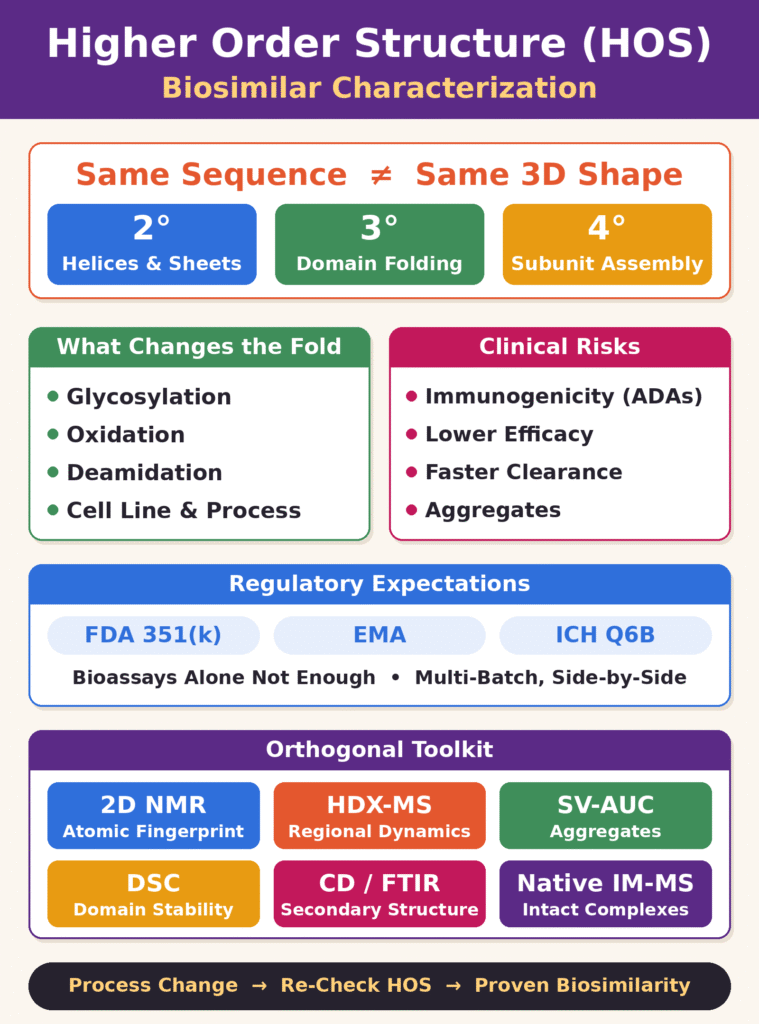
- Same sequence doesn’t mean same structure. Biosimilars with identical amino acid sequences can still fold differently in 3D, which affects efficacy, target binding and immunogenicity. That makes higher order structure (HOS) analysis essential.
- Folding is shaped by process and chemistry. Post-translational modifications (glycosylation, oxidation, deamidation), the host cell line, bioreactor conditions and process stress can all subtly change secondary, tertiary or quaternary structure without changing molecular weight.
- Structural changes carry clinical risk. Misfolding can expose hidden hydrophobic regions and new epitopes. These can trigger anti-drug antibodies, which may neutralize the drug, speed its clearance, or cause serious immune reactions. Aggregates are an especially high-risk impurity.
- Regulators expect direct HOS evidence. FDA (Section 351(k)), EMA and ICH Q6B all require thorough structural characterization. Bioassays alone are too variable (10–20% RSD) to prove comparability, so multiple biosimilar and reference batches must be tested side by side.
- No single technique is enough. An orthogonal toolkit is needed:
- 2D NMR for atomic fingerprints
- HDX-MS for regional dynamics
- SV-AUC for aggregates
- DSC for domain stability
- CD/FTIR for secondary structure
- Native IM-MS for intact complexes
- Monitoring continues after approval. Manufacturing changes such as new media, resins or scale-up can cause gradual “biological drift.” HOS must be re-checked to confirm the product stays comparable.
- Bottom line: Rigorous, multi-method HOS analysis links chemical identity to clinical safety and performance. It is a core requirement for demonstrating biosimilarity and gaining regulatory approval.
The Biological Impetus: Why Primary Sequence Identity Fails to Guarantee Conformational Fidelity
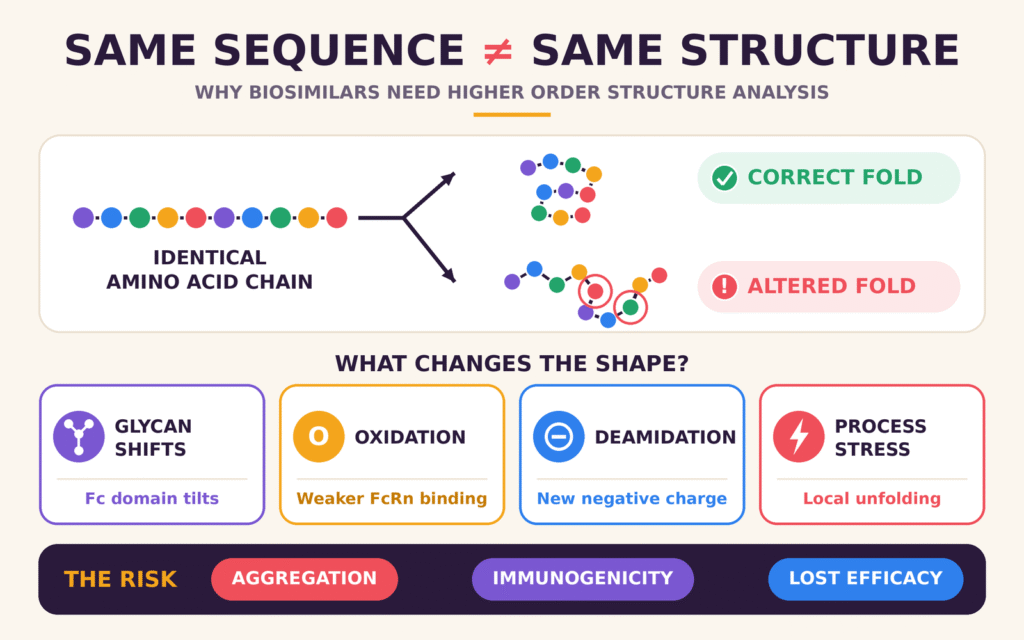
Identical primary amino acid sequences do not necessarily result in identical protein folding because post-translational modifications, thermodynamic microenvironments, and cell culture dynamics can introduce subtle structural variations at the secondary, tertiary, and quaternary levels. Polypeptide chains undergo folding processes governed by localized thermodynamic minima, hydrophobic collapse, and electrostatic interactions during translation and post-translational processing. Differences in host cell line expression machinery, such as Chinese Hamster Ovary (CHO) cells versus murine NS0 or Sp2/0 platforms, along with variations in bioreactor operating parameters and downstream purification protocols, can alter the microenvironmental conditions under which biotherapeutics fold.
Post-translational modifications, including site-specific N-glycosylation, methionine oxidation, asparagine deamidation, and C-terminal lysine truncations, can change local charge distributions and steric interactions without altering the overall length of the underlying polypeptide backbone. These chemical modifications can disturb localized folding dynamics and shift the equilibrium between active and inactive conformational states. For example, methionine oxidation at the CH2-CH3 domain interface of an IgG1 monoclonal antibody can alter local hydrophobic interactions, producing subtle conformational changes that reduce binding affinity to the neonatal Fc receptor (FcRn), even when the overall intact mass remains virtually unchanged. Similarly, variations in core fucosylation or terminal galactosylation within the Fc glycan network can influence the spatial orientation of the CH2 domains. These changes directly affect interactions with FcγRIIIa receptors and can influence antibody-dependent cellular cytotoxicity (ADCC).
Furthermore, alternative disulfide bond pairing or variations in hinge-region flexibility can produce distinct conformational isoforms that exhibit identical molecular weights under denaturing conditions but behave differently in vivo. The primary drivers of structural divergence despite identical primary sequences include site-specific post-translational heterogeneity, thermodynamic micro-unfolding, and disturbances in quaternary associations. Deamidation introduces negative charges that alter local electrostatic surface distributions and can destabilize adjacent structural elements. Thermal or shear stress during bioprocessing can also cause localized domain unfolding without breaking covalent bonds. These subtle tertiary structural changes may expose hydrophobic patches, accelerating the formation of soluble oligomers and sub-visible aggregates.
To learn more about how chemical modifications influence biosimilar structure and function, read our guide to post-translational modifications (PTMs) in biosimilars.
Clinical and Immunogenic Risks of Conformational Divergence in Biotherapeutics
Conformational divergence in biosimilar products can expose cryptic hydrophobic regions and neo-epitopes that may trigger immune responses and promote the formation of anti-drug antibodies. When biotherapeutics undergo partial unfolding, domain misalignment, or improper assembly, previously buried hydrophobic residues can become accessible on the molecular surface. These exposed structural motifs may function as damage-associated molecular patterns (DAMPs) or novel conformational epitopes, increasing uptake by antigen-presenting cells (APCs) and stimulating T-cell activation.
The clinical consequences of induced immunogenicity can range from reduced drug efficacy to severe systemic adverse reactions. Anti-drug antibodies (ADAs) generated against conformational neo-epitopes may bind to the target-binding complementarity-determining regions (CDRs) of a biosimilar, thereby neutralizing its biological activity. In other cases, non-neutralizing ADAs can accelerate drug clearance from circulation through immune complex formation, altering pharmacokinetic (PK) and pharmacodynamic (PD) profiles. In severe cases, ADAs may cross-react with endogenous proteins, resulting in the neutralization of naturally occurring biological factors.
Sub-visible aggregates and soluble oligomers represent some of the most critical product-related impurity classes associated with higher-order structural instability. Multimers and high-molecular-weight species can directly cross-link B-cell receptors, potentially bypassing conventional immune tolerance mechanisms and triggering potent cytokine cascades. Consequently, establishing analytical sameness of higher-order structures during early-stage development and commercial lot release is essential for protecting patient safety.
Understand how analytical methods identify and characterize potentially significant product-related impurities in our guide to impurity profiling of biosimilars.
Regulatory Mandates for Higher Order Structure Analysis for Biosimilar Characterization
Regulatory frameworks enforced by the FDA, EMA, and ICH Q6B establish the importance of Higher Order Structure Analysis for Biosimilar Characterization in demonstrating analytical sameness and supporting the streamlining of clinical trials when scientifically justified. International harmonization guidelines, particularly ICH Q6B, specify that biotechnological and biological products must undergo comprehensive characterization of their physicochemical properties, biological activity, immunochemical properties, purity, and higher-order structure. FDA and EMA regulatory science directives emphasize a stepwise approach to biosimilar development in which rigorous comparative analytical assessments provide the foundation for justifying reduced animal and clinical study requirements.
Under regulatory scrutiny, biological assays alone are insufficient to establish higher-order structural comparability. Although bioassays measure overall functional output, they often exhibit substantial variability, typically reflected by a relative standard deviation of 10% to 20%, and may not distinguish a fully native molecule from a mixture containing structurally altered variants whose activities compensate for one another. Regulators therefore expect direct, high-resolution biophysical characterization of secondary, tertiary, and quaternary structural similarity using orthogonal analytical techniques.
Regulatory submissions require biosimilar applicants to evaluate multiple batches of the proposed biosimilar alongside multiple batches of the reference product tested side by side to establish statistically justified acceptance ranges. Any observed structural differences must be thoroughly characterized, and their potential effects on clinical safety and efficacy must be scientifically justified through mechanistic evaluation.
For additional context on the regulatory expectations governing biological product characterization, explore our overview of the ICH Q6B guidelines for biological characterisation.
Orthogonal Analytical Toolkit for Higher Order Structure Analysis for Biosimilar Characterization
A comprehensive Higher Order Structure Analysis for Biosimilar Characterization requires an orthogonal combination of high-resolution spectroscopic, calorimetric, hydrodynamic, and mass spectrometric platforms to minimize analytical blind spots. Because no single biophysical method can simultaneously characterize global secondary structural features, localized tertiary loop flexibility, and low-abundance quaternary aggregates, regulatory authorities expect a multilayered analytical characterization strategy.
High-Resolution Biophysical Techniques for Higher Order Structure Analysis for Biosimilar Characterization
Two-dimensional Nuclear Magnetic Resonance (2D NMR) spectroscopy provides atomic-level, site-specific structural fingerprints of intact biotherapeutics in solution. Techniques such as 1H-15N and 1H-13C methyl Heteronuclear Single Quantum Coherence (HSQC) or Heteronuclear Multiple Quantum Coherence (HMQC) measure chemical shifts associated with backbone amide and methyl side-chain environments. By calculating chemical shift perturbations (CSP) and applying principal component chemometrics, 2D NMR can detect subtle conformational variations throughout the molecular architecture with sub-nanometer resolution.
Hydrogen-Deuterium Exchange Mass Spectrometry (HDX-MS) evaluates regional conformational dynamics and solvent accessibility by measuring the exchange rates of backbone amide hydrogens with deuterium in heavy water (D2O). Peptides undergoing conformational loosening or increased solvent exposure generally exhibit accelerated deuterium uptake. Following enzymatic digestion, these changes can be localized to individual peptide segments. HDX-MS is particularly sensitive to subtle domain shifts, epitope mapping, and hinge flexibility that may remain undetected by lower-resolution spectroscopic techniques.
Sedimentation Velocity Analytical Ultracentrifugation (SV-AUC) serves as a primary matrix-free method for characterizing quaternary structural assemblies, native oligomers, and sub-visible aggregates. By measuring sedimentation coefficients (s20,w) under high centrifugal forces in native formulation buffers, SV-AUC can quantify low-abundance, high-molecular-weight species without the stationary-phase column interactions or dilution artifacts associated with size-exclusion chromatography (SEC).
Differential Scanning Calorimetry (DSC) measures the thermodynamic stability of individual structural domains by monitoring changes in heat capacity during controlled thermal denaturation. DSC profiles provide distinct transition temperatures (Tm1, Tm2, Tm3) and unfolding enthalpies (ΔH) associated with the localized melting of Fab, CH2, and CH3 domains. These measurements offer quantitative insights into domain stability and interdomain interactions.
Spectroscopic techniques, including Far-UV Circular Dichroism (Far-UV CD, 190-250 nm), Near-UV CD (250-320 nm), and Fourier-Transform Infrared (FTIR) spectroscopy, provide essential baseline assessments of secondary structural features, including α-helix and β-sheet content, and tertiary aromatic environments involving tryptophan, tyrosine, and phenylalanine side chains. Additionally, Native Mass Spectrometry (Native MS), combined with Ion Mobility MS (IM-MS), can preserve non-covalent quaternary assemblies during transfer into the gas phase. These techniques generate collision cross-section (CCS) values that help distinguish gas-phase structural isomers and intact proteoforms.
Explore how native-state mass spectrometry helps investigate intact protein assemblies and non-covalent interactions in our article on native mass spectrometry for biosimilars.
| Analytical Technique | Structural Dimension Assessed | Analytical Sensitivity & Resolution | Key Informative Output for Biosimilarity |
|---|---|---|---|
| 2D NMR (1H-13C / 1H-15N) | Global tertiary and quaternary fingerprint | High (atomic resolution, site-specific) | Chemical shift perturbations (CSP) and structural similarity metrics |
| HDX-MS | Regional dynamics and solvent accessibility | High (peptide-level, 4-10 amino acids) | Deuterium uptake kinetics and solvent exposure maps |
| SV-AUC | Quaternary aggregation and oligomeric states | High (first-principles, solution-state) | Sedimentation coefficient (s20,w) distribution |
| DSC | Thermodynamic domain stability | Moderate (domain-level transitions) | Transition temperatures (Tm) and unfolding enthalpy (ΔH) |
| Far-UV / Near-UV CD | Secondary (β-sheet) and tertiary (aromatic) structure | Moderate (global average) | Molar ellipticity (θ) and alterations in chiral environments |
| Native IM-MS | Gas-phase quaternary structure and proteoforms | High (intact non-covalent complexes) | Ion mobility collision cross-section (CCS) and mass-to-charge ratio (m/z) |
Mitigating Biological Drift and Manufacturing Process Variations
Continuous monitoring of higher-order structures helps mitigate biological drift during post-approval manufacturing changes, ensuring that modifications to cell culture or purification parameters do not adversely affect critical quality attributes. Biopharmaceutical manufacturing depends on living host organisms, making minor changes in raw materials, culture feeds, or scale-up logistics difficult to avoid throughout commercial production lifecycles.
When manufacturers optimize upstream culture duration, modify culture media, or change downstream chromatography resins to improve yields, they must verify that the structural profile of the post-change product remains comparable to that of the pre-change material. Biological drift can occur when subtle, cumulative manufacturing variations gradually alter the distribution of structural variants over time. Implementing continuous higher-order structural characterization helps maintain comparability and prevent unintended changes in clinical performance or safety profiles.
A well-designed comparability strategy helps determine whether manufacturing changes affect the product’s structural and functional characteristics. Learn more in our guide to biosimilar comparability studies.
Conclusion
Higher Order Structure Analysis for Biosimilar Characterization is a fundamental requirement for demonstrating biosimilarity by connecting linear chemical identity with clinical safety and consistent product performance. Identical primary amino acid sequences alone cannot guarantee that a biosimilar molecule will adopt the precise spatial architecture required for therapeutic equivalence. Even minor changes in three-dimensional folding, domain flexibility, or quaternary assembly can compromise target-binding kinetics, alter pharmacokinetics, or trigger serious immunogenic responses in patients.
To meet stringent global regulatory requirements, biosimilar developers must implement orthogonal biophysical testing strategies that combine atomic-resolution methods, such as 2D NMR and HDX-MS, with solution-state hydrodynamic techniques, including SV-AUC, and thermodynamic methods such as DSC. Collaborating with advanced contract testing facilities enables biopharmaceutical innovators to address regulatory expectations, strengthen analytical comparability assessments, and support the approval of high-quality biotherapeutics.
quality biotherapeutics.
For support with advanced structural analysis and comprehensive analytical characterization, explore ResolveMass Laboratories’ biosimilar characterization services.
To consult technical specialists about advanced mass spectrometry workflows and biophysical comparability studies, visit the official ResolveMass Contact Page.
Frequently Asked Questions (FAQs)
Hydrogen-Deuterium Exchange Mass Spectrometry (HDX-MS) monitors the exchange of backbone amide hydrogens with deuterium to evaluate protein flexibility and solvent accessibility. It identifies structural differences within specific peptide regions, including changes in domain dynamics, hinge flexibility, and binding interfaces. This regional information can reveal conformational changes that global spectroscopic techniques may overlook.
Post-translational modifications can influence protein folding by changing local charge distributions, steric interactions, and hydrogen-bonding patterns. Modifications such as methionine oxidation and asparagine deamidation may alter domain stability or shift the balance between different conformational states. These changes can affect biological activity, molecular interactions, and the overall structural comparability of biosimilars.
Biological activity assays measure a protein’s functional response but do not directly establish whether its three-dimensional structure matches that of the reference product. Differences in conformation, domain flexibility, or aggregation may remain undetected if they do not substantially change the measured biological activity. Therefore, these assays should be complemented by orthogonal biophysical techniques to establish a more comprehensive assessment of structural comparability.
Two-dimensional Nuclear Magnetic Resonance (2D NMR) spectroscopy generates detailed structural fingerprints by measuring chemical environments throughout a protein in solution. Comparing chemical shift patterns helps identify subtle conformational differences between a proposed biosimilar and its reference product. The resulting data support the assessment of structural similarity and consistency across manufacturing batches.
Sedimentation Velocity Analytical Ultracentrifugation (SV-AUC) evaluates protein assemblies by measuring their sedimentation behavior under high centrifugal forces in solution. Because it does not require a stationary-phase separation matrix, it can characterize native oligomers and high-molecular-weight species while avoiding column-related interactions. Its solution-based measurements provide valuable evidence of quaternary structure and aggregation profiles.
The FDA and EMA evaluate higher-order structural differences as part of the overall evidence supporting biosimilarity. Any observed differences must be characterized and assessed to determine whether they could affect biological activity, clinical safety, efficacy, or immunogenicity. Significant unexplained differences may require additional analytical or clinical evidence and can complicate regulatory approval.
Far-UV Circular Dichroism (Far-UV CD) estimates overall secondary structure composition, including α-helices and β-sheets, by measuring differences in the absorption of circularly polarized light. However, it provides a global structural assessment and may not identify localized changes in specific protein regions. Combining CD with techniques such as 2D NMR, HDX-MS, and Differential Scanning Calorimetry (DSC) provides a more complete evaluation of structural comparability.
Higher-order structural instability can promote partial unfolding and aggregate formation, exposing normally buried molecular regions and creating new conformational epitopes. These structural changes may increase recognition and uptake by antigen-presenting cells, potentially stimulating immune responses against the therapeutic antibody. The resulting anti-drug antibodies can reduce treatment effectiveness, accelerate drug clearance, or contribute to adverse immune reactions.
Higher-order structure analysis should begin during early development and continue through formulation optimization, process development, scale-up, and manufacturing changes. Early characterization helps identify structural differences before they create substantial development or regulatory challenges. Repeating appropriate analyses during comparability assessments and commercial manufacturing also helps verify that critical structural attributes remain consistent throughout the product lifecycle.
Reference:
- Jones, L. M., Zhang, H., Cui, W., Kumar, S., Sperry, J. B., Carroll, J. A., & Gross, M. L. (2013). Complementary MS methods assist conformational characterization of antibodies with altered S–S bonding networks. Journal of the American Society for Mass Spectrometry, 24(6), 835–845. https://doi.org/10.1007/s13361-013-0582-4
- International Council for Harmonisation of Technical Requirements for Pharmaceuticals for Human Use. (1999, March 10). Specifications: Test procedures and acceptance criteria for biotechnological/biological products (Q6B). https://database.ich.org/sites/default/files/Q6B%20Guideline.pdf
- U.S. Food and Drug Administration. (2022). Assessing the effects of food on drugs in INDs and NDAs—Clinical pharmacology considerations: Guidance for industry. https://www.fda.gov/media/159261/download
- U.S. Food and Drug Administration. (2015, April). Quality considerations in demonstrating biosimilarity of a therapeutic protein product to a reference product: Guidance for industry. https://www.fda.gov/media/135612/download
- U.S. Food and Drug Administration. (2025, September). Development of therapeutic protein biosimilars: Comparative analytical assessment and other quality-related considerations: Guidance for industry. https://www.fda.gov/regulatory-information/search-fda-guidance-documents/development-therapeutic-protein-biosimilars-comparative-analytical-assessment-and-other-quality
- European Medicines Agency. (2014, October 23). Guideline on similar biological medicinal products (Revision 1). https://www.ema.europa.eu/en/documents/scientific-guideline/guideline-similar-biological-medicinal-products-rev1_en.pdf
Get In Touch With Us
About The Author


