

Introduction
cGMP Peptide Manufacturing Services Canada provide comprehensive support across chemical synthesis, preparative chromatographic purification, counter-ion exchange, controlled lyophilization, orthogonal analytical characterization, and quality release under a Health Canada Drug Establishment Licence (DEL). Rather than functioning solely as custom-synthesis suppliers, qualified Canadian contract development and manufacturing organizations (CDMOs) connect early-stage process chemistry with regulated clinical and commercial manufacturing. These activities are performed in accordance with Health Canada GUI-0104, ICH Q7, USP , and U.S. Food and Drug Administration (FDA) requirements.
Synthetic peptides occupy an intermediate position between conventional small-molecule drugs and recombinant biologics. Consequently, pharmaceutical sponsors need specialized manufacturing and analytical capabilities to manage deletion impurities, investigate trace nitrosamine formation, and support Master File submissions across multiple regulatory jurisdictions without relying on fragmented laboratory handoffs. Within Canada’s life-sciences sector, available facilities range from Eastern Canadian cGMP process development organizations to specialized analytical and clinical-supply providers in Quebec.
Review the differences between peptide and small-molecule drugs to understand their distinct development and characterization requirements.
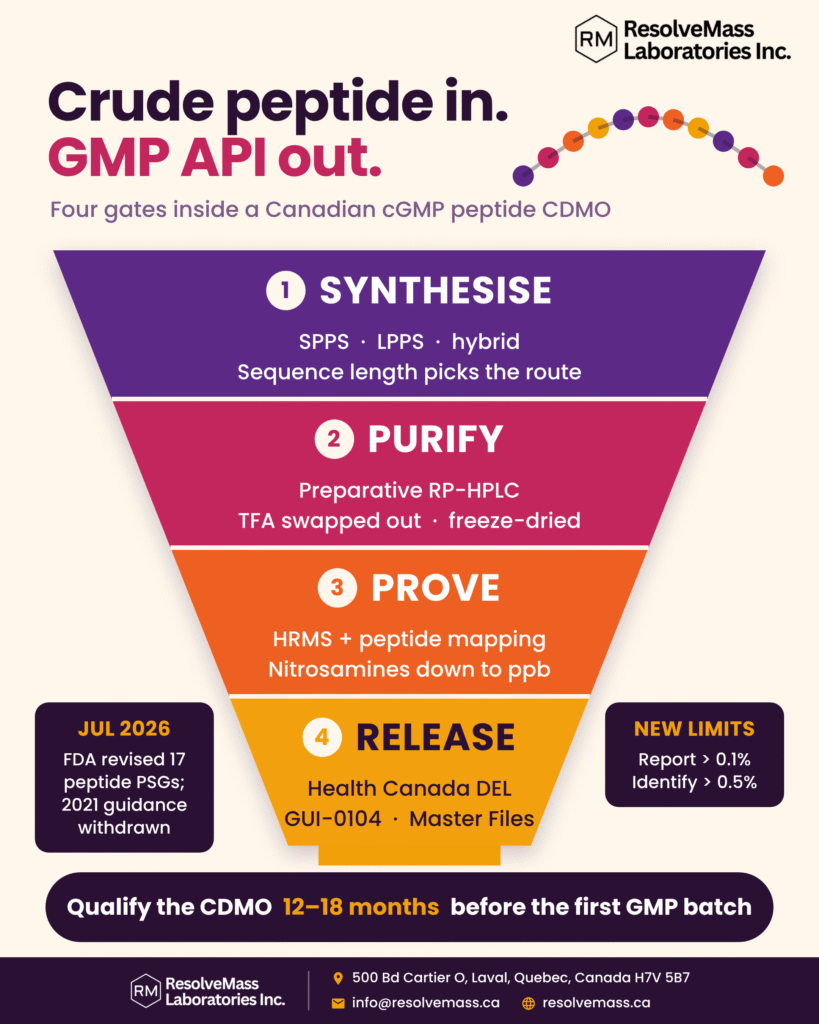
For instance, ResolveMass Laboratories Inc., headquartered in Laval within the greater Montreal corridor, demonstrates how Canadian service providers can integrate discovery chemistry, high-resolution mass spectrometry (HRMS), and licensed GMP testing and clinical release within a unified quality framework. The organization has more than 15 years of peptide and protein analysis experience, a PhD-led scientific team, Health Canada DEL No. 3-002945-A, U.S. FDA Establishment Identifier 3042696771, and ISO 9001:2015 certification. Bringing these capabilities together helps reduce operational gaps between development, analytical characterization, and regulated supply. CDMO planning recommendations generally suggest beginning technical discussions and quality qualification approximately 12–18 months before the intended first GMP batch. This preparation period provides sufficient time for synthesis route optimization, analytical method validation, and stability study initiation.
Share via:
Quick Summary:
- What these CDMOs actually do: Canadian cGMP peptide providers cover chemical synthesis, preparative purification, counter-ion exchange, lyophilisation, orthogonal analytical characterisation and quality release under a Health Canada Drug Establishment Licence, aligned to GUI-0104, ICH Q7 and FDA requirements — bridging early process chemistry and regulated clinical or commercial supply.
- Three synthesis platforms, chosen by sequence: SPPS suits sequences up to ~40 residues and early clinical supply; LPPS suits short 2–15 residue peptides at large scale; hybrid SPPS/LPPS fragment assembly handles 30–60+ residue APIs such as GLP-1 analogues, with lower deletion impurities. Resin loading, coupling kinetics and solvent choice (including green solvent limits with hydrophobic residues) are optimised before the master batch record is fixed.
- Downstream processing decides purity and yield: preparative RP-HPLC scaled geometrically from the analytical method, MCSGP or low-dead-volume systems for hard separations, validated TFA counter-ion exchange to a pharmaceutically acceptable salt, then primary and secondary lyophilisation, with amino acid analysis to confirm net peptide content.
- Small batches are expensive because of hold-up and QC: no statutory minimum batch size exists under ICH Q7, but equipment dead volume, tray losses and fixed QC release samples dominate at gram scale — fixed overhead exceeds 80% of batch cost for a 20 g lot, versus under 15% at 25 kg. Multi-product sites must also hold HBEL-based MACO cleaning limits that can fall near analytical detection limits for potent peptides.
- One HPLC number is not characterisation: diastereomers, deamidated and oxidised variants co-elute, so release relies on a layered package — RP-HPLC/UHPLC purity plus SEC, HRMS with LC-MS/MS peptide mapping, qNMR/CD/FTIR and amino acid analysis, ICH Q1A(R2) stability and forced degradation, and compendial endotoxin and sterility testing.
- Nitrosamines need a peptide-specific method: piperidine or 4-methylpiperidine from Fmoc deprotection, dimethylamine from DMF degradation, coupling by-products and trace nitrites can nitrosate vulnerable amines, so NDSRI testing under ICH M7(R2) uses matrix-matched sample prep with QqQ LC-MS/MS, Orbitrap HRMS or headspace GC-MS/MS at ppb-level quantitation with isotope-labelled internal standards.
- Regulatory framework and audit checks: activities sit under Part C Division 2, with GUI-0104 governing API manufacture and data integrity and GUI-0001 taking over at sterilisation and fill-finish; Type I ASMFs map to FDA Type II DMFs, and CETA and the expanded Canada–Switzerland MRA reduce duplicate inspections without removing Canadian finished-product testing duties. Before signing, verify the DEL scope, data governance, in-house orthogonal instrumentation, scale-up and salt-exchange controls, cleaning validation records and master file experience — and start that qualification 12–18 months before the first GMP batch.
Core Technical Scope of cGMP Peptide Manufacturing Services Canada
A comprehensive provider of cGMP Peptide Manufacturing Services Canada typically offers three scalable synthesis approaches: Solid-Phase Peptide Synthesis (SPPS), Liquid-Phase Peptide Synthesis (LPPS), and hybrid SPPS/LPPS fragment assembly. These manufacturing strategies are supported by automated downstream purification and isolation technologies. Selecting the most appropriate approach depends on several factors, including amino acid sequence length, chemical modifications such as cyclization or conjugation, and the required production volume.
Process engineering assessments used by peptide manufacturers demonstrate how Canadian CDMOs match sequence complexity and clinical development requirements with suitable chemical synthesis platforms.
| Synthesis Methodology | Typical Sequence Length | Target Scale Range | Key Chemical Advantages | Primary Clinical Applications |
|---|---|---|---|---|
| Solid-Phase Peptide Synthesis (SPPS) | Up to 40+ residues | Grams to 25+ kg/batch | High automation, faster process optimization, and effective management of hydrophobic and aggregation-prone sequences | Early-phase clinical supply, complex cyclic peptides, and personalized neoantigen therapeutics |
| Liquid-Phase Peptide Synthesis (LPPS) | 2 to 15 residues | 100+ kg campaigns | Cost-efficient manufacturing, high volumetric productivity, and elimination of resin-related limitations | Peptide linkers, short peptide APIs, and commercial diagnostic applications |
| Hybrid Strategy (SPPS/LPPS) | 30 to 60+ residues | Multi-kilogram scale | Lower deletion impurity levels, improved crude yields, and enhanced scalability | Commercial GLP-1 analogues and long-chain polypeptide APIs (e.g., tirzepatide) |
In addition to conventional linear peptides, specialized Canadian facilities manufacture cyclic, stapled, branched, and multifunctional peptide constructs. Their capabilities may also extend to peptide-oligonucleotide conjugates (POCs), which require the integration of SPPS, oligonucleotide chemistry, and solution-phase bioconjugation under cGMP quality systems.
For long-chain metabolic therapeutics such as tirzepatide, peer-reviewed manufacturing literature demonstrates the advantages of combining a hybrid SPPS/LPPS convergent fragment assembly approach with continuous manufacturing. This combination supports kilogram-scale GMP production while helping control closely related deletion impurities. Such manufacturing strategies are particularly important when developing complex peptide APIs that require high purity, reproducible production, and consistent batch performance.
Sponsors evaluating larger production requirements can examine specialized peptide CDMO scale-up services to understand how manufacturing processes transition from development batches to commercial production.
Resin Loading, Coupling Kinetics, and Green Solvent Optimization
Before finalizing master batch records, Canadian CDMO process chemists evaluate several critical synthesis parameters. These include solid-support swelling behavior, resin loading density, reagent stoichiometry, and coupling kinetics. Optimizing these variables helps prevent incomplete deprotection reactions and peptide aggregation during on-resin synthesis.
Hydrophobic peptide sequences can sometimes associate with one another while attached to the polymer resin matrix. This self-association can restrict reagent accessibility and slow reaction kinetics, resulting in truncated sequences or deletion-related by-products. These impurities can subsequently increase the complexity of downstream purification and reduce overall manufacturing yields.
To improve environmental sustainability and manage solvent-related expenses during scale-up, North American CDMOs are increasingly evaluating green solvent alternatives and closed-loop distillation recovery systems. These approaches can be incorporated into SPPS coupling and resin-washing operations to reduce solvent consumption and improve manufacturing efficiency.
However, process scale-up assessments identify an important chemical limitation. Although sustainable solvents may offer lower toxicity and improved environmental characteristics, some have limited solubility for highly hydrophobic amino acid derivatives. Consequently, process chemists must carefully optimize cosolvent compositions and reaction conditions before transferring the manufacturing process into GMP production suites. This evaluation helps maintain reaction efficiency, product quality, and reproducibility while supporting more sustainable manufacturing practices.
Sponsors planning the transition from laboratory synthesis to larger manufacturing campaigns can review peptide API scale-up considerations to understand the process variables that influence production efficiency and scalability.
Preparative RP-HPLC, Counter-Ion Exchange, and Lyophilization in cGMP Peptide Manufacturing Services Canada
Downstream processing within cGMP Peptide Manufacturing Services Canada generally includes preparative Reversed-Phase High-Performance Liquid Chromatography (RP-HPLC), validated counter-ion exchange procedures, and multi-stage vacuum lyophilization. These operations are designed to produce active pharmaceutical ingredients (APIs) that meet specified quality requirements, including ≥95.0% chromatographic purity and no individual unspecified impurity exceeding 2.0%.
When transferring an analytical RP-HPLC method using 214 nm UV detection to preparative GMP columns with comparable bed lengths and stationary-phase particle sizes, process engineers must maintain appropriate chromatographic conditions. Volumetric flow rate and crude sample loading are scaled proportionally to the square of the column internal diameter ratio. This approach helps preserve constant linear velocity, column volumes per gradient, and chromatographic resolution during scale-up.
For challenging impurity separations, conventional single-column purification may require sacrificing substantial product yield to obtain the desired purity. To address this limitation, specialized manufacturing facilities may use Multi-Column Solvent Gradient Purification (MCSGP) or low-dead-volume micro-preparative systems. These technologies allow impure side fractions to be recycled, improving product recovery while maintaining the required purification performance.
Preparative RP-HPLC frequently uses trifluoroacetic acid (TFA) as an ion-pairing modifier. Therefore, CDMOs must perform counter-ion exchange before final product isolation to comply with applicable residual TFA limits, which may be restricted to ≤0.5% or ≤0.1%.
Depending on the peptide molecule and its intended pharmaceutical application, laboratories replace TFA⁻ with pharmaceutically acceptable counter-ions. For example, TFA⁻ can be exchanged for chloride (Cl⁻) through controlled freeze-drying in hydrochloric acid or by using dedicated chromatographic salt-exchange procedures.
After purification and salt exchange, the finished peptide solutions undergo primary and secondary lyophilization. These operations are commonly performed under a vacuum of 10–50 mTorr to remove bound water and achieve the required residual moisture characteristics. Quantitative Amino Acid Analysis (AAA) or Elemental Analysis (EA) is subsequently performed to determine Net Peptide Content. This value commonly needs to reach ≥80.0% on a dry-weight basis, allowing clinical formulation teams to calculate the actual peptide content accurately and avoid under-dosing during drug product preparation.
Explore the technical considerations involved in formulating a lyophilized peptide injectable to understand how peptide stability, formulation composition, and freeze-drying parameters influence the finished drug product.
How Do Minimum Batch Sizes and Equipment Hold-Up Losses Shape GMP Campaigns?
Minimum batch sizes at a Canadian cGMP peptide CDMO are primarily influenced by fixed quality control (QC) release sample requirements, equipment dead-volume hold-up losses, and cleaning limitations associated with multi-product manufacturing. These requirements are not governed by a universal statutory minimum batch size under ICH Q7.
Although ICH Q7 allows manufacturing controls to be adapted to the development stage and intended clinical application, fixed cleanroom operating expenses and analytical testing requirements can substantially increase the manufacturing cost per gram for batches below the kilogram scale.
No independent cross-CDMO cost audit was identified in publicly available regulatory filings. However, vendor process engineering models generally categorize peptide manufacturing campaigns into several production ranges:
- Phase 1 clinical supply: 10–250 g.
- Phase 2/3 pivotal trials: 250 g–5 kg.
- Niche or rare-disease commercial launches: 1–10 kg.
- High-volume commercial therapies: 100+ kg.
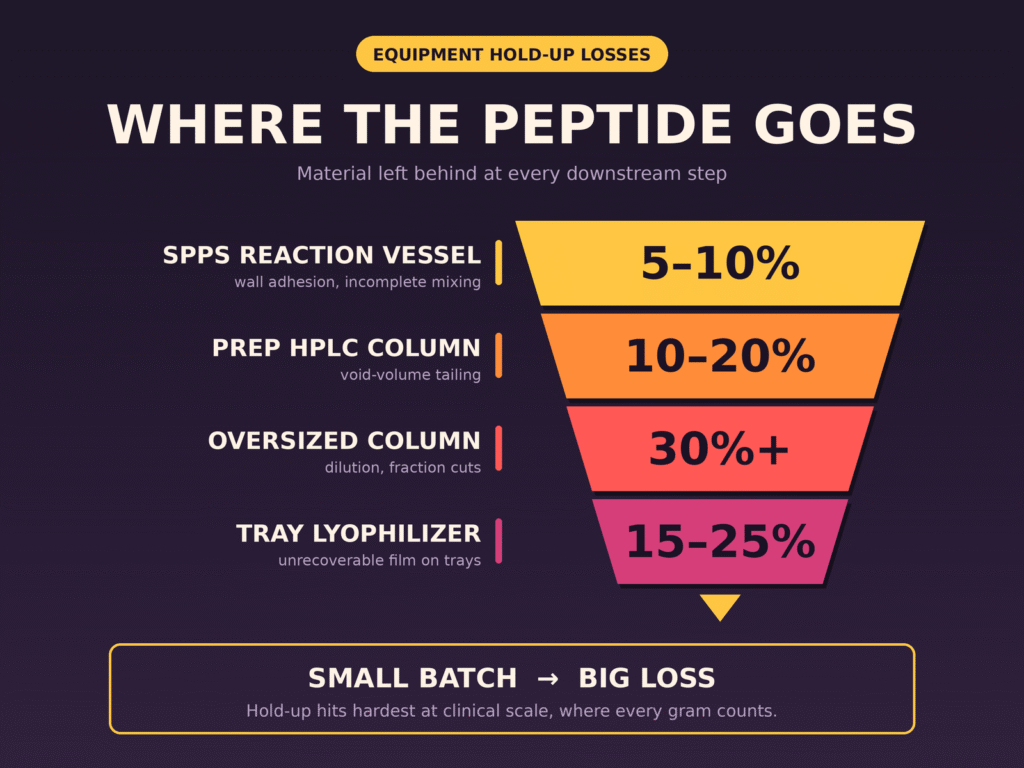
At smaller clinical manufacturing scales, physical material losses across standard equipment can account for a considerable proportion of the starting peptide quantity. These losses occur because of incomplete material recovery, equipment surface adhesion, dilution, and unavoidable process hold-up.
Typical equipment-related losses identified in vendor modeling include:
- Bench or pilot SPPS vessels (1–15 L): Approximately 5%–10% of the material may be lost because of incomplete mixing and adhesion to vessel walls.
- Mid-scale preparative HPLC columns (15–30 cm diameter): Approximately 10%–20% of the material may be lost through void-volume tailing.
- Oversized preparative HPLC columns (60–100 cm diameter): Material losses may exceed 30% because of dilution and fraction-cutting requirements.
- Industrial tray lyophilizers (200–500 L): Approximately 15%–25% of the material may remain unrecoverable as a film on tray surfaces.
The following table illustrates how manufacturing scale influences raw material requirements, isolation yields, QC losses, and fixed production overhead.
| Process Cost Metric | 20-Gram GMP Batch Scale | 1-Kilogram GMP Batch Scale | 25-Kilogram GMP Batch Scale |
|---|---|---|---|
| Raw Material Weight Input Ratio | ~120 g–180 g crude synthesis equivalents | ~4 kg–6 kg crude synthesis equivalents | ~100 kg–140 kg crude synthesis equivalents |
| Estimated Net Isolation Yield | 12%–18% (high hold-up impact) | 25%–35% (optimized downstream) | 35%–45% (fully optimized hybrid route) |
| QC Release Material Loss Share | 20%–40% of total isolated lot | 0.5%–1.0% of total isolated lot | <0.05% of total isolated lot |
| Fixed Overhead Share of COGS | >80% of total batch cost | ~35%–45% of total batch cost | <15% of total batch cost |
Additional vendor modeling indicates that these yield limitations and fixed overhead requirements can increase the per-gram manufacturing cost of a 20 g GMP batch to approximately 15×–25× the baseline multiple.
Furthermore, Canadian facilities operating multi-product manufacturing campaigns must implement appropriate cleaning validation procedures. These procedures rely on Maximum Allowable Carryover (MACO) calculations derived from the Permitted or Acceptable Daily Exposure (HBELprevious) of the previously manufactured peptide API and the minimum batch size (MBSnext) of the subsequent product produced using shared equipment. Relevant dosing and safety parameters must also be considered.
When manufacturing highly potent peptides, the resulting MACO limits may become extremely low. If the required swab acceptance limits approach or fall below practical analytical detection capabilities, sponsors may need to consider increasing the campaign batch size or investing in dedicated purification columns and resin lines. These measures help control cross-contamination risks and maintain compliance with cleaning validation requirements.
Compare the peptide CDMO vs. CMO model when evaluating manufacturing responsibilities, technical capabilities, and project requirements.
What Analytical Characterization and Nitrosamine Controls Are Required for Regulatory Release?
Canadian cGMP peptide CDMOs provide a combination of chromatographic, mass spectrometric, spectroscopic, and microbiological testing to verify peptide identity, purity, structural integrity, and overall product quality. These analytical capabilities are essential for confirming the primary amino acid sequence, identifying synthesis-related and degradation-related impurities at levels down to ≥0.10%, and measuring trace genotoxic contaminants.
Peptide impurities can be particularly challenging to characterize because diastereomers, deamidated variants, and oxidized amino acid residues may co-elute during conventional single-wavelength UV detection. As a result, regulators expect multiple complementary analytical techniques to establish structural identity and impurity profiles rather than relying exclusively on HPLC purity results.
Explore GLP-1 peptide analytical characterization to understand the analytical approaches used to assess complex peptide APIs.
Orthogonal Impurity Profiling and Immunogenicity Risk Assessment
Under USP , ICH Q3A frameworks, and FDA expectations for synthetic peptides, peptide impurities present at ≥0.10% of the total drug substance may require structural elucidation through UHPLC-HRMS and MS/MS fragmentation analysis.
Newly identified impurities that exceed 0.10% but remain below a 0.5% qualification ceiling typically require additional evaluation to determine whether they introduce potential immunogenicity concerns. Such assessments may include in silico Major Histocompatibility Complex (MHC) binding models and in vitro T-cell assays. These approaches help determine whether sequence variants could trigger undesirable immune responses.
In July 2026, the U.S. FDA updated its generic peptide development expectations by issuing 17 revised draft Product-Specific Guidances (PSGs) covering nine injectable peptide drugs. These included semaglutide, tirzepatide, liraglutide, teriparatide, glucagon, calcitonin salmon, pegcetacoplan, dasiglucagon hydrochloride, and vosoritide. The agency also proposed withdrawing its May 2021 guidance concerning ANDAs for Certain Highly Purified Synthetic Peptide Drug Products.
To address Canadian and U.S. regulatory requirements across both innovative and generic peptide development programs, qualified analytical laboratories generally implement a comprehensive five-part testing strategy.
1. Chromatographic Purity and Aggregation
Validated RP-HPLC or UHPLC-UV methods are used to assess chromatographic purity while meeting applicable USP resolution requirements of ≥1.5 and peak symmetry criteria. These methods are complemented by Size Exclusion Chromatography (SEC), which helps identify and separate covalent aggregates and peptide dimers.
2. High-Resolution Mass and Peptide Mapping
Orbitrap or QToF HRMS instruments are used to confirm the exact intact molecular weight of peptide APIs. Enzymatic digestion followed by LC-MS/MS peptide mapping helps identify and localize sequence-related errors, oxidation products, and deamidation modifications. Combining these techniques provides more detailed structural information than molecular weight confirmation alone.
3. Spectroscopic and Compositional Verification
Quantitative NMR (qNMR), Circular Dichroism (CD), and FTIR spectroscopy are applied to verify peptide structure, conformation, and other relevant physicochemical characteristics. Amino Acid Analysis (AAA) is additionally performed to establish absolute amino acid composition and support peptide content and potency assessment.
4. Forced Degradation and ICH Stability
Long-term, accelerated, and stress-testing stability studies are conducted under ICH Q1A(R2) conditions. These investigations help identify degradation pathways, evaluate product stability under different environmental conditions, and establish appropriate retest periods for peptide APIs.
5. Compendial Microbiological Release
Bacterial endotoxin testing is performed using Limulus Amebocyte Lysate (LAL) chromogenic or turbidimetric assays. Testing is conducted against product-specific acceptance limits, such as <5 EU/mg, where applicable. Microbiological release testing also includes 14-day USP sterility testing through membrane filtration or direct inoculation.
Review the semaglutide peptide characterization case study to understand how orthogonal analytical techniques support peptide characterization.
Nitrosamine and NDSRI Quantitation in Synthetic Peptide Matrices
Synthetic peptides and GLP-1 analogues require targeted nitrosamine risk assessments and confirmatory analytical testing. These evaluations cover both small-molecule nitrosamines and Nitrosamine Drug Substance-Related Impurities (NDSRIs) that may form during SPPS operations or subsequent formulation processes.
Several manufacturing-related materials and process by-products can contribute to nitrosamine formation. These include residual piperidine or 4-methylpiperidine from Fmoc deprotection, dimethylamine produced through DMF degradation, coupling reagent by-products, and trace nitrites originating from excipients or container-closure polymers. Under suitable chemical conditions, these substances may contribute to the nitrosation of vulnerable peptide amines.
To meet Health Canada, FDA, and EMA expectations under ICH M7(R2) and Q2(R2), analytical laboratories must develop sample preparation procedures that account for the specific peptide matrix. Techniques such as solid-phase extraction may be combined with triple-quadrupole (QqQ) LC-MS/MS, Orbitrap LC-HRMS, and headspace GC-MS/MS to achieve the required analytical sensitivity and selectivity.
Specialized CRO benchmarks, including the PhD-led mass spectrometry workflows available at ResolveMass Laboratories Inc., demonstrate the importance of establishing rigorous analytical validation criteria for confirmatory peptide NDSRI testing. These criteria include:
- Limit of Quantitation (LOQ): ≤10% of the applicable Acceptable Intake, typically corresponding to 0.1–1.0 ng/mL or 1–10 ppb.
- Calibration Linearity: A coefficient of determination of r² ≥ 0.999.
- Matrix Spike Recovery: Between 90% and 110%.
- LOQ Repeatability: Relative Standard Deviation (RSD) of ≤5%.
- Chromatographic Resolution: Rs > 2.0 from peptide-related degradation products, using custom isotope-labeled internal standards.
Meeting these analytical performance requirements helps demonstrate that nitrosamine-related impurities are adequately controlled and that the peptide drug substance satisfies applicable regulatory quality expectations. Matrix-specific validation is particularly important because peptide composition, degradation behavior, and sample preparation characteristics can influence analytical recovery and detection sensitivity.
How Does Canada’s Regulatory Framework Govern Peptide CDMOs and Global Filings?
Canadian peptide CDMOs operate under Part C, Division 2 of the Food and Drug Regulations. Their activities are overseen by Health Canada through Drug Establishment Licences (DELs), GUI-0104 (API GMP), GUI-0001 (Drug Product GMP), electronic Common Technical Document (eCTD) Master Files, and international Mutual Recognition Agreements (MRAs).
A Drug Establishment Licence authorizes specific regulated activities, including fabrication, packaging/labelling, testing, importing, distributing, and wholesaling. The authorization applies to the activities and sites specified in the licence and is separate from a drug’s Marketing Authorization.
When contracting Canadian peptide manufacturing services, pharmaceutical sponsors must understand the distinction between GUI-0104 and GUI-0001. Version 2 of GUI-0104, implemented on February 10, 2022, governs non-sterile APIs and intermediates, as well as sterile peptide APIs up to the stage immediately before sterilization. Its requirements apply from the point at which the defined API Starting Material enters the manufacturing process.
Harmonized with ICH Q7, Q9, and Q10, GUI-0104 Version 2 emphasizes strong data governance practices throughout API manufacturing and analytical testing. These expectations include validated computerized systems, electronic audit trails, safeguards against unauthorized data deletion, periodic backup verification, and formal investigations of both Out-of-Trend (OOT) and Out-of-Specification (OOS) results.
When a peptide manufacturing process proceeds to sterilization, aseptic processing, or dosage-form fill-finish operations, the applicable regulatory oversight shifts to GUI-0001. Additional requirements under GUI-0036 and Annex 13 also apply to relevant clinical trial drug products.
The following table summarizes the primary regulatory filing tools and their corresponding international equivalents.
| Regulatory Filing Tool | Health Canada Framework | U.S. FDA Equivalent | Operational Benefit for Peptide Sponsors |
|---|---|---|---|
| Active Substance Master File | Type I Master File (ASMF) | Type II Drug Master File (DMF) | Protects proprietary CDMO synthesis information through a Restricted Part while providing sponsors with an Applicant’s Part and Letter of Access (LoA) for CTA, IND, NDS, NDA, or ANDA review |
| Packaging & Container Closure | Type II Master File | Type III DMF | Supports extractables and leachables (E&L) assessments involving vials, stoppers, and delivery polymers |
| Excipient Master File | Type III Master File | Type IV DMF | Covers formulation buffers, stabilizers, and polymer-based delivery carriers |
| Site GMP Authorization | Drug Establishment Licence (DEL) | FDA Registration & Inspection | Required for authorized Canadian fabrication or QC testing activities; Canadian importers must list foreign API manufacturing buildings on their DEL |
International regulatory cooperation further supports the cross-border activities of Canadian peptide CDMOs. Canada participates in the Pharmaceutical Inspection Co-operation Scheme (PIC/S) and maintains bilateral MRAs with several international regulatory jurisdictions.
Under the EU–Canada Comprehensive Economic and Trade Agreement (CETA) GMP Protocol, including the recognition of third-country GMP inspection reports since April 2021, regulatory authorities can exchange relevant compliance information to reduce unnecessary duplicate inspections.
Similarly, the expanded Canada–Switzerland MRA, updated on January 31, 2025, incorporates APIs and extra-jurisdictional GMP certificates. These arrangements facilitate regulatory cooperation and the exchange of Certificates of Compliance between participating authorities.
However, such recognition arrangements do not eliminate every national regulatory obligation. Imported finished dosage forms remain subject to applicable Canadian finished-product testing requirements under C.02.019. Therefore, sponsors must evaluate both the manufacturing site’s GMP status and the specific Canadian regulatory responsibilities associated with imported products.
Compare Canadian and U.S. peptide CDMOs to understand the differences in manufacturing capabilities, regulatory oversight, and supply-chain considerations.
Checklist for Auditing a Canadian cGMP Peptide CDMO
Before entering into a quality agreement with a Canadian peptide CDMO, sponsor Quality Assurance (QA) and Chemistry, Manufacturing, and Controls (CMC) teams should evaluate six essential operational areas. Conducting these checks in a structured sequence helps establish whether the proposed manufacturing partner can support the required clinical or commercial development program.
1. Active DEL and Multi-Agency Credentials
Verify that the facility holds an active Health Canada Drug Establishment Licence covering the exact activity included in the proposed contract. Sponsors should distinguish between fabrication and testing authorizations rather than assuming that one automatically covers the other. If international regulatory submissions are planned, additional credentials such as U.S. FDA registration and ISO 9001:2015 Quality Management System (QMS) certification should also be reviewed.
2. GUI-0104 Data Governance Compliance
Evaluate the chromatography and mass spectrometry software used by the facility to confirm that appropriate data integrity controls are in place. The assessment should include role-based user access, protected electronic audit trails, periodic backup verification, and documented procedures for handling OOS and OOT results. These controls are essential for maintaining reliable analytical records and supporting regulatory inspections.
3. In-House Orthogonal Analytical Capacity
Confirm that the CDMO has access to the necessary analytical instruments and technical expertise. Relevant equipment should include QqQ LC-MS/MS, Orbitrap or QToF HRMS, qNMR, AAA, SEC, and CD/FTIR instrumentation. Having these capabilities available within the facility helps reduce reliance on external laboratories and minimizes delays associated with structural elucidation, peptide mapping, and nitrosamine testing.
4. Downstream Hold-Up and Salt-Exchange Controls
Review preparative RP-HPLC scale-up documentation to determine whether geometric scaling principles have been appropriately applied. Sponsors should also assess the availability of MCSGP or low-dead-volume purification options for small clinical batches. In addition, validated TFA counter-ion exchange procedures should be examined to confirm that residual counter-ion levels meet the applicable product specifications.
5. Cleaning Validation and MACO Documentation
Assess the facility’s multi-product manufacturing changeover procedures and cleaning validation documentation. Particular attention should be given to HBEL-based MACO calculations, analytical swab recovery, and established acceptance limits. These records should demonstrate that potential peptide carryover remains within acceptable limits and sufficiently below relevant analytical detection thresholds.
6. eCTD Master File Maintenance
Confirm that the CDMO has practical experience preparing, submitting, and maintaining Health Canada Type I ASMFs and U.S. FDA Type II DMFs. Sponsors should also evaluate the organization’s ability to manage confidential manufacturing information, maintain current regulatory documentation, and issue Letters of Access (LoA) within the required timelines. Effective Master File management helps support regulatory submissions while protecting proprietary synthesis and manufacturing information.
Use this guide to choosing a peptide CDMO in the U.S. to assess important partner-selection and qualification considerations.
Conclusion
Partnering with cGMP Peptide Manufacturing Services Canada provides pharmaceutical developers with considerably more than the advantage of proximity to the North American supply chain. Qualified Canadian CDMOs can offer integrated SPPS, LPPS, and hybrid synthesis route development, preparative purification with validated salt exchange, orthogonal HRMS and NMR-based impurity characterization, trace nitrosamine control, and coordinated Health Canada and FDA regulatory support.
By matching manufacturing batch sizes and analytical strategies with GUI-0104 data governance requirements and evolving 2026 peptide regulatory expectations, pharmaceutical sponsors can reduce fragmented technology transfers between research and development, process optimization, and clinical product release. A well-qualified manufacturing partner also helps manage process-related impurities, maintain consistent product quality, and establish a reliable foundation for clinical and commercial peptide supply.
For development teams seeking Canadian expertise in complex peptide synthesis, structural characterization, nitrosamine/NDSRI quantitation, and Health Canada–licensed GMP testing and release under DEL No. 3-002945-A and FDA Registration 3042696771, connecting with the PhD-led scientific team at ResolveMass Laboratories Inc. can help identify suitable analytical and manufacturing support for their development requirements.
Explore peptide CDMO services in Canada to learn more about Canadian peptide development, analytical support, and manufacturing capabilities.
Visit the Contact Us page to discuss peptide analytical characterization, regulatory testing, and GMP-related service requirements.
Frequently Asked Questions
ICH Q7 does not prescribe a fixed minimum production quantity for peptide active pharmaceutical ingredients. Instead, manufacturers establish practical batch sizes according to process requirements, analytical testing needs, equipment recovery limitations, and cleaning validation criteria. The appropriate scale also depends on the intended clinical development stage and the level of process control required.
Peptide release testing requires material for several analytical procedures, including RP-HPLC, HRMS, AAA, residual TFA analysis, moisture determination, endotoxin testing, sterility testing, and stability studies. Since many of these tests require relatively fixed sample quantities, they can consume a substantial percentage of smaller manufacturing lots. For example, vendor models estimate that QC sampling may account for 20%–40% of a 20 g batch, compared with approximately 0.5%–1.0% of a 1 kg batch.
Sequence length directly affects synthesis complexity, crude product quality, and downstream purification requirements. Short peptides containing 2–15 residues are generally suitable for LPPS, while automated SPPS can accommodate sequences of up to 40+ residues. Longer polypeptides containing approximately 30–60+ residues may benefit from hybrid SPPS/LPPS fragment assembly, which helps improve synthesis efficiency and manage deletion-related impurities.
Under USP , ICH Q3A frameworks, and FDA expectations for synthetic peptides, impurities reaching ≥0.10% of the drug substance may require structural characterization using UHPLC-HRMS and MS/MS analysis. Newly identified impurities above 0.10% but below the 0.5% qualification ceiling generally require further safety evaluation. Depending on their characteristics, in silico MHC binding predictions and in vitro T-cell assays may be used to investigate potential immunogenicity risks.
Health Canada GUI-0104 establishes GMP requirements for non-sterile APIs, intermediates, and sterile APIs before the sterilization stage, beginning with the introduction of the defined API Starting Material. GUI-0001 applies to drug product manufacturing activities, including sterilization, aseptic processing, and finished dosage-form production. Both guidelines operate within the framework of Part C, Division 2 of the Food and Drug Regulations and emphasize appropriate quality management, documentation, and data integrity practices.
A Health Canada Type I Active Substance Master File (ASMF) and a U.S. FDA Type II Drug Master File (DMF) allow manufacturers to protect confidential information about API synthesis and manufacturing processes. Both regulatory systems provide mechanisms for sharing proprietary information with authorities while allowing sponsors access to the relevant documentation through an Applicant’s Part and a Letter of Access (LoA). Their primary distinction is the regulatory classification and submission framework used by Health Canada and the U.S. FDA.
Preparative RP-HPLC commonly uses trifluoroacetic acid (TFA) as an ion-pairing agent, which can leave residual TFA associated with the purified peptide. Excessive TFA may not meet the applicable quality requirements for the final API. Therefore, CDMOs perform validated counter-ion exchange procedures, such as replacing TFA⁻ with chloride (Cl⁻), before final lyophilization to achieve the specified residual TFA limits.
Nitrosamine testing examines potential contaminants originating from peptide synthesis reagents, including piperidine, 4-methylpiperidine, DMF degradation products, and nitrite-containing excipients. Laboratories use techniques such as QqQ LC-MS/MS, Orbitrap HRMS, and headspace GC-MS/MS to identify and quantify these compounds. Representative CRO validation benchmarks include an LOQ of ≤10% of the applicable Acceptable Intake, calibration linearity of r² ≥ 0.999, matrix spike recovery of 90%–110%, and chromatographic resolution of Rs > 2.0 from peptide-related degradation products.
Sponsors should ideally initiate technical discussions and quality qualification approximately 12–18 months before their planned first GMP manufacturing batch. This preparation period allows sufficient time for synthesis route development, purification process optimization, analytical method validation, raw material procurement, and manufacturing facility scheduling. Early engagement also gives both parties an opportunity to identify potential technical or regulatory challenges before clinical supply deadlines approach.
Reference:
- Health Canada. (n.d.). Good manufacturing practices for active pharmaceutical ingredients (GUI-0104). Government of Canada. https://www.canada.ca/en/health-canada/services/drugs-health-products/compliance-enforcement/information-health-product/drugs/guidelines-active-pharmaceutical-ingredients-0104/document.html
- Health Canada. (n.d.). Master files: Procedures and administrative requirements. Government of Canada. https://www.canada.ca/en/health-canada/services/drugs-health-products/drug-products/applications-submissions/guidance-documents/master-files-procedures-administrative-requirements.html
- Erckes, V., Streuli, A., Chamera Rendueles, L., Krämer, S. D., & Steuer, C. (2025). Towards a consensus for the analysis and exchange of TFA as a counterion in synthetic peptides and its influence on membrane permeation. Pharmaceuticals, 18(8), 1163. https://doi.org/10.3390/ph18081163
- U.S. Food and Drug Administration. (2026, July 28). FDA publishes revised draft product-specific guidances for certain generic peptide products. https://www.fda.gov/drugs/drug-alerts-and-statements/fda-publishes-revised-draft-product-specific-guidances-certain-generic-peptide-products
- Health Canada. (2020, July 1). Good manufacturing practices guide for drug products (GUI-0001). Government of Canada. https://www.canada.ca/en/health-canada/services/drugs-health-products/compliance-enforcement/good-manufacturing-practices/guidance-documents/gmp-guidelines-0001.html
- European Medicines Agency. (n.d.). Mutual recognition agreements (MRA). https://www.ema.europa.eu/en/human-regulatory-overview/research-development/compliance-research-development/good-manufacturing-practice/mutual-recognition-agreements-mra
- Health Canada. (2020, September 1). Good manufacturing practices for active pharmaceutical ingredients (GUI-0104). Government of Canada. https://www.canada.ca/en/health-canada/services/drugs-health-products/compliance-enforcement/information-health-product/drugs/guidelines-active-pharmaceutical-ingredients-0104.html
Get In Touch With Us
About The Author