

Article Summary
- Highlights the growing importance of High-Performance Liquid Chromatography (HPLC) analysis in Montreal’s scientific and industrial landscape
- Explains the strategic role of HPLC in modern analytical workflows, including method development, stability testing, and quality control
- Covers key applications of HPLC across pharmaceuticals, biotechnology, environmental monitoring, and food and beverage quality assurance
- Discusses recent innovations such as UHPLC, green HPLC techniques, and LC-MS integration
- Outlines the expertise and capabilities of ResolveMass Laboratories in delivering reliable, regulatory-compliant HPLC solutions
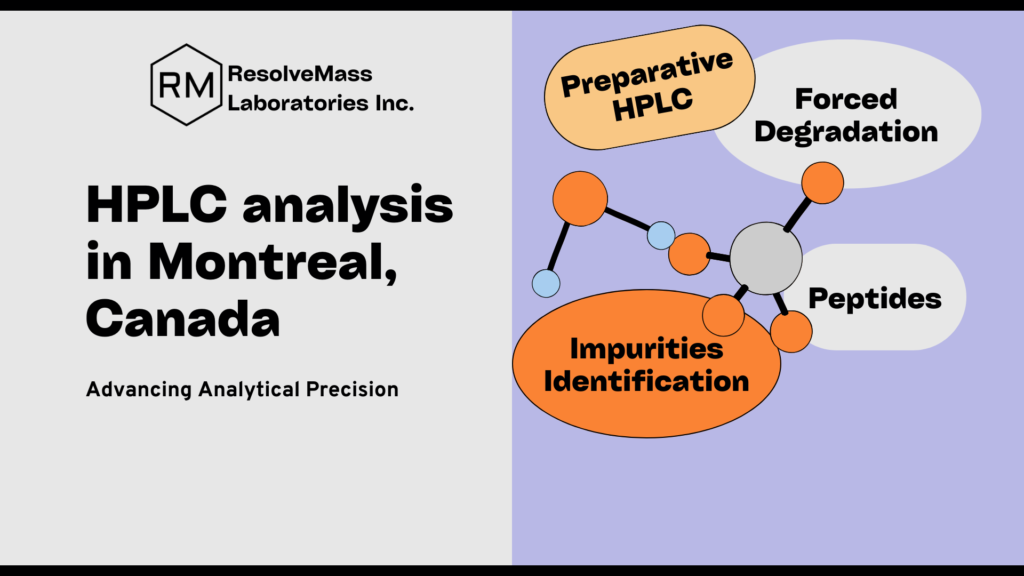
Montreal is recognized as a hub for scientific innovation and advanced analytical solutions. High-Performance Liquid Chromatography (HPLC) analysis, a cornerstone of modern analytical science, is widely utilized across various industries, including pharmaceuticals, environmental sciences, food safety, and biotechnology. This blog explores the importance of HPLC analysis in Montreal, Canada its diverse applications, advancements, and why ResolveMass Laboratories Inc. is your trusted partner for HPLC analysis.
The Strategic Importance of HPLC in Modern Analytical Workflows
In modern laboratories, HPLC is not just an analytical technique but a strategic tool that influences research direction and operational efficiency. The ability to generate precise, reproducible data allows organizations to make confident decisions related to product development, quality assurance, and regulatory compliance. As analytical expectations continue to rise, HPLC serves as a dependable backbone for scientific workflows that demand consistency and traceability.
In Montreal’s competitive scientific and industrial landscape, organizations increasingly rely on HPLC to shorten development timelines and reduce analytical uncertainty. Whether supporting early-stage research or commercial manufacturing, HPLC enables teams to identify issues early, optimize formulations, and avoid costly downstream failures. This strategic value makes HPLC an indispensable asset across multiple sectors.
Why HPLC Analysis is Indispensable
HPLC is a powerful technique for separating, identifying, and quantifying compounds in complex mixtures. Its precision, versatility, and sensitivity make it the method of choice for numerous industries.
Key Features of HPLC:
- High Precision and Accuracy: Delivers reliable quantitative data.
- Versatility: Applicable to a wide range of samples, from small molecules to complex biomolecules.
- Speed and Efficiency: Allows for rapid analysis and method development.
- Scalability: Supports both research-scale and industrial-scale requirements.
Method Development and Optimization in HPLC Analysis
Effective HPLC analysis begins with robust method development and optimization. Selecting appropriate stationary phases, mobile phase compositions, and detection parameters is essential for achieving reliable separation and accurate quantification. Well-designed methods improve sensitivity and selectivity while minimizing interference from complex sample matrices.
In practice, method optimization is an iterative process that balances analytical performance with efficiency. Laboratories in Montreal often tailor HPLC methods to meet specific regulatory, research, or production needs. This customized approach ensures that analytical methods remain fit for purpose across different sample types and application requirements.
Applications of HPLC Analysis in Montreal
Montreal’s scientific community has embraced HPLC for its capacity to drive advancements in:
1. Pharmaceutical Research and Development
HPLC analysis is pivotal in drug development, from assessing the purity of active pharmaceutical ingredients (APIs) to characterizing drug formulations. Montreal-based pharmaceutical companies and research institutions rely on HPLC to meet stringent regulatory standards and ensure drug safety [1].
HPLC in Stability Testing and Shelf-Life Determination
HPLC plays a vital role in stability testing by monitoring changes in chemical composition over time. Through stability-indicating methods, analysts can detect degradation products, assess impurity growth, and evaluate the impact of storage conditions on product quality. These insights are essential for determining appropriate shelf-life and storage recommendations.
In regulated markets like Canada, stability data generated through HPLC supports compliance with global regulatory guidelines. Montreal-based laboratories leverage HPLC to generate long-term and accelerated stability profiles, ensuring that pharmaceutical products remain safe, effective, and compliant throughout their intended lifecycle.
2. Biotechnology and Proteomics
Montreal’s thriving biotechnology sector utilizes HPLC for the separation and analysis of proteins, peptides, and other biomolecules. This is crucial for understanding biological processes and developing innovative therapies [2].
3. Environmental Monitoring
HPLC is essential for detecting and quantifying pollutants in water, air, and soil. Environmental agencies and researchers in Montreal leverage HPLC to ensure compliance with environmental regulations and safeguard public health [3].
4. Food and Beverage Quality Assurance
From detecting contaminants to verifying nutritional content, HPLC analysis ensures the safety and quality of food products. Montreal’s food industry benefits from HPLC’s ability to deliver precise and reliable results [4].
Quality Control and Batch Release Testing Using HPLC
HPLC is a cornerstone of quality control laboratories, where it is routinely used for batch release testing. By confirming identity, potency, and purity, HPLC ensures that products meet predefined specifications before reaching the market. This level of analytical control is essential for maintaining product consistency and consumer trust.
In Montreal’s manufacturing and processing sectors, HPLC supports both routine testing and investigative analysis. When deviations occur, chromatographic data helps identify root causes quickly, minimizing production delays and preventing potential recalls. As a result, HPLC strengthens overall quality systems across industries.
Innovations in HPLC Analysis
Montreal-based laboratories, including ResolveMass Laboratories Inc., are adopting cutting-edge advancements to enhance HPLC capabilities:
1. Ultra-High-Performance Liquid Chromatography (UHPLC)
UHPLC offers faster analysis and improved resolution compared to conventional HPLC. This innovation is particularly beneficial for complex sample matrices [5].
2. Green HPLC Techniques
Sustainability is a growing focus, and green HPLC techniques minimize solvent usage and waste, aligning with eco-friendly practices [6].
3. Integration with Mass Spectrometry (LC-MS)
Coupling HPLC with mass spectrometry enables detailed molecular characterization, enhancing applications in proteomics, metabolomics, and drug discovery [7].
Why Choose ResolveMass Laboratories for HPLC Analysis in Montreal?
ResolveMass Laboratories Inc. is a leader in providing comprehensive HPLC analysis services in Montreal. Our expertise spans various industries, ensuring that we meet the unique analytical needs of our clients.
Our Service Highlights:
- Custom Method Development: Tailored HPLC methods for complex analytical challenges.
- Regulatory Compliance: Adherence to industry standards such as USP, EP, and ICH guidelines.
- State-of-the-Art Infrastructure: Equipped with advanced HPLC and LC-MS instrumentation for accurate and reliable results.
Explore our HPLC Analysis Services and Analytical Solutions to learn more about how we can assist your research and industrial needs.
Challenges in HPLC Analysis and How We Address Them
1. Sample Complexity
Analyzing complex mixtures can be challenging. Our expertise in method optimization ensures precise separation and quantification.
2. Regulatory Demands
Stringent regulatory requirements necessitate accurate and reproducible results. Our team is well-versed in meeting these demands through validated methods.
3. Instrument Maintenance
HPLC systems require regular maintenance for consistent performance. At ResolveMass Laboratories, we maintain our equipment to the highest standards, ensuring reliable results for our clients.
Training, Expertise, and Data Integrity in HPLC Operations
Advanced instrumentation alone is not enough to ensure high-quality HPLC results. Skilled analysts with a deep understanding of chromatography, sample preparation, and data interpretation are essential. Proper training reduces variability, improves troubleshooting efficiency, and ensures that analytical methods are executed consistently.
Data integrity is equally critical, particularly in regulated environments. Laboratories must ensure secure data handling, proper documentation, and compliance with data integrity guidelines. By combining technical expertise with strong quality systems, HPLC laboratories in Montreal can deliver results that are not only accurate but also fully defensible during audits and inspections.
Learn more about the HPLC Analysis Instruments – https://resolvemass.ca/hplc-analysis-instruments/
Future of HPLC Analysis in Montreal
Montreal’s analytical landscape is set to grow with advancements in:
- Artificial Intelligence in HPLC: Enhancing data analysis and method development.
- Miniaturized HPLC Systems: Increasing portability and reducing resource consumption.
- Personalized Medicine: Leveraging HPLC for precision diagnostics and targeted therapies.
ResolveMass Laboratories is committed to staying at the forefront of these innovations, providing our clients with cutting-edge analytical solutions.
Partner with ResolveMass Laboratories for HPLC Excellence
With a strong presence in Montreal’s scientific community, ResolveMass Laboratories Inc. is your trusted partner for high-quality HPLC analysis. Whether you’re in pharmaceuticals, biotechnology, environmental science, or food safety, our expertise and state-of-the-art infrastructure are here to support your analytical needs.
Visit our Contact Us page to discuss your project or request a consultation.
Frequently Asked Questions
HPLC analysis is used to separate, identify, and quantify individual components within complex mixtures. It is widely applied in pharmaceuticals, biotechnology, food testing, and environmental analysis to assess purity, potency, impurities, and stability. HPLC provides accurate and reproducible data that supports research, quality control, and regulatory compliance.
The principle of HPLC is based on the differential interaction of sample components between a stationary phase and a mobile phase. Compounds move through the column at different rates depending on their chemical properties and affinity for each phase. This results in effective separation as components elute at distinct retention times.
The rule of 3 in HPLC refers to maintaining a minimum resolution of 1.5, a signal-to-noise ratio of at least 3 for detection, and consistent retention time reproducibility. It serves as a practical guideline to ensure acceptable separation, detection reliability, and method robustness during analysis.
The normal operating range in HPLC typically includes flow rates between 0.5 and 2.0 mL/min and pressures up to 400 bar for conventional systems. Detection wavelengths commonly range from 190 to 400 nm for UV detectors. Actual ranges may vary depending on column type and application requirements.
HPLC is suitable for a wide variety of samples, including small molecules, pharmaceuticals, biomolecules, environmental contaminants, and food components. Samples must be soluble in the mobile phase and properly filtered to avoid column damage. Both liquid and solid samples can be analyzed after appropriate preparation.
Common HPLC solvents include water, methanol, acetonitrile, and buffer solutions. These solvents are selected based on sample solubility, polarity, and detector compatibility. High-purity, HPLC-grade solvents are essential to minimize background noise and ensure accurate results.
HPLC columns are generally categorized into normal-phase, reverse-phase, ion-exchange, size-exclusion, and affinity columns. Each column type is designed for specific separation mechanisms and sample characteristics. Reverse-phase columns are the most widely used in routine pharmaceutical analysis.
HPLC data is calculated by measuring peak area or peak height and comparing it to calibration standards. Quantitative results are derived using response factors or calibration curves. Parameters such as retention time, resolution, and theoretical plates are also evaluated to assess method performance.
References
- Nikolin B, Imamović B, Medanhodzić-Vuk S, Sober M. High perfomance liquid chromatography in pharmaceutical analyses. Bosn J Basic Med Sci. 2004 May;4(2):5-9. doi: 10.17305/bjbms.2004.3405.
Get In Touch With Us
Sample Preparation and Extraction Techniques for Nitrosamine Analysis: SPE, LLE, and Headspace Methods
Introduction: Nitrosamine sample preparation and extraction is the single most consequential step in generating defensible,…
Bioanalytical CRO Services for Gene Therapy and AAV-Based Drug Programs
Introduction: Bioanalytical CRO Services for Gene Therapy provide the specialized analytical support needed to measure…
Container Closure Systems for Injectable Steroids
Introduction: Container Closure Systems for Injectable Steroids are a foundational part of injectable drug-product development,…
Extractables and Leachables in Lyophilized Drug Products
Introduction: Extractables and Leachables in Lyophilized Drug Products are important pharmaceutical quality considerations because chemical…

Case Study: Converting a Peptide API from TFA to Acetate Salt to Meet Regulatory Expectations
Introduction Converting a peptide active pharmaceutical ingredient (API) from the trifluoroacetate (TFA) form to an…
Case Study: Extractables and Leachables Assessment for a Peptide Prefilled Syringe
Introduction A thorough Extractables and Leachables Assessment of a peptide prefilled syringe generates the empirical…

