

Introduction
Acceptable Intake (AI) Limits for Nitrosamines Calculation is performed through linear low-dose extrapolation using rodent TD50 carcinogenicity bioassays or by applying structural potency classification models such as the Carcinogenic Potency Categorization Approach (CPCA) when empirical toxicity data are not available. This quantitative toxicological evaluation is intended to ensure that patient exposure to genotoxic N-nitrosamine impurities remains below a lifetime excess cancer risk threshold of 1 in 100,000 (10⁻⁵). N-nitrosamines and Nitrosamine Drug Substance-Related Impurities (NDSRIs) are classified within the “Cohort of Concern” under the International Council for Harmonisation (ICH) M7(R1) guideline because of their potential for significant mutagenic and carcinogenic potency. Regulatory authorities worldwide, including the U.S. Food and Drug Administration (FDA), the European Medicines Agency (EMA), and Health Canada, require pharmaceutical manufacturers to establish safe exposure limits using empirical animal toxicity data, structure-activity relationships, or standardized structural scoring algorithms. This report presents a detailed assessment of the toxicological principles, mathematical transformations, structural scoring parameters, and analytical conversions necessary to calculate compliant daily AI limits and concentration thresholds for nitrosamines in drug products.
To understand the basic mechanisms, regulatory origins, and fundamentals of these genotoxic impurities, read our complete overview: What Are Nitrosamines?
Quick Summary:
- AI limits protect patients from genotoxic N-nitrosamine impurities by controlling lifetime excess cancer risk to approximately 1 in 100,000 (10⁻⁵).
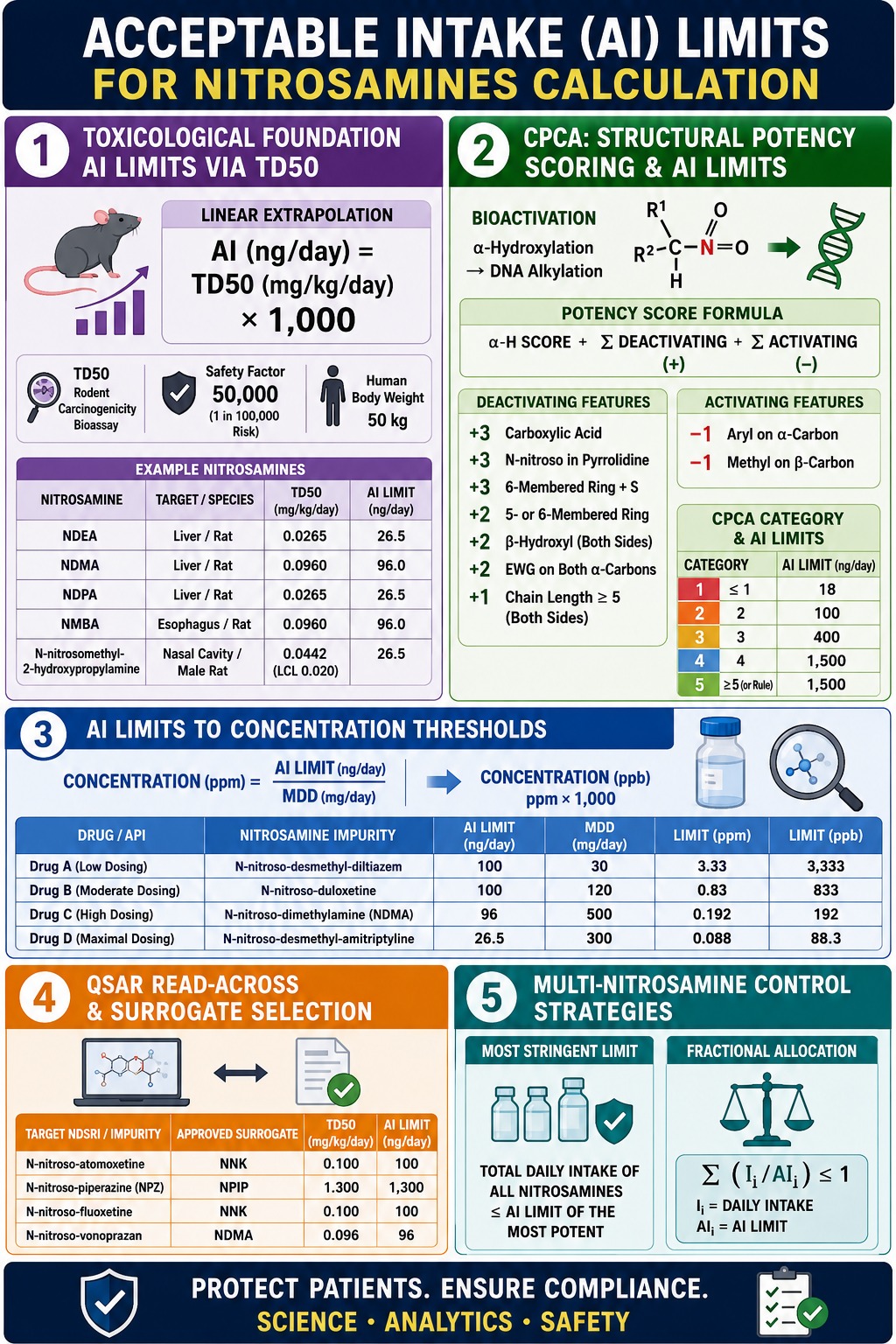
- TD50-based calculation uses rodent carcinogenicity data and linear low-dose extrapolation: AI (ng/day) = TD50 (mg/kg/day) × 1,000.
- When toxicity data are unavailable, the Carcinogenic Potency Categorization Approach (CPCA) evaluates structural features affecting α-hydroxylation and carcinogenic potency, assigning Category 1–5 with corresponding AI limits.
- AI limits must be converted into concentration thresholds based on the drug’s Maximum Daily Dose (MDD): ppm = AI/MDD and ppb = ppm × 1,000. Higher-dose drugs therefore require tighter impurity specifications.
- QSAR and read-across approaches can establish AI limits for unstudied nitrosamines by comparing structural, metabolic, and reactivity characteristics with well-characterized surrogate compounds.
- For products containing multiple nitrosamines, regulators may require either the most stringent AI limit or a fractional exposure approach, where the sum of individual exposure-to-AI ratios must remain ≤ 1.
- Effective nitrosamine control requires an integrated toxicological, computational, analytical, and regulatory strategy, supported by sensitive methods such as LC-MS/MS and ongoing regulatory compliance under frameworks including ICH M7(R1).
Toxicological Foundations of Acceptable Intake (AI) Limits for Nitrosamines Calculation via TD50
The calculation of Acceptable Intake (AI) limits for nitrosamines using TD50 values involves linearly scaling the dose that produces tumors in 50% of test animals to a human-equivalent intake corresponding to a 1 in 100,000 excess cancer risk. This empirical toxicological methodology relies on chronic-dose carcinogenicity bioassay data obtained from resources such as the Carcinogenic Potency Database (CPDB) or the Lhasa Carcinogenicity Database (LCDB).
The Mathematical Formula for Linear Extrapolation
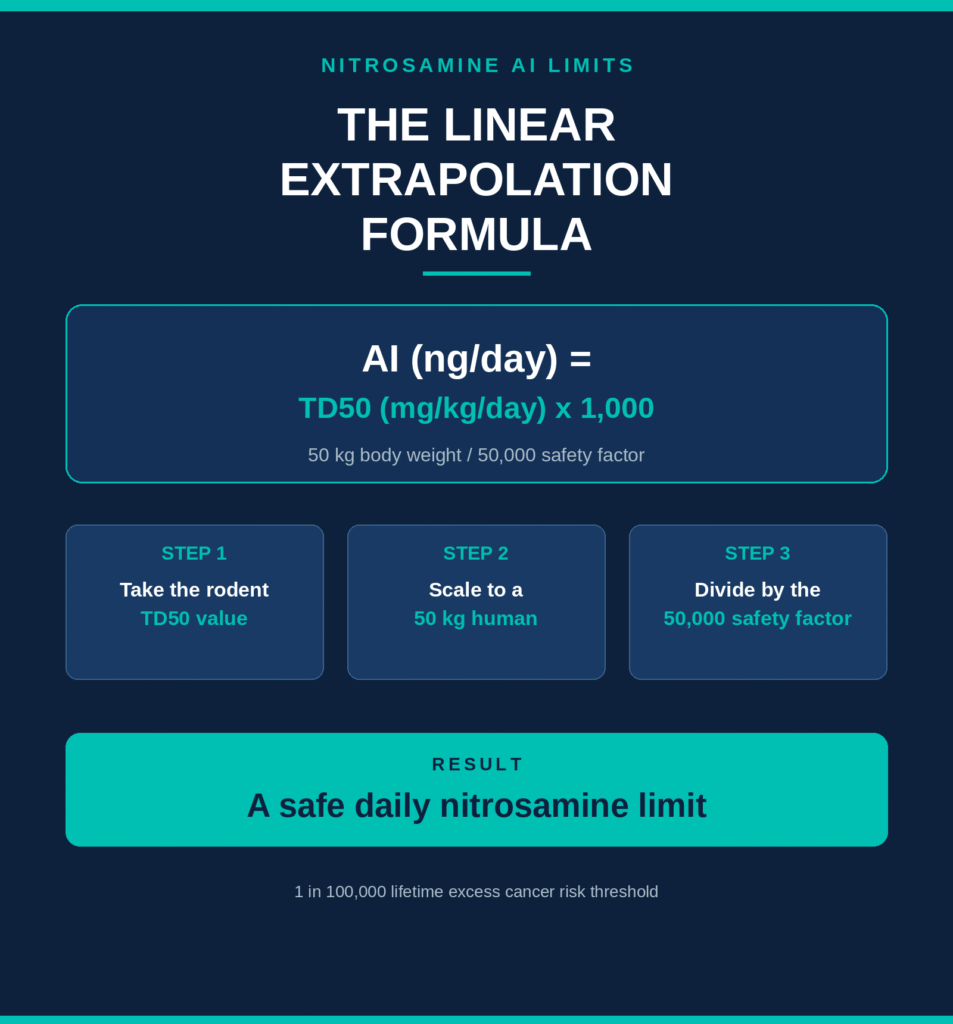
The linear extrapolation equation determines the human Acceptable Intake in nanograms per day by adjusting the rodent TD50 value to a 50 kg human body weight and applying a 50,000 safety-factor divisor. When the unit conversions are applied, this calculation simplifies to multiplying the empirical TD50 value, expressed in mg/kg/day, by a factor of 1,000.
The fundamental toxicological derivation for linear low-dose extrapolation is represented as:
AI (mg/day) = [TD50 (mg/kg/day) × 50 kg] / 50,000
The resulting intake value, expressed in milligrams per day (mg/day), can then be converted to nanograms per day (ng/day) by multiplying it by the conversion factor of 1,000,000 ng/mg (10⁶). This produces the following practical equation:
AI (ng/day) = TD50 (mg/kg/day) × 1,000 ng·kg/mg
In this calculation, the 50,000 divisor scales the TD50, which represents a 1:2 or 50% tumor incidence in test animals, to a conservative human risk level corresponding to a 1:100,000 (10⁻⁵) excess lifetime cancer risk. When reliable bioassay data are available from multiple animal species or studies, regulatory guidance recommends using the harmonic mean TD50 obtained from the most sensitive species, strain, sex, and anatomical tumor site.
When historical animal studies involve small cohort sizes or non-standard experimental protocols, safety assessors may use the lower bound of the 99% confidence interval (TD50 L1%) to account for statistical uncertainty. For example, bioassays evaluating N-nitrosomethyl-2-hydroxypropylamine reported a TD50 of 0.0442 mg/kg/day based on nasal cavity tumors in male rats. However, because of the small sample sizes, regulatory authorities derived the group AI limit of 26.5 ng/day using the lower 99% confidence interval bound of 0.020 mg/kg/day.
Evaluate how ICH guidelines apply to complex nitrosamine impurities: Genotoxic Impurity Testing & ICH M7 Guidelines
| Nitrosamine Impurity | Primary Rodent Study Target Site / Species | Empirical TD50 (mg/kg/day) | Extrapolated Daily AI Limit (ng/day) | Regulatory Status & Guidance Anchor |
|---|---|---|---|---|
| N-nitrosodiethylamine (NDEA) | Liver / Rat | 0.0265 | 26.5 | Established (FDA, EMA, HC) |
| N-nitrosodimethylamine (NDMA) | Liver / Rat | 0.0960 | 96.0 | Established (FDA, EMA, HC) |
| N-nitrosodi-n-propylamine (NDPA) | Liver / Rat | 0.0265 | 26.5 | Established (FDA, EMA) |
| N-nitrosomethylaminobutyric acid (NMBA) | Esophagus / Rat | 0.0960 | 96.0 | Established (FDA, EMA) |
| N-nitrosomethyl-2-hydroxypropylamine | Nasal Cavity / Male Rat | 0.0442 (Lower 99% CI: 0.020) | 26.5 | Derived via Structural Group 4 Study |
The Carcinogenic Potency Categorization Approach (CPCA) for Acceptable Intake (AI) Limits for Nitrosamines Calculation
The Carcinogenic Potency Categorization Approach (CPCA) determines AI limits for nitrosamines for which empirical toxicity data are unavailable by assessing molecular structural characteristics that influence metabolic bioactivation through α-hydroxylation. The resulting structural potency score places the impurity into one of five risk categories, each associated with default AI limits ranging from 18 ng/day to 1,500 ng/day.
Understand the structural and risk differences between simple small-molecule nitrosamines and complex NDSRIs: NDSRIs vs. Simple Nitrosamines
Metabolic Mechanism of Alpha-Hydroxylation Bioactivation
The bioactivation of N-nitrosamines is primarily mediated by Cytochrome P450-dependent oxidation at the α-carbon. This reaction generates an unstable α-hydroxy-nitrosamine intermediate, which subsequently decomposes to produce an electrophilic diazonium ion capable of alkylating DNA. Structural characteristics that inhibit or enhance α-hydroxylation can therefore directly influence the carcinogenic potency of the compound.
During enzymatic oxidation, a hydroxyl group is introduced at the carbon directly adjacent to the N-nitroso group, known as the α-carbon. The resulting intermediate undergoes spontaneous loss of an aldehyde or ketone to generate a monoalkylnitrosamine, which rapidly decomposes to form an alkyl diazonium ion. This highly reactive cation can form covalent adducts with nucleophilic DNA bases, including O⁶-alkylguanine, resulting in pro-mutagenic replication errors. Structural characteristics that interfere with CYP binding, introduce steric hindrance, or promote alternative non-mutagenic metabolic detoxification pathways can reduce carcinogenic potency. In contrast, substituents that stabilize the relevant reactive intermediates may increase potency.
Examine how active pharmaceutical ingredients generate specific nitrosamine structures: Nitrosamine Formation Pathways in API Synthesis
CPCA Potency Scoring Rules and Decision Tree Logic
The CPCA potency score is determined by combining an initial α-hydrogen baseline score with numerical modifiers assigned to deactivating structural characteristics and then incorporating activating structural features. Higher scores correspond to lower predicted carcinogenic potency and therefore less restrictive daily intake limits.
The evaluation of an N-nitrosamine structure follows a defined sequence:
- Applicability Domain Check: Confirm that the molecule contains a carbon atom directly bonded to both sides of the N-nitroso group and does not contain double bonds to heteroatoms on the α-carbon. This applicability domain excludes nitrosamides, nitrosoureas, and nitrosoguanidines.
- Direct Category 5 Assignment: Assign the compound to Category 5 (1,500 ng/day) when it contains no α-hydrogens (0,0), has a tertiary α-carbon associated with detoxification through water entrapment, or contains 0,1 or 1,1 α-hydrogens that strongly disfavor bioactivation.
- Potency Score Calculation: For the remaining structures, calculate the overall score using the following formula:
Potency Score = α-Hydrogen Score + Σ Deactivating Feature Scores + Σ Activating Feature Scores
| α-Hydrogen Combination (Lowest Count Listed First) | Structural Environment Details | Baseline α-Hydrogen Score |
|---|---|---|
| 0, 2 | Methylene α-carbon not part of an ethyl group | +3 |
| 0, 2 | Methylene α-carbon part of an ethyl group | +2 |
| 0, 3 | Methyl group opposite a quaternary center | +2 |
| 1, 2 | Methine and methylene α-carbons | +3 |
| 1, 3 | Methine and methyl α-carbons | +3 |
| 2, 2 | Unsubstituted acyclic or ring methylene carbons | +1 |
| 2, 3 | Methylene and methyl carbons (e.g., N-nitroso-N-methyl-N-ethylamine) | +1 |
Deactivating and activating features modify the baseline score according to the effects of neighboring functional groups on metabolic reactivity:
| Feature Category | Specific Structural Feature | Score Modifier | Primary Mechanism of Effect |
|---|---|---|---|
| Deactivating | Carboxylic acid group anywhere on molecule | +3 | Promotes rapid renal clearance and impedes DNA interaction |
| Deactivating | N-nitroso group in a pyrrolidine ring | +3 | Ring strain restricts conformational access to the CYP active site |
| Deactivating | N-nitroso group in 6-membered ring with Sulfur | +3 | Electronic disruption of the metabolic transition state |
| Deactivating | N-nitroso group in 5- or 6-membered ring | +2 | Moderate conformational constraint on α-carbons |
| Deactivating | Hydroxyl group on β-carbon (both sides) | +2 | Hydrophilic stabilization and steric hindrance |
| Deactivating | Electron-withdrawing group (EWG) on both α-carbons | +2 | Inductive withdrawal reduces electron density available for oxidation |
| Deactivating | Chain length ≥ 5 non-H atoms on both sides | +1 | Molecular bulk sterically obstructs the CYP active site |
| Activating | Aryl group bonded to α-carbon (benzylic) | -1 | Resonance stabilizes the carbonium intermediate, accelerating the reaction |
| Activating | Methyl group bonded to β-carbon | -1 | Hyperconjugative hyper-activation of the α-position |
The calculated Potency Score is then mapped directly to the corresponding CPCA Potency Category and its assigned Acceptable Intake limit:
| Potency Category (PC) | Calculated Potency Score | Recommended AI Limit (US FDA & Health Canada) | Recommended AI Limit (EMA) |
|---|---|---|---|
| Category 1 | ≤ 1 | 18 ng/day | 26.5 ng/day |
| Category 2 | 2 | 100 ng/day | 100 ng/day |
| Category 3 | 3 | 400 ng/day | 400 ng/day |
| Category 4 | 4 | 1,500 ng/day | 1,500 ng/day |
| Category 5 | ≥ 5 (or direct rule) | 1,500 ng/day | 1,500 ng/day |
Discover when structural assessments are legally mandated: Do All Drugs Need Nitrosamine Risk Assessment?
Converting Daily AI Limits to Concentration Thresholds (PPM and PPB)
Converting a daily Acceptable Intake limit into an analytical concentration threshold requires dividing the mass-based AI limit, expressed in ng/day, by the Maximum Daily Dose (MDD), expressed in mg/day, of the active pharmaceutical ingredient. This calculation determines the maximum permissible concentration of the nitrosamine impurity in parts per million (ppm) or parts per billion (ppb) for batch-release purposes.
Step-by-Step Mathematical Derivation for Concentration Limits
Because analytical laboratories quantify impurity concentrations relative to the mass of the drug substance, the permitted daily mass of the nitrosamine must be normalized against the patient’s total daily intake of the active pharmaceutical ingredient (API).
The equation used to calculate the concentration limit in parts per million (ppm) is:
Acceptable Concentration (ppm) = AI Limit (ng/day) / MDD (mg/day)
To convert the resulting concentration from parts per million to parts per billion (ppb), the ppm value is multiplied by 1,000:
Acceptable Concentration (ppb) = [AI Limit (ng/day) / MDD (mg/day)] × 1,000
Because the AI limit represents a fixed absolute daily mass allowance, the maximum permissible concentration in the drug product varies inversely with the Maximum Daily Dose specified in the product labeling. Consequently, high-dose drugs require tighter analytical specification limits than low-dose drugs.
Review analytical thresholds and calculations applied in real-world generic drug evaluations: Nitrosamine Testing for a Metformin Generic
| Drug Product / Active Ingredient | Nitrosamine Impurity Identified | CPCA Category / Safety Basis | Daily AI Limit (ng/day) | Prescribed MDD (mg/day) | Concentration Limit (ppm) | Concentration Limit (ppb) |
|---|---|---|---|---|---|---|
| Drug A (Low Dosing) | N-nitroso-desmethyl-diltiazem | Surrogate (NNK) | 100 | 30 | 3.333 | 3,333 |
| Drug B (Moderate Dosing) | N-nitroso-duloxetine | Surrogate (NNK) | 100 | 120 | 0.833 | 833 |
| Drug C (High Dosing) | N-nitroso-dimethylamine (NDMA) | Empirical Bioassay | 96 | 500 | 0.192 | 192 |
| Drug D (Maximal Dosing) | N-nitroso-desmethyl-amitriptyline | CPCA Category 1 | 26.5 | 300 | 0.088 | 88.3 |
Learn how low concentration thresholds impact cardiovascular therapeutics: Nitrosamine Testing in Beta Blockers
Computational QSAR, Read-Across Analysis, and Surrogate Selection
Computational Structure-Activity Relationship (SAR) read-across is used to establish AI limits for unstudied nitrosamines by comparing them with structurally similar surrogate compounds for which robust empirical TD50 carcinogenicity data are available. This methodology provides a scientifically supported basis for establishing higher AI limits when the default CPCA categories result in exposure limits that may be unnecessarily conservative.
Principles of Valid Read-Across under ICH M7(R1)
Under ICH M7(R1) guidelines, a scientifically defensible surrogate read-across requires evidence of structural, metabolic, and reactivity equivalence between the target nitrosamine and the selected surrogate compound. The scientific rationale should be documented using computational QSAR profiling tools, such as Lhasa Derek Nexus or Leadscope, and should address the following considerations:
- Core Steric and Electronic Features: Evaluate similarity in substituent size, steric environment, and electronic density surrounding the N-nitroso group to support comparable Cytochrome P450 active-site binding characteristics.
- α-Carbon Hydroxylation Reactivity: Compare substitution patterns, including alkyl, aryl, and cyclic groups, at the α-carbons to establish whether similar bioactivation rates are expected.
- Detoxification Routes: Confirm that the target molecule does not lack important clearance or detoxification pathways that are present in the selected surrogate.
| Target NDSRI / Complex Impurity | Regulated Approved Surrogate | Surrogate TD50 (mg/kg/day) | Derived AI Limit (ng/day) | Toxicological Rationale for Read-Across |
|---|---|---|---|---|
| N-nitroso-atomoxetine | 4-(methylnitrosoamino)-1-(3-pyridinyl)-1-butanone (NNK) | 0.100 | 100 | Matching aryl-alkyl α-substitution pattern and metabolic bioactivation profile |
| N-nitroso-piperazine (NPZ) | N-nitrosopiperidine (NPIP) | 1.300 | 1,300 | Saturated 6-membered heterocyclic ring core with equivalent steric constraints |
| N-nitroso-fluoxetine | NNK | 0.100 | 100 | Similar secondary amine derivative with electron-withdrawing aromatic moiety |
| N-nitroso-vonoprazan | N-nitrosodimethylamine (NDMA) | 0.096 | 96 | Conserved acyclic methyl-substituted α-carbon activation pathway |
Explore read-across challenges when analyzing large molecules: Nitrosamine Impurities in Biologics
Global Regulatory Compliance and Control Strategies for Multiple Nitrosamines
Global regulatory agencies implement stringent control strategies for nitrosamines in pharmaceutical products and require cumulative exposure assessments when multiple nitrosamines are present in the same drug product. In situations involving multiple nitrosamines, the total combined daily exposure must be controlled according to the AI limit of the most potent nitrosamine or managed using a fractional additivity approach.
Analyze past market withdrawals to refine your risk mitigation plans: Nitrosamine Drug Recalls Analysis
Multi-Nitrosamine Control Methodologies
When a drug product or API contains more than one confirmed or potential N-nitrosamine impurity, regulatory authorities generally require the application of one of two primary control strategies:
- Most Stringent Limit Approach: The total combined daily mass intake of all detected nitrosamines must not exceed the daily AI limit assigned to the most potent individual nitrosamine present. For example, if a formulation contains both NDMA (AI = 96 ng/day) and NDEA (AI = 26.5 ng/day), the total combined daily mass of NDMA + NDEA must remain ≤ 26.5 ng/day.
- Fixed Fractional Allocation Approach: Manufacturers may apply a fractional exposure model in which the sum of the individual exposure-to-AI ratios must not exceed unity:
Σ(i=1 to n) [Iᵢ / AIᵢ] ≤ 1
Here, Iᵢ represents the measured daily intake of nitrosamine i, while AIᵢ represents the established daily Acceptable Intake limit for nitrosamine i.
To minimize the risk of significant drug supply disruptions while long-term risk mitigation measures are being implemented, health authorities may provide time-limited “Interim AI Limits” for approved products. Such temporary limits, including values such as 3,000 ng/day for 1-methyl-4-nitrosopiperazine in rifampin, can permit continued patient access while manufacturers complete required remediation activities within defined timelines.
Implement robust control frameworks for multi-impurity products: Nitrosamine Control Strategy Development Services
Conclusion: Mastering Acceptable Intake (AI) Limits for Nitrosamines Calculation
Establishing compliant Acceptable Intake (AI) Limits for Nitrosamines Calculation requires the integrated application of rodent TD50 linear extrapolation, CPCA structural scoring, and QSAR read-across methodologies. Applying these standardized toxicological approaches supports the development of robust regulatory submission packages while protecting patients from the potential risks associated with genotoxic impurities. As global regulatory expectations continue to evolve, combining advanced structural read-across methodologies with highly sensitive liquid chromatography-tandem mass spectrometry (LC-MS/MS) analytical methods remains critical for effective drug quality control and ongoing regulatory compliance.
Accelerate your analytical program with specialized testing partners: Outsourcing Nitrosamine Testing to a CRO
For technical consultations, custom QSAR SAR read-across evaluations, or specialized nitrosamine testing support, visit the ResolveMass Laboratories Contact Page.
Frequently Asked Questions
The Carcinogenic Potency Categorization Approach (CPCA) evaluates the molecular structure of a nitrosamine using α-hydrogen characteristics together with defined activating and deactivating structural features. These parameters generate a Potency Score that places the compound into one of five categories. Each category has an associated default AI limit ranging from 18 ng/day for Category 1 to 1,500 ng/day for Category 5.
α-Hydrogens are important because their presence allows Cytochrome P450-mediated α-hydroxylation, which is a key metabolic bioactivation pathway for many nitrosamines. This process can generate reactive intermediates, including alkyl diazonium ions, that form DNA adducts. Consequently, structural differences involving α-hydrogen availability can substantially influence the predicted carcinogenic potency of a nitrosamine.
The product concentration limit is obtained by dividing the established daily AI limit in ng/day by the Maximum Daily Dose (MDD) of the active pharmaceutical ingredient in mg/day. This calculation expresses the permitted nitrosamine exposure relative to the amount of drug administered each day. For example, an AI limit of 96 ng/day with an MDD of 500 mg/day corresponds to a concentration limit of 0.192 ppm.
When multiple nitrosamines are identified in one pharmaceutical product, their combined exposure must be evaluated rather than assessing each impurity independently. Control may be based on the AI limit of the most potent nitrosamine or by applying a fractional exposure approach. Under the latter method, the sum of the individual daily intake-to-AI ratios should not exceed 1.
Within the CPCA framework described in this assessment, the presence of a carboxylic acid group contributes a +3 score modifier as a deactivating structural feature. This increases the overall Potency Score and therefore corresponds to a lower predicted carcinogenic potency. The structural effect is associated with factors such as enhanced clearance and reduced potential for interaction with DNA.
An empirical TD50-based AI limit is derived from carcinogenicity data obtained through animal bioassays for the compound or an appropriately supported toxicological dataset. In contrast, a CPCA AI limit is assigned according to structural characteristics when suitable empirical toxicity information is unavailable. Therefore, empirical evidence and scientifically justified data are important considerations when determining the most appropriate AI limit.
A scientifically supported SAR read-across can potentially provide an alternative basis for establishing an AI limit when the default CPCA classification is considered overly conservative. The assessment requires comparison of the target impurity with a suitable surrogate that has reliable empirical TD50 data. Structural similarity, metabolic behavior, and reactivity should be adequately demonstrated and documented to support the proposed read-across.
Detection and quantification of nitrosamines at low ppm or ppb concentrations generally require highly sensitive analytical instrumentation. Liquid Chromatography-Tandem Mass Spectrometry (LC-MS/MS) and High-Resolution Mass Spectrometry (LC-HRMS) are commonly used platforms for this purpose. Appropriate method sensitivity, selectivity, accuracy, and quantitation capability are essential for reliable low-level nitrosamine analysis.
Nitrosamines that lack α-hydrogens cannot undergo the conventional α-hydroxylation pathway required to generate alkyl diazonium ions. This structural characteristic can substantially reduce their potential for the metabolic bioactivation associated with nitrosamine carcinogenicity. However, the absence of α-hydrogens should not automatically be interpreted as complete safety, and the compound should still undergo an appropriate toxicological and regulatory assessment.
Reference:
- U.S. Food and Drug Administration. (2024, October 11). Carcinogenic potency categorization approach (CPCA). FDA document
- U.S. Food and Drug Administration. (2023, August). Recommended acceptable intake limits for nitrosamine drug substance-related impurities (NDSRIs): Guidance for industry. Center for Drug Evaluation and Research. FDA guidance document
- European Medicines Agency. (n.d.). Nitrosamine impurities: Guidance for marketing authorisation holders. European Medicines Agency
- Health Canada. (2026, March 11). Nitrosamine impurities in medications: Established acceptable intake limits. Government of Canada. Health Canada page
- ElenaLy. (2022, October 4). AI for small nitrosamines not listed in EMA, FDA or Health Canada. Nitrosamines Exchange. https://nitrosamines.usp.org/t/ai-for-small-nitrosamines-not-listed-in-ema-fda-or-health-canada/3758
- U.S. Food and Drug Administration. (2026). CDER nitrosamine impurity acceptable intake limits. Center for Drug Evaluation and Research. FDA webpage
- Health Canada. (2026, May 29). Nitrosamine impurities in medications: Guidance. Government of Canada. Health Canada guidance
Get In Touch With Us
About The Author


