

Introduction
Establishing rigorous quality attributes for Amino Acid Derivatives and Building Blocks is one of the most critical factors in controlling crude peptide purity, ensuring process robustness, and maintaining regulatory compliance during the Good Manufacturing Practice (GMP) production of therapeutic peptides. Unlike small-molecule active pharmaceutical ingredients (APIs), which can be synthesized through convergent liquid-phase synthesis, synthetic peptides are assembled sequentially on a solid support through repeated cycles of deprotection and coupling. Consequently, chemical impurities, enantiomeric defects, and degradation products present in protected monomers can become incorporated into the growing peptide chain.
As global regulatory expectations continue to evolve, compendial standards, including United States Pharmacopeia General Chapter USP, establish minimum quality parameters for protected amino acid starting materials to prevent downstream process failures. Uncharacterized contaminants in starting materials can introduce closely related sequence variants, such as deletion peptides, insertion variants, and diastereomers, which may co-elute with the target API during preparative chromatography. Controlling these risks requires an advanced analytical control strategy that evaluates starting material purity before solid-phase assembly begins. A thorough understanding of raw material quality enables manufacturers to minimize batch failures, streamline downstream purification, and meet regulatory requirements governing the safety of therapeutic peptides.
For a broader understanding of peptide quality requirements, review our approach to regulatory requirements for GLP-1 peptide characterization.
Share via:
Quick Summary:
- Why monomer quality matters: Therapeutic peptides are built one amino acid at a time on a solid support. Impurities in the protected building blocks can end up inside the peptide chain as deletion, insertion or diastereomer variants that are hard to purify away.
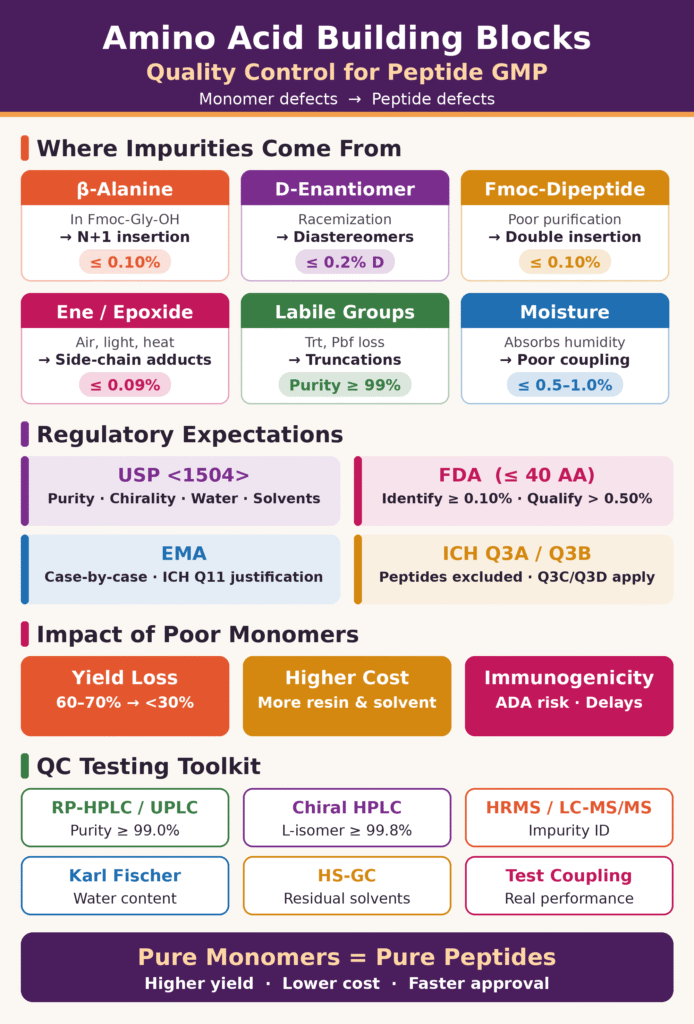
- Main impurity sources: These include β-alanine in Fmoc-Gly-OH (N+1 insertions), D-enantiomers from racemization (diastereomers), and Fmoc-dipeptides (double insertions). Oxidative Fmoc-ene/epoxide species (adducts on Cys, Met and Trp), labile Trt/Pbf protecting groups, and excess moisture also contribute.
- Typical acceptance limits: Most specific impurities are kept at about ≤ 0.05–0.10%, D-isomer content at ≤ 0.2% (≥ 99.8% enantiomeric purity), and overall chemical purity at ≥ 99.0%. Water content is held at ≤ 0.5–1.0% w/w.
- Regulatory landscape: Synthetic peptides are excluded from ICH Q3A/Q3B, so manufacturers need custom Raw Material Acceptance Criteria guided by USP, FDA and EMA expectations. For peptides of 40 or fewer amino acids, FDA guidance points to identifying impurities at ≥ 0.10% and qualifying new ones above 0.50%.
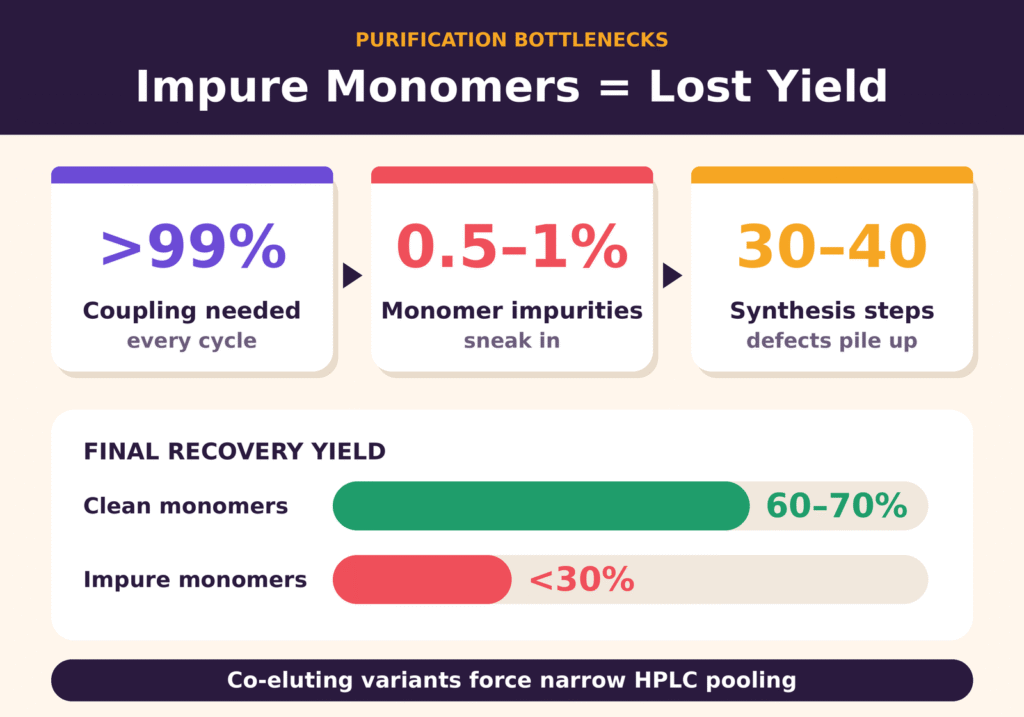
- Impact on yield and cost: Impure monomers create co-eluting impurities that force narrow HPLC pooling windows. This can drop recovery from 60–70% to below 30% and drive up solvent, resin and processing costs.
- Clinical risk: Structural variants such as β-alanine insertions, D-amino acid substitutions and epoxide adducts can create new T-cell epitopes. That raises the risk of anti-drug antibodies, clinical holds or program cancellation.
- Control strategy: A strong release program uses complementary tests before synthesis begins:
- RP-HPLC/UPLC for purity
- chiral HPLC for D-isomers
- HRMS and LC-MS/MS for impurity identification
- Karl Fischer titration for water
- headspace GC for residual solvents
- functional test couplings on resin
Chemical Origins of Raw Material Impurities in Amino Acid Derivatives and Building Blocks
Raw material impurities in Amino Acid Derivatives and Building Blocks can originate during precursor chemical synthesis, storage-related degradation, or incomplete protecting group derivatization. During Solid-Phase Peptide Synthesis (SPPS), even minor monomer contaminants can participate in coupling reactions, producing co-eluting insertion, deletion, and diastereomeric peptide impurities.
Beta-Alanine Contamination in Fmoc-Gly-OH Derivatives
Beta-alanine is a structural isomer that can form as a synthetic byproduct during Fmoc-Gly-OH preparation, potentially leading to N+1 beta-alanine insertion variants during peptide assembly. Because β-alanine contains a primary amine that is structurally similar to glycine, it can couple efficiently to the peptide resin during assembly. This reaction produces an N+1 β-alanine insertion variant that may have a molecular weight identical to that of the target sequence while incorporating an additional methylene group (−CH₂−) into the peptide backbone. This relatively minor structural alteration changes peptide backbone geometry, potentially affecting biological activity and complicating chromatographic separation.
Accurate structural verification helps distinguish the intended sequence from closely related impurities. Learn more about sequence confirmation for synthetic therapeutic peptides.
Enantiomeric Impurities and D-Amino Acid Content in Chiral Building Blocks
Chiral inversion during raw material manufacturing can generate D-amino acid impurities that become incorporated into the target sequence as diastereomeric variants. Racemization may occur during monomer chemical manufacturing or prolonged storage under basic conditions. During SPPS, D-amino acids can couple at rates comparable to those of their L-enantiomers, resulting in stereoisomeric impurities with identical mass-to-charge (m/z) ratios. These diastereomers often exhibit very similar physicochemical properties, making their purification through reversed-phase high-performance liquid chromatography (RP-HPLC) particularly challenging.
Because mass spectrometry alone may not distinguish stereoisomers, complementary chiral analysis is important for assessing amino acid configuration and stereochemical purity. Explore our chiral analysis services for therapeutic peptide APIs.
Fmoc-Dipeptide Impurities and Double-Insertion Precursors
Residual Fmoc-dipeptides in monomer lots can lead to double-insertion sequence defects during solid-phase synthesis cycles. These impurities may remain in monomer lots when coupling reagents or unreacted amino acids contaminate the building block during chemical production. When an Fmoc-dipeptide impurity, such as Fmoc-Gly-Gly-OH present in Fmoc-Gly-OH, enters an SPPS cycle, it can cause the double insertion of a residue. This produces an N+1 sequence variant that cannot be reliably prevented simply by adjusting coupling times or capping parameters on automated synthesizers.
Comprehensive impurity identification can help clarify the origin of sequence-related defects. See how peptide sequencing workflows for GLP-1 analogs support the investigation of structural variants.
Ene and Epoxide Derivatives in Fmoc-Protected Monomers
Exposure of Fmoc-protected amino acids to light, air, elevated temperatures, or trace iron can promote oxidation and the formation of reactive Fmoc-ene and Fmoc-epoxide species. Fluorenylmethoxycarbonyl (Fmoc) α-substituted amino acids are susceptible to oxidative degradation when exposed to atmospheric oxygen, ambient light, elevated temperatures, or trace iron catalysts during storage. This oxidation can generate Fmoc-ene and Fmoc-epoxide impurities. These reactive species may undergo unwanted side reactions during coupling or global acidolytic cleavage, producing unexpected covalent adducts on sensitive side chains, including Cysteine, Methionine, and Tryptophan.
For therapeutic peptides, identifying chemical modifications requires analytical methods capable of detecting subtle structural changes. Discover how multi-attribute monitoring (MAM) for peptide characterization can support the assessment of multiple quality attributes within a coordinated analytical strategy.
Protecting Group Lability and Residual Moisture
Insufficient side-chain protecting group stability and elevated residual moisture can cause premature deprotection and reduce coupling rates during SPPS. Partial loss of Trityl (Trt) protection from Histidine or 2,2,4,6,7-pentamethyldihydrobenzofuran-5-sulfonyl (Pbf) protection from Arginine can expose side chains prematurely during repeated Fmoc-deprotection steps. This instability can lead to branching, over-coupling, and truncated sequences. In addition, excessive residual moisture, measured using Karl Fischer titration, can hydrolyze activated amino acid intermediates and promote premature Fmoc cleavage, significantly reducing overall coupling efficiency.
| Impurity Class | Synthetic / Storage Origin | Downstream Peptide Defect | Critical Quality Attribute (CQA) Limit | Analytical Detection Method |
|---|---|---|---|---|
| β-Alanine Contamination | Synthetic byproduct in Fmoc-Gly-OH synthesis | β-Alanine insertion variant (N+1) | ≤ 0.05%–0.10% | High-Resolution LC-MS, UPLC |
| D-Enantiomer Content | Chiral inversion during monomer synthesis or storage | Diastereomeric peptide variant | Enantiomeric purity ≥ 99.8% (≤ 0.2% D-isomer) | Chiral HPLC / UHPLC, Enzymatic Hydrolysis |
| Fmoc-Dipeptides | Incomplete monomer purification by supplier | Double-insertion sequence variant | ≤ 0.05%–0.10% | Reversed-Phase HPLC, LC-MS |
| Fmoc-Ene / Epoxides | Oxidative exposure to air, heat, or iron | Covalent adducts on Cys/Met/Trp | ≤ 0.09% | LC-MS/MS, High-Resolution MS |
| Labile Side-Chain Groups | Incomplete protecting group attachment | Branched and over-coupled peptides | Purity ≥ 99.0% | UPLC-MS, Peptide Mapping |
| Residual Moisture (H₂O) | Atmospheric moisture absorption | Incomplete coupling and deletion peptides | ≤ 0.5%–1.0% w/w | Karl Fischer Titration |
Regulatory Frameworks and Specifications for Amino Acid Derivatives and Building Blocks
Regulatory expectations for protected Amino Acid Derivatives and Building Blocks are established through compendial standards, such as USP, alongside specific guidance from the FDA and EMA. Because synthetic peptides are explicitly excluded from the standard impurity thresholds established under ICH Q3A, drug developers must establish customized Raw Material Acceptance Criteria (RMAC) supported by validated analytical testing.
The Role of USP General Chapter
USP General Chapter, titled “Quality Attributes of Starting Materials for the Chemical Synthesis of Therapeutic Peptides,” outlines recommended quality attributes for starting materials used in therapeutic peptide synthesis to support process reproducibility and regulatory compliance under ICH Q11. It advises manufacturers to establish rigorous release criteria covering chemical purity, optical purity, structural identity, residual solvents, water content, and process-related impurities. Aligning starting material testing with the applicable USP requirements helps demonstrate adequate chemical control to regulatory authorities.
A well-defined analytical strategy should connect starting material testing with the characterization requirements of the final drug substance. Review the full characterization data package for a GLP-1 receptor agonist ANDA for a related example of comprehensive peptide quality assessment.
Regulatory Thresholds: FDA and EMA Guidance vs. ICH Standards
Because synthetic peptides are explicitly excluded from the standard impurity thresholds established under ICH Q3A, regional regulatory expectations require careful evaluation of impurity identification and qualification criteria. The thresholds of 0.10% for identification and 0.50% for qualification are often referenced in the context of synthetic peptide impurity assessment; however, their applicability depends on the relevant regulatory guidance and product-specific requirements.
Under FDA guidance for synthetic peptides containing 40 or fewer amino acids, peptide-related impurities may require structural identification at or above 0.10%, depending on the applicable recommendations and circumstances. Furthermore, new impurities exceeding 0.50% may require additional qualification, including a toxicological assessment and evaluation of immunogenicity risks, to determine whether they could trigger unwanted T-cell immune responses.
| Regulatory Framework | Scope & Application | Impurity Identification Threshold | Impurity Qualification Threshold | Key Starting Material Expectations |
|---|---|---|---|---|
| USP General Chapter | Guidance on starting material quality attributes | Monomer lot-specific evaluation | Compendial release specification alignment | Defines identity, chemical and chiral purity, water content, and residual solvents |
| FDA Synthetic Peptide Guidance | Synthetic peptides ≤ 40 amino acids | ≥ 0.10% of drug substance | > 0.50% of drug substance | Enforces immunogenicity assessment for new sequence variants |
| EMA Synthetic Peptide Guideline | Synthetic peptide APIs and drug products | Case-by-case threshold evaluation | Ph. Eur. alignment and safety evaluation | Requires starting material justification under ICH Q11 |
| ICH Q3A(R2) / Q3B(R2) | Small-molecule APIs and drug products | Synthetic peptides excluded | Synthetic peptides excluded | General solvent (Q3C) and elemental impurity (Q3D) requirements still apply where relevant |
Downstream Technical and Economic Impact on SPPS Workflows
Substandard raw material quality can have cascading effects throughout solid-phase peptide synthesis, increasing purification requirements, reducing manufacturing yields, and elevating immunogenicity risks. Controlling building block purity before assembly helps protect manufacturing economics and maintain clinical development timelines.
Purification Bottlenecks and Cumulative Yield Losses
Co-eluting deletion and insertion variants generated by low-purity monomers can necessitate narrow preparative HPLC fraction-pooling windows, substantially reducing recovery yields. In solid-phase synthesis, coupling efficiencies must consistently exceed 99% per cycle to achieve acceptable crude peptide purity. When raw materials contain 0.5%–1.0% sequence-related impurities, such as dipeptides or enantiomeric defects, these contaminants can accumulate across 30–40 synthetic steps. Removing these target-like impurities during RP-HPLC purification requires narrow fraction-pooling criteria, potentially reducing recovery yields from an expected 60%–70% to below 30%.
Detailed structural analysis can help determine whether observed impurities arise from synthesis, degradation, or other manufacturing variables. Learn about peptide sequencing services for GLP-1 development and their role in investigating sequence-related impurities.
Financial and Process Sustainability Implications
Low crude peptide purity can significantly increase the consumption of expensive chromatographic stationary phases and hazardous organic solvents, raising overall production costs. Commercial peptide synthesis costs can range from 50 to more than 1,000 per gram of API, depending on sequence length and monomer complexity. Poor monomer quality can substantially increase the consumption of expensive chromatographic stationary phases, acetonitrile, and N,N-dimethylformamide (DMF) or alternative solvents with more favorable environmental profiles. Additional processing cycles and longer manufacturing times further increase total production expenditure while reducing plant throughput.
Immunogenicity Risks and Clinical Development Delays
Uncontrolled peptide-related impurities originating from building block defects can pose significant immunogenicity risks and potentially delay or halt clinical development. Structural modifications, including β-alanine insertion variants, altered side chains resulting from reactive Fmoc-epoxides, and D-amino acid substitutions, can change the immunological properties of a peptide and potentially create or alter T-cell epitopes. These structural variants may increase the risk of anti-drug antibody (ADA) formation or other immune responses during clinical trials, potentially resulting in regulatory holds or project cancellations.
Critical Quality Control Strategies for Amino Acid Derivatives and Building Blocks
Implementing a robust analytical control strategy before SPPS assembly helps ensure that raw materials consistently meet stringent Raw Material Acceptance Criteria (RMAC). A comprehensive release protocol relies on orthogonal testing methodologies to identify trace chemical, chiral, and physical defects.
– Reversed-Phase HPLC/UPLC with Photodiode Array (PDA) Detection: Quantifies chemical purity and helps resolve process impurities, related substances, and residual Fmoc-dipeptides. Acceptance criteria are typically established at ≥ 99.0% for standard monomers.
– Chiral Stationary Phase HPLC/UHPLC: Evaluates optical purity and detects trace D-enantiomers resulting from racemization, supporting L-isomer acceptance criteria of ≥ 99.8%.
– High-Resolution Mass Spectrometry (HRMS) and LC-MS/MS: Identifies specific sequence-related impurities, Fmoc-ene/epoxide adducts, and structural isomers, such as β-alanine in Fmoc-Gly-OH.
– Karl Fischer Titration: Determines residual water content to verify that moisture levels remain within the specified limit, typically ≤ 0.5%–1.0% w/w, helping prevent premature Fmoc cleavage and coupling hydrolysis.
– Headspace Gas Chromatography (HS-GC-FID/MS): Monitors residual organic solvents, such as acetate, ethyl acetate, and DMF, to assess compliance with applicable ICH Q3C limits.
– Functional Test Coupling on Resin: Evaluates practical coupling efficiency and deprotection kinetics using model resins before bulk monomer lots are released for commercial GMP manufacturing.
Orthogonal analytical methods provide complementary evidence of peptide identity, purity, and structural integrity. Explore physicochemical characterization services for peptides to understand how complementary testing approaches support peptide quality assessment.
Conclusion
Establishing rigorous control over Amino Acid Derivatives and Building Blocks is fundamental to achieving high crude peptide purity, operational efficiency, and regulatory approval for synthetic therapeutic peptides. Monomer contaminants, ranging from D-enantiomers and β-alanine in Fmoc-Gly-OH to Fmoc-dipeptides and reactive ene/epoxide degradation products, can propagate during SPPS, generating target-like peptide impurities that compromise purification yields and introduce potential immunogenicity risks.
By implementing comprehensive Raw Material Acceptance Criteria (RMAC) supported by advanced mass spectrometry, chiral HPLC, and Karl Fischer analysis, peptide manufacturers can protect downstream yields and control commercial manufacturing costs. As regulatory bodies enforce requirements for impurity identification and qualification, rigorous analytical characterization throughout the manufacturing process remains essential to therapeutic peptide quality assurance. ResolveMass Laboratories Inc. provides expert analytical characterization, lot-release testing, and impurity profiling services to support compliant peptide drug development.
ResolveMass Laboratories Inc. provides expert analytical characterization, lot-release testing, and impurity profiling services to support compliant peptide drug development. To understand the information required for a complete analytical assessment, consult our peptide characterization CRO deliverables checklist.
For technical consultations regarding starting material characterization, mass spectrometry testing, or regulatory analytical support, contact our scientific team through ResolveMass Contact Us.
Frequently Asked Questions
Beta-alanine can arise as a manufacturing byproduct during the preparation of Fmoc-Gly-OH. Because it can participate in coupling reactions during Solid-Phase Peptide Synthesis (SPPS), it may become incorporated into the growing peptide chain as an N+1 insertion variant. This structural change can affect peptide conformation, biological activity, and downstream chromatographic separation.
D-amino acid impurities can participate in peptide assembly alongside their corresponding L-enantiomers, producing diastereomeric peptide variants. Although these variants have identical molecular masses, their spatial configurations and physicochemical properties may differ only slightly. Consequently, separating them from the target peptide using preparative HPLC can be challenging and may reduce product recovery.
Fmoc-dipeptide impurities may remain in protected amino acid building blocks when purification during manufacturing is insufficient. If these contaminants participate in an SPPS coupling cycle, they can introduce two amino acid residues instead of the intended single residue. The resulting sequence defects may be difficult to eliminate through routine adjustments to coupling times or capping conditions.
ICH Q3A primarily addresses impurities in new drug substances and does not directly cover synthetic peptides within its standard scope. Peptide manufacturing can generate sequence-related impurities, including deletion variants, insertions, and stereoisomers, that require specialized analytical characterization. Therefore, manufacturers must establish appropriate impurity controls and acceptance criteria based on applicable peptide-specific regulatory guidance.
Testing protected amino acid derivatives typically combines several complementary analytical techniques. RP-HPLC/UPLC evaluates chemical purity, chiral HPLC assesses enantiomeric purity, Karl Fischer titration measures water content, and Headspace GC-FID/MS determines residual solvent levels. LC-MS and HRMS provide additional structural information to help identify impurities and confirm the identity of potentially problematic compounds.
Excessive moisture in protected amino acid monomers can interfere with peptide synthesis by hydrolyzing activated amino acid intermediates. It may also contribute to premature Fmoc deprotection and reduced coupling efficiency under susceptible process conditions. These effects can increase the formation of incomplete or deletion sequences, lower crude peptide purity, and create additional downstream purification requirements.
Fmoc-ene and Fmoc-epoxide impurities can develop through oxidative degradation of susceptible Fmoc-protected amino acids during storage or handling. Exposure to oxygen, light, elevated temperatures, or trace iron may promote these degradation pathways. The resulting reactive species can participate in unwanted side reactions during peptide assembly or cleavage, potentially forming covalent adducts involving sensitive residues such as Cysteine, Methionine, and Tryptophan.
Impurities introduced through defective starting materials can generate altered peptide sequences, including insertions, deletions, and stereochemical variants. These structural changes may affect biological activity or introduce potential immunogenic epitopes that could trigger immune responses. Manufacturers should assess the significance of identified impurities through appropriate analytical characterization and risk-based immunogenicity evaluations to support regulatory submissions and patient safety.
An impurity identification threshold of 0.10% and a qualification threshold of 0.50% are commonly cited in discussions of synthetic peptide impurity assessment. However, the applicable requirements depend on the relevant FDA guidance, impurity characteristics, and product-specific circumstances. Manufacturers should verify the appropriate identification, qualification, toxicological, and immunogenicity assessment requirements before applying these thresholds to a regulatory submission.
Reference:
- European Medicines Agency. (2025). Guideline on the development and manufacture of synthetic peptides (EMA/CHMP/CVMP/QWP/367182/2025). https://www.ema.europa.eu/en/documents/scientific-guideline/guideline-development-manufacture-synthetic-peptides_en.pdf
- Tiwari, A. (n.d.). ICH Q11 Q&A: A supporting document for the selection and justification of starting materials [Presentation]. U.S. Food and Drug Administration. https://www.fda.gov/media/147595/download
- Macielag, M., Patch, R. J., Zhang, R., Case, M. A., Wall, M., & Zhang, Y.-M. (2018). Cyclic peptide tyrosine tyrosine compounds as modulators of neuropeptide Y receptors (Canadian Patent Application No. CA3041672A1). Google Patents. https://patents.google.com/patent/CA3041672A1/en
- United States Pharmacopeia. (n.d.). GLP-1s. https://www.usp.org/biologics/peptides/glp1s
- United States Pharmacopeia. (2023, June 1). Commentary for USP–NF 2023, Issue 3. https://www.uspnf.com/sites/default/files/usp_pdf/EN/USPNF/usp-nf-commentary/uspnf-2023-issue-3-commentary-20230601.pdf
- International Council for Harmonisation of Technical Requirements for Pharmaceuticals for Human Use. (2023). ICH M7(R2) guideline: Assessment and control of DNA reactive (mutagenic) impurities in pharmaceuticals to limit potential carcinogenic risk. https://database.ich.org/sites/default/files/ICH_M7%28R2%29_Guideline_Step4_2023_0216_0.pdf
Get In Touch With Us
About The Author