

Introduction
Analytical Characterization for 505(b)(2) Peptide Products provides the comprehensive physicochemical, structural, and functional profile required to establish product safety, quality, and efficacy when a candidate peptide is intentionally different from a Reference Listed Drug (RLD). Under Section 505(b)(2) of the Federal Food, Drug, and Cosmetic Act (FD&C Act), developers may rely on the United States Food and Drug Administration’s (FDA) previous findings of safety and effectiveness for an approved drug product while incorporating novel modifications, including altered formulations, modified primary sequences, alternative salt forms, or new routes of administration. The FDA regulates polymers containing 40 or fewer amino acids as synthetic or recombinant drug products rather than biological therapeutics, subjecting them to specific drug purity and active ingredient characterization frameworks. Establishing a robust analytical dataset using orthogonal analytical techniques is essential for scientifically connecting these candidate peptide modifications to the reference standard.
Therapeutic peptides occupy a distinctive structural space between small molecules and large biological proteins, combining high receptor specificity with complex synthetic impurity profiles. Developing a 505(b)(2) peptide candidate requires comprehensive assessment of primary sequence integrity, higher-order secondary and tertiary folding, aggregation propensity, process- and product-related impurities, stability degradation pathways, and biological potency. Instead of demonstrating complete active ingredient identity as required in generic filings, analytical characterization for 505(b)(2) applications emphasizes quantifying structural differences, assessing the toxicological significance of novel impurities, and demonstrating that changes in physicochemical properties do not adversely affect clinical performance.
Explore our peptide physicochemical characterization services to support comprehensive analytical evaluation of modified peptide products.
Share via:
Quick Summary:
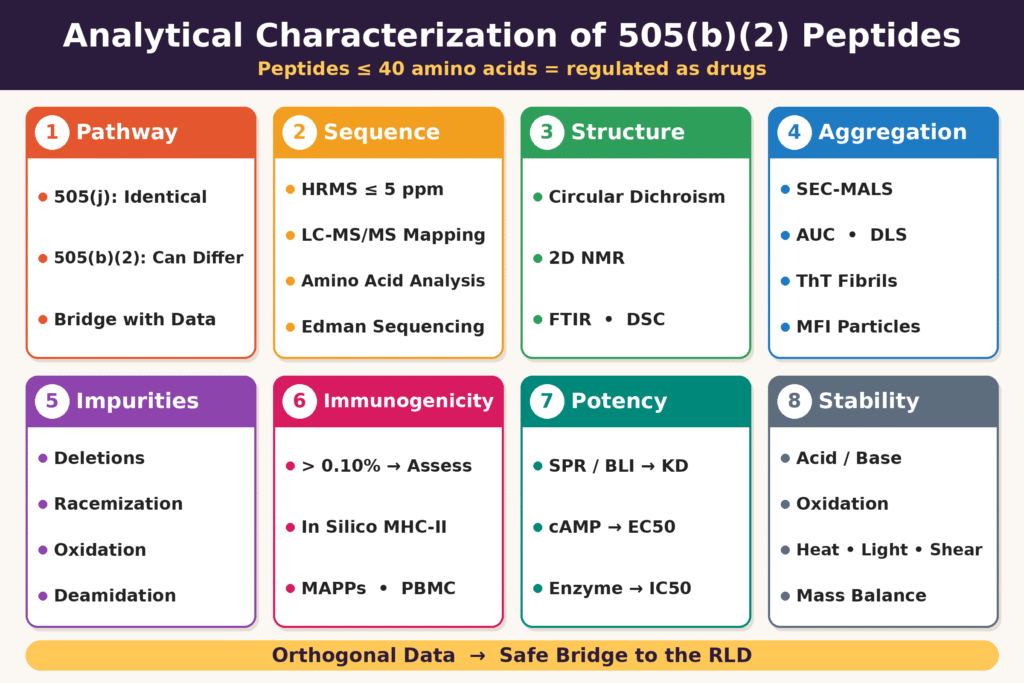
- Purpose: Under 505(b)(2), a peptide can differ from the reference drug (RLD) and still rely on FDA’s earlier safety findings. Analytical characterization supplies the data that links the new product to the RLD. Peptides of 40 or fewer amino acids are regulated as drugs, not biologics.
- 505(b)(2) vs 505(j): The 505(j) generic pathway requires the same active ingredient, and any new impurity above 0.50% makes the product ineligible. The 505(b)(2) pathway allows changes to sequence, formulation and impurity levels, provided they are supported by toxicology or bridging data.
- Primary sequence: High-resolution mass spectrometry confirms the exact mass (within 5 ppm), and LC-MS/MS peptide mapping confirms the sequence. Amino acid analysis and terminal sequencing (Edman degradation and carboxypeptidase digestion) complete the picture.
- Higher-order structure and aggregation: Circular dichroism, NMR, FTIR and DSC show whether the peptide’s folding has changed. SEC-MALS, AUC, DLS, ThT assays and micro-flow imaging measure aggregates and particles, from small oligomers to visible particulates.
- Impurities and immunogenicity: Synthesis and degradation create impurities such as deletion sequences, racemized residues, oxidation and deamidation. Any impurity at or above 0.10% must be identified and checked for immune risk using in silico MHC-II prediction, MAPPs and PBMC assays.
- Potency: SPR or BLI measures receptor binding (KD). Cell-based assays such as cAMP measure EC50, and enzyme assays measure IC50, to confirm that the changes do not reduce biological activity.
- Stability: Forced degradation studies stress the peptide with acid, base, oxidation, heat, light and shear, following ICH Q1A(R2), Q1B and Q5C. Stability-indicating LC-MS methods must show mass balance, meaning the loss of parent peptide matches the degradants that form.
Regulatory Frameworks: 505(b)(2) NDA vs 505(j) ANDA Pathways
The 505(b)(2) regulatory pathway permits intentional differences in active ingredient structure, formulation excipients, route of administration, or clinical indication compared with an RLD, while relying on analytical characterization to scientifically establish a connection between these changes. In contrast, an Abbreviated New Drug Application (ANDA) submitted under Section 505(j) requires strict active ingredient “sameness” and therapeutic equivalence to the reference standard.
For generic synthetic peptides referencing recombinant origin RLDs, such as glucagon, liraglutide, or teriparatide, under the 505(j) pathway, regulatory guidelines establish stringent impurity boundaries. Any novel peptide-related impurity detected between 0.10% and 0.50% must be fully isolated, characterized, and evaluated to demonstrate that it does not increase immunogenicity risk through T-cell activation or innate immune responses. Novel impurities exceeding 0.50% render a peptide candidate entirely ineligible for the 505(j) generic pathway.
The 505(b)(2) pathway accommodates active ingredient modifications, sequence alterations, sustained-release delivery vehicles, and novel impurities exceeding 0.10% or 0.50%, provided that the sponsor supports these differences through non-clinical bridging, toxicological characterization, or targeted clinical evaluations. Consequently, the strategy for Analytical Characterization for 505(b)(2) Peptide Products focuses on establishing comprehensive structural profiles, defining degradation kinetics, and demonstrating that product variations preserve the desired safety and pharmacodynamic profiles.
Review our regulatory requirements for GLP-1 peptide characterization for additional guidance on analytical expectations for peptide products.
| Analytical & Regulatory Parameter | 505(j) ANDA Pathway (Generic) | 505(b)(2) NDA Pathway (Hybrid) |
|---|---|---|
| Active Ingredient Sameness | Mandatory; identical primary sequence and higher-order structure. | Permitted to differ (e.g., sequence modifications, mimetics, novel salts). |
| Formulation Flexibility | Restricted strictly to Q1/Q2 sameness for parenterals. | Flexible; supports sustained-release, liposomal, or oral delivery platforms. |
| Impurity Threshold Limits | Novel impurities >0.10% require safety characterization; >0.50% prohibited. | Novel impurities >0.10% or >0.50% allowed if supported by toxicological bridging. |
| Immunogenicity Assessment | Must prove no increased immunogenicity risk compared to RLD. | Evaluated via preclinical/clinical bridging alongside analytical modeling. |
| Reliance on FDA Findings | Total reliance on RLD safety and effectiveness findings. | Partial reliance on RLD findings, supplemented by applicant’s proprietary data. |
Primary Sequence and Monoisotopic Mass Verification
Primary sequence verification establishes the exact linear ordering of amino acids, monoisotopic molecular mass, and terminal group integrity for a therapeutic peptide active pharmaceutical ingredient. High-resolution analytical techniques confirm that synthetic steps or sequence modifications have not introduced unintended amino acid substitutions, deletions, or unexpected covalent modifications.
Orthogonal Techniques for Primary Structure Determination
Orthogonal methods for primary sequence determination integrate high-resolution mass spectrometry, tandem mass spectrometry fragmentation, Edman degradation, and quantitative amino acid analysis to confirm sequence fidelity. Combining these complementary techniques provides comprehensive sequence coverage and accurate molar stoichiometry throughout the peptide backbone.
- High-Resolution Electrospray Ionization Mass Spectrometry (ESI-HRMS): Operating through Orbitrap or Quadrupole Time-of-Flight (QToF) mass spectrometers, ESI-HRMS determines the exact monoisotopic molecular mass and charge-state distributions. This establishes molecular identity within tight mass accuracy limits (≤ 5 ppm), confirming that synthesized batches correspond to the theoretical molecular formulas.
- Tandem Mass Spectrometry (LC-MS/MS Peptide Mapping): Using collision-induced dissociation (CID), higher-energy C-trap dissociation (HCD), or electron-transfer dissociation (ETD), tandem MS fragments the peptide backbone along b and y ion series. This produces structural maps that verify individual amino acid residues, localize post-translational or synthetic modifications, and identify sequence variants.
- Quantitative Amino Acid Analysis (AAA): Acid hydrolysis using 6 M HCl at 110°C breaks peptide amide bonds into their constituent free amino acids. Subsequent derivatization and Ultra-Performance Liquid Chromatography (UPLC) separation with optical or fluorescence detection quantify amino acid stoichiometry, thereby confirming absolute molar ratios.
- N-Terminal and C-Terminal Sequencing: Chemical Edman degradation sequentially cleaves N-terminal residues for direct identification, whereas C-terminal verification uses carboxypeptidase enzymatic digestion combined with mass spectrometry tracking.
Learn more about peptide sequencing of GLP-1 peptides and analytical approaches used to verify peptide sequence integrity.
Higher-Order Structure (HOS) and Conformational Profiling
Higher-order structure profiling evaluates the three-dimensional secondary (α-helices, β-sheets, random coils) and tertiary conformations that govern receptor binding affinity and biological activity. Even subtle amino acid substitutions, salt modifications, or excipient changes in a 505(b)(2) peptide candidate can alter backbone hydrogen bonding, potentially resulting in structural misfolding or changes in therapeutic potency.
Circular Dichroism (CD) spectrophotometry serves as a core spectroscopic technique for assessing conformational integrity. Far-UV CD spectroscopy (190 nm to 250 nm) measures the differential absorption of circularly polarized light by peptide amide bonds, providing quantitative spectral estimates of secondary structure composition. Near-UV CD spectroscopy (260 nm to 350 nm) evaluates the tertiary structural environment surrounding aromatic residues (phenylalanine, tyrosine, tryptophan) and disulfide linkages, allowing the detection of conformational realignments caused by formulation changes.
Explore our CD spectroscopy approach for peptide secondary-structure characterization to evaluate conformational changes in therapeutic peptides.
Nuclear Magnetic Resonance (NMR) spectroscopy provides atomic-resolution conformational fingerprinting for formulated peptide products. Two-dimensional ¹H-¹⁵N Heteronuclear Single Quantum Coherence (HSQC) and ¹H-¹³C HMBC experiments map amide proton chemical shifts, generating unique structural spectra that serve as sensitive indicators of tertiary folding alterations. Complementary vibrational techniques, such as Fourier-Transform Infrared (FTIR) spectroscopy, which tracks Amide I vibrational bands (1600–1700 cm⁻¹), and thermal analysis using Differential Scanning Calorimetry (DSC), which tracks denaturation temperatures (Tm), further support the evaluation of physical conformational stability across varying temperature and pH ranges.
See how 2D NMR is applied to peptide characterization for detailed structural and conformational assessment.
Aggregation and Oligomeric State Determination
Aggregation characterization quantifies monomeric purity and identifies soluble or insoluble oligomeric complexes that may reduce bioactivity or contribute to severe immunogenic responses. Comprehensive analytical testing for 505(b)(2) peptide formulations evaluates particle sizes across the entire continuum, ranging from soluble dimers and trimers to sub-visible and visible particulates.
Size-Exclusion Chromatography coupled with Multi-Angle Light Scattering (SEC-MALS) provides primary separation and molecular mass determination for soluble aggregates. Although traditional SEC depends on column calibration standards that may interact non-ideally with hydrophobic peptides, inline MALS light scattering detectors directly calculate absolute molar masses, enabling the resolution of monomeric populations from higher-order soluble oligomers.
Analytical Ultracentrifugation Sedimentation Velocity (AUC-SV) provides matrix-free quantification of oligomeric states in native formulation buffers. AUC-SV measures sedimentation coefficients under high centrifugal fields, distinguishing native monomeric peptides from self-associated complexes without stationary-phase interactions or sample dilution artifacts. Dynamic Light Scattering (DLS) complements AUC by measuring translational diffusion coefficients to calculate hydrodynamic radius (Rh), providing high sensitivity for trace sub-micron aggregates.
To evaluate amyloid-like fibril formation, Thioflavin-T (ThT) fluorescence assays monitor cross-β-sheet nucleation kinetics. Finally, sub-visible particulate matter (2–100 μm) is quantified using Micro-Flow Imaging (MFI) and light obscuration techniques to ensure compliance with compendial standards (USP and USP) for parenteral administration.
Discover analytical approaches for peptide aggregation analysis to assess oligomeric species and aggregation-related quality attributes.
Impurity Profiling and Immunogenicity Assessment in Analytical Characterization for 505(b)(2) Peptide Products
Impurity profiling in Analytical Characterization for 505(b)(2) Peptide Products involves the isolation, identification, and quantification of process-related and product-related impurities present at concentrations at or above 0.10%. Solid-Phase Peptide Synthesis (SPPS) introduces distinctive chemical impurity risks that require dedicated high-resolution separation protocols.
Synthetic and Chemical Degradation Impurity Characterization
Synthetic peptide manufacturing through SPPS generates specific impurities, including deletion sequences resulting from incomplete coupling, truncated fragments, diastereomers caused by amino acid racemization, and residual protecting group adducts. Chemical degradation during processing and storage can additionally produce oxidized methionine or cysteine residues, deamidated asparagine variants, isoaspartate rearrangements, and pyroglutamate cyclizations.
Because amino acid substitutions or minor chemical modifications can generate novel antigenic epitopes, impurities present above 0.10% in 505(b)(2) filings require rigorous immunogenicity evaluation. Applicants use in silico Major Histocompatibility Complex Class II (MHC-II) binding algorithms to predict T-cell epitope potential. These computational models are further evaluated using in vitro MHC-associated peptide proteomics (MAPPs) and peripheral blood mononuclear cell (PBMC) cytokine release assays to determine whether novel impurities trigger unwanted adaptive or innate immune responses.
| Analytical Technique | Targeted Quality Attribute / Impurity | Detection Threshold / LOQ | Regulatory & Compendial Standard |
|---|---|---|---|
| Reverse-Phase UPLC-HRMS | Deletion sequences, oxidized residues, truncated fragments. | LOQ ≤ 0.05%–0.10% w/w. | ICH Q3A/B, FDA Synthetic Peptide Guidance. |
| Chiral Phase UPLC-MS | D-amino acid enantiomers, diastereomeric variants. | LOQ ≤ 0.10% w/w. | FDA Active Ingredient Sameness Guidelines. |
| Ion-Exchange Chromatography (IEX) | Charge variants, deamidated species, isoaspartate. | Quantitation ≥ 0.10% w/w. | USP Chromatography, ICH Q6B. |
| Headspace GC-MS | Residual organic solvents (DMF, Piperidine, TFA, ACN). | PPM levels meeting ICH limits. | USP Residual Solvents. |
| ICP-MS | Elemental impurities, heavy metal catalysts. | Sub-PPM / PPB sensitivity. | USP / USP Elemental Impurities. |
| LAL Endotoxin Assay | Bacterial endotoxins, pyrogenic contaminants. | Sub-EU/mL detection. | USP Bacterial Endotoxins Test. |
In Vitro Biological Activity and Potency Assays
In vitro potency assays quantify the functional biological activity of a candidate peptide by measuring target receptor binding kinetics and cell-based signal transduction pathways. These functional bioassays confirm whether modifications to the primary sequence, salt form, or formulation excipients in a 505(b)(2) peptide candidate preserve the intended pharmacodynamic potency.
Receptor interaction dynamics are characterized using label-free biosensors such as Surface Plasmon Resonance (SPR) or Bio-Layer Interferometry (BLI). SPR measures real-time association rates (kon), dissociation rates (koff), and overall equilibrium dissociation constants (KD), helping determine whether structural alterations affect target binding affinity.
Cell-based bioassays evaluate downstream intracellular signaling cascades triggered by receptor activation. For peptides targeting G-protein coupled receptors (GPCRs), functional potency is quantified through intracellular cyclic Adenosine Monophosphate (cAMP) accumulation assays, receptor phosphorylation cascades, or reporter gene expression assays, producing precise half-maximal effective concentration (EC50) values. For peptide enzyme inhibitors, in vitro enzymatic kinetic assays establish half-maximal inhibitory concentrations (IC50) and inhibition constants (Ki) to demonstrate functional comparability.
Stability Testing and Forced Degradation Studies
Forced degradation studies expose therapeutic peptides to deliberately selected stress conditions to identify intrinsic degradation pathways and verify the stability-indicating capabilities of proposed analytical methods. Regulatory submission dossiers under 505(b)(2) rely on stress testing data to establish storage conditions, retest periods, and degradation kinetics in accordance with ICH Q1A(R2) and ICH Q5C guidelines.
Review our GLP-1 peptide stability and analytical methods to learn more about stability-indicating analytical strategies for peptide products.
- Acidic and Alkaline Hydrolysis: Incubating peptide samples in 0.1–1.0 M HCl or NaOH evaluates susceptibility to peptide bond cleavage, deamidation kinetics, and cyclic imide formation.
- Oxidative Stress Testing: Exposure to varying concentrations of hydrogen peroxide (H2O2) or peroxyl radicals quantifies oxidation rates at methionine, cysteine, and tryptophan residues.
- Thermal and Humidity Stress: Storing peptide samples at elevated temperatures (40°C to 60°C) under controlled relative humidity promotes physical unfolding and secondary aggregation pathways.
- Photolytic Stress Testing: Exposing samples to artificial daylight and near-UV light according to ICH Q1B protocols identifies light-sensitive degradation pathways.
- Mechanical Shear and Interfacial Stress: Agitation through orbital shaking or vortexing highlights surface-induced aggregation and precipitation tendencies in liquid parenteral formulations.
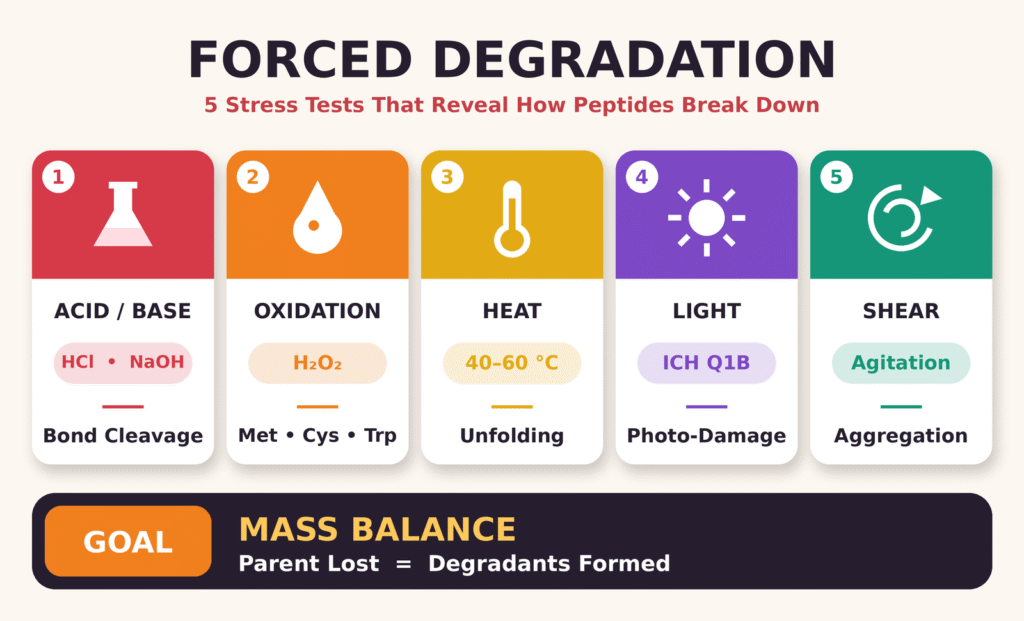
Stability-indicating analytical methods—primarily high-resolution RP-UPLC-MS—must demonstrate mass balance throughout forced degradation studies, establishing that the reduction in parent peptide concentration corresponds quantitatively to the formation of identified degradation products.
Conclusion
Analytical Characterization for 505(b)(2) Peptide Products provides the scientific foundation required to establish product safety, structural integrity, and biological efficacy when introducing modified peptide therapeutics. Deploying an integrated matrix of high-resolution mass spectrometry, conformational spectroscopy, aggregate profiling, impurity characterization, and cell-based functional assays enables the analytical bridging of product modifications to reference standards while supporting compliance with global regulatory requirements.
Need a structured analytical package for your peptide development program? Explore our peptide characterization CRO deliverables checklist to understand key characterization outputs and documentation.
To explore specialized bioanalytical testing protocols, high-resolution LC-MS sequence validation, or regulatory submission support for your peptide development pipeline, visit the ResolveMass Contact Page.
Frequently Asked Questions
LC-HRMS combines chromatographic separation with highly accurate mass measurement, making it valuable for confirming peptide identity and investigating related substances. It can support sequence-specific fragmentation, terminal group verification, and identification of modifications such as oxidation or truncation. Orbitrap and QToF platforms provide the mass resolution needed to distinguish the intended peptide from closely related impurities.
For peptide products, impurities at or above established reporting and characterization thresholds require appropriate identification and evaluation based on their nature and regulatory context. A 0.10% level is commonly used as an important analytical threshold for peptide-related impurities in the characterization strategy. For 505(b)(2) products, impurities above relevant thresholds may require additional structural, toxicological, and immunogenicity risk assessment.
Circular Dichroism spectroscopy evaluates conformational characteristics by measuring differences in the absorption of circularly polarized light by peptide bonds and relevant chromophore groups. Far-UV CD spectroscopy, typically covering 190–250 nm, provides information about secondary structural elements such as α-helices and β-sheets. Near-UV CD spectroscopy, generally covering 260–350 nm, provides information about the tertiary environments of aromatic residues and disulfide bonds.
No single analytical technique can adequately characterize every form of peptide aggregation, so complementary methods are used across different size ranges. SEC-MALS evaluates soluble oligomers and provides molecular mass information, while AUC assesses sedimentation behavior in native formulations. DLS determines hydrodynamic radius, and Micro-Flow Imaging (MFI) supports the detection and characterization of sub-visible particles from 2 to 100 μm.
Isobaric amino acids, such as leucine and isoleucine, can have identical molecular masses, while D-amino acid variants may require stereospecific separation for reliable differentiation. Standard mass spectrometry alone may therefore be insufficient for definitive identification. Chiral-phase UPLC, appropriate derivatization strategies, and detailed LC-MS/MS fragmentation analysis can provide the additional selectivity required to distinguish these related species.
Forced degradation studies intentionally expose peptide products to conditions such as acidic, alkaline, oxidative, thermal, photolytic, and mechanical stress. The resulting degradation products help establish degradation pathways and demonstrate that analytical procedures can reliably indicate stability changes. These studies also support mass balance assessments, formulation development, and the justification of storage and shelf-life conditions under applicable ICH guidelines.
The need for cell-based potency bioassays depends on the product’s mechanism of action, the proposed modifications, and the extent to which physicochemical methods can establish functional comparability. When structural or formulation changes may influence receptor signaling or biological activity, functional assays can provide important supporting evidence. SPR or BLI may assess receptor interactions, while cAMP, reporter gene, or other cell-based assays can measure downstream biological responses.
Formulation excipients can influence chromatographic separation, UV detection, sample recovery, and mass spectrometry ionization efficiency. Components such as surfactants, preservatives, and tonicity agents may therefore create matrix-related analytical interference. Method development may require sample preparation, selective extraction, solid-phase clean-up, or complementary orthogonal techniques to obtain reliable peptide characterization results.
The analytical strategy for synthetic peptides can incorporate applicable ICH guidelines covering specifications, impurities, and residual solvents, together with relevant USP compendial requirements. ICH Q6A/B, ICH Q3A/B, and ICH Q3C may provide important frameworks depending on the product and testing objective. Applicable FDA guidance and USP standards should also be considered for attributes such as endotoxins, elemental impurities, and residual solvents.
Reference:
- U.S. Food and Drug Administration. (2017). Determining whether to submit an ANDA or a 505(b)(2) application: Guidance for industry [Draft guidance]. U.S. Department of Health and Human Services. FDA guidance document
- U.S. Food and Drug Administration. (2019). Determining whether to submit an ANDA or a 505(b)(2) application: Guidance for industry. U.S. Department of Health and Human Services. https://www.fda.gov/media/124848/download
- U.S. Food and Drug Administration. (2022). Sameness evaluations in an ANDA—Active ingredients: Guidance for industry [Draft guidance]. U.S. Department of Health and Human Services, Center for Drug Evaluation and Research. FDA guidance document
- Gordon, M. L. (2026). Peptide safety and integrity: Understanding quality, verification, and regulatory boundaries: A white paper on origin, verification, and risk in modern peptide use. Millennium Health Publications. https://doi.org/10.13140/RG.2.2.18383.55201
- AC Immune SA. (2020). Annual report on Form 20-F for the fiscal year ended December 31, 2019. U.S. Securities and Exchange Commission. SEC filing
Get In Touch With Us
About The Author


