


Introduction:
Analytical Characterization of Dexamethasone Injection is one of the most important activities in developing a generic injectable drug product. Before a formulation scientist can successfully reproduce an innovator product, every critical quality attribute (CQA) of the reference listed drug (RLD) must be thoroughly understood — the active pharmaceutical ingredient (API), impurities, degradation products, excipients, elemental impurities, packaging interactions, and physicochemical characteristics all need to be mapped out with confidence.
This case study illustrates how a comprehensive analytical characterization strategy built an in-depth understanding of a Dexamethasone Injection formulation. While specific client information remains confidential, this representative project demonstrates the systematic analytical workflow ResolveMass Laboratories applies to support pharmaceutical companies developing complex injectable products for regulatory submission.
Summary:
- Analytical Characterization of Dexamethasone Injection is the systematic evaluation of a reference product’s API, impurities, excipients, physicochemical properties, elemental impurities, and packaging interactions to support generic injectable development.
- Comprehensive characterization spans assay confirmation, related-substance and unknown impurity profiling, excipient identification, elemental impurity testing, particulate analysis, and container closure/extractables and leachables assessment.
- A multi-platform, orthogonal analytical strategy — combining HPLC, UHPLC, LC-HRMS, LC-MS/MS, GC-MS, and ICP-MS — reduces regulatory risk and strengthens confidence in formulation understanding.
- This case study walks through a representative ResolveMass reverse-engineering program that generated a complete analytical dataset for a Dexamethasone Injection formulation ahead of generic development.
- Detailed characterization data directly supports formulation optimization, quality-by-design (QbD) strategy, technology transfer, and regulatory submissions.
1: Why Is Analytical Characterization of Dexamethasone Injection Important?
The primary objective of characterization is to understand every measurable attribute of the reference product that could influence safety, efficacy, stability, manufacturability, and regulatory acceptance. Unlike oral dosage forms, injectable products carry extremely tight quality requirements because they bypass many of the body’s natural physiological barriers — even small differences in formulation composition, impurity profile, or particulate matter can affect patient safety.
Comprehensive analytical characterization enables developers to:
- Understand the complete formulation composition
- Identify critical excipients
- Detect trace impurities
- Characterize degradation pathways
- Support reverse engineering
- Guide formulation development
- Reduce development timelines
- Minimize regulatory questions
- Improve ANDA submission success
Project Background
A pharmaceutical company intended to develop a generic version of Dexamethasone Injection for multiple international markets and needed a full analytical picture of the reference product before formulation work could begin. The client required:
- Complete reverse analytical characterization
- Excipient identification
- Unknown impurity identification
- Stability-indicating analytical methods
- Container closure compatibility evaluation
- Extractables and leachables assessment
- Regulatory-ready analytical reports
The objective was to generate sufficient analytical knowledge before formulation development commenced, in line with the broader development pathway outlined in ResolveMass’s dexamethasone injection development resources.
2: Initial Challenges
The project team faced several analytical challenges typical of complex generic injectable characterization, summarized below alongside the broader development challenges common to dexamethasone programs.
| Challenge | Analytical Concern |
|---|---|
| Low concentration impurities | Require highly sensitive LC-MS/MS methods |
| Multiple excipients | Accurate qualitative and quantitative identification |
| Injectable dosage form | Strict particulate and sterility-related requirements |
| Unknown degradants | Structural elucidation required |
| Packaging interactions | Possible leachables from elastomer and glass |
| Regulatory expectations | Comprehensive characterization documentation |
3: Analytical Strategy
A multi-platform analytical approach delivers the highest confidence in Analytical Characterization of Dexamethasone Injection because no single technique can answer every formulation question on its own. ResolveMass designed an orthogonal workflow — outlined further in our dexamethasone injection analytical methods resource — combining chromatographic, spectroscopic, elemental, and mass spectrometric techniques.
| Analytical Objective | Technique Used |
|---|---|
| API assay | HPLC-UV |
| Related substances | UHPLC |
| Unknown impurities | LC-HRMS |
| Structural confirmation | LC-MS/MS |
| Excipient profiling | LC-MS |
| Residual solvents | GC-MS |
| Elemental impurities | ICP-MS |
| Particulates | Light Obscuration |
| Packaging extractables | LC-HRMS & GC-MS |
| Container interaction | E&L Study |
Step 1 – API Identification and Assay
The first analytical activity confirmed the identity, salt form, and strength of dexamethasone in the formulation. Methods included:
- HPLC assay
- Reference standard comparison
- Retention time matching
- UV spectral comparison
- Mass confirmation by LC-MS
Because dexamethasone can appear in different ester and salt forms across marketed products, confirming the correct form was essential — see our comparison of dexamethasone phosphate vs. acetate for how salt-form selection affects solubility, onset, and analytical strategy. The API concentration matched the product label claim within pharmacopeial acceptance criteria.
Step 2 – Related Substance Profiling
Understanding impurities is essential because regulators expect generic products to demonstrate impurity profiles comparable to the reference product. A stability-indicating UHPLC method, developed in line with the approach described in dexamethasone impurities analysis, separated:
- Process impurities
- Known degradants
- Oxidative degradation products
- Hydrolytic degradation products
- Unknown trace impurities
Several impurities were detected below reporting thresholds, while two unknown peaks required additional investigation.
Step 3 – Unknown Impurity Identification
High-resolution mass spectrometry (HRMS) was used to identify the unknown chromatographic peaks. The workflow included:
- Accurate mass determination
- Isotopic distribution analysis
- MS/MS fragmentation
- Molecular formula prediction
- Database comparison
- Structural confirmation
The study confirmed that the unknown peaks represented expected degradation products rather than unexpected contaminants — a finding that significantly reduced regulatory risk for the program.
Step 4 – Excipient Characterization
Excipient profiling ensures every formulation component is identified and understood before generic formulation work begins. The reference formulation contained multiple excipients requiring confirmation and quantification, consistent with the excipient and buffer systems described in dexamethasone sodium phosphate formulation. The program evaluated:
- Buffer composition
- pH-adjusting agents
- Stabilizers
- Preservatives (where applicable)
- Antioxidants
- Solubilizing agents
Each excipient was confirmed using complementary chromatographic and spectroscopic techniques.
Step 5 – Physicochemical Characterization
Physicochemical properties directly influence formulation stability and manufacturability. The following parameters were evaluated:
| Property | Importance |
|---|---|
| pH | Drug stability |
| Osmolality | Patient compatibility |
| Appearance | Product quality |
| Color | Degradation indication |
| Clarity | Particulate assessment |
| Viscosity | Manufacturing consistency |
| Density | Formulation understanding |
These data established the formulation’s baseline quality attributes.
Step 6 – Elemental Impurity Testing
Elemental impurities may originate from raw materials, water systems, manufacturing equipment, glass containers, or processing aids. ICP-MS analysis evaluated elemental impurities in accordance with ICH Q3D principles, monitoring lead, cadmium, mercury, arsenic, nickel, chromium, cobalt, and vanadium. All monitored elements remained well below applicable limits.
Step 7 – Extractables and Leachables Evaluation
Packaging components can contribute chemical migrants throughout a product’s shelf life, which is why extractables and leachables in dexamethasone injectables are assessed as a core part of characterization. The program investigated:
- Glass vial compatibility
- Rubber stopper interactions
- Aluminum seal components
- Manufacturing tubing
- Filling equipment contact materials
Advanced LC-HRMS and GC-MS methods screened for plasticizers, antioxidants, oligomers, organic additives, volatile compounds, and semi-volatile compounds. No safety-significant leachables were observed under the evaluated conditions.
Step 8 – Stability-Indicating Evaluation
A forced degradation program, designed per the principles in forced degradation of dexamethasone, evaluated the product under acid hydrolysis, base hydrolysis, oxidation, thermal stress, photolysis, and humidity exposure. The resulting degradation profile enabled method validation, degradation pathway understanding, and confirmation of a stability-indicating method — feeding directly into the broader dexamethasone injection stability strategy for the product.
Step 9 – Particulate Matter Assessment
Injectable products require stringent particulate control. Testing included visible particulate inspection, light obscuration, and microscopic evaluation where necessary. The characterization confirmed compliance with injectable quality expectations and supported future manufacturing controls.
Step 10 – Comprehensive Data Integration
One of the most valuable outcomes of the project was integrating data from multiple analytical platforms into a single, unified scientific assessment covering API confirmation, impurity fingerprint, excipient composition, degradation pathways, packaging interaction profile, physicochemical properties, and stability behavior. This integrated package became a strong scientific foundation for the formulation scientists carrying the program forward, and later fed into lifecycle management strategies for dexamethasone injectables as the product moved toward commercial supply.
Key Outcomes of the Study
The analytical characterization project enabled the client to:
- Fully understand the reference formulation
- Identify all major formulation components
- Characterize degradation products
- Establish impurity profiles
- Confirm packaging compatibility
- Reduce formulation development risk
- Accelerate reverse engineering
- Support regulatory documentation
- Improve development efficiency
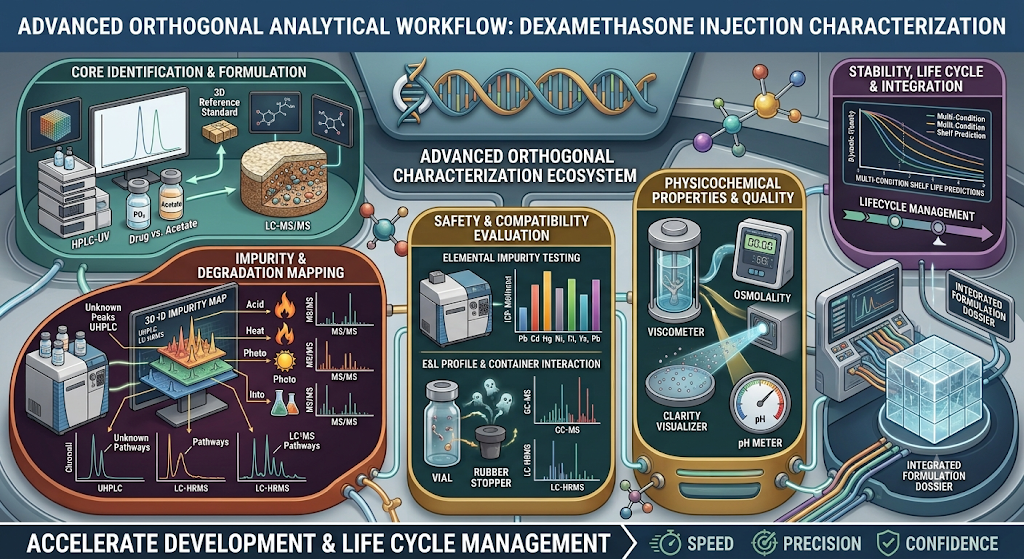
4: Why Orthogonal Analytical Techniques Matter
No single instrument can completely characterize a sterile injectable product. Combining multiple analytical platforms provides higher confidence in results, better impurity identification, improved method robustness, stronger regulatory defensibility, and reduced analytical uncertainty. Orthogonal testing is particularly valuable for injectable products, where patient safety requirements are exceptionally high — a principle that also applies to related depot formats, such as the work described in our dexamethasone implant PLGA characterization case study.
5: Regulatory Considerations
Analytical characterization should align with global regulatory expectations, including:
- ICH Q2 (Analytical Procedure Validation)
- ICH Q3A and Q3B (Impurities)
- ICH Q3D (Elemental Impurities)
- ICH Q8 (Pharmaceutical Development)
- ICH Q9 (Quality Risk Management)
- ICH Q10 (Pharmaceutical Quality System)
- USP monographs and applicable general chapters
Comprehensive characterization data can facilitate smoother interactions with regulatory agencies by providing a clear scientific rationale for formulation development and control strategies.
6: Why Choose ResolveMass Laboratories?
ResolveMass Laboratories combines scientific expertise with advanced analytical technologies to support complex pharmaceutical development programs, functioning as a dedicated dexamethasone injectable CRO partner from reverse engineering through regulatory submission. Our capabilities include:
- Reverse engineering of injectable formulations
- LC-MS/MS and high-resolution mass spectrometry
- Extractables and Leachables (E&L) studies
- Impurity identification and structural elucidation
- Elemental impurity testing (ICP-MS)
- Stability-indicating method development
- Degradation pathway investigations
- Method development and validation
- Regulatory-ready technical reporting
Our multidisciplinary team works closely with pharmaceutical and biotechnology companies to generate reliable analytical data that supports formulation development, quality assessment, and regulatory submissions.
Conclusion:
Analytical Characterization of Dexamethasone Injection provides the scientific foundation for successful generic injectable development. By systematically evaluating the API, impurities, excipients, physicochemical properties, elemental impurities, packaging interactions, and stability characteristics, developers gain the knowledge required to design robust formulations with reduced technical and regulatory risk.
A comprehensive, orthogonal analytical strategy not only accelerates reverse engineering but also strengthens regulatory submissions by providing defensible, high-quality scientific evidence. At ResolveMass Laboratories, advanced analytical instrumentation, experienced scientists, and regulatory-focused workflows enable clients to confidently navigate the challenges of complex injectable product development. Whether the objective is reverse engineering, impurity characterization, extractables and leachables assessment, or complete Analytical Characterization of Dexamethasone Injection, our team delivers data-driven solutions that support successful pharmaceutical innovation.
Frequently Asked Questions:
Analytical characterization provides a complete understanding of the injectable formulation by identifying the active pharmaceutical ingredient (API), excipients, impurities, degradation products, and physicochemical properties. It also evaluates parameters such as pH, osmolality, particulate matter, and elemental impurities. This information helps scientists understand the product’s quality, stability, and performance. The data serves as the foundation for generic drug development and regulatory submissions.
Analytical characterization compares the generic product with the reference listed drug (RLD) to ensure they are pharmaceutically equivalent. It evaluates assay, impurity profiles, excipient composition, and critical quality attributes. These studies help identify formulation differences that could impact safety or efficacy. Comprehensive analytical data strengthens regulatory submissions and supports successful product development.
The pH of an injectable formulation directly influences drug stability, solubility, and compatibility with the human body. Even small pH variations can accelerate degradation or affect product performance. Monitoring pH helps maintain consistent product quality throughout its shelf life. It also ensures compliance with pharmacopeial and regulatory specifications.
Osmolality measures the concentration of dissolved particles in an injectable formulation. Maintaining the correct osmolality helps reduce irritation, pain, and tissue damage during administration. It also ensures compatibility with physiological fluids and supports patient safety. Osmolality is considered an important critical quality attribute for many injectable drug products.
Forced degradation studies intentionally expose the product to stress conditions such as heat, light, oxidation, acid, and base. These studies help identify degradation pathways and degradation products. They also demonstrate that analytical methods can accurately detect changes in product quality. This information is essential for stability studies and regulatory compliance.
HRMS provides highly accurate molecular weight measurements and structural information for unknown compounds. It enables scientists to identify trace impurities, degradation products, and packaging-related leachables with high confidence. The technique offers exceptional sensitivity and selectivity, making it valuable for complex injectable formulations. HRMS data also supports regulatory investigations and impurity identification.
Particulate matter is assessed using visual inspection, light obscuration methods, and microscopic examination when necessary. These tests identify visible and subvisible particles that may affect product quality and safety. Injectable products must meet strict pharmacopeial limits for particulate matter. Routine monitoring helps ensure compliance with regulatory standards and protects patient health.
Residual solvents are commonly analyzed using gas chromatography (GC) or GC-MS techniques. These methods accurately detect and quantify volatile organic solvents remaining after manufacturing. Results are compared against ICH Q3C limits to ensure patient safety. Monitoring residual solvents also demonstrates that the manufacturing process is well controlled.
Yes. Comprehensive analytical characterization identifies potential formulation issues early in development, allowing manufacturers to address them before regulatory submission. It provides strong scientific evidence to support product quality and equivalence claims. This proactive approach reduces the likelihood of regulatory deficiencies, delays, or additional information requests. Ultimately, it improves the chances of successful product approval.
Reference
- Chang-Lin JE, Attar M, Acheampong AA, Robinson MR, Whitcup SM, Kuppermann BD, Welty D. Pharmacokinetics and pharmacodynamics of a sustained-release dexamethasone intravitreal implant. Investigative ophthalmology & visual science. 2011 Jan 1;52(1):80-6.https://tvst.arvojournals.org/article.aspx?articleid=2128537
- Eckerlin RH, Ebel JG, Henion JD, Covey TR. The case of the tainted dexamethasone. Analytical Chemistry. 1989 Jan 1;61(1):53-9.https://pubs.acs.org/doi/full/10.1021/ac00176a002
- Bhargava D, Deshpande A, Thomas S, Sharma Y, Khare P, Sahu SK, Dubey S, Pandey A, Sreekumar K. High performance liquid chromatography determination of dexamethasone in plasma to evaluate its systemic absorption following intra-space pterygomandibular injection of twin-mix (mixture of 2% lignocaine with 1: 200,000 epinephrine and 4 mg dexamethasone): randomized control trial. Oral and maxillofacial surgery. 2016 Sep;20(3):259-64.https://link.springer.com/article/10.1007/s10006-016-0564-3
- Chen Q, Zielinski D, Chen J, Koski A, Werst D, Nowak S. A validated, stability-indicating HPLC method for the determination of dexamethasone related substances on dexamethasone-coated drug-eluting stents. Journal of pharmaceutical and biomedical analysis. 2008 Nov 4;48(3):732-8.https://www.sciencedirect.com/science/article/pii/S0731708508003853
- da Silva Leite JM, Barros Araújo CB, Alves LP, Bezerra Pereira MR, Guedes GG, de Carvalho Moreira LM, Rocha BP, Borges JC, de Azevedo EP, Alencar Fernandes FH, Oshiro Junior JA. Trends and application of analytical methods for the identification and quantification of dexamethasone in drug delivery system. Current Pharmaceutical Analysis. 2023 Jan 1;19(1):1-9.https://www.benthamdirect.com/content/journals/cpa/10.2174/1573412918666221004122046
- Alimohammadi S, Kiani MA, Imani M, Rafii-Tabar H, Sasanpour P. Electrochemical determination of dexamethasone by graphene modified electrode: experimental and theoretical investigations. Scientific reports. 2019 Aug 13;9(1):11775.https://www.nature.com/articles/s41598-019-47420-0
- Yuan Y, Zhou X, Li J, Ye S, Ji X, Li L, Zhou T, Lu W. Development and validation of a highly sensitive LC‐MS/MS method for the determination of dexamethasone in nude mice plasma and its application to a pharmacokinetic study. Biomedical Chromatography. 2015 Apr;29(4):578-83.https://analyticalsciencejournals.onlinelibrary.wiley.com/doi/abs/10.1002/bmc.3316
About the Author


