

Introduction
Antisense Oligonucleotide-Peptide Conjugates have emerged as an advanced therapeutic platform designed to address the longstanding pharmacokinetic, biodistribution, and intracellular delivery challenges associated with unmodified nucleic acid therapeutics. Instead of depending on high-dose systemic administration, which frequently results in limited penetration into extrahepatic tissues, these conjugates combine sequence-specific gene-modulating oligonucleotides with specialized carrier peptides that exploit endogenous biological transport pathways to efficiently traverse lipid membranes. This molecular partnership fundamentally reshapes the biodistribution characteristics of the therapeutic payload, enabling selective delivery to otherwise difficult-to-access tissues, including the central nervous system, cardiac muscle, and skeletal muscle. As precision genetic medicine continues to gain momentum in the treatment of neuromuscular disorders and rare genetic diseases, optimizing every aspect of these hybrid therapeutics—from peptide vector selection and bio-orthogonal linker chemistry to sophisticated analytical characterization—has become essential for biopharmaceutical developers seeking to achieve optimal therapeutic efficacy while maintaining an excellent safety profile.
Explore the Core Biological Framework: Understand how these molecular systems operate at a cellular level by exploring the peptide-oligonucleotide conjugates mechanism of action.
Article Summary:
- Antisense Oligonucleotide-Peptide Conjugates (AOPCs) combine gene-targeting oligonucleotides with specialized peptides to improve cellular uptake, tissue specificity, and therapeutic delivery, overcoming the limitations of conventional antisense therapies.
- Peptide vector selection plays a central role in treatment success. Cell-penetrating, receptor-targeting, and tissue-homing peptides direct therapeutic molecules to specific organs such as skeletal muscle, heart, tumors, and the central nervous system while enhancing intracellular transport.
- Linker chemistry determines conjugate performance by balancing stability in circulation with efficient intracellular release. Cleavable linkers release the oligonucleotide inside target cells, whereas non-cleavable linkers maintain structural integrity for applications requiring continuous peptide attachment.
- Escaping endosomal entrapment is essential for therapeutic activity. Advanced peptide designs promote disruption of the endosomal membrane, allowing the oligonucleotide to reach the cytoplasm before degradation occurs within lysosomes.
- Manufacturing these hybrid molecules is technically demanding because peptide and oligonucleotide synthesis rely on different chemical conditions. Developers typically use either post-synthetic conjugation or fragment-based solid-phase assembly while carefully optimizing purification and formulation processes.
- Clinical studies demonstrate improved therapeutic outcomes, particularly in neuromuscular disorders such as Duchenne Muscular Dystrophy (DMD) and Spinal Muscular Atrophy (SMA), where peptide conjugation enhances tissue penetration, increases gene-modifying activity, and reduces dosing frequency compared with unconjugated oligonucleotides.
- Comprehensive analytical characterization is critical to ensure product quality, safety, and regulatory compliance. Advanced techniques such as high-resolution mass spectrometry, orthogonal chromatography, and specialized bioanalytical assays are essential for confirming molecular identity, detecting impurities, and supporting successful clinical development and commercialization.
Vector Selection in Antisense Oligonucleotide-Peptide Conjugates
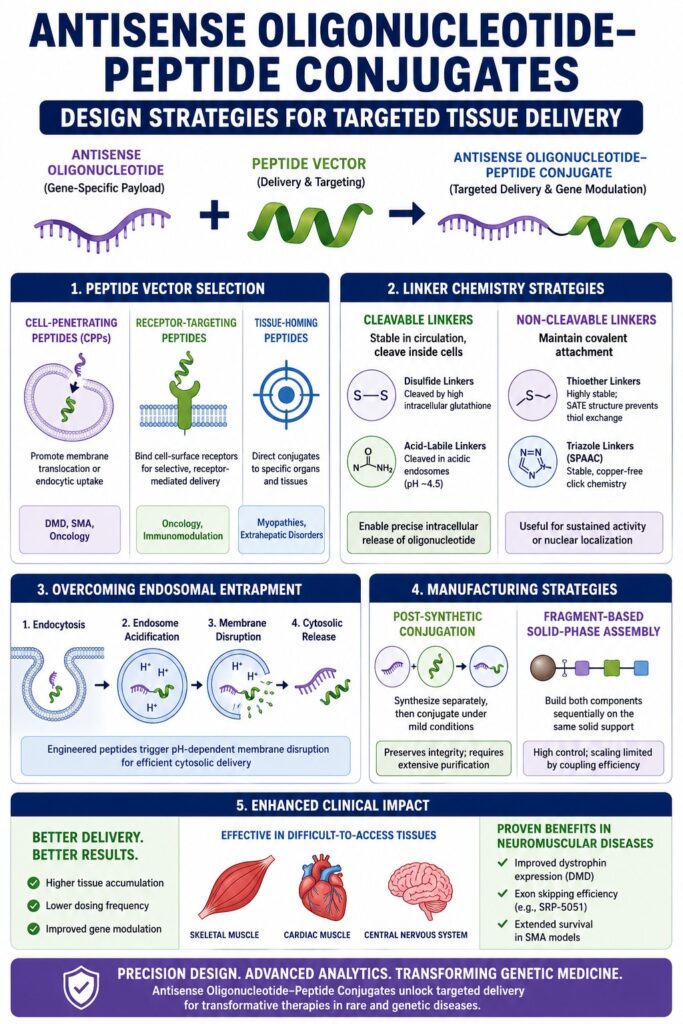
The selection of an appropriate peptide vector in Antisense Oligonucleotide-Peptide Conjugates is one of the most influential factors governing biodistribution, cellular internalization pathways, and the overall biological performance of the therapeutic construct. Naked oligonucleotides possess relatively high molecular weights together with strongly polyanionic phosphate backbones, characteristics that contribute to rapid nuclease-mediated degradation, inefficient membrane permeability, and accelerated renal elimination before therapeutically meaningful concentrations can accumulate within the cytoplasm or nucleus.
To overcome these inherent physicochemical limitations, researchers engineer specialized peptide vectors that function as molecular transporters, guiding the oligonucleotide payload toward its intended intracellular destination. The molecular architecture of these peptides determines whether the conjugate enters cells through direct membrane translocation, receptor-mediated endocytosis, or selective tissue-homing mechanisms, ultimately influencing therapeutic specificity and potency.
Review Design Classes: Delve into the specific structural configurations used today by reading about the different types of peptide-oligonucleotide conjugates.
| Peptide Vector Class | Mechanism of Action | Key Structural Features | Therapeutic Applications |
|---|---|---|---|
| Cell-Penetrating Peptides (CPPs) | Promotes membrane destabilization or endocytic uptake to transport large polyanionic payloads across lipid bilayers. | Cationic (arginine-rich) or amphipathic peptide sequences, frequently incorporating non-natural amino acids for enhanced stability. | Duchenne Muscular Dystrophy (DMD), Spinal Muscular Atrophy (SMA), and oncology. |
| Receptor-Targeting Peptides | Selectively binds cell-surface receptors, initiating receptor-mediated endocytosis with high tissue specificity. | Ligand-specific peptide sequences, such as cRGD for αvβ3 integrin receptors overexpressed in tumor tissues. | Precision oncology, tumor microenvironment targeting, and localized immunomodulation. |
| Tissue-Homing Peptides | Directs therapeutic conjugates preferentially toward specific organs while reducing hepatic accumulation. | Peptide sequences identified through in vivo phage display screening, including the M12 peptide for striated muscle targeting. | Advanced myopathies and extrahepatic genetic disorders. |
Among the most extensively investigated peptide vectors, the Pip (PNA/PMO Internalization Peptide) family represents one of the most clinically advanced classes of chimeric cell-penetrating peptides engineered to restore defective gene expression. The Pip6a sequence, defined as RXRRBRRXRYQFLIRXRBRXRB, incorporates a strategically positioned hydrophobic core (YQFLI) flanked by arginine-rich cationic domains that include beta-alanine (B) and aminohexanoic acid (X) spacer residues. This carefully engineered spatial organization significantly reduces susceptibility to serum proteolytic degradation while enhancing interactions with the highly restrictive sarcolemma of skeletal and cardiac muscle cells. Likewise, next-generation muscle-targeting constructs such as the M12 peptide have demonstrated the ability to restore dystrophin expression to approximately 25% of normal levels in mdx mouse models using comparatively low therapeutic doses. Importantly, these constructs effectively minimize the extensive hepatic sequestration commonly observed with unconjugated oligonucleotide therapies, thereby substantially improving extrahepatic tissue delivery.
Compare Alternate Conjugation Scaffolds: Evaluate how peptide carriers perform relative to antibody platforms by reading about peptide vs. antibody oligonucleotide conjugates.
Advanced Linker Chemistry for Antisense Oligonucleotide-Peptide Conjugates
Advanced linker chemistry plays a pivotal role in determining the overall performance of Antisense Oligonucleotide-Peptide Conjugates by balancing systemic stability with efficient intracellular release of the therapeutic oligonucleotide. If the chemical linkage is excessively unstable, premature cleavage within systemic circulation can result in rapid renal elimination and undesirable off-target effects. Conversely, if the linker exhibits excessive stability, the oligonucleotide may remain sterically constrained by the attached peptide after cellular uptake, preventing efficient hybridization with its complementary pre-mRNA or mRNA target.
Designing these molecular linkages requires an in-depth understanding of the diverse biological environments encountered during circulation and intracellular trafficking. Consequently, developers carefully select either cleavable or non-cleavable bio-orthogonal linker systems according to the intended therapeutic mechanism and intracellular release requirements.
Optimize Linker Stability: Discover how specific chemical designs influence therapeutic stability and release profiles in our guide on peptide-oligonucleotide conjugate linker chemistry.
Cleavable vs. Non-Cleavable Linkage Strategies
Cleavable linkers are intentionally engineered to remain highly stable within extracellular physiological environments while undergoing rapid cleavage in response to specific intracellular stimuli, including enzymatic activity, acidic pH conditions, or redox potential. Disulfide linkers represent one of the most widely utilized examples of this strategy. These linkages remain stable within the oxidizing environment of blood plasma but are rapidly reduced after entering the cytoplasm, where intracellular glutathione concentrations are substantially higher. This redox-responsive behavior enables precise release of the oligonucleotide payload directly at its intended intracellular site of action. Similarly, acid-sensitive linkages such as hydrazone and oxime bonds exploit the progressive reduction in pH that accompanies endosomal maturation, typically decreasing from approximately pH 7.4 to pH 4.5. This acidic microenvironment triggers selective cleavage of the linker as the conjugate advances through the endolysosomal pathway, promoting efficient intracellular payload release.
Non-cleavable linkers, including thioether and triazole linkages, are selected when continuous covalent attachment between the peptide and oligonucleotide is required to sustain biological activity, such as facilitating nuclear localization or maintaining steric blockade of target RNA. Thiol-maleimide conjugation remains one of the foundational chemistries within this category because it enables rapid and highly selective Michael addition reactions between peptide cysteine residues and maleimide-functionalized oligonucleotides. Although thioether linkages exhibit excellent resistance to enzymatic degradation, they may undergo in vivo retro-Michael exchange reactions unless stabilized through ring-opening hydrolysis that produces the highly stable succinamidic acid thioether (SATE) structure. This transformation effectively suppresses subsequent thiol exchange reactions and provides exceptional long-term stability, with reported half-lives extending beyond two years. In addition, copper-free click chemistry based on Strain-Promoted Azide-Alkyne Cycloaddition (SPAAC) enables the formation of highly stable triazole linkages under mild reaction conditions while eliminating the risk of metal-induced degradation of the nucleic acid backbone.
Overcoming Endosomal Entrapment and Cellular Barriers
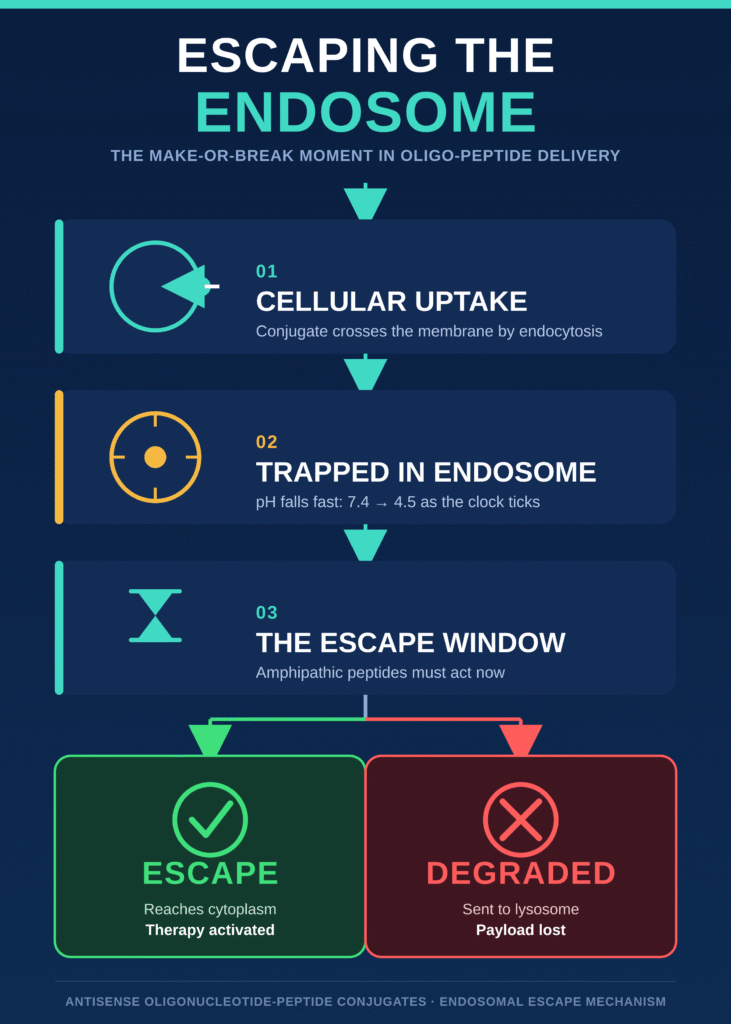
Successfully overcoming endosomal entrapment represents one of the most significant pharmacokinetic challenges in the development of Antisense Oligonucleotide-Peptide Conjugates because failure to escape the endosomal compartment ultimately directs the therapeutic payload toward lysosomal degradation. Following cellular uptake through caveolae-mediated or clathrin-mediated endocytosis, the conjugate initially becomes confined within early endosomes. To produce the desired pharmacological response, the therapeutic complex must efficiently disrupt the endosomal membrane before progressive acidification and enzymatic maturation transform the vesicle into a degradative lysosome.
Analyze Transport and Delivery Dynamics: Examine how structural designs address complex delivery barriers by visiting peptide-oligonucleotide conjugates drug delivery.
The efficiency of endosomal escape is largely governed by carefully engineered structural motifs incorporated within the peptide sequence. Amphipathic peptides containing clearly defined hydrophilic and hydrophobic domains undergo pH-dependent conformational rearrangements as the endosomal environment becomes increasingly acidic. These structural changes enable hydrophobic amino acid residues to insert into the endosomal lipid bilayer, promoting transient pore formation or membrane fusion events that facilitate release of the oligonucleotide into the cytoplasm. More sophisticated peptide constructs, including members of the Pip and Cyto1a families, further enhance intracellular delivery by incorporating strategically positioned non-natural amino acids that reduce susceptibility to proteolytic degradation while simultaneously providing the conformational flexibility required to destabilize endosomal membranes. This highly engineered design enables efficient cytosolic delivery without relying exclusively on elevated polycationic charge density.
Mitigate In Vivo Biological Hurdles: Review common developmental roadblocks and solutions in our breakdown of challenges in peptide-oligonucleotide conjugates.
Manufacturing, Scale-Up, and Synthetic Compatibility
The manufacturing and large-scale production of Antisense Oligonucleotide-Peptide Conjugates require the successful integration of two fundamentally different synthetic platforms, creating substantial challenges in preserving molecular integrity while achieving commercially feasible manufacturing yields. Oligonucleotides are generally synthesized using phosphoramidite chemistry, a process that requires strongly basic conditions during the final deprotection and cleavage steps performed on the solid support. In contrast, peptide synthesis is most commonly carried out using Fmoc/tBu solid-phase peptide synthesis (SPPS), which depends on highly acidic conditions, particularly trifluoroacetic acid (TFA), for side-chain deprotection.
This fundamental acid-base incompatibility creates significant protecting-group challenges throughout the conjugation process. Exposure of fully synthesized oligonucleotides to strongly acidic environments can rapidly induce depurination of the nucleic acid backbone, whereas subjecting peptide sequences to strongly basic conditions may result in racemization, aspartimide formation, or degradation of peptide amide bonds. To overcome these manufacturing obstacles, developers generally employ one of two principal synthetic strategies.
Evaluate Production Methodologies: Learn more about scaling these chemical reactions by examining peptide-oligonucleotide conjugate synthesis methods.
Post-Synthetic Solution-Phase Conjugation
In this approach, the peptide and oligonucleotide components are independently synthesized, fully deprotected, and purified before being conjugated under mild aqueous or semi-aqueous conditions using bio-orthogonal chemistries such as maleimide-thiol coupling or SPAAC reactions. Because each molecular component is prepared separately, this strategy effectively preserves the structural integrity of both the peptide and oligonucleotide throughout synthesis. However, it also necessitates extensive downstream chromatographic purification to isolate the desired 1:1 conjugate from unreacted starting materials, truncated intermediates, hydrolysis products, and other process-related impurities.
Fragment-Based Solid-Phase Assembly
Fragment-based solid-phase assembly constructs both the peptide and oligonucleotide sequentially on a shared universal solid support using specialized protecting groups specifically designed for mutual compatibility. Examples include base-labile peptide protecting groups that permit orthogonal synthesis without compromising either molecular component. This strategy enables intermediate washing steps that efficiently eliminate reaction byproducts during synthesis while providing outstanding control over conjugate architecture and linker orientation. Nevertheless, scaling this methodology becomes increasingly challenging for constructs exceeding approximately 40 to 50 total residues because cumulative coupling inefficiencies progressively reduce overall manufacturing yield with each successive synthetic cycle.
In addition to synthetic complexity, downstream manufacturing operations can significantly influence product quality and long-term stability. Lyophilization (freeze-drying), for example, introduces physical stresses during freezing, sublimation, and final drying that may promote peptide denaturation, molecular aggregation, or alterations in conjugate structure if formulation parameters are not carefully optimized. To preserve structural integrity throughout these processes, formulations are commonly supplemented with cryoprotectants such as sucrose, together with appropriate bulking agents and surfactants that minimize surface-induced damage, reduce oxidative stress, and enhance overall product stability during storage and transportation.
Ensure Long-Term Quality Control: Find guidelines for handling, transport, and stabilization protocols at handling and storage for peptide-oligonucleotide conjugates.
Clinical Translation and Efficacy in Neuromuscular Disease
The successful clinical translation of Antisense Oligonucleotide-Peptide Conjugates depends on their ability to demonstrate improved pharmacokinetic performance, enhanced accumulation within extrahepatic tissues, and more effective disease-modifying gene regulation than unconjugated first-generation oligonucleotide therapies. The shortcomings of unconjugated phosphorodiamidate morpholino oligomers (PMOs) in the treatment of neuromuscular disorders such as Duchenne Muscular Dystrophy (DMD) are well established. Therapeutics like eteplirsen require high-dose, frequent administration—typically 30 mg/kg on a weekly basis—yet produce only modest improvements in functional dystrophin expression because of limited cellular uptake within skeletal and cardiac muscle tissues.
The incorporation of cell-penetrating peptides into the PMO backbone, thereby generating peptide-conjugated phosphorodiamidate morpholino oligomers (PPMOs), has significantly transformed the therapeutic potential of this platform. Clinical findings from the MOMENTUM Phase 2 trial evaluating SRP-5051 (vesleteplirsen), an advanced PPMO designed to induce exon 51 skipping in patients with DMD, illustrate the substantial clinical advantages offered by peptide conjugation. Administered at approximately 30 mg/kg once every four weeks, SRP-5051 achieved an average dystrophin expression of 5.17% together with a mean exon-skipping efficiency of 11.11% after 28 weeks of treatment. Even when administered at a reduced monthly dose of 20 mg/kg, the conjugate produced a 4.3-fold greater improvement in exon skipping from baseline than weekly administration of 30 mg/kg eteplirsen at 24 weeks, while requiring a considerably lower cumulative drug exposure throughout the treatment period.
Access Preclinical Evaluation Pathways: Navigate initial pipeline development stages with peptide-oligonucleotide conjugates preclinical services.
Comparable therapeutic benefits have also been observed in preclinical models of Spinal Muscular Atrophy (SMA). Systemic administration of peptide-conjugated PMOs targeting the SMN2 gene has demonstrated the ability to overcome the restrictive properties of the blood-brain barrier. Conjugates incorporating peptide vectors such as DG9 or Pip6a have successfully promoted significant exon inclusion within both the brain and spinal cord, resulting in dramatic improvements in median survival among severe SMA mouse models when compared with unconjugated PMO therapies.
Review Absorption and Distribution Profiles: Understand systemic transit and clearance properties by exploring peptide-oligonucleotide conjugates pharmacokinetics.
Despite these therapeutic advances, the enhanced intracellular uptake of highly charged conjugates also necessitates comprehensive toxicological evaluation. Following systemic administration, oligonucleotide therapeutics predictably accumulate within the proximal tubular epithelial cells of the kidneys. Although the PMO backbone itself is electrically neutral and generally exhibits an excellent safety profile, the polycationic peptide component can promote concentration-dependent renal effects. Clinical evaluation of SRP-5051 identified hypomagnesemia as a manageable adverse event, highlighting the importance of routine electrolyte monitoring and appropriate supplementation throughout treatment. Furthermore, the peptide vector introduces metabolically vulnerable regions that are susceptible to degradation by endogenous proteases. Preclinical investigations have demonstrated that while the PMO backbone remains highly resistant to nuclease-mediated degradation, peptide components—including arginine-rich sequences found in Pip derivatives—are progressively cleaved within plasma and tissue lysates. Consequently, peptide metabolism becomes a major determinant of the overall biological half-life and persistence of the active conjugate.
Fulfill Regulatory Criteria for Filings: Prepare your investigational data sets efficiently with our peptide-oligonucleotide conjugates in IND submissions framework.
Analytical Characterization and Impurity Profiling
Analytical characterization and impurity profiling of Antisense Oligonucleotide-Peptide Conjugates require highly advanced orthogonal chromatographic and mass spectrometric techniques capable of resolving structurally similar, exceptionally complex macromolecules. These hybrid therapeutics combine the chemical complexity of modified oligonucleotides with the structural sensitivity of peptide amide bonds, generating impurity profiles that are substantially more heterogeneous than those encountered with conventional small-molecule drugs or standalone biologics.
To satisfy the rigorous Chemistry, Manufacturing, and Controls (CMC) expectations established by regulatory authorities, developers must comprehensively characterize conjugation sites, verify molecular stoichiometry, identify sequence integrity, and quantify trace-level degradation products throughout development and manufacturing. ResolveMass Laboratories Inc. supports these critical activities by implementing a comprehensive portfolio of high-resolution bioanalytical methodologies specifically developed and validated for the characterization of complex chimeric therapeutic molecules.
| Impurity Category | Source Mechanism | Impact on Therapeutic Efficacy |
|---|---|---|
| Truncated Peptide Fragments | Generated through incomplete coupling during SPPS or proteolytic degradation during manufacturing or in vivo. | Reduces membrane permeability and compromises targeted tissue delivery. |
| Short/Long Oligonucleotides | Produced by incomplete phosphoramidite synthesis, including N-1 and N+1 sequence errors. | Decreases target mRNA specificity and reduces gene-silencing efficiency. |
| Conjugation Side-Products | Arises from inefficient conjugation reactions, premature linker hydrolysis, or conjugate scrambling. | Lowers manufacturing yield and generates inactive or off-target molecular species. |
| Oxidation Products | Results from environmental exposure, light, oxygen, or suboptimal storage conditions. | Accelerates in vivo degradation while negatively affecting long-term product stability and shelf life. |
The cornerstone of comprehensive impurity characterization is High-Resolution Mass Spectrometry (LC-HRMS), utilizing advanced analytical platforms such as the Thermo Orbitrap Q Exactive Plus and the Sciex 5600 TOF. These high-resolution instruments generate accurate mass measurements that confirm the molecular identity of the intact conjugate, distinguish between isobaric impurities, and detect trace-level degradation products that cannot be resolved using conventional unit-resolution mass analyzers.
For quantitative purity assessment and efficient separation of closely related truncated or N-1 impurities, Ion-Pair Reversed-Phase High-Performance Liquid Chromatography (IP-RP-HPLC) remains the analytical method of choice. Because Antisense Oligonucleotide-Peptide Conjugates combine a highly polar, polyanionic oligonucleotide backbone with a comparatively hydrophobic peptide domain, IP-RP-HPLC employs specialized ion-pairing reagents—including butylammonium acetate or triethylamine/hexafluoroisopropanol—to transiently neutralize negative phosphate charges. This enables predictable interaction with hydrophobic stationary phases, including wide-pore C18 chromatographic columns. Method optimization frequently requires elevated column temperatures, sometimes reaching 80°C, to disrupt secondary structural interactions, improve chromatographic peak shape, maximize resolution, and minimize sample carry-over.
Map High-Resolution Fingerprints: Review structural verification strategies at structural characterization of peptide-oligonucleotide conjugates.
Accurate quantification of these conjugates within complex biological matrices—including plasma, serum, tissue homogenates, and other biological samples—requires equally sophisticated bioanalytical methodologies. Advanced hybridization LC-MS/MS approaches utilize biotinylated capture probes that selectively isolate target conjugates through highly specific Watson-Crick base pairing prior to mass spectrometric analysis. This strategy automates sample enrichment while significantly improving recovery compared with conventional liquid-liquid extraction (LLE) or solid-phase extraction (SPE) techniques, which often demonstrate limited efficiency for highly polar oligonucleotide conjugates. As an ISO 9001:2015 certified and Health Canada GMP-compliant laboratory, ResolveMass integrates these advanced analytical workflows with comprehensive Extractables and Leachables (E&L) testing and stability-indicating analytical methods, ensuring that highly complex oligonucleotide-peptide conjugates satisfy global regulatory expectations throughout product development and commercialization.
Conclusion
The development of Antisense Oligonucleotide-Peptide Conjugates represents a significant advancement in precision genetic medicine by addressing the longstanding challenges of limited biodistribution and poor membrane permeability that have historically restricted the clinical potential of RNA-based therapeutics. Through the strategic selection of cell-penetrating, receptor-targeting, or tissue-specific peptide vectors combined with carefully engineered bio-orthogonal linker chemistries, these hybrid therapeutics enable efficient delivery of disease-modifying oligonucleotides to difficult-to-access tissues, including skeletal muscle, cardiac tissue, and the central nervous system. This targeted delivery strategy substantially expands the therapeutic possibilities for neuromuscular disorders and numerous rare genetic diseases.
Nevertheless, the remarkable structural sophistication of these conjugates also introduces substantial manufacturing, analytical, and regulatory challenges. Successfully overcoming issues related to synthetic compatibility, intracellular trafficking, endosomal escape, process scalability, and trace-level impurity characterization is essential for ensuring product quality, clinical safety, and regulatory compliance. Advanced analytical technologies—including high-resolution mass spectrometry, orthogonal chromatographic methods, and specialized bioanalytical workflows—play an indispensable role in verifying molecular integrity throughout the product lifecycle.
With extensive expertise in high-resolution mass spectrometry, complex synthetic chemistry, impurity characterization, and regulatory-compliant analytical testing, biopharmaceutical organizations can confidently accelerate the development of next-generation Antisense Oligonucleotide-Peptide Conjugates from early-stage research through clinical development and ultimately toward successful commercial manufacturing.
For specialized analytical support, impurity profiling, and custom synthesis solutions tailored to complex therapeutic macromolecules, visit the ResolveMass Laboratories Contact Us page: https://resolvemass.ca/contact/.
Frequently Asked Questions (FAQs)
The Pip6a peptide is specifically engineered to maximize delivery into muscle tissues by combining a hydrophobic core with positively charged arginine-rich domains. This structural arrangement promotes efficient interaction with muscle cell membranes while facilitating cellular uptake. The inclusion of non-natural amino acid spacers, including beta-alanine and aminohexanoic acid, increases resistance to proteolytic degradation and improves molecular stability in circulation. Together, these characteristics enable more efficient transport of antisense oligonucleotides into skeletal and cardiac muscle cells.
The selection of linker chemistry depends on how the therapeutic conjugate is intended to function after entering the target cell. Cleavable linkers are designed to release the oligonucleotide in response to intracellular conditions such as reducing environments or acidic pH, allowing the payload to bind efficiently to its RNA target. Non-cleavable linkers are preferred when the peptide remains functionally important throughout the therapeutic process, such as maintaining intracellular localization or providing prolonged biological activity. Choosing the appropriate linker is therefore essential for balancing stability, release kinetics, and therapeutic performance.
After entering a cell through endocytosis, the conjugate becomes enclosed within endosomes. Without efficient escape, these vesicles mature into lysosomes where the therapeutic molecule can be degraded before reaching its intracellular target. To overcome this barrier, many peptide vectors incorporate amphipathic sequences that become activated under acidic endosomal conditions. These structural changes disrupt the endosomal membrane, allowing the oligonucleotide to enter the cytoplasm and perform its intended gene-modulating function.
Solid-phase assembly constructs both the peptide and oligonucleotide sequentially on a common solid support, enabling excellent control over synthesis and producing highly purified conjugates. However, the process becomes increasingly difficult as molecular size and sequence complexity increase. In contrast, solution-phase conjugation involves independently synthesizing each component before coupling them under mild reaction conditions using bio-orthogonal chemistry. Although this method offers greater flexibility for larger molecules, it typically requires extensive purification to remove reaction impurities and unreacted materials.
The Phase 2 MOMENTUM study demonstrated that SRP-5051, a peptide-conjugated phosphorodiamidate morpholino oligomer (PPMO) developed for Duchenne Muscular Dystrophy, achieved encouraging improvements in dystrophin production and exon 51 skipping with monthly administration. Compared with first-generation unconjugated PMO therapy, the conjugated approach produced greater biological activity while requiring less frequent dosing. These findings suggest that peptide conjugation substantially enhances tissue delivery and therapeutic efficiency. The trial also highlighted the potential of next-generation PPMOs for treating neuromuscular disorders more effectively.
Antisense Oligonucleotide-Peptide Conjugates possess highly polar and negatively charged oligonucleotide backbones that are difficult to separate using conventional reversed-phase chromatography. IP-RP-HPLC employs ion-pairing reagents that temporarily neutralize these charges, allowing the molecules to interact more effectively with hydrophobic chromatographic columns. This approach significantly improves retention, peak resolution, and impurity separation. Consequently, IP-RP-HPLC has become one of the most reliable analytical techniques for purity assessment and quality control of oligonucleotide conjugates.
High-Resolution Mass Spectrometry (HRMS) provides the mass accuracy and resolving power needed to characterize structurally complex oligonucleotide-peptide conjugates. Unlike conventional mass analyzers, HRMS can distinguish molecules that differ by only a few Daltons while accurately confirming molecular composition and conjugation stoichiometry. It is also highly effective for detecting low-level degradation products and process-related impurities that may not be visible using lower-resolution techniques. These capabilities make HRMS indispensable for product characterization and regulatory documentation.
Although Antisense Oligonucleotide-Peptide Conjugates offer improved therapeutic delivery, systemic administration requires careful safety evaluation because peptide components may accumulate in certain organs, particularly the kidneys. Highly cationic peptide vectors can increase exposure within proximal tubular epithelial cells, potentially leading to reversible renal effects. Clinical studies have reported manageable findings such as hypomagnesemia, emphasizing the importance of routine patient monitoring. Optimizing peptide design and dosing strategies remains essential for minimizing toxicity while preserving therapeutic efficacy.
Manufacturing these conjugates is particularly complex because peptide synthesis and oligonucleotide synthesis require fundamentally different chemical conditions. Oligonucleotides are generally prepared under basic conditions, whereas peptide synthesis relies heavily on acidic deprotection chemistries. Exposure to incompatible reaction environments can damage either molecular component, reducing product quality and yield. To address these challenges, manufacturers use orthogonal protecting group strategies or synthesize each component separately before joining them through carefully controlled bio-orthogonal conjugation reactions.
Reference:
- Bharadwaj, S., Lee, C. H., & Prakash, T. P. (2023). Enhancing antisense oligonucleotide-based therapeutic delivery with DG9, a versatile cell-penetrating peptide. Pharmaceutics, 15(10), 2464. https://doi.org/10.3390/pharmaceutics15102464
- McNally, E. M., & Leverson, B. D. (2019). Better living through peptide-conjugated chemistry: Next-generation antisense oligonucleotides. The Journal of Clinical Investigation, 129(11), 4570–4571. https://doi.org/10.1172/JCI131933
- Seow, Y., Yin, H., & Wood, M. J. A. (2010). Identification of a novel muscle targeting peptide in mdx mice. Peptides, 31(10), 1873–1877. https://doi.org/10.1016/j.peptides.2010.06.036
- Katzhendler, J., Klauzner, Y., Beylis, I., Mizhiritskii, M., Shpernat, Y., Ashkenazi, B., & Fridland, D. (2006). Method for the preparation of peptide-oligonucleotide conjugates (European Patent Application No. EP1725250A2). European Patent Office. https://patents.google.com/patent/EP1725250A2/en
- Gait, M. J., & Agrawal, S. (2022). Introduction and history of the chemistry of nucleic acid therapeutics. In V. Arechavala-Gomeza & A. Garanto (Eds.), Antisense RNA Design, Delivery, and Analysis (Methods in Molecular Biology, Vol. 2434). Humana, New York, NY. https://www.ncbi.nlm.nih.gov/books/NBK584232/
Get In Touch With Us
About The Author


