

Introduction:
Anyone comparing an antisense oligonucleotide vs peptide-oligonucleotide conjugate is really asking a structural question: is the therapeutic molecule a “bare” nucleic acid, or a nucleic acid that has been chemically attached to a peptide carrier to help it reach its target? Both modalities sit within the fast-growing oligonucleotide therapeutics space, and both are being explored for gene silencing, exon skipping, and splice modulation across rare disease, oncology, and neurology programs. But they differ in molecular architecture, delivery behavior, and — critically for sponsors and CDMO partners — in how they need to be synthesized, manufactured, and analytically characterized on the path to an IND or NDA filing. This article breaks down what each molecule is, how they differ structurally and functionally, and what that means for the development strategy behind a successful submission.
Summary:
- An antisense oligonucleotide (ASO) is a short, single-stranded synthetic nucleic acid that binds complementary mRNA to block or modify gene expression.
- A peptide-oligonucleotide conjugate (POC) is an oligonucleotide covalently linked to a peptide, most commonly a cell-penetrating or receptor-targeting peptide, to improve delivery into target tissues or cells.
- The core distinction in the Antisense Oligonucleotide vs Peptide-Oligonucleotide Conjugate comparison comes down to structure: an ASO is the therapeutic nucleic acid itself, while a POC is a delivery-enhanced hybrid molecule built around that nucleic acid.
- POCs require substantially more complex synthesis, manufacturing, and bioanalytical characterization because they combine peptide and nucleic acid chemistries — and a linker — in a single molecule.
- Both modalities depend on rigorous analytical characterization — purity, sequence confirmation, impurity profiling, and stability data — to meet regulatory expectations for identity, safety, and quality from early development through IND submission.
1: What Is an Antisense Oligonucleotide (ASO)?
An antisense oligonucleotide is a short, single-stranded synthetic strand of DNA or RNA (typically 15-25 nucleotides) engineered to bind, through Watson-Crick base pairing, to a specific complementary sequence on a target messenger RNA (mRNA).
Mechanism of Action
Once bound to the target mRNA, an ASO can act through several mechanisms, similar in principle to the broader mechanism of action pathways used across peptide-oligonucleotide conjugate platforms:
- RNase H-mediated degradation — recruiting the RNase H enzyme to cleave the target mRNA strand
- Steric blocking — physically obstructing ribosomal machinery or splicing factors without triggering degradation
- Splice modulation — redirecting pre-mRNA splicing to include or exclude specific exons
Chemistry and Backbone Modifications
Unmodified oligonucleotides are rapidly degraded by nucleases in biological fluids, so most clinical-stage ASOs incorporate chemical modifications such as phosphorothioate backbones, 2′-O-methyl or 2′-O-methoxyethyl sugar modifications, or locked nucleic acid (LNA) units. These modifications improve nuclease resistance and binding affinity but also add complexity to purity and impurity characterization, since each modification introduces its own set of process-related and degradation-related impurities to monitor.
2: What Is a Peptide-Oligonucleotide Conjugate (POC)?
A peptide-oligonucleotide conjugate is an oligonucleotide — frequently an ASO or siRNA — that has been covalently linked to a peptide moiety, usually to improve cellular uptake, tissue targeting, or endosomal escape.
Types of Peptide-Oligonucleotide Conjugates
POCs are not a single, uniform class. Sponsors typically work with several types of peptide-oligonucleotide conjugates, differentiated by the peptide’s function — cell-penetrating, endosomolytic, or tissue-targeting — and by the oligonucleotide payload it carries (ASO, siRNA, or splice-switching sequence).
Peptide vs. Antibody Conjugates
Peptides are not the only carrier molecules used to improve oligonucleotide delivery; antibody fragments are a competing approach. Understanding the tradeoffs in peptide vs. antibody oligonucleotide conjugates — cost, manufacturability, immunogenicity risk, and tissue specificity — helps sponsors choose the right delivery strategy early, since switching carrier platforms later in development is costly.
Receptor-Targeted Conjugates
Beyond generic cell-penetrating peptides, many current-generation programs use a receptor-targeted peptide-oligonucleotide conjugate design, where the peptide is selected to bind a receptor enriched on the target cell type — improving tissue selectivity and reducing off-target exposure compared with non-targeted uptake.
Role in Gene Silencing
POCs are increasingly used to extend the reach of RNA interference and antisense approaches into tissues that are otherwise difficult to transfect. Their expanding role in gene silencing applications for peptide-oligonucleotide conjugates reflects the peptide’s ability to shuttle the oligonucleotide payload across the cell membrane and into the cytoplasm or nucleus where it can act.
3: Antisense Oligonucleotide vs Peptide-Oligonucleotide Conjugate: Key Differences
| Feature | Antisense Oligonucleotide (ASO) | Peptide-Oligonucleotide Conjugate (POC) |
|---|---|---|
| Core structure | Single-stranded nucleic acid only | Nucleic acid covalently linked to a peptide |
| Primary mechanism | Direct mRNA binding (RNase H, steric block, splice modulation) | Same mechanism, plus peptide-assisted delivery |
| Molecular complexity | Lower — one chemistry class | Higher — combines nucleic acid, peptide, and linker chemistries |
| Delivery challenge addressed | Limited cellular uptake remains a key hurdle | Peptide is specifically designed to improve uptake/targeting |
| Manufacturing | Solid-phase oligonucleotide synthesis | Oligonucleotide synthesis plus peptide synthesis and conjugation step |
| Typical analytical focus | Sequence confirmation, purity, backbone-modification impurities | All ASO-related testing plus conjugation efficiency, linker stability, unconjugated species |
| Mass spectrometry demand | Standard oligonucleotide MS workflows | Higher-resolution, hybrid peptide-nucleic acid MS/MS workflows |
4: Synthesis and Manufacturing of Peptide-Oligonucleotide Conjugates
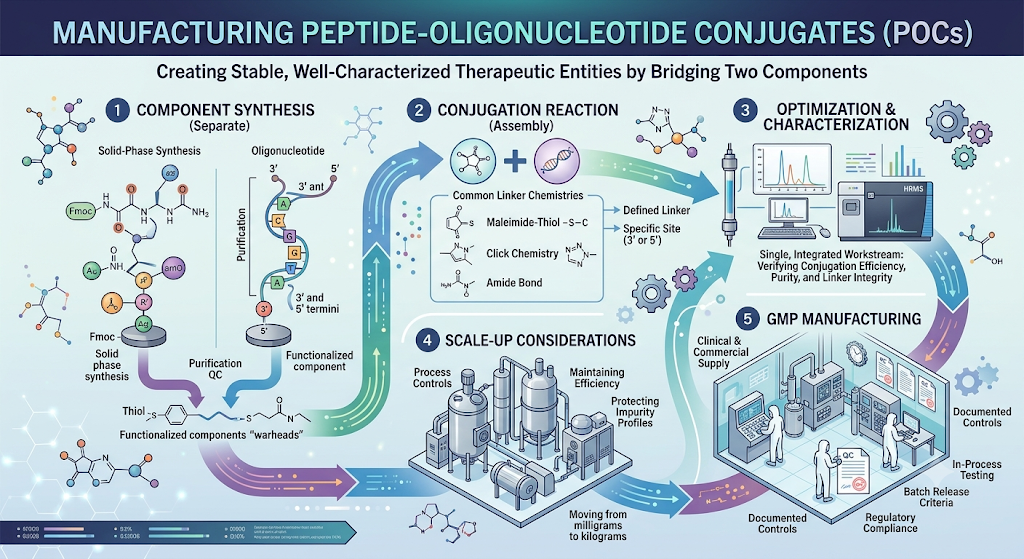
Manufacturing a POC answers the question of how two chemically distinct molecules — a peptide and a nucleic acid — become one stable, well-characterized therapeutic entity, and it takes more process steps than manufacturing an ASO alone.
Synthesis Methods
Sponsors generally choose between solid-phase, solution-phase, or hybrid approaches when selecting peptide-oligonucleotide conjugate synthesis methods, with the choice driven by conjugate size, linker chemistry, and the scale needed for downstream development.
Linker Chemistry
The peptide is typically attached through a defined linker — commonly a maleimide-thiol, click chemistry, or amide bond — at a specific site on the oligonucleotide, often the 3′ or 5′ terminus. Selecting the right peptide-oligonucleotide conjugate linker chemistry affects conjugate stability, the potential for linker cleavage in vivo, and the analytical strategy needed to confirm conjugation site and efficiency.
Synthesis and Characterization Together
Because conjugation efficiency and purity are so closely linked to the synthesis route chosen, sponsors benefit from combining POC synthesis and characterization into a single, integrated workstream rather than treating them as sequential, disconnected activities.
Scale-Up Considerations
Moving from milligram-scale discovery synthesis to gram- or kilogram-scale clinical supply introduces new process control challenges. Careful scale-up of peptide-oligonucleotide conjugates protects conjugation efficiency and impurity profiles that were established at small scale.
GMP Manufacturing
Clinical and commercial supply ultimately requires GMP manufacturing of peptide-oligonucleotide conjugates, with documented process controls, in-process testing, and batch release criteria that reflect both the peptide and oligonucleotide components of the molecule. Broader peptide-oligonucleotide conjugate manufacturing support spans process development through technology transfer.
5: Analytical Characterization Challenges:
Both molecule classes answer to the same regulatory expectation — proven identity, purity, and consistency from lot to lot — but the testing burden differs sharply in scope, and POCs demand a broader analytical toolkit.
For a standalone ASO, characterization centers on confirming the exact nucleotide sequence, verifying backbone modification patterns, and quantifying process-related impurities such as truncated sequences and depurinated species. A POC adds another layer entirely, and general peptide-oligonucleotide conjugate analysis must additionally confirm the site and stoichiometry of conjugation, unconjugated species, and linker integrity.
Mass Spectrometry Characterization
High-resolution mass spectrometry characterization of peptide-oligonucleotide conjugates is the workhorse technique for confirming conjugate identity, since it can resolve both the peptide and oligonucleotide fragments within a single hybrid molecule.
HPLC Purification
Achieving the purity levels needed for clinical material typically requires dedicated HPLC purification services for peptide-oligonucleotide conjugates, using methods optimized to separate conjugated product from unconjugated peptide and unconjugated oligonucleotide.
Impurity Profiling
A thorough approach to peptide-oligonucleotide conjugate impurity profiling covers process-related impurities from both synthesis routes plus conjugation-specific impurities such as mis-conjugated or over-conjugated species.
QC Testing
Routine QC testing for peptide-oligonucleotide conjugates confirms that each manufactured lot meets predefined identity, purity, and potency specifications before release.
Bioanalytical Method Development
Measuring conjugate concentrations and metabolites in biological matrices calls for tailored bioanalytical method development for POC therapeutics, since standard small-molecule bioanalytical approaches don’t translate directly to a hybrid peptide-nucleic acid molecule.
Degradation Pathways and Stability
Understanding peptide-oligonucleotide conjugate degradation pathways — including linker hydrolysis, peptide proteolysis, and nuclease-mediated oligonucleotide cleavage — informs both formulation strategy and the stress-testing program used to establish peptide-oligonucleotide conjugate stability under real-world storage and shipping conditions.
6: Pharmacokinetics and Drug Delivery
The peptide component doesn’t just aid cellular uptake — it also reshapes how the molecule behaves in the body.
Pharmacokinetics
Conjugation to a peptide changes distribution, clearance, and half-life relative to the unconjugated oligonucleotide, which is why dedicated study of peptide-oligonucleotide conjugate pharmacokinetics is a standard part of preclinical development.
Drug Delivery Strategy
More broadly, the peptide is the delivery engine of the molecule, and evaluating peptide-oligonucleotide conjugates for drug delivery means assessing not just uptake efficiency but also biodistribution to non-target tissues.
7: Safety, Immunogenicity, and Toxicology
Adding a peptide to an oligonucleotide introduces safety considerations that go beyond what’s typically assessed for an ASO alone.
Immunogenicity
Peptides can be immunogenic in ways nucleic acids generally are not, so a structured assessment of immunogenicity of peptide-oligonucleotide conjugates is an important part of the nonclinical package. Ongoing monitoring throughout development, informed by current immunogenicity risk data for peptide-oligonucleotide conjugates, helps sponsors flag and manage immune-response signals before they become late-stage surprises.
Toxicology Studies
Because a POC combines two active chemistries, toxicology studies for peptide-oligonucleotide conjugates need to evaluate the safety profile of the peptide, the oligonucleotide, and the intact conjugate — since each can behave differently once metabolized or cleaved.
8: Regulatory and Quality Considerations
Regulatory agencies evaluate oligonucleotide therapeutics — conjugated or not — against well-established expectations for identity, purity, potency, and impurity control, consistent with ICH quality guidelines.
CMC Services
A well-organized CMC services program for peptide-oligonucleotide conjugates ties synthesis, analytical characterization, and stability data together into a coherent quality package that supports regulatory filings.
Specification Setting
Establishing appropriate peptide-oligonucleotide conjugate specification setting requires justifying acceptance criteria for both the peptide and oligonucleotide components, plus conjugation-specific attributes, based on process capability and clinical experience.
IND Submissions
Sponsors should expect reviewers to scrutinize conjugation efficiency data and impurity control strategy closely when peptide-oligonucleotide conjugates are included in IND submissions; building this data package early reduces the risk of analytical gaps surfacing during review. Sponsors preparing for that stage often lean on dedicated POC-focused IND submission support to organize the CMC section around both molecular components.
Preclinical Services
Ahead of an IND filing, comprehensive preclinical services for peptide-oligonucleotide conjugates — spanning PK, toxicology, and analytical characterization — give sponsors the data foundation needed to support a regulatory submission.
9: Challenges Associated with Both Technologies
Although both antisense oligonucleotides (ASOs) and peptide-oligonucleotide conjugates (POCs) have shown tremendous potential in treating genetic and rare diseases, each presents unique scientific, manufacturing, and regulatory challenges. Addressing these issues early in development is essential to ensure product quality, safety, efficacy, and successful regulatory approval.
Challenges of Antisense Oligonucleotides (ASOs)
While ASOs are supported by an increasingly mature regulatory framework, developers still face several technical hurdles:
- Rapid Clearance: ASOs can be rapidly eliminated from the bloodstream, reducing their therapeutic exposure and often requiring repeated dosing or chemical modifications to improve stability.
- Off-Target Hybridisation: Despite their sequence specificity, ASOs may bind to unintended RNA sequences, potentially affecting the expression of non-target genes and increasing the risk of adverse effects.
- Immune Stimulation: Certain oligonucleotide sequences or chemical modifications can activate innate immune receptors, leading to unwanted inflammatory or immunological responses.
- Renal Accumulation: ASOs are commonly distributed to the kidneys, where prolonged exposure may contribute to nephrotoxicity if not carefully evaluated during preclinical and clinical development.
- Limited Cellular Delivery: Efficient uptake into target cells remains one of the greatest challenges. Many ASOs become trapped within endosomes after cellular entry, reducing the amount of active drug reaching the cytoplasm or nucleus.
Challenges of Peptide-Oligonucleotide Conjugates (POCs)
Peptide-oligonucleotide conjugates are designed to overcome delivery limitations, but their increased structural complexity introduces additional development challenges:
- Complex Chemical Synthesis: Manufacturing requires precise conjugation of peptides and oligonucleotides while maintaining the integrity of both components, making production more technically demanding.
- Batch-to-Batch Variability: Small differences in conjugation efficiency, peptide purity, or manufacturing conditions can affect product consistency and critical quality attributes (CQAs).
- Conjugation Efficiency: Ensuring a high proportion of correctly conjugated molecules is essential, as incomplete conjugation can reduce potency and increase impurity levels.
- Linker Stability: The chemical linker connecting the peptide and oligonucleotide must remain stable during manufacturing, storage, and circulation while releasing the therapeutic payload appropriately within target cells.
- Peptide Degradation: Peptide components are susceptible to enzymatic degradation, which may reduce targeting efficiency, alter pharmacokinetics, or generate degradation products requiring further characterisation.
- More Complex Impurity Profiles: In addition to conventional oligonucleotide impurities, POCs may contain free peptides, unconjugated oligonucleotides, partially conjugated species, linker-related impurities, and degradation products, all of which require comprehensive analytical evaluation.
- Greater Analytical Characterisation Requirements: Because POCs combine two distinct molecular entities, developers must employ multiple orthogonal analytical techniques—including LC-MS/MS, high-resolution mass spectrometry (HRMS), peptide mapping, oligonucleotide mapping, and stability studies—to confirm identity, purity, conjugation efficiency, and structural integrity throughout development.
Successfully overcoming these challenges requires an integrated analytical strategy, robust method development, and thorough characterisation to meet global regulatory expectations and support the safe development of next-generation oligonucleotide therapeutics.
10: Why Partner with an Experienced Analytical CRO/CDMO
Distinguishing an antisense oligonucleotide from a peptide-oligonucleotide conjugate is straightforward on paper; building the synthesis, manufacturing, and analytical package that proves identity, purity, and conjugation integrity for either molecule is not. ResolveMass Laboratories works with sponsors developing both modalities, applying high-resolution mass spectrometry and orthogonal chromatographic methods to characterize oligonucleotide sequence, backbone chemistry, and — for conjugates — peptide conjugation site, efficiency, and linker stability. That combined nucleic acid and peptide analytical expertise is exactly what a POC development program requires, since the two molecule types cannot be fully characterized with a single, one-size-fits-all method.
Conclusion:
In the antisense oligonucleotide vs peptide-oligonucleotide conjugate comparison, the practical takeaway is this: an ASO is the therapeutic nucleic acid on its own, while a POC is that same class of molecule engineered with a peptide carrier to solve the delivery problem ASOs often face. The choice between them depends on the target tissue, the delivery hurdle a program needs to overcome, and the synthesis, manufacturing, and analytical infrastructure available to characterize the resulting molecule. Whichever modality a program is built around, robust, orthogonal analytical characterization is what ultimately supports a credible regulatory submission.
Frequently Asked Questions:
Peptide-oligonucleotide conjugates address one of the biggest limitations of conventional ASOs—poor cellular delivery. The attached peptide helps transport the oligonucleotide across cell membranes and can improve endosomal escape. This results in better tissue targeting, higher intracellular drug concentrations, and potentially lower therapeutic doses. These advantages make POCs an attractive next-generation platform for RNA-based therapeutics.
Antisense oligonucleotides are approved or under investigation for treating several genetic and rare diseases, including spinal muscular atrophy (SMA), Duchenne muscular dystrophy (DMD), hereditary transthyretin amyloidosis, and certain neurological disorders. Researchers are also exploring their use in oncology, cardiovascular diseases, and metabolic disorders. Their ability to selectively regulate disease-causing genes makes them valuable in precision medicine.
Although ASOs are highly specific to their target RNA, they do not readily cross cell membranes and often become trapped inside endosomes after entering cells. This limits the amount of active drug reaching the cytoplasm or nucleus, where gene regulation occurs. Poor tissue distribution may also reduce therapeutic efficacy. Chemical modifications and delivery technologies are therefore essential to improve their clinical performance.
Regulatory agencies require detailed analytical evidence demonstrating the identity, purity, potency, stability, and consistency of peptide-oligonucleotide conjugates. Sponsors must also provide data on conjugation efficiency, linker stability, impurity profiles, and validated analytical methods. Batch-to-batch consistency and stability studies are critical components of the submission package. These data help demonstrate that the product is safe, effective, and manufactured under controlled conditions.
A specialised CRO offers expertise in oligonucleotide chemistry, peptide conjugation, advanced analytical techniques, and regulatory requirements. It can support method development, impurity identification, stability testing, and comprehensive product characterisation using state-of-the-art instrumentation. Experienced CROs also generate regulatory-ready data packages that streamline IND, NDA, and BLA submissions. This reduces development risks and accelerates product timelines.
Reference
- Järver P, Coursindel T, Andaloussi SE, Godfrey C, Wood MJ, Gait MJ. Peptide-mediated cell and in vivo delivery of antisense oligonucleotides and siRNA. Molecular Therapy Nucleic acids. 2012 Jan 1;1.https://www.cell.com/molecular-therapy-family/nucleic-acids/fulltext/S2162-2531(16)30083-X
- Tung CH, Stein S. Preparation and applications of peptide− oligonucleotide conjugates. Bioconjugate Chemistry. 2000 Sep 18;11(5):605-18.https://pubs.acs.org/doi/full/10.1021/bc0000334
- Venkatesan N, Kim BH. Peptide conjugates of oligonucleotides: synthesis and applications. Chemical reviews. 2006 Sep 13;106(9):3712-61.https://pubs.acs.org/doi/full/10.1021/cr0502448
- Gait MJ. Peptide-mediated cellular delivery of antisense oligonucleotides and their analogues. Cellular and Molecular Life Sciences CMLS. 2003 May;60(5):844-53.https://link.springer.com/article/10.1007/s00018-003-3044-5
- Astriab-Fisher A, Sergueev DS, Fisher M, Shaw BR, Juliano RL. Antisense inhibition of P-glycoprotein expression using peptide–oligonucleotide conjugates. Biochemical pharmacology. 2000 Jul 1;60(1):83-90.https://www.sciencedirect.com/science/article/pii/S0006295200003105
- Astriab-Fisher A, Sergueev D, Fisher M, Shaw BR, Juliano RL. Conjugates of antisense oligonucleotides with the Tat and antennapedia cell-penetrating peptides: effects on cellular uptake, binding to target sequences, and biologic actions. Pharmaceutical research. 2002 Jun;19(6):744-54.https://link.springer.com/article/10.1023/A:1016136328329
About the Author


