

Introduction:
Aripiprazole lauroxil (Aristada®) is a PLGA-based long-acting injectable antipsychotic that differs fundamentally from other LAI microsphere products. As discussed in our article on PLGA-based long-acting injectable drug delivery technologies, formulation performance depends heavily on polymer design and degradation behavior. Before aripiprazole reaches systemic circulation, two sequential bioactivation steps — one enzymatic and one spontaneous — must occur after release from the PLGA matrix. This means characterization must resolve two co-occurring kinetic processes simultaneously: PLGA bulk erosion and prodrug conversion.
Unlike risperidone or naltrexone microspheres, where characterization centers on physical drug release alone, aripiprazole lauroxil depot programs require analytical methods capable of tracking the prodrug, its intermediate (ALNMS), and the active drug in parallel. Understanding the role of PLGA polymer grade in long-acting release formulations is particularly important because polymer attributes directly influence release behavior, degradation kinetics, and formulation performance.
Summary:
- Aripiprazole lauroxil (AL) is a lauric acid ester prodrug of aripiprazole formulated as PLGA-based long-acting injectable (LAI) microspheres, requiring sequential enzymatic and hydrolytic bioactivation before the active moiety reaches systemic circulation.
- Characterizing AL depots demands simultaneous resolution of two independent kinetic processes: intramuscular prodrug-to-drug conversion and PLGA matrix erosion — each governed by distinct physical, enzymatic, and degradation chemistry.
- In vitro release testing must be designed to decouple these two processes, using orthogonal analytical methods including reverse-phase HPLC, LC-MS/MS, and physiologically relevant dissolution media.
- PLGA autocatalytic acidification during bulk erosion can directly accelerate or suppress ester bond hydrolysis of the lauroxil linker, creating a formulation-specific, pH-dependent bioactivation environment that must be characterized independently of in vivo conditions.
- ResolveMass Laboratories provides integrated analytical and formulation development services for PLGA-based LAI prodrug systems, including AL depot characterization, in vitro–in vivo correlation (IVIVC) development, and regulatory package support.
1: What Is Aripiprazole Lauroxil and Why Does Its Characterization Require a Dual-Mechanistic Approach?
Aripiprazole lauroxil depot characterization is analytically demanding because the formulation encodes two biologically distinct release-controlling mechanisms within a single injectable microsphere: PLGA matrix degradation that governs physical drug release, and a sequential enzymatic prodrug activation cascade that determines pharmacological availability of the active moiety. Neither mechanism can be characterized in isolation without generating misleading data.
Aripiprazole lauroxil (AL), marketed as Aristada® (Alkermes), is a once-monthly to once-every-six-weeks LAI antipsychotic indicated for schizophrenia. Structurally, it is the N-aralkyl piperazine lauric acid ester of aripiprazole — a bulky, highly lipophilic prodrug (log P ~8.5) engineered specifically to retard absorption from the intramuscular depot site while enabling predictable, slow bioactivation. Unlike conventional small-molecule PLGA microsphere payloads, AL is not itself pharmacologically active: it requires stepwise enzymatic and chemical conversion to liberate the parent drug aripiprazole.
PLGA microspheres degrade by bulk erosion, not surface erosion, meaning the interior of each microsphere acidifies during degradation. Understanding the differences between bulk erosion versus surface erosion in PLGA systems is essential because the localized pH drop directly influences both polymer degradation and aripiprazole lauroxil hydrolysis kinetics.
A comprehensive characterization campaign should incorporate multiple PLGA characterization methods to evaluate molecular weight loss, polymer composition changes, degradation products, and release kinetics over time.
Changes in the PLGA glass transition temperature (Tg) can also affect polymer mobility, water uptake, degradation behavior, and long-term product stability. Consequently, thermal characterization is a critical component of Aripiprazole PLGA Depot Characterization studies.
This prodrug architecture was deliberately chosen to extend the release duration to 441 mg/monthly, 662 mg/6-weekly, and 882 mg/2-monthly dosing formats, and to reduce the peak-to-trough plasma fluctuation inherent to direct aripiprazole formulations. However, it substantially increases the complexity of characterization work, because any analytical method that quantifies only released drug — without also tracking the prodrug conversion state — yields an incomplete mechanistic picture of formulation performance.
2: The Prodrug Bioactivation Pathway: Enzymatic and Hydrolytic Steps That Must Be Characterized Separately
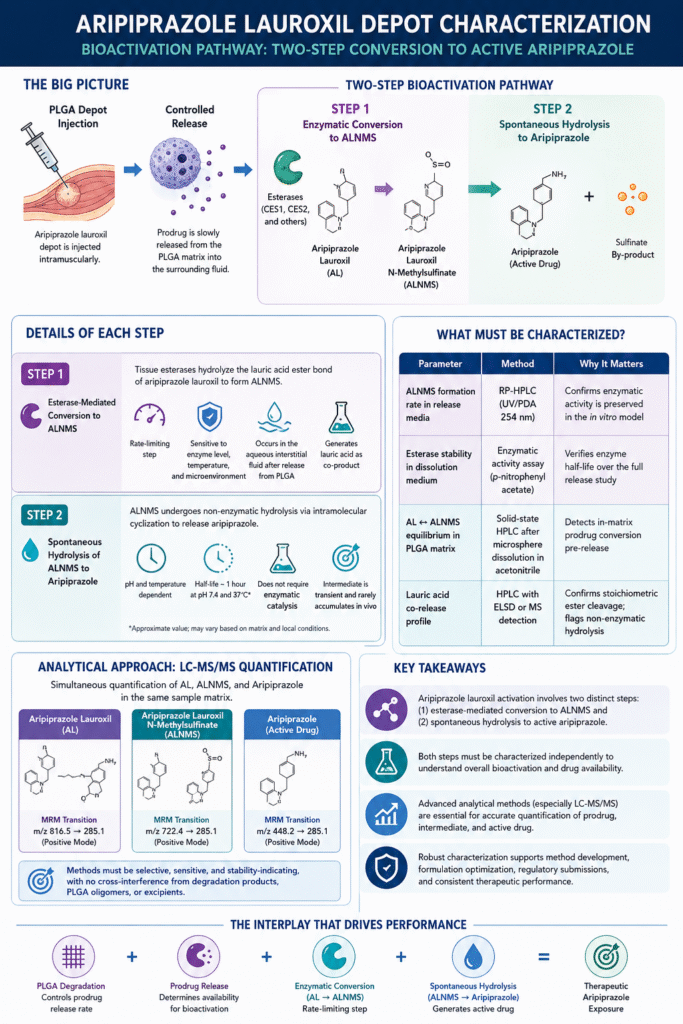
Aripiprazole lauroxil undergoes a two-step activation sequence, not a single hydrolysis event, and characterization methods must distinguish intermediates from the active moiety at every stage.
Step 1 — Esterase-Mediated Conversion to Aripiprazole Lauroxil N-Methylsulfinate (ALNMS)
Upon intramuscular injection, aripiprazole lauroxil is slowly released from the PLGA matrix into the surrounding aqueous interstitial fluid. Tissue esterases (primarily carboxylesterases, CES1 and CES2 isoforms, alongside non-specific plasma esterases) catalyze hydrolysis of the lauric acid ester bond, generating an intermediate — aripiprazole lauroxil N-methylsulfinate (ALNMS) — as the first discrete bioactivation product. This step is rate-limiting under physiological conditions and is highly sensitive to local enzyme concentration, temperature, and the hydrophobic microenvironment at the PLGA–tissue interface.
Critical characterization implications of Step 1:
| Parameter | Characterization Method | Why It Matters |
|---|---|---|
| ALNMS formation rate in release media | RP-HPLC with UV/PDA at 254 nm | Confirms enzymatic activity is preserved in the in vitro model |
| Esterase stability in dissolution medium | Enzymatic activity assay (para-nitrophenyl acetate substrate) | Verifies enzyme half-life over the full release study duration |
| AL ↔ ALNMS equilibrium in PLGA matrix | Solid-state HPLC after microsphere dissolution in acetonitrile | Detects in-matrix prodrug conversion pre-release |
| Lauric acid co-release profile | HPLC with ELSD or MS detection | Confirms stoichiometric ester cleavage; flags non-enzymatic hydrolysis |
Step 2 — Spontaneous Hydrolysis of ALNMS to Aripiprazole
ALNMS is not stable under physiological conditions. It undergoes spontaneous (non-enzymatic) hydrolysis via intramolecular cyclization, releasing aripiprazole and a sulfinate by-product. This second step is pH-dependent and temperature-dependent but does not require enzymatic catalysis. At physiological pH 7.4 and 37°C, ALNMS half-life is approximately 1 hour, making it a transient intermediate that rarely accumulates in vivo — but one that must be explicitly tracked in vitro, particularly in simulated physiological buffers where the spontaneous hydrolysis rate may differ from in vivo conditions.
Characterization of the two-step activation pathway requires validated LC-MS/MS methods capable of simultaneously quantifying AL, ALNMS, and aripiprazole in the same sample matrix, without cross-interference from degradation products or PLGA oligomers co-released into the dissolution medium. Method development should use authentic ALNMS reference standard (not synthesized in situ from AL hydrolysis), and the mass spectrometer should be programmed with specific MRM transitions for each analyte:
- AL: m/z 816.5 → 285.1 (positive mode)
- ALNMS: m/z 722.4 → 285.1 (positive mode)
- Aripiprazole: m/z 448.2 → 285.1 (positive mode)
3: PLGA Matrix Degradation in AL Depots: Bulk Erosion, Autocatalysis, and the pH Microenvironment Problem
PLGA microspheres degrade by bulk erosion, not surface erosion, meaning the interior of each microsphere acidifies during degradation — and that localized pH drop has a direct, non-trivial effect on aripiprazole lauroxil ester bond stability.
Mechanism of PLGA Bulk Erosion
PLGA degrades by random-chain ester hydrolysis throughout the polymer matrix simultaneously (bulk erosion), generating lactic acid and glycolic acid oligomers that remain trapped within the microsphere interior until the polymer structure is sufficiently degraded to permit diffusion. This creates an internal acidic microenvironment (pH 2–4 in some PLGA formulations during peak degradation) that is significantly more acidic than the surrounding physiological buffer.
This internal acidification is particularly important for AL depots because:
- The lauric acid ester bond in AL is susceptible to acid-catalyzed hydrolysis, meaning PLGA degradation can directly accelerate or alter the prodrug conversion pathway independently of tissue esterase activity.
- Acid-catalyzed hydrolysis of AL may favor generation of aripiprazole via a non-enzymatic route, bypassing ALNMS accumulation — an observation that would manifest as anomalous ALNMS-deficient release profiles in in vitro studies with simulated esterase activity.
- The resulting aripiprazole released directly within the acidic microsphere core may have altered solubility (pKa ~7.6 for the piperazine nitrogen; more soluble at lower pH), affecting diffusional release kinetics from the degrading matrix.
PLGA Degradation Characterization Methods for AL Depots
A comprehensive PLGA characterization campaign for AL microspheres should include the following orthogonal methods:
| Method | Instrument | Parameter Measured | Application to AL Depot |
|---|---|---|---|
| GPC/SEC with RI detection | Waters Alliance with Styragel columns | Mn, Mw, PDI over time | Tracks polymer MW loss as a degradation marker independent of drug release |
| DSC | TA Instruments Q2000 | Tg, crystallinity, enthalpy of fusion | Monitors PLGA amorphization and plasticization by water and lactic acid oligomers |
| Microencapsulated pH sensing | Fluorescent pH-sensitive dye (SNARF-1) or pH microelectrode sampling | Intra-particle pH vs. time | Directly quantifies the autocatalytic acidification profile within AL microspheres |
| SEM/FIB-SEM | Hitachi SU8230 (cryo-SEM for hydrated microspheres) | Pore evolution, morphological degradation | Reveals pore formation chronology correlated with release phase transitions |
| 1H-NMR (solution state after dissolution) | Bruker Avance III 400 MHz | LA:GA ratio, end-group analysis, oligomer identification | Confirms copolymer composition consistency and detects degradation by-product accumulation |
| TGA | TA Instruments TGA 5500 | Residual solvent, water content, mass loss profile | Critical QC for residual DCM (ICH Q3C Class 2) in AL microspheres prepared by solvent evaporation/extraction |
| FTIR-ATR | Thermo Nicolet iS50 | Carbonyl band shift, ester/acid ratio | Semi-quantitative indicator of ester bond hydrolysis without sample destruction |
4: In Vitro Release Testing: Designing for the Dual-Complexity Problem
Standard USP dissolution methods often require modification when evaluating complex depot formulations. Similar challenges have been reported across various long-acting injectable drug delivery technologies, where extended-release behavior is influenced by both formulation architecture and polymer degradation.
The release testing strategy must simultaneously evaluate prodrug release, bioactivation, polymer erosion, and environmental pH changes to generate clinically relevant performance data.
Method Selection for Long-Acting AL Microspheres
The three most widely employed in vitro release (IVR) approaches for PLGA-based LAI microspheres each present specific trade-offs when applied to AL:
USP Apparatus 4 (Flow-Through Cell)
- Best suited for AL depot IVR because it allows continuous medium replacement, preventing accumulation of lactic/glycolic acid degradation products that would artificially suppress autocatalytic acidification read-out.
- Requires careful control of flow rate (typically 4–8 mL/min with closed-loop recirculation) to maintain sink conditions for AL (aqueous solubility ~0.3 µg/mL at pH 7.4; highly non-sink without surfactant).
- Esterase supplementation (porcine liver esterase, 5–50 U/mL or CES1/CES2 recombinant) must be validated for stability and activity throughout the test duration; enzyme replenishment protocols are required for studies >7 days.
Modified Dialysis Bag / Membrane Diffusion
- Simpler setup; useful for early-stage screening of AL formulation variants.
- Membrane molecular weight cut-off must exclude PLGA oligomers (>1,000 Da) while permitting aripiprazole (MW 448 Da) and ALNMS (MW 721 Da) permeation — a technically narrow window requiring 1,000–3,500 Da MWCO cellulose membranes.
- Significant AL accumulation within the donor compartment at low aqueous solubility makes sink maintenance difficult without high surfactant concentrations (0.1–0.5% Tween 80 or Cremophor EL), which must be validated not to denature the supplemented esterase.
Sample-and-Separate (S&S) with Centrifugation
- Gold-standard for mechanistic studies; microspheres are directly incubated in release medium and sampled by centrifugation + supernatant collection.
- Permits direct correlation of PLGA MW (GPC of the pelleted microspheres at each time point) with release profile evolution — a uniquely powerful capability for IVIVC development.
- Risk: repeated centrifugation cycles (>5,000 × g) can mechanically degrade partially eroded microspheres, artificially accelerating late-stage release profiles. Use gentle centrifugation (800–1,200 × g) for microspheres in advanced degradation stages.
Recommended IVR Media Composition for AL Depot Studies
| Medium Component | Concentration | Purpose |
|---|---|---|
| Phosphate-buffered saline | pH 7.4, 50 mM | Physiological ionic strength baseline |
| Sodium dodecyl sulfate (SDS) or Tween 80 | 0.02–0.1% | Solubility enhancement for sink conditions (AL solubility-limited) |
| Porcine liver esterase or recombinant CES1 | 10–50 U/mL | Enzymatic prodrug activation (Step 1 of AL bioactivation) |
| Sodium azide | 0.02% | Microbial growth inhibition for long-duration studies |
| Calcium chloride | 0.9 mM | Cofactor for phospholipase-class esterases if using tissue homogenate |
| Temperature | 37.0 ± 0.5°C | Physiological simulation |
Critically, the release medium pH must be monitored at each sampling time point. PLGA degradation of AL microspheres can depress bulk medium pH by 0.3–0.8 units over 4–8 weeks even in well-buffered PBS, affecting ALNMS spontaneous hydrolysis rate (Step 2) and thereby distorting the apparent aripiprazole appearance profile.
5: Particle Characterization Methods: Physical Attributes That Govern Both Release Mechanisms
The physical attributes of aripiprazole lauroxil microspheres are direct determinants of release kinetics and polymer degradation behavior. These considerations are commonly encountered during PLGA microsphere formulation development, where particle engineering plays a critical role in product performance.
Developers should also understand the differences between PLGA nanoparticles versus microspheres when evaluating alternative controlled-release platforms, as particle architecture can dramatically affect release rates and biodistribution.
Critical Particle Characterization Tests
Particle Size Distribution (PSD) Laser diffraction (Malvern Mastersizer 3000; wet dispersion in 0.1% Tween 80/water) is the regulatory standard for injectable microsphere PSD. Report D10, D50, D90, and span. For AL microspheres, target D50 in the 30–120 µm range typical for intramuscular injectables; fine particles (<10 µm) elevate the risk of phagocytic uptake, which alters the enzymatic microenvironment and is incompatible with the prodrug activation model on which AL bioavailability depends.
Morphology and Surface Topography Cryo-SEM (for hydrated/partially degraded microspheres, e.g., Leica EM CPD300 critical point dryer) and conventional SEM (gold/palladium sputter-coated, Hitachi SU3500) are both required. AL microspheres should present smooth, non-porous surfaces at t=0; the appearance of surface pitting or internal void formation in SEM cross-sections (achieved by FIB milling) at later time points should correlate with inflection points in the IVR profile.
Zeta Potential Measured by phase analysis light scattering (PALS; Brookhaven NanoBrook Omni or Malvern Zetasizer Ultra) in 1 mM KCl. PLGA microspheres exhibit negative zeta potential (−15 to −40 mV) due to terminal carboxylic acid groups; values shifting toward neutral over time in degradation studies indicate surface carboxylate consumption and can serve as an early degradation marker independent of MW data.
Encapsulation Efficiency (EE%) and Drug Loading (DL%) EE% for AL microspheres is determined by complete polymer dissolution (acetonitrile or DMSO) followed by RP-HPLC quantification of AL (not aripiprazole) against a validated standard curve. Crucially, the HPLC method must use a non-aqueous diluent to prevent in-solution acid-catalyzed or enzymatic hydrolysis of AL during sample preparation; all sample processing should be performed at 4°C with minimal aqueous exposure.
6: Regulatory Framework for AL Depot Characterization
FDA and ICH guidances governing LAI PLGA microsphere characterization apply to AL depots, but the prodrug dimension adds additional analytical validation requirements not explicitly addressed in standard PLGA guidance.
For generic developers, demonstrating formulation equivalence often requires extensive PLGA polymer characterization for generics (https://resolvemass.ca/plga-polymer-characterization-for-generics/) and evidence supporting PLGA polymer sameness for ANDA submissions (https://resolvemass.ca/plga-polymer-sameness-for-anda/).
Many development programs also utilize PLGA reverse engineering for ANDA applications and specialized PLGA reverse engineering CRO services to identify critical formulation attributes and establish analytical comparability.
Key regulatory references applicable to AL depot characterization programs:
| Regulatory Document | Relevance to AL Depot |
|---|---|
| FDA Guidance: Liposome Drug Products (2018) | Provides IVR method development principles transferable to LAI microspheres |
| FDA Draft Guidance: Long-Acting Parenteral Products (2022 draft) | Directly addresses PLGA microsphere characterization expectations for NDAs/ANDAs |
| ICH Q8(R2): Pharmaceutical Development | Requires design space exploration for formulation variables affecting PLGA degradation rate |
| ICH Q1A(R2): Stability Testing | Stability conditions (25°C/60% RH; 40°C/75% RH; 5°C refrigerated) applied to characterize shelf-life of AL microsphere suspension or lyophilized cake |
| USP <1> Injections and Implanted Drug Products | General requirements for injectable dosage form characterization |
| USP <1] Particulate Matter | Sub-visible particle testing (light obscuration; HIAC HRLD-400 or equivalent) applicable to AL reconstituted suspension |
| ICH Q3C: Residual Solvents | DCM (Class 2, 600 ppm limit) is the primary residual solvent concern for AL microspheres prepared by solvent evaporation |
An ANDA referencing Aristada® as the reference listed drug (RLD) must demonstrate in vitro bioequivalence through an IVIVC that accounts for both PLGA degradation kinetics and prodrug conversion rates — a substantially higher analytical bar than conventional PLGA microsphere products containing pharmacologically active payloads.
7: IVIVC Development for AL Depots: Correlating In Vitro to Prodrug Pharmacokinetics
IVIVC for aripiprazole lauroxil depot is uniquely challenging because the in vivo PK profile reflects the convolution of prodrug release, enzymatic bioactivation, and parent drug PK — requiring deconvolution of the in vivo absorption rate before correlation with in vitro data is possible.
The complexity of aripiprazole lauroxil depots makes IVIVC development particularly challenging. Similar reverse-engineering and characterization approaches have been successfully applied to reverse engineering of risperidone PLGA microspheres and the reverse engineering of PLGA polymer in Lupron Depot.
The standard Level A IVIVC approach requires that the in vitro release profile be the rate-limiting step. For AL depots, this is complicated by the fact that:
- Enzymatic conversion of AL to ALNMS is subject to inter-individual variability in tissue esterase expression (CES1 genetic polymorphisms affect conversion rates by up to 2-fold in some populations).
- ALNMS → aripiprazole spontaneous hydrolysis proceeds rapidly and uniformly, but its rate is pH- and temperature-dependent.
- Plasma aripiprazole PK has a long terminal half-life (~75 hours), meaning even modest changes in the LAI release rate are buffered and may not manifest as proportional changes in observed PK.
A mechanistic absorption model (using GastroPlus® or MATLAB PK-Sim) that explicitly incorporates a two-compartment prodrug conversion module, with PLGA degradation-linked drug release as the forcing function, is the recommended approach for AL depot IVIVC development. The in vitro release data from the S&S method with esterase supplementation serves as the model input; aripiprazole plasma concentration data from clinical PK studies serves as the model output for fitting.
8: Common Analytical Pitfalls in AL Depot Characterization Programs
Formulators and analytical scientists working on AL depot characterization should anticipate the following failure modes:
- Hydrolysis during HPLC sample preparation: AL is highly susceptible to both enzymatic and acid-catalyzed hydrolysis. Aqueous sample diluents, even at neutral pH, can generate measurable ALNMS within minutes if trace esterase contamination is present. Use fully non-aqueous diluents (100% acetonitrile) for polymer dissolution steps and validate the HPLC method for AL stability in the final diluent at room temperature for the maximum anticipated run duration.
- Missing the ALNMS intermediate in release samples: Because ALNMS has a short half-life at 37°C/pH 7.4, it may be undetected in release samples collected at standard 24-hour intervals. Increase sampling frequency to 2–4 hours in the early release phase (first 48 hours) to capture ALNMS peak concentration and confirm the enzymatic pathway is operating as intended in the in vitro model.
- Confounding surfactant effect on esterase activity: Common solubilizing surfactants (SDS, Tween 80, Brij 35) can inhibit or denature carboxylesterases. Conduct a preliminary esterase activity assay across the planned surfactant concentration range before committing to a release medium formulation. Non-ionic surfactants (Tween 80, Poloxamer 188) at ≤0.02% are generally well tolerated by porcine liver esterase.
- PLGA MW measurement without precipitation step: Direct GPC injection of PLGA dissolved in THF without prior precipitation can be contaminated with lactic acid, glycolic acid, and lauric acid (co-released from AL hydrolysis), all of which interfere with RI detection baseline and apparent MW distribution. Always precipitate PLGA from the microsphere matrix using cold methanol (3:1 methanol:acetonitrile) before THF re-dissolution for GPC.
- Ignoring the Tg depression effect of residual DCM on PLGA: Residual dichloromethane in AL microspheres prepared by solvent evaporation acts as a plasticizer, depressing the PLGA glass transition temperature (Tg) below storage temperature even at concentrations below the ICH Q3C limit. This can accelerate in-storage PLGA chain mobility, pre-degradation, and AL solid-state crystallinity changes. DSC characterization of Tg at multiple DCM concentration levels should be included in the residual solvent characterization program.
9: ResolveMass Laboratories: Integrated Characterization Services for Aripiprazole Lauroxil Depot Programs
ResolveMass Laboratories has extensive experience supporting characterization programs for a wide range of PLGA-based drug delivery systems. Related case studies include the Dexamethasone Implant PLGA Characterization Case Study, Goserelin PLGA Implant Characterization , Leuprolide Depot Formulation Challenges, and PLGA Characterization of Lupron Depot.
Additional examples include the Exenatide PLGA Microsphere Characterization Case Study and Buprenorphine Depot PLGA Characterization, which highlight common challenges associated with complex long-acting injectable products.
ResolveMass Laboratories is a Canadian CRO specializing in PLGA-based drug delivery and LAI formulation development. Our characterization capabilities directly address the dual-complexity analytical requirements of aripiprazole lauroxil depot programs:
Analytical capabilities relevant to AL depot characterization:
- LC-MS/MS method development and validation for simultaneous quantification of AL, ALNMS, and aripiprazole in in vitro release samples, polymer matrices, and simulated biological fluids, with validated ICH Q2(R1) accuracy, precision, specificity, and stability parameters
- In vitro release testing using USP Apparatus 4 (flow-through cell) and sample-and-separate protocols with enzymatic media containing porcine liver esterase or recombinant CES1/CES2
- PLGA molecular weight tracking by GPC-SEC (RI + UV dual detection; THF mobile phase; polystyrene and PLGA standards) across accelerated degradation time courses
- Particle characterization including laser diffraction PSD (Mastersizer 3000), cryo-SEM and conventional SEM morphology, zeta potential by PALS, and sub-visible particle analysis by light obscuration
- Thermal characterization by DSC (Tg, crystallinity, enthalpy of fusion) and TGA (residual solvent, water content) with calibration traceable to NIST reference standards
- Solid-state characterization by FTIR-ATR and XRPD for AL crystallinity state within the PLGA matrix
- IVIVC and PK modeling support using mechanistic absorption modeling platforms for Level A correlation development for LAI prodrug systems
- Regulatory package preparation aligned with FDA Draft Guidance on Long-Acting Parenterals, ICH Q8/Q9/Q10, and USP standards
Whether your program requires early-phase feasibility characterization, comparability testing for process changes, or full NDA/ANDA analytical package development, our team combines formulation science expertise with regulatory rigor.
To discuss your aripiprazole lauroxil depot characterization requirements, contact our formulation science team.
Conclusion:
Aripiprazole lauroxil depot characterization requires resolving two mechanistically independent, temporally overlapping processes within the same analytical program: PLGA matrix bulk erosion and the two-step enzymatic/hydrolytic prodrug activation cascade. Neither can be characterized accurately without accounting for the influence of the other — the acidic microenvironment generated by PLGA autocatalysis modulates AL ester hydrolysis kinetics, while the lipophilic AL payload and its conversion products alter PLGA degradation morphology and pore evolution.
Successful characterization programs deploy orthogonal analytical methods — LC-MS/MS for prodrug species tracking, GPC for polymer MW, DSC/TGA for thermal transitions, and SEM for morphological evolution — within a unified experimental design that correlates all parameters against a single time axis. In vitro release testing must incorporate enzymatic media management, pH monitoring, and sampling frequency appropriate for capturing the transient ALNMS intermediate and the non-linear release phases driven by PLGA degradation transitions.
For organizations developing generic or novel AL depot formulations, early investment in a fit-for-purpose analytical platform — one that explicitly addresses the prodrug dimension, not merely the polymer release dimension — is the clearest path to regulatory-ready data packages and defensible IVIVC models.
Frequently Asked Questions:
In vitro release testing for aripiprazole lauroxil depots is performed by incubating the formulation in a physiologically relevant release medium under controlled temperature and agitation conditions. Samples are collected at predefined intervals over weeks or months and analyzed for released prodrug, intermediates, and active drug. The study helps evaluate burst release, sustained-release behavior, polymer degradation effects, and batch-to-batch consistency. Advanced analytical methods such as HPLC and LC-MS/MS are commonly used to quantify released compounds throughout the testing period.
Several PLGA polymer characteristics are considered critical quality attributes because they directly affect drug release and depot performance. These include:
-Molecular weight
-Lactide:glycolide ratio
-Polymer polydispersity
-End-group chemistry
-Residual solvent content
-Glass transition temperature (Tg)
-Polymer crystallinity
-Moisture content
-Degradation rate
Changes in any of these attributes can significantly alter release kinetics, stability, and overall product performance.
PLGA degradation controls the rate at which aripiprazole lauroxil becomes available for bioactivation. As the polymer undergoes hydrolysis, its molecular weight decreases and pores form within the matrix. These structural changes allow greater water penetration and facilitate drug diffusion. During later stages of degradation, matrix erosion accelerates drug release. Therefore, polymer degradation and drug release are closely linked and must be characterized together to accurately predict product behavior.
Mass spectrometry is essential because it provides the sensitivity and selectivity needed to distinguish closely related chemical species present during depot degradation and prodrug conversion.
Key applications include:
-Quantification of aripiprazole lauroxil
-Measurement of active aripiprazole
-Detection of transient intermediates
-Identification of degradation products
-Impurity profiling
-Stability studies
-Extractables and leachables assessments
LC-MS/MS methods are particularly valuable because they can simultaneously monitor multiple analytes in complex release media while minimizing interference from PLGA degradation products.
Regulatory agencies typically require comprehensive analytical data demonstrating product quality, consistency, and performance.
Common requirements include:
-Polymer characterization
-Particle size distribution analysis
-In vitro release profiling
-Stability studies
-Drug content and potency testing
-Impurity identification and qualification
-Residual solvent analysis
-Morphological characterization
-Analytical method validation
-Batch-to-batch consistency assessments
-Comparative characterization studies for generic products
These data help establish product safety, efficacy, and manufacturing reproducibility.
Particle size is a major determinant of depot behavior because it influences surface area, hydration rate, and polymer degradation.
Generally:
-Smaller particles have larger surface areas and may release drug more rapidly.
-Larger particles often provide longer release durations.
-Broad particle size distributions can lead to inconsistent release profiles.
-Particle morphology and porosity can further influence release kinetics.
Maintaining a controlled particle size distribution is therefore critical for ensuring predictable pharmacokinetic performance and product consistency.
PLGA serves as the biodegradable controlled-release matrix in aripiprazole lauroxil depot formulations. Its primary function is to regulate the release of the prodrug over an extended period following intramuscular injection.
PLGA contributes to:
-Sustained drug delivery
-Controlled release kinetics
-Reduction of dosing frequency
-Depot stability during storage
-Protection of the encapsulated drug
-Predictable biodegradation into lactic acid and glycolic acid
Because PLGA properties directly influence release behavior and therapeutic performance, comprehensive PLGA characterization is a fundamental component of Aripiprazole PLGA Depot Characterization studies.
Reference:
- Chen J, Zhao Z, Wang X, Huang J. Utilizing 505 (b)(2) regulatory pathway for new drug applications: an overview on the advanced formulation approach and challenges. Drug Repurposing-Advances, Scopes and Opportunities in Drug Discovery. 2023 Apr 13.https://www.intechopen.com/chapters/86425
- Nammas M. The impact of drug delivery systems on pharmacokinetics and drug-drug interactions in neuropsychiatric treatment. Cureus. 2025 Jun 8;17(6).https://www.cureus.com/articles/373327-the-impact-of-drug-delivery-systems-on-pharmacokinetics-and-drug-drug-interactions-in-neuropsychiatric-treatment.pdf
- Rohde M, Håkansson AE, Jensen KG, Pedersen H, Dige T, Holm R. Biological conversion of aripiprazole lauroxil− An N-acyloxymethyl aripiprazole prodrug. Results in pharma sciences. 2014 Jan 1;4:19-25.https://www.sciencedirect.com/science/article/pii/S2211286314000049
- Markowicz-Piasecka M, Kubisiak M, Asendrych-Wicik K, Kołodziejczyk M, Grzelińska J, Fabijańska M, Pietrzak T. Long-acting injectable antipsychotics—a review on formulation and in vitro dissolution. Pharmaceutics. 2023 Dec 24;16(1):28.https://www.mdpi.com/1999-4923/16/1/28
- Nguyen HD, Jang M, Ngo HV, Gil MC, Jin G, Cui JH, Cao QR, Lee BJ. Physicochemical properties, drug release and in situ depot-forming behaviors of alginate hydrogel containing poorly water-soluble aripiprazole. Gels. 2024 Nov 29;10(12):781.https://www.mdpi.com/2310-2861/10/12/781
- Citrome L, Correll CU, Cutler AJ, Dunbar M, Hoberg AR, Hopkinson C, Mattingly GW, McGrory JA, Rege B, Weiden PJ, McDonnell D. Aripiprazole lauroxil: development and evidence-based review of a long-acting injectable atypical antipsychotic for the treatment of schizophrenia. Neuropsychiatric Disease and Treatment. 2025 Dec 31:575-96.https://www.tandfonline.com/doi/abs/10.2147/NDT.S499367
About the Author


