

Introduction:
Bioanalytical CRO Services for Gene Therapy provide the specialized analytical support needed to measure therapeutic agents, biomarkers, biological responses, and other relevant analytes in biological samples generated during gene therapy development. For AAV-based drug programs, bioanalysis becomes particularly complex because the development program can involve vector-related measurements, biodistribution studies, pharmacodynamic biomarkers, immune-response assessments, and long-term follow-up sampling that extends years beyond initial dosing.
Unlike conventional small-molecule programs, gene therapy products can produce biological effects that persist well beyond administration. Analytical strategies therefore need to be built around the product’s mechanism of action, vector characteristics, study objectives, biological matrices, and regulatory pathway — not a generic bioanalytical template borrowed from small-molecule or standard biologic development.
For developers working with AAV and other gene therapy platforms, a specialized Bioanalytical CRO can help establish analytical methods that generate reproducible, interpretable data throughout the development lifecycle, from early biodistribution work through IND-enabling studies and into the clinic.
Summary:
- Gene therapy and AAV-based programs need bioanalytical support that spans vector genome quantification (ddPCR/qPCR), transgene expression analysis, biomarker testing, biodistribution assessment, and immunogenicity/anti-AAV antibody testing
- A specialized Bioanalytical CRO brings orthogonal LC-MS, HRMS, ligand-binding assay, and molecular biology platforms under one GLP-compliant roof, reducing method transfer risk across IND-to-BLA timelines
- Key regulatory anchors are ICH S12 (nonclinical biodistribution), ICH M10 (bioanalytical method validation), and FDA’s gene therapy guidance portfolio, all of which demand fit-for-purpose validation appropriate to the study stage
- Outsourcing to an experienced partner shortens study start-up, de-risks matrix effects unique to viral vectors, and supports both US and Canadian submission pathways from IND through Phase I and beyond
1: What Are Bioanalytical CRO Services for Gene Therapy?
Bioanalytical CRO Services for Gene Therapy are outsourced laboratory services used to develop, validate, and apply analytical methods for measuring drug-related substances, biomarkers, vector-related analytes, and biological responses in samples generated during gene therapy studies. For AAV-based programs specifically, this means assays capable of detecting vector genomes at extremely low copy numbers, distinguishing transgene-derived protein from endogenous background, tracking evolving immune responses, and quantifying biomarkers tied to the therapy’s mechanism of action.
Depending on the program, this work can span:
- Bioanalytical method development and fit-for-purpose assay development
- Method qualification and validation
- Biomarker quantification
- Pharmacokinetic and toxicokinetic analysis
- LC-MS/MS-based and high-resolution mass spectrometry quantification
- Ligand-binding assay strategies
- Sample preparation, extraction, and stability assessment
- Nonclinical and clinical study sample analysis
- Data review and analytical reporting
The exact assay package depends on the therapeutic modality, analyte, matrix, study phase, and applicable regulatory expectations — not a generic, one-size-fits-all panel.
2: Why Does AAV-Based Drug Development Need a Different Bioanalytical Approach?
AAV programs need a different bioanalytical approach because the analytes involved — vector DNA, mRNA transcripts, capsid proteins, biomarkers, and neutralizing antibodies — behave nothing like small-molecule drugs or even conventional biologics in biological matrices, and because gene therapy products can produce biological effects that persist well beyond initial administration.
A few reasons this matters:
- Extremely low limits of detection are required. Vector genome quantification in tissue or plasma often needs to detect single-digit copy numbers per microgram of genomic DNA, which pushes standard qPCR toward droplet digital PCR (ddPCR) for the sensitivity and precision regulators expect.
- Pre-existing immunity complicates baseline measurements. A meaningful fraction of the population carries pre-existing anti-AAV neutralizing antibodies from natural infection, so screening assays must be validated to distinguish clinically relevant titers from background noise.
- Biodistribution studies span many tissue types and long timeframes. Because gene therapy effects can persist for years, biodistribution and shedding studies may require validated extraction and quantification methods across a dozen or more tissue matrices, each with its own extraction efficiency and interference profile.
- Transgene expression must be separated from the vector signal. Measuring the therapeutic protein a transgene encodes, while the vector itself is still present, requires assay specificity that many general-purpose ligand-binding platforms weren’t originally built for.
- Biomarker strategies are mechanism-specific. Protein, peptide, metabolite, and disease-associated molecular biomarkers used to demonstrate pharmacodynamic activity each need methods developed and validated or qualified according to their specific intended use.
3: What Bioanalytical Assays Are Core to Gene Therapy and AAV Programs?
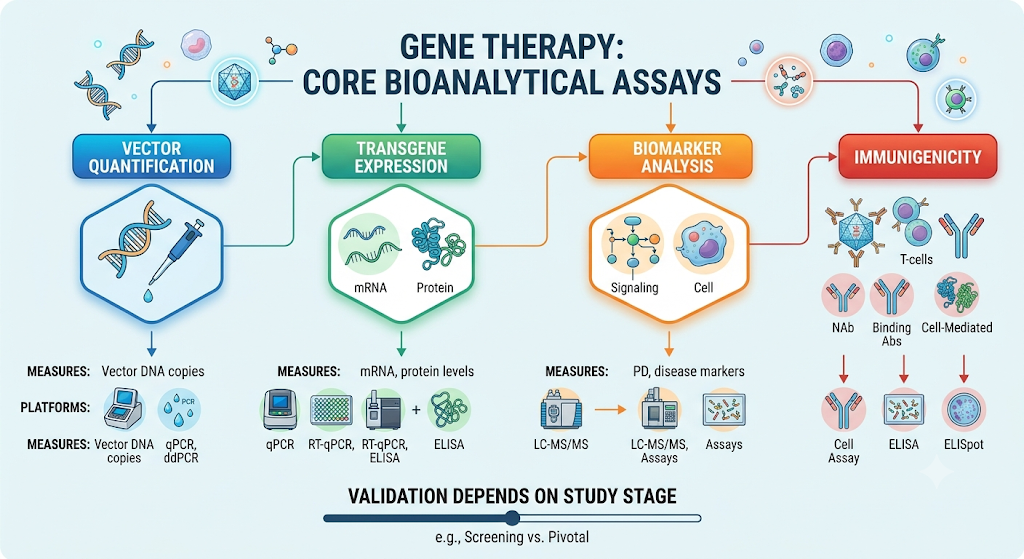
The core Bioanalytical CRO Services for Gene Therapy and AAV-Based Drug Programs typically include vector genome quantification, transgene product quantification, biomarker analysis, immunogenicity testing, and biodistribution-related analysis — usually run as an integrated package rather than standalone services.
| Assay Category | What It Measures | Common Platform |
|---|---|---|
| Vector genome (biodistribution/shedding) | Copy number of vector DNA in tissue, blood, or excreta | ddPCR, qPCR |
| Transgene expression | Transgene-derived mRNA or protein level | RT-qPCR, ELISA, LC-MS/MS |
| Biomarker quantification | Pharmacodynamic, disease, or pathway-modulation markers | LC-MS/MS, HRMS, ligand-binding assay |
| Anti-AAV neutralizing antibodies (NAb) | Pre-existing and treatment-emergent immunity to capsid | Cell-based neutralization assay |
| Total anti-AAV binding antibodies | Total immune response, binding but not necessarily neutralizing | ELISA, electrochemiluminescence |
| Cell-mediated immunity | T-cell response to capsid or transgene | ELISpot, intracellular cytokine staining |
Each of these typically requires its own fit-for-purpose or fully validated bioanalytical method, since the appropriate validation rigor depends on the study stage and how the data will be used — an early screening assay doesn’t need the same validation depth as a pivotal-study assay supporting a BLA.
4: Why Are Bioanalytical Services Important for AAV-Based Programs?
Bioanalytical testing is important because it connects administration of an AAV-based therapy with measurable exposure, distribution, biological activity, and immune response — without it, sponsors have no quantitative evidence to support development or regulatory decisions.
AAV programs generate several recurring analytical questions:
- Where does the therapeutic material go, and how long does a relevant signal persist?
- Is the intended biological response occurring?
- Can changes in biomarkers be quantified reliably across time points?
- Are the analytical methods sufficiently sensitive and specific for the study objective?
- Can the resulting data support regulatory and scientific decision-making?
ICH S12 provides harmonized considerations for the nonclinical biodistribution of gene therapy products, giving sponsors a structured framework for designing biodistribution studies rather than building one from scratch for each program. Analytical planning under this framework needs to account for tissue or fluid matrices, sampling schedules, assay sensitivity, specificity, controls, reference materials, and the biological interpretation of detected signals.
5: How Is a Gene Therapy Bioanalytical Method Developed and Validated?
A gene therapy bioanalytical method is developed by optimizing sample preparation, chromatography or PCR parameters, and calibration strategy for the specific analyte and matrix, then validated against defined performance characteristics appropriate to the study’s intended use.
Method development typically covers:
- Selection of analytical technology
- Sample preparation and extraction optimization
- Chromatographic or PCR optimization
- Internal-standard selection and calibration strategy
- Matrix-effect assessment, recovery evaluation, and carryover assessment
- Stability evaluation
Method development and validation work at the CDMO/CRO stage often needs to move quickly between nonclinical and early clinical timelines without losing rigor — a challenge covered in more depth in bioanalytical method development and validation at a CDMO.
Validation then demonstrates the method performs consistently for its intended purpose:
| Parameter | Why It Matters |
|---|---|
| Selectivity | Distinguishes the target analyte from matrix components and interfering substances |
| Specificity | Supports confident identification or quantification of the intended analyte |
| Accuracy | Evaluates closeness of measured results to the accepted reference value |
| Precision | Measures repeatability and intermediate precision |
| Sensitivity | Establishes whether low concentrations can be measured reliably |
| Calibration performance | Demonstrates the relationship between response and analyte concentration |
| Stability | Determines whether samples and analytes remain suitable under defined conditions |
| Recovery | Evaluates analyte recovery during sample preparation |
| Matrix effect | Determines whether matrix components influence analytical response |
Accuracy and precision are frequently the parameters sponsors get pushback on during regulatory review — see accuracy and precision requirements for a validated bioanalytical method for how these thresholds are typically defined and demonstrated.
6: How Does Immunogenicity Testing Differ for AAV Vectors?
Immunogenicity testing for AAV vectors differs from standard biologic immunogenicity work because it must separately characterize pre-existing immunity, treatment-induced neutralizing antibody response, and cell-mediated immunity — three parallel workstreams instead of one ADA cascade.
For most protein therapeutics, immunogenicity testing follows a tiered screen-confirm-titer cascade against a single analyte. AAV programs add complexity because:
- Patients are often screened for eligibility based on pre-existing NAb titers before dosing, meaning the assay has to be validated and locked well ahead of first-in-human dosing.
- Sustained transgene expression depends on managing the immune response, so sponsors frequently track NAb titers longitudinally for years post-dose, not just during the active study period.
- Cell-mediated responses (particularly capsid-specific T-cell activity) are increasingly requested by regulators, especially where liver-directed AAV therapies have shown transaminase elevations linked to T-cell responses.
7: What Does a Practical Bioanalytical Workflow Look Like for an AAV Program?
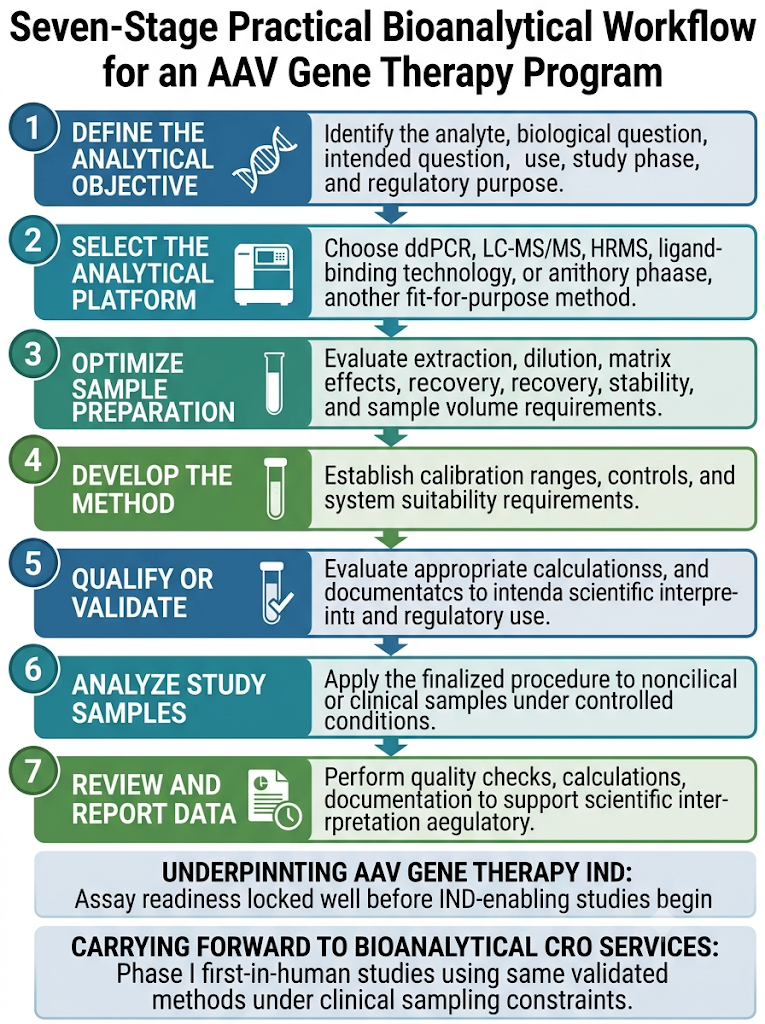
A practical bioanalytical workflow for an AAV program begins with defining the analytical objective and ends with validated or qualified sample analysis and documented data interpretation, typically across seven stages.
- Define the analytical objective — identify the analyte, biological question, intended use, study phase, and regulatory purpose.
- Select the analytical platform — choose ddPCR, LC-MS/MS, HRMS, ligand-binding technology, or another fit-for-purpose method.
- Optimize sample preparation — evaluate extraction, dilution, matrix effects, recovery, stability, and sample volume requirements.
- Develop the method — establish calibration ranges, controls, and system suitability requirements.
- Qualify or validate — evaluate appropriate validation characteristics according to intended use and applicable regulatory expectations.
- Analyze study samples — apply the finalized procedure to nonclinical or clinical samples under controlled conditions.
- Review and report data — perform quality checks, calculations, and documentation to support scientific interpretation and regulatory use.
This same workflow underpins bioanalytical support for an AAV gene therapy IND, where assay readiness needs to be locked well before IND-enabling studies begin, and it carries forward into bioanalytical CRO services for Phase I first-in-human studies, where the same validated methods are applied under clinical sampling constraints.
8: What Regulatory Guidance Applies to Gene Therapy Bioanalytical Programs?
Bioanalytical work for AAV and gene therapy programs is shaped by ICH S12 for nonclinical biodistribution, ICH M10 for general bioanalytical method validation, and FDA’s broader gene therapy guidance portfolio.
| Regulatory/Scientific Framework | Relevance |
|---|---|
| ICH M10 | Harmonized bioanalytical method validation and study sample analysis |
| ICH S12 | Nonclinical biodistribution considerations for gene therapy products |
| FDA Bioanalytical Method Validation Guidance | Method development, validation, and study sample analysis |
| FDA Biomarker Bioanalytical Validation Guidance | Biomarker concentration methods used in development |
| FDA Gene Therapy Guidance Portfolio | Product development, manufacturing, safety, clinical, and long-term follow-up considerations |
| EMA Gene Therapy Guidance | Quality, nonclinical, and clinical development of gene therapy medicinal products |
Because this guidance continues to evolve, sponsors should confirm current applicable guidance for their specific product and development stage before finalizing an analytical strategy, and should work with a partner who tracks both FDA and Health Canada expectations in parallel.
9: What Should a Sponsor Look for in a Gene Therapy Bioanalytical CRO?
A sponsor evaluating a Bioanalytical CRO Services for Gene Therapy partner should prioritize demonstrated ddPCR/qPCR and mass spectrometry capability, validated NAb and cell-mediated immunity platforms, multi-matrix extraction experience, strong quality and data-integrity systems, and a track record supporting IND-enabling and clinical-stage gene therapy programs specifically.
Practical questions worth asking a prospective CRO:
- Can they validate vector genome assays across the specific tissue matrices your biodistribution protocol requires?
- Do they have in-house cell-based NAb assay capability, or will that be subcontracted?
- What is their experience bridging LC-MS/MS and ligand-binding platforms for transgene protein and biomarker quantification?
- Can they support both GLP toxicology-stage work and later clinical-stage bioanalysis without a platform or lab-to-lab transfer?
- Do they have documented experience supporting both FDA and Health Canada submission packages?
Conclusion:
Bioanalytical CRO Services for Gene Therapy are a critical component of evidence generation for AAV-based and other advanced therapeutic programs. Well-designed bioanalytical strategies help sponsors obtain reliable information on vector genomes, transgene expression, biomarkers, biodistribution-related endpoints, and immune responses — evidence that directly supports development and regulatory decision-making from IND through BLA.
Because gene therapy programs are highly product-specific, analytical methods should be selected and developed according to the intended purpose rather than applying a one-size-fits-all approach. ICH S12, ICH M10, FDA’s cellular and gene therapy guidance portfolio, and EMA’s gene therapy framework all provide important reference points for building a scientifically appropriate bioanalytical strategy, and vector quantification, transgene expression, biomarker analysis, immunogenicity, and biodistribution testing work best when planned as one integrated strategy rather than assembled piecemeal across multiple vendors.
Frequently Asked Questions:
AAV programs may require different analytical tests depending on the product and study objectives. These can include biodistribution analysis, biomarker quantification, pharmacokinetic or exposure-related analysis, immunogenicity-related testing, and characterization of relevant biological analytes.
AAV biodistribution analysis evaluates where a gene therapy product or relevant vector-associated signal is detected within biological tissues or matrices following administration. The study design depends on the therapeutic product, administration route, target tissue, and scientific objectives.
Biomarkers can provide measurable evidence of biological activity, pharmacodynamic effects, disease response, or pathway modulation. Appropriate biomarker assays can therefore help connect treatment exposure with biological effects.
ICH S12 is an international guideline addressing nonclinical biodistribution considerations for gene therapy products. It provides a harmonized framework for considering biodistribution during nonclinical development.
Yes. Depending on the biomarker and analytical platform, CROs can develop and apply quantitative assays for suitable protein, peptide, metabolite, small-molecule, or other biological biomarkers associated with an AAV program.
Relevant frameworks can include ICH M10 for bioanalytical method validation and study sample analysis, ICH S12 for nonclinical biodistribution considerations for gene therapy products, and applicable FDA and EMA guidance for gene therapy development and analytical testing.
Reference
- Tounekti O, Shubow S, Wassmer S, Van Tuyl A, Yang L, Gong B, Abhari MR, Kalina W, Myler H, DelCarpini J, Escobar D. 2025 White Paper on Recent Issues in Bioanalysis: Redosing Patients with AAV Gene Therapy; CRS Immunogenicity Risk; Shedding Assays; NHP Studies Immunogenicity; CMC vs Bioanalytical Assays; Artificial Intelligence-Powered Genomic Pipelines for NGS (PART 3A–Recommendations on Gene, Cell, and Vaccine Therapies Immunogenicity & Technologies; Biotherapeutics & Biosimilars Immunogenicity Assessment & Clinical Relevance PART 3B–Regulatory Agencies’ Input on Immunogenicity/Technologies of Biotherapeutics, Gene …. Bioanalysis. 2025 Nov 17;17(22):1365-409.https://www.tandfonline.com/doi/abs/10.1080/17576180.2025.2586976
- Bivi N, Graham D, Joglekar L, McGuire K, Stoop J, Zoghbi J, Baker B, Bandukwala A, Bond S, Buoninfante A, Chen J. 2024 White paper on recent issues in bioanalysis: Impact of LDT in US and IVDR in EU; AI/ML for High Parameter Flow Cytometry; The rise of Olink Technology; CDx for AAV Gene Therapies; Integrative Bioanalysis by Multiple Platforms; Super Sensitive ADA/NAb LBA (PART 2A–Recommendations on Advanced Strategies for Biomarkers, IVD/CDx Assays (BAV), Cell Based Assays (CBA), and Ligand-Binding Assays (LBA) PART 2B–Regulatory Agencies’ Input on Biomarkers, IVD/CDx, and Biomarker Assay Validation). Bioanalysis. 2025 Feb 16;17(4):211-48.https://www.tandfonline.com/doi/abs/10.1080/17576180.2024.2442218
- Kavita U, Sun K, Braun M, Lembke W, Mody H, Kamerud J, Yang TY, Braun IV, Fang X, Gao W, Gupta S. PK/PD and bioanalytical considerations of AAV-based gene therapies: an IQ consortium industry position paper. The AAPS Journal. 2023 Jul 31;25(5):78.https://link.springer.com/article/10.1208/s12248-023-00842-1
- Pan L, Mora J, Walravens K, Wagner L, Hopper S, Loo L, Bettoun D, Bond S, Dessy F, Downing S, Garofolo F. 2022 White Paper on Recent Issues in Bioanalysis: FDA Draft Guidance on Immunogenicity Information in Prescription Drug Labeling, LNP & Viral Vectors Therapeutics/Vaccines Immunogenicity, Prolongation Effect, ADA Affinity, Risk-based Approaches, NGS, qPCR, ddPCR Assays (Part 3–Recommendations on Gene Therapy, Cell Therapy, Vaccines Immunogenicity & Technologies; Immunogenicity & Risk Assessment of Biotherapeutics and Novel Modalities; NAb Assays Integrated Approach). Bioanalysis. 2023 Jul 1;15(14):773-814.https://www.tandfonline.com/doi/abs/10.4155/bio-2023-0135
About the Author


