


Introduction: Why Late-Phase Bioanalysis Requires a Different Approach
As a clinical development program progresses into Phase II and Phase III, the expectations surrounding bioanalysis increase dramatically. Bioanalytical CRO services for Phase II and Phase III clinical trials are far more than expanded versions of early-phase support. These later stages demand a stronger quality framework, broader validation requirements, deeper regulatory alignment, and operational systems capable of managing thousands of samples while maintaining complete data integrity.
At this point in development, bioanalytical data directly influences dose-response assessments, population pharmacokinetic (PK) modeling, efficacy evaluations, and ultimately, regulatory approval decisions. A method considered acceptable for a small Phase I study involving 50 samples may become unsuitable when applied to a global Phase III program involving 5,000 or more samples collected from multiple clinical sites across different regions.
ResolveMass Laboratories Inc. supports sponsors during this critical transition, where analytical uncertainty is no longer acceptable and every reported result becomes part of the permanent regulatory record.
Partner with a Specialized CRO: Explore how our comprehensive Bioanalytical Strategy for Drug Development aligns your late-phase trials with global regulatory expectations.
Share via:
Article Summary:
- Phase II and Phase III clinical trials require significantly higher bioanalytical standards compared to early-stage studies, with strong emphasis on assay consistency, regulatory compliance, and cross-site data reliability.
- Choosing the right bioanalytical CRO is critical for ensuring PK/PD data can successfully withstand regulatory evaluations from agencies such as the FDA, EMA, and Health Canada.
- Essential late-phase bioanalytical deliverables include fully validated analytical methods, robust Incurred Sample Reanalysis (ISR) programs, and complete audit-ready documentation aligned with global regulatory expectations.
- Large-scale clinical programs must effectively manage high sample volumes, complex biological matrices, multi-center logistics, and demanding project timelines while maintaining data integrity throughout the study.
- ResolveMass Laboratories Inc. provides specialized bioanalytical CRO services supported by regulated LC-MS/MS platforms and operational systems designed specifically for Phase II and Phase III clinical development.
- This article explores major late-phase bioanalytical considerations, including method validation requirements, ISR expectations, regulatory submission readiness, common analytical risks, and key questions sponsors should ask before selecting a CRO partner.
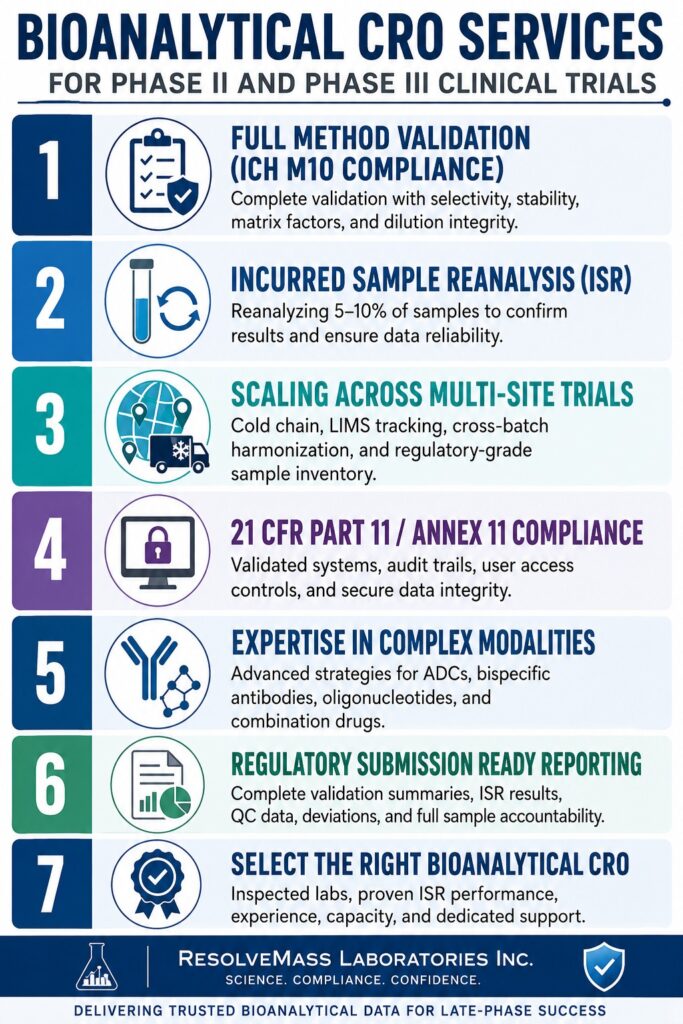
1. Method Validation in Phase II and Phase III: Full Compliance Without Compromise
For Phase II and Phase III clinical trials, full bioanalytical method validation (BMV) is mandatory. Partial validation approaches are insufficient for regulatory submissions intended to support product approval.
By the time a program enters Phase II, the resulting analytical data may ultimately be included within an NDA, BLA, or MAA submission package. Consequently, the bioanalytical method must comply fully with internationally recognized regulatory standards, including:
- FDA Bioanalytical Method Validation Guidance (2018)
- EMA Guideline on Bioanalytical Method Validation (2011, currently under revision)
- ICH M10 Guideline on Bioanalytical Method Validation (2022), now recognized as the harmonized global benchmark
ICH M10 Compliance: Expanded Expectations for Late-Phase Studies
ICH M10 introduced several critical requirements that continue to challenge many laboratories transitioning into fully harmonized compliance. For late-phase programs, these additions significantly increase analytical expectations.
| ICH M10 Requirement | Phase I Impact | Phase II/III Impact |
|---|---|---|
| Parallelism testing for LBAs | Recommended | Required |
| ISR scope | Suggested | Mandatory |
| Matrix equivalence for rare matrices | Optional | Documented justification required |
| Endogenous analyte validation | Flexible | Strict anchored calibration required |
| Carry-over assessment | Basic | Extensive evaluation across realistic sample sequences |
For small molecule programs utilizing LC-MS/MS platforms, a fully ICH M10-compliant validation at ResolveMass includes:
- Selectivity assessment across at least six independent matrix lots
- Matrix factor evaluations with and without isotopically labeled internal standards
- Comprehensive dilution integrity testing
- Bench-top, freeze-thaw, and long-term stability studies aligned with actual clinical sample handling conditions
These validation elements are essential for ensuring reproducibility and regulatory acceptance in large-scale clinical trials.
Navigate Global Harmonization: Learn how our validation frameworks meet the highest standards under the ICH M10 Bioanalytical Method Validation Guidelines.
2. Incurred Sample Reanalysis (ISR): A Critical Measure of Data Reliability
ISR is no longer considered optional. Both FDA and EMA reviewers evaluate ISR performance closely as a direct indicator of method reproducibility using authentic clinical study samples.
ISR involves reanalyzing a subset of previously tested samples, typically 5% to 10% of the total study population, to confirm that the original analytical results can be consistently reproduced. Regulatory concern arises when ISR acceptance criteria are not met. For small molecules, at least two-thirds of ISR samples must fall within ±20% of the original value, while LBAs generally require agreement within ±30%.
Common Causes of ISR Failure in Phase II and Phase III Programs
Several issues commonly contribute to ISR discrepancies in late-phase studies:
- Metabolite back-conversion: Unstable metabolites reverting to the parent compound during freeze-thaw cycles
- Protein binding variability: Particularly in disease-state populations compared with healthy volunteer matrices
- Sample handling inconsistency: Variability in collection and processing procedures across multiple sites
- Complex patient matrices: Disease-modified plasma compositions not represented adequately during validation
At ResolveMass, ISR planning begins before the first study sample is analyzed. Collection procedures, storage requirements, and matrix stability assessments are incorporated directly into the Bioanalytical Plan to minimize downstream variability and improve reproducibility throughout the study lifecycle.
Ensure Method Reproducibility: Discover how we manage reproducibility and handle complex matrices during Incurred Sample Reanalysis (ISR) in Bioanalytical Studies.
3. Scaling Bioanalysis Across Multi-Site Phase III Trials
Large multi-center Phase III studies introduce operational complexities that can significantly impact data quality if the CRO lacks the necessary infrastructure.
A Phase III study involving 800 patients across 40 clinical sites throughout North America and Europe generates unavoidable variability in sample collection and handling. Under these circumstances, operational systems become just as important as analytical performance.
Essential Infrastructure Requirements for Multi-Site Clinical Studies
Cold Chain Management
A compliant bioanalytical operation must maintain documented chain-of-custody procedures from the clinical site to the analytical laboratory. Temperature excursion management protocols must also be clearly defined and consistently applied.
LIMS Integration
Validated Laboratory Information Management Systems (LIMS) are essential for tracking each sample from receipt through final reporting while maintaining a complete audit trail.
Cross-Batch Harmonization
Quality control performance must be continuously monitored across analytical batches to identify systematic drift before it compromises the study dataset.
Regulatory-Grade Sample Inventory
Retained sample management must comply fully with ICH M10 and 21 CFR Part 11 electronic recordkeeping standards.
ResolveMass operates within a validated LIMS environment designed specifically to support multi-center North American clinical studies. Standard operating procedures governing sample receipt and processing are structured to preserve data integrity from the moment specimens leave the clinical site.
Mitigate Trial Risks: Avoid operational pitfalls across multi-site trials by reviewing our guide on Common Bioanalytical Mistakes.
4. Regulated Bioanalysis and 21 CFR Part 11 / Annex 11 Compliance
Every electronic record generated during Phase II and Phase III bioanalysis must comply with regulatory requirements established under 21 CFR Part 11 in the United States and Annex 11 in the European Union.
This requirement is not merely administrative. During regulatory inspections, investigators routinely review audit trails associated with chromatographic data systems, LIMS platforms, and electronic laboratory notebooks. Any inconsistency between raw data and reported results can result in serious inspection findings, including FDA Form 483 observations.
Key Compliance Areas Sponsors Should Evaluate
Before selecting a bioanalytical CRO, sponsors should verify the following:
- Chromatographic Data System (CDS) Qualification
Is the instrument software fully validated? Are audit trails enabled and protected from modification? - Electronic Laboratory Notebooks (ELN)
Are all entries timestamped and directly linked to supporting raw data? - User Access Controls
Can the laboratory demonstrate role-based access restrictions across regulated systems? - Backup and Disaster Recovery Procedures
Are raw datasets backed up securely off-site with documented recovery protocols?
Strong compliance systems are essential for minimizing regulatory risk and preserving submission readiness.
Maintain Strict Auditable Standards: Learn more about our rigorous protocols for maintaining Data Integrity in Bioanalytical Studies.
5. Bioanalytical Strategy for Combination Drugs and Complex Biologics
Modern late-phase clinical programs increasingly involve complex therapeutic modalities, including combination products, antibody-drug conjugates (ADCs), bispecific antibodies, and oligonucleotide therapeutics. These programs require specialized analytical strategies that extend beyond traditional PK assay models.
Bioanalytical Challenges by Drug Type
| Drug Type | Bioanalytical Challenge | Preferred Platform |
|---|---|---|
| Small molecule combination | Mutual interference between analytes | Selective LC-MS/MS MRM with interference testing |
| Antibody-Drug Conjugate (ADC) | Total antibody vs. conjugated antibody vs. free payload | Separate LBA + LC-MS/MS |
| Bispecific antibody | Target engagement vs. drug concentration decoupling | Bridging ELISA / SPR correlation |
| Oligonucleotide therapeutics | Short-sequence discrimination and nuclease degradation | Hybrid LC-MS/MS |
| Protein therapeutic | Endogenous protein interference and ADA impact on PK | Acid dissociation + capture LC-MS/MS |
For biomarker co-development programs within Phase II and Phase III studies, ResolveMass applies context-of-use (COU) biomarker qualification frameworks to differentiate exploratory biomarkers from those requiring full fit-for-purpose validation.
Advance Your Complex Biologics: Explore our technical capabilities and advanced platforms for Proteomics and Bioanalytical Services.
6. Regulatory Submission Readiness: Requirements for the Bioanalytical Report
A Phase II or Phase III bioanalytical report is not simply a laboratory summary. It is a formal regulatory document that must meet strict standards for completeness, traceability, and technical accuracy.
Bioanalytical reports submitted as part of a Clinical Study Report (CSR) under ICH E3 guidelines should contain the following minimum components:
- Method validation summaries with parameter tables covering:
- Accuracy
- Precision
- LLOQ
- ULOQ
- Recovery
- Stability
- Documentation of run acceptance criteria applied throughout the study
- QC performance summaries across all analytical runs
- ISR results with pass/fail determinations and investigations for any failures
- Calibration curve data for every analytical batch
- Deviation logs documenting departures from the Bioanalytical Plan and corresponding impact assessments
- Complete sample accountability records confirming receipt, analysis, and retention status
Many sponsors underestimate the time required to assemble a compliant bioanalytical report when study documentation has not been structured properly from the beginning. At ResolveMass, reporting activities are developed concurrently with study execution to ensure submission readiness throughout the program rather than after database lock.
Secure Submission-Ready Data: Find out how ResolveMass guarantees the delivery of Robust Bioanalytical Data for successful global filings.
7. Selecting the Right Bioanalytical CRO for Phase II and Phase III Programs
Selecting the appropriate CRO is one of the most important decisions a late-phase sponsor will make. Ideally, this evaluation should occur well before Phase IIb data readout.
Before awarding a bioanalytical contract, sponsors should assess each CRO against a comprehensive operational and regulatory checklist.
CRO Qualification Checklist
- ✅ Has the CRO undergone inspection by FDA, EMA, or Health Canada, and what were the outcomes?
- ✅ Does the laboratory operate within an active and auditable GLP/GCP compliance framework?
- ✅ Is the CDS fully validated and compliant with 21 CFR Part 11 requirements?
- ✅ Can the CRO provide ISR performance data from comparable programs?
- ✅ Does the laboratory have demonstrated experience with the required matrix type, including plasma, dried blood spot, CSF, or tissue?
- ✅ What is the laboratory’s capacity for large-scale batch processing without operational delays?
- ✅ Will the sponsor receive a dedicated scientific point of contact instead of a rotating account representative?
- ✅ Can the CRO provide sample Bioanalytical Plans and example reports for review?
- ✅ What are the contractual turnaround expectations for data delivery?
- ✅ Does the CRO have direct experience supporting submissions to FDA, EMA, Health Canada, or PMDA?
A thorough qualification process significantly reduces operational and regulatory risk during pivotal clinical development stages.
Build a Dependable Alliance: Discover the benefits of long-term collaboration through a strategic Bioanalytical CRO Partnership with ResolveMass.
Conclusion
Bioanalytical CRO services for Phase II and Phase III clinical trials operate at the intersection of analytical science, regulatory compliance, and large-scale operational execution. In many cases, the difference between a smooth regulatory review and one complicated by agency queries, inspection findings, or clinical hold concerns can be traced back to early bioanalytical decisions made during late-phase development.
ResolveMass Laboratories Inc. provides fully regulated, ICH M10-aligned bioanalytical CRO services for sponsors advancing through Phase II and Phase III clinical development. With advanced LC-MS/MS platforms, LIMS-driven chain-of-custody management, and submission-ready reporting processes integrated into every program, ResolveMass supports sponsors with the scientific and regulatory rigor required for successful late-stage execution.
Connect with Our Experts: Contact us today to learn about our specialized Bioanalytical CRO for First-in-Human Studies and late-phase clinical support.
The ResolveMass scientific team functions as an embedded extension of the sponsor’s development organization, ensuring that analytical strategy remains fully aligned with regulatory and clinical objectives throughout the program lifecycle.
If your development program is approaching Phase II readiness or preparing for a pivotal Phase III study, now is the time to establish a bioanalytical strategy that can withstand regulatory scrutiny and support long-term success.
👉 Contact ResolveMass Laboratories Inc.
Frequently Asked Questions (FAQs)
Phase II studies may allow limited flexibility for exploratory pharmacokinetic evaluations and evolving analytical methods. In contrast, Phase III studies demand fully validated, ICH M10-compliant bioanalytical methods because the resulting data supports regulatory submissions and product approval decisions. Requirements related to precision, stability, selectivity, and ISR become significantly stricter during late-phase development.
Sponsors should ideally partner with a bioanalytical CRO at least 6 to 9 months before the first patient is dosed in a Phase III trial. This timeframe allows sufficient opportunity for method transfer, re-validation activities, Bioanalytical Plan preparation, and operational alignment across clinical sites. Early engagement also helps avoid rushed timelines that can negatively affect study quality and regulatory documentation.
Under ICH M10 guidance, approximately 5% to 10% of total study samples are typically selected for incurred sample reanalysis (ISR). These samples should represent different concentration ranges, subjects, and collection time points to properly evaluate assay reproducibility. In large Phase III studies, ISR can involve hundreds or even thousands of additional analyses, making it a major component of study planning and budgeting.
A Phase I method generally cannot move directly into Phase III without additional validation work. Patient populations in late-phase studies often introduce matrix variability caused by disease conditions, co-administered medications, and altered protein binding profiles that are not present in healthy volunteer studies. If the original method predates ICH M10 requirements, sponsors may also need bridging or cross-validation studies to ensure compliance.
Human plasma, particularly K2EDTA plasma, remains the most frequently analyzed matrix in late-phase clinical trials. However, modern oncology, neurology, and rare disease programs increasingly require more specialized matrices such as cerebrospinal fluid (CSF), urine, tumor tissue homogenates, and dried blood spots (DBS). Each matrix presents unique analytical challenges related to stability, extraction efficiency, and matrix effects that must be fully characterized during validation.
An experienced bioanalytical CRO provides detailed sample handling instructions to every participating clinical site before study initiation. These guidelines typically include collection tube specifications, centrifugation procedures, aliquoting instructions, labeling requirements, and cold-chain shipment protocols. Strong CROs also conduct proactive site training to minimize handling deviations and maintain sample integrity throughout the study.
Regulatory agencies commonly question bioanalytical data when ISR acceptance criteria are not met or when investigations into failures are incomplete. Additional concerns may include inadequate stability data, audit trail deficiencies within chromatographic systems, repeated QC failures, or poorly documented protocol deviations. Any weakness in data traceability or analytical integrity can result in regulatory queries, delayed approvals, or inspection findings.
A complete ICH M10-compliant validation for a single analyte in plasma usually requires approximately 6 to 10 weeks after method development is finalized. More complex programs involving multiple analytes, ligand-binding assays (LBAs), or specialized matrices may require 12 to 16 weeks or longer. Sponsors should always include contingency time in the project schedule to address unexpected troubleshooting or optimization needs.
Reference:
- Guideline IH. Bioanalytical method validation M10. European Medicines Agency: Amsterdam, The Netherlands. 2019 Feb.https://www.wrib.org/PDFs/ICH_M10_BMV_Draft_Guideline-190227.pdf
- Gu M, Gehman A, Nifong B, Mayer AP, Li V, Birchler M, Wang K, Tang H. From guidelines to implementation: a case study on applying ICH M10 for bioanalytical assay cross-validation. The AAPS Journal. 2025 Feb 28;27(2):54.https://link.springer.com/article/10.1208/s12248-025-01038-5
- Timmerman P, White S, Adcock N, Arfvidsson C, Barfield M, Cowan K, Ferrari L, Golob M, Goodwin L, Hughes R, Ivanova T. Feedback from a workshop by the European Bioanalysis Forum on assay validation requirements for in vitro assays following the publication of ICH M12 guideline–a plea for context-of-use over ICH M10 standards.https://www.tandfonline.com/doi/abs/10.1080/17576180.2025.2468596
Get In Touch With Us
About The Author


