


Introduction
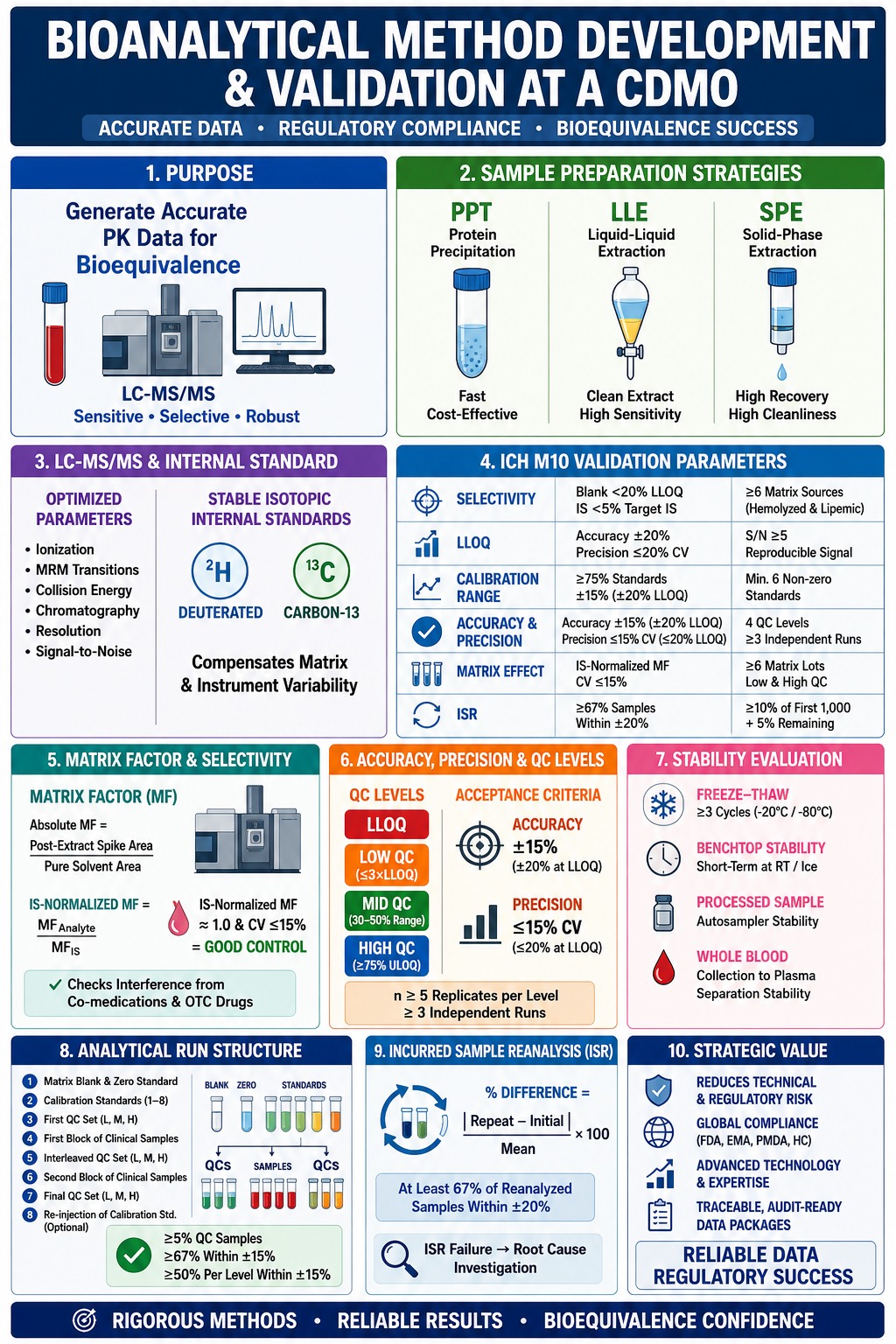
Bioanalytical Method Development and Validation at a CDMO provides the quantitative foundation needed to establish pharmacokinetic equivalence between generic oral or parenteral formulations and Reference Listed Drugs (RLDs) for regulatory submissions. By developing sensitive, selective, and robust analytical assays in accordance with International Council for Harmonisation (ICH) M10 guidelines, specialized contract facilities enable reliable analysis of biological samples and generation of accurate pharmacokinetic data appropriate for Abbreviated New Drug Application (ANDA) submissions.
In generic drug development, establishing bioequivalence (BE) involves comparing key pharmacokinetic parameters, particularly maximum plasma concentration (Cmax) and area under the plasma concentration-time curve (AUC), between test and reference formulations. Since clinical BE studies measure drug concentrations in biological matrices such as human plasma, serum, or whole blood, the analytical method must consistently quantify the target analytes in the presence of substantial endogenous matrix components. Contract development and manufacturing organizations (CDMOs), including ResolveMass Laboratories Inc., utilize Liquid Chromatography-Tandem Mass Spectrometry (LC-MS/MS) platforms together with automated sample preparation procedures to achieve the sensitivity, selectivity, and analytical range expected by international regulatory authorities. Contemporary bioanalytical workflows are also designed to proactively manage matrix suppression, co-formulated active pharmaceutical ingredients (APIs), and metabolite back-conversion, thereby reducing analytical and regulatory risks throughout the generic drug approval process.
Learn how robust laboratory methodologies support complete regulatory packages with One-Stop CDMO Analytical Services for ANDA Submissions.
Share via:
Quick Summary:
- Bioanalytical method development at a CDMO provides accurate pharmacokinetic (PK) data needed to demonstrate bioequivalence (BE) between generic and Reference Listed Drug (RLD) products.
- LC-MS/MS is the primary analytical platform, supported by optimized sample preparation methods such as Protein Precipitation (PPT), Liquid-Liquid Extraction (LLE), and Solid-Phase Extraction (SPE).
- Method optimization focuses on selectivity, sensitivity, chromatographic separation, ionization, MRM transitions, and stable-isotope internal standards to minimize matrix interference and improve quantitative reliability.
- ICH M10 validation evaluates critical parameters including selectivity, LLOQ, calibration range, accuracy, precision, matrix effects, and incurred sample reanalysis (ISR) to meet global regulatory expectations.
- Matrix effects, QC performance, and stability are carefully assessed using multiple matrix lots and QC levels, including freeze-thaw, benchtop, processed-sample, and whole-blood stability studies.
- During clinical sample analysis, structured analytical runs, QC bracketing, system suitability, data tracking, and ISR help ensure reproducibility, traceability, and reliable results.
- Specialized CDMOs provide advanced analytical expertise, regulatory compliance, and audit-ready data packages, helping reduce technical risks and support successful generic drug bioequivalence and ANDA submissions.
Technical Strategies for Bioanalytical Method Development
Bioanalytical method development involves systematic optimization of sample extraction, chromatographic separation, and mass spectrometry ionization conditions to effectively isolate and quantify target analytes from complex biological fluids before formal regulatory validation begins. This development stage defines the operating conditions and performance limits required to produce consistent quantitative results across potentially thousands of clinical subject samples.
Sample Extraction Optimization and Matrix Clean-up
Sample preparation is designed to separate target analytes and internal standards from proteins, lipids, salts, and other endogenous components that can contribute to mass spectrometer source contamination and ionization suppression. Contract laboratories typically assess Protein Precipitation (PPT), Liquid-Liquid Extraction (LLE), and Solid-Phase Extraction (SPE), selecting the most suitable approach according to analyte polarity, plasma protein binding characteristics, and the required lower limits of quantification (LLOQ).
- Protein Precipitation (PPT): This approach uses water-miscible organic solvents, such as acetonitrile or methanol, to denature and precipitate proteins present in the biological matrix. PPT is generally rapid and economical; however, it may leave phospholipids and other endogenous components in the extract, potentially causing matrix effects during electrospray ionization (ESI). Combining PPT with phospholipid-removal filtration plates can reduce background interference and improve assay performance, particularly for mid-to-high concentration assays.
- Liquid-Liquid Extraction (LLE): LLE uses water-immiscible organic solvents, including methyl tert-butyl ether, ethyl acetate, and hexane, to partition non-polar analytes from aqueous proteins, salts, and other polar matrix components. This procedure can generate relatively clean extracts with low background noise, making it particularly useful for hydrophobic small molecules where sub-nanogram per milliliter sensitivity is required.
- Solid-Phase Extraction (SPE): SPE uses specialized stationary-phase chemistries, including reverse-phase, hydrophobic-lipophilic balance, and ion-exchange sorbents, to selectively retain target analytes while unwanted matrix components are removed through washing steps. SPE generally provides high analyte recovery and substantial sample cleanliness, making it particularly valuable for polar compounds, low-dose formulations, and analytically challenging biological matrices.
Discover how target strategies ensure full compliance via CMC Documentation at a CDMO for ANDA.
LC-MS/MS Parameter Tuning and Internal Standard Selection
Optimization of mass spectrometry ionization parameters, together with appropriate Stable-Isotope Labeled Internal Standard (SIL-IS) selection, helps compensate for instrumental variation and matrix-related fluctuations in analytical response. Deuterated (²H) and carbon-13 (¹³C) labeled internal standards are commonly selected because their physicochemical characteristics closely resemble those of the target analytes, allowing them to behave similarly during extraction and ionization.
Mass spectrometry conditions, including collision energy, declustering potential, gas flow settings, and Multiple Reaction Monitoring (MRM) precursor-to-product ion transitions, are optimized to maximize the signal-to-noise ratio (S/N). At the same time, liquid chromatography conditions are refined by evaluating parameters such as column stationary phase chemistry (e.g., C18, C8, Phenyl-Hexyl, HILIC), mobile phase pH, organic modifiers, and gradient slopes. These parameters are adjusted to provide adequate chromatographic resolution between target analytes and potential interferents, including isobaric compounds, phase II metabolites, and endogenous matrix constituents.
Mitigate clinical risk early by leveraging expert guidance on RLD Sourcing and Reverse Engineering.
Executing Bioanalytical Method Development and Validation at a CDMO Under ICH M10 Standards
Executing Bioanalytical Method Development and Validation at a CDMO according to harmonized ICH M10 guidelines provides a standardized framework for ensuring that analytical procedures satisfy global regulatory expectations across agencies such as the US FDA, EMA, Health Canada, and PMDA. The validation process systematically assesses critical assay characteristics, including selectivity, sensitivity, calibration performance, accuracy, precision, matrix effects, and analyte stability.
| Validation Parameter | ICH M10 Chromatographic Acceptance Criteria | Technical and Operational Execution |
|---|---|---|
| Selectivity | Blank matrix response <20% of LLOQ; IS response <5% of target IS. | Evaluated across ≥6 individual matrix sources, including hemolyzed and lipemic lots. |
| Lower Limit of Quantification (LLOQ) | Accuracy within ±20%; Precision ≤20% CV. | Lowest calibration point; requires S/N ≥5 with reproducible signal. |
| Calibration Range | ≥75% of non-zero standards within ±15% (±20% at LLOQ). | Minimum 6 non-zero standards spanning expected clinical Cmax and elimination phases. |
| Accuracy & Precision | Intra/Inter-run Accuracy ±15% (±20% at LLOQ); Precision ≤15% CV (≤20% at LLOQ). | Tested across 4 QC levels (LLOQ, Low QC, Medium QC, High QC) over ≥3 independent runs. |
| Matrix Effect | IS-normalized Matrix Factor CV ≤15% across lots. | Analyzed in ≥6 independent matrix lots at Low and High QC concentrations. |
| Incurred Sample Reanalysis (ISR) | ≥67% of reanalyzed samples within ±20% difference of mean. | Executed on ≥10% of first 1,000 clinical samples, plus 5% of remaining samples. |
Evaluation of Matrix Factor and Selectivity
Selectivity and matrix factor evaluations establish whether endogenous blood components, hemolysis-associated constituents, and plasma lipids interfere with analyte detection or modify the response generated by the mass spectrometer. Contract laboratories assess matrix effects across multiple independent matrix sources to demonstrate that ionization suppression or enhancement remains adequately controlled and consistent among different patient populations.
The absolute Matrix Factor (MF) and Internal Standard-Normalized Matrix Factor are determined using the following mathematical equations:
Absolute MF = Peak Area of Analyte Spiked Post-Extraction / Peak Area of Analyte in Pure Solvent
IS-Normalized MF = Absolute MF_analyte / Absolute MF_IS
An IS-normalized MF value close to 1.0, together with a coefficient of variation (% CV) of ≤15% across six distinct matrix lots, indicates that the internal standard effectively compensates for matrix-associated variability in ionization. In addition, selectivity assessments examine possible interference caused by concomitantly administered medications and over-the-counter drugs to ensure that such substances do not compromise analyte quantification.
Complement bioanalytical method validation with compliant limits by reading about Impurity Control Strategies Under ICH Q3A.
Accuracy, Precision, and Quality Control Placement
Accuracy and precision assessments characterize the systematic error and random variability associated with a bioanalytical assay across independent analytical batches. Under ICH M10 guidelines, assay performance is evaluated using four Quality Control (QC) concentrations: LLOQ, Low QC (≤3 × LLOQ), Medium QC (approximately 30% to 50% of the calibration range), and High QC (≥75% of the ULOQ).
Within-run (intra-batch) and between-run (inter-batch) performance is established by analyzing replicate QC samples (n ≥5 at each concentration level) across a minimum of three independent analytical runs performed on multiple days.
% Accuracy = (Mean Measured Concentration / Nominal Concentration) × 100
% Precision (CV) = (Standard Deviation / Mean Measured Concentration) × 100
The acceptance criteria require the overall mean accuracy to remain within ±15% of the nominal concentration, with the allowable range extended to ±20% at the LLOQ. Precision must remain ≤15% CV, or ≤20% CV at the LLOQ. These requirements demonstrate that the method can generate results that are both accurate and reproducible throughout its intended concentration range.
Stability Evaluation and Whole Blood Integrity
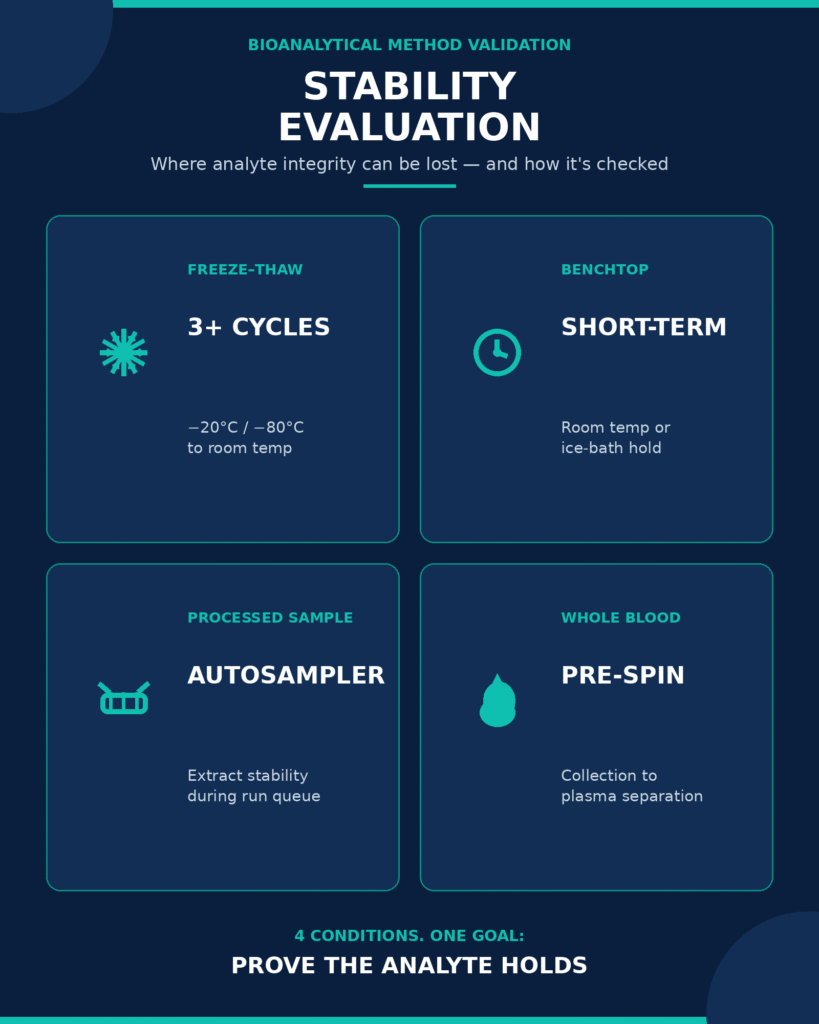
Stability assessments determine whether target analytes remain chemically and structurally stable during the various pre-analytical, analytical, and storage conditions encountered throughout a bioanalytical workflow. Contract testing laboratories assess analyte stability under several relevant matrix conditions:
- Freeze-Thaw Stability: Determines whether analyte concentrations remain consistent after matrix QC samples undergo at least three freeze-thaw cycles between −20 °C or −80 °C and ambient temperature.
- Benchtop (Short-Term) Stability: Evaluates the ability of the analyte to remain stable in untreated biological matrix under ambient laboratory conditions or ice-bath conditions for periods that exceed normal sample preparation times.
- Processed Sample Stability: Determines whether extracted samples remain stable in autosampler trays, thereby confirming sample integrity during instrument interruptions, extended analytical sequences, or periods of instrument downtime.
- Whole Blood Stability: Evaluates analyte stability during the blood collection and harvesting period at clinical sites before plasma separation. This assessment can identify temperature-related degradation or changes in analyte distribution between plasma and cellular components.
Compare analytical degradation considerations across distinct modalities by examining Differences Between a Peptide and a Small Molecule Drug.
Operational Execution and Quality Assurance in Bioequivalence Sample Analysis
Operational execution during clinical study sample analysis depends on carefully structured analytical batches, continuous system suitability assessment, and automated data tracking to ensure reliable processing of bioequivalence study samples. Comprehensive quality control procedures help minimize batch failures while maintaining complete data traceability and auditability for regulatory inspections.
Analytical Run Structure and Sample Bracketing
An analytical batch generally includes a matrix blank, a zero sample consisting of matrix with internal standard, non-zero calibration standards, quality control samples, and clinical subject samples. QC samples are distributed throughout the analytical batch to bracket clinical samples and provide continuous confirmation that instrument and assay performance remain within established acceptance limits.
A standard analytical sequence is typically organized as follows:
- Matrix Blank and Zero Standard
- Calibration Standards (ascending order, points 1 to 8)
- First QC Set (Low, Medium, High QCs)
- First Block of Clinical Subject Samples
- Interleaved QC Set (Low, Medium, High QCs)
- Second Block of Clinical Subject Samples
- Final QC Set (Low, Medium, High QCs)
- Re-injection of Calibration Standards (optional/ending verification)
At least 5% of the total samples in an analytical run, or a minimum of two QC sets consisting of Low, Mid, and High QCs, must be incorporated into the run. For an analytical batch to be accepted, at least 67% of all QC samples must satisfy the ±15% accuracy criterion, and at least 50% of QC samples at every individual concentration level must meet the same acceptance requirement.
Incurred Sample Reanalysis (ISR) Protocol
Incurred Sample Reanalysis (ISR) is used to confirm the reproducibility of a bioanalytical method by reanalyzing a predefined proportion of authentic clinical study samples in a separate analytical run after the initial results have been generated. ISR can identify matrix-related interference, variations in protein binding, or unstable metabolite back-conversion that may not be evident when using artificially spiked validation QC samples.
The percentage difference between the initial and repeat concentration measurements is determined using the following equation:
% Difference = |Repeat Concentration − Initial Concentration| / Mean Concentration × 100
For chromatographic assays, at least 67% of the reanalyzed samples must demonstrate a percentage difference of ≤20%. When an ISR failure is identified, contract laboratories perform a documented root-cause investigation. The investigation may examine factors such as sample handling procedures, instrument performance and stability, calibration integrity, and the potential impact of metabolite stability or back-conversion.
Learn how bioanalytical standards extend to challenging delivery systems via Generic Ophthalmic Suspension ANDA Development.
Strategic Value of Specialized CDMO Partners in Complex Generic Bioequivalence
Specialized contract development and manufacturing organizations help reduce technical and regulatory risks within bioequivalence programs by combining advanced analytical technologies with comprehensive global compliance expertise. Experienced CDMO partners can improve project execution timelines while maintaining appropriate Good Laboratory Practice (GLP) and Good Clinical Practice (GCP) requirements throughout the relevant development and analytical activities.
Complex generic drug development programs, including those involving endogenous compounds, narrow therapeutic index drugs, highly variable formulations, and liposomal delivery systems, can introduce substantial bioanalytical challenges. Such programs may require specialized analytical approaches to achieve reliable quantification in the presence of difficult matrix backgrounds and other sources of interference. Contract laboratories can employ advanced strategies such as surrogate matrix matching, chemical derivatization, and multidimensional liquid chromatography to reduce baseline interference and achieve the required analytical sensitivity.
Integrated data management platforms, validated LIMS systems, and dedicated regulatory expertise further support the generation and maintenance of complete bioanalytical data packages. These capabilities help ensure that analytical records remain traceable, scientifically defensible, and suitable for inspection by regulatory authorities across different jurisdictions.
Evaluate North American service capabilities by reviewing Canadian vs US Peptide CDMOs.
Conclusion
Rigorous Bioanalytical Method Development and Validation at a CDMO provides the quantitative evidence needed to demonstrate bioequivalence for generic pharmaceutical approvals. Application of harmonized ICH M10 guidelines establishes a consistent framework for generating reproducible analytical data while supporting operational efficiency and broader regulatory acceptance of bioequivalence submissions.
Through systematic optimization of sample preparation, LC-MS/MS chromatographic separation, matrix effect control, and analytical run execution, specialized contract facilities can reduce the likelihood of analytical failures during clinical sample testing. Selecting an experienced service provider helps ensure that bioanalytical methods remain reliable, compliant, reproducible, and audit-ready throughout the drug development lifecycle.
Streamline your upcoming ANDA filings with expert analytical validation from Peptide CDMO Capabilities in Canada.
To assess how advanced bioanalytical method development and ICH M10 validation strategies can support your generic bioequivalence program, contact the analytical team at ResolveMass Laboratories Inc. through the ResolveMass Contact Us Page.
Frequently Asked Questions
The ICH M10 guideline establishes a common framework for bioanalytical method development and validation across major regulatory jurisdictions, including the FDA, EMA, Health Canada, and PMDA. It defines consistent expectations for parameters such as accuracy, precision, selectivity, stability, and matrix effects. This harmonized approach helps reduce regional differences in validation requirements and supports regulatory submissions across multiple markets.
Stable-Isotope Labeled Internal Standards (SIL-IS) closely resemble the target analyte in their chemical and physicochemical properties while remaining distinguishable by the mass spectrometer. Their similar extraction and chromatographic behavior allows them to compensate for variability during sample preparation and analysis. They also help correct for matrix-induced signal changes and fluctuations in instrument response.
For chromatographic assays, ICH M10 recommends four Quality Control (QC) levels: LLOQ, Low QC (≤3 × LLOQ), Medium QC (30% to 50% of the calibration range), and High QC (≥75% of the ULOQ). These concentrations cover different portions of the analytical range. Evaluating all four levels helps demonstrate consistent assay performance across clinically relevant concentrations.
Matrix effect assessment involves determining the Matrix Factor (MF) using multiple independent biological matrix lots at appropriate QC concentrations. The evaluation commonly includes at least six distinct matrix sources at Low and High QC levels. Under the stated acceptance criterion, the coefficient of variation (% CV) for the IS-normalized MF should be ≤15% across the tested matrix lots.
Incurred Sample Reanalysis (ISR) assesses whether the validated assay produces reproducible results when authentic clinical samples are analyzed again. For chromatographic assays, at least 67% of reanalyzed samples should show a percentage difference of ≤20% between the original and repeat measurements. The assessment provides additional evidence that the analytical method performs consistently with real study samples.
Lipemic and hemolyzed matrices contain elevated levels of endogenous components that can affect chromatographic separation and mass spectrometric response. Lipids and substances released from disrupted red blood cells may contribute to ion suppression, enhancement, or other analytical interference. Testing these challenging matrix types helps demonstrate that the assay remains selective and reliable across clinically variable samples.
Partial validation may be appropriate when an established validated bioanalytical method undergoes specific changes that could influence its performance. Examples include transferring the method to another laboratory, modifying sample extraction procedures, changing matrix anticoagulants, or extending the calibration range. The extent of validation depends on the nature and potential impact of the modification.
Quality Control samples are strategically distributed throughout the analytical batch rather than being analyzed only at one point in the sequence. They bracket clinical subject samples and provide ongoing evidence that assay accuracy, precision, and instrument sensitivity remain within established limits. This arrangement also helps identify performance changes that may occur during a prolonged analytical run.
Contract laboratories develop and validate analytical procedures capable of simultaneously extracting and quantifying the active ingredients present in co-formulated drug products. LC-MS/MS methods are assessed for cross-analyte interference, selectivity, recovery, and appropriate assay performance for each component. Stability evaluations are also performed to determine whether co-existing drugs or metabolites undergo degradation or back-conversion during sample handling and analysis.
Reference:
- European Medicines Agency. (2023). ICH guideline M10 on bioanalytical method validation. https://www.ema.europa.eu/en/ich-m10-bioanalytical-method-validation-scientific-guideline
- Vazvaei-Smith, F., Wickremsinhe, E., Woolf, E., Yu, C., & others. (2024). ICH M10 bioanalytical method validation guideline—1 year later. The AAPS Journal, 26(5), 103. https://doi.org/10.1208/s12248-024-00974-y
- U.S. Food and Drug Administration. (2019). M10 bioanalytical method validation: Guidance for industry [Draft guidance]. https://www.fda.gov/media/128343/download
- U.S. Food and Drug Administration. (2018). M10 bioanalytical method validation [Draft guidance]. https://www.fda.gov/media/128343/download
Get In Touch With Us
About The Author


