


Introduction
Bioanalytical Method Transfer Services provide a structured and well-documented approach for transferring validated analytical methods between laboratories while maintaining regulatory compliance and ensuring uninterrupted data continuity. When a pharmaceutical development program requires the replacement of, or addition to, a Contract Research Organization (CRO) during an ongoing study, a carefully managed method transfer becomes essential to avoid expensive regulatory setbacks and project delays. Moving bioanalytical activities during either clinical or nonclinical development represents a significant regulatory undertaking that demands scientific precision and comprehensive oversight. This article explains what biopharmaceutical sponsors should anticipate during such transitions, how the harmonized ICH M10 guideline defines regulatory expectations, and how robust scientific governance safeguards data integrity throughout a mid-program CRO change. Rather than simply repeating method validation, implementing professional Bioanalytical Method Transfer Services enables sponsors to establish continuity between historical and newly generated datasets, ensuring regulatory acceptance by agencies including the FDA, Health Canada, and the EMA.
Learn more about our comprehensive Integrated Chemistry and Bioanalytical CRO solutions.
Article Summary:
- Bioanalytical method transfer enables validated analytical methods to be successfully transferred between laboratories while maintaining data consistency, regulatory compliance, and uninterrupted study progress during clinical or nonclinical development.
- Mid-program CRO transitions are commonly prompted by quality concerns, operational disruptions, limited laboratory capacity, mergers, acquisitions, or strategic business decisions that require a reliable analytical partner.
- ICH M10 requires partial validation whenever a validated bioanalytical method is transferred to another laboratory. The receiving lab must demonstrate equivalent performance through assessments such as accuracy, precision, LLOQ, matrix effects, dilution integrity, and stability.
- Method transfer and cross-validation serve different purposes. Method transfer confirms that a new laboratory can reproduce an established assay, whereas cross-validation compares results generated by different laboratories or analytical platforms to ensure dataset comparability.
- Modern statistical tools such as Bland-Altman analysis, Deming or Passing-Bablok regression, and Lin’s Concordance Correlation Coefficient (CCC) are used to evaluate analytical bias and support scientifically sound regulatory decisions.
- Successful transfers require technical harmonization, including standardized sample preparation, optimized instrument settings, controlled reagent management, and consistent laboratory procedures to minimize variability across analytical platforms.
- Strong project management and digital laboratory systems help reduce transition risks by improving sample traceability, maintaining audit-ready documentation, protecting data integrity, and keeping development timelines on track under global GxP and regulatory requirements.
Crucial Triggers for Mid-Program CRO Transitions
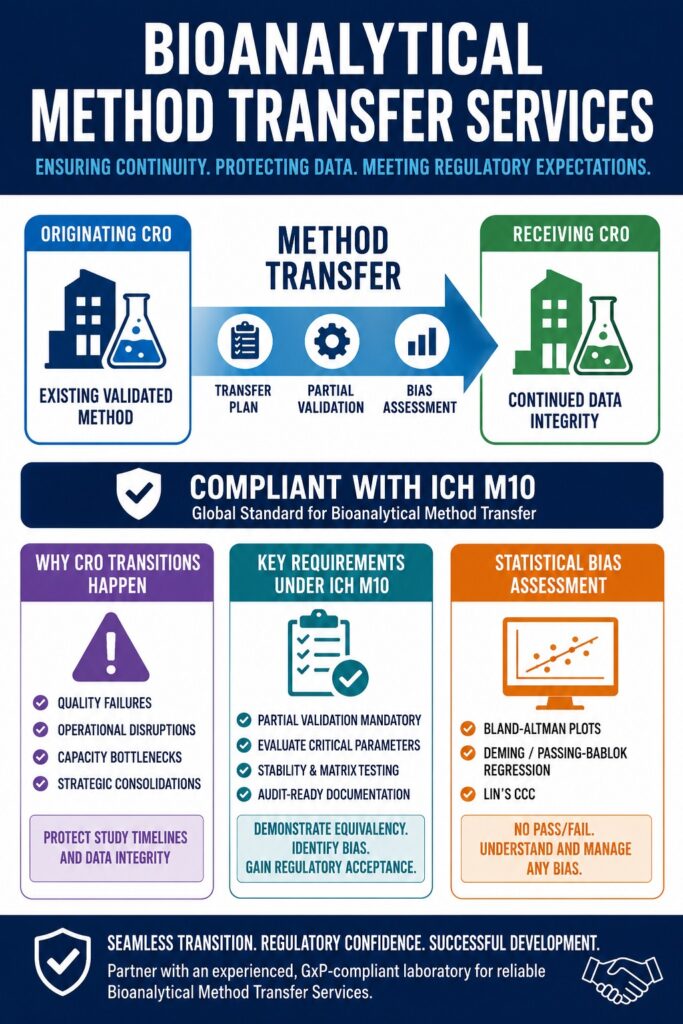
Mid-program transitions between CROs are commonly driven by major quality concerns, limitations in laboratory capacity, operational interruptions, or strategic business decisions that arise during clinical development. These transitions are undertaken to protect drug development programs from regulatory noncompliance, operational disruption, and potential data integrity issues. Clinical studies generate substantial volumes of biological samples that require efficient, high-throughput analytical processing. Even with comprehensive planning, unexpected circumstances can necessitate the rapid transfer of laboratory operations. The most common drivers generally fall into the technical and operational categories outlined below.
| Transition Trigger | Technical Indicator | Primary Operational Risk | Regulatory Impact |
|---|---|---|---|
| Quality Control & Assay Failures | Elevated out-of-specification (OOS) results, repeated calibration failures, or unsuccessful Incurred Sample Reanalysis (ISR). | Loss of analytical timelines and increased project costs. | Data integrity concerns and potential regulatory rejection. |
| Operational Disruptions | Unexpected facility shutdowns, instrument lifecycle limitations, or departure of essential personnel. | Complete interruption of sample processing and reporting activities. | Chain of custody concerns and compromised sample stability. |
| Capacity Bottlenecks | Expansion into later clinical phases resulting in sample volumes beyond CRO processing capabilities. | Analytical backlogs, inconsistent turnaround times, and reporting delays. | Delayed clinical milestones and postponed IND/ANDA submissions. |
| Strategic Consolidations | Mergers, acquisitions, licensing agreements, or organizational restructuring that relocate development programs. | Operational inefficiencies during laboratory transfer and vendor coordination challenges. | Requirement for extensive cross-validation before integrating clinical datasets. |
Ensure your program stays on track with our Bioanalytical Strategy for Drug Development.
Regulatory Mandates: Bioanalytical Method Transfer Services Under ICH M10
According to the harmonized ICH M10 guideline, Bioanalytical Method Transfer Services must demonstrate method equivalency and identify any potential analytical bias whenever validated assays are transferred between laboratories to ensure worldwide regulatory acceptance of generated data. This harmonized framework replaces previously fragmented regional guidance with a unified regulatory standard applicable to both nonclinical and clinical bioanalytical studies.
Review our guide on ICH M10 Bioanalytical Method Validation Guidelines to ensure compliance.
Officially adopted in May 2022 and globally implemented in January 2023, the ICH M10 guideline marked a major advancement in the international harmonization of regulated bioanalysis. It establishes comprehensive validation requirements for chromatographic techniques as well as ligand-binding assays, defining clear expectations for nonclinical toxicokinetic (TK) studies and every stage of clinical development, including comparative bioavailability and bioequivalence (BA/BE) studies. Under the provisions of ICH M10, transferring any validated analytical method between laboratories automatically necessitates a partial validation.
Explore the nuances of EMA vs. FDA Bioanalytical Method Validation Differences for your global regulatory strategy.
The guideline requires dedicated evaluation of critical validation characteristics to confirm that the receiving laboratory can reproduce method performance consistently and accurately. These assessments include verification of the lower limit of quantitation (LLOQ), analytical accuracy and precision across anticipated study runs, evaluation of matrix effects using multiple independent matrix lots, confirmation of dilution integrity, and comprehensive stability testing. Stability assessments should encompass bench-top storage, long-term storage, and multiple freeze-thaw cycles under conditions that accurately reflect actual clinical sample handling procedures. Every laboratory transition involving validated analytical methods must be supported by a fully traceable, audit-ready validation package capable of withstanding regulatory review by global agencies, including the FDA and Health Canada.
Bioanalytical Method Transfer Services vs. Cross-Validation: Key Distinctions
Bioanalytical Method Transfer Services are designed to demonstrate that a receiving laboratory can accurately reproduce and perform an existing validated analytical method, whereas cross-validation focuses on statistically comparing analytical results generated by different methods or laboratories. Understanding this distinction is critical because it determines whether data generated at multiple clinical sites can be legitimately integrated within regulatory submissions.
Method transfer primarily represents a validation and implementation exercise, while cross-validation is fundamentally a statistical comparison process. Whenever multiple laboratories or different analytical technologies—such as ligand-binding assays (LBA) and LC-MS/MS—generate data within the same development program, cross-validation becomes essential for demonstrating inter-laboratory consistency and analytical comparability. Unlike conventional method transfer procedures, cross-validation requires simultaneous analysis of quality control (QC) samples together with an appropriate number of incurred clinical study samples.
| Validation Parameter | Chromatographic Methods (LC-MS/MS) | Ligand-Binding Assays (LBA) | Transfer Considerations |
|---|---|---|---|
| Primary Platform | Mass spectrometry systems combined with chromatographic separation. | Microplate readers, Meso Scale Discovery (MSD), or ELISA platforms. | Consistent platform alignment between originating and receiving laboratories minimizes analytical bias. |
| Calibration Range | Wide dynamic range, generally spanning 3–4 orders of magnitude. | Narrower dynamic range, typically covering 2 orders of magnitude using sigmoidal curve fitting. | Calibration curve performance should be verified using identical biological matrices. |
| QC Levels | Minimum of four QC levels (LLOQ, Low, Mid, High) analyzed in replicate. | Minimum of five QC levels (LLOQ, Low, Mid, High, ULOQ) analyzed in replicate. | QC acceptance criteria should demonstrate equivalent performance across both laboratories. |
| Selectivity & Specificity | Evaluated using six independent matrix sources at the LLOQ. | Evaluated using ten independent matrix sources at the LLOQ and High QC levels. | Matrix effects and endogenous interferences should be minimized and adequately characterized. |
| Parallelism | Performed when appropriate for endogenous analytes. | Mandatory for endogenous analytes and complex biological products. | Essential for identifying matrix-related dilution bias within clinical samples. |
Understand the requirements for Incurred Sample Reanalysis (ISR) in Bioanalytical Studies to maintain data integrity.
Statistical Frameworks for Bias Assessment Post-ICH M10
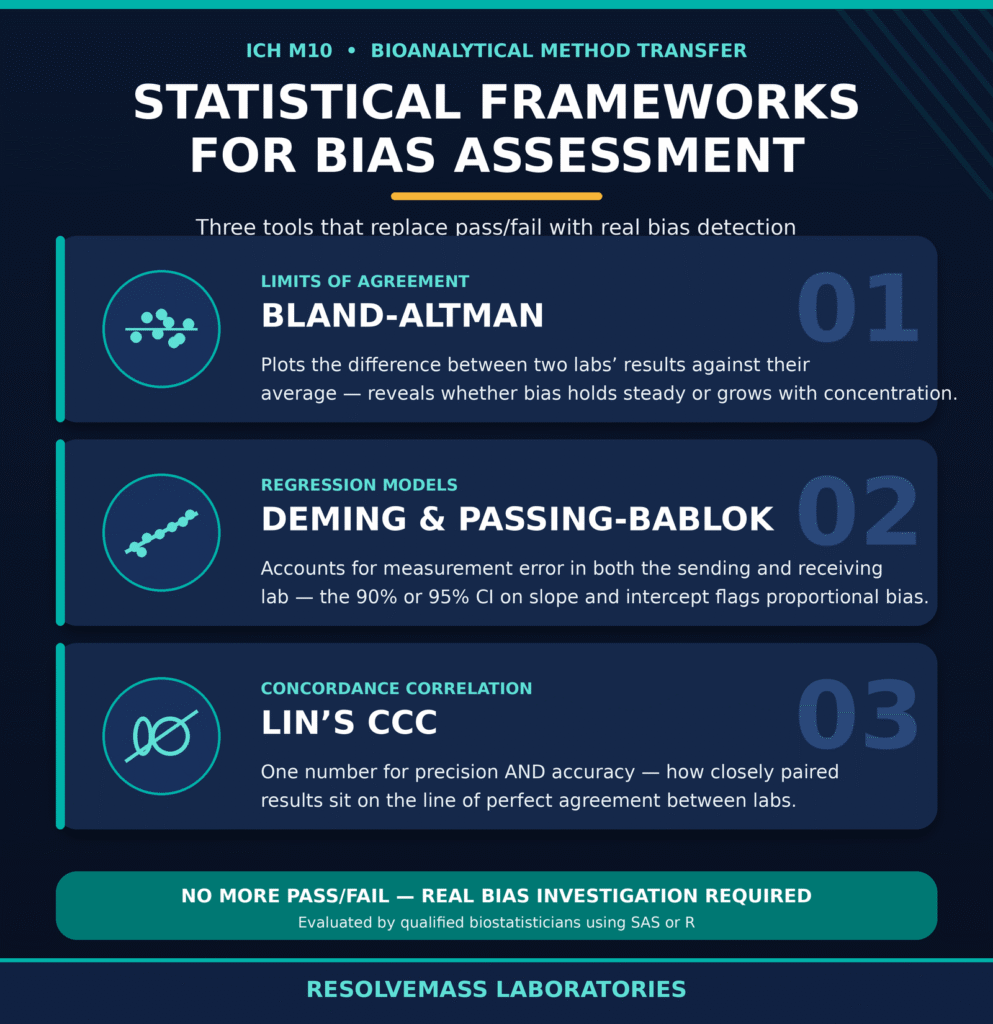
Following the implementation of ICH M10, statistical evaluation of inter-laboratory bias relies on analytical tools such as Bland-Altman plots, Deming regression, and Lin’s Concordance Correlation Coefficient (CCC) rather than relying solely on traditional pass/fail acceptance criteria. These sophisticated statistical techniques are intended to identify proportional bias, systematic differences, or concentration-dependent variability between analytical datasets generated by different laboratories.
The removal of rigid pass/fail criteria for cross-validation within the ICH M10 guideline represents a significant evolution in regulatory expectations for the bioanalytical community. Instead of applying a simple binary acceptance decision, regulatory authorities now expect a comprehensive investigation of any systematic bias observed between datasets, together with an assessment of its potential influence on pharmacokinetic (PK) calculations and dosing decisions. These statistical evaluations should be conducted by qualified biostatistical specialists using advanced analytical software such as SAS or R to ensure mathematical robustness and regulatory confidence.
The principal statistical approaches recommended under ICH M10 include the following:
- Bland-Altman Limits of Agreement: This approach compares paired analytical measurements by plotting their differences against their average values. It determines whether analytical bias remains consistent across the concentration range or whether heteroscedasticity exists, indicating that variability changes as analyte concentration increases.
- Deming and Passing-Bablok Regression: These regression models account for analytical measurement error originating from both the reference laboratory and the receiving laboratory, unlike conventional ordinary least squares (OLS) regression. Evaluation of the calculated 90% or 95% confidence intervals for the regression slope and intercept allows identification of proportional or constant analytical bias.
- Lin’s Concordance Correlation Coefficient (CCC): This statistical index simultaneously measures precision and accuracy by determining how closely paired analytical results align with the line of perfect agreement. Lower CCC values indicate meaningful differences in scale or location between the datasets generated by participating laboratories.
Overcoming Technical Hurdles in Complex Bioanalytical Transfers
Successfully overcoming technical challenges during bioanalytical method transfers requires careful management of platform-specific analytical differences, matrix-related effects, extraction recovery performance, and variability associated with critical reagent lots. Proactive method optimization combined with rigorous harmonization of standard operating procedures (SOPs) significantly reduces the likelihood of validation failures when analytical methods are transferred to a new laboratory facility.
The transfer of analytical methods for complex pharmaceutical products—including therapeutic proteins, synthetic peptides, monoclonal antibodies, and oligonucleotides—introduces substantial physicochemical and biophysical complexities. During Bioanalytical Method Transfer Services, the receiving laboratory must carefully optimize both sample extraction and detection conditions to match the unique physicochemical properties of the target molecule.
We offer specialized Oligonucleotide Bioanalytical Services to support your complex drug development needs.
For LC-MS/MS methods, even minor differences in high-performance liquid chromatography (HPLC) system configuration, column temperature, collision gas pressure, or mass spectrometry source architecture—such as differences between SCIEX Triple Quad and Waters Xevo platforms—can significantly influence ionization efficiency and increase matrix-related ion suppression. Therefore, harmonizing sample preparation procedures, including protein precipitation, solid-phase extraction (SPE), and liquid-liquid extraction (LLE), is essential to achieve consistent analyte recovery across both laboratories. For large-molecule ligand-binding assays, variability introduced by changes in critical reagent lots, including anti-idiotypic capture and detection antibodies, remains one of the most significant sources of analytical drift. The receiving laboratory should maintain complete documentation of reagent batch history, storage conditions, stability, and purity throughout each reagent’s lifecycle to preserve assay specificity and minimize risks such as the prozone or hook effect.
Learn about managing Matrix Effects in LC-MS/MS Bioanalysis to ensure accurate results.
Active Project Management and Financial Mitigations in Rescue Transfers
Effective project management during rescue transfers depends on well-defined quality agreements, continuous real-time data oversight, and digitized laboratory workflows that minimize transition timelines while reducing financial impact. When these best practices are implemented effectively, clinical study delays can be reduced by as much as 40%, enabling faster completion of analytical activities and more timely final study reporting.
Accelerate your timeline with our Bioanalytical Services for Rapid Proof of Concept.
Mid-study CRO transitions are inherently complex and high-risk operations that can lead to substantial schedule disruptions and increased project costs if they are not managed through disciplined operational planning. Establishing a comprehensive Quality Agreement before study initiation serves as the foundation of successful CRO project management. This agreement should clearly define regulatory compliance responsibilities, standardized procedures for Corrective and Preventive Action (CAPA) and deviation management, sponsor rights for reviewing electronic raw data and chromatograms, as well as detailed requirements for long-term data archiving and retention.
In addition, the adoption of digitized laboratory management systems substantially improves operational performance throughout the method transfer process. Modern digital platforms provide integrated workflows that combine study planning, sample tracking, analytical scheduling, and automated reporting within a unified environment. These digital ecosystems have been shown to reduce study cycle times by up to 55% while improving overall operational efficiency by approximately 20–30%. Through the use of electronic audit trails, automated barcode-based sample tracking, and continuous real-time monitoring of analytical runs, sponsors can preserve complete data integrity in accordance with 21 CFR Part 11 and ALCOA+ principles. As a result, all analytical data generated by the receiving laboratory remain fully traceable, secure, and inspection-ready for regulatory audits.
Conclusion
Successfully implementing Bioanalytical Method Transfer Services during a mid-program CRO transition requires the integration of clinical pharmacology expertise, advanced statistical evaluation, and rigorous GxP compliance to preserve the scientific credibility and regulatory defensibility of the development program. Engaging an experienced and highly qualified laboratory early in the transition process enables sponsors to maintain critical clinical timelines while safeguarding the integrity and reliability of analytical data.
Although mid-study CRO transitions represent technically demanding and highly regulated events, they can be managed effectively when supported by a structured methodology grounded in sound scientific principles and robust statistical assessment. By utilizing compliant Bioanalytical Method Transfer Services, pharmaceutical sponsors can confidently establish continuity between clinical and nonclinical datasets generated across multiple laboratories and analytical platforms. For organizations seeking to protect their development pipelines against quality deficiencies, operational disruptions, or laboratory capacity constraints, transferring validated analytical methods to a globally recognized and trusted laboratory represents a highly strategic decision.
Laboratories operating under Health Canada Drug Establishment Licences (DEL), FDA registrations, and comprehensive GxP and ISO quality management systems provide the high-quality, audit-ready analytical data required to support successful regulatory submissions and product approvals. Sponsors seeking specialized scientific guidance on customized method transfer strategies for either small-molecule or large-molecule therapeutic programs are encouraged to consult with the PhD-level scientific experts at the ResolveMass Contact Us page.
Frequently Asked Questions
Although both activities support data consistency, they serve different purposes. Bioanalytical method transfer verifies that a receiving laboratory can successfully perform an existing validated method, whereas cross-validation compares results generated by different laboratories or analytical methods to confirm data comparability. Method transfer primarily relies on validation samples, while cross-validation involves parallel testing of incurred study samples to assess agreement between datasets.
Under the ICH M10 guideline, cross-validation becomes necessary whenever bioanalytical data are generated by multiple laboratories or when different validated analytical methods contribute to the same regulatory submission. This commonly occurs during multi-center clinical trials, CRO transitions, or studies involving different analytical platforms. The objective is to demonstrate that results from different sources can be reliably interpreted together.
Several statistical approaches are used to evaluate agreement between laboratories during method transfer and cross-validation. Commonly applied tools include Bland-Altman plots, Deming regression, Passing-Bablok regression, and Lin’s Concordance Correlation Coefficient (CCC). These techniques help identify systematic, proportional, or concentration-dependent bias, providing a more comprehensive assessment than simple acceptance limits.
ICH M10 intentionally avoids prescribing fixed pass/fail acceptance criteria because each study may have different scientific objectives and clinical considerations. Instead, regulators encourage sponsors to evaluate any observed bias within the context of pharmacokinetic data, clinical relevance, and statistical analysis. This flexible approach allows scientifically justified decisions without unnecessarily rejecting otherwise reliable analytical data.
Mass spectrometry method transfers can be challenging because even small differences in instrumentation, chromatographic conditions, or sample preparation procedures may influence analytical performance. Factors such as platform-specific hardware, chromatography columns, matrix-induced ion suppression, and extraction efficiency can all affect assay reproducibility. Careful harmonization of SOPs, system suitability testing, and optimization studies help minimize these technical variations.
Managing reagent lot changes is essential for maintaining the reliability of ligand-binding assays during laboratory transfers. Laboratories should maintain detailed documentation covering reagent batch history, purity, storage conditions, stability, and qualification records throughout the reagent lifecycle. Whenever a significant reagent change occurs, partial validation is typically performed to verify that assay specificity, sensitivity, and selectivity remain consistent.
ICH M10 recommends evaluating at least 30 incurred clinical study samples, when available, during cross-validation to adequately assess agreement between laboratories. In addition, quality control samples representing low, mid, and high concentration levels should be analyzed in replicate at both laboratories. Selecting samples that span the full calibration range provides a reliable assessment of method comparability across clinically relevant concentrations.
A qualified bioanalytical CRO should operate in compliance with applicable GxP requirements, including GLP and GCP, while maintaining recognized quality certifications such as ISO 9001:2015. Registration or inspection by regulatory agencies such as the USFDA and Health Canada further demonstrates a laboratory’s commitment to quality and regulatory compliance. These credentials help ensure that generated data are reliable, traceable, and suitable for regulatory review.
Digitized laboratory workflows improve efficiency by integrating sample tracking, analytical scheduling, data capture, and reporting into a centralized electronic system. Features such as electronic audit trails, barcode-based sample management, and real-time monitoring reduce manual errors and improve operational visibility throughout the transfer process. These digital solutions also support compliance with 21 CFR Part 11 and ALCOA+ principles while helping laboratories shorten project timelines and accelerate study completion.
Reference:
- Deshpande, K., Hong, M., Ware, M., Li, M., & Dysinger, M. (2026). Managing the transition: Switching bioanalytical laboratories during a clinical trial – A sponsor’s perspective. Expert Opinion on Drug Metabolism & Toxicology, 17(24), 1769–1777. https://doi.org/10.1080/17576180.2026.2617265
- Fjording, M. S., Goodman, J., & Briscoe, C. (2025). Cross-validation of pharmacokinetic assays post-ICH M10 is not a pass/fail criterion. Bioanalysis, 17(1), 1–5. https://doi.org/10.1080/17576180.2024.2418284
- International Council for Harmonisation of Technical Requirements for Pharmaceuticals for Human Use. (2022). ICH guideline M10 on bioanalytical method validation and study sample analysis (Step 5). European Medicines Agency. https://www.ema.europa.eu/en/documents/scientific-guideline/ich-guideline-m10-bioanalytical-method-validation-step-5_en.pdf
- Yoneyama, T., Kudo, T., Jinno, F., Schmidt, E. R., & Kondo, T. (2014). Retrospective data analysis and proposal of a practical acceptance criterion for inter-laboratory cross-validation of bioanalytical methods using liquid chromatography/tandem mass spectrometry. The AAPS Journal, 16(6), 1226–1236. https://doi.org/10.1208/s12248-014-9653-0
- Gleason, C. R., Ji, Q. C., & Wickremsinhe, E. R. (2020). Evaluation of correlation between bioanalytical methods. Bioanalysis, 12(6), 419–426. https://doi.org/10.4155/bio-2020-0019
- International Council for Harmonisation of Technical Requirements for Pharmaceuticals for Human Use. (2023). ICH guideline M10 on bioanalytical method validation and study sample analysis – Frequently Asked Questions (FAQ). European Medicines Agency. https://www.ema.europa.eu/en/documents/scientific-guideline/ich-guideline-m10-bioanalytical-method-validation-and-study-sample-analysis-frequently-asked-questions-faq_en.pdf
Get In Touch With Us
About The Author


