

Introduction
Bioequivalence study design for complex generic drug products requires a comprehensive and integrated development strategy that combines precise qualitative/quantitative (Q1/Q2) deformulation, detailed physicochemical (Q3) characterization, and scientifically validated in vitro or in vivo testing protocols developed collaboratively by the sponsor and the Contract Development and Manufacturing Organization (CDMO). This coordinated approach helps ensure that Critical Quality Attributes (CQAs) are aligned with applicable Product-Specific Guidances (PSGs) while reducing the likelihood of regulatory delays and repeated assessment cycles.
Looking to streamline your regulatory submission package? Explore our comprehensive one-stop CDMO analytical services for ANDA filings to accelerate approval timelines.
Complex generic drug products—including topical semisolids, liposomal suspensions, polymeric microspheres, ophthalmic emulsions, transdermal drug delivery systems, and complex inhalation formulations—present significantly greater development challenges than conventional immediate-release oral solid dosage forms. Their clinical performance is often influenced by non-systemic mechanisms of action, intricate physical structures, critical excipient interactions, and manufacturing-dependent quality attributes that cannot be adequately assessed through conventional plasma concentration measurements alone. Consequently, regulatory agencies such as the U.S. Food and Drug Administration (FDA) and the European Medicines Agency (EMA) require specialized bioequivalence (BE) strategies that incorporate Q1 sameness, Q2 sameness, Q3 structural similarity, in vitro release and permeation assessments, and advanced pharmacokinetic (PK) or pharmacodynamic (PD) modeling approaches.
Developing complex eye drops or emulsions? Discover specialized CDMO services for generic ophthalmic drug products tailored to meet stringent regulatory expectations.
Successfully navigating these complex regulatory pathways requires strong scientific and operational collaboration between drug sponsors and CDMOs. Sponsors contribute therapeutic objectives, clinical development oversight, and commercialization strategies, while CDMOs provide advanced analytical capabilities, formulation expertise, process development knowledge, and regulatory testing support. When formulation development, bioanalytical testing, and clinical study planning are conducted independently without proper integration, the risk of unexpected bioequivalence failures, refuse-to-file actions, and prolonged review timelines increases substantially. By implementing joint governance structures, coordinated risk assessments, and harmonized bioequivalence strategies from the earliest stages of development, sponsors and CDMO partners such as ResolveMass Laboratories Inc. can proactively address formulation challenges, satisfy PSG expectations, and accelerate the pathway toward Abbreviated New Drug Application (ANDA) approval.
Share via:
Article Summary:
- Complex generic bioequivalence (BE) requires integrated planning between the sponsor and CDMO, combining formulation, analytical, manufacturing, and regulatory expertise.
- Q1/Q2/Q3 alignment is the foundation: Q1 confirms the same inactive ingredients, Q2 targets comparable concentrations, and Q3 evaluates physicochemical and structural similarity.
- Analytical deformulation using techniques such as HPLC, MS, NMR, TGA, and FTIR helps reverse-engineer the Reference Listed Drug (RLD) and establish formulation sameness.
- IVRT and IVPT can provide powerful in vitro evidence of comparable drug release and skin permeation, particularly for topical and locally acting complex products.
- When in vitro testing is insufficient, clinical PK/PD studies, local sampling, and PBPK modeling may be needed to demonstrate therapeutic equivalence.
- GDUFA III Pre-ANDA pathways, including PDEV meetings, PSUB meetings, and Controlled Correspondence, enable early FDA feedback and help reduce regulatory uncertainty.
- A joint Quality by Design (QbD) and risk-management strategy helps control manufacturing variability, protect CQAs, strengthen the BE package, and accelerate the path toward ANDA approval.
Core Pillars of Bioequivalence Study Design for Complex Generic Drug Products: Q1, Q2, and Q3 Alignment
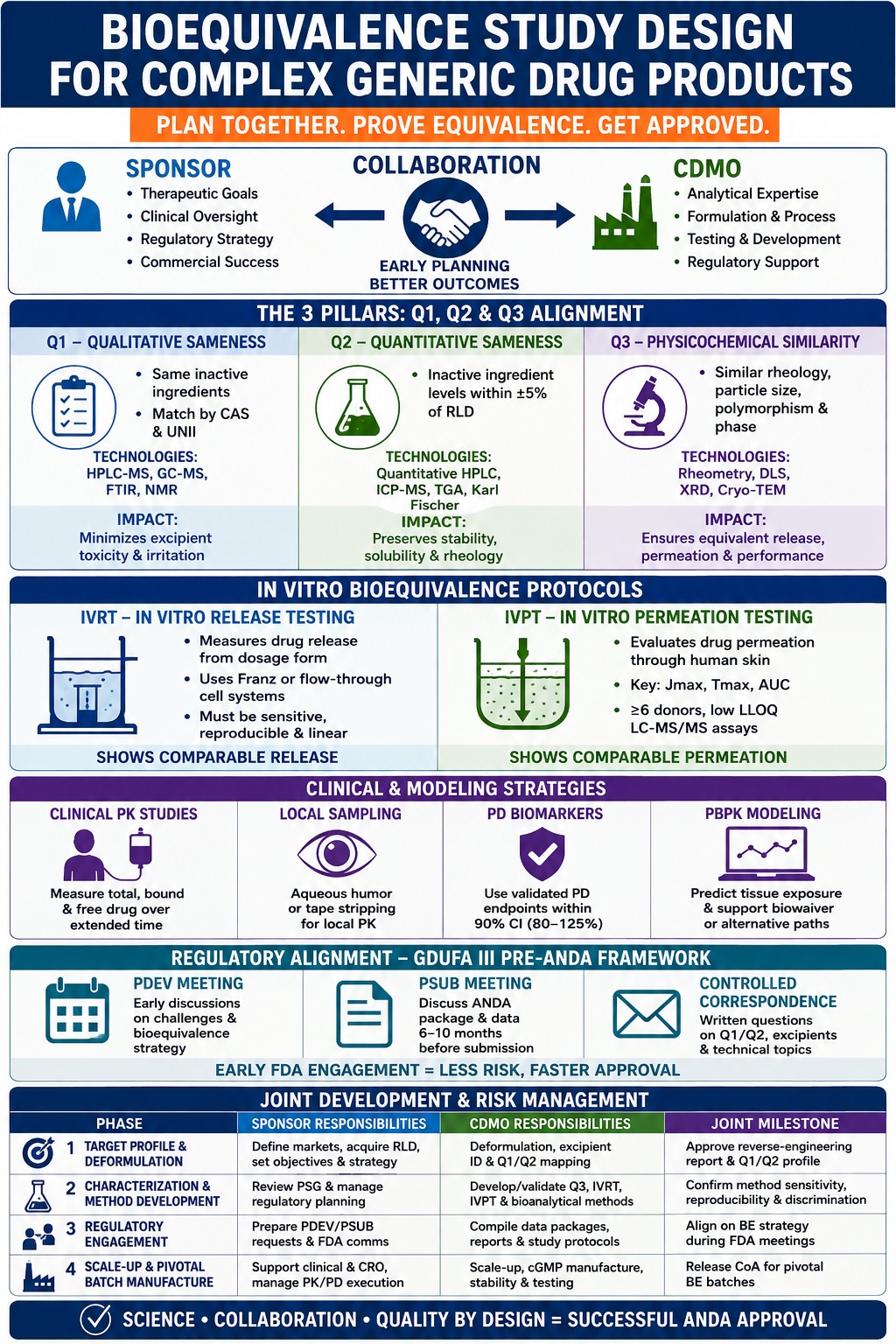
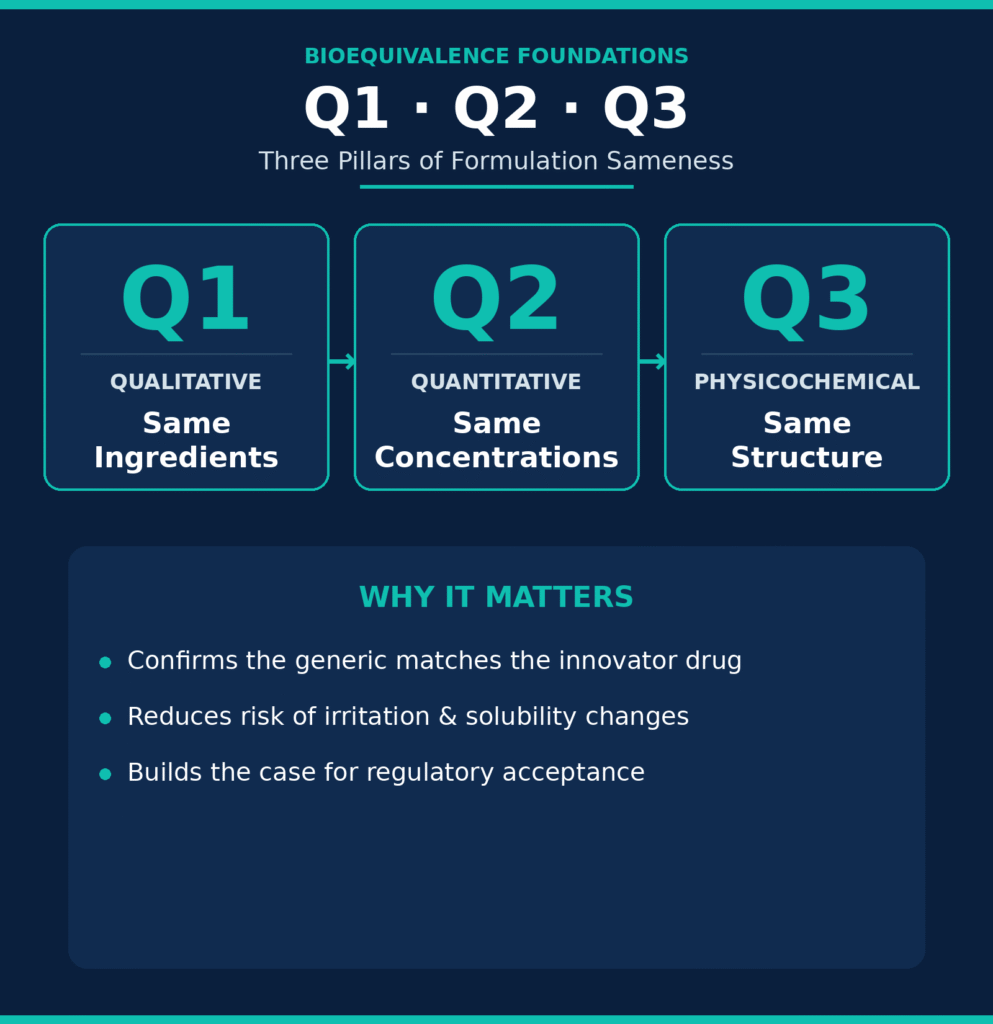
An effective bioequivalence study design for complex generic drug products begins with the establishment of qualitative (Q1) sameness, quantitative (Q2) sameness, and physicochemical (Q3) similarity relative to the Reference Listed Drug (RLD). These three foundational elements reduce the risk of performance-related failures and create the scientific basis necessary for regulatory acceptance, biowaiver justification, and in vitro equivalence demonstrations.
For many complex dosage forms—including parenteral suspensions, ophthalmic products, otic formulations, and topical semisolids—regulatory agencies require strict adherence to both Q1 and Q2 criteria. Qualitative sameness (Q1) confirms that the generic product contains the same inactive ingredients as the RLD, verified through Unique Ingredient Identifiers (UNII) and recognized compendial classifications. Quantitative sameness (Q2) requires that the concentration of each inactive ingredient remains within a narrow tolerance range, typically defined as ±5% of the concentration present in the RLD. Achieving Q1/Q2 sameness is essential for minimizing safety and performance risks, including tissue irritation, changes in active pharmaceutical ingredient (API) solubility, altered formulation behavior, and excipient-related stability concerns.
Complex APIs like GLP-1 analogues require specialized structural validation. Learn more about GLP-1 peptide analytical characterization and testing methodologies.
Analytical Deformulation and Physicochemical (Q3) Characterization
Analytical deformulation serves as the foundation for reverse-engineering the RLD formulation and confirming the identity and composition of inactive ingredients. Q3 characterization then evaluates whether the physical microstructure, rheological properties, and thermodynamic characteristics of the generic product are comparable to those of the innovator product. Together, these studies help ensure that manufacturing-related variations do not negatively influence API release, permeation, or overall therapeutic performance.
Deformulation of complex drug products requires the application of advanced analytical technologies, including high-performance liquid chromatography (HPLC), nuclear magnetic resonance (NMR) spectroscopy, mass spectrometry (MS), and thermogravimetric analysis (TGA). Formulations containing polymers with varying molecular weights, high moisture content, emulsified systems, or cross-linked excipient networks often present significant analytical complexities that require carefully developed and validated separation and characterization methods.
Interested in real-world application? Read our peptide characterization case study of semaglutide to see analytical deformulation and Q3 characterization in action.
Following confirmation of Q1 and Q2 sameness, Q3 characterization focuses on evaluating whether the physical arrangement and structural attributes of the generic formulation closely resemble those of the innovator product. Differences in crystal morphology, polymorphic form, particle or globule size distribution, viscosity, yield stress, or glass transition temperature can significantly influence drug release behavior and local bioavailability, even when Q1 and Q2 requirements have been successfully met.
| Equivalence Dimension | Target Criteria | Key Analytical Technologies | Regulatory & Functional Impact |
|---|---|---|---|
| Q1 (Qualitative Sameness) | Identical inactive ingredients matched through CAS and UNII identifiers. | HPLC-MS, GC-MS, FTIR, NMR spectroscopy. | Minimizes risks associated with excipient incompatibility, toxicity, and local tissue irritation. |
| Q2 (Quantitative Sameness) | Inactive ingredient concentrations maintained within ±5% of the RLD. | Quantitative HPLC, ICP-MS, TGA, Karl Fischer titration. | Preserves formulation stability, solubility characteristics, and rheological behavior. |
| Q3 (Physicochemical Similarity) | Comparable rheology, particle size distribution, polymorphism, and phase characteristics. | Rheometry, Dynamic Light Scattering (DLS), XRD, Cryo-TEM. | Supports equivalent drug release, tissue penetration, and thermodynamic performance. |
Need tailored solutions for complex therapeutics? Discover how partnering with a peptide drug development CDMO can streamline your early-to-late stage formulation strategies.
In Vitro Bioequivalence Protocols: IVRT, IVPT, and Discriminating Assays
In vitro bioequivalence study design for complex generic drug products frequently relies on In Vitro Release Testing (IVRT) and In Vitro Permeation Testing (IVPT) to establish comparable drug release and permeation behavior without requiring extensive clinical endpoint studies. Sponsors and CDMOs must collaboratively develop highly sensitive and discriminating analytical methods capable of identifying even minor formulation or manufacturing differences.
For topical semisolid products and other locally acting formulations, traditional systemic pharmacokinetic studies often provide limited value because systemic drug exposure may be minimal or undetectable. As a result, regulatory authorities such as the FDA and EMA increasingly recognize validated in vitro methodologies as meaningful surrogates for demonstrating bioequivalence. IVRT evaluates the rate and extent of API release from a dosage form into a receptor medium across a synthetic membrane using Franz diffusion cells or flow-through cell systems. To be considered suitable for regulatory use, an IVRT method must demonstrate strong reproducibility, sensitivity, and consistent linear release characteristics throughout the study duration.
In Vitro Permeation Testing (IVPT) Method Development and Validation
IVPT evaluates the movement of a drug across human skin using vertical diffusion cell systems and serves as a scientifically relevant surrogate for local tissue bioavailability in topical generic product development. Successful validation requires careful donor selection, verification of stratum corneum integrity, and highly sensitive LC-MS/MS bioanalytical methods capable of detecting extremely low drug concentrations.
Unlike IVRT, which employs synthetic membranes, IVPT utilizes human dermatomed skin to more accurately replicate the barrier properties and absorption characteristics of human skin. Key performance parameters include total cumulative permeated drug mass (Jmax), time required to achieve steady-state flux (Tmax), and area under the flux curve (AUC).
Sponsors and CDMOs must carefully design IVPT studies to minimize variability associated with human skin samples. Standard study designs typically require multiple replicate measurements from each donor and the inclusion of at least six individual donors. Additionally, the LC-MS/MS methods used to quantify drug concentrations in receptor fluids must achieve extremely low lower limits of quantitation (LLOQ) because drug permeation levels often occur in the sub-nanogram range. To demonstrate assay discrimination capability, studies commonly evaluate intentionally modified formulations, such as non-Q1/Q2 variants or products manufactured under altered processing conditions, ensuring that the analytical method can reliably detect meaningful performance differences.
Clinical, Pharmacokinetic, and Modeling Strategies for Complex Generics
When in vitro approaches are insufficient to establish bioequivalence, complex generic drug products may require clinical pharmacokinetic (PK) studies, localized tissue sampling strategies, pharmacodynamic (PD) biomarker evaluations, or physiologically based pharmacokinetic (PBPK) modeling. Early coordination between sponsors and CDMOs is critical to ensure that clinical study materials accurately represent the intended commercial manufacturing process.
Certain categories of complex generic products—including long-acting injectable microspheres such as PLGA-based systems, liposomal formulations, and complex inhalation products—often require clinical PK studies to establish therapeutic equivalence. For systemic injectable products, bioequivalence assessments generally involve the measurement of total drug, protein-bound drug, and unencapsulated free drug concentrations over extended sampling periods. For locally acting products where systemic exposure does not adequately reflect drug concentrations at the site of action, alternative clinical approaches may be necessary:
- Local Pharmacokinetic Sampling: Direct assessment of drug concentrations at the therapeutic target site, such as aqueous humor sampling for ophthalmic products or stratum corneum tape stripping techniques for dermatological formulations.
- Pharmacodynamic (PD) Biomarker Assays: Utilization of validated PD endpoints, including vasoconstrictor skin blanching studies for topical corticosteroids, to establish equivalent pharmacological responses within accepted 90% confidence intervals (80.00%–125.00%).
- PBPK and Virtual Bioequivalence Modeling: Application of computational models and virtual clinical simulations to predict tissue exposure, evaluate formulation performance, investigate boundary conditions, and support alternative bioequivalence pathways or biowaiver requests within FDA scientific review frameworks.
Are you developing stable parenteral systems? Explore key considerations for formulating a lyophilized peptide injectable to optimize drug stability and shelf life.
Regulatory Alignment via the GDUFA III Pre-ANDA Framework
The GDUFA III Pre-ANDA meeting framework provides sponsors and CDMOs with structured opportunities to engage directly with the FDA, validate proposed bioequivalence strategies, and resolve scientific uncertainties before formal submission. Strategic use of Product Development (PDEV) and Pre-Submission (PSUB) meetings can substantially reduce review delays and lower the risk of refuse-to-file outcomes.
Through the Generic Drug User Fee Amendments (GDUFA III), the FDA expanded and strengthened the Pre-ANDA program to better support the development of complex generic products. Companies pursuing generic versions of complex drug products can utilize several formal communication pathways to obtain agency feedback before submitting an ANDA:
- Product Development (PDEV) Meetings: Early-stage scientific discussions intended to address complex development challenges, novel bioequivalence methodologies, or alternative study approaches when existing Product-Specific Guidance is unavailable or when sponsors propose alternative strategies.
- Pre-Submission (PSUB) Meetings: Enhanced under GDUFA III, these meetings provide sponsors with an opportunity to discuss the planned structure of the ANDA package, review supporting data, and address scientific concerns approximately 6 to 10 months before submission.
- Controlled Correspondence: A formal written communication pathway used to obtain clarification on Q1/Q2 assessments, excipient requirements, regulatory expectations, or other technical questions, typically within established FDA response timelines.
The CDMO contributes significantly to these regulatory interactions. Supporting documentation submitted for PDEV and PSUB meetings typically includes extensive analytical characterization data, manufacturing records, stability results, and validated IVRT/IVPT methodologies—much of which is generated by the CDMO. Joint participation in FDA discussions helps ensure that both formulation science and clinical development strategies are clearly communicated and appropriately defended.
Understanding molecule classification is key to establishing appropriate regulatory testing. Check out our detailed guide on the difference between a peptide and a small molecule drug.
Joint Operational Risk Management: Sponsor and CDMO Decision Matrix
Effective operational risk management requires clearly defined responsibilities between sponsors and CDMOs for analytical development, manufacturing operations, and regulatory compliance activities. A collaborative governance structure helps ensure that Critical Process Parameters (CPPs) remain controlled during scale-up and that bioequivalence outcomes are not compromised by manufacturing variability.
Complex formulations are highly sensitive to manufacturing conditions. In liposomal and polymeric microsphere systems, even small changes in mixing intensity, cooling rates, solvent removal conditions, or nozzle dimensions can affect encapsulation efficiency, particle size distribution, and polymer architecture. Likewise, variability in raw material attributes—including PLGA lactide-to-glycolide ratios, inherent viscosity specifications, and lipid purity profiles—can significantly influence drug release behavior and in vivo performance.
To effectively manage these risks, sponsors and CDMOs should establish a Quality by Design (QbD)-based risk management framework. Such a framework includes stringent raw material specifications, pilot-scale process evaluations, stress-testing studies, and cross-validation of analytical methods before engineering and clinical batch production begins.
Preparing to transition from lab to commercial scale? Learn about key technical strategies for peptide API scale-up to preserve quality attributes at larger batch sizes.
| Development Phase | Sponsor Responsibilities | CDMO Responsibilities | Joint Alignment Milestone |
|---|---|---|---|
| Phase 1: Target Product Profile & Deformulation | Define target markets, acquire the RLD, and establish commercial objectives and regulatory strategy. | Conduct deformulation studies, excipient characterization, and Q1/Q2 mapping. | Approval of the reverse-engineering report and target Q1/Q2 formulation profile. |
| Phase 2: Characterization & In Vitro Method Development | Review PSG recommendations and manage regulatory communication planning. | Develop and validate Q3 characterization methods, IVRT procedures, and IVPT bioanalytical assays. | Confirmation of method sensitivity, reproducibility, and discriminatory capability. |
| Phase 3: Regulatory Engagement (Pre-ANDA) | Prepare PDEV/PSUB meeting requests and manage FDA communications. | Compile technical data packages, analytical reports, and study protocols. | Alignment on the proposed bioequivalence strategy during FDA interactions. |
| Phase 4: Scale-Up & Pivotal Batch Manufacture | Support clinical studies, oversee CRO activities, and manage PK/PD execution. | Perform scale-up activities, manufacture engineering and pivotal batches under cGMP, and conduct stability studies. | Release of Certificate of Analysis documentation for pivotal bioequivalence batches. |
Conclusion: Bioequivalence Study Design for Complex Generic Drug Products
The successful execution of a bioequivalence study design for complex generic drug products depends on early and continuous alignment between sponsors and CDMOs across Q1/Q2/Q3 characterization, validated in vitro testing, and proactive regulatory engagement. Addressing scientific and manufacturing challenges through a collaborative Quality by Design (QbD) approach enables more efficient ANDA development and supports accelerated market entry.
As the global market for complex generic products continues to expand, regulatory agencies increasingly expect robust, science-driven evidence demonstrating therapeutic equivalence while avoiding unnecessary clinical burdens. By replacing empirical development approaches with systematic QbD methodologies, comprehensive analytical deformulation strategies, and validated in vitro surrogate methods such as IVRT and IVPT, pharmaceutical developers can reduce development risk, improve regulatory confidence, and shorten approval timelines.
ResolveMass Laboratories Inc. serves as a trusted scientific partner for complex generic drug characterization, deformulation, and bioequivalence study support. Through advanced analytical technologies and extensive expertise in Q1/Q2/Q3 characterization, IVRT/IVPT method development, and regulatory strategy, ResolveMass Laboratories Inc. helps sponsors and manufacturing organizations successfully navigate the complexities of generic drug development.
Ready to take your complex generic product to market? Read why top pharma companies choose to outsource peptide manufacturing to CDMO partners for end-to-end expertise.
To learn how ResolveMass Laboratories Inc. can support your complex generic drug development program and strengthen your bioequivalence study strategy, visit the ResolveMass Laboratories Inc. contact page.
Frequently Asked Questions (FAQs)
Q1/Q2 sameness is a foundational regulatory requirement for many complex generic products because it ensures that the generic formulation closely matches the Reference Listed Drug (RLD) in composition. Q1 sameness confirms the presence of the same inactive ingredients, while Q2 sameness verifies that these ingredients are present at comparable concentrations. Achieving this level of similarity helps minimize formulation-related differences that could affect drug release, stability, safety, or therapeutic performance.
Physicochemical (Q3) similarity focuses on matching the structural and functional characteristics of a generic product to those of the innovator product. Parameters such as particle size distribution, viscosity, rheological behavior, polymorphic form, and microstructure can directly influence drug release and absorption. Maintaining Q3 similarity reduces the risk that manufacturing differences will alter product performance and compromise bioequivalence outcomes.
In Vitro Release Testing (IVRT) is used to evaluate the rate and extent of drug release from a formulation under controlled laboratory conditions. The method helps determine whether a generic product exhibits release characteristics comparable to the reference product. Because IVRT is highly sensitive to formulation and manufacturing changes, it serves as an important tool for product development, quality control, and bioequivalence assessment.
In Vitro Permeation Testing (IVPT) measures the movement of a drug through human skin using diffusion cell systems and provides valuable information about local drug delivery. By assessing parameters such as drug flux and cumulative permeation, IVPT can predict how a topical product behaves at the site of action. When properly validated and conducted using multiple skin donors, IVPT may support bioequivalence demonstrations without the need for extensive clinical endpoint studies.
The GDUFA III Pre-ANDA Program provides several opportunities for sponsors to interact with the FDA during complex generic development. Product Development (PDEV) meetings are designed to address scientific challenges and discuss proposed bioequivalence approaches early in development. Pre-Submission (PSUB) meetings focus on reviewing submission readiness and data packages before filing, while Controlled Correspondence offers a formal mechanism for obtaining answers to specific technical or regulatory questions.
Establishing bioequivalence for liposomal injectable products requires a comprehensive assessment of both formulation characteristics and pharmacokinetic behavior. Regulatory evaluations often include measuring total drug concentrations, encapsulated drug levels, and free drug fractions in systemic circulation. Additional characterization of liposome size, morphology, lipid composition, and encapsulation efficiency is necessary to demonstrate comparable in vivo performance.
Bioanalytical methods used in IVPT studies must be capable of accurately measuring very low drug concentrations because permeation levels are often minimal. Validation typically includes assessments of selectivity, sensitivity, accuracy, precision, recovery, matrix effects, and sample stability. Demonstrating reliable performance across these parameters ensures that the generated permeation data are scientifically robust and suitable for regulatory submissions.
Physiologically Based Pharmacokinetic (PBPK) modeling integrates physiological, biochemical, and formulation-specific data to simulate drug absorption, distribution, metabolism, and elimination. These models help predict product performance under various clinical scenarios and can be used to evaluate bioequivalence virtually. Regulatory agencies increasingly recognize PBPK modeling as a valuable tool for supporting formulation development, optimizing study designs, and justifying alternative regulatory pathways.
Controlled Correspondence provides a structured pathway for obtaining FDA feedback on specific scientific or regulatory questions related to generic drug development. Under GDUFA III performance goals, standard requests generally receive responses within 60 calendar days, while more complex inquiries may require up to 120 calendar days. If clarification of a previous response is needed, follow-up requests are typically addressed within a shorter review timeframe.
Reference:
- U.S. Food and Drug Administration. (n.d.). GDUFA III enhancements to the pre-ANDA program. U.S. Department of Health and Human Services. https://www.fda.gov/industry/generic-drug-user-fee-amendments/gdufa-iii-enhancements-pre-anda-program
- European Medicines Agency. (n.d.). Product-specific bioequivalence guidance. https://www.ema.europa.eu/en/human-regulatory-overview/research-development/scientific-guidelines/clinical-pharmacology-pharmacokinetics-guidelines/product-specific-bioequivalence-guidance
- European Medicines Agency. (n.d.). Quality and equivalence of locally applied, locally acting cutaneous products. https://www.ema.europa.eu/en/quality-equivalence-locally-applied-locally-acting-cutaneous-products-scientific-guideline
- U.S. Food and Drug Administration. (2023). Bioequivalence studies with pharmacokinetic endpoints for drugs submitted under an ANDA: Guidance for industry. U.S. Department of Health and Human Services. https://www.fda.gov/media/168921/download
- European Medicines Agency. (n.d.). Liposomal amphotericin B: Product-specific bioequivalence guidance. https://www.ema.europa.eu/en/liposomal-amphotericin-b-product-specific-bioequivalence-guidance
- U.S. Food and Drug Administration. (n.d.). ANDA assessment program: GDUFA III performance goals and program enhancements. U.S. Department of Health and Human Services. https://www.fda.gov/industry/generic-drug-user-fee-amendments/anda-assessment-program-gdufa-iii-performance-goals-and-program-enhancements
- European Medicines Agency. (n.d.). Pegylated liposomal doxorubicin hydrochloride: Product-specific bioequivalence guidance. https://www.ema.europa.eu/en/pegylated-liposomal-doxorubicin-hydrochloride-product-specific-bioequivalence-guidance
Get In Touch With Us
About The Author


