
Introduction
Biologics CDMO Services cover the complete range of activities required to develop, manufacture, and release large-molecule therapeutics under current Good Manufacturing Practice (cGMP) conditions. These activities include cell line engineering, upstream and downstream bioprocessing, aseptic drug product fill-finish, and orthogonal analytical characterization. Together, they support the progression of biologic therapeutics from initial DNA transfection through commercial manufacturing and final cGMP batch release.
Unlike conventional small-molecule drugs, biologics—including monoclonal antibodies (mAbs), bispecific constructs, antibody-drug conjugates (ADCs), and biosimilars—are produced using living biological systems. Their quality and performance are closely linked to the manufacturing process. Even relatively small changes in cell substrate genetics, bioreactor hydrodynamics, purification chromatography, or container closure systems can influence glycosylation patterns, charge heterogeneity, aggregation, and potential clinical immunogenicity. Consequently, coordinating Chemistry, Manufacturing, and Controls (CMC) activities through a unified Pharmaceutical Quality System is critical for minimizing clinical holds, comparability failures, and Complete Response Letters during submissions to the US FDA, European Medicines Agency (EMA), and Health Canada.
The selection and management of a contract development and manufacturing organization (CDMO) have a direct impact on Cost of Goods (CoG), regulatory timelines, and supply chain reliability throughout a biologic product’s lifecycle. Drawing on the scientific and regulatory expertise of ResolveMass Laboratories Inc., a CRO and CDMO based in Laval, Québec, this guide explores the technical considerations, regulatory expectations, technology transfer challenges, and commercial contracting arrangements involved in successful biologics outsourcing. The organization operates under an ISO 9001:2015 Quality Management System and maintains a Health Canada Drug Establishment Licence (DEL), FDA registration, and compliance with GLP, GCP, and ISO 17025 standards.
Share via:
Quick Summary:
- Process is product. Biologics are made in living systems, so small changes in cell substrate, bioreactor conditions, purification or container closure can shift glycosylation, charge variants, aggregation and immunogenicity — which is why CMC has to run through one quality system to avoid holds, comparability failures and CRLs.
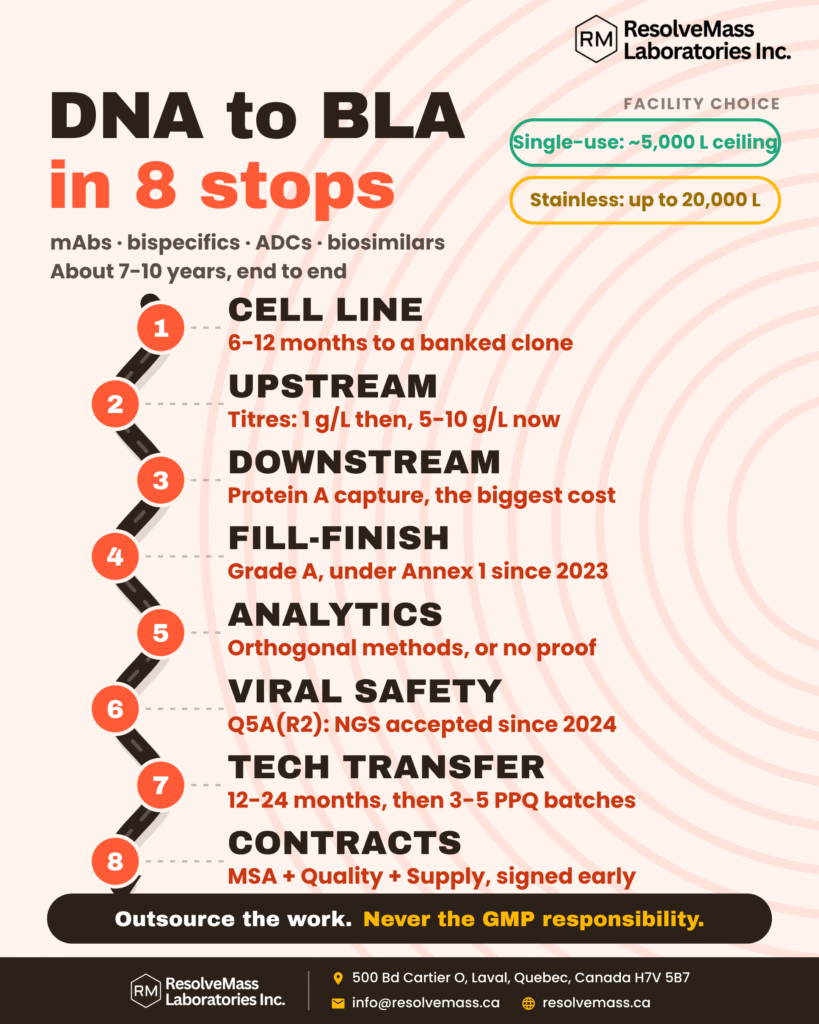
- Drug substance is five linked steps. Cell line development and two-tier banking (6–12 months conventionally, ICH Q5B/Q5D clonality and 60-generation stability), upstream expansion, harvest, multistep purification and UF/DF. Fed-batch runs 10–14 days at 15–25M cells/mL; perfusion and N-1 intensification push densities and titres far higher, but only if media handling and downstream capacity keep up.
- Downstream is the cost and complexity centre. Protein A remains the biggest single purification expense, and titres rising from ~1 g/L to 5–10 g/L have loaded harvests with HCPs, DNA and aggregates. Bispecifics add mispairing and homodimers (needing chain-ratio work, selective affinity capture and intact MS); ADCs add HPAPI containment, DAR control and HIC polishing.
- Facility choice is an economics decision, not a preference. Single-use suites build in 18–24 months with lower CapEx; stainless takes 36–60 months but wins on per-batch cost at sustained high volume, with the crossover usually quoted around 2,000–5,000 L and 100–200 batches a year. Hybrid single-use upstream plus stainless downstream is increasingly common.
- Sterile fill-finish is governed by Annex 1. Biologics can’t be terminally sterilised, so Grade A aseptic filling applies, with a facility-wide contamination control strategy, barrier technology, PUPSIT for sterilising filters, and lyophilisation controls including thermal characterisation and container closure integrity testing.
- Submissions fail on analytics, not titre. Regulators look for orthogonal characterisation, validated potency assays and ICH Q5E comparability packages; ICH Q5A(R2) (EU-effective June 2024) now accepts validated NGS in place of certain in vivo adventitious agent tests. Regional licensing — FDA registration, Health Canada DEL, EU GMP alignment — decides which sites may actually release batches.
- Transfer early, contract carefully. Technology transfer runs 12–24 months across six phases, with potency assay transfer alone taking 6–12 months and PPQ needing three to five consecutive batches; deciding on a commercial partner only after Phase III can add a year to BLA filing. Qualify partners 12–18 months before first GMP batch, keep MSA, quality and supply agreements separate, audit inspection history and data integrity — and remember cGMP responsibility never transfers to the CDMO.
End-to-End Biologics CDMO Services: Cell Line Development to Commercial Drug Substance
Comprehensive Biologics CDMO Services integrate five closely connected drug substance manufacturing activities: cell line development and banking, upstream bioreactor expansion, harvest clarification, multistep downstream purification, and ultrafiltration/diafiltration (UF/DF). These operations must be carefully coordinated to ensure that improvements in upstream productivity do not introduce purification difficulties or quality-related limitations during downstream processing. A lack of alignment between these manufacturing stages can result in reduced yields, process inefficiencies, and expensive comparability bridging studies during scale-up.
Cell Line Engineering, Clone Screening, and ICH Q5D Banking
Cell line development establishes the biological starting point for every subsequent GMP manufacturing batch. Conventional development programs generally require approximately 6 to 12 months, although accelerated approaches using transposase technology and optofluidic screening platforms can reduce the timeline to approximately 5 to 7 months.
Chinese Hamster Ovary (CHO) cell lines, particularly CHO-K1, CHO-S, and glutamine synthetase (GS) knockout hosts, remain the primary mammalian expression systems used in commercial biologics manufacturing. Their widespread adoption is supported by extensive regulatory experience and reliable performance under suspension culture conditions. When compared with dihydrofolate reductase (DHFR) amplification systems, GS selection using methionine sulfoximine (MSX) provides greater selection stringency and can reduce the number of amplification steps required. With optimized modern mAb expression platforms, clonal titers can reach approximately 5 to 10+ g/L, with certain vendor-reported intensified CHO-K1 processes achieving titers as high as 11 g/L.
For products where human-authentic post-translational modifications are particularly important, developers may choose HEK293 expression systems, although these hosts generally demonstrate greater variability in clonal expression. Expression specialists indicate that HEK293 development programs commonly begin with the screening of 200 to 400 or more clones. This is typically followed by 2 to 4 weeks of suspension adaptation and stability assessment across 30 to 60 passages to identify potential promoter silencing or integration-site-related expression changes.
Regardless of the mammalian expression system selected, ICH Q5B and ICH Q5D establish important expectations for cell substrate characterization and qualification. These include evidence of single-cell clonality, generally established through automated imaging and statistical probability assessments, together with genetic and expression stability studies conducted across 60 or more generations. Following successful characterization, manufacturers establish a two-tier cell banking system consisting of a cGMP Master Cell Bank (MCB), commonly containing approximately 50 vials in commercial CDMO configurations, and a Working Cell Bank (WCB), which generally contains around 200 vials. These banks provide the controlled biological starting material required for consistent future manufacturing operations.
Upstream Intensification: Fed-Batch vs. Perfusion Bioreactors
Upstream processing begins with the expansion of a thawed WCB vial through a controlled seed train before transfer into production bioreactors. Depending on the manufacturing strategy, these vessels may operate through fed-batch, perfusion, or hybrid N-1 intensified processes. The selected approach must balance volumetric productivity, manufacturing efficiency, and operational complexity.
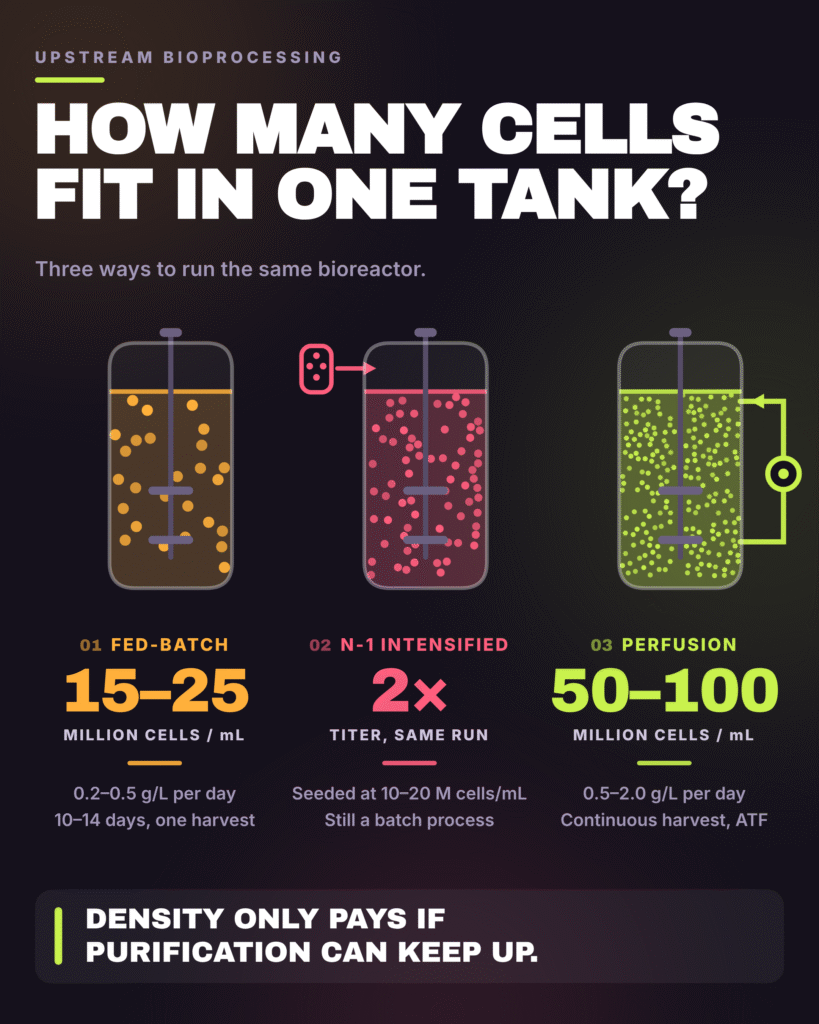
Conventional fed-batch manufacturing typically involves production runs lasting approximately 10 to 14 days. During this period, viable cell densities generally reach 15 to 25 million cells/mL, while volumetric productivities range from 0.2 to 0.5 g/L/day before a single terminal harvest. Perfusion processing follows a different approach by continuously replacing spent culture media while retaining cells within the bioreactor through alternating tangential-flow filtration (ATF). According to a 2025 literature review referenced in industry analyses, perfusion systems can achieve cell densities of approximately 50 to 100 million cells/mL and volumetric productivities ranging from 0.5 to 2.0 g/L/day.
To combine the advantages of both manufacturing strategies, many CDMOs use N-1 perfusion seeding before initiating conventional fed-batch production. This approach allows production vessels to receive cells at exceptionally high densities without requiring early-stage manufacturing facilities to undergo complete continuous GMP process validation. Published bioprocess research indicates that N-1 perfusion seeding, with cell densities reaching approximately 100 million cells/mL, can nearly double titers in a 14-day fed-batch process.
Additionally, vendor-modeled concentrated fed-batch (CFB) strategies have demonstrated potential yield improvements of approximately 3- to 5-fold while retaining a batch-based manufacturing framework. However, successful implementation depends on whether the manufacturing facility has sufficient media preparation and handling capacity to accommodate the increased nutrient requirements associated with intensified cell culture operations.
For a related perspective on process optimization and manufacturing expansion in peptide production, see peptide CDMO scale-up services.
Downstream Purification Architecture and Complex Modality Workflows
Downstream purification is one of the most significant contributors to biologics manufacturing expenses. Industry analyses estimate that purification accounts for approximately 60% to 80% of total biomanufacturing costs. In contrast, vendor-modeled intensified large-scale facilities estimate this contribution at approximately 50%, with Protein A affinity resin continuing to represent the largest individual purification expense.
As upstream manufacturing titers have increased from approximately 1 g/L in the early 2000s to around 5 to 10 g/L in contemporary processes, harvest streams have become increasingly concentrated in host-cell proteins (HCPs), residual DNA, and aggregates. These changes create additional demands on column loading capacity, process viscosity management, and purification resin performance.
For conventional IgG mAbs, an established downstream purification sequence generally includes centrifugation or depth filtration, Protein A capture, low-pH or detergent-based viral inactivation, cation-exchange (CEX) bind-and-elute chromatography, anion-exchange (AEX) flow-through polishing, viral nanofiltration, and UF/DF for final buffer exchange.
However, newer biologic modalities frequently require purification strategies that extend beyond the conventional IgG manufacturing platform. These products introduce additional molecular heterogeneity, processing requirements, and containment considerations.
Asymmetric bispecific antibodies (bsAbs), for example, can produce incorrectly paired light and heavy chains, half-antibodies, and homodimers. These impurities may exhibit similar chromatographic behavior and co-elute during conventional Protein A purification.
Addressing bsAb heterogeneity requires combining molecular engineering strategies, including Knob-into-Hole and CrossMab designs, with optimized heavy- and light-chain expression ratios. Additional purification approaches may involve selective light-chain (Kappa/Lambda) or CH1-specific affinity capture, intermediate pH washing steps, such as pH 4.3–4.6, and orthogonal hydrophobic interaction or mixed-mode polishing. Published Cytiva Knob-into-Hole optimization studies have demonstrated the potential to achieve 99% monomeric purity using these approaches.
Intact mass spectrometry is also important for distinguishing correctly assembled heterodimers from homodimeric species with identical or similar molecular masses. Conventional techniques such as SEC-HPLC and SDS-PAGE may not provide sufficient resolution to differentiate these closely related molecular species.
Antibody-drug conjugates (ADCs) introduce another layer of manufacturing complexity because their production combines three major activities: mAb manufacturing, highly potent API (HPAPI) linker-payload synthesis, and bioconjugation. These operations require appropriate high-tier Occupational Exposure Band containment, based on the industry OEB1–OEB6 scale, using specialized isolators or Restricted Access Barrier Systems (RABS) with validated payload decontamination procedures.
Maintaining precise Drug-to-Antibody Ratio (DAR) control is particularly important during ADC manufacturing. This requires carefully calibrated disulfide reduction, controlled co-solvent addition, and effective mixing strategies. DMSO concentrations are generally maintained below 10% v/v to minimize the risk of protein precipitation. Static or continuous in-line mixing systems have been reported in clinical-stage manufacturing programs to reduce DAR distribution variability by approximately 10% to 20% compared with conventional batch mixing. Subsequent hydrophobic interaction chromatography (HIC) polishing helps enrich the desired conjugated species, with processes targeting DAR 4 achieving levels above 85%.
| Biologic Modality | Primary Manufacturing Bottleneck | Critical Analytical and Process Controls | Typical DNA-to-IND / Total to BLA |
|---|---|---|---|
| Monoclonal Antibodies (mAbs) | Downstream Protein A resin capacity and large-scale buffer holding volumes at elevated titers | CHO-GS/K1 clonal stability across 60+ generations; three-step chromatography; charge and glycan profiling | 12–18 months to IND; 7–10 years total |
| Bispecific Antibodies (bsAbs) | Chain mispairing, homodimer formation, half-antibodies, and interface-driven aggregation | Chain-ratio optimization; light-chain/CH1 affinity capture; intact LC-MS verification of heterodimers | Requires custom development and generally longer DSP optimization than IgG1 |
| Antibody-Drug Conjugates (ADCs) | Coordinating dual mAb and HPAPI supply chains while maintaining OEB containment | Controlled reduction and mixing with less than 10% v/v DMSO; HIC-based DAR enrichment; HIC-HPLC, RP-HPLC, and native MS | 24–30 months to IND; 8–12 years total |
| Biosimilars | Establishing analytical and functional similarity to an originator across Critical Quality Attributes (CQAs) | Multi-lot originator profiling; HRMS peptide mapping, SEC-MALS, icIEF, CE-SDS, and functional bioassays | Stepwise ICH Q5E-aligned comparability before clinical bridging |
Single-Use vs. Stainless Steel Infrastructure in Biologics CDMO Services
Selecting between single-use and stainless steel bioreactor infrastructure within Biologics CDMO Services requires evaluating working volume, annual production frequency, and the flexibility needed for multiproduct manufacturing. The decision should be based on manufacturing economics and operational requirements rather than a general preference for one equipment configuration.
Industry facility assessments indicate that single-use manufacturing suites require lower initial capital expenditure and can generally be designed, constructed, and qualified within approximately 18 to 24 months. Comparable stainless steel facilities may require 36 to 60 months to complete. However, fixed stainless steel infrastructure can offer more favorable long-term Cost of Goods when manufacturing demand remains consistently high and commercial production volumes increase.
Industry estimates generally identify a total cost of ownership crossover at working volumes of approximately 2,000 to 5,000 L and annual manufacturing frequencies of around 100 to 200 batches. Below these levels, disposable biocontainers provide significant operational advantages by eliminating the need for Clean-in-Place (CIP) and Steam-in-Place (SIP) piping systems. They also reduce water and caustic utility consumption while minimizing product-contact cleaning validation requirements across multiproduct clinical manufacturing suites.
At volumes exceeding 2,000 L, particularly for blockbuster mAbs requiring substantial annual output, the recurring expenses associated with single-use consumables can become less economically attractive. For example, disposable consumables may cost approximately 5,000 to 15,000 per 2,000 L batch, with expenses increasing proportionally as production volumes rise because these materials cannot be amortized across multiple manufacturing cycles.
In comparison, stainless steel bioreactors require higher initial investment but can offer lower per-batch operating expenses at sustained production levels. They also support larger commercial manufacturing capacities, with established systems scaling to approximately 20,000 L, compared with typical commercial single-use capacity limits of 5,000 to 6,000 L.
To achieve a balance between manufacturing flexibility and commercial scalability, an increasing number of facilities are adopting hybrid infrastructure. These configurations combine single-use upstream processing suites with stainless steel downstream purification skids. However, successful implementation requires appropriate management of single-use supply chain vulnerabilities, particularly through comprehensive Extractables and Leachables (E&L) profiling and the qualification of alternative film and filter suppliers.
| Decision Parameter | Single-Use Bioprocessing (SUB) | Stainless Steel Bioprocessing | Strategic CDMO Implication |
|---|---|---|---|
| Facility Build and Qualification | 18–24 months | 36–60 months | Single-use infrastructure supports faster clinical entry and reduces initial CapEx requirements. |
| Commercial Scale Ceiling | Typically 2,000–5,000 L, with a maximum of approximately 6,000 L | From 500 mL up to 20,000 L | Modeled multi-train SUB configurations encounter space and bag-supply limitations beyond approximately eight trains. |
| Cost Structure | Lower CapEx, with consumable expenses of approximately 5,000–15,000 per 2,000 L batch | Higher CapEx, but lower per-batch OpEx above 100–200 batches annually | Modeled 10-year total cost of ownership (TCO) favors stainless steel for consistent, high-volume blockbuster manufacturing. |
| Cleaning and Contamination Risk | Eliminates CIP/SIP requirements and product-contact cleaning validation for disposable fluid paths | Requires extensive CIP/SIP cycle validation and carryover control | Single-use systems can reduce cross-contamination risks in multiproduct clinical manufacturing suites. |
| Primary Operational Risk | Potential polymer film and filter supply bottlenecks, together with E&L-related leachables | Extended facility construction timelines, inflexible layouts, and substantial fixed overhead | Hybrid upstream-SUB and downstream-stainless steel configurations help bridge clinical and commercial manufacturing requirements. |
Sterile Fill-Finish, Lyophilization, and EU GMP Annex 1 Compliance
Biologic drug products generally cannot undergo conventional terminal heat sterilization because therapeutic proteins are vulnerable to denaturation and structural degradation at elevated temperatures. Consequently, manufacturing these products requires aseptic filtration using 0.2-micron membranes, followed by sterile fill-finish operations conducted under ISO 5 (Grade A) environmental conditions. Historical industry benchmarks indicate that sterile filling operations have experienced average line losses of approximately 10%.
The 2022 revision of EU GMP Annex 1 introduced more comprehensive expectations for contamination prevention and aseptic manufacturing controls. Therefore, any CDMO supplying European commercial markets or operating dual US/EU commercial manufacturing programs must maintain an integrated, facility-wide Contamination Control Strategy (CCS). This strategy should address cleanroom pressure cascades, barrier isolation systems, sterilization procedures, and continuous environmental monitoring.
During technical due diligence for sterile fill-finish CDMO selection, sponsors should examine compliance with three particularly important Annex 1 requirements.
Closed Isolators Over Open RABS:
Revised Annex 1 (§4.3) identifies closed isolator systems as the preferred approach for aseptic processing because they reduce direct human intervention and strengthen contamination prevention. Closed isolators are generally operated within a minimum Grade D background environment, whereas open isolators require a Grade C background. These requirements should be evaluated when assessing facility design, operational controls, and the suitability of Restricted Access Barrier Systems (RABS).
Mandatory PUPSIT Implementation:
Pre-Use Post-Sterilization Integrity Testing (PUPSIT) is required for sterilizing-grade product filters under Annex 1 (§8.82). Any alternative arrangement must be supported by specific process-related constraints and justified through documented risk assessments within the facility’s Contamination Control Strategy. Sponsors should verify that the CDMO has appropriate procedures, validated testing capabilities, and documented scientific justification wherever alternative controls are proposed.
Lyophilization Controls and CCI:
Biologics and ADCs that demonstrate inadequate stability in liquid formulations may require freeze-drying through lyophilization. Designing an appropriate lyophilization cycle requires detailed thermal characterization, particularly the glass transition temperature (Tg’) and collapse temperature (Tc), which establish important processing limits.
Annex 1 (§8.122–8.126) also establishes requirements for automated loading of partially stoppered vials under Grade A protection. Additional controls include validated lyophilizer Steam-in-Place (SIP) procedures, vacuum integrity and leak testing, and post-lyophilization Container Closure Integrity (CCI) verification. These measures help maintain product sterility and protect biologic quality throughout storage and distribution.
Lyophilization also plays an important role in stabilizing certain peptide-based injectable formulations. For a related formulation perspective, see how to formulate a lyophilized peptide injectable.
Analytical Characterization, Viral Safety, and Regulatory CMC Strategy
Regulatory deficiencies in biologics submissions frequently arise from inadequate analytical characterization, insufficiently validated potency assays, or incomplete comparability packages rather than limitations in bioreactor productivity. Regulatory authorities assess biologics CMC through four interconnected areas: cell substrate characterization, manufacturing process control, orthogonal analytical characterization, and product stability.
Each area requires appropriate qualification based on the product’s development stage. Analytical methods and process controls must progressively mature throughout development, ultimately meeting the expectations of full ICH Q2(R2) and ICH Q14 validation before Process Performance Qualification (PPQ).
Analytical Characterization and Comparability in Biologics CDMO Services
Under ICH Q6B and ICH Q5E, Biologics CDMO Services must incorporate orthogonal physicochemical and biological analytical methods to establish product identity, purity, potency, and comparability following manufacturing changes. No individual analytical technique can independently characterize every relevant product attribute, including primary amino acid sequence, post-translational modifications, and higher-order structural characteristics.
When manufacturing scale-up or technology transfer between production sites occurs, ICH Q5E provides the framework for evaluating product comparability. Products manufactured before and after a process change are not necessarily required to be identical. However, analytical characterization, functional testing, and accelerated or stress stability studies must collectively demonstrate that any identified differences do not negatively affect product safety or efficacy.
Combining ICH Q14 Analytical Target Profiles (ATPs) and Method Operable Design Regions (MODRs) with ICH Q12 Post-Approval Change Management Protocols (PACMPs) provides sponsors with additional opportunities to manage analytical method modifications after approval. These frameworks support scientifically justified method improvements while offering greater flexibility in regulatory change management.
Achieving this level of analytical coverage can be challenging for manufacturing-focused CDMOs, making specialized analytical CRO/CDMOs important partners during CMC development and regulatory preparation.
At ResolveMass Laboratories Inc., Ph.D. and M.Sc. scientists bring substantial expertise in advanced bioanalytical characterization, with senior scientists averaging more than 15 years of experience each. Their collective scientific leadership has contributed to over 200 regulatory submissions and the development of more than 300 validated analytical methods.
The organization’s analytical capabilities combine high-resolution Orbitrap and Q-TOF mass spectrometry platforms, including the Thermo Q Exactive Plus and SCIEX TripleTOF 6600+, with peptide mapping, icIEF, CE-SDS, SEC-MALS, circular dichroism, DSC/TGA, and 500 MHz NMR. Additional testing capabilities include ligand-binding assays such as ELISA, MSD, and Gyrolab, together with cell-based functional assays and anti-drug antibody (ADA) testing. These activities are supported by digital systems designed to comply with 21 CFR Part 11 requirements.
For an additional example of advanced analytical approaches used in peptide characterization, explore GLP-1 peptide analytical characterization.
Bringing GMP batch release testing, stability studies, E&L testing, and USP/ICH Q3C residual solvent analysis together within a single qualified facility can provide important operational and analytical advantages. Stability programs may include storage at 5°C ± 3°C under refrigerated conditions and ICH photostability testing. Consolidating these activities reduces the need for inter-laboratory analytical method transfers, minimizes variability between laboratories, and enables manufacturers to connect batch release trends directly with product shelf-life justification.
A practical example of advanced peptide characterization and the integration of multiple analytical techniques is available in this semaglutide peptide characterization case study.
Viral Safety Evolution Under ICH Q5A(R2) and NGS
ICH Q5A(R2), adopted by the FDA in January 2024 and effective in the European Union from June 14, 2024, updates the established three-pillar framework for viral safety evaluation in biotechnology products. The framework incorporates cell bank and raw material testing, validated downstream viral clearance using at least two orthogonal mechanisms, and testing of unprocessed bulk harvest material from individual production lots.
One of the most important developments introduced by the revised guideline is the formal recognition of validated non-targeted Next-Generation Sequencing (NGS) as a complementary or alternative approach to certain in vivo animal infectivity assays. Unlike targeted detection techniques that require predefined viral sequences or specific hypotheses, NGS supports broader, hypothesis-free identification of viral genetic material across both DNA and RNA viruses. This approach also contributes to international 3Rs objectives by supporting the reduction of animal testing.
The revised guideline additionally establishes dedicated considerations for viral clearance during continuous manufacturing. These include evaluating prolonged resin cycling, potential viral breakthrough, and appropriate sampling strategies for surge tanks. It also allows manufacturers to use relevant prior platform knowledge when working with well-characterized CHO substrates, provided the scientific justification and applicable regulatory requirements are adequately addressed.
Manufacturing budgets and development schedules must account for these viral safety testing requirements because they can influence both overall CMC timelines and the readiness of cell banks for GMP production.
Industry estimates indicate that MCB viral safety testing may cost approximately 80,000 to 120,000 and require 3 to 6 months to complete. A worked CHO-K1 mAb manufacturing example estimates testing expenses of approximately 89,500 over 12 to 16 weeks. These activities form part of a broader MCB characterization package that may range from 150,000 to 300,000.
In addition to cell bank testing, unprocessed bulk harvest material must undergo appropriate viral safety evaluation for each manufacturing lot. Industry estimates place the cost of per-lot unprocessed bulk harvest testing at approximately 17,500, with a typical testing timeline of 14 to 21 days. Incorporating these requirements into early development planning helps sponsors establish realistic manufacturing schedules, allocate appropriate testing budgets, and reduce the likelihood of regulatory delays.
Navigating FDA, EMA, and Health Canada GMP Expectations
Although ICH guidelines harmonize the technical requirements for regulatory submissions through CTD Module 3 (3.2.S Drug Substance and 3.2.P Drug Product), regional establishment licensing determines which facilities are authorized to manufacture, test, and release clinical and commercial batches. In Canada, any organization involved in fabricating, packaging, labelling, testing, or importing Schedule D biological drugs must obtain a site- and activity-specific Drug Establishment Licence (DEL) under Section C.02.014 of the Food and Drug Regulations.
These organizations must also comply with Health Canada’s GUI-0001 (Division 2 GMP), GUI-0027 (Annex 2 for Schedule D biologics, implemented in 2024), and GUI-0036 (Annex 13 for clinical trial supplies under Division 5). Selecting manufacturing partners that maintain appropriate FDA registration, Health Canada DEL authorization, and alignment with EU GMP Annex 1 requirements allows sponsors to support clinical and commercial supply across multiple markets without establishing separate and duplicative quality management systems.
For organizations evaluating the Canadian peptide manufacturing landscape alongside broader biologics outsourcing considerations, see this overview of peptide CDMO services in Canada.
| ICH Guideline | Regulatory Scope in Biologics | Practical CDMO and Analytical Deliverable |
|---|---|---|
| ICH Q5A(R2) (2023/2024) | Viral safety evaluation of products derived from human and animal cell substrates | MCB/WCB/LIVCA testing, NGS as an alternative to certain in vivo assays, at least two orthogonal viral clearance steps, and sampling strategies for continuous manufacturing |
| ICH Q5B and Q5D | Expression construct analysis and cell substrate characterization | Genetic sequence and copy-number stability assessments at MCB and end of production; evidence of clonality and establishment of two-tier cell banking systems |
| ICH Q5C | Stability testing of biotechnological and biological products | Real-time refrigerated stability at 5°C ± 3°C, accelerated studies, and stress stability testing using protein-specific stability-indicating analytical methods |
| ICH Q5E and Q6B | Comparability following manufacturing process changes; product specifications and acceptance criteria | Pre- and post-change physicochemical and potency comparisons; scientifically justified lot-release specifications supported by preclinical and clinical batch data |
| ICH Q8(R2)–Q12 and Q14 | Quality by Design (QbD), Quality Risk Management (QRM), Pharmaceutical Quality System (PQS), drug substance control strategy, product lifecycle management, and analytical development | QTPP-to-CQA/CPP mapping, Design Space establishment, ATP/MODR development, PACMP implementation, and cross-site change-control governance |
De-Risking Biologics Technology Transfer and Commercial Scale-Up
Technology transfer for biologics manufacturing generally requires approximately 12 to 24 months. When a commercial manufacturing site change is planned, the timeline can extend to 18 to 24 months. Among the activities involved, transferring and qualifying cell-based potency assays alone may require 6 to 12 months, making this workstream a significant contributor to the overall project timeline.
Treating technology transfer as a simple exchange of manufacturing recipes, standard operating procedures, and batch records can create substantial operational risks. Successful transfer requires translating the established process into a different manufacturing environment while accounting for non-linear mixing behavior, oxygen mass transfer, and thermal conditions. Failure to address these engineering differences is a major contributor to unsuccessful batches, manufacturing inconsistencies, and regulatory submission delays.
Implementing a structured six-phase technology transfer strategy helps reduce these risks by coordinating technical, analytical, engineering, and regulatory activities across overlapping development workstreams.
1. Knowledge Transfer (Months 0–3):
The initial phase involves preparing a comprehensive Technology Transfer Dossier (TTD) that captures the scientific and operational knowledge accumulated during process development. The dossier should include finalized Standard Operating Procedures (SOPs), manufacturing batch records, and detailed process documentation.
Importantly, it should also contain information about unsuccessful development batches, previously identified process sensitivities, and Failure Mode and Effects Analysis (FMEA) risk assessments. Documenting these findings allows the receiving manufacturing team to understand potential process limitations and avoid repeating earlier development mistakes.
2. Facility Fit and Gap Closure (Months 2–6):
During this phase, every manufacturing unit operation must be compared with the equipment and infrastructure available at the receiving facility. The objective is to identify technical differences that could affect process performance and establish appropriate corrective measures before manufacturing begins.
Common challenges include differences in bioreactor agitation power, TFF membrane surface-area limitations, and insufficient cGMP buffer preparation and storage capacity. For example, industry estimates place agitation power requirements at approximately 40–80 W/m³ in single-use vessels compared with 100–200 W/m³ in stainless steel systems.
Buffer requirements can also become substantial during commercial production. Industry practitioners indicate that a single 10,000 L commercial manufacturing campaign may require as much as 500,000 L of process buffer. Therefore, receiving facilities must demonstrate adequate preparation, storage, and handling capabilities to support the complete manufacturing schedule.
3. Analytical Method Transfer (Months 3–8):
Analytical method transfer should begin early enough to ensure that critical testing procedures are qualified before engineering and GMP manufacturing activities. Comparative studies or co-validation activities should follow PDA Technical Report 57 principles and ideally begin at least 3 to 6 months before engineering runs.
Particular attention should be given to potency assays and stability-indicating analytical methods because their successful transfer and qualification are essential for demonstrating product quality and process consistency.
4. Scale-Down Model Qualification and Engineering Runs (Months 6–12):
Scale-down models must be qualified against relevant manufacturing-scale data to establish that they accurately represent critical process characteristics. These models should protect important biological and process attributes, including cell growth, glycosylation patterns, and HCP clearance, rather than relying on arbitrary operating setpoints.
Following model qualification, engineering batches can be performed to evaluate the receiving facility’s readiness. These at-risk manufacturing runs should involve Person-in-Plant (PIP) subject-matter experts who can provide immediate technical guidance, investigate deviations, and support process optimization.
5. Process Performance Qualification (Months 10–15):
Process Performance Qualification (PPQ) demonstrates that the transferred manufacturing process can consistently produce biologic drug substance or drug product meeting established quality requirements at the intended commercial scale.
Depending on the applicable validation strategy and regulatory expectations, manufacturers generally execute three to five consecutive GMP PPQ batches to establish process reproducibility and demonstrate that the receiving facility can maintain consistent manufacturing performance.
6. Regulatory Filing (Months 12–18+):
The final phase involves consolidating PPQ results and ICH Q5E comparability evidence into the appropriate regulatory submission. Depending on the jurisdiction and nature of the manufacturing change, sponsors may need to submit a Prior Approval Supplement to the FDA or a Type II Variation to the EMA.
Complete documentation should establish that the transferred process maintains the required product quality attributes and that any identified differences have been appropriately evaluated for their potential impact on safety and efficacy.
Sponsors should also address the Phase II decision of whether to remain with their existing clinical CDMO or transition to a commercial manufacturing partner before pivotal trials begin.
Delaying this decision until Phase III clinical readout can create substantial regulatory and operational complications. Transferring manufacturing from a flexible clinical CDMO to a commercial-scale partner at such a late stage may add at least one year to the Biologics License Application (BLA) filing timeline. It can also result in the loss of valuable tacit manufacturing knowledge accumulated during earlier development.
Conversely, continuing with a clinical CDMO that lacks adequate commercial manufacturing capacity can expose the program to production bottlenecks, restricted batch availability, and unfavorable commercial pricing arrangements. Early evaluation of commercial readiness is therefore essential for maintaining development continuity and protecting long-term manufacturing economics.
For additional insight into the challenges involved in increasing peptide manufacturing capacity, review this guide to peptide API scale-up.
How to Evaluate, Contract, and Audit Biologics CDMO Services
Selecting an appropriate partner for Biologics CDMO Services requires a comprehensive assessment of quality compliance, total Cost of Goods, therapeutic modality expertise, and geopolitical supply chain resilience. These qualifications should ideally be completed 12 to 18 months before the first GMP manufacturing batch to provide sufficient time for technical evaluation, contracting, and facility readiness activities.
Industry benchmarks estimate that total mAb CMC development expenditure from pre-IND through BLA submission may range from 75 million to 195 million. Approximately 40 million to 100 million of this expenditure may be concentrated in Phase 3 process characterization, PPQ, and manufacturing validation activities.
However, actual development costs can vary considerably depending on the biologic modality, manufacturing geography, process complexity, and availability of established production platforms. Consequently, early contracting, realistic cost modeling, and manufacturing facility alignment are important factors in controlling financial exposure throughout development.
Contracting, Pricing Models, and Risk Allocation in Biologics CDMO Services
Under FDA guidance, EU GMP Chapter 7, and ICH Q10, legal responsibility for cGMP compliance remains with the product owner. Outsourcing manufacturing activities does not eliminate the sponsor’s responsibility for ensuring that contracted operations comply with applicable regulatory requirements.
To establish clear responsibilities and reduce contractual uncertainty, sponsors should maintain three separate but interconnected agreements:
- Master Services Agreement (MSA): Defines commercial terms, intellectual property ownership, liability provisions, and the general contractual relationship between the sponsor and CDMO.
- Quality Agreement: Establishes GMP responsibilities, deviation management procedures, quality oversight requirements, inspection notifications, and other quality-related obligations.
- Supply Agreement: Defines manufacturing forecasts, reserved production capacity, supply commitments, delivery schedules, and pricing arrangements.
Beyond establishing these agreements, sponsors should carefully negotiate four important contractual and commercial areas.
1. Pricing Models and Unit COGS Benchmarks:
According to Grand View Research pricing intelligence for 2025/2026, clinical-stage manufacturing prices per unit may be approximately 2 to 5 times higher than commercial manufacturing benchmarks. Transactional fee-for-service arrangements may carry premiums of approximately 20% to 40% above baseline pricing.
In comparison, Master Service Agreements may provide discounts of approximately 5% to 12% below baseline rates, generally accompanied by annual price escalation caps of 2% to 4%. Longer-term strategic partnerships spanning 5 to 10 years may offer larger discounts, potentially ranging from 15% to 30%.
Sponsors should avoid evaluating CDMO proposals solely on the basis of quoted manufacturing fees. A comprehensive cost assessment must account for all major Cost of Goods drivers, including product titer, manufacturing yield, raw material expenditure, and operational efficiency.
Analytical testing and batch release expenses should also be included in financial projections. Normalized industry benchmarks estimate Quality Control (QC) testing costs at approximately 881 to 1,824 per sample, while batch release activities may range from 2,435 to 5,044. These expenses can become significant when multiplied across extensive testing requirements and repeated commercial manufacturing campaigns.
2. Process Improvement IP Ownership:
Contractual arrangements should clearly distinguish between sponsor-owned intellectual property and general manufacturing platform improvements retained by the CDMO.
Process improvements developed through molecule-specific knowledge, sponsor-funded research, or optimization activities directly related to the sponsor’s biologic product should have clearly defined ownership provisions. At the same time, CDMOs may retain rights to general platform technologies, manufacturing improvements, and process innovations that are not exclusively dependent on confidential sponsor information.
Clearly defining these boundaries helps prevent sponsor-funded process optimization from unintentionally becoming intellectual property that can be used for competing products or transferred to other clients without appropriate authorization.
3. Batch Failure Liability:
The contractual framework should establish how financial and operational responsibility will be allocated when a manufacturing batch fails to meet established acceptance criteria.
Failures resulting from CDMO manufacturing execution errors should be distinguished from problems caused by sponsor-supplied raw materials, inadequate starting materials, or incomplete technology transfer documentation.
Commercial agreements commonly limit CDMO liability for manufacturing failures to the batch cost or specified fee multiples, subject to negotiated exceptions such as gross negligence. Sponsors should therefore examine these provisions carefully and ensure that the agreement establishes clear procedures for deviation investigations, root-cause analysis, corrective actions, and financial responsibility.
4. Dual-Sourcing and BIOSECURE Exit Provisions:
Geopolitical considerations and changing biotechnology procurement restrictions can influence long-term CDMO selection and manufacturing continuity.
Under the BIOSECURE Act framework, the initial Office of Management and Budget (OMB) list of biotechnology companies of concern is required by December 18, 2026. Federal procurement restrictions are expected around late 2028, with five-year grandfathering provisions for eligible existing contracts.
Sponsors with exposure to US federal funding or procurement requirements should incorporate appropriate contractual protections at the beginning of the CDMO relationship. These provisions should address notification requirements following a designation, technology transfer cooperation, access to relevant manufacturing documentation, and dual-sourcing exit arrangements.
Establishing these safeguards early can help sponsors maintain manufacturing continuity and avoid disruptive supplier transitions if regulatory or geopolitical requirements change.
Quality Audits and Ongoing CDMO Governance
A valid GMP certificate or ISO accreditation should not be considered sufficient evidence of a CDMO’s technical suitability. Although these credentials demonstrate compliance with specific quality frameworks, they do not independently establish manufacturing competence, analytical reliability, or the ability to manage complex biologic products.
Before awarding a manufacturing contract, sponsor qualification teams should conduct a risk-based technical audit covering four major areas.
1. Regulatory Inspection Record:
The audit should include a detailed review of the CDMO’s recent regulatory inspection history. Relevant records may include FDA Form 483 observations, warning letters, EMA inspection findings, and Health Canada inspection outcomes.
Sponsors should also examine site-specific manufacturing failure rates and determine whether the facility has demonstrated successful experience with the exact therapeutic modality under consideration. A CDMO with an established mAb manufacturing history, for example, may still require additional qualification before handling complex bispecific antibodies or ADCs.
2. Pharmaceutical Quality System Maturity (ICH Q10):
The maturity of the Pharmaceutical Quality System should be evaluated through actual operational records rather than documented policies alone.
Important audit areas include deviation and Corrective and Preventive Action (CAPA) closure timelines, the scientific quality of Out-of-Specification (OOS) and Out-of-Trend (OOT) investigations, change-control processing times, and qualification procedures for raw materials and subcontractors.
Sponsors should determine whether the CDMO can consistently identify underlying causes, implement effective corrective actions, and prevent recurring quality issues across manufacturing operations.
3. Analytical Controls and Data Integrity:
Analytical capabilities and data integrity controls require particular attention because weaknesses in these areas can compromise regulatory submissions and batch release decisions.
Audit teams should examine raw chromatographic and mass-spectrometric data, electronic audit trails, 21 CFR Part 11 role-based access controls, and reference standard qualification procedures.
It is also important to establish whether critical potency assays and other specialized analytical methods are performed internally or outsourced to third-party laboratories. Subcontracting arrangements should be evaluated for their qualification status, data accessibility, oversight procedures, and potential impact on analytical turnaround times.
4. Operational Governance:
Effective CDMO oversight requires clearly defined communication channels and accountability throughout the manufacturing relationship.
Sponsors should confirm the appointment of designated technical leads, establish joint Key Performance Indicators (KPIs), and negotiate appropriate Person-in-Plant access for qualified sponsor representatives.
Periodic re-audit schedules should also be established according to supplier criticality, manufacturing risk, and changes in regulatory or operational status. Continuous governance allows sponsors to identify emerging issues early, maintain visibility into manufacturing performance, and ensure that quality expectations remain consistent throughout the product lifecycle.
Conclusion
Successfully delivering commercially viable and regulatory-compliant Biologics CDMO Services requires the coordinated integration of cell line engineering, upstream process intensification, downstream purification chemistry, Annex 1 aseptic manufacturing controls, and ICH-aligned CMC analytical strategies. Each activity contributes to the overall quality, safety, and consistency of the final biologic product.
Organizations that evaluate manufacturing partners early, with particular attention to data integrity, orthogonal analytical capabilities, scientifically justified scale-down models, and clearly structured quality and supply agreements, are better positioned to prevent late-stage technology transfer complications and regulatory delays.
A well-qualified CDMO relationship should extend beyond manufacturing capacity. It should provide the scientific expertise, regulatory understanding, analytical infrastructure, and operational flexibility required to support the product from early development through clinical manufacturing and commercial supply.
If your development team requires orthogonal biologics or biosimilar characterization, GLP/GCP bioanalytical method validation, GMP batch release testing, ICH stability studies, or CMC regulatory support, connect with the scientific leadership at ResolveMass Laboratories Inc. through our Contact Us page:
Contact ResolveMass Laboratories Inc.
Frequently Asked Questions
Transferring a biologics manufacturing process generally takes 12 to 24 months, while moving production to a commercial manufacturing site may require 18 to 24 months. Analytical method transfer is often one of the most time-consuming activities, particularly when cell-based potency assays require additional qualification. These assays alone can take approximately 6 to 12 months, potentially extending the overall project schedule.
Single-use bioprocessing is generally economically favorable at working volumes below 2,000 to 5,000 L and annual production frequencies below 100 to 200 batches. Its lower initial capital requirements and reduced cleaning validation expenses can compensate for the recurring costs of disposable bags, filters, and other consumables. At consistently high commercial production volumes, stainless steel systems often provide better long-term economics through reduced per-batch operating costs.
An integrated CDMO can simplify manufacturing by reducing transfers between facilities, minimizing duplicate quality documentation, and avoiding additional technology transfer activities. However, working with separate providers may be more appropriate when a product requires highly specialized manufacturing infrastructure. For example, sponsors may combine a mammalian drug substance manufacturer with an EU GMP Annex 1-compliant isolator-based fill-finish facility or a dedicated HPAPI ADC conjugation provider.
CHO expression systems, including CHO-K1 and CHO-GS, are widely preferred for therapeutic protein manufacturing because of their established regulatory history, reliable suspension growth, and stable expression capabilities. Optimized CHO platforms can achieve titers of approximately 5 to 10+ g/L. HEK293 cells are useful when specific human-like post-translational modifications are required, although their greater clonal variability often necessitates screening 200 to 400+ clones and monitoring expression stability across 30 to 60 passages.
ICH Q5A(R2), adopted by the FDA and EMA in 2024, expanded the available approaches for evaluating viral safety in biotechnology-derived products. It recognizes validated non-targeted Next-Generation Sequencing (NGS) as an alternative or complementary approach to certain in vivo animal assays for detecting adventitious viruses. The guideline also addresses viral clearance during continuous manufacturing and allows the use of relevant historical platform knowledge for well-characterized CHO cell substrates.
A CDMO Quality Agreement should clearly establish the responsibilities of both parties for maintaining GMP compliance throughout manufacturing and testing activities. Important provisions include scope of work, Quality Unit oversight, deviation investigations, CAPA procedures, change control, laboratory operations, material management, and regulatory inspection reporting. Although operational responsibilities may be delegated, the product owner retains ultimate legal accountability for ensuring cGMP compliance under applicable FDA and EU regulatory requirements.
The 2022 revision of EU GMP Annex 1 introduced stricter expectations for contamination prevention during sterile manufacturing. Selected CDMOs must maintain a documented Contamination Control Strategy (CCS), demonstrate appropriate barrier technology, and implement PUPSIT for sterilizing-grade filters unless an alternative is scientifically justified. For lyophilized products, automated vial handling under Grade A protection, validated lyophilizer controls, and Container Closure Integrity (CCI) testing are also important qualification considerations.
Clinical manufacturing generally has a higher per-unit cost because production volumes are smaller and facility preparation, equipment qualification, and analytical testing expenses are distributed across fewer units. Frequent protocol modifications, limited automation, and additional process adjustments can further increase manufacturing expenditure. Clinical-stage pricing may be approximately 2 to 5 times higher than commercial benchmarks, particularly when sponsors use transactional fee-for-service arrangements rather than long-term manufacturing agreements.
The BIOSECURE Act establishes restrictions affecting certain US federal procurement activities, federal funding arrangements, and contractor supply chains rather than imposing a blanket prohibition on every private commercial relationship with Chinese CDMOs. Sponsors should monitor the designation process, including the initial OMB list expected by December 18, 2026, and anticipated restrictions around late 2028. Companies with federal funding or procurement exposure should evaluate alternative manufacturing partners and establish dual-sourcing arrangements, technology transfer provisions, and contractual exit mechanisms to protect supply continuity.
Reference:
- ICH Harmonised Tripartite Guideline Q5E – Comparability of Biotechnological/Biological Products: https://database.ich.org/sites/default/files/Q5E%20Guideline.pdf
- ICH Harmonised Tripartite Guideline Q6B – Specifications for Biotechnological/Biological Products: https://database.ich.org/sites/default/files/Q6B%20Guideline.pdf
- European Medicines Agency (EMA) – ICH Q5A(R2) Viral Safety Evaluation: https://www.ema.europa.eu/en/scientific-guidelines/ich-q5ar2-guideline-viral-safety-evaluation-biotechnology-products-derived-cell-lines-human-or-animal-origin
- U.S. FDA – ICH Q5A(R2) Final Guidance Document: https://www.fda.gov/regulatory-information/search-fda-guidance-documents/q5ar2-viral-safety-evaluation-biotechnology-products-derived-cell-lines-human-or-animal-origin
- ICH Q5A(R2) Training Material Modules 1–3: https://database.ich.org/sites/default/files/Q5A%28R2%29TrainingMaterialModule1-3_2025_0428.pdf
- ICH Guideline Q14 – Analytical Procedure Development: https://database.ich.org/sites/default/files/ICH_Q14_Document_Step2_Guideline_2022_0324.pdf
- European Commission – EU GMP Annex 1: Manufacture of Sterile Medicinal Products: https://health.ec.europa.eu/document/download/6eaee230-0dde-4bd2-b4b8-4f248be26d13_en
- Health Canada – Good Manufacturing Practices Guide for Drug Products (GUI-0001): https://www.canada.ca/en/health-canada/services/drugs-health-products/compliance-enforcement/good-manufacturing-practices/guidance-documents/gmp-guidelines-0001/document.html
Get In Touch With Us
About The Author