
.
.
.
Biosimilar CDMO Services
Biosimilar CDMO Services play a critical role in helping pharmaceutical and biotechnology companies navigate the complex journey from biosimilar development to regulatory submission and commercialization. Biosimilars require extensive analytical characterization, comparability assessment, process development, quality evaluation, and regulatory support to demonstrate similarity to the reference biologic. ResolveMass Laboratories Inc. provides comprehensive scientific and analytical solutions that support biosimilar developers throughout every stage of development, helping reduce technical risks while maintaining regulatory compliance and product quality.
As biologics continue to dominate global pharmaceutical markets, the demand for cost-effective biosimilars continues to increase. Successful biosimilar programs require a strong understanding of molecular characterization, critical quality attributes (CQAs), process consistency, and regulatory expectations established by agencies such as the FDA, EMA, Health Canada, MHRA, and PMDA. Our scientific team supports sponsors with advanced analytical strategies and data-driven decision-making to facilitate successful biosimilar development programs.
Learn more about our One-Stop CDMO Analytical Services for ANDA Submissions.
Share via:
Why Biosimilar Development Requires Specialized CDMO Support
Unlike traditional small-molecule generics, biosimilars cannot be replicated through simple chemical synthesis. They are highly complex biological products produced through living systems, making manufacturing and characterization significantly more challenging.
Explore the key differences in Difference Between a Peptide and a Small Molecule Drug.
Even minor variations in:
- Protein structure
- Glycosylation patterns
- Charge variants
- Aggregation levels
- Process impurities
- Biological activity
can influence product quality, efficacy, safety, and regulatory acceptance.
Comprehensive Biosimilar CDMO Services help developers establish analytical comparability, understand critical quality attributes, optimize manufacturing processes, and generate scientifically robust datasets required for regulatory submissions.
Read our guide on How to Choose a Peptide CDMO in the US.
Our Biosimilar CDMO Services Capabilities
Analytical Characterization of Biosimilars
Extensive analytical characterization forms the foundation of every biosimilar development program. Our laboratories support detailed evaluation of:
- Primary structure confirmation
- Peptide mapping
- Amino acid sequence verification
- Molecular weight determination
- Glycan profiling
- Charge heterogeneity analysis
- Protein aggregation assessment
- Higher-order structure characterization
- Stability-indicating studies
Advanced analytical technologies help generate comprehensive evidence demonstrating similarity to the reference product.
👉 Discover our capabilities in GLP-1 Peptide Analytical Characterization.
Biosimilar Comparability Studies
Regulatory agencies require a stepwise comparability approach for biosimilar approval. We support scientifically rigorous comparability programs designed to evaluate:
- Structural similarity
- Physicochemical comparability
- Functional similarity
- Biological activity
- Product-related impurities
- Process-related impurities
- Stability profiles
These studies provide critical evidence supporting biosimilar regulatory submissions.
👉 Check out our Peptide Characterization Case Study of Semaglutide.
Method Development and Validation
Reliable analytical methods are essential for biosimilar characterization and quality control.
Our experts support:
- Method development
- Method optimization
- Method qualification
- Method validation
- Method transfer
- Stability-indicating method development
All studies are conducted following applicable ICH, FDA, EMA, and Health Canada expectations.
Bioanalytical Support Services
Biosimilar development often requires comprehensive bioanalytical evaluation during preclinical and clinical programs.
Capabilities include:
- PK assessment
- Immunogenicity testing support
- Biomarker analysis
- ADA method support
- Comparative bioanalysis
- Clinical sample analysis support
These services help sponsors generate robust data packages for clinical development programs.
👉 Learn about our Bioequivalence Study Design for Complex Generic Drug Products.
Process Development Support
Manufacturing consistency is essential for biosimilar success.
Our scientific teams assist with:
- Process characterization
- Process optimization
- Scale-up support
- Critical process parameter evaluation
- Product quality assessment
- Manufacturing comparability assessments
These activities help ensure product consistency throughout development and commercialization.
👉 Read more about our Peptide CDMO Scale-Up Services.
Advanced Technologies Supporting Biosimilar Programs
ResolveMass utilizes state-of-the-art analytical platforms to support biosimilar characterization and comparability studies, including:
- LC-MS/MS
- High-resolution mass spectrometry (HRMS)
- Orbitrap mass spectrometry
- Q-TOF mass spectrometry
- HPLC and UHPLC
- SEC-MALS
- CE-SDS
- icIEF
- Circular dichroism spectroscopy
- Differential scanning calorimetry
- Glycan analysis platforms
These technologies enable comprehensive characterization of complex biologic products.
Biosimilar Products We Support
Our Biosimilar CDMO Services support a broad range of biologic products, including:
Monoclonal Antibodies (mAbs)
Comprehensive characterization and comparability assessments for therapeutic monoclonal antibodies.
Antibody Drug Conjugates (ADCs)
Advanced analytical support for highly complex ADC biosimilar programs.
Fusion Proteins
Structural and functional evaluation of fusion protein therapeutics.
Recombinant Proteins
Detailed characterization and quality assessment of recombinant biologics.
Therapeutic Enzymes
Analytical and bioanalytical support for enzyme-based therapies.
Cytokines and Growth Factors
Comprehensive evaluation of biological activity and product quality attributes.
👉 Explore our Formulating a Lyophilized Peptide Injectable expertise.
Regulatory Support for Biosimilar Development
Global regulatory agencies expect a robust analytical foundation before approving biosimilar products.
Our scientific support helps sponsors address requirements associated with:
- FDA Biosimilar Pathway
- EMA Biosimilar Guidelines
- Health Canada Biosimilar Guidance
- ICH Quality Guidelines
- Comparative analytical assessments
- Quality attribute evaluation
- Risk-based development strategies
Our experience with complex analytical programs helps sponsors generate high-quality data packages that support regulatory interactions and submissions.
Why Choose ResolveMass Laboratories Inc.
Scientific Expertise
Our team possesses extensive experience in advanced analytical characterization of complex biologics, peptides, proteins, and biosimilars.
Regulatory-Focused Approach
Development strategies are designed with regulatory expectations in mind, helping sponsors generate meaningful and submission-ready datasets.
Advanced Instrumentation
Access to modern analytical platforms enables detailed characterization of critical quality attributes and product comparability.
Customized Solutions
Every biosimilar program presents unique challenges. We tailor analytical strategies to align with product-specific development goals.
Data Integrity and Quality
All studies are conducted using scientifically sound methodologies and robust quality systems to ensure reliable, reproducible results.
👉 Compare options with Canadian vs US Peptide CDMOs.
Benefits of Partnering with a Biosimilar CDMO
Organizations working with specialized Biosimilar CDMO Services can achieve:
- Faster development timelines
- Reduced technical risk
- Stronger comparability packages
- Improved regulatory readiness
- Enhanced product understanding
- Better manufacturing consistency
- Streamlined development programs
- Greater confidence during agency interactions
Conclusion
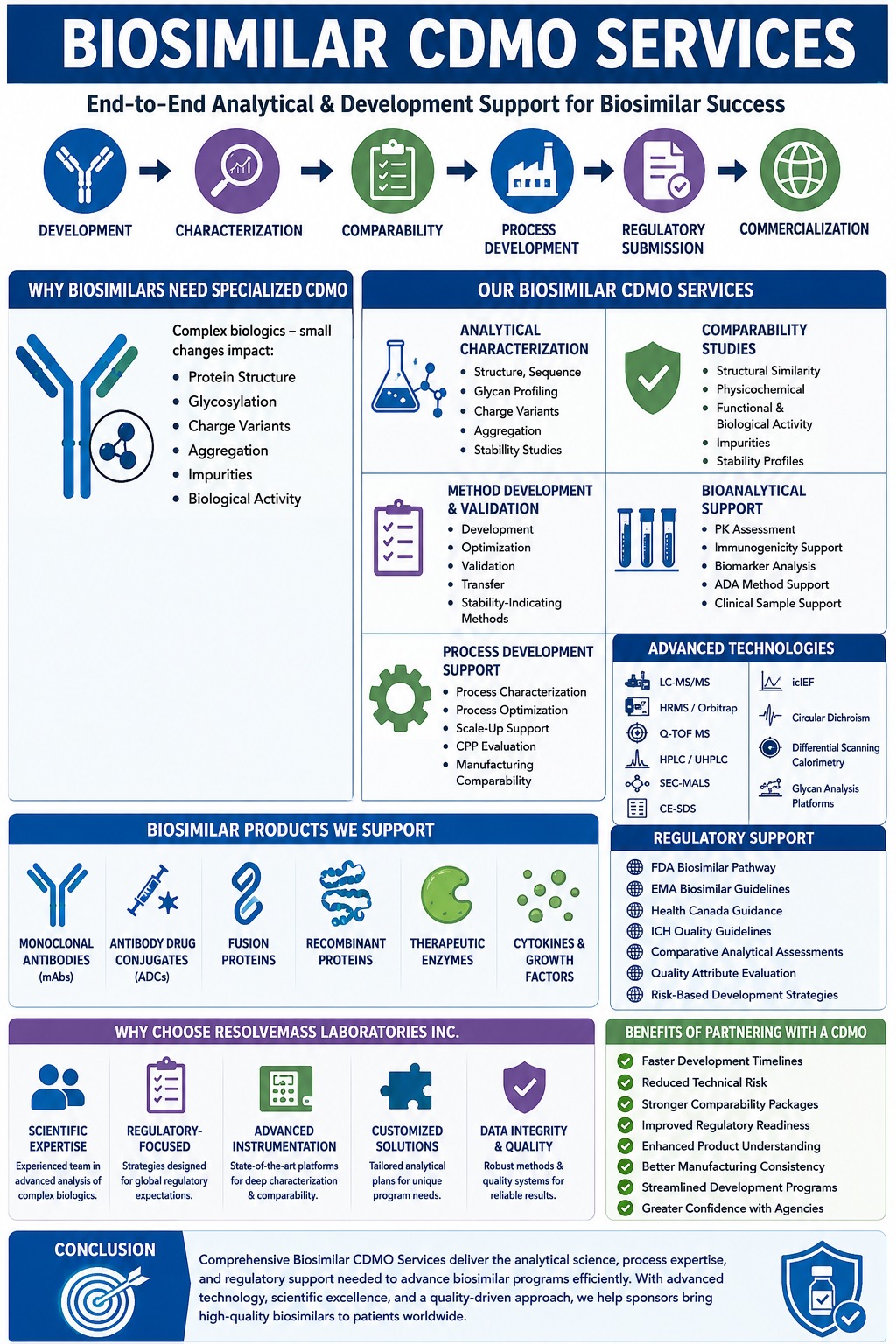
The successful development of biosimilars requires a deep understanding of analytical science, product characterization, comparability assessment, manufacturing consistency, and regulatory expectations. Comprehensive Biosimilar CDMO Services provide the scientific foundation needed to advance biosimilar programs efficiently while generating the high-quality evidence required for global regulatory submissions. Through advanced analytical capabilities, experienced scientific support, and a quality-focused approach, ResolveMass Laboratories Inc. helps sponsors navigate the complexities of biosimilar development with confidence.
Ready to discuss your biosimilar development program?
Contact our scientific team today: Contact us
Frequently Asked Questions (FAQs)
Traditional generic drugs are chemically synthesized and can be reproduced as identical copies of the original product. Biosimilars, however, are large and complex biological molecules manufactured using living cells, making exact replication impossible. Instead, biosimilar developers must demonstrate that their product is highly similar to the reference biologic with no clinically meaningful differences in safety, purity, or efficacy.
Analytical characterization is the foundation of biosimilar development. Studies typically include primary structure analysis, peptide mapping, glycan profiling, charge variant analysis, aggregation assessment, impurity profiling, potency testing, and higher-order structure evaluation. These studies help establish the critical quality attributes necessary to demonstrate biosimilarity and support regulatory approval.
Analytical comparability provides the scientific evidence that a biosimilar closely matches its reference product. Regulatory agencies increasingly rely on comprehensive analytical datasets because advanced analytical methods can detect subtle molecular differences more effectively than many clinical studies. A strong analytical comparability package often serves as the cornerstone of a successful biosimilar submission.
Biosimilar CDMO Services support a broad range of biologics, including monoclonal antibodies, recombinant proteins, fusion proteins, therapeutic enzymes, cytokines, growth factors, and antibody-drug conjugates. Each product class presents unique analytical and manufacturing challenges, requiring tailored development strategies and specialized expertise throughout the program lifecycle.
Critical Quality Attributes are measurable properties that directly impact the safety, efficacy, and quality of a biologic product. Attributes such as glycosylation patterns, protein aggregation, charge variants, purity, and biological activity must be carefully monitored and controlled. Understanding these attributes enables developers to maintain product consistency and satisfy regulatory expectations throughout development and commercialization.
Process development is essential because manufacturing conditions can significantly affect the final characteristics of a biologic product. Cell culture parameters, purification processes, formulation strategies, and scale-up activities all influence product quality. Effective process development helps ensure batch-to-batch consistency, manufacturing robustness, and long-term regulatory compliance while minimizing development risks.
A knowledgeable CDMO helps sponsors generate scientifically sound data packages that align with expectations from agencies such as the FDA, EMA, and Health Canada. Support may include analytical characterization, method validation, comparability studies, stability programs, and regulatory documentation. These activities help strengthen submissions and facilitate productive interactions with regulatory authorities.
Organizations should evaluate scientific expertise, regulatory experience, analytical capabilities, quality systems, project management processes, and experience with complex biologics. A strong biosimilar CDMO should offer advanced characterization technologies, customized development strategies, data integrity, and a proven understanding of global regulatory expectations. Selecting the right partner can significantly improve the likelihood of a successful biosimilar development program.
Reference:
- McCamish, M., & Woollett, G. (2012). The state of the art in the development of biosimilars. Clinical Pharmacology & Therapeutics, 91(3), 405–417. https://doi.org/10.1038/clpt.2011.343
- Al-Sabbagh, A., Olech, E., McClellan, J. E., & Kirchhoff, C. F. (2016). Development of biosimilars. Seminars in Arthritis and Rheumatism, 45(5 Suppl), S11–S18. https://doi.org/10.1016/j.semarthrit.2016.01.002
- Sainz, B., Jr., Nair, D. G., & Kannan, A. (2024). Biosimilars: Current landscape, regulatory considerations, and future perspectives. BioDrugs, 38(2), 173–190. https://doi.org/10.1007/s40259-023-00635-1
- Rathore, A. S., & Bhambure, R. (2019). Current perspectives on biosimilars. Journal of Industrial Microbiology & Biotechnology, 46(9–10), 1297–1311. https://doi.org/10.1007/s10295-019-02216-z