

Introduction
A specialized Biosimilar Functional Bioassay Development Service provides Mechanism of Action (MoA)-reflective cell-based and binding assays that are specifically designed to establish biological comparability between a biosimilar candidate and its reference product. The quantitative potency measurements and binding kinetics data generated through these studies constitute a critical component of Module 3 (Quality) within regulatory submissions prepared for Biologics License Applications (BLA) under the FDA 351(k) pathway and Marketing Authorization Applications (MAA) under the European Medicines Agency (EMA) framework.
Although advanced physicochemical characterization technologies—including liquid chromatography-mass spectrometry (LC-MS), capillary electrophoresis, and nuclear magnetic resonance (NMR)—can comprehensively define primary, secondary, and tertiary molecular structures, these analytical techniques alone are insufficient to accurately predict complex biological responses arising from molecular micro-heterogeneity. Variations in post-translational modifications, including differences in glycosylation patterns, terminal amino acid processing, and low-level aggregation, can substantially affect biological activity, target binding affinity, receptor engagement, and downstream cellular signaling. Functional bioassays address this important analytical limitation by directly measuring biologically active responses within physiological or surrogate cellular systems. ResolveMass Laboratories Inc. provides comprehensive bioanalytical solutions that support the development of robust Quality Target Product Profiles (QTPP) while meeting global regulatory expectations for biosimilar development.
Explore ResolveMass Biosimilar Characterization Services to support your complete analytical and regulatory roadmap.
Share via:
Article Summary:
- Biosimilar functional bioassay development combines binding assays and cell-based potency assays to demonstrate biological similarity between a biosimilar and its reference product, supporting global regulatory submissions.
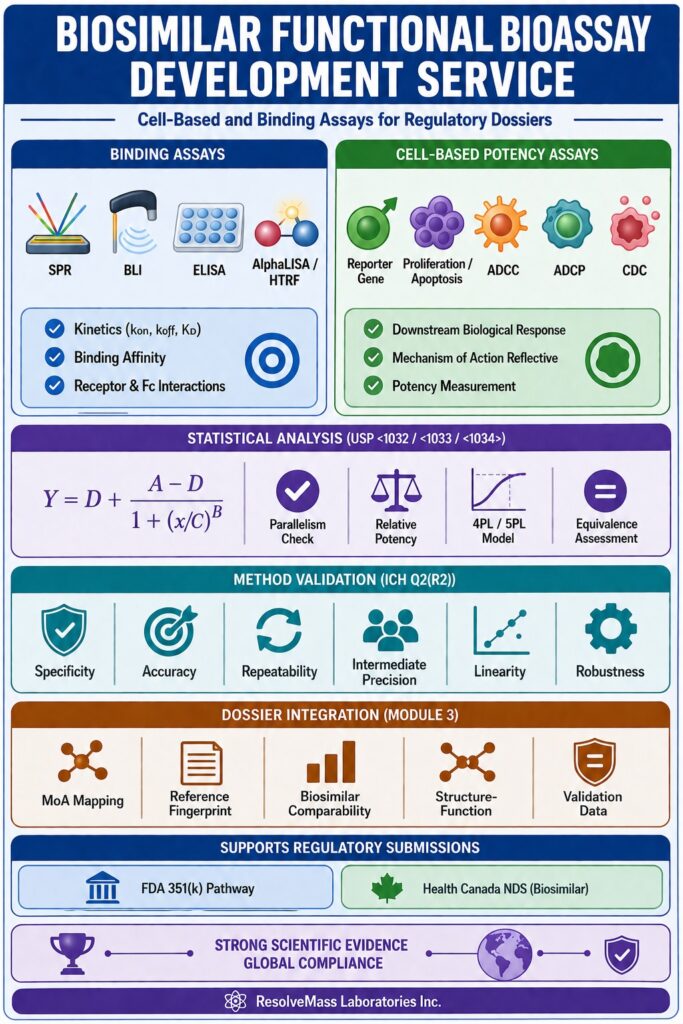
- Binding assays such as SPR, BLI, ELISA, and AlphaLISA evaluate target affinity, receptor interactions, and binding kinetics, while cell-based assays measure mechanism-of-action (MoA), relative potency, and immune effector functions like ADCC, ADCP, and CDC.
- Global regulatory agencies expect risk-based analytical comparability, where validated functional bioassays complement physicochemical characterization to confirm there are no clinically meaningful functional differences.
- Statistical analysis using validated 4PL/5PL dose-response models, parallelism testing, and relative potency calculations provides robust evidence of biosimilar biological equivalence.
- Method validation under ICH Q2(R2) establishes assay reliability by evaluating specificity, accuracy, precision, linearity, robustness, and reproducibility across routine testing conditions.
- Functional bioassay results are integrated into CTD Module 3 through mechanism-of-action mapping, reference product fingerprinting, biosimilar comparability studies, structure–function correlation, and comprehensive validation documentation.
- A well-designed Biosimilar Functional Bioassay Development Service generates regulatory-ready evidence that strengthens biosimilar quality dossiers, supports efficient clinical development, and facilitates successful submissions to global health authorities.
Regulatory Frameworks Governing Biosimilar Functional Bioassay Development Services
Regulatory agencies such as the FDA, EMA, and organizations operating under the ICH framework require comprehensive comparative biological characterization demonstrating that a biosimilar exhibits no clinically meaningful differences in function when compared with its reference product. A dedicated Biosimilar Functional Bioassay Development Service fulfills these requirements by correlating physicochemical characteristics with MoA-associated biological activity, thereby supporting compliance with ICH Q6B and ICH Q5E expectations.
Read about ICH Q6B Guidelines for Biological Characterisation to align your specifications with regulatory expectations.
Current global regulatory guidance advocates a risk-based, stepwise approach to biosimilar development and evaluation. Health authorities expect extensive side-by-side analytical comparability studies involving multiple lots of the reference product manufactured across different production periods and expiration timelines. These datasets establish the reference product’s analytical and functional variability range, creating a scientifically justified target design space for biosimilar development. Demonstration of functional similarity through validated bioassays provides strong evidence supporting a streamlined clinical development strategy and may reduce the need for extensive Phase II or Phase III efficacy studies when analytical, functional, and pharmacokinetic/pharmacodynamic (PK/PD) data collectively demonstrate a high degree of similarity.
Discover how to structure your Comparability Exercise in Biosimilar Development to streamline regulatory approvals.
| Regulatory Guideline / Authority | Document Scope & Standard | Primary Bioanalytical Expectation for Dossiers |
|---|---|---|
| ICH Q6B | Specifications: Test Procedures for Biotechnological Products | Requires quantitative biological assays (potency assays) directly linked to biological activity and product function. |
| ICH Q2(R2) / Q14 | Analytical Procedure Validation and Development Lifecycle | Defines validation requirements and Analytical Target Profiles (ATP) for quantitative bioassays. |
| FDA 351(k) Pathway | Public Health Service Act (42 U.S.C. 262(k)) | Requires extensive comparative analytical and functional studies demonstrating that the biosimilar is highly similar to the reference product. |
| EMA CHMP Guidelines | Similar Biological Medicinal Products Framework | Requires comprehensive head-to-head functional comparability covering all clinically relevant mechanisms of action. |
| USP <1032>, <1033>, <1034> | Design, Validation, and Analysis of Biological Assays | Establishes statistical requirements for 4PL/5PL curve fitting, assay parallelism, and relative potency calculations. |
Advanced Binding Assays in Biosimilar Characterization
Binding assays are used to evaluate equilibrium dissociation constants (KD) and kinetic association/dissociation parameters (kon and koff) across primary target antigens and secondary Fc receptor interactions to verify both structural integrity and functional performance. The integration of real-time, label-free biophysical technologies such as Surface Plasmon Resonance (SPR) and Bio-Layer Interferometry (BLI) enables detailed characterization of binding kinetics and interaction profiles that are essential for regulatory submissions.
Learn how Native Mass Spectrometry for Biosimilars provides structural insights into intact protein complexes and binding interactions.
For therapeutic monoclonal antibodies (mAbs) and antibody-drug conjugates (ADCs), simple target binding assessment represents only one aspect of functional characterization. A complete evaluation strategy must also include interaction studies with the neonatal Fc receptor (FcRn) to assess endosomal recycling mechanisms and potential effects on systemic half-life. Additionally, interactions with complement component C1q and the complete family of Fc gamma receptors, including FcγRI (CD64), FcγRIIa/b (CD32a/b), and FcγRIIIa/b (CD16a/b), must be characterized. Evaluation frequently includes both high-affinity (158V) and low-affinity (158F) receptor polymorphic variants to ensure a comprehensive understanding of Fc-mediated biological activity.
| Binding Platform | Detection Principle | Primary Analytical Metrics | Dossier Application & Advantage |
|---|---|---|---|
| Surface Plasmon Resonance (SPR) | Measures refractive index changes at a biosensor gold surface | kon, koff, KD, and binding stoichiometry | Considered the gold standard for kinetic characterization and highly sensitive to subtle conformational and glycosylation-related changes. |
| Bio-Layer Interferometry (BLI) | Detects optical interference shifts at a fiber-optic biosensor tip | kon, koff, KD, and percentage relative binding | High-throughput and fluidics-free platform with strong performance in complex sample matrices. |
| Enzyme-Linked Immunosorbent Assay (ELISA) | Measures enzymatic substrate conversion producing an optical signal | Relative binding affinity (EC50) and competitive IC50 | Well-established assay format suitable for routine comparability assessments, stability testing, and lot release programs. |
| AlphaLISA / HTRF | Bead-based proximity energy transfer using luminescence or FRET principles | Equilibrium binding constants and receptor cross-linking activity | Homogeneous wash-free assay format offering excellent signal-to-noise performance for high-throughput studies. |
MoA-Reflective Cell-Based Assays for Potency Determination
Cell-based bioassays are designed to evaluate downstream cellular signaling pathways, gene expression responses, and physiological outcomes to demonstrate that a biosimilar candidate reproduces the therapeutic Mechanism of Action (MoA) of its reference product. These biological systems transform receptor-binding interactions into measurable and quantitative dose-response relationships, enabling accurate estimation of relative potency through sigmoidal curve analysis.
The biological response generated within living cells reflects the integrated activity of a therapeutic molecule across multiple functional pathways. For recombinant proteins and monoclonal antibodies, cell-based assays can detect the biological consequences of post-translational modifications—including afucosylation, terminal galactosylation, and other glycan-related variations—that may not be fully captured through biophysical binding measurements alone.
Review our comprehensive guide to Glycosylation Analysis of Biosimilars to understand how glycan profiles influence biological potency.
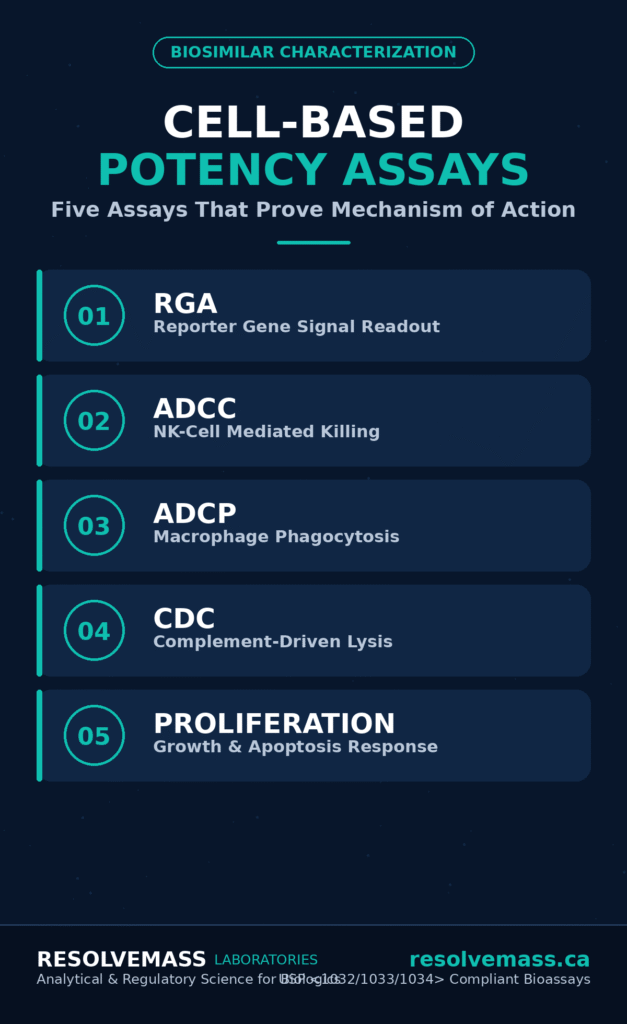
Key cell-based assay formats commonly employed during biosimilar evaluation include:
Reporter Gene Assays (RGAs):
Engineered cell lines expressing target receptors linked to transcriptional reporter systems, such as Luciferase under the control of NFAT, NF-κB, or STAT-responsive promoters. RGAs provide excellent assay precision, broad dynamic ranges, and lower variability compared with many primary-cell-based methods.
Cell Proliferation and Apoptosis Assays:
Quantitative assessment of cellular growth, inhibition of proliferation, apoptosis induction, and metabolic activity using fluorescent or luminescent indicators such as AlamarBlue and CellTiter-Glo. These assays are widely applied to cytokines, growth factors, and oncology-focused biologics.
Antibody-Dependent Cellular Cytotoxicity (ADCC):
Measurement of effector-cell-mediated destruction of target cells using primary human peripheral blood mononuclear cells (PBMCs), isolated Natural Killer (NK) cells, or engineered Jurkat CD16a NFAT reporter cell lines. ADCC assays are particularly important for therapeutic antibodies whose efficacy depends on Fc-mediated immune activation.
Antibody-Dependent Cellular Phagocytosis (ADCP):
Evaluation of macrophage-driven engulfment and clearance of target cells using either primary monocyte-derived macrophages or engineered cellular systems expressing FcγRIIa receptors. These assays help characterize Fc-mediated effector functions associated with therapeutic activity.
Complement-Dependent Cytotoxicity (CDC):
Assessment of target cell lysis initiated through C1q binding and subsequent membrane attack complex formation. CDC activity is typically measured by exposing target cells to active human complement serum and quantifying complement-mediated cellular destruction.
Statistical Modeling and Parallelism Analysis Under USP <1032/1033/1034>
Relative biological potency is calculated using non-linear 4-parameter logistic (4PL) or 5-parameter logistic (5PL) regression models after demonstrating mathematical parallelism between the biosimilar and reference product dose-response curves. The principles outlined in USP <1032>, USP <1033>, and USP <1034> require the application of equivalence-based statistical approaches to confirm that the biosimilar behaves as a simple dilution of the reference standard across the assay range.
The standard 4-parameter logistic (4PL) model is expressed as:
Y = D + (A − D) / [1 + (x/C)^B]
Where:
- Y represents the measured biological response, such as relative luminescence units, fluorescence intensity, or optical density.
- x represents the log-transformed analyte concentration.
- A denotes the lower asymptote associated with minimal or zero analyte concentration.
- D denotes the upper asymptote corresponding to maximal analyte concentration.
- C represents the inflection point concentration, commonly reported as EC50 or IC50.
- B represents the Hill slope, which describes the steepness of the dose-response curve.
Demonstrating mathematical parallelism requires showing that the key curve parameters—including the upper asymptote (D), lower asymptote (A), and slope (B)—do not differ significantly between the biosimilar and reference product. Under USP <1033> recommendations, parallelism is formally assessed using predefined equivalence limits applied to parameter ratios. An example criterion is expressed as:
|Bbiosimilar / Breference − 1| ≤ θ
Following successful confirmation of parallelism, relative biological potency can be calculated directly using the ratio of inflection point concentrations:
Relative Potency = (Creference / Cbiosimilar) × 100%
This statistical approach provides a scientifically robust framework for demonstrating that the biosimilar and reference product exhibit equivalent biological activity within the validated assay system.
Examine how biological and physical attributes intersect in Critical Quality Attributes (CQAs) in Biosimilars.
Method Validation for Biosimilar Functional Bioassay Development Services
Method validation conducted according to ICH Q2(R2) requirements establishes that a bioassay consistently generates accurate, precise, specific, and robust measurements of relative potency throughout its intended operating range. Implementing a validated Biosimilar Functional Bioassay Development Service ensures that biological assays satisfy predefined Analytical Target Profile (ATP) requirements for release testing, comparability assessments, and stability studies.
Unlike conventional physicochemical methods, cell-based bioassays inherently introduce biological variability associated with factors such as cell passage number, cell viability, seeding density, incubation conditions, and reagent lot-to-lot differences. As a result, validation acceptance criteria are developed using a fit-for-purpose approach that reflects the unique characteristics of biological systems while maintaining regulatory compliance.
Check out our specialized services for Impurity Profiling of Biosimilars to ensure assay performance remains unaffected by matrix impurities.
| ICH Q2(R2) Parameter | Experimental Strategy | Acceptable Performance Standard |
|---|---|---|
| Specificity / Selectivity | Assessment in the presence of formulation excipients, degradation products, and structural variants. | Complete inhibition or neutralization by target-specific antibodies with no measurable interference from matrix components. |
| Accuracy (Recovery) | Dilution and spike-recovery studies performed across multiple potency levels (e.g., 50%, 70%, 100%, 130%, and 150%). | Mean relative potency recovery within 80%–120% (or 70%–130% for highly complex cell-based assays). |
| Repeatability (Intra-assay Precision) | Replicate analyses (n ≥ 6) conducted by a single analyst on the same day using identical cell preparations. | Percent Coefficient of Variation (%CV) ≤ 10%–15% for relative potency measurements. |
| Intermediate Precision | Multi-day evaluations involving different analysts, instruments, laboratories, and cell passage numbers. | Overall intermediate precision %CV ≤ 15%–20% across routine operating conditions. |
| Linearity and Range | Regression analysis comparing observed and nominal relative potency values throughout the reportable range. | Correlation coefficient r² ≥ 0.98, slope between 0.90 and 1.10, and a statistically non-significant intercept. |
| Robustness | Deliberate variation of critical parameters using Design of Experiments (DoE), including incubation time variations of ±15 minutes and changes in cell density. | Demonstrated stability of EC50 values and relative potency results within predefined ATP acceptance limits. |
Integrating Bioassay Data into Regulatory Dossiers for BLA and MAA
The integration of functional bioassay data into Module 3 of the Common Technical Document (CTD) establishes a direct relationship between physicochemical quality attributes and biological activity, thereby supporting claims of biosimilarity. Comparative analytical characterization packages help place observed structural micro-heterogeneities into a functional context, enabling regulators to evaluate whether such differences have any meaningful impact on clinical performance. This comprehensive evidence package supports streamlined and scientifically justified clinical development strategies.
A complete regulatory dossier section focused on bioactivity generally includes the following elements:
Mechanism of Action Mapping:
A scientifically justified explanation linking each selected bioassay to the known clinical mechanisms of action across all approved indications. This information supports scientific arguments for indication extrapolation.
Reference Product Fingerprinting:
Extensive characterization of approximately 10 to 30 or more reference product batches to establish the historical variability range and define acceptable quality boundaries for biosimilar comparison.
Biosimilar Comparability Testing:
Direct head-to-head evaluation demonstrating that biosimilar batch potency and biological activity remain within the established reference product design space.
Structure-Function Correlation Studies:
Targeted investigations involving forced degradation samples and isolated molecular variants, such as altered glycoforms or oxidized species, to determine the precise impact of structural changes on biological function.
Validation Documentation:
Comprehensive ICH Q2(R2)-compliant validation reports confirming that the analytical methods are suitable for routine release testing, comparability assessments, and long-term stability monitoring.
Explore how stress testing via Forced Degradation of Biosimilars supports structure-function correlation studies for regulatory dossiers.
Through scientifically rigorous bioanalytical strategies, ResolveMass Laboratories Inc. generates regulatory-ready comparative data packages designed to meet the expectations of major global health authorities.
Learn about executing thorough Biosimilar Comparability Studies for complete BLA and MAA readiness.
Conclusion
Establishing robust biological comparability requires a combination of highly sensitive binding assays, detailed kinetic characterization, and Mechanism of Action-reflective cell-based potency testing performed in accordance with internationally recognized regulatory standards. Utilizing a specialized Biosimilar Functional Bioassay Development Service enables biosimilar developers to generate submission-ready analytical packages that satisfy the requirements of both the FDA 351(k) pathway and the EMA biosimilar framework.
By systematically linking structural micro-heterogeneity to measurable biological outcomes, developers can better understand potential product differences, minimize clinical development uncertainty, and strengthen the overall quality of their regulatory submissions.
To discuss your functional characterization, bioassay development, comparability assessment, or method validation requirements with experienced regulatory and bioanalytical specialists, contact ResolveMass Laboratories Inc. through their contact page at https://resolvemass.ca/contact/.
Frequently Asked Questions
Mathematical parallelism is a critical prerequisite because it demonstrates that the biosimilar and reference product generate concentration-response curves with comparable shapes and slopes. When parallelism is established, any difference between the curves can be attributed primarily to potency rather than altered biological behavior. This ensures that relative potency calculations are scientifically valid and accurately reflect functional similarity.
Glycosylation plays a major role in determining the biological activity and receptor interactions of monoclonal antibodies. Variations in glycan structures can alter Fc receptor binding, complement activation, and immune effector functions such as ADCC. Certain glycosylation profiles may enhance therapeutic activity, while others can affect clearance rates, stability, or overall biological performance, making their evaluation essential during biosimilar characterization.
USP recommends the use of 4-parameter logistic (4PL) and 5-parameter logistic (5PL) regression models for analyzing biological dose-response data. These models are particularly suitable for the sigmoidal curves commonly observed in potency assays. While the 4PL model is widely used for symmetrical responses, the 5PL model provides improved fitting when the response curve exhibits asymmetry around the inflection point.
Cell-based bioassays inherently exhibit greater variability than physicochemical methods because they rely on living biological systems. As a result, intermediate precision acceptance criteria are generally broader, with relative potency assays commonly targeting a %CV of approximately 15% to 20%. These limits are considered acceptable when supported by appropriate validation data demonstrating consistent assay performance across analysts, instruments, and testing days.
Many oncology monoclonal antibodies depend on Antibody-Dependent Cellular Cytotoxicity (ADCC) as an important mechanism for eliminating tumour cells. FcγRIIIa receptors expressed on Natural Killer (NK) cells play a central role in triggering this immune response. Evaluating FcγRIIIa binding characteristics helps confirm that a biosimilar can induce effector-cell-mediated cytotoxicity comparable to that of the reference product.
Regulatory agencies generally expect biosimilar developers to evaluate a sufficiently large number of reference product lots to capture natural manufacturing variability. In practice, studies often include between 10 and 30 or more reference batches obtained from different production periods and expiry ranges. This approach helps establish a reliable reference quality profile against which biosimilar performance can be assessed.
The neonatal Fc receptor (FcRn) is responsible for protecting antibodies from intracellular degradation and extending their circulation time within the body. Assessing FcRn binding under physiologically relevant pH conditions helps determine whether a biosimilar is likely to exhibit pharmacokinetic behaviour similar to the reference product. This information supports the demonstration of comparable exposure and therapeutic performance.
In certain circumstances, comprehensive analytical and functional comparability data may reduce the need for extensive clinical efficacy studies. Regulatory authorities may consider a streamlined development pathway when structural characterization, bioassay results, and pharmacokinetic/pharmacodynamic data collectively demonstrate a high level of similarity. Decisions are made on a case-by-case basis and must be supported by strong scientific justification.
Ready-to-use cryopreserved cells provide a standardized testing platform by minimizing variability associated with continuous cell culture and repeated passaging. Their use helps reduce the risk of genetic drift, phenotypic changes, and operator-dependent differences that can affect assay performance. Consequently, these cells often improve reproducibility, enhance method consistency, and support reliable potency testing across multiple laboratories and study phases.
Reference:
- European Medicines Agency. (n.d.). Biosimilar medicines: Overview. European Medicines Agency. Retrieved July 29, 2026, from European Medicines Agency biosimilar overview page
- U.S. Food and Drug Administration. (2025). Development of therapeutic protein biosimilars: Comparative analytical assessment and other quality-related considerations: Guidance for industry. U.S. Department of Health and Human Services. https://www.fda.gov/media/119258/download
- European Medicines Agency. (n.d.). Multidisciplinary guidelines: Biosimilar. European Medicines Agency. Retrieved July 29, 2026, from https://www.ema.europa.eu/en/human-regulatory-overview/research-development/scientific-guidelines/multidisciplinary-guidelines/multidisciplinary-guidelines-biosimilar
- International Council for Harmonisation of Technical Requirements for Pharmaceuticals for Human Use. (1999). ICH Q6B: Specifications: Test procedures and acceptance criteria for biotechnological/biological products. European Medicines Agency. https://www.ema.europa.eu/en/ich-q6b-specifications-test-procedures-acceptance-criteria-biotechnological-biological-products-scientific-guideline
- International Council for Harmonisation of Technical Requirements for Pharmaceuticals for Human Use. (2025). ICH Q2(R2) and Q14 training materials: Module 7—Additional case studies and examples. International Council for Harmonisation. https://database.ich.org/sites/default/files/ICH_Q2%28R2%29Q14_TrainingMat_Module7_2025_0620.pdf
- International Council for Harmonisation of Technical Requirements for Pharmaceuticals for Human Use. (2023). ICH Q2(R2): Validation of analytical procedures. International Council for Harmonisation. https://database.ich.org/sites/default/files/ICH_Q2%28R2%29_Guideline_2023_1130.pdf
Get In Touch With Us
About The Author


