

Introduction
CDMO Support for EU Generic Drug Registrations plays a pivotal role in accelerating market authorization by integrating complex Chemistry, Manufacturing, and Controls (CMC) activities with the regulatory expectations of the European Medicines Agency (EMA) and the UK Medicines and Healthcare products Regulatory Agency (MHRA). Strategic partnerships with specialized contract development and manufacturing organizations help bridge the gap between formulation development, bioequivalence assessment, and sustained regulatory compliance across multiple European jurisdictions. Successfully navigating the European generic drug approval landscape requires the demonstration of bioequivalence, strict adherence to EudraLex data integrity requirements, and the preparation of a Common Technical Document (CTD) dossier capable of withstanding comprehensive regulatory scrutiny.
The European generic pharmaceutical market operates within a highly regulated environment that requires compliance with evolving legislative requirements, post-Brexit regulatory structures, and harmonized quality expectations. Securing a Marketing Authorization (MA) through the EMA Centralised Procedure, Decentralised Procedure (DCP), Mutual Recognition Procedure (MRP), or the MHRA International Recognition Procedure (IRP) demands technical precision throughout the product lifecycle. Effective CDMO Support for EU Generic Drug Registrations enables sponsors to reduce regulatory risks, strengthen dossier quality, optimize active pharmaceutical ingredient (API) documentation, and maintain full compliance with EU Good Manufacturing Practice (GMP) Annex 16 batch release requirements.
Explore Resolve Mass One-Stop CDMO Analytical Services for ANDA Submissions to streamline your regulatory strategy.
Share via:
Article Summary:
- CDMO support is critical for successful EU generic drug registrations, helping sponsors manage formulation development, bioequivalence studies, CMC documentation, and regulatory compliance with EMA and MHRA requirements.
- Generic products in Europe can be approved through multiple pathways, including the Centralised Procedure (CP), Decentralised Procedure (DCP), Mutual Recognition Procedure (MRP), and the UK MHRA International Recognition Procedure (IRP).
- Regulatory submissions may be filed as Article 10(1) generic applications when bioequivalence and pharmaceutical sameness can be demonstrated, or as Article 10(3) hybrid applications when additional clinical or non-clinical evidence is required.
- A well-prepared eCTD Module 3 is essential and must include robust API documentation through an ASMF or CEP, along with comprehensive process validation, analytical method validation, and stability data.
- MHRA’s International Recognition Procedure (IRP) provides a faster route to Great Britain market access, offering 60-day (Route A) or 110-day (Route B) review timelines by leveraging approvals from recognized regulatory authorities such as the EMA.
- Compliance with EU GMP Annex 16 and EudraLex requirements is mandatory for imported products, including analytical verification, Qualified Person (QP) certification, and batch release within the EU/EEA.
- Strong data integrity systems based on ALCOA++ principles, combined with harmonized global development strategies, help reduce regulatory risks, accelerate approvals, and support market access across the EU, UK, and other international regions.
EMA Regulatory Pathways and Approval Frameworks
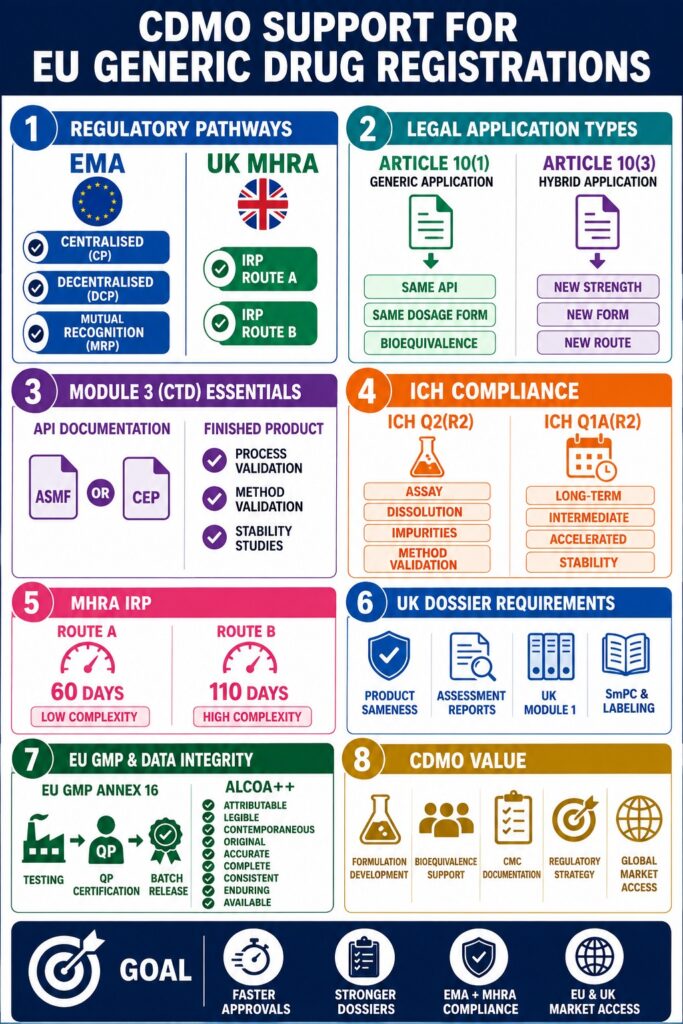
Generic drug approvals within the European Union are founded on the demonstration of bioequivalence and essential similarity to an already authorized reference medicinal product, as outlined under Directive 2001/83/EC and Regulation (EC) No 726/2004. Depending on the authorization status of the reference product and the intended market coverage, applicants may pursue approval through the Centralised Procedure (CP), Decentralised Procedure (DCP), or Mutual Recognition Procedure (MRP).
Legal Submissions under Article 10(1) and Article 10(3) Hybrid Applications
Applications submitted under Article 10(1) of Directive 2001/83/EC allow generic manufacturers to avoid repeating extensive non-clinical and clinical studies by establishing bioequivalence with a reference medicinal product that has been authorized within the European Economic Area (EEA) for a minimum of eight years. The generic product must contain the same active substance composition, the same pharmaceutical form, and demonstrate bioequivalence through appropriate bioavailability studies.
However, when a product falls outside the strict requirements of an Article 10(1) generic application—such as changes involving active substance salts, dosage strengths, pharmaceutical forms, routes of administration, or situations where bioequivalence cannot be adequately demonstrated through standard bioavailability studies—the application must be submitted under Article 10(3) as a Hybrid Application. Hybrid submissions require supplementary non-clinical and/or clinical evidence to address any differences affecting safety or efficacy. CDMOs provide critical support by generating comparative dissolution data, physicochemical characterization results, and analytical evidence necessary to justify these regulatory bridges.
Read our analysis on CRO vs CDMO Partnership Models to choose the right operational strategy.
Centralised Procedure Requirements and CDMO Support for EU Generic Drug Registrations
The EMA Centralised Procedure results in a single Marketing Authorization that is valid throughout all EU and EEA Member States following a formal 210-day evaluation conducted by the Committee for Medicinal Products for Human Use (CHMP). Generic products whose reference medicines were originally approved through the Centralised Procedure under Regulation (EC) No 726/2004 are generally eligible for automatic access to this pathway.
For products whose reference medicines were approved through national procedures, MRP, or DCP routes, eligibility for the Centralised Procedure requires evidence that the generic product offers a significant scientific or technical advancement or that a Union-wide authorization would benefit public health. To support such claims, generic developers often collaborate with experienced CDMOs capable of producing comparative quality data, advanced formulation characterizations, innovative drug delivery evaluations, and stability datasets required during eligibility and pre-submission discussions with regulators.
| Regulatory Pathway | Governing Regulation / Directive | Primary Scope & Eligibility | Approval Authority & Reach | Standard Evaluation Timeline |
|---|---|---|---|---|
| Centralised Procedure (CP) | Regulation (EC) No 726/2004; Article 3(3) | Mandatory for biotechnology products and certain innovative therapies; generic access generally available when the reference product is centrally approved. | European Medicines Agency (EMA) and European Commission; authorization valid throughout the EU/EEA. | 210 calendar days, excluding clock stops. |
| Decentralised Procedure (DCP) | Directive 2001/83/EC; Chapter 4 | Used for products not yet authorized in any EU Member State seeking simultaneous approval in multiple countries. | Reference Member State (RMS) coordinates assessment with Concerned Member States (CMS). | Approximately 210 days. |
| Mutual Recognition Procedure (MRP) | Directive 2001/83/EC; Articles 27–39 | Applicable to products already holding a national authorization in one EU Member State and seeking expansion to additional markets. | RMS updates the Assessment Report and CMS recognize the authorization. | Approximately 90 days. |
| MHRA International Recognition Procedure (IRP) | UK Human Medicines Regulations 2012 | UK pathway recognizing approvals from trusted international regulators including EMA, FDA, and TGA. | Medicines and Healthcare products Regulatory Agency (MHRA); authorization valid in Great Britain. | Recognition Route A: 60 days; Recognition Route B: 110 days. |
Module 3 CTD Optimization: CDMO Support for EU Generic Drug Registrations
The successful preparation of eCTD Module 3 requires comprehensive API documentation and complete finished product manufacturing data that satisfy EMA quality expectations. Robust Chemistry, Manufacturing, and Controls (CMC) packages significantly reduce the likelihood of regulatory deficiencies and help minimize review delays. High-quality documentation also supports compliance with European Pharmacopoeia standards and facilitates efficient regulatory assessment.
Check out our dedicated guide on CDMO Services for Generic Ophthalmic Drug Products.
API Technical Documentation: ASMF vs. EDQM CEP Integrity
Active Pharmaceutical Ingredient (API) compliance within Module 3.2.S is generally established through either an Active Substance Master File (ASMF) or an EDQM Certificate of Suitability (CEP). The ASMF approach separates information into an Applicant’s Part, accessible to the sponsor, and a Restricted Part that remains confidential and is submitted directly to regulatory authorities. In contrast, a CEP confirms that the API complies with the relevant European Pharmacopoeia monograph and quality requirements.
Obtaining a CEP from the European Directorate for the Quality of Medicines & HealthCare can substantially simplify regulatory review of Module 3.2.S. Regulatory assessors often accept the CEP as evidence of active substance quality, impurity control, and manufacturing consistency, allowing greater focus on finished product performance, container-closure compatibility, and degradation behavior. CDMOs support CEP and ASMF strategies by conducting extensive analytical characterization, evaluating elemental impurities in accordance with ICH Q3D, and performing comprehensive nitrosamine risk assessments.
Discover how GLP-1 Peptide Analytical Characterization sets the benchmark for regulatory data integrity.
Process Validation and Analytical Method Validation under ICH Guidelines
Finished product documentation within Module 3.2.P requires prospective process validation programs and analytical method validation activities that comply with ICH Q2(R2). CDMOs are responsible for generating commercial-scale manufacturing data and long-term stability evidence to support product shelf-life claims.
Process Validation Protocols (Module 3.2.P.3.5)
European regulatory expectations require prospective validation using a minimum of three consecutive commercial-scale batches or the implementation of an approved continuous process verification strategy before commercialization. If final validation activities are scheduled for completion after approval, detailed validation plans and commitments must be clearly presented within the original submission dossier.
Transitioning from clinical batches to commercial output? Read our practical insights on Peptide API Scale-Up Strategies.
Analytical Method Validation (ICH Q2(R2))
Methods used for assay determination, dissolution testing, impurity analysis, and related quality assessments must be validated according to ICH Q2(R2) requirements. Validation studies are expected to demonstrate specificity, linearity, accuracy, precision (including repeatability and intermediate precision), robustness, and suitability across release and stability testing conditions.
Stability Protocols (ICH Q1A(R2))
Registration batches must be subjected to long-term, intermediate, and accelerated stability studies under the appropriate ICH climatic conditions. These studies must demonstrate that the product remains physically, chemically, and microbiologically stable throughout the proposed shelf life and storage conditions.
👉 Working with complex solid dosage forms or injectables? Learn more about Formulating Lyophilized Injectables for long-term stability.
Post-Brexit UK Registration via the MHRA International Recognition Procedure (IRP)
The MHRA International Recognition Procedure (IRP) offers an accelerated route to obtaining authorization in Great Britain by leveraging approvals granted by recognized international regulatory agencies, including the EMA. Through this pathway, generic drug developers may achieve UK approval within 60 to 110 days using existing regulatory assessment information.
Following the conclusion of temporary reliance mechanisms implemented after Brexit, the MHRA introduced the IRP on January 1, 2024. The framework enables sponsors holding an EMA Centralised approval or a completed DCP/MRP authorization to seek Great Britain market access through a streamlined reliance-based review process.
Recognition Route A and Route B Operational Mechanics
Recognition Route A provides a 60-day review period without clock stops for generic products approved by a recognized reference regulator within the previous two years. Recognition Route B allows for a 110-day review period and includes a Day 70 clock stop to accommodate products with greater regulatory or manufacturing complexity.
Route A is generally appropriate for straightforward generic products where manufacturing controls, analytical specifications, and quality systems closely mirror those approved by the reference regulator. Route B applies when approvals are older, when conditional approvals were granted, or when significant manufacturing or regulatory differences exist between the reference dossier and the proposed UK submission.
Technical Requirements for UK eCTD Dossier Alignment
IRP submissions require the proposed UK generic product to maintain qualitative and quantitative consistency with the product approved by the reference regulator. This includes identical active substances, strengths, pharmaceutical forms, and relevant formulation characteristics. Sponsors must also submit a UK-specific eCTD Module 1 together with complete and unredacted regulatory assessment documentation.
Product Sameness Demonstration
Applicants must provide evidence that the active substance composition, excipient profile, dosage strength, and pharmaceutical form are consistent with the product approved by the EMA or another recognized reference authority.
Assessment Report Compilation
Complete and unredacted assessment reports, regulatory correspondence, question-and-answer exchanges, and finalized product information documents—including the Summary of Product Characteristics (SmPC), labeling, and package leaflet—must accompany the submission.
UK Module 1 Integration
A UK-specific Module 1 must be prepared, incorporating national application forms, cover letters, UK labeling requirements, and documentation demonstrating that the applicant is appropriately established within the UK or EU/EEA framework.
Compare regional regulatory and manufacturing dynamics in our article on United States vs Overseas Peptide CDMOs.
Quality Assurance, EU GMP Annex 16, and Data Integrity Standards
EU GMP Annex 16 requires imported generic medicinal products to undergo comprehensive analytical verification within the EEA before Qualified Person (QP) certification and commercial release. At the same time, regulatory authorities require stringent data integrity systems aligned with ALCOA++ principles to ensure the reliability of bioequivalence, manufacturing, and quality data.
EudraLex Volume 4 Annex 16 and Import Re-Testing
Under EudraLex Volume 4, Annex 16, titled Certification by a Qualified Person and Batch Release, medicinal products manufactured outside the EU/EEA must undergo appropriate analytical testing within an EEA-authorized facility before a Qualified Person can certify the batch for distribution.
EU-based CDMOs provide the infrastructure necessary to fulfill these obligations through:
- Receipt and controlled quarantine of drug products manufactured in third countries.
- Complete qualitative and quantitative analytical testing of active substances and critical finished product quality attributes according to approved Module 3 specifications.
- Qualified Person batch certification performed within the EU regulatory framework, confirming compliance with all approved marketing authorization requirements.
Maintaining Data Integrity (ALCOA++) Across Non-Clinical and Clinical Data
Regulatory authorities place significant emphasis on data integrity across analytical testing, non-clinical studies, and bioequivalence programs. Historical regulatory actions involving data manipulation at contracted facilities have reinforced the importance of comprehensive data governance systems.
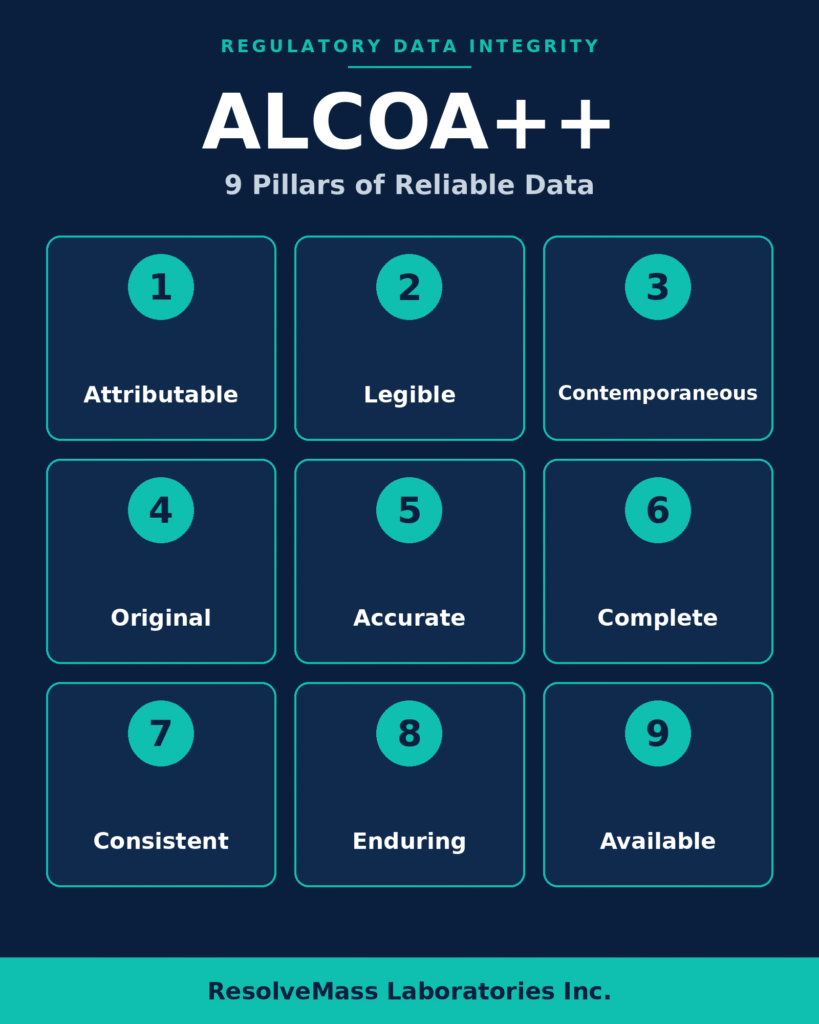
To ensure regulatory confidence, CDMOs implement ALCOA++ principles—Attributable, Legible, Contemporaneous, Original, Accurate, Complete, Consistent, Enduring, and Available—throughout analytical testing, process validation, and stability programs. The use of validated software systems, secure electronic audit trails, automated data acquisition platforms, and independent quality oversight helps eliminate vulnerabilities that could otherwise result in regulatory observations or dossier rejection.
👉 Selecting the right partner for regulatory compliance? Read our checklist on How to Choose a US-Based CDMO for complex submissions.
Strategic Execution in CDMO Support for EU Generic Drug Registrations
Achieving successful multi-market registration requires CDMOs to align technical development activities across different regulatory frameworks, including FDA Product-Specific Guidances (PSGs) and EMA bioequivalence expectations. Early harmonization of development strategies, bioequivalence study designs, and lifecycle management plans helps prevent costly regulatory divergence and facilitates broader global market access.
While the FDA relies heavily on Product-Specific Guidances to define generic drug development requirements, the EMA utilizes therapeutic-area guidance documents and structured biowaiver frameworks. Under EMA guideline EMA/CHMP/QWP/49313/2010, immediate-release oral solid dosage forms containing BCS Class I or BCS Class III active substances may qualify for biowaivers, allowing sponsors to avoid in vivo bioequivalence studies when predefined solubility, permeability, and comparative dissolution criteria are satisfied.
CDMOs develop formulation strategies and dissolution testing programs that address both FDA PSG requirements and EMA biowaiver expectations. By establishing harmonized analytical control strategies, coordinated stability programs, and globally aligned Module 3 documentation packages, sponsors can pursue regulatory approvals in the EU, UK, and North American markets more efficiently while reducing long-term regulatory maintenance costs.
👉 Looking to streamline your outsourcing pipeline? Learn how to effectively Outsource Manufacturing to a Dedicated CDMO Partner.
Conclusion
Securing robust CDMO Support for EU Generic Drug Registrations is essential for successfully navigating the technical and regulatory demands associated with EMA, MHRA, and Centralised Procedure submissions. An integrated strategy that combines high-quality Module 3 documentation, Qualified Person batch certification, and effective reliance pathways can significantly improve the likelihood of regulatory success and long-term commercial sustainability.
By leveraging comprehensive API technical documentation, validating analytical methods in accordance with current ICH guidelines, and implementing harmonized multi-jurisdictional regulatory strategies, generic pharmaceutical companies can reduce review timelines, strengthen regulatory compliance, and achieve reliable market access throughout Europe and Great Britain.
For expert analytical development, CTD dossier support, and regulatory strategy tailored to European drug registrations, visit the ResolveMass Laboratories Contact Page.
Frequently Asked Questions (FAQs)
The Article 10(3) Hybrid pathway is used when a proposed product differs in certain aspects from the reference medicine, making a standard generic application unsuitable. Differences may include dosage strength, pharmaceutical form, route of administration, or changes to the active substance. In such cases, additional non-clinical or clinical evidence is required to support the safety and efficacy of the modified product.
Eligibility for the EMA Centralised Procedure depends largely on the authorization status of the reference product and the nature of the generic medicine. If the reference product was approved through the Centralised Procedure, the corresponding generic can generally follow the same route. In other situations, applicants may need to demonstrate significant scientific value, technical innovation, or a broader public health benefit to justify centralized evaluation.
An Active Substance Master File (ASMF) is a regulatory document that allows confidential manufacturing information about an API to be submitted directly to authorities while sharing relevant information with the applicant. An EDQM Certificate of Suitability (CEP), on the other hand, confirms that the API complies with the applicable European Pharmacopoeia standards. A CEP often simplifies regulatory review because it serves as recognized evidence of API quality and compliance.
The MHRA International Recognition Procedure enables applicants to utilize previous assessments conducted by trusted regulatory agencies, including the EMA. Rather than undergoing a completely independent review, the MHRA performs a focused assessment using existing regulatory evidence and assessment reports. This approach significantly reduces review timelines while maintaining high standards for product quality, safety, and efficacy.
Recognition Route A is intended for products that have received recent approval from a recognized regulatory authority and generally follows a faster review process. Recognition Route B is designed for applications that may involve older approvals or additional regulatory complexities, requiring a more detailed assessment. As a result, Route B includes a longer review period and provides opportunities for regulatory questions and applicant responses.
EU GMP Annex 16 establishes the requirements for Qualified Person certification and batch release within the European Economic Area. Medicinal products manufactured outside the EU must undergo appropriate verification and testing before they can be released for commercial distribution. The Qualified Person must confirm that each batch complies with the approved marketing authorization and applicable GMP standards.
ICH Q2(R2) provides a globally harmonized framework for validating analytical methods used in pharmaceutical development and quality control. Regulatory submissions must include evidence demonstrating that analytical procedures are reliable, accurate, and suitable for their intended purpose. Parameters such as specificity, precision, accuracy, linearity, robustness, and detection capability are evaluated to ensure consistent product quality throughout its lifecycle.
Process validation data demonstrate that the manufacturing process consistently produces products that meet predefined quality specifications. Regulatory authorities rely on this information to confirm that the process is robust, controlled, and reproducible at commercial scale. Comprehensive validation documentation reduces regulatory concerns and supports successful product approval and lifecycle management.
Maintaining strong data integrity practices is essential for avoiding regulatory observations and application delays. Companies should implement ALCOA++ principles, maintain secure electronic records, establish comprehensive audit trails, and ensure that all data are attributable, accurate, and traceable. Routine quality audits, employee training, and validated computerized systems further strengthen compliance and enhance confidence in submitted regulatory data.
Reference:
- U.S. Food and Drug Administration. (2001). Bioanalytical method validation: Guidance for industry. U.S. Department of Health and Human Services, Food and Drug Administration, Center for Drug Evaluation and Research (CDER), Center for Veterinary Medicine (CVM). https://www.fda.gov/media/71581/download
- European Medicines Agency. (n.d.). Generic and hybrid applications. European Medicines Agency. https://www.ema.europa.eu/en/human-regulatory-overview/marketing-authorisation/generic-hybrid-medicines/generic-hybrid-applications
- European Medicines Agency. (2025). European Medicines Agency post-authorisation procedural advice for users of the centralised procedure (EMA/821278/2015 Rev. 28). European Medicines Agency. https://www.ema.europa.eu/en/documents/regulatory-procedural-guideline/european-medicines-agency-post-authorisation-procedural-advice-users-centralised-procedure_en.pdf
- U.S. Food and Drug Administration. (2024). Guidance for industry: Referencing approved drug products in ANDA submissions (Revision 1). U.S. Department of Health and Human Services, Food and Drug Administration, Center for Drug Evaluation and Research (CDER). https://www.fda.gov/media/177936/download
- European Parliament and the Council of the European Union. (2001). Directive 2001/83/EC of the European Parliament and of the Council of 6 November 2001 on the Community code relating to medicinal products for human use. Official Journal of the European Communities. https://www.ema.europa.eu/en/documents/regulatory-procedural-guideline/directive-200183ec-european-parliament-and-council-6-november-2001-community-code-relating-medicinal-products-human-use_en.pdf
- European Medicines Agency. (2008). Guideline on the use of the CTD format in the preparation of a registration application for traditional herbal medicinal products (EMEA/HMPC/71049/2007). European Medicines Agency. https://www.ema.europa.eu/en/guideline-use-ctd-format-preparation-registration-application-traditional-herbal-medicinal-products
Get In Touch With Us
About The Author


