

Introduction
Requesting a Certificate of Analysis (CoA) for Pharmaceutical-Grade PLGA involves defining a comprehensive set of characterization requirements, including molecular weight distribution, lactide-to-glycolide ratio, end-group chemistry, and residual impurity specifications. These parameters are necessary to demonstrate that the material meets applicable quality requirements and performs consistently during formulation. A Certificate of Analysis (CoA) for Pharmaceutical-Grade PLGA functions as a fundamental regulatory and quality document confirming that a particular lot of poly(lactic-co-glycolic acid) meets established physical, chemical, and microbiological specifications intended for human drug product manufacturing.
Review comprehensive analytical testing protocols for PLGA excipients in this PLGA Characterization and Testing Guide.
Poly(lactic-co-glycolic acid) (PLGA) is a synthetic and biodegradable polyester that is extensively used as an excipient in controlled-release parenterals, depot injectables, microparticles, and implantable medical devices. PLGA undergoes degradation through hydrolytic cleavage of its ester backbone, producing biocompatible metabolites such as lactic acid and glycolic acid. The degradation behavior of the polymer therefore has a direct influence on the release kinetics of encapsulated active pharmaceutical ingredients (APIs). Even relatively small differences in polymer chemistry, chain length, or residual impurity levels can modify the degradation profile. Such variations may contribute to batch failures, unexpected burst release, or compromised bio-equivalence in generic long-acting injectables. For this reason, regulatory authorities, including the United States Food and Drug Administration (US FDA) and the European Medicines Agency (EMA), require thorough analytical characterization of PLGA excipients, supported by appropriate compendial methods and Drug Master File (DMF) documentation.
Explore formulation strategies for microparticles and depots with this guide on PLGA Long-Acting Injectable Formulations.
Procurement teams, analytical chemists, and formulation scientists therefore need a clear understanding of how each technical parameter listed on a PLGA CoA should be specified, assessed, and audited. This report describes the technical information that should be requested for a compliant CoA, explains the critical quality attributes expected for pharmaceutical-grade PLGA, and provides analytical verification approaches for assessing the associated raw data.
Share via:
Quick Summary:
- Pharmaceutical-grade PLGA CoA should provide comprehensive evidence of polymer identity, purity, consistency, and suitability for drug-product manufacturing.
- Key Critical Quality Attributes (CQAs) include lactide:glycolide ratio, Mn, Mw, PDI, end-group chemistry, Tg, residual monomers, solvents, and elemental impurities.
- L:G ratio and molecular weight distribution strongly influence PLGA hydrophobicity, degradation rate, viscosity, drug diffusion, and potential burst release.
- USP and ICH-aligned analytical testing—including ¹H-NMR, GPC/SEC, DSC, GC, HPLC, and ICP-MS—supports reliable characterization and regulatory compliance.
- Impurity control is essential: residual monomers, solvents, and metal catalysts should meet appropriate ICH Q3C/Q3D and pharmaceutical specifications.
- When requesting a CoA, suppliers should provide validated methods, complete raw analytical data, cGMP/DMF documentation, and formal quality/change-control agreements.
- Supplier data integrity audits should verify GPC calibration and peak quality, NMR signal-to-noise and integrations, and DSC Tg measurements to ensure reliable results, consistent polymer performance, and stronger regulatory confidence.
Critical Quality Attributes to Request on a Certificate of Analysis (CoA) for Pharmaceutical-Grade PLGA
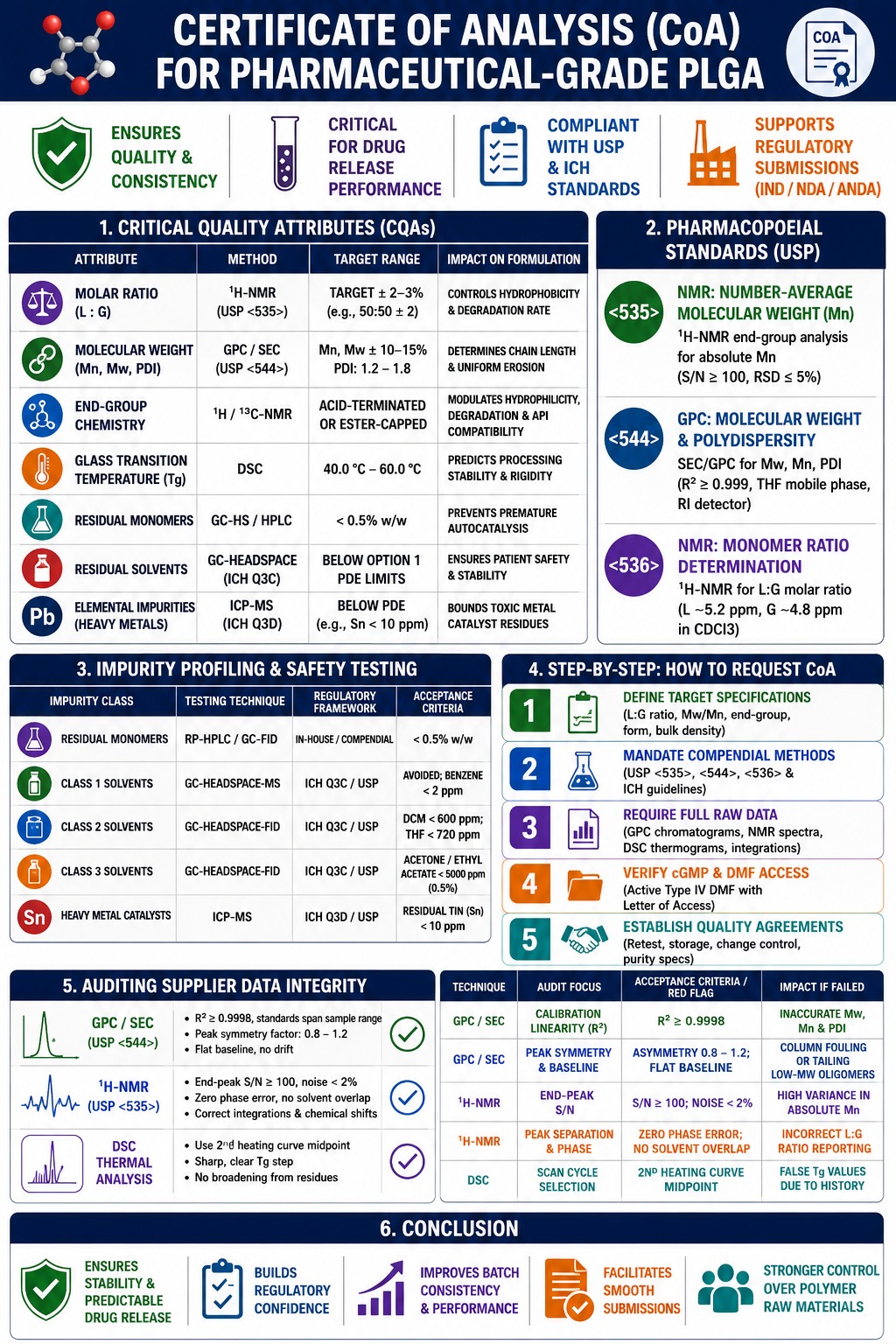
For reliable formulation performance and consistent manufacturing between batches, a Certificate of Analysis (CoA) for Pharmaceutical-Grade PLGA should document important critical quality attributes (CQAs), including weight-average molecular weight (Mw), number-average molecular weight (Mn), polydispersity index (PDI), monomer molar ratio (L:G), glass transition temperature (Tg), and end-group capping status. Collectively, these characteristics provide evidence that the polymer lot possesses the expected chemical and physical properties and will undergo degradation in a predictable manner without adversely affecting the structural integrity or drug-release behavior of the finished formulation.
PLGA excipients can exhibit structural heterogeneity because of variations associated with ring-opening polymerization and subsequent processing. Consequently, a robust CoA should provide quantitative analytical results for the major physical and chemical characteristics that influence polymer quality, consistency, and performance.
Monomer Molar Ratio (Lactide to Glycolide)
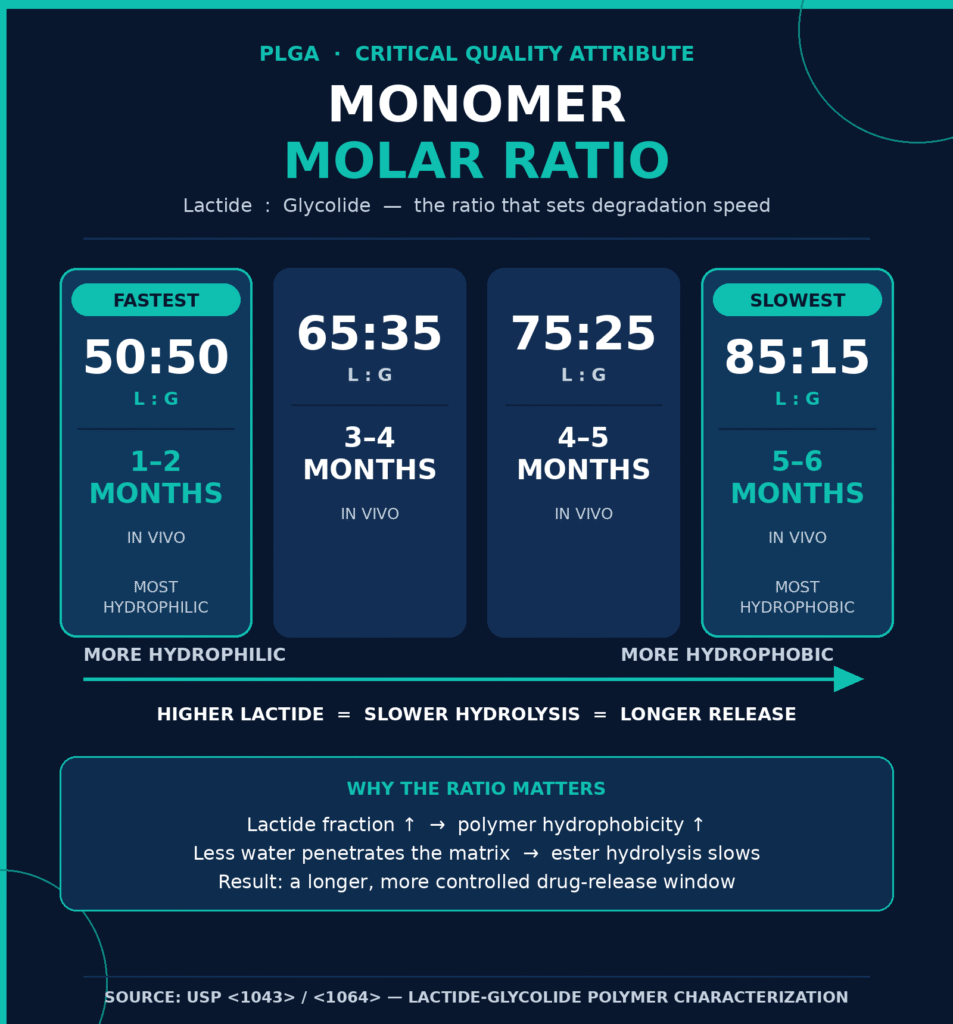
The molar proportion of D,L-lactide (or lactic acid) relative to glycolide (or glycolic acid) is an important determinant of the polymer’s hydrophobicity and crystalline structure. Increasing the lactide fraction generally produces a more hydrophobic polymer, which can reduce water penetration into the matrix and consequently slow hydrolytic ester cleavage. Commonly available commercial compositions include 50:50, 65:35, 75:25, and 85:15. As an example, 50:50 PLGA generally undergoes degradation over approximately 1 to 2 months, while an 85:15 copolymer may remain in vivo for approximately 5 to 6 months.
Understand structural and degradation variations between polymer grades with this analysis on PLGA 50:50 vs. PLGA 75:25 Comparison.
Molecular Weight Distribution (Mw, Mn, and PDI)
The molecular weight characteristics of PLGA have a major influence on its mechanical properties, solution viscosity, matrix erosion behavior, and drug diffusion kinetics. The CoA should therefore identify the number-average molecular weight (Mn), weight-average molecular weight (Mw), and Polydispersity Index (PDI = Mw / Mn). A relatively narrow PDI, commonly within the range of 1.2 to 1.8, reflects a more consistent distribution of polymer chain lengths. Maintaining an appropriate molecular weight distribution is particularly important because low-molecular-weight oligomeric fractions can contribute to accelerated degradation and premature burst release.
See how molecular weight distribution impacts drug delivery kinetics in Understanding PDI in Pharmaceutical Polymers.
End-Group Functionalization
Commercial PLGA polymers may contain free carboxylic acid end-groups, referred to as acid-terminated polymers, or esterified end-groups, referred to as ester-capped polymers, including alkyl esters. Acid-terminated PLGA is generally more hydrophilic and can demonstrate a faster initial degradation rate. It may also exhibit increased reactivity toward basic active substances. Ester-capped PLGA, in comparison, generally provides greater chemical stability and a slower degradation profile. The CoA should clearly identify the end-group chemistry and confirm the assigned end-group identity using appropriately validated spectroscopic techniques.
Thermal Glass Transition Temperature (Tg)
The glass transition temperature represents the temperature range at which the polymer changes from a relatively rigid, glassy state to a more flexible, rubbery state. Amorphous PLGA copolymers generally demonstrate Tg values in the approximate range of 40 °C to 60 °C. Determination of Tg using Differential Scanning Calorimetry (DSC) provides useful information regarding polymer characteristics and can help assess physical stability during processes involving elevated temperatures, including hot-melt extrusion, spray drying, and terminal sterilization.
Examine thermal properties across biodegradable materials in this Degradation Rates Comparison for PLGA, PLA, and PCL.
| Critical Quality Attribute (CQA) | Primary Analytical Method | Target Specification Range | Impact on Formulation Performance |
|---|---|---|---|
| Molar Ratio (L:G) | 1H-NMR Spectroscopy (USP ) | Target ratio ± 2-3% (e.g., 50:50 ± 2) | Controls polymer hydrophobicity and degradation rate |
| Number-Average MW (Mn) | 1H-NMR / GPC (USP , ) | Target Mn ± 10% (7,000 – 100,000 Da) | Determines chain length and end-group concentration |
| Weight-Average MW (Mw) | GPC / SEC-RI (USP ) | Target Mw ± 10-15% | Governs structural integrity and solution viscosity |
| Polydispersity Index (PDI) | GPC / SEC Calculation (Mw / Mn) | 1.2 – 1.8 | Ensures uniform erosion and prevents burst release |
| End-Group Chemistry | 1H / 13C-NMR Spectroscopy | Acid-terminated or Ester-capped | Modulates hydrophilicity, degradation rate, and API compatibility |
| Glass Transition Temp (Tg) | Differential Scanning Calorimetry (DSC) | 40.0 °C – 60.0 °C | Predicts processing stability, storage condition, and rigidity |
| Residual Monomers | GC-HS / HPLC | < 0.5% w/w (Lactide / Glycolic acid) | Prevents premature autocatalysis and API degradation |
| Residual Solvents | GC-Headspace (ICH Q3C) | Below Option 1 PDE limits (e.g., DCM < 600 ppm) | Guarantees patient safety and product stability |
| Elemental Impurities | ICP-MS (ICH Q3D / USP ) | Below PDE (e.g., Tin catalyst < 10 ppm) | Bounds toxic metal catalyst residues |
Pharmacopoeial Standards and Testing Methods for a Certificate of Analysis (CoA) for Pharmaceutical-Grade PLGA
A Certificate of Analysis (CoA) for Pharmaceutical-Grade PLGA should be prepared in alignment with relevant United States Pharmacopeia standards, particularly General Chapters USP , USP , and USP , where applicable, to support the evaluation of chemical identity, molecular weight distribution, and monomer ratios. These compendial chapters provide standardized analytical approaches intended to improve consistency in testing and reduce discrepancies between supplier laboratories and pharmaceutical development laboratories.
Historically, the lack of standardized compendial monographs for synthetic lactide-glycolide polymers resulted in differences in analytical practices between testing laboratories. To promote greater consistency in polymer characterization, the United States Pharmacopeia (USP) introduced dedicated general chapters addressing LG polymers.
USP : NMR Number-Average Molecular Weight Determination
USP General Chapter describes proton Nuclear Magnetic Resonance (1H-NMR) spectroscopy procedures for determining the number-average molecular weight (Mn) of lactide-glycolide polymers. In contrast to Gel Permeation Chromatography, which determines relative molecular weight using calibration standards, NMR end-group analysis can provide an absolute Mn measurement without dependence on polymer calibration standards.
The procedure determines the relationship between the integrated signals corresponding to the repeating monomer units and those associated with terminal end-group protons. The number-average molecular weight is determined using the compendial formula:
Mn = (nrepeat / nend) × Mrepeat
where nrepeat represents the integrated signal area associated with the lactide and glycolide repeating units, nend represents the integrated area corresponding to end-group protons, and Mrepeat represents the average molar mass calculated according to the specific lactide-to-glycolide molar ratio. USP specifies system suitability requirements, including a signal-to-noise ratio (S/N) of ≥ 100 for end-group peaks and a relative standard deviation (RSD) of ≤ 5.0% across replicate acquisitions.
Learn how compendial testing supports regulatory approval in Polymer Sameness Evaluation for ANDA Filings.Learn more about demonstrating analytical equivalence with Q1/Q2 Equivalence Testing Procedures.
USP : GPC Molecular Weight and Polydispersity Determination
USP General Chapter establishes Size Exclusion Chromatography (SEC) / Gel Permeation Chromatography (GPC) conditions for the determination of Mw, Mn, and PDI. The compendial configuration uses an isocratic HPLC system with a Refractive Index (RI) detector and porous polystyrene-divinylbenzene columns, such as the Styragel HR series, connected in series. Tetrahydrofuran (THF) is used as the mobile phase at a flow rate of 1.0 mL/min, with the column maintained at 35 °C.
Molecular weight distributions are obtained from calibration curves prepared using narrow-polydispersity polystyrene reference standards. The calibration procedure requires a correlation coefficient (R2) of ≥ 0.999.
USP : NMR Monomer Ratio Determination
USP General Chapter establishes a standardized 1H-NMR spectroscopy procedure for determining the lactide-to-glycolide molar ratio within the copolymer backbone. The analytical method distinguishes the multiplet signals associated with the methine (-CH-) protons of lactide units at approximately 5.2 ppm and the methylene (-CH2-) protons of glycolide units at approximately 4.8 ppm when analyzed in deuterated chloroform (CDCl3). Integration of these characteristic spectral regions allows determination of the respective mole fractions of the monomer components.
Learn how compendial testing supports regulatory approval in Polymer Sameness Evaluation for ANDA Filings.
Impurity Profiling and Safety Testing for PLGA Characterization
Impurity profiling of a PLGA CoA should include the measurement of residual lactide and glycolide monomers, residual organic solvents in accordance with ICH Q3C, and trace elemental catalysts in accordance with ICH Q3D. Controlling these substances is important for minimizing premature hydrolytic degradation and potential toxicological concerns. Appropriate impurity limits help ensure that the excipient remains stable during storage and does not introduce undesirable chemical species into parenteral drug products.
Chemical synthesis and polymer processing can leave small quantities of residual substances within the final polymer. These residues can influence shelf-life stability, degradation behavior, and patient safety. A Certificate of Analysis for pharmaceutical-grade PLGA should therefore define acceptable limits for three principal impurity categories.
Residual Monomer Content
Incomplete purification can result in unreacted D,L-lactide and glycolide remaining within the polymer matrix. Free monomeric carboxylic acids can accelerate hydrolytic ester cleavage during storage and may cause a progressive and uncontrolled reduction in polymer molecular weight. Residual monomer concentration can be measured using Gas Chromatography (GC) or Reverse-Phase High-Performance Liquid Chromatography (RP-HPLC), with standard pharmaceutical specifications commonly establishing limits below 0.5% w/w.
Residual Solvents (ICH Q3C / USP )
The manufacture and purification of PLGA may involve organic solvents, including dichloromethane (DCM), acetone, ethyl acetate, or tetrahydrofuran (THF). The CoA should identify the residual solvent concentrations determined using Static Headspace Gas Chromatography with Flame Ionization Detection (GC-HS-FID) or Mass Spectrometry (GC-MS). Reported concentrations should comply with International Council for Harmonisation (ICH) Q3C requirements based on Permitted Daily Exposure (PDE) criteria.
Read detailed guidelines on controlling volatile organic compounds in Residual Solvent Control in Microsphere Manufacturing.
Elemental Impurities (ICH Q3D / USP / )
Ring-opening polymerization of lactide and glycolide generally uses organometallic catalysts, with tin(II) 2-ethylhexanoate (stannous octoate) being a commonly used catalyst. Residual heavy metal catalysts may present toxicological concerns, particularly when the polymer is incorporated into long-acting parenteral formulations. A pharmaceutical-grade CoA should therefore include elemental impurity results generated using Inductively Coupled Plasma Mass Spectrometry (ICP-MS) in accordance with ICH Q3D. The results should demonstrate that residual tin (Sn) concentrations remain below the applicable safety thresholds, typically < 10-20 ppm.
| Impurity Class | Primary Testing Technique | Applicable Regulatory Framework | Target Acceptance Criteria |
|---|---|---|---|
| Residual Monomers | RP-HPLC / GC-FID | In-house validated / Compendial | < 0.5% w/w total free lactide/glycolide |
| Class 1 Residual Solvents | GC-Headspace-MS | ICH Q3C / USP | Avoided; Benzene < 2 ppm if present |
| Class 2 Residual Solvents | GC-Headspace-FID | ICH Q3C / USP | DCM < 600 ppm; THF < 720 ppm |
| Class 3 Residual Solvents | GC-Headspace-FID | ICH Q3C / USP | Acetone / Ethyl Acetate < 5000 ppm (0.5%) |
| Heavy Metal Catalysts | ICP-MS | ICH Q3D / USP | Residual Tin (Sn) < 10 ppm |
Step-by-Step Guide: How to Request a Certificate of Analysis (CoA) for Pharmaceutical-Grade PLGA
Obtaining a Certificate of Analysis (CoA) for Pharmaceutical-Grade PLGA should involve more than simply requesting a summary document from the supplier. The process should begin with clearly defined raw material specifications, followed by requirements for compendial testing, complete raw analytical data, verification of DMF documentation, and formalization of quality and change-control expectations. This structured approach helps ensure that each supplied polymer lot meets the international quality requirements applicable to clinical and commercial drug manufacturing.
To help ensure that the issued CoA can adequately support regulatory requirements associated with IND, NDA, or ANDA drug product submissions, procurement personnel and analytical leads should implement the following five-step procurement protocol.
- Define Target Physicochemical SpecificationsEstablish comprehensive raw material specifications according to the intended drug-release requirements. The specification should identify the required lactide-to-glycolide molar ratio, such as 50:50, target molecular weight parameters (Mw, Mn), end-group functionality, including acid-terminated versus ester-capped polymer, physical form such as powder, flakes, or pearls, and bulk density.
- Mandate Compendial and Validated Analytical ProtocolsProcurement documentation should specify that analytical characterization is performed according to applicable current USP general chapters, including USP , , and , together with relevant ICH guidelines, rather than relying exclusively on non-validated vendor-internal procedures. GPC testing requirements should specify RI detection with THF as the mobile phase and should require reporting of both absolute and relative molecular weight measurements.
- Require Full Analytical Raw Data PackagesA single-page summary CoA should not be considered sufficient when detailed analytical verification is required. Suppliers should be requested to provide comprehensive analytical data packages containing raw GPC chromatograms with baseline integration markings, calibration curve overlays, 1H-NMR spectra with clearly identified baseline integrations, and DSC thermograms demonstrating the glass transition inflections. Access to these raw records allows the receiving organization to independently assess the reliability of the reported results.
- Verify cGMP Compliance and Drug Master File AccessThe purchaser should verify that the PLGA material is manufactured in accordance with current Good Manufacturing Practice (cGMP) guidelines and is supported by an active Type IV Drug Master File (DMF) registered with the US FDA or EMA. A formal Letter of Access (LOA) should also be requested where applicable so that the relevant regulatory authorities can review the supplier’s DMF as part of the drug product evaluation process.
- Establish Quality and Change-Control AgreementsA formal Quality Agreement should define important quality responsibilities and controls. The agreement should address re-test intervals, storage requirements, such as storage in moisture-impermeable containers at -20 °C, notification requirements for changes to synthesis routes, and clearly defined purity specifications. These provisions help ensure that changes capable of affecting polymer performance are appropriately assessed and communicated.
Review benchmarking methodologies for target specifications at PLGA Characterization for Reference Listed Drugs (RLD).
Auditing Supplier Data Integrity for a Certificate of Analysis (CoA) for Pharmaceutical-Grade PLGA
Auditing a Certificate of Analysis (CoA) for Pharmaceutical-Grade PLGA should include detailed examination of raw GPC chromatograms, 1H-NMR integration baselines, and DSC thermograms. The objective is to verify instrument performance, calibration, peak symmetry, integration accuracy, and system suitability. Independent examination of raw analytical records provides greater confidence that the reported polymer characteristics accurately represent the tested material rather than resulting from baseline artifacts, calibration problems, or integration errors.
After receiving the supplier CoA and associated analytical data package, quality control (QC) and quality assurance (QA) personnel should conduct a structured analytical review. Examination of the underlying data can identify potential problems associated with instrument calibration drift, incorrect baseline selection, inappropriate peak integration, or other analytical deficiencies before the material is accepted for manufacturing or formulation use.
Discover how erosion profiles affect audit checks in Bulk Erosion vs. Surface Erosion Mechanisms.
Auditing GPC/SEC Chromatograms
During the audit of GPC chromatograms, the reviewer should assess whether the elution profile is appropriately shaped and symmetrical. Peak tailing or fronting may indicate column fouling or non-specific interactions between the polymer and the column packing material. The calibration curve prepared with narrow-polydispersity polystyrene standards should encompass the molecular weight distribution of the analyzed sample. The correlation coefficient (R2) should remain ≥ 0.9998. System suitability records should additionally demonstrate that baseline drift remained minimal and did not interfere with accurate integration throughout the analytical run.
Auditing 1H-NMR Spectra
For verification of compliance with USP and , the 1H-NMR spectra should exhibit stable, well-phased, and appropriately corrected baselines. Baseline noise should remain below 2% of the intensity of the primary monomer signal, while end-group resonance signals should demonstrate a signal-to-noise ratio (S/N) of ≥ 100. Chemical shifts should be appropriately calibrated against an internal reference, such as tetramethylsilane (TMS) at 0 ppm. The auditor should also verify that solvent-related signals, including chloroform at approximately 7.26 ppm or water at approximately 1.56 ppm, do not interfere with the integration regions used for critical monomer or end-group measurements.
Auditing DSC Thermograms
The glass transition temperature (Tg) stated on the CoA should be reviewed against the second heating scan of the DSC thermogram. The first heating cycle is generally used to remove residual moisture and eliminate the effects of previous thermal processing history. The second heating cycle therefore provides a more representative measurement of the polymer matrix’s glass transition midpoint. A broadened Tg transition step may indicate a broad molecular weight distribution, plasticization resulting from residual solvents, or partial hydrolytic degradation of the polymer.
Learn about long-term stability and shelf life verification in Shelf Life Analysis of Biodegradable Polymers.
| Analytical Technique | Audit Focus Parameter | Acceptance Criteria / Red Flag Threshold | Consequence of Failure |
|---|---|---|---|
| GPC / SEC (USP ) | Calibration Linearity (R2) | R2 ≥ 0.9998; Polystyrene standards span sample range | Inaccurate Mw, Mn, and PDI calculations |
| GPC / SEC (USP ) | Peak Symmetry & Baseline | Peak asymmetry factor 0.8 – 1.2; Flat baseline | Column fouling or tailing low-MW oligomers |
| 1H-NMR (USP ) | End-Peak Signal-to-Noise | S/N ≥ 100 for end-group protons; Noise < 2% | High variance in absolute Mn determination |
| 1H-NMR (USP ) | Peak Separation & Phase | Zero phase error; No overlap with solvent peaks | Incorrect lactide-to-glycolide ratio reporting |
| DSC Thermal Analysis | Scan Cycle Selection | Determined from 2nd heating curve midpoint | False Tg values due to thermal history |
Conclusion
Implementing a rigorous procedure for requesting and auditing a Certificate of Analysis (CoA) for Pharmaceutical-Grade PLGA is critical for maintaining formulation stability, predictable controlled drug release, and regulatory compliance. Consistent application of appropriate compendial standards helps support reliable batch-to-batch performance, particularly for complex parenteral drug products. By requiring comprehensive transparency, alignment with applicable compendial requirements (USP , , ), controlled impurity specifications under ICH Q3C/Q3D, and access to verifiable raw analytical data, drug developers can exercise stronger control over the quality and consistency of their polymer raw materials. Comprehensive characterization also facilitates regulatory submissions and contributes to predictable in vivo drug delivery performance.
Address manufacturing complexities with expert support for Overcoming Microsphere Development Challenges.
For technical assistance, analytical characterization services, or specialized testing of pharmaceutical-grade biopolymers, visit the ResolveMass Laboratories contact portal at https://resolvemass.ca/contact/.
Frequently Asked Questions
The molecular weight of PLGA can be evaluated using Gel Permeation Chromatography (GPC/SEC), which provides relative weight-average (Mw) and number-average (Mn) molecular weight distributions according to USP . Absolute Mn can also be determined through Nuclear Magnetic Resonance (1H-NMR) end-group analysis in accordance with USP . These measurements help establish polymer chain length and consistency.
Polydispersity Index (PDI = Mw / Mn) describes the distribution of molecular weights within a PLGA sample. A relatively narrow PDI, commonly around 1.2–1.8, indicates a more consistent population of polymer chains and supports predictable degradation. A broader distribution may contribute to variable erosion and less predictable drug-release or burst-release behavior.
Acid-terminated PLGA contains free terminal carboxylic acid groups, which generally increase polymer hydrophilicity and can accelerate degradation. Ester-capped PLGA contains esterified end-groups, such as alkyl esters, and typically demonstrates greater hydrophobicity and slower hydrolysis. The choice of end-group chemistry can therefore affect polymer stability and API compatibility.
The relevant USP general chapters identified for PLGA characterization include USP for 1H-NMR molecular weight determination, USP for GPC/SEC-based molecular weight and polydispersity evaluation, and USP for NMR determination of the monomer ratio. These compendial procedures provide standardized approaches for assessing important PLGA quality attributes.
Residual solvents, including dichloromethane and tetrahydrofuran, can be measured using Static Headspace Gas Chromatography (GC-HS) with Flame Ionization Detection (FID) or Mass Spectrometry (MS). The resulting concentrations should be assessed against the applicable limits established under ICH Q3C and USP . Controlling these residues is important for both product quality and patient safety.
Differential Scanning Calorimetry (DSC) is used to determine the glass transition temperature (Tg) of PLGA, which commonly falls within approximately 40 °C to 60 °C for amorphous PLGA copolymers. Tg provides information about the polymer’s thermal behavior and physical stability. It can also help assess whether processing conditions may adversely affect the polymer matrix.
Stannous octoate is commonly employed as a catalyst during PLGA polymerization, making residual tin (Sn) an important elemental impurity to monitor. ICP-MS can be used to quantify residual tin in accordance with ICH Q3D requirements. Appropriate control of catalyst residues helps minimize potential toxicological concerns and supports the quality and stability of the polymer.
Under the specified USP General Chapter requirements, end-group proton resonance peaks should achieve a signal-to-noise ratio (S/N) of at least 100. Baseline noise should also remain sufficiently low relative to the primary monomer signal. These system suitability requirements help ensure reliable integration of end-group signals and accurate Mn determination.
A Type IV Drug Master File (DMF) contains confidential information concerning the manufacture, specifications, analytical controls, and quality of an excipient such as PLGA. The CoA provides lot-specific analytical results demonstrating that a particular batch meets established specifications. Together, these documents support regulatory assessment and supplier qualification activities.
Reference:
- USP. (n.d.). Lactide-glycolide (LG) polymers. United States Pharmacopeia. https://www.usp.org/excipients/lg-polymers
- United States Pharmacopeia. (2023, December 29). GC 315 prospectus. USP–NF. https://www.uspnf.com/notices/gc-315-prospectus-20231229
- International Council for Harmonisation of Technical Requirements for Pharmaceuticals for Human Use. (2024). ICH harmonised guideline Q3C(R9): Impurities: Guideline for residual solvents. https://database.ich.org/sites/default/files/ICH_Q3C%28R9%29_Guideline_MinorRevision_2024_2024_Approved.pdf
- International Council for Harmonisation of Technical Requirements for Pharmaceuticals for Human Use. (n.d.). Quality guidelines. ICH. https://www.ich.org/page/quality-guidelines (ich.org)
- U.S. Food and Drug Administration. (2017, June). Q3C—Tables and list: Guidance for industry. https://www.fda.gov/media/71737/download (fda.gov)
Get In Touch With Us
About The Author
