

Introduction
Chiral Purity Testing and D-Amino Acid Quantification in a synthetic octapeptide active pharmaceutical ingredient (API) requires high-resolution liquid chromatography coupled with tandem mass spectrometry (LC-MS/MS), supported by deuterated acid hydrolysis and chiral derivatization, to accurately determine sub-0.10% enantiomeric impurities. During solid-phase peptide synthesis (SPPS), repeated chemical coupling and deprotection cycles expose chiral centers to basic reagents and activating agents. These conditions can promote trace α-carbon enolization and subsequent racemization of constituent L-amino acids. Because D-amino acid epimers may modify secondary peptide folding, decrease target binding affinity, or contribute to unpredictable immunogenic responses, quantitative chiral evaluation must be capable of detecting and measuring these impurities at levels well below applicable regulatory reporting thresholds.
Explore high-resolution LC-MS characterization of GLP-1 peptides to accurately quantify trace enantiomeric impurities in synthetic API batches.
The incorporation of non-native D-amino acid enantiomers into a therapeutic octapeptide sequence can interfere with the precise three-dimensional orientation required for biological activity. Conventional reverse-phase liquid chromatography (RP-HPLC) may not adequately resolve peptide diastereomers that differ at only one stereocenter because their macromolecular hydrophobic interactions can remain highly similar. Therefore, total chemical hydrolysis followed by pre-column chiral derivatization is used as a robust analytical workflow for separating and quantifying individual D-amino acid residues.
Evaluate specialized peptide sequencing of GLP-1 drugs for comprehensive primary structure verification and stereocenter profiling.
Establishing reliable Chiral Purity Testing and D-Amino Acid Quantification protocols provides comprehensive traceability of optical purity throughout API process development and batch release. This case study describes the analytical methodology, underlying chemical mechanisms, validation parameters, and regulatory considerations necessary for the accurate quantification of D-amino acid impurities in a synthetic octapeptide API with high analytical precision.
Access expert CRO services for GLP-1 peptide characterization to support end-to-end API process development and analytical release.
Share via:
Quick Summary:
- Chiral purity testing is essential for detecting and quantifying trace D-amino acid impurities in synthetic octapeptide APIs, which can affect peptide folding, biological activity, and immunogenicity.
- Racemization during SPPS can occur when basic reagents and activating agents cause α-carbon enolization, leading to inversion of amino acid stereochemistry.
- Deuterated acid hydrolysis (6 N DCl) helps distinguish genuine D-amino acid impurities from hydrolysis-induced artifacts by introducing a measurable +1.006 Da mass shift.
- Marfey’s derivatization converts L- and D-amino acids into separable diastereomers, enabling accurate quantification using UHPLC-MS/MS.
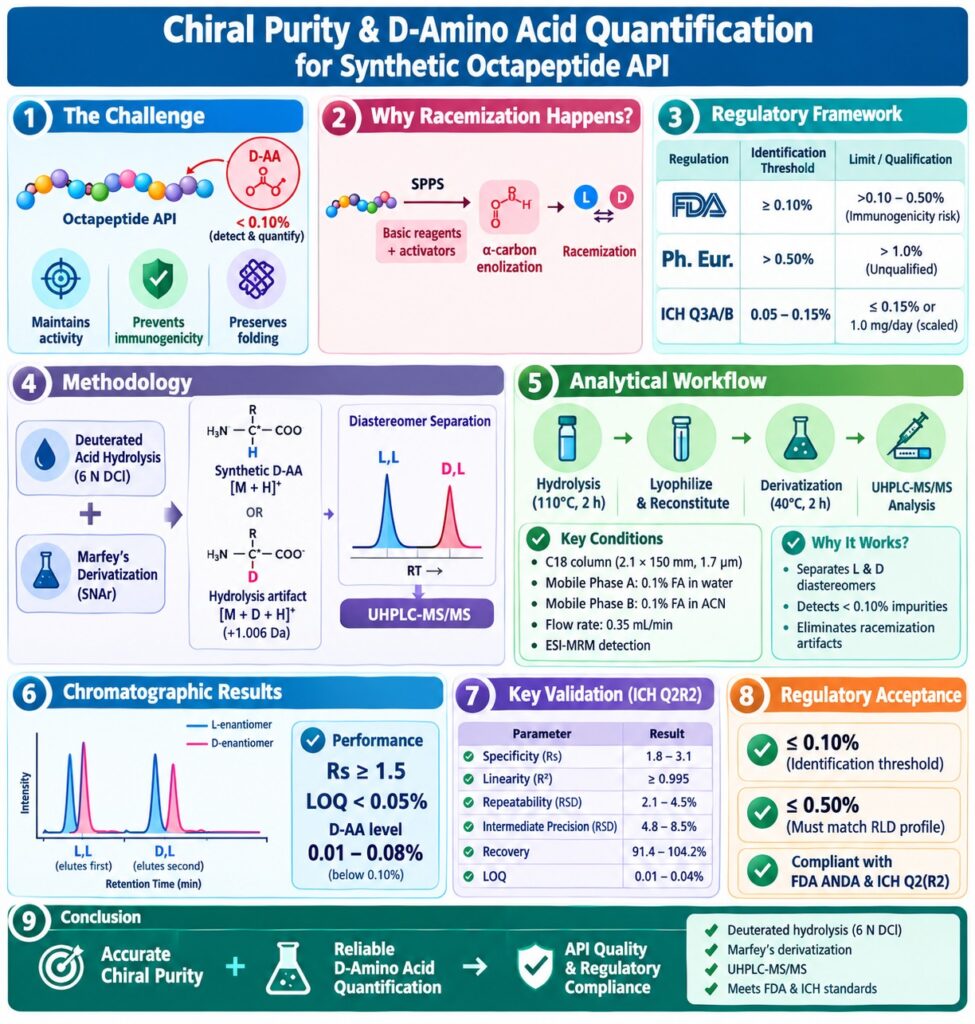
- The analytical workflow achieved baseline separation (Rs 1.8–3.1), LOQ of 0.01–0.04%, and measured D-amino acid levels of 0.01–0.08%, all below the 0.10% FDA identification threshold.
- ICH Q2(R2) validation confirmed strong linearity (R² ≥ 0.995), acceptable precision, 91.4–104.2% recovery, and reliable trace-level detection.
- The method supports FDA ANDA compliance, API sameness, batch release, and stability monitoring, helping ensure accurate chiral purity assessment and consistent synthetic peptide quality.
Regulatory Framework and Impurity Thresholds for Chiral Purity Testing and D-Amino Acid Quantification
Regulatory guidance established by the U.S. Food and Drug Administration (FDA) requires structural characterization and quantitative assessment of peptide-related impurities, including D-amino acid diastereomers, at or above the 0.10% threshold for synthetic peptide drug submissions. For Abbreviated New Drug Applications (ANDAs) referencing recombinant or synthetic listed drugs under section 505(j) of the FD&C Act, a specified D-amino acid epimer exceeding 0.10% requires rigorous immunogenicity risk evaluation, while levels above 0.50% require extensive clinical qualification before they can be considered acceptable.
Review regulatory workflows for GLP-1 peptide impurity characterization to meet FDA guidance and ANDA submission requirements.
For regulatory approval, manufacturers of generic synthetic peptides must demonstrate active ingredient “sameness” relative to the Reference Listed Drug (RLD), including comparable primary sequence, higher-order structure, and impurity profiles. In contrast to conventional small-molecule therapeutics addressed under ICH Q3A/B guidelines, where impurity thresholds are scaled according to maximum daily dose, synthetic peptides containing 40 or fewer amino acids are subject to peptide-specific FDA guidance overlays. Regulatory agencies place particular emphasis on chiral purity because inversion of a single stereocenter within an octapeptide sequence may modify target receptor binding kinetics or contribute to the development of anti-drug antibodies (ADAs) in patient populations.
Review guidelines on regulatory requirements for GLP-1 peptide characterization to establish full API sameness.
| Regulatory Framework | Identification Threshold | Qualification Limit | Acceptance Criteria for New Impurities |
|---|---|---|---|
| FDA Synthetic Peptide ANDA Guidance | ≥ 0.10% | > 0.10% to 0.50% (Requires Immunogenicity Risk Assessment) | Strictly ≤ 0.50%; MUST match RLD profile if > 0.10% |
| European Pharmacopoeia (Ph. Eur.) Monograph 2034 | > 0.50% | > 1.0% | Unqualified known impurities allowed up to 1.0% |
| ICH Q3A(R2) / Q3B(R2) Standard Overlay | 0.05% to 0.15% (Dose-dependent) | 0.15% or 1.0 mg/day TDI | Scaled according to Maximum Daily Dose (MDD) |
Methodological Framework: Deuterated Acid Hydrolysis and Marfey’s Derivatization
A major methodological challenge in D-amino acid quantification is distinguishing genuine synthetic D-amino acid impurities from artificial racemization generated during sample preparation. This challenge can be addressed by using deuterated hydrochloric acid (6 N DCl). During chemical cleavage of peptide bonds at elevated temperatures, proton exchange at the α-carbon can introduce a deuterium atom into hydrolysis-induced epimers. This produces a +1.006 Da mass shift, enabling mass spectrometry to differentiate pre-existing synthetic D-amino acids ([M+H]+) from sample preparation artifacts ([M+D+H]+).
Synthetic D-Amino Acid (Inherent Impurity):
      R
      |
H3N+--C*--COO-  --->  Derivatization  --->  [M + H]+  (Nominal m/z)
      |
      H (Proton preserved from synthesis)

Hydrolysis-Induced D-Amino Acid (Artifact):
      R
      |
H3N+--C*--COO-  --->  Derivatization  --->  [M + D + H]+  (m/z + 1.006 Da)
      |
      D (Deuterium incorporated from 6 N DCl)
The sample preparation and derivatization process consists of three principal stages:
- Deuterated Acid Hydrolysis: Approximately 2.0 mg of the synthetic octapeptide API is combined with 500 μL of 6 N DCl in D2O within a specialized glass reaction vial. The vial headspace is purged with inert Argon gas to minimize exposure to atmospheric oxygen and reduce the potential for oxidative degradation of sensitive side chains, including Tyrosine and Histidine. The vial is then sealed and heated at 110°C for 2 hours. Following hydrolysis, lyophilization is performed to remove excess deuterated acid.
- Marfey’s Derivatization (SNAr Reaction): The dried amino acid hydrolysate is reconstituted in 100 μL of 1 M Sodium Bicarbonate (NaHCO3) and combined with 100 μL of Marfey’s reagent, 1-fluoro-2,4-dinitrophenyl-5-L-alanine amide (L-FDAA; 3 mg/mL in acetone), together with 200 μL of ultra-pure water. The nucleophilic aromatic substitution (SNAr) reaction is conducted at 40°C for 2 hours, resulting in attachment of the chiral dinitrophenyl-L-alaninamide chromophore to the primary amino groups. The reaction is subsequently quenched with 50 μL of 2 N formic acid.
- Diastereomeric Pair Formation: The derivatization reaction transforms otherwise non-separable enantiomeric pairs, consisting of L- and D-amino acids, into distinct diastereomers, specifically L,L and D,L derivatives. These diastereomers possess different physical properties, dipole moments, and partition coefficients, allowing their separation on achiral reverse-phase stationary phases.
Polyfunctional amino acids containing reactive side-chain functional groups require carefully controlled derivatization conditions to minimize the possibility of over-derivatization. Histidine and Tyrosine contain secondary nucleophilic sites within their imidazole and phenol rings, respectively. Under standardized reaction conditions of 40°C for 2 hours, mono-derivatization at the α-amine is predominant, thereby preserving a stoichiometric and linear detector response throughout the calibration range.
Implement validated GLP-1 analog peptide sequencing workflows to ensure accurate chiral derivatization and resolution.
Case Study Execution: Analytical Workflow and UHPLC-MS/MS Results for Synthetic Octapeptide API
Implementation of Chiral Purity Testing and D-Amino Acid Quantification for a representative synthetic octapeptide API demonstrated complete baseline chromatographic separation (Rs ≥ 1.5) and sub-0.05% limits of quantification (LOQ) for all eight constituent amino acid enantiomeric pairs. The analytical assessment confirmed that individual D-amino acid impurities in the commercial octapeptide API batch were present at concentrations ranging from 0.01% to 0.08%, remaining below the FDA identification threshold of 0.10%.
Examine advanced 2D NMR for peptide characterization to confirm stereospecific configurations and higher-order structural fidelity.
The analytical platform employed a high-efficiency C18 stationary phase (2.1 mm × 150 mm, 1.7 μm) operated using a non-linear binary gradient consisting of 0.1% formic acid in water as Mobile Phase A and 0.1% formic acid in acetonitrile as Mobile Phase B. The flow rate was maintained at 0.35 mL/min. Mass spectrometric detection was performed using Electrospray Ionization (ESI) in Multiple Reaction Monitoring (MRM) mode, with precursor-to-product ion transitions selected specifically for each FDAA-derivatized amino acid.
Under standard reverse-phase chromatographic conditions, L,L-diastereomers generally elute before D,L-diastereomers because the L-amino acid side chain interacts with the L-alanine amide moiety of FDAA to produce a more polar conformation. However, basic amino acids with positively charged side chains under acidic mobile phase conditions, particularly Arginine, Lysine, and Histidine, demonstrate an inversion of the typical elution order. In these cases, the D-amino acid derivative elutes before the corresponding L-amino acid derivative.
| Constituent Amino Acid | Native Mass (m/z) | FDAA Diastereomer (m/z) | Retention Time L-Enantiomer (min) | Retention Time D-Enantiomer (min) | Chromatographic Resolution (Rs) | Quantified D-AA Level (% w/w) | Artifact Signal Status (+1 Da) |
|---|---|---|---|---|---|---|---|
| L/D-Aspartic Acid | 134.04 | 386.10 | 4.12 | 5.38 | 2.4 | 0.04% | Fully Corrected |
| L/D-Serine | 106.05 | 358.10 | 3.85 | 4.92 | 2.1 | 0.08% | Fully Corrected |
| L/D-Histidine | 156.08 | 408.13 (Mono) | 6.20 (Elutes 2nd) | 5.15 (Elutes 1st) | 1.8 | 0.03% | Fully Corrected |
| L/D-Arginine | 175.12 | 427.18 | 5.88 (Elutes 2nd) | 4.62 (Elutes 1st) | 2.2 | 0.02% | Fully Corrected |
| L/D-Phenylalanine | 166.09 | 418.14 | 11.45 | 13.80 | 3.1 | 0.05% | Fully Corrected |
| L/D-Leucine | 132.10 | 384.15 | 10.12 | 12.35 | 2.8 | 0.06% | Fully Corrected |
| L/D-Lysine | 147.11 | 399.16 (Mono) | 7.42 (Elutes 2nd) | 6.10 (Elutes 1st) | 2.0 | 0.01% | Fully Corrected |
| L/D-Tyrosine | 182.08 | 434.13 (Mono) | 8.90 | 10.75 | 2.5 | 0.03% | Fully Corrected |
Method Validation Parameters for Chiral Purity Testing and D-Amino Acid Quantification Under ICH Q2(R2)
Analytical method validation for chiral purity testing under ICH Q2(R2) guidelines requires formal evaluation of specificity, linearity, precision, accuracy, limit of detection (LOD), and limit of quantification (LOQ). Validation establishes that the analytical procedure can reliably measure trace D-amino acid epimers in commercial API batches and stability samples while minimizing the influence of matrix-related interference.
- Specificity: Specificity was demonstrated through complete baseline separation (Rs ≥ 1.8) of all eight derivatized L- and D-amino acid pairs in the presence of reagents, degradation products, and hydrolysate matrix components. Isolation of individual MRM mass channels minimized cross-talk between co-eluting non-isobaric amino acids and supported selective detection of the target derivatives.
- Linearity and Range: Calibration curves were prepared individually for each D-amino acid epimer over a relative concentration range of 0.01% to 2.00%. The resulting calibration models demonstrated strong linearity, with correlation coefficients (R² > 0.995) and residual standard factors (RSF < 12%).
- Precision: Repeatability was assessed using six independent replicate preparations of the octapeptide API hydrolysate. Retention time precision remained below 0.8% RSD, while peak area precision was below 4.5% RSD. Intermediate precision assessed across different instruments, column lots, and analysts maintained total variability below 8.5% RSD at the 0.10% threshold.
- Accuracy and Recovery: Accuracy was determined by spiking known concentrations of D-amino acid standards at 0.05%, 0.10%, and 0.50% into native octapeptide hydrolysates. Mean recoveries for all eight amino acid residues ranged from 91.4% to 104.2%, satisfying the ICH Q2(R2) acceptance criteria of 85–115%.
- LOD and LOQ Sensitivity: Using signal-to-noise ratios of 3:1 and 10:1, respectively, the lower limits of quantification (LOQ) for all eight constituent D-amino acids were established between 0.01% and 0.04%. This sensitivity provided adequate analytical capability to monitor and enforce the 0.10% FDA identification threshold.
Incorporate robust peptide aggregation analysis alongside chiral evaluation to detect higher-order physical instability.
| Validation Parameter | ICH Q2(R2) Acceptance Criteria | Experimental Result (Synthetic Octapeptide API) | Compliance Status |
|---|---|---|---|
| Chromatographic Specificity | Peak resolution Rs ≥ 1.5 for all diastereomers | Rs = 1.8 to 3.1 across all 8 enantiomeric pairs | Compliant |
| Linearity Range | R² ≥ 0.990 from 0.01% to 2.0% | R² ≥ 0.995 for all constituent amino acids | Compliant |
| Method Repeatability | Peak area RSD < 10.0% at 0.10% level | RSD = 2.1% to 4.5% | Compliant |
| Intermediate Precision | Peak area RSD < 15.0% across separate days/analysts | RSD = 4.8% to 8.5% | Compliant |
| Spike Recovery (Accuracy) | Mean recovery within 85.0% to 115.0% | 91.4% to 104.2% across all spike levels | Compliant |
| Limit of Quantification (LOQ) | ≤ 0.05% relative to main API concentration | 0.01% to 0.04% across all 8 D-amino acids | Compliant |
Conclusion: Ensuring API Quality and Regulatory Compliance Through Advanced Chiral Purity Testing and D-Amino Acid Quantification
Comprehensive Chiral Purity Testing and D-Amino Acid Quantification, using deuterated acid hydrolysis (6 N DCl) followed by Marfey’s reagent derivatization and UHPLC-MS/MS analysis, provides the analytical rigor required to support synthetic peptide API development and regulatory submissions. Replacing conventional hydrochloric acid with deuterated acid during complete peptide hydrolysis enables analytical laboratories to account for hydrolysis-induced racemization artifacts and thereby obtain a more accurate assessment of synthetic D-amino acid impurities.
Download the complete peptide characterization CRO deliverables checklist to ensure complete analytical compliance for release testing.
Application of this robust analytical methodology supports compliance with FDA ANDA guidelines, including assessment against the 0.10% impurity identification threshold and evaluation of API batch sameness relative to reference listed drugs. In addition, validation of the analytical procedure according to ICH Q2(R2) standards establishes the reliability required for routine quality control release testing and long-term stability monitoring of therapeutic synthetic peptides.
Leverage comprehensive peptide physicochemical characterization services for complete routine quality control and stability release testing.
To discuss specialized analytical support, method development, or regulatory testing for synthetic peptide APIs, contact our laboratory team through the ResolveMass Contact Portal.
Frequently Asked Questions
For synthetic peptides containing 40 or fewer amino acids, the FDA synthetic peptide guidance establishes an identification threshold of 0.10% for individual peptide-related impurities. D-amino acid epimers exceeding this level require further characterization. New impurities between 0.10% and 0.50% also require an appropriate immunogenicity risk assessment.
Marfey’s reagent, or L-FDAA, converts L- and D-amino acids into diastereomeric derivatives that can be separated using conventional reverse-phase UHPLC columns. This approach provides compatibility with high-efficiency C18 or Biphenyl stationary phases and acidic mobile phases. It can also avoid limitations associated with direct chiral stationary phase separations, including reduced efficiency and restricted chromatographic conditions.
Histidine and Tyrosine contain additional reactive groups within their imidazole and phenol side chains, respectively, which can participate in derivatization. Carefully controlled reaction conditions help favor formation of the desired mono-FDAA derivatives. Maintaining the reaction at 40°C for 2 hours supports consistent derivatization and improves reproducibility during LC-MS/MS quantification.
The FDA framework uses a lower identification threshold of 0.10% for relevant synthetic peptide impurities and applies stricter expectations when impurity levels exceed this value. Ph. Eur. Monograph 2034 uses a higher default identification threshold of 0.50% and permits certain known impurities up to 1.0%. Consequently, analytical strategies intended for global submissions may consider the more stringent FDA criteria during method development.
L,L-diastereomers generally elute before D,L-diastereomers during reverse-phase Marfey’s analysis. However, basic amino acids such as Lysine, Arginine, and Histidine can carry positively charged side chains under acidic mobile phase conditions. These charge-dependent interactions can modify retention behavior and result in the D-amino acid derivative eluting before the corresponding L-amino acid derivative.
Validation under ICH Q2(R2) evaluates key characteristics including Specificity, Linearity, Accuracy, Precision, and Sensitivity. The analytical procedure should demonstrate suitable chromatographic separation, consistent calibration performance, acceptable recovery, and reproducible measurements at trace impurity levels. Establishing an appropriate LOQ is particularly important when monitoring D-amino acids near the applicable regulatory threshold.
UHPLC-MS/MS may distinguish intact peptide diastereomers when a stereochemical change produces sufficient differences in conformation, hydrophobicity, or chromatographic behavior. However, intact analysis generally does not provide the same residue-level information as hydrolysis followed by chiral derivatization. Total acid hydrolysis therefore remains valuable for identifying the specific amino acid residue associated with racemization.
Replacing an L-amino acid with its D-enantiomer can alter the local three-dimensional conformation of a synthetic peptide. This stereochemical change may affect target receptor binding, biological activity, and therapeutic efficacy. It can also influence proteolytic stability, aggregation behavior, and potentially the immunogenicity profile of the peptide.
The stability of FDAA-derivatized amino acids during sample handling is important for obtaining reliable quantitative results. Controlled derivatization conditions and appropriate auto-sampler storage help minimize degradation or changes in the dinitrophenyl adducts. Maintaining consistent sample temperature and handling conditions supports reproducible retention times and peak areas during LC-MS/MS analysis.
Reference:
- U.S. Food and Drug Administration. (2024, September 25). Teriparatide injection first generic approval: Quality-related review considerations [PowerPoint slides]. FDA
- Badgujar, D., Paritala, S. T., Matre, S., & Sharma, N. (2024). Enantiomeric purity of synthetic therapeutic peptides: A review. Chirality, 36(3). https://doi.org/10.1002/chir.23652
- Ayon, N. J., Sharma, A. D., & Gutheil, W. G. (2019). LC-MS/MS-based separation and quantification of Marfey’s reagent derivatized proteinogenic amino acid DL-stereoisomers. Journal of the American Society for Mass Spectrometry, 30(3), 448–458. https://doi.org/10.1007/s13361-018-2093-9
- van Tricht, E., & Sänger-van de Griend, C. E. (2025). A practical approach to implementing ICH Q14: Tools for analytical quality by design in capillary electrophoresis method development. Electrophoresis, 46(13–14), 933–953. https://doi.org/10.1002/elps.8110
Get In Touch With Us
About The Author


