


Introduction:
For any company preparing to file an Abbreviated New Drug Application (ANDA), a Comparative Dissolution Study for ANDA is one of the earliest and most consequential pieces of analytical evidence generated during development. It evaluates whether a proposed generic drug releases its active pharmaceutical ingredient (API) into solution in a manner comparable to the Reference Listed Drug (RLD) — data that can support a biowaiver, strengthen a bioequivalence submission, or simply flag a formulation problem long before it becomes a costly clinical failure.
For an ANDA applicant, dissolution testing is far more than measuring the percentage of drug released from a tablet or capsule at a single time point. Done well, it reveals how formulation composition, API particle characteristics, manufacturing process, and coating systems interact to influence drug release — insight that shapes formulation decisions long before a pivotal batch is ever manufactured. FDA’s dissolution framework also emphasizes that methodology is product-specific: where no established USP or FDA method exists, applicants are expected to develop a suitable, discriminating dissolution procedure and justify it with supporting data in the ANDA itself. This article walks through what a comparative dissolution study involves, when FDA expects one, how similarity is judged, and where sponsors most often run into trouble.
Summary:
- A Comparative Dissolution Study for ANDA compares the in-vitro drug-release behavior of a proposed generic against its Reference Listed Drug (RLD) — but the exact requirement depends on dosage form, API properties, and the applicable FDA Product-Specific Guidance (PSG), not a one-size-fits-all rule.
- These studies support bioequivalence justification, BCS-based biowaivers, formulation development, and ongoing quality control, depending on the regulatory strategy chosen.
- The f2 similarity factor (generally ≥50) is the primary tool for judging profile similarity, but ICH M9 sets specific conditions under which f2 is even applicable.
- Studies are typically run across multiple dissolution media and sampling time points, with method selection driven by FDA’s Dissolution Methods Database, USP monographs, and current PSGs.
- Dissolution mismatches are a leading cause of ANDA deficiencies — often traceable to formulation variables like particle size, polymorphic form, or manufacturing process rather than the math itself.
- ResolveMass Laboratories supports comparative dissolution programs as part of full ANDA analytical packages, from method development through profile comparison and regulatory documentation.
1: What Is a Comparative Dissolution Study for ANDA?
A Comparative Dissolution Study for ANDA is an in-vitro comparison of the dissolution profiles of a proposed generic drug product and its RLD under specified experimental conditions, used to determine whether the two products release their active ingredient in a sufficiently similar way.
For an ANDA applicant, dissolution testing is more than measuring the percentage of drug released from a tablet or capsule — it reveals how formulation composition, API properties, manufacturing processes, particle characteristics, and coating systems affect drug release. A typical comparison holds nearly every variable constant between test and reference so that any difference in the resulting profile can be attributed to the formulation itself:
| Parameter | Test Product | Reference Product |
|---|---|---|
| Dosage form | Generic product | RLD |
| Strength | Applicable strength(s) | Corresponding RLD strength |
| Apparatus | Same | Same |
| Dissolution medium | Same | Same |
| Volume | Same | Same |
| Rotation speed | Same | Same |
| Temperature | Same | Same |
| Sampling schedule | Same | Same |
| Analytical procedure | Validated/qualified | Same analytical approach |
Importantly, these conditions should never simply be copied from another product’s method. FDA treats dissolution methodology as product-specific, and the adequacy of the proposed method and acceptance criteria is evaluated individually during ANDA review — a consideration that carries through the entire generic drug development process at a CDMO.
2: Why Is Comparative Dissolution Important for Generic Drug Development?
Comparative dissolution matters because it is often the most sensitive early indicator of whether a generic formulation will behave like the RLD in the body — well before any clinical study is run. A formulation that passes assay and content-uniformity testing can still show a meaningfully different release profile from the reference product.
Dissolution behavior can be influenced by a long list of formulation and process variables, including:
- API solubility, particle size, polymorphic form, and salt form
- Excipient selection and concentration
- Granulation process, compression force, and tablet hardness
- Coating characteristics and disintegration behavior
- Release-controlling polymers and formulation viscosity
- Manufacturing process consistency and drug loading
This is precisely why dissolution testing is treated as a formulation-development tool as much as a regulatory checkbox — and why it plays a particularly large role for generic drug development involving poorly soluble APIs, where small formulation changes can produce outsized effects on release rate.
3: When Is a Comparative Dissolution Study Required for ANDA Approval?
A Comparative Dissolution Study for ANDA is required in some form for essentially all solid oral dosage forms, but there is no single universal requirement that applies identically to every product — the specific study design depends on the applicable PSG, dosage form, API properties, and proposed bioequivalence approach.
Before finalizing a study design, applicants should evaluate:
- The FDA Product-Specific Guidance for the drug product
- The FDA Dissolution Methods Database
- Applicable USP dissolution requirements
- Immediate-release versus modified-release characteristics
- API solubility and permeability (BCS classification)
- Whether a BCS-based biowaiver is being pursued
- Strength-related requirements and any product-specific FDA recommendations
FDA routinely updates its PSG database, making it an essential starting point regardless of whether development is being managed through a generic drug development CRO for ANDA or an internal team.
4: Situations Where Comparative Dissolution Is Particularly Relevant
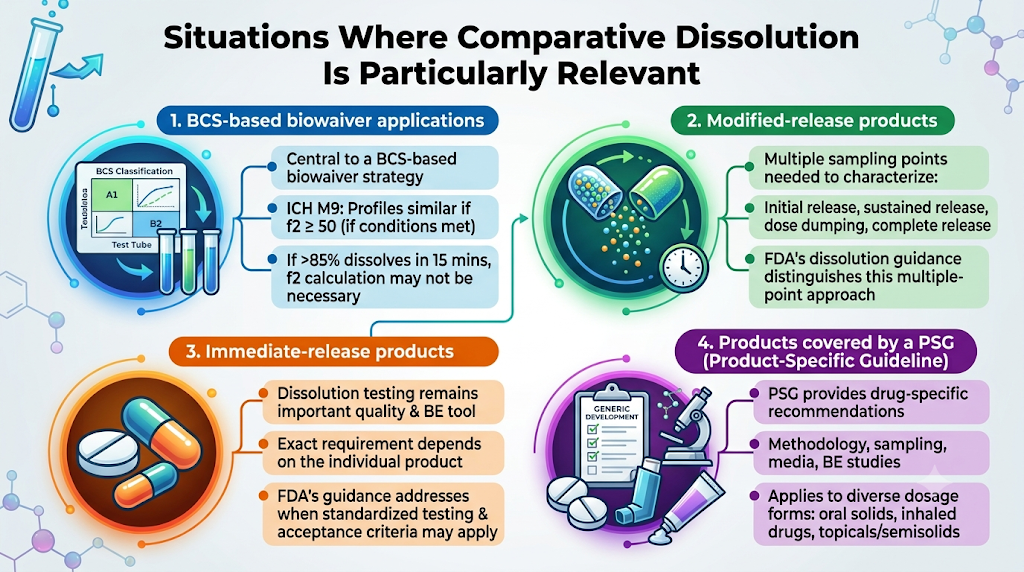
BCS-based biowaiver applications. Comparative dissolution is central to a BCS-based biowaiver strategy. Under ICH M9, profiles may be considered similar when f2 ≥ 50, provided the conditions for applying f2 are met; if both products dissolve at least 85% within 15 minutes, an f2 calculation may not even be necessary under the guideline’s criteria.
Modified-release products. Multiple sampling points are needed to characterize initial release, sustained release, potential dose dumping, and complete drug release — FDA’s dissolution guidance distinguishes this multiple-point approach from the simpler methods sometimes appropriate for immediate-release products.
Immediate-release products. Dissolution testing remains an important quality and bioequivalence-related tool, though the exact requirement depends on the individual product; FDA’s guidance for highly soluble drug substances addresses when standardized testing and acceptance criteria may apply.
Products covered by a PSG. A PSG can provide drug-specific recommendations on methodology, sampling, media, and bioequivalence studies, so checking the current PSG should be one of the first steps in planning — whether the product is an oral solid, an inhaled dosage form covered under generic drug development for inhaled drug products, or a topical or semisolid product supported through CDMO services for generic topical and semisolid drug products.
5: How Is a Comparative Dissolution Study Designed and Performed?
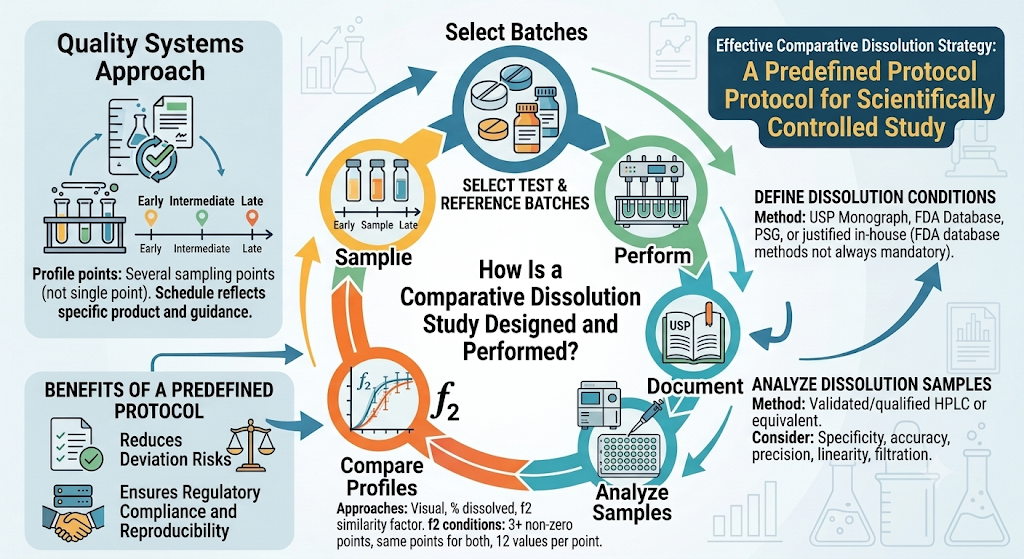
A scientifically controlled comparative dissolution study follows a predefined protocol built around five core steps: selecting representative batches, defining dissolution conditions, sampling at multiple time points, analyzing samples with a validated method, and statistically comparing the resulting profiles.
Step 1 — Select test and reference batches. The test batch should represent the formulation intended for commercial production or the appropriate pivotal development batch, compared against multiple market-sourced RLD lots to account for reference-product variability.
Step 2 — Select dissolution conditions. The method may be based on a USP monograph, the FDA Dissolution Methods Database, the applicable PSG, or a scientifically justified in-house method — FDA notes that database-recommended methods are not automatically mandatory, and alternative methods may be considered when appropriately supported.
Step 3 — Evaluate multiple time points. A profile generally requires several sampling points (early, intermediate, and late release) rather than a single endpoint, with the schedule reflecting the specific product and applicable guidance.
Step 4 — Analyze dissolution samples. Samples are typically analyzed by HPLC or another validated/qualified method, with attention to specificity, accuracy, precision, linearity, filter compatibility, and potential excipient interference.
Step 5 — Compare the profiles. Depending on regulatory strategy, comparison may involve visual assessment, percent dissolved at specified time points, the f2 similarity factor, or other statistical approaches. For f2 analysis, ICH M9 specifies conditions including at least three non-zero time points, identical time points for test and reference, 12 individual values per time point, and defined variability limits.
6: What Is the f2 Similarity Factor?
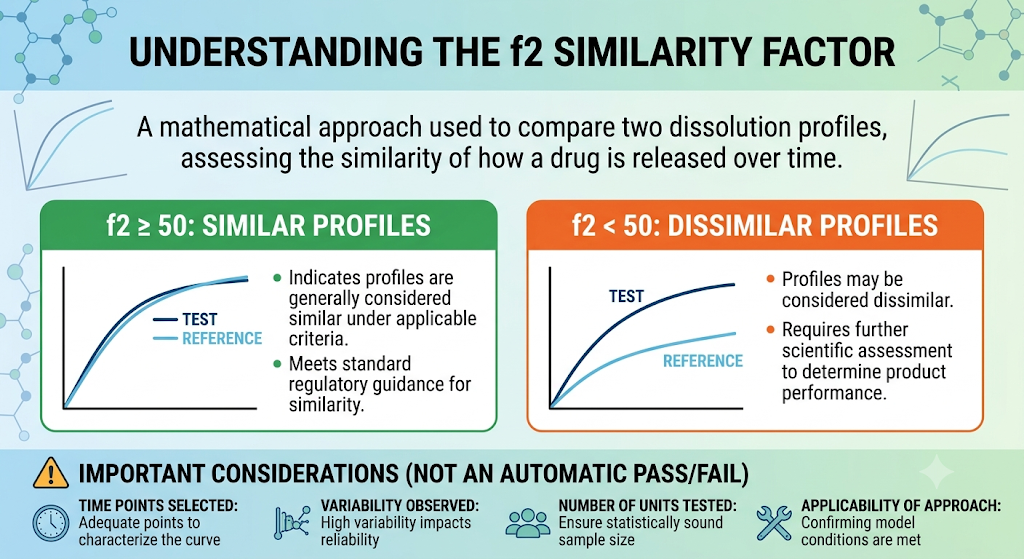
The f2 similarity factor is the standard mathematical approach for comparing two dissolution profiles: an f2 value of 50 or greater is generally considered evidence of similarity, provided the required conditions for the calculation are satisfied.
- f2 ≥ 50: profiles generally considered similar under applicable criteria
- f2 < 50: profiles may be considered dissimilar and require further scientific assessment
f2 should never be treated as an automatic pass/fail calculation independent of study design — the time points selected, variability observed, number of units tested, and applicability of the statistical approach all affect whether the resulting number actually reflects real product performance.
7: What Dissolution Conditions Must Be Controlled?
| Variable | Key Consideration |
|---|---|
| Apparatus | USP Apparatus 1 (basket) or 2 (paddle); product-specific selection |
| Dissolution medium | Water, HCl medium, buffers, or surfactant-containing media as scientifically justified |
| Temperature | Maintained near physiological conditions per USP/FDA requirements |
| Agitation | Excessive speed can mask formulation differences; insufficient speed can produce a non-discriminating method |
| Sampling | Time points must capture the meaningful portion of the release curve |
| Filtration | Filter selection evaluated for adsorption, drug loss, or interference |
Comparative Dissolution vs. Routine QC Dissolution Testing
| Feature | Comparative Dissolution | Routine QC Dissolution |
|---|---|---|
| Primary purpose | Compare test and reference | Control batch quality |
| Main comparison | Generic vs. RLD | Batch vs. specification |
| Typical use | Development, BE, biowaiver, regulatory support | Release and stability testing |
| Sampling | Often multiple time points | Product-specific |
| Output | Dissolution profiles / similarity | Specification compliance |
8: What Happens If Dissolution Profiles Are Not Similar?
If test and reference profiles are not similar, the result should prompt a scientific investigation rather than simply adjusting the calculation. Relevant variables to review include formulation composition, API particle size and solid-state properties, excipient functionality, compression parameters, disintegration behavior, coating characteristics, manufacturing variability, and the dissolution method itself (medium, apparatus, agitation, sampling, analytical variability).
FDA’s SUPAC-IR Q&A also recognizes that when f2 does not demonstrate similarity, a scientifically justified assessment may sometimes be presented depending on the circumstances, rather than treating the numerical result in isolation. In many cases, the formulation requires optimization before the study is repeated.
9: Common Mistakes in Comparative Dissolution Studies
- Using an inappropriate or non-discriminating dissolution method
- Failing to check the current FDA Product-Specific Guidance
- Relying on outdated database information without verification
- Comparing test and reference under mismatched conditions
- Applying f2 when its underlying assumptions are not met
- Using nonrepresentative test batches or a single RLD lot
- Treating dissolution testing as a purely numerical exercise rather than a formulation-diagnostic tool
10: Choosing the Right Partner for ANDA Dissolution Programs
Dissolution testing should be integrated into a broader analytical and regulatory strategy rather than run as an isolated lab exercise — which is part of why sponsors weigh CRO vs. in-house ANDA development and CDMO vs. CRO for generic drug development early in program planning. The right partner should also fit into the realistic generic drug development timeline at a CDMO, since dissolution method development and profile comparison sit on the critical path to ANDA submission. For sponsors managing both FDA and Health Canada filings, working with a pharmaceutical CDMO supporting both the US and Canada can simplify cross-border testing strategy.
11: Key Takeaways for ANDA Applicants
Before initiating a Comparative Dissolution Study for ANDA, ask:
- What does the current FDA Product-Specific Guidance require?
- Is a USP or FDA dissolution method available, or is a product-specific method needed?
- Is the product immediate-release or modified-release?
- Is a BCS-based biowaiver being considered, and does the product qualify?
- Are the selected sampling points and dissolution media scientifically justified?
- Is the method sufficiently discriminating, and is f2 actually applicable to the data?
- Are the test and reference batches representative of commercial production?
Conclusion:
A Comparative Dissolution Study for ANDA is an important tool for demonstrating comparable in-vitro drug-release behavior between a proposed generic product and its Reference Listed Drug. However, the study design should be driven by the specific product, FDA guidance, dosage form, formulation characteristics, and proposed bioequivalence or biowaiver strategy—not by a one-size-fits-all protocol.
FDA resources such as the Product-Specific Guidance database, Dissolution Methods Database, USP requirements, and applicable FDA/ICH guidance should be evaluated before finalizing the study design.
For BCS-based approaches, dissolution profile similarity can play a particularly important role, with ICH M9 establishing defined criteria for comparative dissolution and f₂ evaluation.
For generic manufacturers preparing an ANDA, investing in a scientifically appropriate dissolution strategy early can help identify formulation differences, strengthen the analytical package, and reduce the potential for avoidable regulatory questions.
Frequently Asked Questions:
Comparative dissolution testing primarily compares the dissolution profiles of a test product and a reference product, while routine dissolution testing is generally used to confirm that individual production batches meet established quality specifications. Comparative studies are commonly associated with development, bioequivalence, or biowaiver evaluations, whereas routine dissolution is an important component of ongoing quality control.
The f₂ similarity factor is a mathematical method used to compare two dissolution profiles. Under applicable regulatory conditions, an f₂ value of 50 or greater is generally interpreted as indicating similarity. However, f₂ should only be applied when the required experimental and statistical conditions are satisfied; it should not be treated as an isolated pass/fail calculation.
The number of dosage units depends on the applicable regulatory guidance and study design. For profile comparisons under ICH M9, 12 individual dosage units are used at each specified time point. Product-specific FDA guidance may establish different or additional requirements, so the applicable guidance should always be checked before finalizing the protocol.
Comparative dissolution is particularly important when an applicant is pursuing a BCS-based biowaiver. Under the applicable BCS framework, dissolution characteristics of the test and reference products must meet defined criteria. For eligible products, demonstrating appropriate dissolution behavior can support the scientific justification for waiving an in-vivo bioequivalence study.
Reference
- Anand OM, Yu LX, Conner DP, Davit BM. Dissolution testing for generic drugs: an FDA perspective. The AAPS journal. 2011 Sep;13(3):328-35.https://link.springer.com/article/10.1208/s12248-011-9272-y
- Hulawale A, Sawant M, Jogdand A. Comparing Branded and Generic Drug Dissolution Under Biowaiver Criteria: A Review. International Journal of Creative and Open Research in Engineering and Management. 2026;2(05).https://ijcope.org/article/comparing-branded-and-generic-drug-dissolution-under-biowaiver-criteria-a-review/
- Al Ameri MN, Nayuni N, Kumar KA, Perrett D, Tucker A, Johnston A. The differences between the branded and generic medicines using solid dosage forms: In-vitro dissolution testing. Results in pharma sciences. 2012 Jan 1;2:1-8.https://www.sciencedirect.com/science/article/pii/S2211286311000157
- Gelber L. Obtaining Approval of a Generic Drug, Pre-1984 to the Present. InThe Pharmaceutical Regulatory Process 2008 Dec 2 (pp. 303-332). CRC Press.https://books.google.com/books?hl=en&lr=&id=rCUwEQAAQBAJ&oi=fnd&pg=PA283&dq=What+Is+a+Comparative+Dissolution+Study+and+When+Is+It+Required+for+Generic+Drug+ANDA+Approval%3F&ots=ndcbh07qSn&sig=4cBofsQMA94I_SiaaeySPJ_hBls
- Raw AS, Furness MS, Gill DS, Adams RC, Holcombe Jr FO, Yu LX. Regulatory considerations of pharmaceutical solid polymorphism in Abbreviated New Drug Applications (ANDAs). Advanced drug delivery reviews. 2004 Feb 23;56(3):397-414.https://www.sciencedirect.com/science/article/pii/S0169409X03002242
About the Author


