


Introduction:
The CTD Format for Generic ANDA and ANDS Submissions plays a fundamental role in the successful approval of generic pharmaceutical products in the United States and Canada. Whether preparing an Abbreviated New Drug Application (ANDA) for the U.S. FDA or an Abbreviated New Drug Submission (ANDS) for Health Canada, sponsors must organize their scientific, quality, nonclinical, and clinical information in a standardized format that regulatory reviewers can efficiently evaluate.
The Common Technical Document (CTD), developed through the International Council for Harmonisation (ICH), has become the global standard for regulatory submissions. While generic drug applications typically rely on demonstrating pharmaceutical equivalence and bioequivalence rather than conducting extensive clinical trials, the quality expectations remain exceptionally high. This is especially true for complex generics — including peptide CDMO services supporting synthetic peptide APIs and long-acting injectable formulations — where regulators expect complete analytical evidence, validated methods, impurity profiles, stability data, manufacturing controls, and comprehensive documentation.
A well-prepared CTD not only improves submission quality but also reduces review questions, shortens approval timelines, and demonstrates the scientific credibility of the sponsor. In this article, we explore the role of the CTD format in generic ANDA and ANDS submissions, its structure, regulatory expectations, common challenges, and how experienced analytical laboratories support successful submissions.
Summary:
- The CTD Format for Generic ANDA and ANDS Submissions provides a globally accepted structure for presenting regulatory information.
- It simplifies the review process for agencies such as the U.S. FDA and Health Canada.
- Although ANDA and ANDS have different regulatory requirements, both rely heavily on CTD organization.
- Proper CTD preparation reduces review cycles, minimizes deficiencies, and accelerates product approvals.
- Analytical testing, method validation, impurity characterization, stability studies, and quality documentation are critical components of Module 3.
- Working with an experienced analytical CRO for ANDA generic drug development helps sponsors generate submission-ready scientific data that aligns with regulatory expectations.
1: What Is the Common Technical Document (CTD)?
The Common Technical Document (CTD) is a harmonized regulatory dossier that standardizes how pharmaceutical companies submit information for drug approvals.
Rather than changing scientific requirements, the CTD standardizes how information is organized, making regulatory reviews more efficient across multiple regions.
The CTD is accepted by regulatory agencies including:
- U.S. FDA
- Health Canada
- European Medicines Agency (EMA)
- PMDA (Japan)
- MHRA (United Kingdom)
- Many ICH member countries
For generic products, the CTD ensures reviewers can quickly locate:
- Manufacturing information
- Product quality data
- Analytical methods
- Stability studies
- Bioequivalence reports
- Validation reports
- Risk assessments
2: Why Is the CTD Format Important for Generic ANDA and ANDS Submissions?
The primary role of the CTD Format for Generic ANDA and ANDS Submissions is to organize scientific evidence in a logical, internationally recognized structure that facilitates regulatory review.
Benefits include:
- Faster regulatory evaluation
- Standardized documentation
- Reduced review deficiencies
- Easier lifecycle management
- Efficient global submissions
- Improved consistency across products
- Better traceability of supporting data
Without proper CTD organization, even high-quality analytical data can become difficult for reviewers to assess — which is why many sponsors rely on regulatory support for generic drugs across the US and Canada to ensure the dossier structure matches reviewer expectations from the outset.
3: Understanding the Five CTD Modules
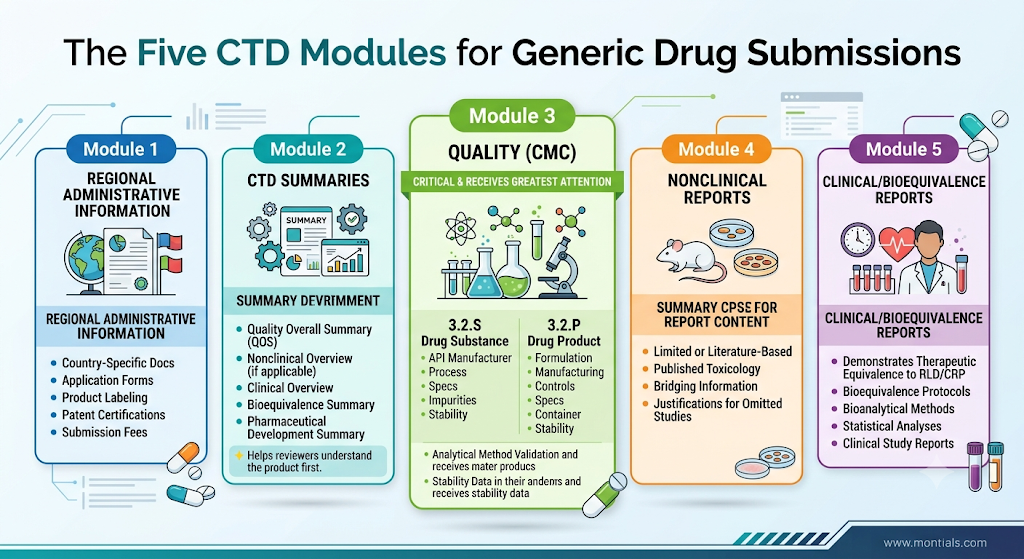
The CTD consists of five standardized modules.
| Module | Purpose | Required for Generic Submissions |
|---|---|---|
| Module 1 | Regional administrative information | Yes |
| Module 2 | CTD summaries | Yes |
| Module 3 | Quality (CMC) | Critical |
| Module 4 | Nonclinical reports | Limited or literature-based |
| Module 5 | Clinical/Bioequivalence reports | Bioequivalence studies |
For generic submissions, Module 3 receives the greatest regulatory attention.
Module 1: Regional Administrative Information
Module 1 contains country-specific documentation.
Examples include:
- Application forms
- Product labeling
- Patent certifications
- Administrative correspondence
- Environmental assessments
- Regional declarations
- Submission fees
Since Module 1 differs between FDA and Health Canada, sponsors must ensure regional compliance — an area where a CDMO for generic drug development in Canada can help align documentation with Health Canada’s specific administrative expectations.
Module 2: Quality Overall Summary (QOS)
Module 2 provides concise summaries of all scientific information included later in the dossier.
Typical sections include:
- Quality Overall Summary
- Nonclinical Overview (if applicable)
- Clinical Overview
- Bioequivalence summary
- Pharmaceutical development summary
A strong Quality Overall Summary helps reviewers understand the product before examining detailed reports.
Module 3: The Heart of Generic Drug Applications
Module 3 contains the Chemistry, Manufacturing, and Controls (CMC) information that demonstrates product quality, consistency, and regulatory compliance.
This module often determines whether reviewers issue deficiencies or proceed toward approval.
3.2.S Drug Substance
Information includes:
- API manufacturer
- Manufacturing process
- Specifications
- Analytical methods
- Validation reports
- Impurity characterization, including peptide degradation product characterization for peptide-based APIs
- Reference standards
- Batch analyses
- Stability studies
For peptide-based generics specifically, sponsors must also address peptide drug regulatory requirements around sequence confirmation, related substances, and higher-order structure where applicable.
3.2.P Drug Product
Drug product documentation includes:
- Formulation development
- Manufacturing process
- Control of excipients
- Finished product specifications
- Method validation
- Container closure system
- Stability studies
- Batch records
Formulation-specific complexity is common in this section. Depot injectables, such as those supported through CRO services for leuprolide depot development, and other long-acting injectable products require additional in-vitro release and characterization data beyond what a standard oral generic would need.
Analytical Method Validation
Regulators expect validated analytical methods supporting:
- Assay
- Related substances
- Dissolution
- Content uniformity
- Residual solvents
- Elemental impurities
- Nitrosamines
- Preservatives
- Microbiological testing
Validation typically follows ICH Q2(R2) principles where applicable.
Stability Data
Stability studies demonstrate that the product maintains quality throughout its shelf life.
Common studies include:
- Accelerated stability
- Long-term stability
- Intermediate stability
- Photostability
- In-use stability
- Freeze-thaw stability (where applicable)
Module 4 in Generic Applications
Unlike new drug applications, Module 4 generally contains limited information for generics.
It may include:
- Literature references
- Published toxicology
- Bridging information
- Justifications for omitted studies
Many generic products require minimal original nonclinical studies.
Module 5: Clinical and Bioequivalence Data
Module 5 focuses on demonstrating therapeutic equivalence.
Typical contents include:
- Bioequivalence protocols
- Bioanalytical methods
- Statistical analyses
- Clinical study reports
- Pharmacokinetic comparisons
The objective is to demonstrate equivalence to the Reference Listed Drug (RLD) or Canadian Reference Product (CRP).
4: Differences Between ANDA and ANDS CTD Requirements
Although both submissions use the CTD structure, there are important regional differences.
| Feature | ANDA (FDA) | ANDS (Health Canada) |
|---|---|---|
| Regulatory Authority | FDA | Health Canada |
| Reference Product | RLD | Canadian Reference Product |
| Electronic Format | eCTD | eCTD |
| Administrative Module | FDA-specific | Health Canada-specific |
| Labeling Requirements | FDA labeling | Canadian labeling |
| Regulatory Guidance | FDA Guidance | Health Canada Guidance |
Despite these regional differences, Module 3 remains largely aligned with ICH expectations. Sponsors filing in both jurisdictions often work with a single pharmaceutical CDMO supporting both US and Canada submissions to keep the underlying analytical dataset consistent across both dossiers, and sponsors focused specifically on the Canadian market frequently turn to a CDMO for generic projects in Canada to navigate ANDS-specific expectations.
5: Why Module 3 Receives the Most Regulatory Scrutiny
Module 3 demonstrates whether manufacturers can consistently produce a safe, effective, and high-quality generic medicine.
Reviewers carefully evaluate:
- Manufacturing consistency
- Product specifications
- Method validation
- Stability evidence
- Impurity control
- Batch reproducibility
- Process validation
- Packaging compatibility
Incomplete Module 3 documentation frequently leads to deficiency letters.
6: Common CTD Deficiencies Observed During Generic Submissions
Many regulatory delays result from documentation rather than poor science.
Common deficiencies include:
- Missing analytical validation
- Incomplete impurity characterization
- Poor stability justification
- Inadequate specification limits
- Missing chromatograms
- Inconsistent batch data
- Incomplete risk assessments
- Insufficient pharmaceutical development discussion
- Weak justification of acceptance criteria
Preventing these issues requires careful planning long before submission, which is one reason sponsors increasingly consider outsourcing generic drug development in Canada to a partner with established regulatory-facing analytical workflows.
7: Analytical Testing That Supports CTD Module 3
Analytical laboratories generate much of the scientific evidence included within Module 3.
| Testing Area | Purpose |
|---|---|
| HPLC Assay | Potency determination |
| LC-MS/MS | Impurity characterization |
| GC-MS | Residual solvents |
| ICP-MS | Elemental impurities |
| Dissolution Testing | Product performance |
| Stability Testing | Shelf-life support |
| Particle Size Analysis | Formulation consistency |
| Extractables & Leachables | Packaging compatibility |
| Nitrosamine Testing | Regulatory compliance |
| Method Validation | Regulatory acceptance |
Each analytical report must be CTD-ready, scientifically justified, and fully traceable. This includes analytical development support for generic drugs in Canada as well as nitrosamine testing for CDMO partners managing impurity risk assessments across their generic product portfolios.
Analytical Considerations for Complex Generic Products
Complex generics — peptides, depot injectables, and poorly soluble small molecules — carry additional Module 3 requirements beyond a standard oral generic:
- Peptide APIs: sequence confirmation, related substances profiling, and peptide analytical characterization services supporting higher-order structure and purity data, including case work such as semaglutide peptide characterization and broader GLP-1 peptide analytical characterization programs
- Long-acting injectables and depot products: in-vitro release testing and formulation-specific stability, supported through leuprolide depot CDMO selection expertise
- Poorly soluble APIs: dissolution method development and bioavailability-enhancing formulation strategies specific to generic drug development for poorly soluble APIs
8: Best Practices for Preparing CTD-Compliant Generic Submissions
Successful submissions begin well before dossier compilation.
Recommended practices include:
- Develop regulatory strategy early.
- Follow ICH guidance throughout development.
- Validate analytical methods before pivotal studies.
- Perform comprehensive impurity assessments.
- Generate complete stability datasets.
- Maintain robust documentation.
- Review data for consistency before submission.
- Use experienced regulatory writers.
- Perform internal quality audits.
- Prepare eCTD-ready reports from the beginning.
Choosing the Right Development Partner
Selecting between an in-house team, a CRO, or a CDMO is one of the earliest and most consequential decisions in a generic program. Sponsors weighing CRO versus in-house ANDA development, evaluating a CDMO versus CRO for generic drug development more broadly, or comparing peptide CDMO versus CRO options for peptide-specific programs should assess partners on analytical depth, regulatory track record, and CTD-readiness of their reporting — not just cost. Practical guidance on how to choose the right CRO or CDMO for an ANDA submission can help structure that evaluation, and sponsors developing peptide-based generics specifically may also benefit from resources on outsourcing peptide manufacturing to a CDMO and identifying the best peptide CDMO for their program, including options for sponsors seeking a peptide CDMO based in the United States.
9: How ResolveMass Laboratories Supports CTD Module 3 Preparation
Preparing Module 3 requires reliable analytical data, scientifically justified reports, and documentation that aligns with regulatory expectations. ResolveMass Laboratories supports pharmaceutical and biotechnology companies by generating high-quality analytical evidence suitable for inclusion in generic ANDA and ANDS submissions, working as a CRO/CDMO partner for ANDA submissions from early development through final dossier compilation.
Our capabilities include:
- Method development and validation
- LC-MS/MS and HRMS analysis
- Impurity identification and characterization
- Nitrosamine risk assessment and testing
- Elemental impurities (ICH Q3D)
- Residual solvent analysis (ICH Q3C)
- Stability studies
- Extractables and Leachables (E&L) studies
- Forced degradation studies
- Pharmaceutical characterization
- CTD-ready analytical reports
- Regulatory-compliant scientific documentation
- Specialized support through our peptide CDMO services for sponsors developing complex, peptide-based generic products
By producing well-documented analytical data, sponsors can strengthen Module 3 submissions while reducing the likelihood of regulatory questions during review. As a CDMO supporting generic drug development across both the U.S. and Canadian markets, and a CDMO positioned to accelerate generic drug development across the US and Canada, ResolveMass works alongside sponsors from early analytical development through final CTD compilation.
10: Future Trends in Generic Regulatory Submissions
Regulatory submissions continue to evolve toward greater digitalization and global harmonization.
Emerging trends include:
- Expanded eCTD adoption
- Greater use of electronic data standards
- Risk-based CMC assessments
- AI-assisted regulatory review
- Enhanced impurity risk assessments
- Lifecycle management through structured data
- Increased expectations for data integrity
Organizations investing in high-quality analytical documentation today are better positioned for future regulatory requirements.
Conclusion:
The CTD Format for Generic ANDA and ANDS Submissions serves as the foundation for organizing scientific and regulatory evidence required to obtain approval for generic medicines. Although the CTD does not change the scientific requirements, it provides a standardized framework that enables regulators to efficiently assess quality, safety, and bioequivalence.
For generic products, Module 3 remains the most critical section, requiring comprehensive analytical testing, validated methods, stability data, impurity characterization, manufacturing controls, and complete documentation. Sponsors that prepare robust, well-organized CTD dossiers are more likely to experience smoother reviews, fewer deficiency letters, and faster regulatory decisions.
Frequently Asked Questions:
The Common Technical Document (CTD) is a globally standardized format used to organize information for pharmaceutical regulatory submissions. It allows sponsors to present administrative, quality, nonclinical, and clinical data in a consistent structure. For generic drug applications, the CTD helps regulatory agencies efficiently review manufacturing, analytical, and bioequivalence information. It improves submission quality, reduces review time, and supports regulatory compliance. Both the U.S. FDA and Health Canada use the CTD framework for generic drug applications.
Yes, the CTD format is mandatory for both ANDA submissions to the U.S. FDA and ANDS submissions to Health Canada. Regulatory authorities require applications to be submitted electronically using the eCTD format. This standardized structure makes it easier for reviewers to locate critical information and assess product quality. Failure to follow CTD requirements can result in submission deficiencies or delays. Sponsors should ensure all modules are complete and compliant before submission.
CTD Module 3 contains the Chemistry, Manufacturing, and Controls (CMC) information that demonstrates the quality of the drug product. It includes details on the drug substance, formulation, manufacturing process, specifications, analytical methods, validation reports, impurity profiles, stability studies, and container closure systems. This module provides evidence that the product can be consistently manufactured to meet regulatory standards. Because of its importance, Module 3 is one of the most thoroughly reviewed sections of a generic submission.
The CTD format organizes regulatory information into a standardized structure that reviewers already understand. This allows regulatory agencies to quickly locate important data without searching through inconsistent documentation. Well-prepared CTD dossiers reduce the likelihood of missing information and facilitate more efficient scientific evaluations. As a result, sponsors may experience fewer review cycles and faster regulatory decisions. A properly organized submission also simplifies lifecycle management after product approval.
The CTD defines the standardized content and organization of a regulatory submission, while the electronic Common Technical Document (eCTD) specifies the digital format used to submit that content. The eCTD includes electronic navigation, hyperlinks, metadata, and lifecycle management features that improve submission efficiency. Most regulatory agencies now require electronic submissions in eCTD format. This digital approach makes it easier for reviewers to access, update, and manage regulatory dossiers throughout the product lifecycle.
Much of the scientific content, particularly Module 3 (Quality), can often be used for both FDA ANDA and Health Canada ANDS submissions because both follow the CTD structure. However, Module 1 contains region-specific administrative documents, application forms, and labeling requirements that must be customized for each regulatory authority. Sponsors should carefully review agency-specific guidance before submission. Adapting regional requirements while maintaining consistent scientific data helps streamline global regulatory strategies.
Reference
- Rafi N, Sandeep DS, Narayanan A. Regulatory requirements and registration procedure for generic drugs in USA. Indian J Pharm Educ Res. 2018 Oct 1;52(4):544-9.https://www.researchgate.net/profile/Sandeep-Ds-3/publication/325822176_Regulatory_Requirements_and_Registration_Procedure_for_Generic_Drugs_in_USA/links/5b4ec7d40f7e9b240fe8b1f7/Regulatory-Requirements-and-Registration-Procedure-for-Generic-Drugs-in-USA.pdf
- Tejeswini AJ, Nagabhushanam MV, Latha GK, Pooja K, Bonthagarala B, Ramakrishna G, Sindhu YR. REGULATORY STANDARDS AND STRATAGIES FOR SUCCESSFUL ABBREVIATED NEW DRUG APPLICATION (ANDA) SUBMISSIONS. WORLD JOURNAL OF PHARMACY AND PHARMACEUTICAL SCIENCES. 2022 Jun 20;11(8):2096-104.https://www.researchgate.net/profile/Brahmaiah-Bonthagarala/publication/367522794_REGULATORY_STANDARDS_AND_STRATAGIES_FOR_SUCCESSFUL_ABBREVIATED_NEW_DRUG_APPLICATION_ANDA_SUBMISSIONS/links/63d663f062d2a24f92dae364/REGULATORY-STANDARDS-AND-STRATAGIES-FOR-SUCCESSFUL-ABBREVIATED-NEW-DRUG-APPLICATION-ANDA-SUBMISSIONS.pdf
- PA S, KAMARAJ R. ANDA Submissions-Refuse to Receive (RTR) Standards and Deficiencies of CTD modules in ANDA. International Journal of Pharmaceutical Research (09752366). 2021 Apr 1;13(2).https://search.ebscohost.com/login.aspx?direct=true&profile=ehost&scope=site&authtype=crawler&jrnl=09752366&AN=153004733&h=%2BpJ9AZb2c3%2FCS7%2FGa3uTtRM7w3kxrhbO3Jh2BgIfzadOXuLKq5TchAjZX3z07lnh7ngQs52bJlKDPI633UDPXA%3D%3D&crl=c
- Chaudhari PV, Badjatya JK. Good Practices in Management of deficiencies in CTD dossier and comparative study for US, EU and Australia. International Journal of Drug Regulatory Affairs. 2019;7(4):40-55.https://www.researchgate.net/profile/Pooja-Chaudhari-4/publication/338171674_Good_Practices_in_Management_of_deficiencies_in_CTD_dossier_and_comparative_study_for_US_EU_and_Australia/links/612506481e95fe241af57035/Good-Practices-in-Management-of-deficiencies-in-CTD-dossier-and-comparative-study-for-US-EU-and-Australia.pdf
- Acharya V, Trivedi A, Movaliy V, Vaghela K, Kanaki N, Zaveri M. A comparative study on regulatory requirement of parenteral dosage form for various regulated countries. International Journal Of Drug Regulatory Affairs. 2023;11(2):37-49.https://www.researchgate.net/profile/Vinit-Movaliya/publication/372371384_A_comparative_study_on_regulatory_requirement_of_parenteral_dosage_form_for_various_regulated_countries/links/66683642b769e769192a1e50/A-comparative-study-on-regulatory-requirement-of-parenteral-dosage-form-for-various-regulated-countries.pdf
About the Author


