

Introduction
Off-the-shelf poly(lactic-co-glycolic acid) (PLGA) polymers often fall short in advanced drug delivery applications because of broad polydispersity indices, batch-to-batch variability arising from catalytic processes, and limited end-group functionality. By utilizing specialized Custom PLGA Synthesis Services, formulation scientists can accurately tailor molecular weight distributions, monomer sequence arrangements, terminal functionalities, and degradation behavior to meet demanding bioequivalence (Q1/Q2/Q3) requirements and sophisticated drug delivery objectives.
Poly(lactic-co-glycolic acid) (PLGA) is widely recognized as the benchmark biodegradable copolymer for controlled-release parenteral formulations, long-acting depot injectables, microparticles, and targeted nanoparticle systems approved by the Food and Drug Administration (FDA). Despite its extensive use, commercially available catalog-grade PLGA materials are generally manufactured according to broad specifications intended for widespread applicability rather than application-specific optimization. Suppliers commonly provide standard lactide-to-glycolide (L:G) ratios, including 50:50, 75:25, and 85:15, within broad molecular weight ranges. Such generalized specifications frequently contribute to inconsistent degradation behavior, increased initial burst release, and reduced drug encapsulation efficiency.
For next-generation therapeutic products—including highly sensitive biologics, nucleic acid-based therapies such as circular RNA and CRISPR ribonucleoproteins, and generic long-acting injectables being developed through the Abbreviated New Drug Application (ANDA) pathway—catalog PLGA materials introduce significant structural and regulatory challenges. Overcoming these limitations requires moving beyond standard polymer inventories and adopting custom synthesis approaches capable of engineering macromolecular characteristics with exceptional precision.
Discover how custom polymers enhance long-acting parenteral performance in our detailed guide on PLGA Long-Acting Injectable Formulations.
Share via:
Article Summary:
- Off-the-shelf PLGA is often inadequate for advanced drug delivery because it has broad molecular weight distribution, batch variability, limited functional groups, and inconsistent degradation behavior.
- Custom PLGA synthesis enables precise polymer design by controlling molecular weight, monomer ratio, polymer architecture, end-group functionality, and degradation rate to meet specific formulation needs.
- Improved polymer quality enhances performance through narrow polydispersity, reduced catalyst residues, predictable drug release, better encapsulation efficiency, and greater batch-to-batch consistency.
- Critical quality attributes (CQAs) such as sequence distribution, glass transition temperature (Tg), acid value, and polymer architecture can be precisely optimized to achieve reliable therapeutic performance.
- Custom PLGA supports FDA Q1/Q2/Q3 bioequivalence by closely matching the Reference Listed Drug (RLD), helping generic long-acting injectable products meet stringent ANDA regulatory requirements.
- Advanced functionalization expands drug delivery possibilities, allowing the development of targeted polymers such as PLGA-PEG block copolymers with reactive groups for antibody, peptide, and ligand conjugation.
- Overall, Custom PLGA Synthesis Services reduce development risks by improving formulation stability, controlling drug release, enhancing targeting capabilities, and increasing the likelihood of successful regulatory approval and commercialization.
Structural and Physicochemical Limitations of Off-the-Shelf Commercial PLGA
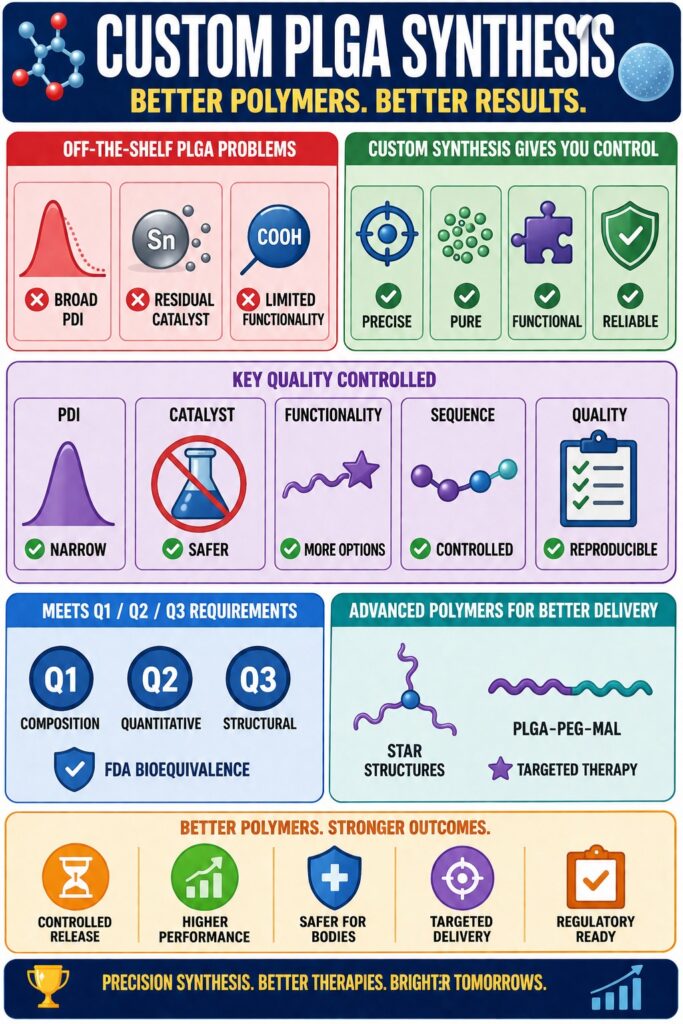
Commercial off-the-shelf PLGA polymers frequently exhibit broad polydispersity indices, uncontrolled residual catalyst levels, and limited end-group functionality, all of which can negatively affect reproducible drug encapsulation and release performance. Engaging specialized Custom PLGA Synthesis Services addresses these physicochemical limitations through precise control of polymerization conditions and the removal of undesirable high- and low-molecular-weight fractions.
Polydispersity Index (PDI) and Molecular Weight Tailing
Broad polydispersity indices (PDI > 1.8) commonly observed in catalog PLGA grades contain both ultra-low and ultra-high molecular weight fractions that contribute to unpredictable release profiles and accelerated degradation behavior. Custom PLGA Synthesis Services employ highly controlled polymerization strategies to generate narrow molecular weight distributions (PDI < 1.3), resulting in more uniform polymer erosion and consistent therapeutic performance.
Commercial PLGA materials synthesized through conventional melt polycondensation or inadequately optimized ring-opening polymerization (ROP) methods often display elevated PDI values. Low-molecular-weight oligomeric fractions hydrolyze rapidly, causing localized acidification, osmotic swelling, and undesirable initial burst release of the encapsulated drug. In contrast, extremely high-molecular-weight fractions may persist for prolonged periods at the administration site, potentially triggering localized inflammatory responses or promoting particle aggregation in physiological environments. Through advanced living polymerization and organocatalytic approaches, custom synthesis narrows molecular weight distributions, removes problematic chain fractions, and enables degradation rates to be carefully matched with the intended therapeutic duration.
Learn how controlling polydispersity impacts delivery systems by reading about PLGA PDI in Pharmaceutical Applications.
Residual Catalyst Contamination and Toxicological Hazards
Conventional catalog PLGA is generally synthesized using organometallic tin catalysts such as stannous octoate, which can leave residual heavy metal contaminants capable of contributing to cellular toxicity and payload instability. Custom synthesis strategies utilize organocatalytic systems or biocompatible catalyst alternatives, including bismuth subsalicylate, to manufacture ultra-pure PLGA materials with significantly reduced toxicological concerns.
Large-scale industrial production of commercial PLGA frequently relies on tin(II) 2-ethylhexanoate (Sn(Oct)₂) as the primary catalyst. Residual tin species may promote premature backbiting transesterification reactions, increase batch-to-batch variability, and exert cytotoxic effects in sensitive biological environments. In contrast, advanced Custom PLGA Synthesis Services employ metal-free organocatalytic systems, including organophosphazene bases and Takemoto’s urea catalysts, as well as safer metallic alternatives such as bismuth subsalicylate (BiSS). These approaches produce high-purity polymers that align with stringent regulatory toxicology expectations.
Terminal Functionality Constraints and Bioconjugation Deficits
Commercial catalog PLGA grades are generally limited to simple carboxylic acid or ester terminal groups, making subsequent ligand attachment dependent on inefficient post-polymerization modification procedures. Custom PLGA Synthesis Services overcome these limitations by incorporating orthogonal click-chemistry handles, zwitterionic functionalities, or stimuli-responsive linkages directly during polymer synthesis.
Traditional catalog polymers often require multiple post-synthetic modification steps to introduce targeting ligands, resulting in reduced yields, increased process complexity, and greater structural heterogeneity. By utilizing functional initiators during ring-opening polymerization, custom synthesis enables the direct incorporation of site-specific terminal groups such as maleimides for thiol conjugation, azides for click chemistry applications, and reactive oxygen species (ROS)-responsive boronate functionalities. This streamlined approach simplifies formulation development and supports highly reproducible manufacturing processes.
Learn more about overcoming specific structural barriers in PLGA in CNS Drug Delivery & Blood-Brain Barrier Systems.
Critical Quality Attributes (CQAs) Managed by Custom PLGA Synthesis Services
Managing critical quality attributes such as lactide-to-glycolide ratios, sequence distribution, glass transition temperature (Tg), and acid value requires a level of polymerization control that commercially available PLGA grades generally cannot provide. Custom PLGA Synthesis Services allow formulation scientists to manipulate monomer reactivity and polymer architecture with precision, resulting in reproducible degradation profiles and drug release characteristics.
Controlling Monomer Reactivity Ratios and Sequence Microstructure
During uncontrolled polymerization, glycolide monomers typically react more rapidly than lactide monomers, leading to the formation of glycolide-rich segments that hydrolyze unevenly. Custom polymer synthesis employs carefully selected catalyst systems that balance monomer propagation rates and generate uniform random or alternating copolymer architectures.
Because of its molecular structure, cyclic glycolide (GA) possesses higher polymerization reactivity than cyclic D,L-lactide (LA). In poorly controlled ring-opening polymerization processes, glycolide tends to polymerize preferentially during the early stages of the reaction, creating glycolide-rich domains that degrade substantially faster than lactide-rich regions. Custom synthesis technologies utilize advanced binary catalyst systems, including organophosphazene base and urea additive combinations, to regulate propagation kinetics and promote truly random monomer incorporation or alternating copolymer sequences, such as poly(lactic-alt-glycolic acid) derived from methyl-glycolide.
Compare hydrolytic behavior across polymers in our study on PLGA, PLA, and PCL Degradation Rates Comparison.
Macromolecular Architecture: Linear vs. Star-Branched Copolymer Design
Polymer architecture plays a critical role in determining solution viscosity, hydrodynamic behavior, and degradation mechanisms within long-acting drug delivery systems. Custom synthesis approaches utilize multifunctional initiators to create star-branched PLGA structures that enhance syringeability and improve drug-loading capacity compared with conventional linear polymers.
Linear PLGA molecules generally undergo bulk erosion driven by autocatalytic hydrolysis of ester bonds throughout the polymer matrix. However, highly concentrated long-acting injectable formulations based on linear PLGA often exhibit elevated viscosity, which can complicate administration through injection needles. Star-branched architectures, including 3-arm, 4-arm, and 8-arm structures synthesized using polyol initiators such as glycerol derivatives or pentaerythritol, alter chain entanglement behavior and permit higher polymer concentrations within shear-thinning injectable suspensions while simultaneously influencing degradation pathways.
Understand how polymer structure dictates erosion pathways in Bulk Erosion vs. Surface Erosion in PLGA.
Thermal and End-Group Profiling (Tg and Acid Number Analysis)
Glass transition temperature (Tg) and acid number are critical parameters governing thermal stability during processing and the rate of initial ester bond hydrolysis. Custom PLGA synthesis enables these characteristics to be aligned closely with benchmark Reference Listed Drug (RLD) profiles.
Thermal properties such as Tg directly influence polymer chain mobility during storage, spray drying, hot-melt extrusion, and related manufacturing operations. Similarly, acid number, typically expressed as mg KOH/g, reflects the concentration of terminal carboxylic acid groups present within the polymer and serves as an important determinant of water uptake and hydrolytic degradation kinetics.
In comparative investigations involving Reference Listed Drugs (RLDs) such as Lupron Depot®, extracted PLGA exhibited a weight-average molecular weight (Mw) of 13,583 Da, a PDI of 1.68, a Tg of 40.54°C, and an acid value of 10.2 mg KOH/g. An internally synthesized PLGA benchmark demonstrated comparable characteristics, including an Mw of 12,118 Da, a PDI of 1.70, a Tg of 43.84°C, and an acid value of 11.8 mg KOH/g. These findings highlight the importance of closely matching thermal properties and end-group characteristics to ensure consistent product performance, depot integrity, and manufacturing reproducibility.
| Critical Quality Attribute | Off-the-Shelf Commercial PLGA | Custom Synthesized PLGA | Impact on Formulation Performance |
|---|---|---|---|
| Polydispersity Index (PDI) | Broad (PDI = 1.60–2.20+) | Narrow (PDI = 1.05–1.30) | Reduces premature burst release and minimizes prolonged release tailing. |
| Catalyst Residuals | Heavy metal Sn(Oct)₂ (100–500 ppm) | Organocatalytic or non-toxic BiSS | Prevents catalytic degradation of payloads and reduces cellular toxicity. |
| Terminal Functionality | Carboxyl (-COOH) or Ester | Orthogonal handles (Maleimide, Azide, Boronate) | Enables direct bioconjugation and active targeting strategies. |
| Sequence Microstructure | Blocky glycolide-rich domains | Controlled random or alternating architectures | Supports predictable hydrolysis and sustained drug release. |
| Batch Reproducibility | Variable monomer ratios and Mw ranges | Tight Q1/Q2/Q3 tolerance specifications | Facilitates compliance with stringent FDA bioequivalence expectations. |
Achieving Regulatory Bioequivalence (Q1/Q2/Q3) in Generic ANDA Submissions
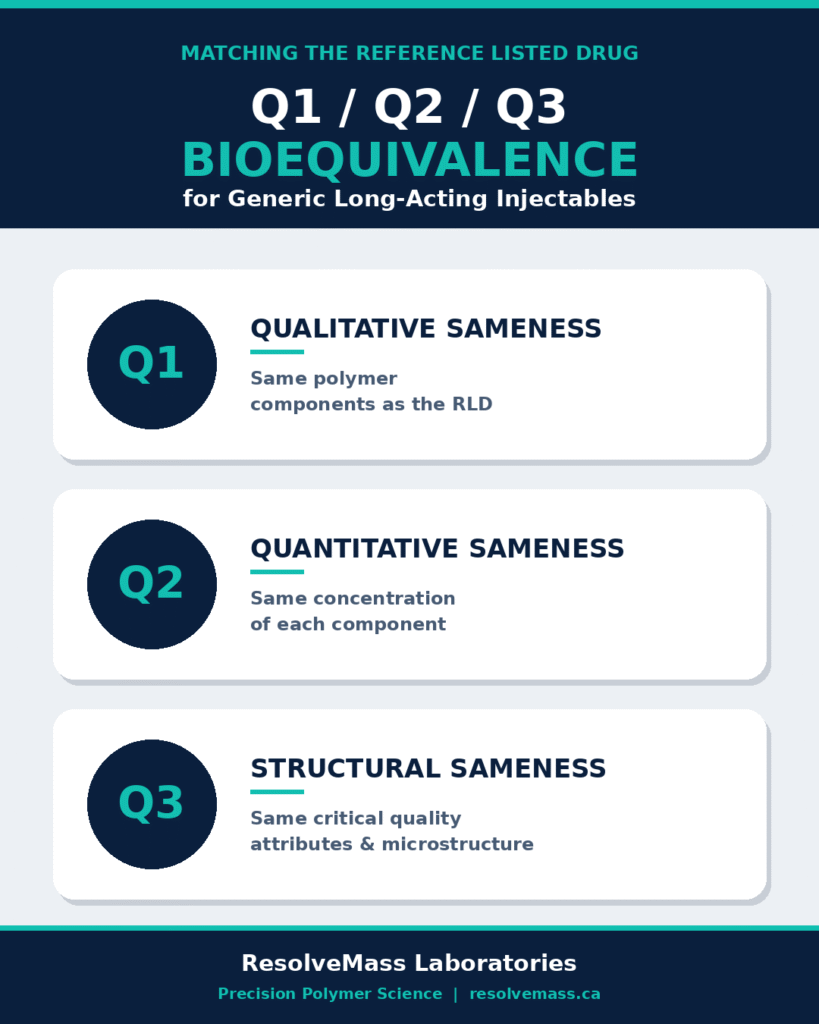
Demonstrating bioequivalence for generic long-acting injectable products requires manufacturers to match the Reference Listed Drug (RLD) in terms of polymer composition (Q1), quantitative formulation characteristics (Q2), and critical structural and physicochemical attributes (Q3). Custom PLGA Synthesis Services play a vital role in reproducing the intricate polymer characteristics of the innovator product, thereby supporting compliance with FDA regulatory expectations for generic drug submissions.
The U.S. FDA imposes stringent polymer sameness requirements for complex parenteral drug products. Even minor differences in PLGA sequence distribution, residual lactide or glycolide monomer content, molecular weight profile, or terminal group chemistry can significantly influence in vitro release testing (IVRT) outcomes and subsequently alter in vivo pharmacokinetic behavior. Commercially available catalog PLGA materials are generally unable to satisfy these highly specific requirements because small shifts in polymer composition can affect bulk erosion mechanisms, local pH changes within the matrix, and pore formation processes that govern drug release.
Review key criteria for establishing equivalence in generic filings via PLGA Polymer Sameness for ANDA Submissions.
To achieve robust Q1/Q2/Q3 equivalence, advanced analytical characterization must be integrated into the custom synthesis strategy. Laboratories such as ResolveMass Laboratories Inc. employ comprehensive analytical workflows that combine 4D Gel Permeation Chromatography with Multi-Angle Light Scattering (4D GPC-MALS), high-resolution ¹H and ¹³C Nuclear Magnetic Resonance (NMR) spectroscopy, and potentiometric titration techniques. This multidimensional analytical approach enables scientists to accurately characterize the polymer fingerprint of the RLD, including absolute molecular weight, branching architecture, monomer composition, and carboxylic acid end-group density. The resulting data serve as the foundation for custom synthesis protocols designed to replicate the original polymer structure with exceptional precision, extending down to the microstructural sequence level.
Learn more about analyzing innovator formulations in PLGA Characterization for Reference Listed Drugs (RLD).
Advanced Functionalization: Block Copolymers and Targeted Delivery Handles
Contemporary nanomedicine platforms increasingly require sophisticated block copolymer architectures and reactive conjugation sites to improve circulation time and facilitate selective targeting of specific tissues or cells. Custom PLGA Synthesis Services enable the synthesis of heterobifunctional block copolymers, including PLGA-PEG-Maleimide systems, with precisely controlled segment lengths and highly reactive terminal functionalities.
Advanced nanomedicines, stealth nanoparticles, and targeted polymeric micelles depend on amphiphilic block copolymer structures that can evade immune recognition while enhancing delivery to diseased tissues. Poly(lactic-co-glycolic acid)-block-Poly(ethylene glycol) (PLGA-PEG) copolymers combine a hydrophobic PLGA core capable of encapsulating therapeutic agents with a hydrophilic PEG shell that minimizes opsonization and prolongs systemic circulation. This dual functionality makes PLGA-PEG a preferred platform for a broad range of targeted drug delivery applications.
The incorporation of maleimide-functionalized PEG segments, resulting in PLGA-PEG-Mal structures, provides highly efficient and site-specific conjugation capabilities for thiol-containing targeting agents. These agents may include monoclonal antibodies, aptamers, peptides such as collagenase I, and retinoic acid-derived ligands. Producing these complex block copolymers directly through controlled living ring-opening polymerization allows precise regulation of block length, narrow polydispersity distributions, and superior batch-to-batch consistency. Such control is often difficult to achieve through conventional post-polymerization grafting techniques, which can introduce variability and structural heterogeneity into the final product.
Examine common formulation and scaling hurdles in Overcoming Challenges in PLGA Microsphere Development.
Conclusion: Strategic Value of Custom PLGA Synthesis Services
Dependence on standard off-the-shelf PLGA grades can introduce significant risks during the development of long-acting parenteral formulations, including inconsistent product performance, regulatory challenges, and potential clinical setbacks. Custom PLGA Synthesis Services provide formulation scientists with the ability to design polymer systems that precisely align with therapeutic objectives, bioequivalence requirements, and product-specific structural specifications.
As drug products progress from early-stage development to commercial manufacturing, polymer carriers must be engineered to accommodate the unique physicochemical characteristics of the active pharmaceutical ingredient. Catalog PLGA materials often present limitations related to polydispersity, residual catalyst content, sequence distribution control, and available functionalization options. Through the application of precision Custom PLGA Synthesis Services, pharmaceutical developers can improve drug loading efficiency, minimize undesirable burst release, accurately control degradation rates, and confidently satisfy FDA Q1/Q2/Q3 bioequivalence expectations.
For organizations seeking specialized expertise in custom polymer design, advanced structural fingerprinting, or bioequivalence assessment, the scientific team at ResolveMass Laboratories Inc. provides comprehensive analytical and development support. Additional information and consultation requests can be submitted through the ResolveMass Contact Page.
Frequently Asked Questions (FAQs)
The polydispersity index (PDI) reflects how uniformly polymer chains are distributed in terms of molecular weight. A broad PDI can result in inconsistent degradation patterns, leading to unpredictable drug release profiles. By maintaining a narrow PDI, custom PLGA synthesis promotes uniform polymer erosion, minimizes premature burst release, and helps ensure more consistent therapeutic performance throughout the intended release period.
The lactide-to-glycolide ratio is one of the most important factors controlling PLGA degradation. Polymers with higher glycolide content generally absorb water more readily and degrade faster because of their increased hydrophilicity. Conversely, increasing the proportion of lactide makes the polymer more hydrophobic, slowing hydrolysis and extending the duration of sustained drug release. Adjusting this ratio allows developers to tailor release kinetics for specific therapeutic goals.
Traditional PLGA manufacturing often relies on stannous octoate (Sn(Oct)₂), which can leave residual metal contaminants in the final product. Custom PLGA synthesis may instead utilize biocompatible catalysts such as bismuth subsalicylate (BiSS) or metal-free organocatalytic systems including organophosphazene bases and Takemoto’s urea catalyst. These alternatives help reduce toxicological concerns, improve polymer purity, and protect sensitive drug payloads from unwanted degradation.
Q1/Q2/Q3 bioequivalence is a regulatory framework used to compare a generic product with its Reference Listed Drug (RLD). Q1 focuses on ingredient sameness, Q2 evaluates the quantitative composition, and Q3 examines critical physicochemical and structural characteristics. For PLGA-based formulations, achieving Q3 equivalence often requires closely matching molecular weight distribution, polymer architecture, degradation behavior, and release profiles, making custom synthesis an essential development strategy.
Functional end-groups such as maleimide provide reactive sites that enable direct attachment of biological targeting molecules. These groups facilitate efficient conjugation with thiol-containing compounds, including antibodies, peptides, and aptamers, without requiring complex post-synthesis modification steps. As a result, targeted drug delivery systems can be developed more efficiently while maintaining greater structural consistency and reproducibility.
Polymer architecture significantly influences viscosity, drug-loading capacity, degradation characteristics, and injectability. Linear PLGA polymers typically exhibit conventional bulk erosion behavior, while star-branched PLGA structures possess multiple polymer arms extending from a central core. These branched architectures can reduce solution viscosity, improve syringeability in concentrated formulations, and modify degradation pathways, making them particularly useful for long-acting injectable products.
Initial burst release often occurs when drug molecules located near the particle surface are rapidly released after administration. The presence of low-molecular-weight polymer fractions can further accelerate this effect by promoting faster hydrolysis and pore formation. Custom PLGA synthesis helps minimize burst release by producing narrow molecular weight distributions, reducing low-molecular-weight tails, and optimizing end-group chemistry to create a more controlled release profile.
Yes. Advanced polymerization strategies allow scientists to regulate how lactide and glycolide units are arranged along the polymer chain. Through the use of specialized organocatalysts and carefully controlled ring-opening polymerization conditions, custom synthesis can generate highly random, alternating, or specifically structured copolymer sequences. This level of control enables precise tuning of degradation rates, mechanical properties, and drug release behavior that cannot typically be achieved with standard catalog-grade PLGA.
Reference:
- Elsayed, S. I., Girgis, G. N. S., & El-Dahan, M. S. (2023). Formulation and evaluation of pravastatin sodium-loaded PLGA nanoparticles: In vitro–in vivo studies assessment. International Journal of Nanomedicine, 18, 721–742. https://doi.org/10.2147/IJN.S394701
- Pardeshi, S. R., Nikam, A., Chandak, P., Mandale, V., Naik, J. B., & Giram, P. S. (2023). Recent advances in PLGA based nanocarriers for drug delivery system: A state of the art review. International Journal of Polymeric Materials and Polymeric Biomaterials, 72(1), 49–78. https://doi.org/10.1080/00914037.2021.1985495
- Lu, Y., & Coates, G. W. (2023). Pairing-enhanced regioselectivity: Synthesis of alternating poly(lactic-co-glycolic acid) from racemic methyl-glycolide. Journal of the American Chemical Society, 145(41), 22425–22432. https://doi.org/10.1021/jacs.3c05941
- Hoover, E. C., Chowdhury, C. R., Ruggiero, O. M., & Day, E. S. (2024). Conjugation of antibodies and siRNA duplexes to polymer nanoparticles via maleimide–thiol chemistry. ACS Omega, 9(48), 47637–47646. https://doi.org/10.1021/acsomega.4c07025
Get In Touch With Us
About The Author


