

Introduction
Cyclic, Stapled, and Constrained Peptides have emerged as an important paradigm in contemporary drug discovery because they combine high target selectivity with improved metabolic stability by restricting flexible linear peptide sequences into bioactive secondary conformations. In contrast to conventional linear peptides, which are often susceptible to rapid proteolysis and experience unfavorable entropic costs during target engagement, Cyclic, Stapled, and Constrained Peptides are structurally pre-organized to reproduce important endogenous binding motifs, including α-helices and β-turns.
Strategic macrocyclization of linear peptide precursors provides a direct means of addressing several longstanding challenges associated with intracellular protein-protein interactions (PPIs). Structural restriction can be introduced through different approaches, from head-to-tail amide linkages to hydrocarbon side-chain staples. These constraints can substantially improve resistance to serum proteases while also enhancing cell membrane permeability in appropriately designed peptide scaffolds. Nevertheless, translating structurally sophisticated macrocycles from synthetic chemistry laboratories into regulated biopharmaceutical development programs requires detailed control of macrocyclization reaction kinetics together with specialized analytical characterization strategies.
Looking for specialized support with complex peptide sequence design and synthesis? Explore our custom peptide synthesis services for development programs requiring tailored peptide architectures and controlled synthesis workflows.
Share via:
Quick Summary:
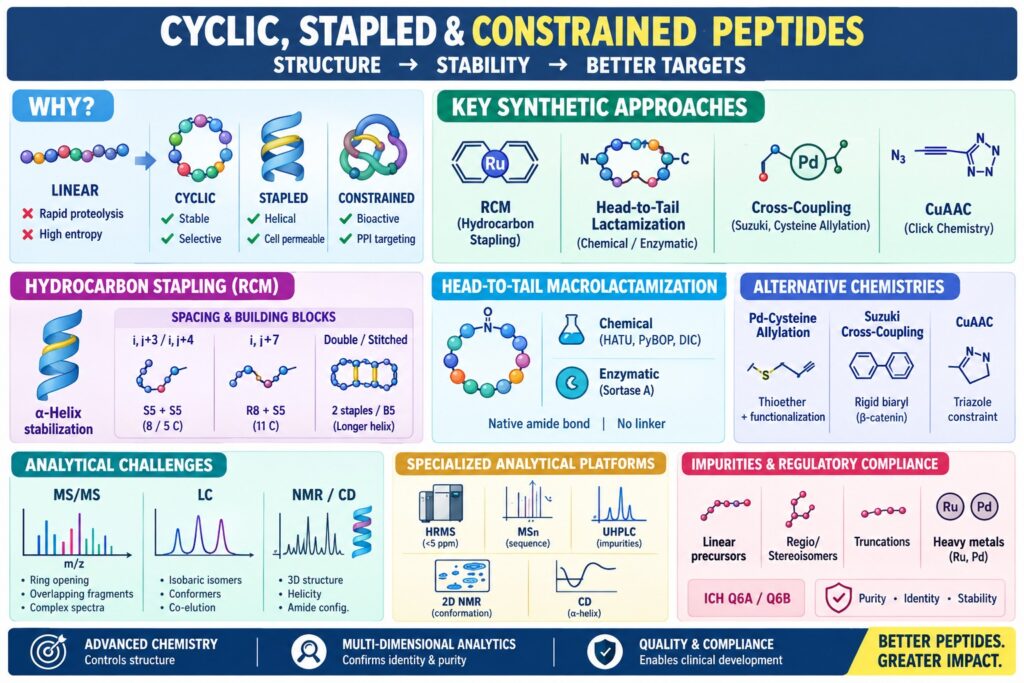
- Cyclic, stapled, and constrained peptides restrict flexible peptide structures to improve conformational stability, protease resistance, target selectivity, and, in suitable designs, cell permeability.
- Key cyclization strategies include hydrocarbon stapling through olefin ring-closing metathesis (RCM), head-to-tail macrolactamization, enzymatic cyclization, and alternative cross-linking methods such as Suzuki-Miyaura coupling, cysteine allylation, and CuAAC click chemistry.
- Hydrocarbon stapling uses strategically positioned non-natural amino acids to stabilize α-helices through i,i+3/i,i+4 or i,i+7 spacing, while double and stitched staples can provide greater structural reinforcement.
- Macrocyclization chemistry requires careful optimization to minimize oligomerization, epimerization, catalyst-related impurities, and incomplete cyclization while maintaining scalability and compatibility with peptide manufacturing processes.
- Analytical characterization is challenging because cyclic peptides can undergo ring opening during MS/MS, produce overlapping fragments, contain isomeric impurities, and exhibit dynamic conformational behavior.
- Orthogonal analytical tools such as HRMS, MSⁿ, energy-resolved MS/MS, UHPLC, 2D NMR, and circular dichroism (CD) are used together to confirm molecular identity, sequence, impurity profiles, 3D structure, amide configuration, and α-helicity.
- Regulatory-quality control requires identification and control of linear precursors, truncations, regioisomers, stereoisomers, and residual metals such as Ru and Pd, supported by ICH-aligned impurity, identity, purity, stability, and structural characterization strategies.
Synthetic Pathways for Cyclic, Stapled, and Constrained Peptides
Synthetic approaches for Cyclic, Stapled, and Constrained Peptides employ specialized macrocyclization chemistries designed to overcome the entropic disadvantage associated with ring closure while minimizing competing intermolecular oligomerization. Selection of the appropriate synthetic route depends on multiple parameters, including the desired secondary structure, ring dimensions, functional group tolerance, precursor architecture, and requirements for process scalability.
Need to translate a complex peptide synthesis from development scale toward GMP production? See our GMP peptide API manufacturing services for peptide drug substance manufacturing support.
Olefin Ring-Closing Metathesis and Hydrocarbon Stapling
Olefin ring-closing metathesis (RCM) uses ruthenium catalysts to connect non-natural alkenyl amino acids and thereby reinforce α-helical secondary structures across one or more helical turns. Blackwell, Grubbs, and Verdine were among the researchers who established the application of this strategy to peptides. The resulting covalent hydrocarbon bridges are positioned across selected turns of an α-helix, restricting conformational freedom and reinforcing the desired bioactive geometry.
The classical hydrocarbon stapling approach introduces α,α-disubstituted non-natural amino acids containing terminal olefinic side chains into the peptide sequence during solid-phase peptide synthesis (SPPS). Representative building blocks include (S)-2-(4-pentenyl)alanine (S5), (R)-2-(7-octenyl)alanine (R8), and (S)-2-(2-propenyl)glycine derivatives. The identity, stereochemistry, and positional arrangement of these residues determine the resulting cross-linking geometry and its influence on helical alignment:
- One Helical Turn (i, i+3 or i, i+4 Spacing): Placing the olefin-bearing residues at positions i and i+3 or i and i+4 enables macrocyclization using two S5 monomers or appropriately matched stereochemical pairs. These arrangements generate 8-carbon or 5-carbon cross-links that span approximately one turn of the helix and restrict local conformational flexibility.
- Two Helical Turns (i, i+7 Spacing): Bridging two complete helical turns generally employs an R8 monomer at position i together with an S5 monomer at position i+7. RCM between these residues produces an 11-carbon hydrocarbon bridge capable of maintaining extended helical regions over a larger portion of the peptide sequence.
- Double Stapling and Stitched Peptides: More demanding molecular interfaces may require more than one structural cross-link. Double-stapled peptides contain two independent hydrocarbon staples, while stitched peptides incorporate a shared central bis-olefinic residue, such as bis-pentenylglycine (B5), within architectures such as i, i+4+4 or i, i+4+7. These configurations can provide conformational stabilization across longer peptide sequences.
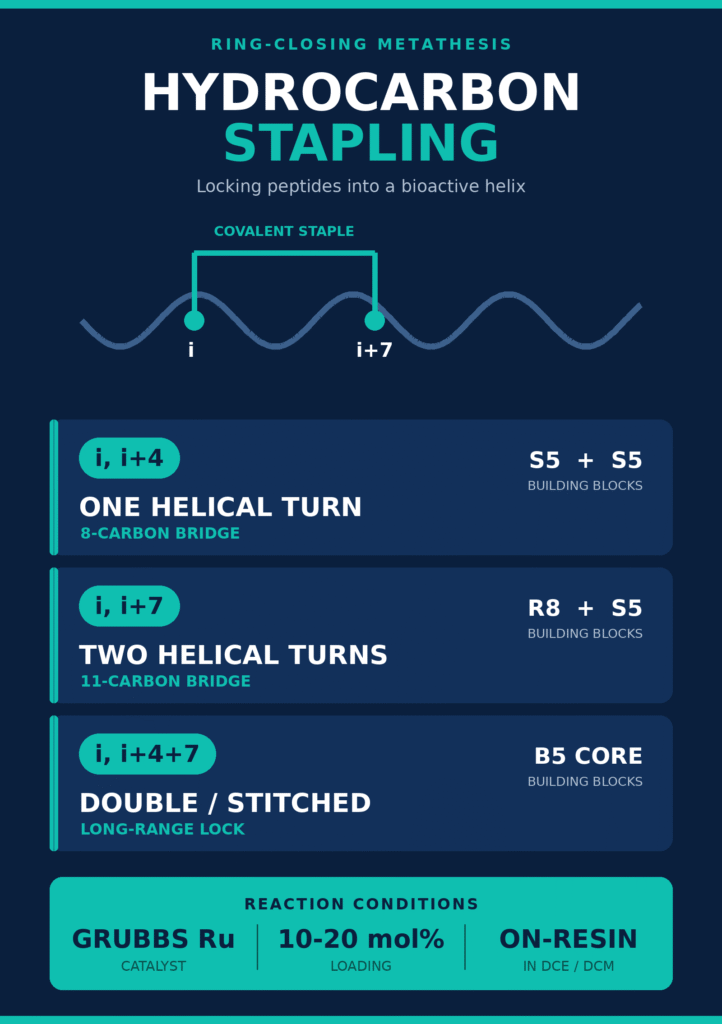
RCM is commonly conducted on-resin using 1st or 2nd generation Grubbs ruthenium catalysts at approximately 10–20 mol%. The catalyst is generally introduced in solvents such as 1,2-dichloroethane (DCE) or dichloromethane (DCM), with the metathesis step performed before global deprotection and resin cleavage.
Working on scale-up of a structurally complex peptide such as a GLP-1 analog? Review our guidance on scaling a GLP-1 analog from preclinical synthesis to GMP kilogram-scale manufacturing.
Head-to-Tail Macrolactamization and Enzymatic Cyclization
Head-to-tail macrolactamization generates a native amide bond between the terminal N- and C-residues of a peptide. This transformation can be achieved chemically with coupling reagents or enzymatically using engineered enzymes such as Sortase A under comparatively mild aqueous conditions.
For chemical head-to-tail lactamization, the reaction may be conducted in solution phase under high-dilution conditions, commonly below 1 mM, to favor intramolecular cyclization over intermolecular oligomerization. Alternatively, cyclization can be performed on solid support using orthogonal protecting-group strategies, including Allyl/Alloc or Mtt/O-2-PhiPr systems. These strategies maintain protection of reactive side-chain functionalities while selectively exposing the peptide termini required for ring closure. Standard aminium/phosphonium coupling reagents, including HATU, PyBOP, or DIC/Oxyma, can facilitate the intramolecular amide-bond-forming reaction.
Enzymatic head-to-tail cyclization provides a chemo- and regioselective alternative that can operate under mild aqueous conditions. Engineered transpeptidases, including Sortase A derived from Staphylococcus aureus, catalyze backbone macrocyclization without the need for conventional activating reagents or global side-chain deprotection. However, excessive structural rigidity or substantial pre-existing α-helicity in the linear precursor can reduce enzymatic cyclization efficiency. Highly rigid helices may resist the partial unfolding required for the peptide termini to achieve the correct alignment within the enzyme active site. Advanced tethered docking systems, including charged homopolymer anchors, are therefore being investigated to increase the effective local concentration of peptide termini and promote productive convergence during ring closure.
Alternative Chemistries and Late-Stage Functionalization
Additional cyclization strategies employ bioorthogonal and cross-coupling reactions, including Pd-catalyzed cysteine allylation, Suzuki-Miyaura cross-coupling, and copper-catalyzed click chemistry. These approaches can generate stable conformational constraints while preserving sensitive functional groups within the peptide framework.
- Pd-Catalyzed Cysteine Allylation: Chemoselective palladium-catalyzed allylation of cysteine thiol groups produces alkene-containing staples. The resulting unsaturated staples can subsequently function as reactive handles for secondary transformations, including bioorthogonal thiol-ene and Diels-Alder reactions. Such strategies can facilitate the incorporation of fluorophores or polyethylene glycol (PEG) chains at later stages of synthesis.
- Late-Stage Suzuki-Miyaura Cross-Coupling: Cross-coupling reactions performed on-resin between halogenated amino acids, such as 5-bromotryptophan, and organoboron-functionalized side chains can generate rigid biaryl macrocycles. These structural elements can reinforce peptide conformations and binding interactions against challenging targets, including β-catenin.
- Copper-Catalyzed Azide-Alkyne Cycloaddition (CuAAC): Click chemistry involving non-natural azido and alkynyl amino acids generates stable 1,2,3-triazole staples. The resulting heterocyclic linkages provide chemical robustness and impose additional conformational restriction on the peptide backbone.
| Cyclization Strategy | Key Reagents / Catalysts | Linkage Type | Helical / Structural Target | Primary Advantages | Process Limitations |
|---|---|---|---|---|---|
| Hydrocarbon Stapling (RCM) | 1st/2nd Gen Grubbs Ru catalysts, DCE | All-hydrocarbon double bond (i, i+4 / i, i+7) | α-Helix stabilization | High metabolic stability, protease resistance, cell permeability | Catalyst cost, residual ruthenium removal, cis/trans isomerism |
| Head-to-Tail Lactamization | HATU, PyBOP, or Sortase A transpeptidase | Native backbone amide bond | Macrocyclic backbone constraint | No unnatural linker insertion required; native peptide backbone | Entropy-unfavorable; risk of dimerization/epimerization |
| Pd-Catalyzed Cysteine Allylation | Pd catalysts, allylic linkers | Thioether / Allylic cross-link | Disulfide replacement, flexible loops | Chemoselective; allows secondary functionalization (Diels-Alder) | Requires free cysteines; potential side reactions with nucleophiles |
| Late-Stage Suzuki-Miyaura | Pt(PPh3)4 or water-soluble Pd complexes | Biaryl / Aryl-alkyl cross-link | Rigid aromatic constraints | High stability; rigid aromatic orientation for PPI targeting | Metal scavenging required; complex monomer synthesis |
| CuAAC Click Cyclization | Cu(I) salts, ligand (e.g., THPTA) | 1,4-disubstituted 1,2,3-triazole | Turn and loop constraints | High chemo- and bio-orthogonality; robust in aqueous media | Copper toxicity concerns; triazole ring polarity |
Analytical Challenges in Characterizing Cyclic, Stapled, and Constrained Peptides
Characterization of Cyclic, Stapled, and Constrained Peptides presents substantial analytical challenges because these molecules can undergo unpredictable gas-phase ring opening during tandem mass spectrometry, contain closely related isomeric impurities, and exhibit dynamic conformational behavior. Conventional analytical workflows may therefore be insufficient for confidently distinguishing related molecular species. Mass spectrometry, liquid chromatography, and spectroscopy must be appropriately configured to resolve complicated gas-phase fragmentation behavior, chromatographic co-elution, and subtle conformational differences.
Need an integrated analytical strategy for a complex peptide API? Explore our peptide analytical testing services for characterization and quality-control requirements.
Mass Spectrometry and Tandem MS/MS Fragmentation Complexity
Tandem mass spectrometry (MS/MS) of macrocyclic peptides is complicated by random backbone ring opening. This process can generate overlapping series of linearized fragments that interfere with conventional automated sequencing algorithms and make direct sequence interpretation considerably more difficult.
For conventional linear peptides, Collision-Induced Dissociation (CID) or Higher-energy C-trap Dissociation (HCD) generally generates predictable b– and y-ion series because the molecules possess accessible N- and C-termini. Cyclic peptides do not contain free termini. During initial activation, an amide bond within the macrocycle can be cleaved at different positions, producing multiple linearized precursor ions with the same mass-to-charge (m/z) ratio. Additional collisional activation then fragments these linearized species into complex internal ions. The resulting overlapping sequence ladders can complicate reconstruction of the original primary structure and may produce apparent sequence scrambling.
Specialized mass spectrometry approaches are consequently required to address these spectral complexities:
- Multi-Stage MSn Sequencing: Ion-trap mass spectrometers can isolate selected primary ring-opened fragment ions during MS2 and subsequently subject those ions to additional activation steps, such as MS3 or MS4. Sequential fragmentation of the linearized intermediates provides additional structural information and can facilitate more definitive sequence assignment.
- Energy-Resolved MS/MS: Linear precursors and their head-to-tail cyclized analogues can exhibit identical nominal masses. Incrementally increasing normalized collision energy (NCE) provides fragmentation profiles that can help distinguish cyclic peptides from isobaric linear impurities. Differences in dissociation behavior reflect the additional structural constraints associated with the cyclic architecture.
- High-Resolution Mass Measurement: Electrospray ionization high-resolution mass spectrometry (ESI-HRMS) can provide sub-5 ppm mass accuracy, supporting accurate elemental composition determination and rapid detection of process-related impurities that differ only slightly in molecular mass.
For peptide programs requiring orthogonal LC-MS and high-resolution characterization, review our peptide analytical testing services.
Chromatographic Resolution of Isobaric Isomers and Conformers
Liquid chromatographic analysis of constrained peptides frequently requires specialized stationary phases and carefully controlled column temperatures to distinguish E/Z staple stereoisomers, regioisomers, and slowly interconverting backbone conformers.
Macrocyclization processes can generate multiple closely eluting isobaric species, including uncyclized linear deletion sequences, head-to-tail versus side-chain regioisomers, and E/Z olefinic stereoisomers produced during RCM. Conventional reversed-phase HPLC gradients may be unable to adequately resolve these species. In addition, conformational isomerism can cause split or broadened peaks when interconversion occurs on a timescale comparable to chromatographic separation.
Improving chromatographic resolution can involve the use of shallow mobile-phase gradients, commonly around 0.5–1% organic modifier per minute across the critical elution region. Elevated column temperatures of approximately 50–60 °C can accelerate conformational interconversion and may reduce peak splitting associated with slowly exchanging conformers. Advanced stationary phases, including sub-2 µm core-shell C18 and phenyl-hexyl chemistries, can provide enhanced selectivity for closely related geometric isomers and structurally similar peptide impurities.
Need support with impurity profiling and method development for complex peptide molecules? Explore our impurity control strategies under ICH Q3A.
Structural Verification via NMR Spectroscopy and Biophysical Assays
Verification of three-dimensional folding, amide configurations, and helical content requires complementary structural techniques, particularly nuclear magnetic resonance (NMR) distance geometry and circular dichroism (CD) ellipticity measurements.
Two-dimensional 1H–1H NOESY and ROESY NMR experiments are important for establishing three-dimensional spatial relationships and assessing amide bond geometries. Trans amide configurations generally produce characteristic Hα(i)–HN(i+1) Nuclear Overhauser Effect (NOE) cross-peaks, whereas cis amide configurations can exhibit strong Hα(i)–Hα(i+1) interactions. Additional information regarding peptide backbone geometry can be obtained by measuring 3JHNα scalar coupling constants, which provide constraints for estimating relevant dihedral angles.
Circular Dichroism (CD) spectroscopy is widely used to evaluate α-helicity in stapled peptides. Characteristic double-minimum ellipticity signals near 208 nm and 222 nm are associated with stable α-helical secondary structures. Comparison of mean residue ellipticity between linear control peptides and their stapled derivatives can be used to determine changes in helical content and assess thermal unfolding behavior, including thermal stability (Tm).
| Analytical Platform | Primary Application | Structural / Quality Metric Evaluated | Key Operational Strategy |
|---|---|---|---|
| ESI-HRMS (High-Res MS) | Accurate Mass Determination | Molecular formula, monoisotopic mass (<5 ppm accuracy) | High-resolution Orbitrap / Q-TOF mass analysis |
| Multi-Stage MSn / CID | Sequence Readout & Ring Verification | De novo sequencing, identification of ring-opening sites | Ion-trap isolation of ring-opened linear intermediates |
| Energy-Resolved MS/MS | Isomer Differentiation | Differentiation of linear vs. cyclic isobaric species | Stepwise NCE ramp to assess fragmentation energy thresholds |
| Shallow-Gradient UHPLC | Impurity Profiling & Separation | Separation of E/Z staple isomers, regioisomers, deletion sequences | 0.5–1%/min organic gradient, elevated temperature (50–60 °C) |
| 2D NMR (NOESY/ROESY) | Conformational Analysis | Cis/trans amide ratios, 3JHNα dihedral angles, 3D space proximity | Distance restraint mapping, NOE intensity cross-peak quantification |
| Circular Dichroism (CD) | Secondary Structure Profiling | Percent α-helicity, thermal stability (Tm) | Far-UV spectral scan (190–260 nm); 222/208 nm ratio calculation |
Regulatory Compliance and Impurity Profiling for Cyclic, Stapled, and Constrained Peptides
Comprehensive quality control of Cyclic, Stapled, and Constrained Peptides within ICH-based development frameworks requires systematic characterization and control of process-related impurities. These impurities can include unreacted linear precursors, regioisomers, truncation sequences, stereochemical variants, and trace levels of heavy-metal catalysts.
Regulatory expectations associated with guidelines such as ICH Q6A and Q6B require thorough characterization of macrocyclic peptide drug substances and related impurities. Unreacted linear precursors, truncation sequences, diastereomers, and misfolded regioisomers should be appropriately identified and quantified using suitable analytical procedures. In addition, stapling chemistries that employ transition-metal catalysts introduce another quality consideration. Residual ruthenium associated with Grubbs-catalyzed RCM and residual palladium originating from cross-coupling reactions must be effectively controlled and, where necessary, removed to appropriate levels consistent with applicable heavy-metal safety requirements.
Preparing regulatory documentation for a peptide development program? See our peptide Drug Master File (DMF) preparation support for structured CMC and regulatory documentation requirements.
Specialized contract analytical testing institutions, such as ResolveMass Laboratories Inc., can apply orthogonal analytical platforms to develop robust, regulatory-compliant characterization strategies. Combining ultra-high performance liquid chromatography (UHPLC), high-resolution tandem mass spectrometry (HR-MS/MS), and biophysical characterization provides complementary information regarding identity, purity, impurity profiles, and structural attributes. Such integrated workflows support evaluation of raw materials, in-process intermediates, and final active pharmaceutical ingredients (APIs) against stringent quality, stability, and purity requirements.
Need stability support for peptide drug substances or products? Explore our peptide stability testing services for stability-indicating characterization.
Conclusion
Development of clinical-grade Cyclic, Stapled, and Constrained Peptides requires an integrated strategy that connects advanced macrocyclization chemistry with high-resolution and multi-dimensional analytical characterization.
Innovative synthetic approaches, including olefin ring-closing metathesis, macrolactamization, late-stage cross-coupling, and enzymatic transpeptidation, provide powerful methods for controlling peptide secondary structure and conformational behavior. At the same time, these approaches can introduce significant analytical complexity. Random gas-phase ring opening during tandem MS/MS, chromatographic co-elution of isobaric impurities, and dynamic conformational interconversion can complicate identity and purity assessment. Addressing these challenges requires complementary analytical workflows incorporating high-resolution LC-MSn, energy-resolved fragmentation, chromatographic optimization, and 2D NMR spectroscopy. Deployment of these specialized analytical technologies enables biopharmaceutical developers to establish comprehensive quality-control strategies and support the clinical development of constrained peptide therapeutics.
Developing a constrained peptide injectable? Review our extractables and leachables testing for peptide injectables to assess potential product-contact material risks.
To consult with experts on complex peptide characterization workflows, visit the ResolveMass Laboratories Inc. Contact Page.
Frequently Asked Questions
RCM connects strategically positioned α,α-disubstituted non-natural amino acid side chains, commonly arranged at i, i+4 or i, i+7 positions. This covalent bridge restricts backbone movement and reduces the conformational freedom required for α-helix formation. The resulting structural constraint can lower the entropic cost of folding and improve resistance to proteolytic degradation.
Cyclic peptides lack the free N- and C-termini found in linear peptides, so their fragmentation does not follow a single predictable pathway. The macrocycle can initially open at different amide bonds, producing several linearized ions with the same mass. Subsequent fragmentation of these species generates overlapping internal ions, making conventional b– and y-ion sequence interpretation more challenging.
Energy-resolved MS/MS evaluates how fragment ions appear as collision energy is progressively increased. Linear and cyclic peptides with the same nominal mass can show different fragmentation behavior because a cyclic peptide must first undergo ring opening. Comparing their fragmentation profiles across different normalized collision energies can therefore help distinguish cyclic products from isobaric linear impurities.
First- and second-generation Grubbs ruthenium catalysts are widely used for olefin ring-closing metathesis in hydrocarbon stapling. These catalysts are compatible with many protected peptide functionalities and can be applied to peptidyl-resins. RCM is commonly performed in organic solvents such as 1,2-dichloroethane (DCE) or dichloromethane (DCM) under controlled reaction conditions.
A highly rigid linear peptide can reduce the efficiency of enzyme-mediated head-to-tail cyclization because its termini may not achieve the orientation required for enzymatic recognition and catalysis. Transpeptidases such as Sortase A require sufficient conformational flexibility for productive terminal alignment. Excessive α-helicity may therefore introduce a kinetic barrier by limiting the partial unfolding needed during cyclization.
UHPLC methods using shallow organic solvent gradients, typically around 0.5–1% organic modifier per minute, can improve separation of closely related cyclic peptide species. Column temperatures of approximately 50–60 °C may also promote faster interconversion of slowly exchanging conformers. Together, these conditions can improve resolution of E/Z isomers, regioisomers, deletion sequences, and conformational variants.
Double stapling places two hydrocarbon cross-links within the same peptide sequence to provide greater conformational control across an extended structure. This approach can be useful when a single staple does not sufficiently restrict flexible regions of a longer peptide. Stitched architectures can similarly provide multiple points of stabilization across extended helical binding domains.
2D NOESY and ROESY NMR experiments provide spatial information that helps establish the three-dimensional arrangement of residues within cyclic peptides. Characteristic Hα(i)–HN(i+1) and Hα(i)–Hα(i+1) correlations can provide information about trans and cis amide configurations, respectively. Measurements of <sup>3</sup>J<sub>HNα</sub> coupling constants further contribute constraints for evaluating backbone dihedral angles.
Late-stage Suzuki-Miyaura cross-coupling provides a method for forming carbon-carbon bonds between halogenated amino acids and organoboron-functionalized residues. Palladium-catalyzed coupling can generate rigid biaryl linkages within an already assembled peptide framework. These aromatic constraints can restrict conformational flexibility and help optimize structural features relevant to peptide-target interactions.
Reference:
- Helegers, C., et al. (2025). Helicity-dependent enzymatic peptide cyclization. Angewandte Chemie International Edition. https://pmc.ncbi.nlm.nih.gov/articles/PMC12034914/
- Reichwein, J. F., Versluis, C., & Liskamp, R. M. J. (2000). Synthesis of cyclic peptides by ring-closing metathesis. The Journal of Organic Chemistry, 65(19), 6187–6195. https://doi.org/10.1021/jo000759t
- Gruß, H., Feiner, R. C., Mseya, R., Schröder, D. C., Jewgiński, M., Müller, K. M., Latajka, R., Marion, A., & Sewald, N. (2022). Peptide stapling by late-stage Suzuki–Miyaura cross-coupling. Beilstein Journal of Organic Chemistry, 18, 1–12. https://doi.org/10.3762/bjoc.18.1
- Cong, W., Shen, H., Liao, X., Zheng, M., Kong, X., Wang, Z., Chen, S., Li, Y., Hu, H., & Li, X. (2023). Discovery of an orally effective double-stapled peptide for reducing ovariectomy-induced bone loss in mice. Acta Pharmaceutica Sinica B, 13(9), 3770–3781. https://doi.org/10.1016/j.apsb.2023.05.004
- Cong, W., Shen, H., Liao, X., Zheng, M., Kong, X., Wang, Z., Chen, S., Li, Y., Hu, H., & Li, X. (2023). Discovery of an orally effective double-stapled peptide for reducing ovariectomy-induced bone loss in mice. Acta Pharmaceutica Sinica B, 13(9), 3770–3781. https://doi.org/10.1016/j.apsb.2023.05.004
- Liu, W.-T., Ng, J., Meluzzi, D., Bandeira, N., Gutierrez, M., Simmons, T. L., Schultz, A. W., Linington, R. G., Moore, B. S., Gerwick, W. H., Pevzner, P. A., & Dorrestein, P. C. (2009). Interpretation of tandem mass spectra obtained from cyclic nonribosomal peptides. Analytical Chemistry, 81(11), 4200–4209. https://doi.org/10.1021/ac900114t
- Negri, T., Vitale, G. A., Adamek, M., Bağcı, C., Hegemann, J. D., Petras, D., Hughes, C. C., & Ziemert, N. (2025). Discovery and heterologous expression of the soil metagenome-derived lasso peptide metanodin with an unprecedented ring structure. Journal of Natural Products, 88(11), 2625–2634. https://doi.org/10.1021/acs.jnatprod.5c00970 PMC full-text article
Get In Touch With Us
About The Author


