

Introduction:
D-Amino Acid Impurity Analysis in Peptides is the set of analytical procedures used to detect, locate, and quantify unwanted D-enantiomers of amino acids in a peptide designed to contain only L-residues (or a defined D/L pattern). A single inverted stereocenter can alter conformation, receptor binding, proteolytic stability, and immunogenicity, while leaving the molecular weight unchanged.
Synthetic peptides made by solid-phase peptide synthesis (SPPS), solution-phase synthesis, or hybrid approaches can pick up many impurity types: deletion sequences, truncations, oxidation products, aggregates, and stereochemical impurities. The last are the hardest to catch because they are isobaric with the intended peptide.
A reliable strategy must answer three questions:
- Is a stereochemical impurity present?
- Which residue has the altered configuration?
- What is its level (% D-isomer)?
At ResolveMass Laboratories Inc., a Canadian analytical CRO/CDMO specializing in mass spectrometry and peptide characterization, we see stereochemical purity questions arise in peptide API release, stability, and ANDA reverse-engineering programs. Under-characterizing them is a common source of regulatory deficiency questions.
Summary:
- D-amino acid impurities are stereoisomeric peptide impurities in which one or more L-amino acid residues are replaced by the D-configuration.
- D-Amino Acid Impurity Analysis in Peptides needs more than conventional reversed-phase HPLC, because D- and L-residues have the same mass and very similar chemical properties.
- The strongest strategy combines chromatographic separation + mass spectrometric characterization + orthogonal confirmation, not a single technique.
- Acid hydrolysis in deuterated acid (DCl/D₂O) followed by chiral LC-MS/MS gives residue-level D/L quantification and corrects for racemization caused by the hydrolysis itself.
- Peptide mapping, enzymatic digestion, and MS/MS help locate which residue carries the stereochemical change.
- Quantification needs reference standards and a validated method (specificity, accuracy, precision, LOQ, system suitability).
- ResolveMass Laboratories Inc. integrates these tools into a documented, submission-ready workflow.
1: What Is a D-Amino Acid Impurity in a Therapeutic Peptide?
A D-amino acid impurity is a peptide-related impurity in which a residue has the opposite stereochemical configuration from the intended amino acid. The impurity has the same elemental composition and nominal mass as the API but a different three-dimensional structure.
Depending on the sequence and residue position, the change can influence:
- Peptide conformation and receptor binding
- Biological activity
- Enzymatic and proteolytic stability
- Solubility and aggregation behavior
- Chromatographic behavior
- Immunogenicity considerations
2: Where Do D-Amino Acid Impurities Come From?
They arise mainly from epimerization during activation and coupling, from D-contaminated raw materials, and from degradation during storage.
- Raw materials: Fmoc/Boc amino acids containing their D-enantiomer
- Coupling and activation: Over-activation, strong bases, and heat, especially at racemization-prone residues (Cys, His, Ser, Asp)
- Deprotection and cleavage: Prolonged base or acid exposure
- Storage and formulation: pH-, temperature-, and excipient-driven racemization
- Analytical artifact: Racemization induced by sample hydrolysis (addressed below)
3: Why Is D-Amino Acid Impurity Analysis in Peptides Challenging?
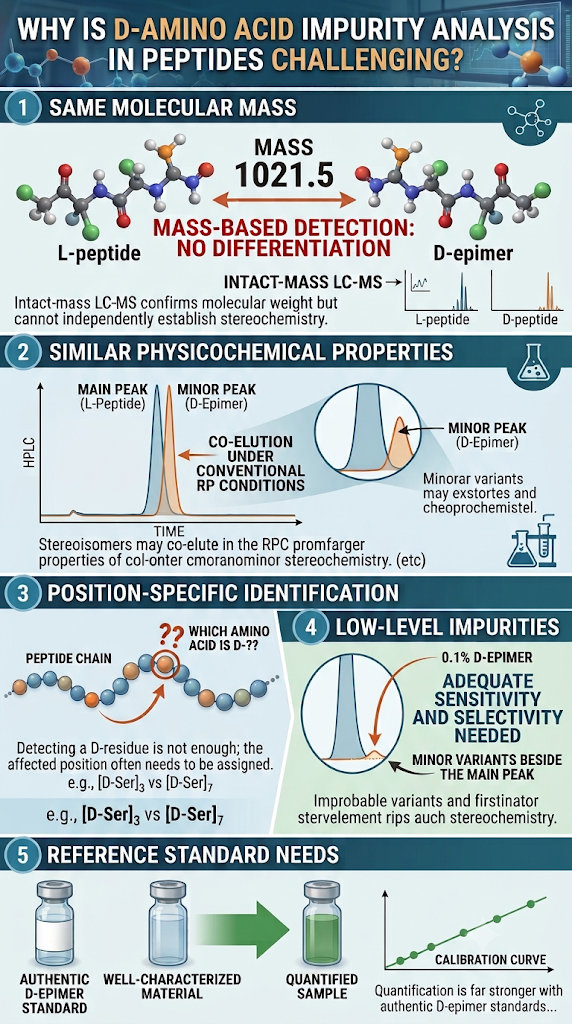
It is challenging because D- and L-residues share the same formula and molecular weight, so mass-based detection alone cannot differentiate them.
- Same molecular mass: Intact-mass LC-MS confirms molecular weight but cannot independently establish stereochemistry.
- Similar physicochemical properties: Stereoisomers may co-elute under conventional reversed-phase conditions.
- Position-specific identification: Detecting a D-residue is not enough; the affected position often needs to be assigned.
- Low-level impurities: Methods need adequate sensitivity and selectivity to measure minor variants beside the main peak.
- Reference standard needs: Quantification is far stronger with authentic D-epimer standards or well-characterized material.
4: How Do You Detect D-Amino Acid Impurities in Synthetic Peptides?
They are detected by combining peptide-level separation, enzymatic digestion or hydrolysis, chiral analysis, and mass spectrometric characterization. A typical workflow looks like this:
Synthetic peptide → RP-HPLC/UPLC profiling → impurity isolation → digestion or hydrolysis → chiral analysis → LC-MS/MS characterization → orthogonal confirmation → quantification
The exact path depends on the peptide structure and the analytical question.
Role of RP-HPLC and UPLC
RP-HPLC/UPLC is the starting point for impurity profiling, but it alone usually cannot prove that an extra peak is a D-isomer. It reveals main-peak purity, related substances, retention differences, and relative impurity abundance. A D-epimer may elute very close to the API, or even co-elute, so a stereochemistry-capable technique is needed in addition.
How Does LC-MS/MS Help?
LC-MS/MS characterizes molecular identity and sequence location of an impurity, but does not by itself establish D-versus-L configuration. A typical use is:
- Detect the impurity peak by LC.
- Measure accurate mass by HRMS.
- Confirm the mass matches the API (isobaric).
- Fragment by MS/MS and inspect ions around the suspected residue.
- Compare against an authentic reference or orthogonal result.
For deeper context on choosing between structural techniques, see our comparison of NMR vs LC-MS for peptide characterization.
How Can Chiral Chromatography Detect D-Amino Acid Impurities?
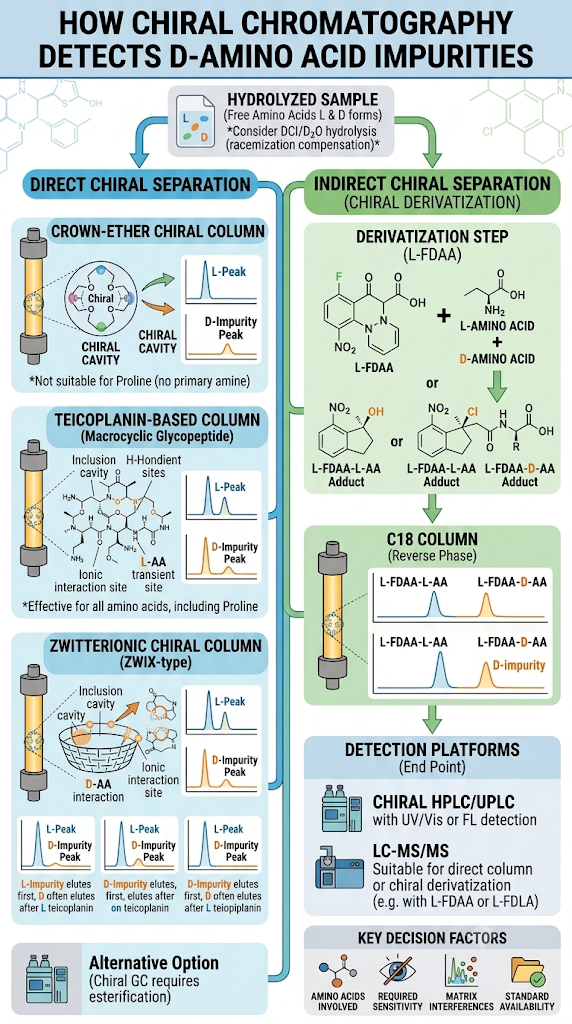
Chiral chromatography separates stereoisomers using a mechanism that responds differently to D- and L-configurations. Two common routes:
- Direct chiral separation of free amino acids after hydrolysis (e.g., crown-ether, teicoplanin-based, or zwitterionic chiral columns)
- Chiral derivatization (e.g., Marfey’s reagent), converting amino acids into diastereomers separable on standard C18 columns
Available platforms include chiral HPLC/UPLC, chiral GC after derivatization, and LC-MS/MS with chiral derivatization. The choice depends on the amino acids involved, required sensitivity, matrix, and standard availability.
5: What Is Deuterated Hydrolysis, and Why Is It Critical for Accurate Quantification?
Deuterated hydrolysis lets you separate D-isomers that were truly present in the peptide from those created by the hydrolysis step. In DCl/D₂O (typically about 110 °C, up to 24 hours, optimized per peptide), amino acids that racemize during hydrolysis incorporate deuterium at the α-carbon, adding about +1 Da. Native D-isomers remain unlabeled. Monitoring both transitions by MRM lets analysts correct for method-induced racemization.
Skipping this correction can overstate D-content, especially for aspartic acid, serine, and cysteine.
How Do You Determine Which Amino Acid Position Is Epimerized?
Locating a D-residue requires peptide-level characterization, because hydrolysis destroys sequence information. Hydrolysis proves D- and L-forms are present; it cannot say where. Position assignment typically uses:
- Enzymatic digestion and targeted peptide mapping
- LC-MS/MS and high-resolution MS
- Comparison with synthesized epimer standards
- Chromatographic comparison of diagnostic fragments
- Orthogonal structural characterization
What Is the Role of Enzymatic Digestion?
Enzymatic digestion cleaves the peptide into smaller fragments that retain sequence information and isolate the region around a suspected stereochemical impurity.
Peptide → enzymatic digestion → fragments → LC separation → MS/MS → diagnostic fragment → chiral/orthogonal confirmation
Enzyme choice matters: cleavage patterns differ, and D-residues can slow or block cleavage, so mapping alone is not conclusive. For regulated programs, peptide mapping and related characterization requirements for NDA and ANDA should guide design.
How Do You Detect Peptide-Level Diastereomers Without Hydrolysis?
You resolve the full-length D-containing diastereomer from the parent peptide by optimized UHPLC and confirm identity by MS/MS. Practical levers include shallow gradients, high-efficiency columns, multiple stationary phase screens (C18, phenyl, embedded polar), column temperature, and ion-pairing choice. Synthesized epimer reference standards confirm retention and allow relative response factors to be established.
For cyclic or conformationally constrained molecules, additional care is needed; see our guidance on cyclic peptide characterization.
6: Which Techniques Should Be Combined?
The most defensible D-Amino Acid Impurity Analysis in Peptides uses orthogonal techniques, because no single platform proves identity, location, stereochemistry, and quantity at once.
| Technique | Primary Information | Main Limitation |
|---|---|---|
| RP-HPLC/UPLC | Purity and related substances | Limited stereochemical specificity |
| LC-HRMS | Accurate mass, composition | D/L isomers are isobaric |
| LC-MS/MS | Sequence and fragment data | Does not inherently prove stereochemistry |
| Chiral HPLC/UPLC | D/L separation | May require hydrolysis or specialized conditions |
| Chiral derivatization (e.g., Marfey’s) | Improved stereo-discrimination | Extra sample prep; derivatization variability |
| Deuterated hydrolysis + chiral LC-MS/MS | Residue-level % D, corrected for artifact | Loses positional information |
| Amino acid analysis | D/L composition | No sequence position |
| Enzymatic peptide mapping | Sequence-level localization | Needs optimized digestion |
| Ion mobility MS | Shape-based isomer separation | Often semi-quantitative |
| Reference standard comparison | Strongest identity evidence | Authentic standard may be hard to obtain |
Higher-order and complementary techniques such as native mass spectrometry for therapeutic peptide characterization and multi-attribute monitoring (MAM) for peptide characterization can add further evidence and routine monitoring capability.
7: How Are D-Amino Acid Impurities Quantified?
They are quantified by measuring the stereoisomer-specific response against an appropriately characterized reference standard or validated approach. Content is commonly expressed as:
% D-isomer = (Measured D-isomer amount / Total relevant peptide amount) × 100
Key requirements:
- Reference standards: Enantiopure amino acids and, where possible, synthesized epimer peptides
- Calibration: Spiking D-isomer into L-isomer matrix across the specification range
- LOQ: Low enough to meet the reporting threshold (commonly around 0.1%, depending on peptide and guidance)
- System suitability: D/L resolution, retention reproducibility, signal-to-noise at LOQ
- Controls: Blanks and matrix checks for carryover and background
What Does Method Validation Require?
A fit-for-purpose method must demonstrate specificity, accuracy, precision, linearity, range, LOQ, and robustness, consistent with ICH Q2(R2).
| Parameter | What Is Demonstrated |
|---|---|
| Specificity | Distinguishes D-isomer from main peptide and other impurities |
| Linearity and range | Proportional response from LOQ above the specification |
| Accuracy | Recovery of spiked D-isomer |
| Precision | Repeatability and intermediate precision |
| LOQ/LOD | Lowest reliably quantifiable level |
| System suitability | Consistent chromatographic performance |
| Stability | Standards and samples remain stable |
| Robustness | Effect of hydrolysis time, temperature, column lot, mobile phase |
| Racemization correction | Deuterium-based correction performs as intended |
8: What Does a Practical Workflow Look Like?
A practical D-amino acid characterization strategy runs in seven stages.
- Method development: Establish chromatographic and detection conditions for the peptide and expected impurities.
- Impurity profiling: Monitor relevant peaks by RP-HPLC/UPLC.
- Mass characterization: Confirm accurate mass and composition by LC-HRMS.
- Fragmentation and localization: Use MS/MS and peptide mapping to examine the suspected region.
- Stereochemical confirmation: Apply chiral chromatography, derivatization, or deuterated hydrolysis.
- Quantification: Use a validated method with proper standards and calibration.
- Documentation: Keep traceable preparation records, raw data, calculations, system suitability, and interpretation.
What Factors Should Be Considered During Method Development?
Method design should be driven by both the peptide and the suspected impurity. Key factors:
- Peptide sequence, size, and hydrophobicity
- Number and type of residues, and suspected D-residue position
- Aggregation tendency and sample concentration
- Expected impurity level and required LOQ
- Availability of impurity standards
- Hydrolysis conditions and enzyme selection
- Chiral stationary phase or derivatization chemistry
- LC-MS ionization behavior and matrix effects
- Standard and sample stability
- Intended regulatory application
A method that works for a short linear peptide may not transfer directly to a hydrophobic, cyclic, modified, or long therapeutic peptide.
What Do Regulators Expect?
Regulators expect stereochemical impurities in synthetic peptides to be identified, controlled, and justified, using principles from ICH Q3A/Q3B, ICH Q6A, and FDA guidance on synthetic peptide products. For ANDA submissions referencing an RLD, sponsors must show that impurity profiles, including new or higher-level impurities, do not raise additional safety or immunogenicity concerns.
Sponsors should be ready to:
- Present an impurity control strategy from raw materials through release and stability
- Justify acceptance criteria for each identified D-isomer
- Demonstrate method suitability and validation
- Provide orthogonal evidence (hydrolysis plus intact-peptide data)
Confirm current requirements against the latest FDA, Health Canada, and EMA documents, as expectations evolve. For early-phase programs, our overview of peptide characterization CRO services for IND submission explains what is typically expected.
9: What Are the Common Mistakes in D-Amino Acid Impurity Analysis?
The most common mistakes are relying on intact mass, assuming every extra peak is a D-isomer, ignoring hydrolysis-induced racemization, and lacking reference standards.
- Relying only on intact mass: Identical mass does not exclude a stereochemical difference.
- Assuming an extra HPLC peak is a D-isomer: It could be a deletion, oxidation product, conformer, or other modification.
- Using only amino acid hydrolysis: It gives composition but not original position.
- Uncorrected racemization: Hydrolysis artifacts inflate D-content.
- Incomplete hydrolysis or residue degradation: Hindered bonds (Val–Val, Ile–Ile) resist hydrolysis; Trp, Cys, and Met can degrade.
- Ignoring reference standards: Peak assignment and quantitative confidence suffer.
- Using one technique: Stereochemical conclusions are strongest with orthogonal evidence.
How Should You Choose a CRO for Peptide Stereochemical Analysis?
Choose a partner that can show orthogonal capability, validated methods, and clear deliverables. Before engaging, define your scope using a checklist of specifications to provide when outsourcing peptide characterization and confirm what to expect using a peptide characterization CRO deliverables checklist. Broader peptide characterization services should cover sequence confirmation, impurity profiling, and stereochemical analysis in one integrated package.
How Does ResolveMass Approach Peptide Impurity Characterization?
ResolveMass Laboratories Inc. treats stereochemical characterization as a problem of connecting chromatographic, mass-spectrometric, sequence, and orthogonal evidence. Project-specific questions guide the design:
- What impurity is being observed, and does its accurate mass support the proposed structure?
- Which region of the sequence is affected?
- Can D/L forms be chromatographically differentiated?
- Is an authentic impurity standard available?
- What level can be reliably detected and quantified?
- Is the evidence sufficient for the intended development or regulatory purpose?
What this means for your program:
- Orthogonal data packages combining deuterated-hydrolysis chiral LC-MS/MS with intact-peptide diastereomer profiling and mapping
- Method development and validation tailored to your sequence and specification
- Regulatory-ready documentation with traceability and data integrity controls
- Lifecycle support across development, release, stability, and comparability or ANDA studies
Conclusion:
Effective D-Amino Acid Impurity Analysis in Peptides is a multi-dimensional investigation, not a simple purity test. Because stereoisomeric impurities are identical in mass to the intended peptide, a reliable package combines chromatographic profiling, LC-MS/MS or HRMS characterization, peptide mapping for localization, and chiral or deuterated-hydrolysis confirmation for quantification. The goal is to establish what the impurity is, where it sits, how well the evidence supports the assignment, and how much is present.
Frequently Asked Questions:
Yes, but complex peptides may require more extensive method development. Peptide size, hydrophobicity, modifications, cyclic structures, aggregation, and multiple potential stereochemical sites can make separation and localization more difficult. A combination of chromatographic, mass-spectrometric, enzymatic, and chiral techniques may therefore be needed.
D-amino acid formation can occur during peptide synthesis because of stereochemical changes associated with amino acid activation, coupling, reaction conditions, and process handling. The risk can depend on the amino acid residue, protecting groups, coupling reagents, reaction time, temperature, and synthesis strategy. Careful process optimization and impurity monitoring can help identify and control stereochemical impurities.
Some amino acid residues can present greater analytical challenges because of their chemical structure, susceptibility to epimerization, or difficulty in chromatographic separation. The risk and analytical difficulty should be evaluated for each amino acid and its position within the peptide rather than assuming that all residues behave similarly.
Epimerization can potentially occur during amino acid activation and coupling as well as under certain reaction or processing conditions. The susceptibility depends on the amino acid and chemistry being used. Monitoring intermediates or the final peptide can help determine whether stereochemical impurities are being generated during the synthesis process.
When a suspected D-isomer co-elutes with the main peptide, method development may focus on improving selectivity through changes in the stationary phase, mobile phase, temperature, gradient, additives, or other chromatographic parameters. Alternative approaches such as chiral derivatization, peptide digestion, or orthogonal mass-spectrometric analysis may also be considered.
Reference
- Zhang B, Xu W, Yin C, Tang Y. Characterization of low-level D-amino acid isomeric impurities of Semaglutide using liquid chromatography-high resolution tandem mass spectrometry. Journal of Pharmaceutical and Biomedical Analysis. 2023 Feb 5;224:115164.https://www.sciencedirect.com/science/article/pii/S0731708522005854
- Cheng X, Liu M, Qin J, Wu Q, Wang D, Wei L. Integrating State-of-the-Art Sensing Platforms for d-Amino Acid Detection: A Comprehensive Review. Analytical Chemistry. 2026 Jul 13.https://pubs.acs.org/doi/full/10.1021/acs.analchem.6c02553
- Adams CM, Zubarev RA. Distinguishing and quantifying peptides and proteins containing D-amino acids by tandem mass spectrometry. Analytical Chemistry. 2005 Jul 15;77(14):4571-80.https://pubs.acs.org/doi/abs/10.1021/ac0503963
- Zhang B, Xu W, Yin C, Tang Y. Characterization of low-level d-amino acid degradation impurities using liquid chromatography-high resolution tandem mass spectrometry. Available at SSRN 4193936. 2022.https://papers.ssrn.com/sol3/papers.cfm?abstract_id=4193936
- Deng F, Wang R, Wu L, Liu Y. Determining the purity of four D-amino acids through mass balance and quantitative nuclear magnetic resonance. Microchemical Journal. 2025 Aug 21:114993.https://www.sciencedirect.com/science/article/pii/S0026265X25023410
About the Author


