

Introduction
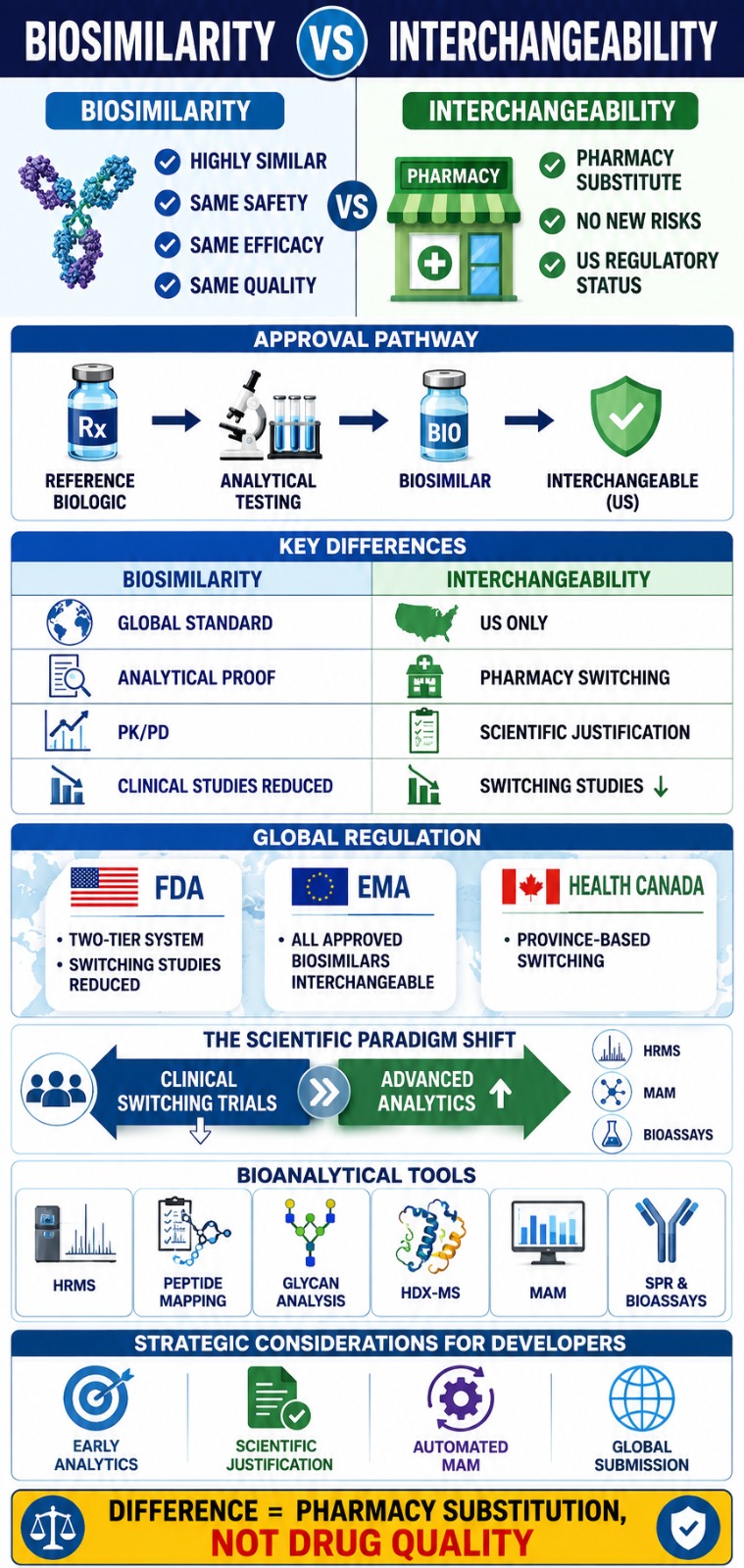
The primary Difference Between Biosimilarity and Interchangeability lies in regulatory designation and pharmacy-level substitution rights rather than any variation in drug quality, therapeutic performance, or safety profile. Biosimilarity establishes that a biologic is highly comparable to a reference product and demonstrates no clinically meaningful differences in safety, purity, or potency. Interchangeability, however, is a distinct regulatory status that allows pharmacists to substitute a biosimilar for its reference product without requiring prior approval from the prescribing healthcare provider.
Biologics constitute an advanced category of therapeutic products derived from living biological systems, including monoclonal antibodies, recombinant proteins, fusion proteins, and other complex biomolecules. Because these medicines are manufactured using living cells, a certain degree of molecular variability naturally exists among production batches, a phenomenon observed in both reference biologics and biosimilars. When patent protection and exclusivity periods for innovator biologics expire, biosimilar manufacturers must demonstrate that their products closely resemble the reference medicine across all relevant critical quality attributes (CQAs).
Learn how Critical Quality Attributes (CQAs) in Biosimilars guide characterization and regulatory approval strategies.
The United States established a structured pathway for biosimilar approval through the Biologics Price Competition and Innovation Act (BPCIA) of 2009. This legislation introduced a two-level regulatory framework. At the foundational level, biosimilar developers are required to demonstrate a high degree of structural and functional similarity, supported by comparable pharmacokinetic characteristics. Historically, a higher designation—interchangeability—required additional evidence from dedicated switching studies showing that alternating between the reference product and the biosimilar did not increase safety concerns, compromise efficacy, or elevate immunogenicity risks.
Advancements in bioanalytical science, including high-resolution mass spectrometry, multi-attribute methods, and other sophisticated characterization technologies, have significantly reshaped regulatory expectations. More than a decade of accumulated real-world clinical experience has demonstrated that switching between approved biosimilars and reference biologics presents minimal clinical concern. As a result, major regulatory agencies such as the US Food and Drug Administration (FDA) and the European Medicines Agency (EMA) are increasingly emphasizing comprehensive analytical evidence while reducing reliance on unnecessary clinical switching trials.
Share via:
Article Summary:
- Biosimilarity confirms that a biologic is highly similar to its reference product, with no clinically meaningful differences in safety, efficacy, purity, or quality, based on comprehensive analytical and clinical evidence.
- Interchangeability is a US-specific regulatory designation that permits pharmacy-level substitution of a biosimilar without prior approval from the prescribing healthcare provider.
- Regulatory agencies such as the FDA, EMA, and Health Canada increasingly rely on advanced analytical characterization instead of routine clinical switching studies, as extensive real-world evidence supports the safety of switching.
- Modern bioanalytical technologies—including High-Resolution Mass Spectrometry (HRMS), Peptide Mapping, Glycan Analysis, HDX-MS, Multi-Attribute Methods (MAM), and Surface Plasmon Resonance (SPR)—are central to demonstrating biosimilarity and supporting regulatory approvals.
- Global regulatory approaches differ: the FDA maintains a biosimilar/interchangeable framework, the EMA considers approved biosimilars interchangeable in clinical practice, and Health Canada manages switching through provincial policies.
- Biopharmaceutical developers can accelerate development by emphasizing early analytical characterization, scientific justification, automated MAM workflows, and harmonized global regulatory submissions, reducing unnecessary studies and development costs.
- The key distinction between biosimilarity and interchangeability is pharmacy substitution authority—not differences in product quality, safety, or therapeutic performance.
Defining Biosimilarity: The Bioanalytical Foundation
Biosimilarity is established when extensive comparative analytical, non-clinical, and clinical assessments demonstrate that a proposed biologic is highly similar to an approved reference product and exhibits no clinically meaningful differences in safety, purity, or potency. This foundational regulatory designation requires a thorough evaluation of molecular structure, biological activity, and pharmacokinetic performance to confirm therapeutic equivalence.
The demonstration of biosimilarity relies on a comprehensive weight-of-evidence approach centered on a Comparative Analytical Assessment (CAA). Because biologics are produced in living cellular systems, creating a molecule that is absolutely identical to another product at every molecular level is not feasible. Instead, manufacturers must show that the biosimilar falls within the established range of variability observed among multiple commercial batches of the reference product.
Explore our end-to-end Biosimilar Characterization Services designed for robust comparability packages.
Traditionally, biosimilar approval followed a stepwise “totality-of-the-evidence” framework that included detailed structural characterization, functional bioassays, animal toxicology studies, human pharmacokinetic and pharmacodynamic (PK/PD) evaluations, and comparative clinical efficacy studies (CES). Over time, however, regulatory science has increasingly recognized that modern analytical technologies possess far greater sensitivity for detecting structural and functional differences than conventional clinical efficacy trials. Consequently, updated FDA recommendations indicate that comparative clinical efficacy studies may be waived when products derived from well-characterized clonal cell lines undergo extensive analytical evaluation using advanced and scientifically robust methodologies.
Defining Interchangeability: Regulatory Standards and Pharmacy Substitution
Interchangeability is a regulatory designation that exists primarily within the United States and permits a biosimilar to be substituted for its reference product at the pharmacy level without direct involvement from the prescribing physician. Although this designation historically required additional clinical evidence from switching studies, recent regulatory developments allow manufacturers to support interchangeability using comprehensive analytical and scientific evidence packages.
Established under Section 351(k) of the Public Health Service (PHS) Act, the interchangeability pathway was intended to provide a mechanism similar to generic drug substitution while accounting for the inherent complexity of biologic medicines. Under FDA guidance released in 2019, manufacturers seeking interchangeability were generally expected to conduct dedicated switching studies in which patients alternated multiple times between the reference biologic and the proposed biosimilar. These investigations aimed to confirm that repeated switching would not adversely affect efficacy, safety, or immunogenicity outcomes.
Subsequent evidence from clinical studies, systematic reviews, meta-analyses, and extensive real-world use has consistently demonstrated that approved biosimilars do not create additional risks when patients switch from a reference biologic. Reflecting this growing body of evidence, the FDA’s updated draft guidance now indicates that dedicated switching studies are generally unnecessary. Instead, manufacturers may provide a scientific justification showing that the analytical and clinical evidence already generated during biosimilarity assessment adequately supports the safety of switching between products.
Discover best practices for structuring a Comparability Exercise in Biosimilar Development to align with regulatory standards.
Key Regulatory and Bioanalytical Factors: Difference Between Biosimilarity and Interchangeability
The core Difference Between Biosimilarity and Interchangeability is rooted in pharmacy substitution authority, historical regulatory requirements, and jurisdiction-specific legal frameworks. Although both designations require equivalent standards for safety, efficacy, and product quality, interchangeability specifically addresses whether a biosimilar may be automatically substituted for the reference product at the dispensing level.
The following table summarizes the major scientific, operational, and regulatory distinctions between these two classifications:
| Feature / Metric | Biosimilarity Standard | Interchangeability Standard |
|---|---|---|
| Primary Regulatory Goal | Demonstrates high structural and functional similarity with no clinically meaningful differences. | Permits pharmacy-level substitution without consulting the prescribing healthcare professional. |
| Jurisdictional Reach | Serves as the foundational approval standard across the FDA, EMA, Health Canada, WHO, and other major regulatory agencies. | Exists primarily under US legislation through the BPCIA and is not a separate designation in the European Union or Canada. |
| Pharmacy Substitution Authority | Typically requires the healthcare provider to prescribe the specific product. | May be substituted at the pharmacy level according to applicable state pharmacy laws. |
| Clinical Study Requirements | Requires comparative PK/PD evaluations, while comparative efficacy studies are increasingly being waived. | Historically required switching studies; current regulatory approaches increasingly rely on analytical evidence. |
| Underlying Bioanalytical Criteria | Requires extensive Comparative Analytical Assessment, including HRMS, MAM, functional bioassays, and structural characterization. | Relies on the same analytical foundation used for biosimilarity, supplemented by scientific assessment of switching safety. |
| Safety and Efficacy Benchmarks | Must demonstrate equivalent safety, purity, and therapeutic effectiveness compared with the reference product. | Applies the same safety and efficacy standards as those required for biosimilar approval. |
The movement away from mandatory switching studies reflects a growing scientific consensus that advanced analytical characterization technologies provide a far more precise assessment of molecular similarity than clinical switching trials. Consequently, the evidence package required to establish biosimilarity generally encompasses the key scientific considerations relevant to switching, leaving the distinction between biosimilarity and interchangeability increasingly centered on regulatory and administrative considerations.
Read how adherence to ICH Q6B Guidelines for Biological Characterisation provides the regulatory foundation for modern approvals.
Global Regulatory Frameworks: FDA, EMA, and Health Canada Alignment
Regulatory agencies around the world approach biosimilar substitution using different legal and administrative frameworks. These range from the FDA’s historically two-tiered model to the EMA’s unified view of interchangeability and Health Canada’s provincially managed switching policies. Despite these differences, leading regulatory authorities consistently agree that approved biosimilars can be used safely and effectively when patients transition from reference biologics.
FDA Guidance Evolution in the United States
The FDA operates within the dual-tier system established under the Biologics Price Competition and Innovation Act (BPCIA), which distinguishes between biosimilar and interchangeable biologic products. However, recent draft guidance reflects a substantial shift in regulatory thinking by largely removing the expectation for dedicated clinical switching studies and emphasizing comprehensive analytical comparability assessments instead.
In addition, the FDA has expressed support for policy changes that would effectively treat approved biosimilars as interchangeable, aligning US regulatory practices more closely with approaches adopted in other major global jurisdictions. These developments reflect the growing recognition that extensive analytical evidence and accumulated clinical experience provide strong assurance regarding switching safety.
European Union Framework under the EMA
The European Medicines Agency (EMA) takes a different approach by considering all approved biosimilars within the European Union to be interchangeable with their reference products and with other biosimilars referencing the same originator medicine. Unlike the United States, the EU does not maintain a separate regulatory designation for interchangeability.
Following the joint position statement issued by the EMA and the Heads of Medicines Agencies (HMA) in 2022, European regulators have consistently maintained that biosimilars approved through the centralized EU authorization process can be switched safely during routine clinical practice. While individual member states retain authority regarding automatic pharmacy substitution policies, the scientific consensus across Europe supports the interchangeability of approved biosimilars.
Canadian Regulatory and Provincial Landscape
Health Canada evaluates and approves biosimilars based on rigorous evidence demonstrating a high degree of similarity to the reference biologic. However, decisions regarding substitution and switching are delegated to provincial and territorial authorities rather than being governed through a single national framework.
Several Canadian provinces—including British Columbia, Alberta, Quebec, Ontario, New Brunswick, Saskatchewan, and Nova Scotia—have implemented non-medical switching initiatives within their public drug plans. Under these policies, patients receiving originator biologics may transition to lower-cost biosimilar alternatives while remaining under the supervision of their healthcare providers. These programs are designed to improve healthcare sustainability while maintaining equivalent standards of clinical effectiveness, safety, and patient care.
The Scientific Paradigm Shift: Why Clinical Switching Studies Are Becoming Obsolete
Comparative clinical switching studies are increasingly being viewed as unnecessary because extensive real-world evidence and comprehensive meta-analyses accumulated over the past decade have consistently demonstrated no increased risk of immunogenicity, safety concerns, or diminished therapeutic effectiveness when patients switch between reference biologics and approved biosimilars. At the same time, advanced analytical technologies such as high-resolution mass spectrometry and sophisticated structural characterization platforms provide substantially greater sensitivity than clinical trials for detecting molecular differences between products.
The original requirement for dedicated switching studies emerged from concerns regarding immunogenicity. Since complex protein therapeutics have the potential to induce anti-drug antibody (ADA) formation, early regulatory frameworks assumed that switching between highly similar biological products might increase the likelihood of unexpected immune responses. However, extensive systematic reviews and large-scale clinical evaluations involving thousands of patients across therapeutic areas such as immunology, oncology, gastroenterology, and endocrinology have consistently shown that both single and repeated switches do not negatively impact safety, efficacy, or immunogenicity outcomes.
Moreover, human clinical studies inherently contain significant variability arising from patient-specific factors, disease progression patterns, treatment responses, and subjective clinical endpoints. In contrast, modern bioanalytical characterization techniques evaluate molecular and structural attributes directly, allowing scientists to detect subtle amino acid modifications, aggregation events, charge variants, and glycosylation changes with extremely high sensitivity. Regulatory agencies increasingly acknowledge that analytical comparability assessments provide a much more precise and reliable method for confirming biosimilar similarity than traditional switching studies.
Learn more about identifying and managing critical impurities in our detailed guide on Impurity Profiling of Biosimilars.
Bioanalytical Technologies Driving Regulatory Approvals
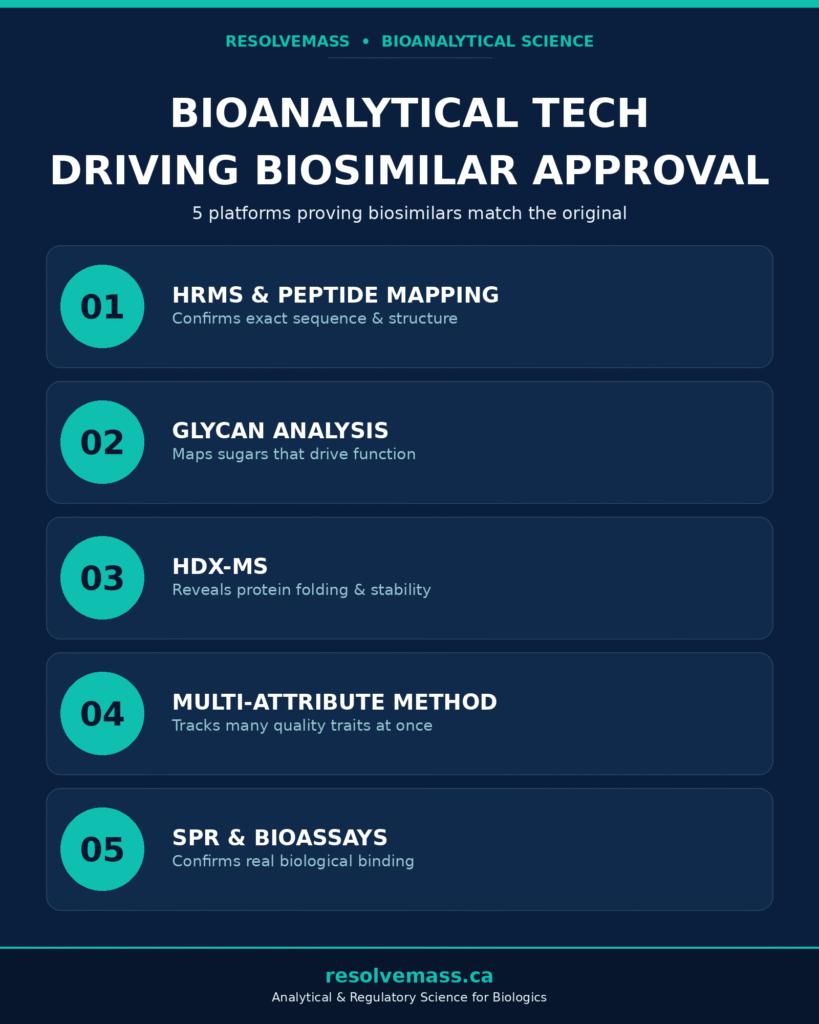
Modern bioanalytical technologies play a central role in establishing biosimilarity and supporting interchangeability assessments by providing comprehensive evidence of structural, functional, and conformational comparability at the molecular level. Advanced analytical platforms such as high-resolution mass spectrometry, peptide mapping, glycan profiling, and multi-attribute methods now form the backbone of regulatory submissions for biosimilar products.
To satisfy evolving regulatory expectations established by agencies such as the FDA, EMA, and Health Canada, biopharmaceutical manufacturers utilize multiple orthogonal analytical techniques to thoroughly characterize complex biologic molecules. These technologies collectively provide a detailed understanding of molecular identity, product consistency, and functional performance.
High-Resolution Mass Spectrometry (HRMS) and Peptide Mapping
High-Resolution Mass Spectrometry (HRMS) combined with peptide mapping is used to verify the primary amino acid sequence, confirm intact molecular mass, and identify site-specific post-translational modifications (PTMs). These techniques enable precise characterization of molecular attributes such as oxidation, deamidation, glycation, and C-terminal lysine heterogeneity, providing critical evidence of structural similarity between a biosimilar and its reference product.
Glycan Analysis (Glycomics)
Glycan analysis focuses on the characterization of N-linked and O-linked oligosaccharide structures present on therapeutic proteins. Detailed assessment of glycosylation patterns—including core fucosylation, terminal sialylation, galactosylation, high-mannose species, and other glycoforms—is essential because these attributes can directly influence antibody-dependent cellular cytotoxicity (ADCC), complement activation, receptor binding, serum half-life, and overall pharmacokinetic behavior.
Read our comprehensive breakdown of Glycosylation Analysis of Biosimilars to understand its impact on efficacy and safety.
Hydrogen-Deuterium Exchange Mass Spectrometry (HDX-MS)
Hydrogen-Deuterium Exchange Mass Spectrometry (HDX-MS) is utilized to investigate protein conformational dynamics and higher-order structural characteristics. By monitoring hydrogen exchange rates within the protein backbone, this technique provides detailed information regarding secondary and tertiary structure similarity, protein folding, stability, and conformational flexibility. Such data are valuable for confirming that the biosimilar exhibits structural behavior comparable to that of the reference biologic.
See how advanced structural analytical approaches like Native Mass Spectrometry for Biosimilars reveal intact biomolecular structure.
Multi-Attribute Method (MAM)
The Multi-Attribute Method (MAM) combines advanced liquid chromatography-mass spectrometry (LC-MS) workflows into a single integrated platform capable of monitoring multiple critical quality attributes (CQAs) simultaneously. MAM enables automated identification, quantification, and trending of key product attributes, making it an increasingly valuable tool for process development, comparability assessments, lot release testing, and ongoing product quality monitoring.
Surface Plasmon Resonance (SPR) and In Vitro Bioassays
Surface Plasmon Resonance (SPR) and complementary in vitro bioassays are employed to evaluate biological functionality and binding performance. These methods assess interactions with target antigens, neonatal Fc receptors (FcRn), Fc gamma receptors (FcγRIIIa), complement proteins such as C1q, and other biologically relevant targets. Through detailed kinetic and functional characterization, these assays help establish functional equivalence between biosimilars and reference biologics.
Learn how state-of-the-art Charge Variant Analysis in Biosimilars resolves molecular heterogeneity using mass spectrometry.
Strategic Considerations for Biopharmaceutical Developers
Biopharmaceutical companies can significantly improve development efficiency by prioritizing advanced bioanalytical characterization during the early stages of biosimilar development. By leveraging modern regulatory expectations and comprehensive analytical evidence packages, developers can potentially avoid unnecessary clinical switching studies while maintaining full regulatory compliance and scientific rigor.
Several strategic considerations can help biosimilar sponsors optimize development timelines, reduce costs, and strengthen regulatory submissions.
Prioritizing Early Analytical Characterization
Applying advanced analytical technologies during candidate selection and process development enables manufacturers to establish a comprehensive understanding of critical quality attributes at an early stage. Comparing multiple lots of the reference product and the biosimilar candidate throughout development helps ensure consistent alignment with the analytical variability range observed in the originator product.
Submitting Scientific Assessment Justifications
Updated regulatory guidance increasingly allows manufacturers to support interchangeability and switching safety through scientific justification rather than dedicated switching studies. Preparing robust analytical comparability packages and comprehensive scientific assessments can reduce development burdens while maintaining regulatory confidence in product performance and patient safety.
Discover stress-testing strategies for stability and degradation pathways in Forced Degradation of Biosimilars.
Implementing Automated MAM Workflows
The adoption of Multi-Attribute Methods for process characterization, stability studies, comparability assessments, and routine quality control can streamline development activities and improve operational efficiency. Automated MAM workflows also support accelerated preparation of Biologics License Application (BLA) and New Drug Submission (NDS) documentation by generating highly reproducible analytical datasets.
Aligning Global Regulatory Submissions
Developers can further improve efficiency by designing analytical comparability programs that simultaneously address the expectations of multiple regulatory agencies, including the FDA, EMA, and Health Canada. Harmonized data packages facilitate global submission strategies, reduce duplication of effort, and support faster access to international markets.
Conclusion
The fundamental Difference Between Biosimilarity and Interchangeability is primarily related to pharmacy-level substitution authority rather than any distinction in clinical quality, safety, efficacy, or biological performance. As regulatory agencies including the FDA, EMA, and Health Canada continue to align their approaches with advances in analytical science, the historical reliance on redundant clinical switching studies is rapidly diminishing.
Modern biosimilar development is increasingly driven by advanced bioanalytical characterization technologies, including high-resolution mass spectrometry, peptide mapping, glycan profiling, multi-attribute methods, and functional bioassays. These sophisticated analytical tools provide highly sensitive assessments of molecular similarity and have become the cornerstone of contemporary biosimilar approval strategies.
Biopharmaceutical organizations that invest in comprehensive analytical characterization programs can efficiently meet global regulatory expectations, strengthen comparability assessments, accelerate submission timelines, and support broader patient access to cost-effective biologic therapies. By integrating advanced analytical workflows into development programs, manufacturers can confidently demonstrate biosimilarity while navigating evolving international regulatory requirements.
To consult with bioanalytical specialists regarding HRMS comparability studies, peptide mapping, glycoform profiling, biosimilar characterization strategies, or regulatory submission planning, visit the ResolveMass Contact Page.
Frequently Asked Questions (FAQs)
No. An interchangeable biosimilar is not considered superior in terms of safety, efficacy, or quality. Both biosimilars and interchangeable biosimilars must satisfy rigorous regulatory requirements demonstrating equivalent clinical performance, safety profiles, and product consistency before receiving approval.
Health Canada evaluates and approves biosimilars based on evidence demonstrating a high level of similarity to the reference biologic. However, decisions regarding substitution and switching are managed by provincial and territorial authorities rather than through a separate federal interchangeability designation, which differs from the US regulatory framework.
Yes. The European Medicines Agency recognizes approved biosimilars as interchangeable with their reference products based on the scientific evidence supporting their authorization. While individual European countries may establish their own pharmacy substitution policies, the EMA does not require a separate interchangeability designation.
Although the FDA determines whether a biosimilar qualifies for interchangeability at the federal level, individual state pharmacy laws govern how substitution can occur in practice. These laws may specify notification requirements, record-keeping procedures, and other conditions that pharmacists must follow when substituting biologic products.
In most cases, no. If a biosimilar has not received an interchangeability designation, pharmacists generally cannot substitute it for the reference biologic without approval from the prescribing healthcare professional or a revised prescription authorizing the change.
Modern biosimilar development relies heavily on advanced analytical tools such as High-Resolution Mass Spectrometry (HRMS), Peptide Mapping, Glycan Profiling, Hydrogen-Deuterium Exchange Mass Spectrometry (HDX-MS), and Multi-Attribute Methods (MAM). These technologies provide detailed structural and functional data that help demonstrate product similarity with exceptional precision.
Non-medical switching refers to the transition of patients from an originator biologic to a biosimilar for reasons unrelated to clinical performance, such as reducing healthcare costs or improving the sustainability of public drug programs. These transitions are typically implemented under established healthcare policies and are often conducted under medical supervision.
There is growing discussion among policymakers and regulatory stakeholders about simplifying the current framework by removing the legal distinction between biosimilar and interchangeable products. While no final decision has been made, proposed reforms aim to align the United States more closely with international regulatory approaches that do not maintain separate interchangeability classifications.
Reference:
- U.S. Food and Drug Administration. (2024, June 20). FDA updates guidance on interchangeability. U.S. Department of Health and Human Services. https://www.fda.gov/drugs/drug-alerts-and-statements/fda-updates-guidance-interchangeability
- Health Canada. (2026, May 20). Handbook for health care professionals on biosimilar biologic drugs: Access to biosimilars and communicating with patients. Government of Canada. https://www.canada.ca/en/health-canada/services/drugs-health-products/biologics-radiopharmaceuticals-genetic-therapies/biosimilar-biologic-drugs/handbook-healthcare-professionals/access-communicating-patients.html
- European Medicines Agency. (n.d.). Biosimilar medicines: Marketing authorisation. European Medicines Agency. https://www.ema.europa.eu/en/human-regulatory-overview/marketing-authorisation/biosimilar-medicines-marketing-authorisation
- U.S. Food and Drug Administration. (2025, October 29). FDA moves to accelerate biosimilar development and lower drug costs. U.S. Department of Health and Human Services. https://www.fda.gov/news-events/press-announcements/fda-moves-accelerate-biosimilar-development-and-lower-drug-costs
- Patented Medicine Prices Review Board. (2023, May/June). Biosimilars in Canada: Policies to promote switching and what it means for payers. Government of Canada. https://www.canada.ca/en/patented-medicine-prices-review/services/npduis/analytical-studies/posters/biosimilars-policies-promote-switching.html
Get In Touch With Us
About The Author


