

Introduction:
Generic injectable manufacturers face a unique quality challenge: unlike oral or topical products, injectables can expose patients directly to any chemical substance that migrates from packaging, tubing, filters, or other manufacturing components into the drug product. This is why E&L Testing for Generic Injectable Drugs has become a core, non-negotiable part of container-closure qualification, formulation development, and ANDA submission strategy. Whether a sponsor is introducing a new stopper supplier, moving to single-use manufacturing components, or qualifying a prefilled syringe system against a reference listed drug, a scientifically defensible extractables and leachables (E&L) program is what stands between a promising generic injectable and a costly regulatory delay. This article walks through what E&L testing involves, why it is especially critical for injectable dosage forms, how a CDMO structures a compliant program, and what regulatory frameworks — including USP <1663>, USP <1664>, and the emerging ICH Q3E guideline — sponsors need to understand before development begins.
Summary:
- E&L Testing for Generic Injectable Drugs evaluates chemicals that may migrate from container-closure systems, manufacturing components, or delivery systems into the drug product.
- Extractables are compounds released under controlled, often exaggerated laboratory conditions; leachables are compounds that actually migrate into the drug product under intended storage and use conditions.
- Injectable products require a carefully designed E&L strategy because they may be administered directly into the body, making chemical contaminant control especially important.
- A robust E&L program combines material/component risk assessment, controlled extraction studies, leachables studies, analytical screening, compound identification, quantification, and toxicological assessment.
- Key analytical technologies include GC-MS, LC-MS/MS, high-resolution MS, ICP-MS, FTIR, and headspace GC-MS, selected according to the chemical characteristics of potential migrants.
- USP <1663> provides a framework for extractables assessments, USP <1664> for drug-product leachables assessments, and the draft ICH Q3E guideline is advancing a harmonized, risk-based global approach.
- Engaging an experienced analytical CDMO early — such as ResolveMass Laboratories Inc. — helps generic injectable manufacturers identify packaging-related risks before they become regulatory or commercial obstacles.
1: Why Is Extractables and Leachables (E&L) Testing Important for Generic Injectable Drugs?
Extractables and Leachables (E&L) Testing for Generic Injectable Drugs is a critical pharmaceutical quality activity because substances originating from packaging, manufacturing components, or delivery systems can migrate into the drug product and affect patient safety, product quality, or regulatory acceptability.
Unlike oral dosage forms, injectable products can involve direct systemic exposure, so chemical compatibility between the formulation and any material that contacts the drug deserves careful evaluation. Components such as glass vials, rubber stoppers, plastic syringes, plungers, tubing, bags, filters, connectors, and other manufacturing or delivery-system components can all represent potential sources of extractables and leachables.
FDA’s container-closure framework emphasizes that packaging systems should be evaluated according to the specific drug product, formulation, dosage form, and intended use, rather than relying on a single universal testing strategy.
For generic injectable products, this becomes particularly important when:
- Establishing equivalence to a reference listed drug (RLD)
- Introducing a new container-closure system
- Changing component suppliers
- Modifying the formulation
- Developing products with sensitive or reactive drug substances
At ResolveMass Laboratories Inc., E&L investigations are supported by analytical technologies including LC-MS/MS, GC-MS, ICP-MS, and FTIR, allowing E&L programs to be tailored to the specific material, formulation, and regulatory requirements involved.
2: What Are Extractables and Leachables?
Extractables are chemical substances that can be released from a material under controlled laboratory extraction conditions, while leachables are substances that migrate into the drug product during actual or simulated storage and use conditions.
The distinction matters because extractables data provides a potential chemical profile of a material, while leachables data provides evidence of what can actually migrate into the pharmaceutical product itself.
| Parameter | Extractables | Leachables |
|---|---|---|
| Definition | Compounds released under laboratory extraction conditions | Compounds migrating into the drug product |
| Conditions | Controlled, often aggressive | Intended storage/use conditions |
| Purpose | Identify potential migrants | Determine actual/potential product exposure |
| Typical Samples | Packaging/material components | Drug product or simulated drug matrix |
| Role | Screening and risk assessment | Product safety and exposure assessment |
Not every extractable becomes a leachable. An extractables study should not automatically be interpreted as proof of patient exposure — it is a screening tool that informs a scientifically justified leachables strategy.
3: Why Is Extractables and Leachables (E&L) Testing for Generic Injectable Drugs Challenging?
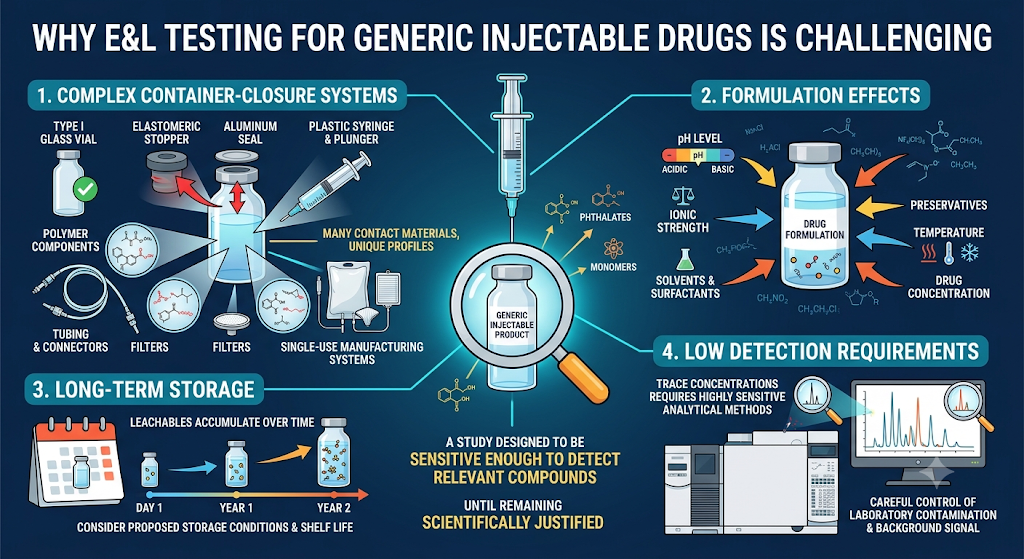
The main challenge is designing a study sensitive enough to detect relevant compounds while remaining scientifically justified for the specific injectable formulation and container-closure system in question.
Several factors drive E&L complexity for injectables:
1. Complex Container-Closure Systems
Injectables may involve multiple contact materials, including:
- Type I glass vials
- Elastomeric stoppers
- Aluminum seals
- Plastic syringes and plungers
- Polymer components
- Tubing and connectors
- Filters
- Single-use manufacturing systems
Each material carries its own chemical composition and potential extractables profile. Single-use manufacturing components in particular have become a growing area of regulatory and scientific focus — our detailed guidance on single-use systems and GMP extractables and leachables testing covers this in depth.
2. Formulation Effects
The formulation itself can influence chemical migration. Factors such as pH, ionic strength, solvents, surfactants, preservatives, temperature, and drug concentration may all affect the interaction between the drug product and its packaging.
3. Long-Term Storage
Leachables may accumulate over time, so evaluations should consider proposed storage conditions and shelf life rather than relying exclusively on short-term testing.
4. Low Detection Requirements
Potential leachables may occur at trace concentrations, so injectable products often require highly sensitive analytical methods and careful control of laboratory contamination and background signal.
4: How Is Extractables and Leachables (E&L) Testing for Generic Injectable Drugs Performed?
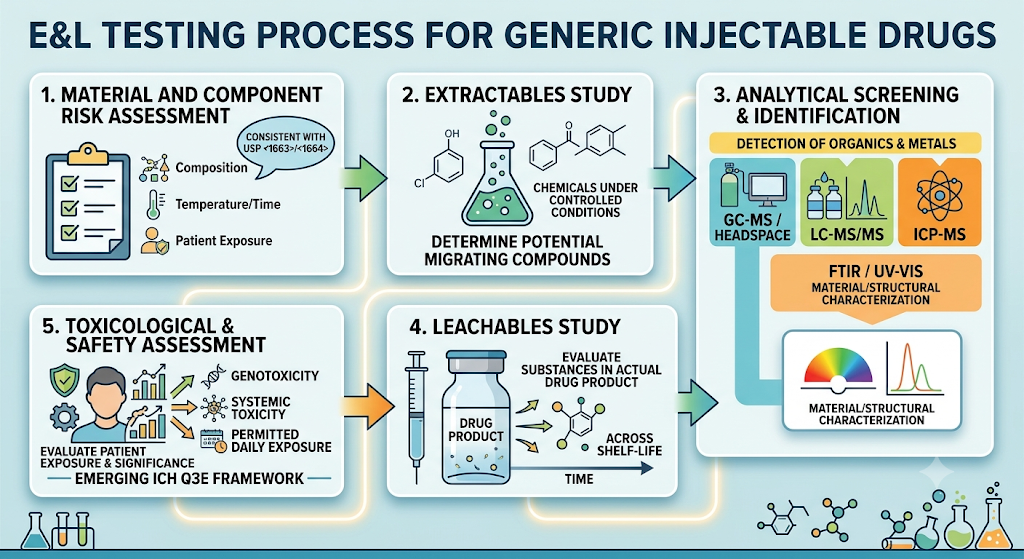
A scientifically sound E&L program generally begins with a risk assessment, followed by extractables testing, analytical characterization, targeted leachables testing, and toxicological evaluation where applicable.
Step 1: Material and Component Risk Assessment
The first step is identifying every material that can contact the drug product during manufacturing, storage, and administration. The assessment may consider:
- Material composition
- Contact duration and temperature
- Surface-area-to-volume ratio
- Manufacturing process
- Formulation characteristics
- Route of administration and patient exposure
- Supplier information and prior extractables data
- Intended shelf life
This risk-based approach is consistent with the philosophy described in USP <1663> and <1664>.
Step 2: Extractables Study
Extractables testing uses controlled laboratory conditions to determine which chemical compounds could potentially migrate from a material. Depending on the material, extraction conditions may involve appropriate solvents, temperatures, contact times, and surface-area-to-volume ratios.
The objective is not simply to generate a long list of chemicals — the study should produce relevant, interpretable chemical information that supports subsequent leachables and toxicological assessments. Our overview of a GMP-compliant extractables and leachables study outlines what a well-designed extraction protocol looks like in practice.
Step 3: Analytical Screening and Identification
No single analytical technique can adequately detect every chemical class, so a combination of platforms is typically required:
| Analytical Technique | Typical Application |
|---|---|
| GC-MS / Headspace GC-MS | Volatile and semi-volatile organic compounds |
| LC-MS/MS | Non-volatile and semi-volatile compounds |
| High-resolution LC-MS | Unknown screening and accurate-mass characterization |
| ICP-MS | Elemental/metal analysis |
| FTIR | Material and structural characterization |
| UV-Vis | Selected chromophoric compounds |
ResolveMass Laboratories maintains capabilities across LC-MS/MS, GC-MS, ICP-MS, FTIR, and headspace GC-MS for E&L investigations.
Step 4: Leachables Study
Leachables testing evaluates chemical substances that migrate into the actual drug product, or a scientifically justified representative matrix, under relevant storage conditions. A leachables program can involve multiple time points to determine whether concentrations remain stable, increase over time, or change due to degradation or formulation interaction.
For generic injectable products, this information helps confirm whether the selected packaging system remains appropriate throughout the proposed product lifecycle. A second detailed example of this workflow is available in our GMP-compliant extractables and leachables study resource.
Step 5: Toxicological and Safety Assessment
Identified leachables must be evaluated according to potential patient exposure and toxicological significance. Depending on the compound and available data, this assessment may consider:
- Identification confidence
- Concentration and maximum daily exposure
- Route of administration
- Genotoxicity concerns
- Systemic toxicity
- Permitted daily exposure or other applicable safety thresholds
- Existing toxicological information
The emerging ICH Q3E framework places patient safety and risk-based control of leachables at the center of this assessment.
5: What Regulatory Guidelines Apply to Extractables and Leachables (E&L) Testing?
USP <1663>, USP <1664>, FDA container-closure guidance, and the developing ICH Q3E framework are the key references when designing pharmaceutical E&L programs.
USP <1663> provides a framework for designing, justifying, and executing extractables assessments associated with pharmaceutical packaging and delivery systems. It emphasizes scientifically justified study design rather than prescribing a single universal extraction protocol.
USP <1664> addresses assessment of drug-product leachables associated with pharmaceutical packaging and delivery systems, highlighting the importance of understanding potential sources of leachables and managing them based on sound science and risk management.
ICH Q3E is a draft guideline representing a significant development toward global E&L harmonization. It presents a holistic framework for assessing and controlling leachable impurities and complements existing impurity guidelines, including ICH Q3A, Q3B, Q3C, and Q3D-related elemental impurity considerations. Note: ICH Q3E remains a developing regulatory framework, so organizations should verify current status and applicable regional requirements when preparing a submission.
FDA Container-Closure Expectations emphasize that packaging information and suitability should be considered in the context of the specific drug product and packaging system. In August 2026, FDA also issued a new draft container-closure guidance incorporating additional considerations related to E&L evaluations and toxicological risk assessments.
6: What Are the Key Extractables and Leachables (E&L) Risks for Generic Injectable Products?
The most important E&L risks for generic injectables generally arise from elastomers, plastics, adhesives, coatings, and manufacturing-contact materials capable of releasing organic or elemental substances.
Potential chemical classes may include:
- Plasticizers
- Antioxidants and their degradation products
- Polymer oligomers and residual monomers
- Lubricants and processing aids
- Phenolic compounds
- Organic acids and aldehydes
- Volatile organic compounds
- Silicone-related compounds
- Elemental impurities
The actual chemical profile depends heavily on material composition and manufacturing history, so generic chemical lists should never replace a product-specific evaluation. This is also true for biologics manufactured using single-use technology — see our discussion of E&L requirements for single-use bioprocessing for a closely related risk category.
7: How Can a CDMO Improve Extractables and Leachables (E&L) Testing for Generic Injectable Drugs?
A specialized analytical CDMO can integrate material assessment, analytical testing, interpretation, and regulatory documentation into one coordinated workflow, reducing the gaps that often appear between development and regulatory submission.
A strong CDMO partner should be able to provide:
- Risk-based study design
- Material and component evaluation
- Controlled extractables studies
- Targeted and non-targeted analytical screening
- Sensitive analytical characterization and compound identification
- Leachables monitoring across the product lifecycle
- Exposure calculations and toxicological interpretation
- Clear, traceable technical reporting
This integrated approach is particularly valuable for generic injectable projects involving multiple component suppliers or complex container-closure systems. Many sponsors choose to work with a dedicated analytical partner rather than build this capability in-house — our guidance on outsourcing E&L testing explains how to evaluate that decision.
ResolveMass Laboratories Inc. structures its E&L workflow around consultation, study design, analytical testing, data interpretation, and regulatory support. This work sits within a broader quality system that includes ISO 9001:2015 certification covering analytical and E&L-related activities.
While injectables carry the highest exposure risk profile, E&L principles extend across dosage forms — for example, our related work on E&L compliance for a dry powder inhaler illustrates how the same risk-based approach applies to inhalation products.
8: Why Choose ResolveMass Laboratories for Extractables and Leachables (E&L) Testing?
ResolveMass Laboratories combines advanced mass-spectrometry-based analytical capabilities with a risk-focused approach to E&L investigations for pharmaceutical and biopharmaceutical applications.
Reported E&L capabilities include:
- LC-MS/MS and GC-MS
- Headspace GC-MS
- ICP-MS
- FTIR
- Extractables screening and leachables testing
- Elemental analysis
- Data interpretation and regulatory-support documentation
These E&L studies are conducted within the scope of the company’s ISO 9001:2015-certified quality management system.
For injectable products, the value of an analytical partner is not simply the ability to detect more compounds — it is the ability to generate scientifically defensible data that connects material composition, analytical findings, patient exposure, and safety assessment into a coherent, submission-ready package.
Conclusion:
Extractables and Leachables (E&L) Testing for Generic Injectable Drugs is a critical component of pharmaceutical quality and risk management because packaging and manufacturing-contact materials can introduce chemical substances into injectable drug products. A successful program moves beyond simply detecting compounds — it establishes a scientifically justified connection between materials, extractables, potential leachables, analytical results, patient exposure, and toxicological risk.
USP <1663> and <1664> provide established frameworks for extractables and leachables assessments, while the evolving ICH Q3E framework is helping advance global harmonization of E&L risk assessment. For generic injectable manufacturers and CDMOs, integrating E&L assessment early in development can help identify material-compatibility risks before they affect stability programs, regulatory submissions, or commercialization timelines.
Frequently Asked Questions:
Not necessarily; the extent of E&L assessment depends on the specific injectable product and its packaging system.
Factors such as formulation, route of administration, container-closure components, manufacturing materials, and patient exposure should be considered.
FDA expectations emphasize appropriate evaluation of packaging-related substances, particularly for parenteral products.
A science- and risk-based approach can determine the appropriate scope of testing.
The ANDA should provide sufficient information to demonstrate the suitability of the proposed container-closure system.
An extractables study evaluates chemicals that can be released from materials under controlled, often exaggerated laboratory conditions.
A leachables study evaluates chemicals that migrate into the actual drug product or representative matrix under relevant storage and use conditions.
Extractables studies help identify potential leachable compounds and establish targets for further investigation.
Leachables studies provide product-specific information about actual chemical migration and potential patient exposure.
Therefore, extractables and leachables studies are complementary rather than interchangeable.
No. ICH Q3E does not simply replace USP <1663> or USP <1664>; the frameworks are complementary.
USP <1663> provides a framework for extractables assessment, while USP <1664> focuses on drug-product leachables assessment.
ICH Q3E provides a broader harmonized framework for assessing and controlling leachable impurities.
Companies should consider the applicable regulatory requirements and relevant USP chapters when developing an E&L strategy.
The current status of ICH Q3E should also be verified because its regulatory implementation continues to evolve.
Common E&L findings include plasticizers, antioxidants, degradation products, polymer-related compounds, oligomers, residual monomers, and processing aids.
Other potential findings include lubricants, volatile and semi-volatile organic compounds, and silicone-related substances.
Elemental impurities or metals may also be investigated depending on the material and study objectives.
The compounds detected depend on the composition, manufacturing process, and storage conditions of the material.
Techniques such as GC-MS, LC-MS/MS, HRMS, and ICP-MS may be used to detect and characterize these substances.
Reference
- Kuzmič S, Zlobec T, Dolenc MS, Roškar R, Lušin TT. Extractables and Leachables in Pharmaceutical Products: Potential Adverse Effects and Toxicological Risk Assessment. Toxics. 2026 Jan 20;14(1):92.https://www.mdpi.com/2305-6304/14/1/92
- Darji P. Data Integrity and 21 CFR Part 11 in a GMP Extractables and Leachables Lab.https://resolvemass.ca/gmp-data-integrity-for-extractables-and-leachables-testing/
- Darji P. Extractables and Leachables from Elastomeric Closures: Regulatory Expectations.https://resolvemass.ca/extractables-and-leachables-from-elastomeric-closures/
About the Author


