

Introduction
A well-executed End-to-End Biosimilar Analytical Package establishes molecular comparability between a proposed biosimilar candidate and its reference product through comprehensive head-to-head evaluation of structural, physicochemical, and functional characteristics. By combining high-resolution mass spectrometry with orthogonal biophysical techniques and cell-based potency bioassays, this integrated testing strategy generates the totality of evidence expected by global regulatory authorities to support an abbreviated non-clinical and clinical development pathway.
The development of therapeutic biologics, including recombinant monoclonal antibodies (mAbs), fusion proteins, and biosimilar cytokines, involves structural characterization challenges that are considerably more complex than those encountered in conventional small-molecule generic drug testing. Recombinant proteins are produced in living cell expression systems, which naturally introduce micro-heterogeneity through enzymatic post-translational modifications, variations in bioprocess parameters, and downstream purification conditions. Since scientifically reproducing an originator biologic as an exact molecular duplicate is not feasible, regulatory approval under pathways such as Section 351(k) of the Public Health Service Act in the United States and the European Medicines Agency (EMA) biosimilar framework relies on demonstrating that the proposed biosimilar is highly similar to the reference product and does not exhibit clinically meaningful differences in safety, purity, or potency.
To meet these regulatory expectations, sponsors are required to assemble an audit-ready Common Technical Document (eCTD) Module 3 quality dossier founded on International Council for Harmonisation (ICH) Q6B guidelines. This case study describes how a biopharmaceutical developer collaborated with a bioanalytical Contract Research Organization (CRO), ResolveMass Laboratories Inc., to develop a regulatory-compliant characterization package capable of addressing complex structural attributes, meeting statistical similarity expectations, and progressing through regulatory assessment without major chemistry, manufacturing, and controls (CMC) queries.
To explore full capabilities, check out our biosimilar characterization services.
Share via:
Quick Summary:
- End-to-end biosimilar analytical packages establish molecular similarity between a proposed biosimilar and its reference product through structural, physicochemical, and functional testing.
- ICH Q6B provides the foundation for evaluating six key domains: primary structure, PTMs and glycosylation, higher-order structure, aggregates, purity and impurities, and biological activity.
- A three-phase workflow guides development: reference product sourcing and QTPP definition, cell line and bioprocess support, and head-to-head comparative analytical assessment.
- Orthogonal analytical techniques such as LC-MS/MS, glycan profiling, CD, FT-IR, SEC-MALLS, SPR, and cell-based assays provide complementary evidence of similarity.
- Three-tier statistical assessment evaluates high-risk attributes through equivalence testing, moderate-risk attributes through quality ranges, and qualitative profiles through visual comparisons.
- Regulatory readiness requires validated methods, comprehensive impurity characterization, robust method transfer, and ALCOA+ data integrity to support an audit-ready eCTD Module 3 dossier.
- A comprehensive analytical strategy can reduce regulatory uncertainty, support indication extrapolation, and enable a more efficient biosimilar development pathway without unnecessary clinical studies.
Regulatory Blueprint: Deconstructing ICH Q6B Requirements for Biosimilar Submissions
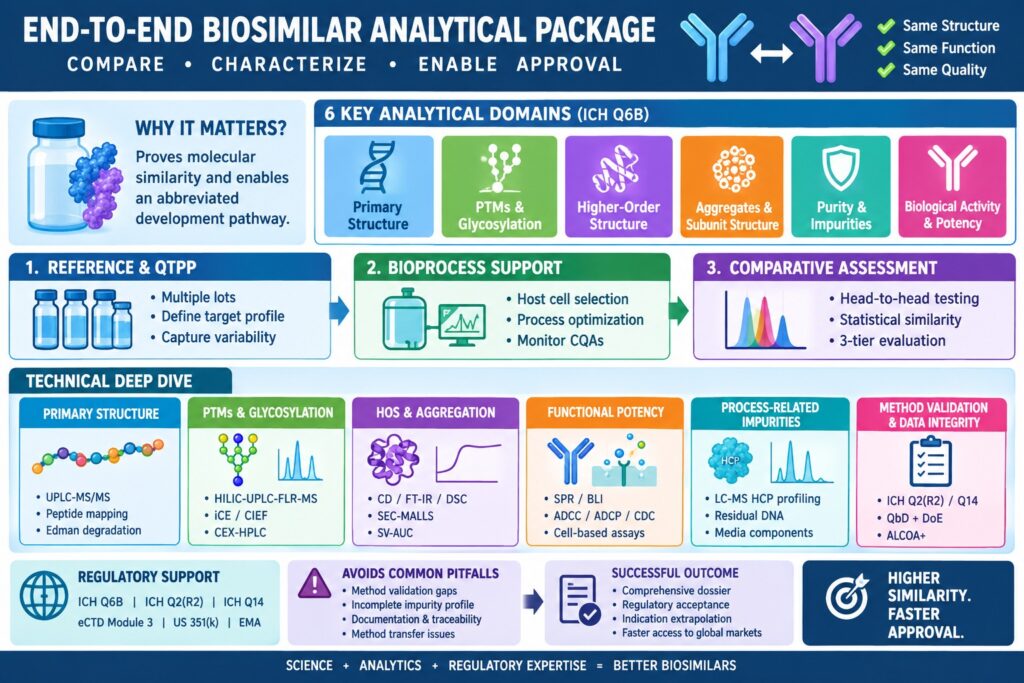
ICH Q6B guidelines provide the international framework for establishing specifications, analytical procedures, and acceptance criteria used to assess the quality and batch-to-batch consistency of biological drug substances and products. In biosimilar development, regulatory authorities expect these fundamental characterization principles to be applied to comparative, side-by-side similarity assessments spanning six major analytical domains.
Read our detailed breakdown of ICH Q6B guidelines for biological characterisation.
Analytical similarity cannot be adequately demonstrated through routine release testing alone. Sponsors must establish a comprehensive structural and functional fingerprint for both the biosimilar candidate and multiple commercial lots of the reference product. Evaluating reference batches manufactured and released over an extended period helps capture historical lot-to-lot variability, allowing scientifically justified statistical boundaries to be established for subsequent comparability assessments.
| ICH Q6B Characterization Domain | Critical Quality Attributes (CQAs) Evaluated | Primary & Orthogonal Analytical Technologies |
|---|---|---|
| Primary Structure | Amino acid sequence identity, N/C-terminal variants, point mutations, sequence coverage | UPLC-Q-TOF/Orbitrap LC-MS/MS Peptide Mapping, Edman Degradation, Intact/Reduced MS |
| Post-Translational Modifications | N/O-Glycan distribution, sialylation, core fucosylation, charge heterogeneity (deamidation, oxidation) | HILIC-UPLC-FLR-MS (2-AB / Procainamide), HPAEC-PAD, iCE / CIEF, CEX-HPLC |
| Higher-Order Structure (HOS) | Secondary folding (α-helix, β-sheet content), tertiary conformation, thermal transition midpoints (Tₘ) | Far/Near-UV Circular Dichroism (CD), FT-IR, Microcalorimetry (DSC), Disulfide Mapping LC-MS |
| Subunit Structure & Aggregates | Soluble aggregate fractions, subvisible particle distribution, molecular weight distribution | SEC-MALLS, Sedimentation Velocity Analytical Ultracentrifugation (SV-AUC), AF4, DLS |
| Purity & Impurities | Product-related variants (fragments, aggregates) and process-related contaminants (HCP, Host Cell DNA) | LC-MS/MS Host Cell Protein (HCP) Identification, RP-HPLC, CE-SDS (Reducing/Non-Reducing) |
| Biological Activity & Potency | Antigen-binding affinity (K_D), Fc effector function (ADCC, CDC, ADCP), FcRn binding clearance | Surface Plasmon Resonance (SPR), Bio-Layer Interferometry (BLI), Cell-Based Reporter Bioassays |
A complete regulatory characterization package integrates the findings from these individual analytical domains into a unified, multi-attribute molecular profile. Detailed documentation of these structural, physicochemical, and functional parameters provides the scientific basis for reducing or potentially eliminating redundant animal toxicity studies and extensive clinical efficacy trials when supported by the applicable regulatory pathway.
Designing an End-to-End Biosimilar Analytical Package: A Stepwise Execution Strategy
An End-to-End Biosimilar Analytical Package can be structured as a phased, three-stage workflow that advances from reverse engineering and characterization of the reference product through bioprocess analytical support and ultimately to formal head-to-head statistical similarity assessment. This organized approach ensures that critical quality attributes are systematically identified, monitored, evaluated, and controlled throughout the different stages of biosimilar development.
Discover how to assemble an end-to-end biosimilar analytical package for regulatory submission.
Phase 1: Reference Product Sourcing and Quality Target Product Profile Definition
Reference product characterization starts with the acquisition of multiple commercial lots of the originator biologic from the regulatory jurisdictions relevant to the intended submission, including US-licensed and EU-authorized reference products. Sourcing batches across a multi-year period provides a broader representation of natural manufacturing variability and supports definition of the Quality Target Product Profile (QTPP). The QTPP establishes scientifically justified target ranges for primary amino acid sequences, glycoform distributions, charge state ratios, aggregate levels, and biological activity specifications, creating a reference framework against which the prospective biosimilar can be evaluated.
Understand the fundamental differences between biosimilar and biologic manufacturing.
Phase 2: Cell Line Selection and Bioprocess Analytics Support
During upstream host cell engineering and bioprocess optimization, high-throughput analytical characterization plays an important role in guiding clone selection, media development, and process optimization. Production of target proteins in different host cell systems, such as CHO compared with NS0 or HEK293, can result in distinct glycosylation profiles, including non-human glycans such as N-glycolylneuraminic acid [NGNA] or Gal-α-1,3-Gal, which may increase immunogenicity concerns. Continuous analytical monitoring during bioreactor scale-up helps identify undesirable changes in post-translational modifications, product quality attributes, or aggregate formation before they become established process-related challenges.
Learn strategies for optimizing cell line development for biosimilars.
Phase 3: Comparative Analytical Assessment and Statistical Tiering in the End-to-End Biosimilar Analytical Package
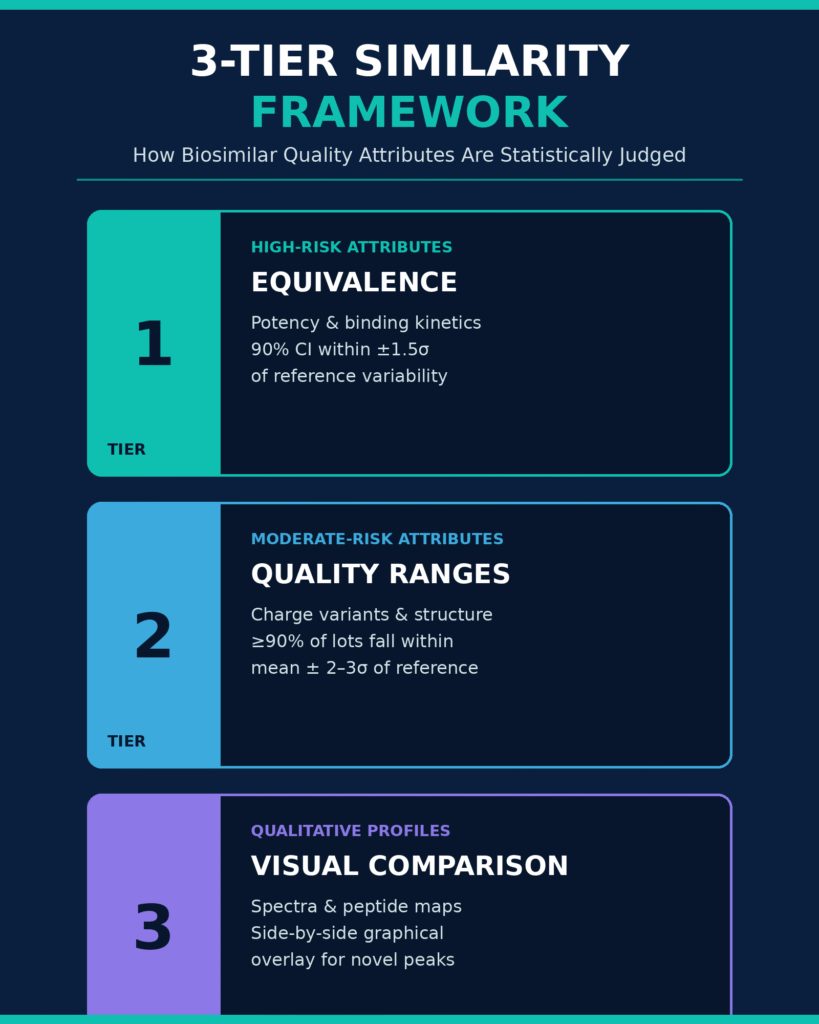
The final stage involves implementation of the formal Comparative Analytical Assessment (CAA), in which prospective biosimilar batches are evaluated side-by-side and head-to-head against the previously established reference product profile. The datasets generated through the End-to-End Biosimilar Analytical Package are assessed according to a three-tier statistical similarity framework used by regulatory agencies for evaluating different categories of quality attributes:
- Tier 1 (Equivalence Testing): This tier is designated for high-risk attributes that have a direct relationship with the principal clinical mechanism of action, including cell-based bioassay potency and target antigen-binding kinetics. Statistical equivalence is demonstrated when the 90% confidence interval for the difference between sample means remains within a predefined equivalence interval of ±1.5 · σ_R, where σ_R denotes the standard deviation observed among reference product lots.
- Tier 2 (Quality Ranges): This tier is generally applied to moderate-risk CQAs, including charge variants, secondary structural characteristics, subvisible particle levels, and Fc receptor binding affinities. Similarity is established when a predefined proportion, typically ≥90%, of biosimilar test lots falls within a quality range calculated from the reference product mean ± x · σ_R, where x generally ranges from 2 to 3.
- Tier 3 (Visual Comparisons): This tier is appropriate for qualitative characteristics and high-density analytical profiles, including intact mass spectra, chromatographic peptide map overlays, and spectroscopic scans. Direct graphical comparisons are performed to determine whether the biosimilar profile is comparable with the reference product and whether any novel or unexplained peak entities are present.
Get guidance on biosimilar comparability study design and CRO support.
Technical Deep Dive: Orthogonal Characterization of Critical Quality Attributes
Orthogonal characterization involves the application of two or more analytical methods that rely on different physical or chemical principles to assess the same quality attribute. Using complementary methodologies reduces the possibility of method-specific bias, improves detection of molecular variants that could remain hidden with a single technique, and strengthens the overall characterization package for regulatory review.
Read our guide on evaluating critical quality attributes (CQAs) in biosimilars.
Primary Structure and Sequence Variant Identification
Primary structure characterization requires confirmation of 100% amino acid sequence identity, assessment of N- and C-terminal integrity, and detection and quantification of low-abundance sequence variants. Ultra-High Performance Liquid Chromatography coupled with high-resolution tandem Mass Spectrometry (UPLC-MS/MS), using Q-TOF or Orbitrap mass spectrometers, provides sub-5 ppm mass accuracy for detailed peptide-level characterization. Digestion of the target protein using complementary proteases, including trypsin, Lys-C, Glu-C, and chymotrypsin, produces overlapping peptide fragments that collectively support comprehensive sequence coverage. N-terminal gas-phase Edman degradation provides an orthogonal confirmation of UPLC-MS findings, while C-terminal peptide mapping supports the assessment of enzymatic lysine clipping and pyroglutamic acid formation.
Examine strategies for detecting sequence variants and misincorporation in peptide biosimilars.
Post-Translational Modifications and Glycosylation Profiling
Post-translational modifications can affect protein charge distribution, conformational stability, serum clearance, and interactions with immune receptors. Glycosylation characterization of monoclonal antibodies typically begins with enzymatic release of N-linked glycans using Peptide-N-Glycanase F (PNGase F). The released glycans are then fluorescently labeled using reagents such as 2-aminobenzamide [2-AB] or procainamide and subsequently characterized using Hydrophilic Interaction Liquid Chromatography with fluorescence and mass spectrometry detection (HILIC-UPLC-FLR-MS). This analytical strategy enables separation and quantification of neutral, high-mannose (M5), core-fucosylated (G0F, G1F, G2F), and sialylated (G1S1, G2S2) glycan structures. Charge heterogeneity associated with C-terminal lysine retention, asparagine deamidation, or aspartate isomerization is evaluated through orthogonal approaches such as imaged capillary isoelectric focusing (iCE/CIEF) and strong cation-exchange chromatography (CEX-HPLC).
Higher-Order Structure and Aggregation Dynamics
Higher-order structure (HOS) characterization determines whether the secondary and tertiary three-dimensional conformations of the biosimilar are consistent with those of the reference standard. Far-UV Circular Dichroism (CD) and Fourier Transform Infrared (FT-IR) spectroscopy are used to assess secondary structural elements, including α-helix, β-sheet, and random coil content. Near-UV CD, intrinsic tryptophan fluorescence, and Differential Scanning Calorimetry (DSC) provide complementary information regarding tertiary structural environments and thermal transition midpoints (T_m1, T_m2).
Comprehensive evaluation of aggregation behavior is also essential because protein aggregates can contribute to clinical immunogenicity concerns. Size-exclusion chromatography coupled with multi-angle laser light scattering (SEC-MALLS) enables determination of absolute molar masses for soluble high-molecular-weight (HMW) species. To provide orthogonal confirmation of SEC findings and address the possibility of stationary-phase or matrix-related interactions, Sedimentation Velocity Analytical Ultracentrifugation (SV-AUC) offers a matrix-free analytical approach for directly measuring soluble aggregate populations within the formulation buffer.
Learn more about methodologies for aggregation analysis in biosimilars.
Functional Potency and Fc Effector Function Assays
Functional characterization establishes the relationship between the physicochemical properties of the biosimilar and its known biological mechanism of action. Surface Plasmon Resonance (SPR) and Bio-Layer Interferometry (BLI) enable real-time assessment of binding kinetics, including association rates (k_a), dissociation rates (k_d), and equilibrium dissociation constants (K_D), between Fab regions and their respective target antigens. In parallel, SPR can be used to characterize interactions with Fc gamma receptors (FcγRIA, FcγRIIA, FcγRIIIA/B), neonatal Fc receptor (FcRn), and complement protein C1q.
Biophysical binding measurements are complemented by cell-based functional assays that assess downstream physiological responses. Reporter gene and cytotoxicity assays can quantify Antibody-Dependent Cellular Cytotoxicity (ADCC), Antibody-Dependent Cellular Phagocytosis (ADCP), and Complement-Dependent Cytotoxicity (CDC). Together, these assays provide evidence that the biosimilar maintains comparable biological activity across the relevant therapeutic mechanisms of action.
Overcoming Common Regulatory Pitfalls in Module 3 Submissions
Submission of an eCTD Module 3 dossier without adequate analytical depth can result in regulatory Information Requests (IRs) or Complete Response Letters (CRLs). Potential review delays can be reduced by proactively addressing analytical method validation deficiencies, limitations in impurity characterization, incomplete documentation, and gaps in data traceability before submission.
Analytical Method Validation under ICH Q2(R2) and ICH Q14
Under the updated ICH Q2(R2) and ICH Q14 guidelines, analytical characterization and release methods should be developed using risk-based Quality by Design (QbD) principles. Sponsors are expected to establish an Analytical Target Profile (ATP), define Proven Acceptable Ranges (PARs), and identify Method Operational Design Regions (MODRs) through appropriately structured Design of Experiments (DoE) studies. Regulatory assessments commonly identify deficiencies involving incomplete robustness evaluations, insufficient method understanding, or inadequate connections between reported results and raw analytical data. Consequently, submissions should maintain comprehensive data traceability in accordance with ALCOA+ data integrity principles throughout analytical development, qualification, and validation activities.
Characterizing Process-Related Impurities via LC-MS Host Cell Protein Profiling
Process-related impurities, including host cell proteins (HCP), residual host cell DNA, and components originating from culture media, may differ between biosimilar and reference product manufacturing processes. Although commercial polyclonal ELISAs are useful for determining total HCP concentrations, these assays generally cannot identify individual HCP species that may be non-immunogenic, persistent, or selectively co-purified with the therapeutic protein. Contemporary biosimilar characterization programs therefore incorporate high-resolution LC-MS/MS HCP profiling to obtain a more detailed impurity profile. This approach can identify specific host proteins that remain associated with the product, determine the abundance of individual species in parts-per-million (ppm), and provide evidence that persistent enzymes or potentially immunogenic proteins do not adversely affect product safety or stability.
Review advanced techniques for impurity profiling of biosimilars.
Method Transfer Protocols and Data Integrity Controls
The transfer of analytical procedures from characterization laboratories to commercial quality control release laboratories is another area in which operational weaknesses can arise. Incomplete method transfer protocols or insufficient evaluation of inter-laboratory variability may affect the reliability of release testing and long-term stability monitoring. Establishing predefined transfer acceptance criteria supported by inter-laboratory intermediate precision data helps demonstrate consistency between laboratories and strengthens analytical readiness during pre-approval inspections (PAI).
Case Study Outcomes: Dossier Compilation and Successful Regulatory Acceptance
Collaboration with an experienced analytical CRO to conduct a comprehensive characterization program successfully established comparative biosimilarity and supported dossier acceptance without major CMC deficiencies.
As part of this case study, ResolveMass Laboratories Inc. conducted an extensive analytical campaign involving 12 reference product batches and 5 prospective biosimilar drug substance lots. More than 30 qualified orthogonal analytical procedures were implemented to generate comprehensive datasets addressing primary amino acid sequence identity, glycan micro-heterogeneity, higher-order conformational stability, aggregation behavior, and Fc effector kinetics.
Statistical similarity assessments demonstrated that the candidate’s critical quality attributes were consistent with the established quality ranges of the reference product. By addressing residual molecular uncertainties through the comprehensive characterization package, the regulatory health authorities granted indication extrapolation across the approved clinical uses of the reference biologic without requiring separate clinical efficacy trials for each indication.
See how to execute a successful comparability exercise in biosimilar development.
Conclusion
An End-to-End Biosimilar Analytical Package represents a fundamental component of biosimilar development and authorization because it demonstrates high similarity and provides the scientific and technical evidence necessary to support streamlined non-clinical and clinical evaluation.
Through collaboration with an experienced bioanalytical laboratory, biopharmaceutical sponsors can gain access to advanced mass spectrometry platforms, qualified orthogonal analytical procedures, and regulatory expertise consistent with ICH Q6B, ICH Q2(R2), and ICH Q14 standards. Establishing a comprehensive analytical comparability strategy early in development can reduce regulatory and submission risks, improve the efficient use of development resources, and support faster delivery of high-quality biologic therapeutics to global markets.
To discuss your biosimilar characterization strategy, analytical testing requirements, or eCTD Module 3 dossier compilation needs, contact the expert team at ResolveMass Laboratories Inc. by visiting the ResolveMass Contact Page.
Frequently Asked Questions
ICH Q6B provides internationally recognized principles for evaluating the quality, characterization, specifications, and consistency of biological products. For biosimilars, these principles are applied through comparative, head-to-head assessment of relevant Critical Quality Attributes (CQAs) against the reference product. This approach helps establish whether observed differences fall within an acceptable range of natural product variability.
Orthogonal analytical techniques assess the same quality attribute using different scientific principles, providing complementary evidence and reducing dependence on a single analytical method. For example, SEC-MALLS and Sedimentation Velocity Analytical Ultracentrifugation (SV-AUC) can independently evaluate soluble aggregate populations. Using multiple techniques increases confidence in the characterization results and helps identify molecular differences that one method alone may overlook.
The three-tier statistical framework organizes Critical Quality Attributes according to their analytical and clinical relevance and applies an appropriate comparison strategy to each category. Tier 1 generally uses statistical equivalence testing for high-risk attributes, while Tier 2 evaluates predefined quality ranges for moderate-risk attributes. Tier 3 relies primarily on graphical or visual comparisons for qualitative and high-density analytical profiles.
Post-translational modification (PTM) characterization evaluates molecular changes such as glycosylation, charge variants, deamidation, and oxidation that can influence protein stability, pharmacokinetics, and biological activity. Techniques such as HILIC-MS and iCE/CIEF provide detailed information about these attributes. Demonstrating comparable PTM profiles helps establish that molecular differences do not result in clinically meaningful changes.
Small-molecule generics are chemically synthesized compounds with relatively well-defined molecular structures, whereas recombinant therapeutic proteins naturally display molecular micro-heterogeneity. Biosimilar characterization therefore requires detailed sequence confirmation using techniques such as UPLC-MS/MS peptide mapping and Edman sequencing. These complementary approaches verify amino acid sequence identity while also assessing terminal variants and sequence-related attributes.
Higher-order structure analysis examines the three-dimensional organization of a therapeutic protein by evaluating its secondary and tertiary structural characteristics. Far/Near-UV Circular Dichroism (CD), FT-IR, fluorescence, and Differential Scanning Calorimetry (DSC) provide complementary structural and thermal information. Comparison with the reference product helps determine whether the biosimilar exhibits comparable folding patterns and thermal transition midpoints (Tm).
Traditional HCP ELISAs primarily provide an overall estimate of host cell protein levels and may not identify individual protein species present in the sample. LC-MS/MS HCP profiling provides more detailed molecular information by identifying specific HCPs and determining their individual abundance in parts-per-million (ppm). This information can help characterize persistent or co-purified HCPs and assess their potential impact on product quality and safety.
Indication extrapolation permits a biosimilar to receive authorization for additional indications of the reference product when scientifically justified, without requiring a separate clinical efficacy study for every indication. A comprehensive analytical package establishes similarity across relevant structural and functional attributes and supports understanding of the product’s mechanisms of action. Regulatory authorities then consider the totality of evidence when determining whether extrapolation is appropriate.
A specialized analytical CRO can provide access to advanced analytical instrumentation, validated or qualified orthogonal methods, experienced scientific personnel, and knowledge of regulatory expectations. This support enables sponsors to efficiently generate and organize characterization data aligned with ICH Q6B, ICH Q2(R2), and ICH Q14. External analytical expertise can also reduce development timelines, limit infrastructure requirements, and help identify potential regulatory gaps before submission.
Reference:
- Bas, T. G. (2025). Innovative formulation strategies for biosimilars: Trends focused on buffer-free systems, safety, regulatory alignment, and intellectual property challenges. Pharmaceuticals, 18(6), 908. https://doi.org/10.3390/ph18060908
- U.S. Food and Drug Administration. (2015). Quality considerations in demonstrating biosimilarity of a therapeutic protein product to a reference product: Guidance for industry. U.S. Department of Health and Human Services. FDA guidance document
- International Council for Harmonisation of Technical Requirements for Pharmaceuticals for Human Use. (1999). ICH Q6B: Specifications: Test procedures and acceptance criteria for biotechnological/biological products. European Medicines Agency. https://www.ema.europa.eu/en/ich-q6b-specifications-test-procedures-acceptance-criteria-biotechnological-biological-products-scientific-guideline
- International Council for Harmonisation of Technical Requirements for Pharmaceuticals for Human Use. (1999). ICH harmonised tripartite guideline: Specifications: Test procedures and acceptance criteria for biotechnological/biological products (Q6B). https://database.ich.org/sites/default/files/Q6B%20Guideline.pdf
- U.S. Food and Drug Administration. (2025). Development of therapeutic protein biosimilars: Comparative analytical assessment and other quality-related considerations: Guidance for industry. U.S. Department of Health and Human Services. https://www.fda.gov/media/159261/download
- Chow, S. C., Song, F., & Bai, H. (2016). Analytical similarity assessment in biosimilar studies. The AAPS Journal, 18(3), 670–677. https://doi.org/10.1208/s12248-016-9882-5
Get In Touch With Us
About The Author


