

Introduction
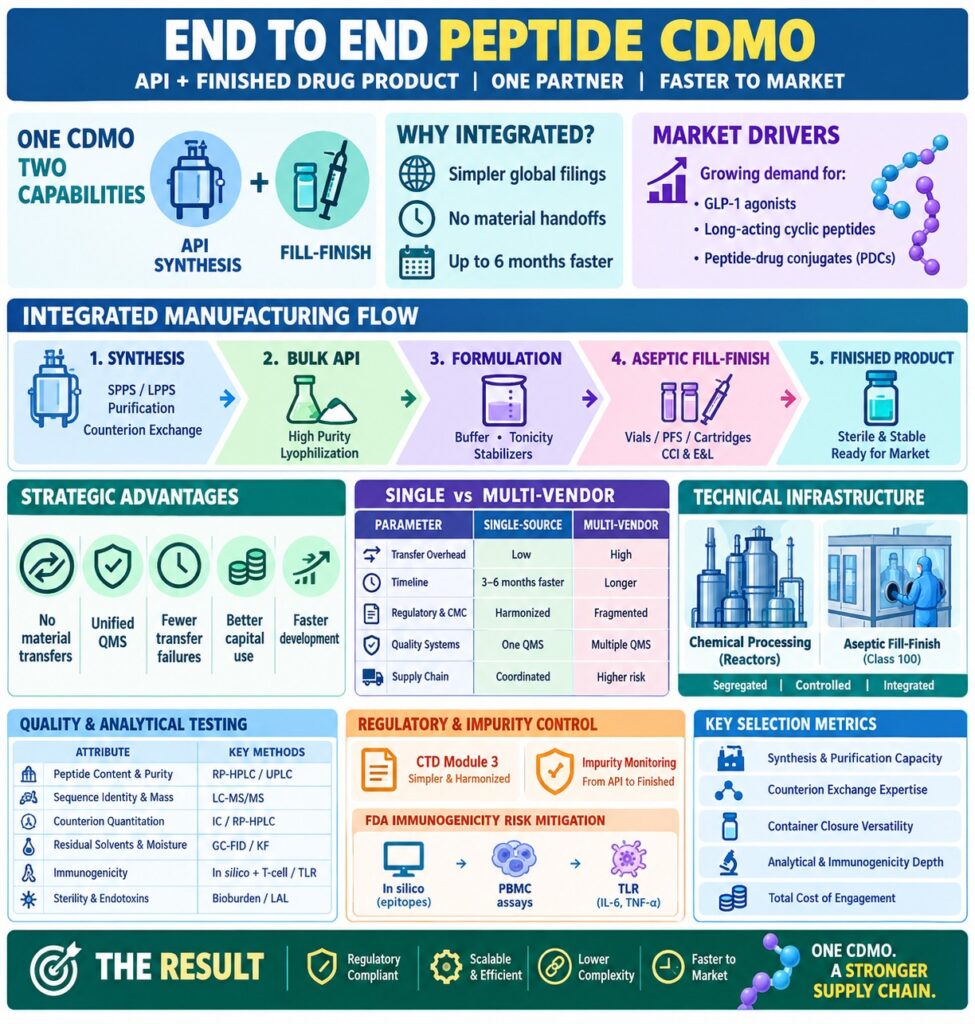
A single qualified contract manufacturing organization can manufacture both active pharmaceutical ingredient (API) drug substance and finished drug product (FDP) when it has integrated capabilities covering chemical synthesis and sterile fill-finish operations. Working with an integrated End to End Peptide CDMO can simplify global regulatory submissions, eliminate delays associated with transferring materials between different vendors, and potentially shorten overall development timelines by up to six months.
As peptide-based therapeutics continue to expand into a wider range of clinical applications—driven in part by advances in metabolic disease treatments such as GLP-1 receptor agonists, long-acting cyclic peptides, and emerging peptide-drug conjugates (PDCs)—pharmaceutical sponsors are increasingly managing complex manufacturing and supply chain requirements. Traditionally, biopharmaceutical developers outsourced drug substance synthesis and finished dosage manufacturing to separate organizations because the two activities require different capital investments, processing environments, and cleanroom infrastructure. API manufacturing generally involves chemical synthesis technologies such as Solid-Phase Peptide Synthesis (SPPS), Liquid-Phase Peptide Synthesis (LPPS), high-pressure preparative reverse-phase liquid chromatography (RP-HPLC), and counterion exchange. In contrast, finished drug product manufacturing involves aseptic liquid or lyophilized formulation, container closure integrity (CCI) validation, primary packaging compatibility assessment, and automated fill-finish operations. An integrated contract manufacturing model brings these distinct capabilities together within a coordinated operational framework, supporting a more efficient pathway toward drug commercialization.
Looking for integrated peptide development and manufacturing support? Explore Custom Peptide Synthesis Services.
Share via:
Quick Summary:
- End-to-End Peptide CDMO: Integrating API synthesis and finished drug product manufacturing under one CDMO can reduce vendor handoffs, simplify regulatory coordination, and potentially shorten development timelines by 3–6 months.
- Integrated Manufacturing Workflow: The process can cover SPPS/LPPS → purification → counterion exchange → formulation → aseptic fill-finish → finished product, creating a coordinated manufacturing pathway.
- Key Operational Benefits: A single-source model provides one QMS, coordinated quality oversight, harmonized CMC documentation, fewer technical-transfer risks, and improved supply-chain continuity compared with multi-vendor sourcing.
- Advanced Infrastructure: An end-to-end facility requires scalable peptide synthesis, preparative RP-HPLC, lyophilization, counterion exchange, and Grade A aseptic fill-finish capabilities for vials, PFS, and cartridges.
- Quality & Regulatory Control: Integrated analytical testing can cover purity, sequence identity, mass, counterions, residual solvents, moisture, sterility, endotoxins, and immunogenicity, supporting consistent API-to-drug-product control.
- Immunogenicity Management: Peptide impurities can be evaluated through in-silico T-cell epitope mapping, PBMC T-cell assays, and TLR activation testing to help assess potential immune-response risks.
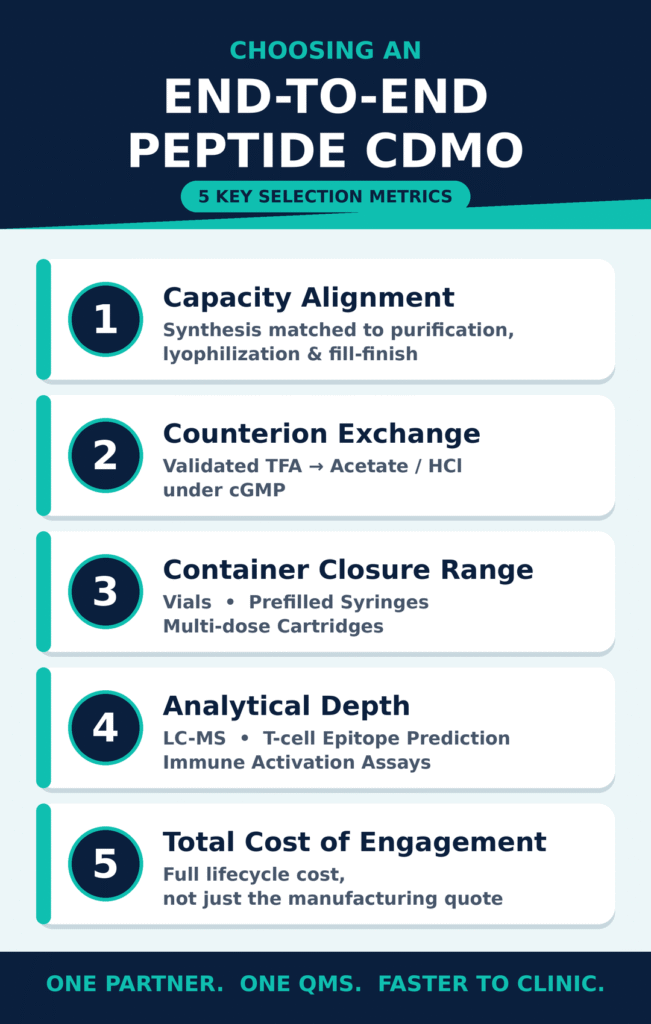
- CDMO Selection Priorities: Sponsors should assess synthesis/purification capacity, validated counterion exchange, container-closure versatility, analytical and immunogenicity capabilities, regulatory experience, and total lifecycle cost before selecting an end-to-end partner.
Strategic Advantages of an End to End Peptide CDMO
Engaging an End to End Peptide CDMO can eliminate inter-vendor material transfers, consolidate Quality Management Systems (QMS), and reduce the risk of technical transfer failures throughout different stages of clinical development. Bringing these activities together can improve capital utilization and support faster development by connecting analytical method validation from bulk chemical isolation through final finished dosage form release.
When drug substance synthesis and drug product fill-finish activities are performed by independent contract manufacturers, pharmaceutical sponsors must manage additional oversight responsibilities, duplicate analytical cross-validation activities, and separate or fragmented Drug Master File (DMF) documentation. A single-source manufacturing strategy allows physical chemistry information generated during API process development—such as solubility constants, degradation kinetics, and aggregate formation thresholds—to be directly incorporated into finished product formulation development and container closure selection.
Need to evaluate an integrated manufacturing pathway? Explore North American Peptide CDMO Services.
| Evaluation Parameter | Integrated Single-Source CDMO Model | Multi-Vendor Sourcing Model |
|---|---|---|
| Technical Transfer Overhead | Internal material and process transfers are coordinated within one organizational framework, eliminating inter-company handoff delays. | Higher transfer complexity because sequential technical transfers are required between independent API and fill-finish facilities. |
| Development Timeline | Development can be compressed by eliminating approximately 3–6 months associated with vendor identification, contracting, and technical transfer activities. | Development may take longer because batch scheduling and analytical cross-validation must be coordinated across separate organizations. |
| Regulatory & CMC Alignment | Drug Master File (DMF) information and Common Technical Document (CTD) Module 3 documentation can be harmonized across the manufacturing lifecycle. | Documentation is distributed across different organizations and requires extensive reconciliation between multiple Quality Management Systems (QMS). |
| Quality Systems Oversight | A single Quality Management System (QMS) provides a consolidated audit framework and coordinated change control processes. | Multiple independent QMS platforms require separate audits, quality agreements, and ongoing vendor oversight. |
| Supply Chain Continuity | Chain of custody and inventory management can be coordinated from amino acid starting materials through commercial vials. | Greater exposure to transportation delays, cold-chain disruptions, and customs-related import/export holds. |
Technical Infrastructure and Operational Requirements for an End to End Peptide CDMO
An integrated single-source manufacturing model requires physically segregated but organizationally coordinated infrastructure covering both chemical processing reactors and Class 100 (Grade A) aseptic filling cleanrooms. The facility must maintain appropriate environmental zoning and specialized containment systems to control cross-contamination risks while allowing analytical, quality, and regulatory oversight to remain integrated across the manufacturing process.
Upstream and Midstream Peptide API Manufacturing
Upstream peptide API manufacturing requires flexible chemical synthesis platforms capable of supporting solid-phase, liquid-phase, and hybrid fragment condensation approaches at multi-kilogram scales. Midstream processing encompasses high-throughput purification, counterion exchange, and large-scale lyophilization to generate high-purity bulk active substances suitable for subsequent formulation and drug product manufacturing.
Solid-Phase Peptide Synthesis (SPPS) continues to serve as the primary manufacturing approach for peptide sequences containing up to 40 amino acid residues. The process commonly uses orthogonal Fmoc/tBu protection strategies to achieve coupling efficiencies exceeding 99% at each individual synthesis step. For longer structural peptides or high-volume commercial products such as GLP-1 analogs, CDMOs may utilize Liquid-Phase Peptide Synthesis (LPPS), modular fragment condensation, or newer approaches such as Tag-Assisted Peptide Synthesis (TAPS). These strategies can address limitations associated with resin capacity while substantially reducing solvent consumption. After cleavage and deprotection, crude peptide material undergoes multiple stages of preparative RP-HPLC purification. An important downstream consideration is the removal of residual trifluoroacetate (TFA) counterions introduced by cleavage cocktails. Ion-exchange chromatography is therefore used to convert the drug substance into a stable acetate or hydrochloride salt form appropriate for parenteral formulation.
Planning to move a peptide from laboratory synthesis toward larger-scale production? Explore GLP-1 Analog Scaling and GMP Kilogram-Scale Manufacturing.
Downstream Formulation and Aseptic Fill-Finish Operations
Downstream drug product processing transforms purified peptide API into sterile and stable finished dosage forms through aseptic liquid filling or lyophilization. These operations require Grade A filling environments, automated inspection systems, and specialized primary packaging compatibility studies designed to minimize peptide aggregation and surface adsorption.
Need sterile manufacturing capabilities for peptide injectables? Explore Sterile Fill-Finish Services for Peptide Injectables.
Peptide molecules have inherent physical stability challenges and can be susceptible to pH-dependent self-assembly, oxidation, deamidation, and fibrillar aggregation. Formulation development within an integrated facility therefore requires careful optimization of buffer composition, tonicity agents, and surfactant stabilizers before sterile filtration. Finished dosage manufacturing lines can accommodate several primary container formats, including freeze-dried vials, prefilled syringes (PFS), and multi-dose cartridge systems intended for use with pen injectors. Maintaining Container Closure Integrity (CCI) and assessing extractables and leachables (E&L) originating from elastomeric closures and glass contact surfaces are essential for supporting multi-year product stability and minimizing the risk of sub-visible particle formation.
Need to assess packaging-related risks for peptide injectables? Explore Extractables and Leachables Testing for Peptide Injectables.
Regulatory Harmonization and Impurity Profile Controls
Coordinating regulatory information between drug substance and drug product manufacturing stages can simplify the preparation of CTD Module 3 submissions and support more efficient development of generic and novel drug products. Integrated manufacturing operations also allow process-related impurities generated during synthesis to be monitored, characterized, and controlled through final finished product release testing.
Need a structured approach to controlling peptide-related impurities? Explore Impurity Control Strategies Under ICH Q3A.
FDA Guidance Framework and Immunogenicity Risk Mitigations
Current FDA regulatory expectations require comprehensive assessment of peptide-related impurities to evaluate the potential for unwanted adaptive or innate immune responses. Synthetic peptide generic applications, including ANDAs referencing RLDs such as liraglutide, teriparatide, or glucagon, must demonstrate API sameness and establish that newly observed impurities do not exceed 0.5% or introduce T-cell epitopes.
Under applicable regulatory requirements, CDMOs can use computational immunology approaches, including platforms such as EpiMatrix and JanusMatrix, to conduct in silico screening for Major Histocompatibility Complex (MHC) binding epitopes associated with deletion or insertion variants. Computational predictions can subsequently be evaluated through in vitro biological assays, including human peripheral blood mononuclear cell (PBMC) T-cell proliferation testing and Toll-Like Receptor (TLR) activation assays that measure inflammatory cytokine release, such as IL-6 and TNF-alpha. Coordinating these analytical and immunogenicity assessments within one manufacturing organization can help reduce regulatory submission risks and determine whether formulation components influence the drug’s immunogenic profile.
| Quality Attribute | API Synthesis Phase Methodology | Finished Drug Product Phase Methodology | Standard Acceptance Criteria |
|---|---|---|---|
| Peptide Content & Purity | RP-HPLC / Ultra-Performance LC (UPLC) | RP-HPLC with photodiode array detection | Monomer purity typically >98%; active content remains within the specified target range. |
| Sequence Identity & Mass | LC-MS/MS tandem mass characterization | LC-MS peptide mapping / fingerprinting | Exact mass corresponds to the theoretical sequence without deletion/insertion variants. |
| Counterion Quantitation | Ion Chromatography (IC) | Ion Chromatography / RP-HPLC | Residual TFA typically <0.1%; target acetate/HCl content is stoichiometrically matched. |
| Residual Solvents & Moisture | Headspace GC-FID / Karl Fischer Titration | Karl Fischer Titration (for lyophilized forms) | Conforms to ICH Q3C limits; moisture is typically <3.0% w/w. |
| Innate / Adaptive Immunogenicity | In silico T-cell epitope mapping | In vitro T-cell proliferation & TLR activation assays | No new impurities >0.5%; no elevated MHC binding or cytokine release compared with RLD. |
| Sterility & Endotoxins | Bioburden / Bacterial Endotoxin Testing (LAL) | USP Sterility Testing & LAL Endotoxin assay | Sterile; endotoxin levels remain within applicable parenteral pharmacopeial limits. |
Need orthogonal analytical characterization across peptide development stages? Explore Peptide Analytical Testing Services.
Critical Selection Metrics for an End to End Peptide CDMO Partnership
Selecting an End to End Peptide CDMO requires a detailed assessment of the balance between synthesis and purification capacity, regulatory inspection history, and the overall cost structure of the engagement. Pharmaceutical sponsors should evaluate facility infrastructure beyond stated reactor capacity and determine whether upstream manufacturing capabilities are appropriately matched with downstream formulation and fill-finish requirements.
Preparing CMC documentation for a peptide regulatory submission? Explore Peptide Drug Master File (DMF) Preparation.
- Capacity Alignment Across Unit Operations: Confirm that large-scale synthesis capacity is appropriately matched with sufficient throughput for preparative RP-HPLC purification, industrial lyophilization, and aseptic fill-finish operations. This helps prevent internal processing bottlenecks and capacity imbalances between manufacturing stages.
- Validated Counterion Exchange Technology: Verify that the CDMO has demonstrated expertise in converting crude TFA salts into acetate or hydrochloride forms under cGMP conditions and has validated analytical controls for confirming the resulting drug substance quality.
- Container Closure Versatility: Evaluate whether the aseptic manufacturing infrastructure can accommodate different primary dosage configurations, including vials, prefilled syringes, and multi-dose cartridges.
- Immunogenicity and Analytical Depth: Assess the availability of in-house analytical capabilities for orthogonal LC-MS characterization, in silico T-cell epitope prediction, and cell-based assays for evaluating innate immune activation.
- Total Cost of Engagement Evaluation: Develop RFP evaluation models around total lifecycle costs rather than isolated manufacturing quotations. Relevant costs may include technical transfer fees, analytical method development, change control activities, and stability storage requirements.
Need stability data to support peptide development and regulatory requirements? Explore Peptide Stability Testing Services.
Conclusion
Combining drug substance synthesis and drug product manufacturing through a single End to End Peptide CDMO can provide biopharmaceutical sponsors with a streamlined and scalable manufacturing pathway while reducing operational complexity. Unified technical oversight can support compliance with stringent regulatory expectations and improve coordination across the development and commercial manufacturing lifecycle.
Planning clinical-stage peptide manufacturing and supply? Explore Clinical Trial Material Supply for Peptide Programs.
Integrated contract development can reduce the operational friction, supply chain vulnerabilities, and regulatory fragmentation that may occur when multiple independent vendors are involved. By coordinating chemical synthesis, counterion exchange, formulation development, and aseptic fill-finish activities under a unified Quality Management System, pharmaceutical companies can improve batch reproducibility and potentially shorten clinical development timelines.
For detailed information on integrated peptide contract development, visit the ResolveMass Contact Us Page.
Frequently Asked Questions
Using different vendors can create additional technical transfer activities, duplicated analytical validation, separate change control processes, and increased logistics requirements. Differences between laboratories may also complicate analytical results and investigations, particularly when API quality data must be transferred and reconciled before finished drug product manufacturing.
Counterion exchange is used to remove residual trifluoroacetate (TFA) introduced during peptide cleavage and replace it with a more suitable counterion, such as acetate or hydrochloride. Controlling the counterion composition can influence peptide solubility, formulation pH, stability, and precipitation behavior in the final drug product.
Synthetic peptide development requires appropriate identification, characterization, qualification, and control of process-related and product-related impurities. For generic peptide products, ANDA applicants must establish active ingredient sameness and evaluate whether impurities could affect product quality or immunogenicity relative to the reference listed drug.
Integrated CDMOs can combine computational and experimental approaches to investigate potential immunogenicity associated with peptide impurities. In silico methods can identify potential MHC binding epitopes, while in vitro testing may include human T-cell proliferation and Toll-Like Receptor (TLR) activation assays to evaluate relevant immune responses and cytokine release.
The appropriate synthesis strategy depends on peptide length, molecular complexity, production volume, and process economics. Solid-Phase Peptide Synthesis (SPPS) is commonly used for short-to-medium sequences, while Liquid-Phase Peptide Synthesis (LPPS) and hybrid fragment condensation approaches can be advantageous for longer peptides and larger commercial manufacturing requirements.
CDMOs control formulation and processing conditions to minimize peptide degradation during aseptic manufacturing. Strategies can include optimized buffer systems, controlled temperature and dissolved oxygen levels, suitable processing times, and rapid filling or lyophilization under controlled environmental conditions. Container compatibility is also assessed to minimize adsorption and aggregate formation.
Finished peptide drug products can be manufactured in several primary container formats, depending on the formulation and delivery system. Common options include liquid or lyophilized vials, prefilled syringes (PFS), and multi-dose cartridges intended for pen injectors. The selected container must be compatible with the peptide formulation and support the required stability period.
Technical transfer timelines vary according to process complexity, development stage, analytical requirements, and facility readiness. Early clinical transfers may require approximately 9 to 15 months, while commercial transfers can take around 12 to 18 months. An integrated CDMO can reduce additional coordination time by avoiding a separate transfer between API and drug product manufacturers.
Sponsors should assess the complete lifecycle cost rather than comparing manufacturing quotations alone. The evaluation should include technical transfer, analytical development, change control, stability testing, storage, batch release, and other program-related activities. Reviewing these costs together provides a more realistic understanding of the financial requirements of the manufacturing program.
Reference:
- López-Sánchez, A. G., Rodríguez-Mejía, K. G., Cuero-Amu, K. J., Ardila-Chantré, N., Reyes-Calderón, J. E., González-López, N. M., Huertas-Ortiz, K. A., Fierro-Medina, R., Rivera-Monroy, Z. J., & García-Castañeda, J. E. (2025). A new methodology for synthetic peptides purification and counterion exchange in one step using solid-phase extraction chromatography. Processes, 13(1), 27. https://doi.org/10.3390/pr13010027
- Erckes, V., Streuli, A., Chamera Rendueles, L., Krämer, S. D., & Steuer, C. (2025). Towards a consensus for the analysis and exchange of TFA as a counterion in synthetic peptides and its influence on membrane permeation. Pharmaceuticals, 18(8), 1163. https://doi.org/10.3390/ph18081163
- Pang, E. (2025). Immunogenicity assessments in peptides: Progress and remaining challenges [PowerPoint slides]. U.S. Food and Drug Administration. FDA document
- Pang, E. (2020). Assessing immunogenicity risk of peptides: The synthetic peptide guidance and PSGs [Presentation]. U.S. Food and Drug Administration, Center for Drug Evaluation and Research. https://www.fda.gov/media/166571/download
- Mattei, A. E., Roberts, B. J., Lelias, S., Miah, S., Howard, K. E., Weaver, J. L., Verthelyi, D., Pang, E. S., Edwards, K., & De Groot, A. S. (2025). Immunogenicity risk assessment of peptide-related impurities identified in generic teriparatide products. Frontiers in Immunology, 16, 1730346. https://doi.org/10.3389/fimmu.2025.1730346
Get In Touch With Us
About The Author


