


Introduction:
Extractables and Leachables (E&L) Testing for Transdermal Patches is one of the most specialized and safety-critical analyses in modern pharmaceutical development. Unlike oral solid dosage forms, transdermal patches are in prolonged, direct contact with human skin — and any chemical compound that migrates from the patch components into the patient’s body can bypass the gastrointestinal barrier entirely, entering the systemic bloodstream with higher bioavailability and potentially greater toxicological impact.
Topical drug delivery systems — including medicated creams, gels, ointments, and adhesive patches — present a unique challenge: the same materials that provide drug delivery functionality (adhesives, membranes, liners, and foils) are potential sources of chemical contaminants. These contaminants, if undetected, can cause skin sensitization, systemic toxicity, or compromise product stability and efficacy.
At ResolveMass Laboratories Inc., we have designed dedicated E&L testing workflows specifically for transdermal and topical systems — combining state-of-the-art analytical capabilities with deep regulatory insight to help pharmaceutical and medical device companies bring safer products to market, faster.
Summary:
- What it is: Extractables and Leachables (E&L) Testing for Transdermal Patches is a critical safety evaluation process that identifies chemical compounds migrating from packaging or device components into drug products.
- Why it matters: Transdermal and topical delivery systems have unique skin-contact risks that make E&L testing both more complex and more urgent than for most other dosage forms.
- Regulatory drivers: ICH Q3E, ISO 10993, FDA guidance, and EMA guidelines all require rigorous E&L assessments for skin-contact drug delivery systems.
- Key steps: The process includes extraction studies, analytical characterization (GC-MS, LC-MS/MS, ICP-MS), toxicological risk assessment, and leachables monitoring under real-use conditions.
- Common materials at risk: Adhesives, backing membranes, release liners, rate-controlling membranes, and primary packaging polymers.
- Industry challenge: Transdermal patches sit at the intersection of drug product and medical device regulation — requiring dual compliance frameworks.
- ResolveMass expertise: ResolveMass Laboratories Inc. provides end-to-end E&L testing services tailored specifically for transdermal and topical drug delivery systems, backed by advanced instrumentation and regulatory know-how.
1: What Are Extractables and Leachables? Definitions and Key Distinctions
Extractables are chemicals that can be released from a material under aggressive laboratory conditions (e.g., elevated temperature, strong solvents), while leachables are the subset that actually migrate into the drug product under normal or accelerated use conditions.
Understanding this distinction is foundational to any E&L program:
| Term | Definition | Study Conditions | Relevance |
|---|---|---|---|
| Extractables | Compounds released under exaggerated lab conditions | Exaggerated solvents, heat, pressure | Defines worst-case chemical profile |
| Leachables | Compounds that actually migrate into product in-use | Normal or accelerated storage conditions | Defines real patient exposure |
| Threshold of Toxicological Concern (TTC) | Safety threshold below which no toxicological risk is assumed | ICH Q3E / SCT guidelines | Drives analytical reporting limits |
| Analytical Evaluation Threshold (AET) | Minimum detection level instruments must achieve | Calculated from TTC and dose | Sets method sensitivity requirements |
For transdermal patches, leachables have a particularly direct patient safety implication: they can be absorbed through the skin continuously over the entire wear duration (typically 12–72+ hours per patch), leading to cumulative systemic exposure that must be carefully quantified. These risk assessments are increasingly guided by the principles outlined in the ICH Q3E Guideline for Extractables and Leachables and the associated ICH Q3E Extractables-Leachables Risk Assessment framework.
For packaging-related systems, manufacturers should also consider Extractables and Leachables Testing for Container Closure Systems as part of a comprehensive contamination control strategy.
2: Regulatory Framework Governing E&L Testing for Transdermal Patches
Transdermal patches are governed by overlapping pharmaceutical and medical device regulatory frameworks, making E&L compliance uniquely complex.
Key regulatory and guidance documents include:
- ICH Q3E: The harmonized international guideline specifically addressing extractables and leachables for drug products. Manufacturers should understand both the ICH Q3E Guideline for Extractables and Leachables and detailed ICH Q3E Extractables and Leachables Study Requirements.
- ISO 10993-18: Biological evaluation of medical device materials — chemical characterization standard used when the patch system has device-like properties.
- ISO 10993-17: Toxicological risk assessment of leachables from medical devices.
- FDA Guidance (2023 – Container Closure Systems): Applies to transdermal systems regarding packaging interactions.
- EMA Guideline on Plastic Immediate Packaging Materials: Relevant for European submissions.
- USP <1664> and <1663>: USP chapters providing practical methodology for assessment of extractables and leachables.
- PQRI (Product Quality Research Institute) Leachables and Extractables Working Group: Industry-recognized best practice framework.
Dual Regulatory Classification: Drug + Device
Transdermal patches are classified as combination products in many jurisdictions. This means:
- The drug component falls under pharmaceutical regulations (ICH Q3E, CDER guidance)
- The device component (rate-controlling membrane, adhesive matrix, backing layer) may additionally require compliance with ISO 10993 biocompatibility requirements
Organizations preparing global submissions frequently compare regional requirements through E&L Testing USA vs Europe to ensure regulatory alignment.
ResolveMass Laboratories helps clients navigate this dual compliance landscape with integrated testing strategies that satisfy both regulatory pathways in a single, efficient program.
3: Unique Challenges of E&L Testing for Transdermal and Topical Drug Delivery Systems
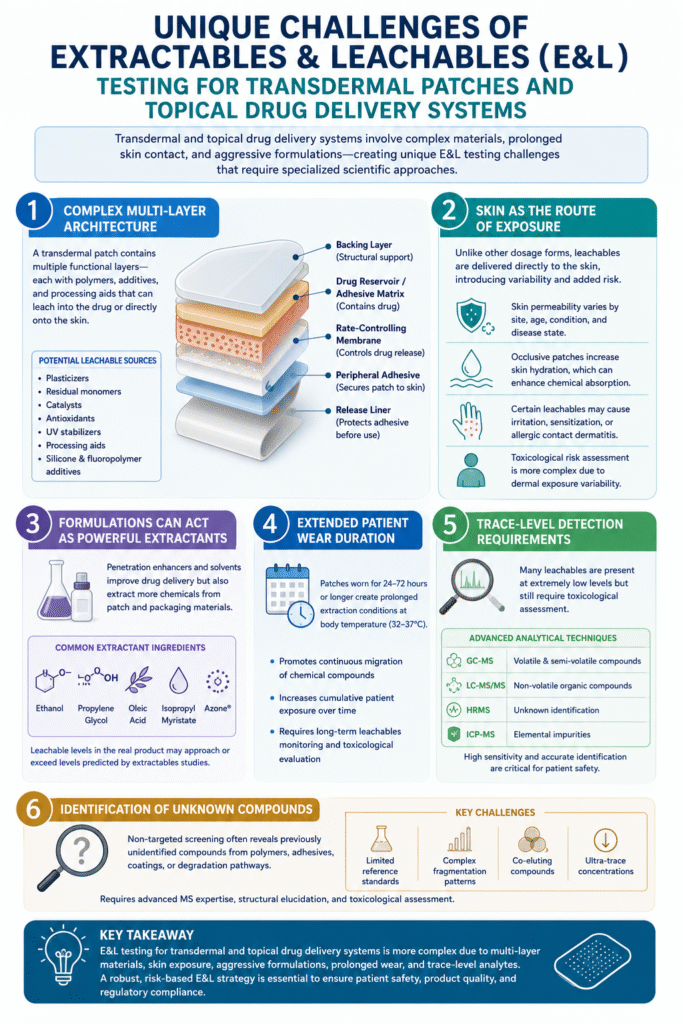
Extractables and Leachables (E&L) Testing for Transdermal Patches presents unique challenges because these systems contain multiple material layers, remain in prolonged contact with the skin, and often use formulations capable of extracting chemicals from packaging and device components. As a result, E&L assessments for transdermal and topical products require specialized study designs that accurately reflect real-world patient exposure.
1. Complex Multi-Layer Architecture
Transdermal patches are sophisticated drug-device combination products composed of several functional layers, each of which may contribute potential extractables and leachables.
Many of these materials are also recognized contributors to contamination risks discussed in Extractables Risk in Plastic Packaging.
A typical transdermal patch contains multiple potential leachable sources:
- Backing membrane (polyester, polyethylene, polyurethane foam) — provides structural integrity
- Drug reservoir or adhesive matrix — primary drug-containing layer (silicone, polyacrylate, or polyisobutylene adhesives)
- Rate-controlling membrane (microporous polypropylene or EVA copolymer) — controls drug release rate
- Release liner (siliconized polyester or fluoropolymer-coated paper) — protects adhesive before use
- Overlay or peripheral adhesive — additional adhesive layer for skin adhesion
Each layer contains polymers, plasticizers, residual monomers, catalysts, antioxidants, UV stabilizers, and processing aids — all of which can potentially leach into the drug formulation or directly onto the patient’s skin.
Because prolonged exposure may elevate toxicological concerns, manufacturers often incorporate Extractables and Leachables Carcinogenicity Testing into their overall risk assessment strategy.
2. Skin as the Route of Exposure
Unlike inhalation or parenteral products where the threshold of concern is well-defined, dermal exposure presents added complexity:
- Skin permeability varies by body site, patient age, skin integrity, and disease state
- The patch’s occlusive nature increases skin hydration, which can alter both drug and leachable absorption
- Chemical sensitization from leachables (e.g., residual acrylate monomers) is a recognized clinical risk
The occlusive nature of many transdermal patches increases skin hydration, which may enhance the absorption of both therapeutic agents and migrated chemicals. Additionally, certain leachables, such as residual acrylate monomers or degradation products, may cause skin irritation, sensitization, or allergic contact dermatitis. These factors make toxicological risk assessments more complex than those for many other dosage forms.
3. Formulations Can Act as Powerful Extractants
Many transdermal and topical formulations contain penetration enhancers and solvents designed to improve drug absorption through the skin. Common examples include ethanol, propylene glycol, oleic acid, isopropyl myristate, and Azone®.
While these ingredients enhance drug delivery, they can also increase the extraction of chemicals from adhesives, membranes, release liners, and packaging materials. In some cases, the actual leachable concentrations detected in the finished product may approach or even exceed levels predicted from extractables studies conducted using conventional laboratory solvents.
4. Extended Patient Wear Duration
Most transdermal patches remain in contact with the skin for prolonged periods, often ranging from 24 to 72 hours or longer. This extended contact time creates conditions that promote the migration of chemical compounds from patch materials at body temperature, typically between 32°C and 37°C.
Long-term wear can increase cumulative patient exposure to low-level leachables, particularly when patches are used repeatedly over weeks, months, or years. Consequently, E&L studies must evaluate not only the presence of potential contaminants but also their long-term toxicological significance.
5. Trace-Level Detection Requirements
Many leachables are present at extremely low concentrations yet may still require toxicological evaluation due to prolonged patient exposure. Detecting these compounds demands highly sensitive analytical technologies capable of identifying substances at trace and ultra-trace levels.
Techniques commonly used include gas chromatography-mass spectrometry (GC-MS) for volatile compounds, liquid chromatography-mass spectrometry (LC-MS/MS) for non-volatile organic compounds, high-resolution mass spectrometry (HRMS) for unknown identification, and inductively coupled plasma-mass spectrometry (ICP-MS) for elemental impurities. Achieving the necessary sensitivity and confidence in compound identification remains one of the most technically demanding aspects of E&L testing.
6. Identification of Unknown Compounds
Non-targeted screening studies frequently reveal previously unidentified compounds originating from polymers, adhesives, coatings, additives, or material degradation pathways. Determining the identity of these unknown compounds can be challenging due to limited reference standards, complex fragmentation patterns, co-eluting substances, and extremely low analyte concentrations.
Comprehensive structural elucidation often requires advanced analytical expertise, sophisticated mass spectrometry techniques, and toxicological assessment to determine whether detected compounds pose any risk to patients.
4: E&L Testing Methodology: Step-by-Step at ResolveMass Laboratories
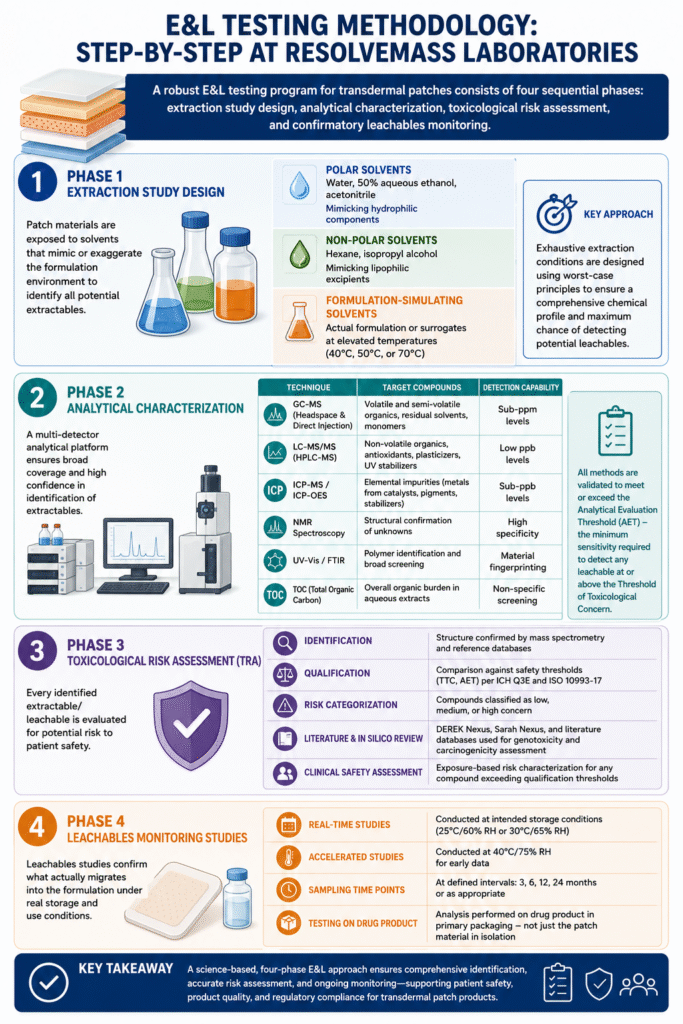
A robust Extractables and Leachables (E&L) Testing program for transdermal patches follows four critical phases: extraction study design, analytical characterization, toxicological risk assessment, and confirmatory leachables monitoring. This systematic approach helps identify potential chemical migrants, evaluate their safety, and demonstrate compliance with global regulatory expectations.
Phase 1: Extraction Study Design
The objective of an extraction study is to identify all compounds that could potentially migrate from patch materials into the drug product during storage or use. To achieve this, patch components are exposed to carefully selected solvents under controlled conditions designed to simulate or exceed real-world product exposure.
The selection of extraction solvents should follow scientifically justified approaches similar to those discussed in Solvents for Extractables Studies to maximize chemical coverage.
Common extraction solvents include:
- Polar solvents such as water, 50% aqueous ethanol, and acetonitrile to represent hydrophilic formulation environments.
- Non-polar solvents such as hexane and isopropyl alcohol to represent lipophilic excipients and drug matrices.
- Formulation-simulating solvents, including the actual drug formulation or representative surrogate formulations, to mimic product-specific interactions.
Extractions are typically performed at elevated temperatures, such as 40°C, 50°C, or 70°C, using exhaustive extraction methodologies. This worst-case approach ensures a comprehensive chemical profile and helps identify compounds that may become potential leachables during product storage and use.
Phase 2: Analytical Characterization
Following extraction, advanced analytical techniques are used to characterize and identify extractable compounds across a wide range of chemical classes. A multi-technique approach is essential because no single analytical platform can detect every potential compound.
Understanding the strengths of GC-MS vs LC-MS in Extractables and Leachables Testing is critical for selecting the most appropriate analytical workflow. For elemental impurities, ICP-MS in Extractables and Leachables Testing remains the industry-standard approach.
| Analytical Technique | Target Compounds | Typical Detection Capability |
|---|---|---|
| GC-MS (Headspace & Direct Injection) | Volatile and semi-volatile organic compounds, residual solvents, monomers | Sub-ppm |
| LC-MS/MS (HPLC-MS) | Non-volatile organics, antioxidants, plasticizers, UV stabilizers | Low ppb |
| ICP-MS / ICP-OES | Elemental impurities from catalysts, pigments, and stabilizers | Sub-ppb |
| NMR Spectroscopy | Structural confirmation of unknown compounds | High specificity |
| UV-Vis / FTIR | Polymer characterization and material screening | Material fingerprinting |
| TOC (Total Organic Carbon) | Overall organic burden in aqueous extracts | Non-specific screening |
All analytical methods are developed and validated to meet or exceed the Analytical Evaluation Threshold (AET), ensuring sufficient sensitivity to detect compounds that may pose a toxicological concern.
Phase 3: Toxicological Risk Assessment (TRA)
Once compounds have been identified, a structured toxicological risk assessment is performed to determine whether detected substances present any potential patient safety concerns.
Modern toxicological evaluations increasingly follow the principles described in ICH Q3E Extractables-Leachables Risk Assessment, focusing on patient exposure and compound-specific hazards.
The assessment typically includes:
- Identification: Chemical structures are confirmed using mass spectrometry data, spectral libraries, and reference standards whenever available.
- Qualification: Detected compounds are evaluated against established safety thresholds, including the Threshold of Toxicological Concern (TTC), Analytical Evaluation Threshold (AET), and applicable regulatory guidance.
- Risk Categorization: Compounds are classified according to their potential risk level, typically as low, medium, or high concern.
- Literature and In Silico Evaluation: Scientific literature, toxicology databases, and computational tools are reviewed to assess potential genotoxicity, carcinogenicity, and other toxicological endpoints.
- Exposure-Based Safety Assessment: For compounds exceeding qualification thresholds, patient exposure calculations are performed to determine clinical relevance and establish acceptable limits.
This risk-based approach ensures that regulatory decisions are driven by patient safety rather than analytical detection alone.
Phase 4: Leachables Monitoring Studies
Leachables studies confirm which compounds actually migrate into the finished drug product under intended storage and usage conditions. These studies provide the most clinically relevant assessment of patient exposure.
Typical leachables studies include:
- Real-time stability studies conducted under recommended storage conditions such as 25°C/60% RH or 30°C/65% RH.
- Accelerated stability studies at 40°C/75% RH to generate early predictive data.
- Sampling at predefined intervals such as 3, 6, 12, and 24 months, depending on the product lifecycle and regulatory requirements.
- Analysis of the finished drug product stored within its final packaging configuration rather than evaluating patch materials in isolation.
Monitoring actual drug product samples throughout the stability program allows manufacturers to confirm the presence, concentration, and long-term behavior of potential leachables.
5: Most Commonly Detected Leachables in Transdermal Patches
The most frequently detected leachables in transdermal patches are antioxidants and their degradation products, residual adhesive monomers, and plasticizers.
Many of these compounds have also been observed during investigations involving Packaging Leachables, Nitrosamines and E&L contamination events.
Based on industry literature and ResolveMass Laboratories’ testing experience, the following compound classes are most commonly identified:
- Irganox 1010, Irganox 1076, and their degradation products — antioxidants widely used in polyolefin backing membranes
- Residual acrylate monomers (e.g., 2-ethylhexyl acrylate, butyl acrylate) — from polyacrylate pressure-sensitive adhesives
- Oligomers from EVA copolymer rate-controlling membranes
- Siliconized liner degradation products — including cyclic siloxanes (D4, D5, D6)
- Phthalate and non-phthalate plasticizers — from PVC-containing components
- Residual solvents — from adhesive coating processes (ethyl acetate, toluene, heptane)
- BHT (butylated hydroxytoluene) and BHA — from polyethylene backing layers
- Zinc stearate and other processing aids — from polymer compounding
6: E&L Considerations for Topical Semi-Solid Drug Delivery Systems
For topical creams, gels, and ointments, E&L testing focuses primarily on primary packaging components — tubes, jars, pumps, and multi-dose container systems.
Many of the same scientific principles apply to E&L Testing for Pre-Filled Syringes, Extractables and Leachables Testing for Autoinjectors, and Extractables and Leachables Testing for Ophthalmic Drug Products, where packaging interactions can directly affect patient safety.
Key considerations for topical semi-solids include:
- Metal tubes (aluminum): Risk of metal leaching when formulation pH is low or contains chelating agents
- Plastic tubes and laminate materials: Multi-layer structures with potential adhesive interlayer leachables
- Pump dispensers: Silicone seals, metal springs, and plastic components all contribute to the extractables profile
- Preservatives interaction: Benzalkonium chloride and parabens in the formulation can interact with packaging polymers, altering leachable profiles
- Surfactants as extractants: High concentrations of polysorbate 80 or PEG-based excipients can extract plasticizers and antioxidants from packaging
7: Building a Risk-Based E&L Program: The ResolveMass Approach
Regulatory-ready documentation is essential for successful submissions. This is particularly important for sponsors conducting Extractables and Leachables Testing for Drug Safety for NDA ANDA Submissions.
Organizations without dedicated in-house E&L capabilities often benefit from Outsourcing Extractables and Leachables Testing Laboratory United States services to accelerate development timelines.
A risk-based E&L program prioritizes testing resources based on the likelihood and severity of patient harm from potential leachables. ResolveMass Laboratories builds every E&L program around five core principles:
- Material Knowledge: Complete supplier material disclosures and composition declarations (CDFs/SDS) for all patch components — obtained before any testing begins.
- Route-Specific Risk Assessment: Dermal exposure assumptions built from product-specific wear conditions, not generic defaults.
- Fit-for-Purpose Analytical Strategy: Selecting the minimum necessary analytical platform to achieve sensitivity at or below the AET — avoiding over-testing while ensuring full regulatory compliance.
- Iterative Testing Design: Preliminary screening data informs targeted confirmatory studies, reducing cost and timeline.
- Regulatory-Ready Documentation: Study protocols, analytical reports, and toxicological risk assessment documents structured to directly support IND, NDA, ANDA, 510(k), or PMA submissions.
Conclusion:
As industry expectations evolve, manufacturers should stay informed about the Future of Extractables and Leachables Testing, particularly for advanced therapies and novel delivery systems.
The importance of E&L testing continues to expand into Extractables and Leachables in Biologics and ATMPs and Extractables and Leachables in Emerging Biologics and Advanced Therapies, where new materials and manufacturing approaches introduce additional risks.
Lessons learned from historical FDA Extractables and Leachables Case Studies continue to shape industry best practices, while understanding Extractables and Leachables Requirements for U.S. Market Authorization and Extractables and Leachables Testing in the United States remains essential for successful submissions.
Many failed regulatory submissions can be traced back to issues highlighted in Root Causes of Failed Extractables and Leachables Studies, making proactive risk assessment and scientifically sound study design more important than ever.
Frequently Asked Questions:
Extractables and Leachables (E&L) testing should begin as early as possible during transdermal patch development, ideally during material selection and formulation design. Early E&L assessments help identify potential risks associated with adhesives, backing layers, release liners, membranes, and packaging materials before they impact product performance or regulatory timelines.
Starting E&L studies during development provides several advantages:
-Supports informed material selection decisions.
-Identifies potential leachable risks before clinical studies.
-Reduces the likelihood of costly reformulation or material changes later.
-Generates data that can support regulatory submissions.
-Helps establish a science-based control strategy throughout the product lifecycle.
Many regulatory agencies encourage a risk-based approach where E&L considerations are integrated into product development rather than treated as a late-stage compliance activity.
Yes, generic transdermal patches submitted through an Abbreviated New Drug Application (ANDA) often require E&L assessments, particularly when materials, manufacturing processes, or packaging systems differ from the reference listed drug (RLD).
Although generic manufacturers rely on demonstrating pharmaceutical equivalence and bioequivalence, E&L testing may still be necessary because:
-Different adhesive formulations may be used.
-Alternative backing membranes or release liners may be selected.
-Packaging materials may not be identical to the innovator product.
-Manufacturing processes can introduce different extractable profiles.
-Regulatory agencies expect manufacturers to evaluate product-specific risks.
A risk assessment may sometimes justify reduced testing if material equivalence can be demonstrated. However, sponsors should not assume that reference product approval eliminates the need for E&L evaluation. Regulatory expectations are increasingly focused on demonstrating that any potential leachables do not adversely affect product quality, safety, or efficacy.
ICH Q3E provides a harmonized framework for assessing and controlling extractables and leachables in pharmaceutical products, including transdermal patches and topical drug delivery systems. The guideline emphasizes a science-based, risk-driven approach to identifying and evaluating compounds that may migrate from product-contact materials.
For transdermal patches, ICH Q3E is particularly relevant because:
-Patches contain multiple polymeric and adhesive components that may release chemical migrants.
-Patients may experience prolonged exposure due to extended wear times.
-Penetration enhancers in the formulation can increase extraction and migration potential.
-Both drug-contact and skin-contact materials must be considered during risk assessment.
Under ICH Q3E, manufacturers are expected to:
-Identify all materials that contact the drug product.
-Conduct appropriate extractables studies.
-Evaluate actual leachables under storage and use conditions.
-Establish Analytical Evaluation Thresholds (AETs).
-Perform toxicological risk assessments based on patient exposure.
-Implement controls for compounds that may present safety concerns.
For transdermal products, the guideline supports a comprehensive lifecycle approach where material characterization, toxicological assessment, and stability-based leachables monitoring are integrated to ensure long-term patient safety and regulatory compliance.
Regulatory expectations are primarily guided by USP (Assessment of Extractables), USP (Assessment of Leachables), FDA recommendations for combination products, EMA requirements, ISO 10993 standards, and ICH guidance related to product safety and risk assessment. Manufacturers are expected to implement a science-based, risk-driven E&L strategy.
Extractables studies involve exposing patch materials to carefully selected solvents under exaggerated conditions such as elevated temperatures and extended contact times. These studies are designed to identify the maximum range of compounds that could potentially migrate into the drug product during storage or use.
Yes. Topical creams, gels, ointments, lotions, sprays, and other dermatological products may interact with packaging materials, pumps, tubes, caps, and applicators. E&L testing helps identify compounds that could migrate from these materials into the formulation and potentially impact patient safety.
Leachables studies generally align with the product’s stability program and may include testing at 3, 6, 12, 24, and sometimes 36 months. Both accelerated and real-time stability studies are commonly performed to understand how leachables levels change over the product shelf life.
Reference
- Jenke D. Extractables and leachables: characterization of drug products, packaging, manufacturing and delivery systems, and medical devices. John Wiley & Sons; 2022 Aug 2.https://books.google.com/books?hl=en&lr=&id=A296EAAAQBAJ&oi=fnd&pg=PR12&dq=Extractables+and+Leachables+(E%26L)+Testing+for+Transdermal+Patches+and+Topical+Drug+Delivery+Systems&ots=WCo2HJla3r&sig=wl8Y5tRms43LfqkGsp893tiuJSI
- Smith EJ, Paskiet DM, Tullo EJ. The management of extractables and leachables in pharmaceutical products. InParenteral Medications, Fourth Edition 2019 Jul 19 (pp. 535-573). CRC Press.https://www.taylorfrancis.com/chapters/edit/10.1201/9780429201400-29/management-extractables-leachables-pharmaceutical-products-edward-smith-diane-paskiet-erica-tullo
- Houston CT, Rodrigues AD, Smith BB, Wang T, Richardson M. Principles for management of extractables and leachables in ophthalmic drug products. PDA Journal of Pharmaceutical Science and Technology. 2022 May 1;76(3):278-94.https://journal.pda.org/content/76/3/278.abstract
- Kuzmič S, Zlobec T, Dolenc MS, Roškar R, Lušin TT. Extractables and Leachables in Pharmaceutical Products: Potential Adverse Effects and Toxicological Risk Assessment. Toxics. 2026 Jan 20;14(1):92.https://www.mdpi.com/2305-6304/14/1/92
- Mihalchik-Burhans AL, Rogers EN, Mihalchik-Burhans AL, Rogers EN, Mihalchik-Burhans AL, Rogers EN. Considerations for Leachables and Extractables Testing. InIntegrated Safety and Risk Assessment for Medical Devices and Combination Products 2020 Feb 25 (pp. 239-263). Cham: Springer International Publishing.https://link.springer.com/chapter/10.1007/978-3-030-35241-7_4
About the Author


