

Introduction:
Extractables and Leachables in Lyophilized Drug Products are important pharmaceutical quality considerations because chemical substances originating from packaging and manufacturing-contact materials can potentially enter the drug product and affect product quality, stability, or patient safety. This is particularly relevant for sterile injectable lyophilized products, including biologics, peptides, vaccines, and other temperature-sensitive formulations.
Lyophilization, also known as freeze-drying, removes water from a formulation through freezing and sublimation to improve product stability. Although the drug product is stored in a dry state, it is generally reconstituted before administration. Therefore, interactions between the formulation and its container closure system can become relevant during manufacturing, storage, reconstitution, and administration. A scientifically designed extractables and leachables assessment evaluates not only the packaging materials themselves but also the actual product-contact environment and potential patient exposure.
Summary:
- Extractables are compounds released from packaging or manufacturing-contact materials under controlled laboratory extraction conditions; leachables are compounds that actually migrate into the drug product during storage or use
- Lyophilized products carry unique E&L risk because the porous cake, vacuum-stoppered closure, and reconstitution step create migration pathways not seen in standard liquid formulations
- Common sources include elastomeric stoppers, glass vials, aluminum seals, silicone materials, plastics, tubing, filters, single-use systems, and manufacturing equipment
- A risk-based E&L program considers formulation composition, container closure system, manufacturing process, storage conditions, administration route, dose, and patient exposure
- Orthogonal analytical techniques — GC-MS, LC-MS, LC-HRMS, ICP-MS, headspace GC-MS, HPLC, and NMR — are combined for comprehensive chemical coverage
- USP <1663>/<1664> and the developing ICH Q3E framework provide the current regulatory basis for E&L assessment
- ResolveMass Laboratories supports E&L testing across the lyophilization lifecycle, from formulation development through commercial batch release
1: What Are Extractables and Leachables in Lyophilized Drug Products?
Extractables are compounds that can be released from packaging or manufacturing materials under controlled laboratory extraction conditions, whereas leachables are compounds that migrate into the actual drug product during storage or use.
What Are Extractables?
Extractables are chemical substances that can be released from pharmaceutical packaging, manufacturing components, or other product-contact materials when exposed to controlled laboratory extraction conditions using selected solvents, temperatures, extraction times, or other scientifically justified conditions.
Typical sources of extractables include:
- Elastomeric vial stoppers
- Plastic components
- Silicone materials
- Tubing
- Filters
- Single-use manufacturing assemblies
- Adhesives and coatings
- Process-contact components
Extractables testing helps establish the chemical profile of a material and provides information that can be used to identify potential leachables.
What Are Leachables?
Leachables are chemical substances that actually migrate from packaging, manufacturing-contact materials, or delivery systems into a drug product during its intended storage or use. For a lyophilized drug product, potential leachables may become relevant during manufacturing, lyophilization, long-term storage, reconstitution, in-use handling, and administration.
The distinction matters because not every extractable will necessarily become a leachable in the final drug product — the relationship depends on material chemistry, contact conditions, and product-specific behavior.
Extractables vs. Leachables
| Parameter | Extractables | Leachables |
|---|---|---|
| Definition | Compounds released under controlled extraction conditions | Compounds that migrate into the drug product |
| Testing environment | Laboratory extraction conditions | Actual or simulated product conditions |
| Main purpose | Characterize potential chemical constituents | Determine actual or potential product exposure |
| Sample | Packaging or material component | Drug product or appropriate simulant |
| Conditions | Usually controlled or exaggerated | Representative of storage and use |
| Role | Supports risk assessment | Supports product safety and quality assessment |
2: Why Are Extractables and Leachables Important for Lyophilized Products?
E&L assessment is important because packaging and manufacturing-contact materials can introduce chemical substances that may affect drug-product quality or patient safety. Lyophilized products commonly use glass vials with elastomeric stoppers, which must provide protection from moisture and environmental contamination while maintaining container closure integrity.
Potential concerns include:
- Chemical contamination
- Product degradation and changes in potency or purity
- Formation of new impurities
- Interaction with proteins or peptides
- Toxicological concerns
- Changes in product appearance or reconstitution behavior
- Regulatory concerns related to inadequate packaging assessment
For sterile injectable products — including peptide injectables and generic injectable drugs — E&L assessment is particularly important because substances introduced into the product can potentially result in direct patient exposure.
3: Common Sources of Extractables and Leachables in Freeze-Dried Products
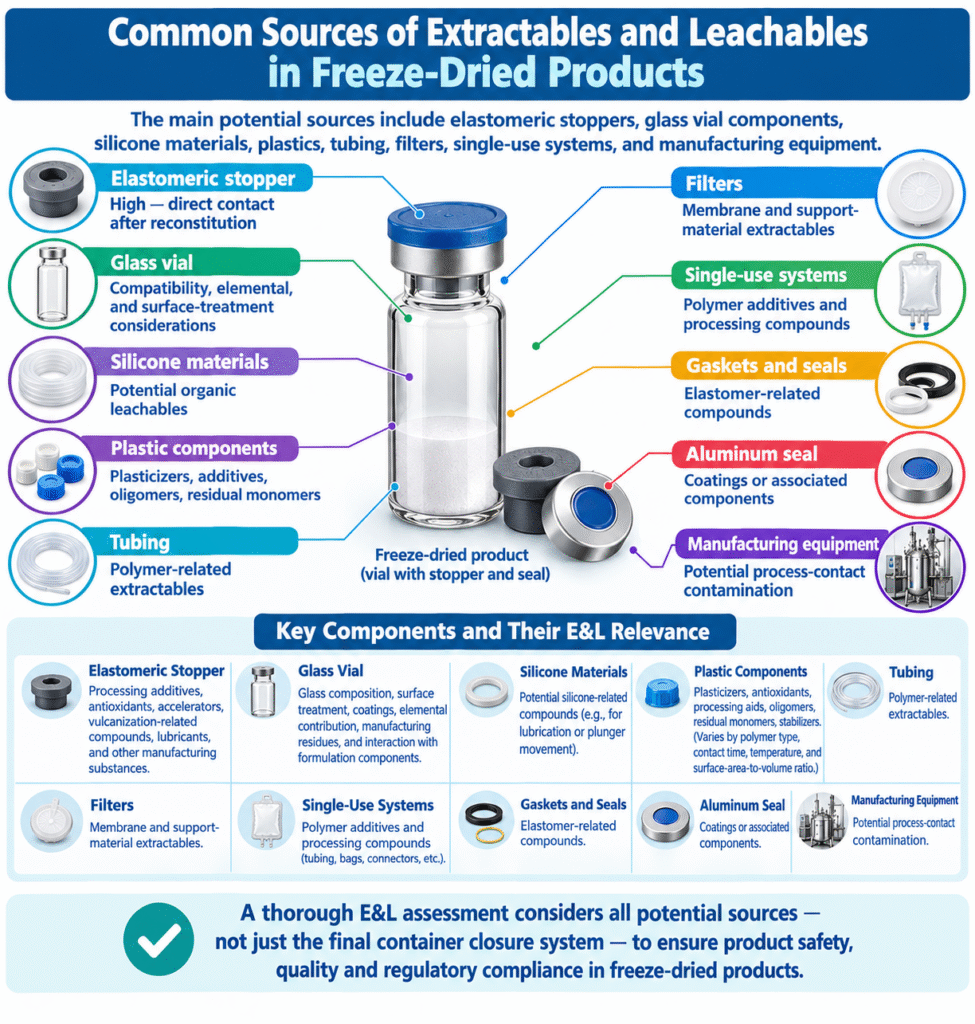
The main potential sources include elastomeric stoppers, glass vial components, silicone materials, plastics, tubing, filters, single-use systems, and manufacturing equipment.
| Material or Component | Potential E&L Relevance |
|---|---|
| Elastomeric stopper | High — direct contact after reconstitution |
| Glass vial | Compatibility, elemental, and surface-treatment considerations |
| Silicone materials | Potential organic leachables |
| Plastic components | Plasticizers, additives, oligomers, residual monomers |
| Tubing | Polymer-related extractables |
| Filters | Membrane and support-material extractables |
| Single-use bags | Polymer additives and processing compounds |
| Gaskets and seals | Elastomer-related compounds |
| Aluminum seal | Coatings or associated components |
| Manufacturing equipment | Potential process-contact contamination |
Elastomeric Stoppers
Elastomeric stoppers can contain processing additives, antioxidants, accelerators, vulcanization-related compounds, lubricants, and other manufacturing-related substances. Because the stopper can come into close contact with the product after reconstitution, it is one of the most important components for E&L assessment in freeze-dried vials.
Glass Vials
Glass is widely used for injectable pharmaceutical products because of its barrier properties and chemical resistance. However, the complete container closure system should still be evaluated for glass composition, surface treatment, coatings, elemental contribution, manufacturing residues, and interaction with formulation components.
Silicone Materials
Silicone materials may be used in pharmaceutical packaging and delivery systems to improve component functionality (such as stopper lubrication or plunger movement). Silicone-related compounds should be considered during E&L risk assessment when relevant to the specific container closure or delivery system.
Plastic Components
Plastic components can potentially contribute plasticizers, antioxidants, processing aids, oligomers, residual monomers, and stabilizers. The potential contribution depends on the polymer type, formulation, contact time, temperature, and surface-area-to-volume ratio.
Manufacturing Components and Single-Use Systems
E&L assessment should not necessarily be restricted to the final container closure system — manufacturing-contact materials also represent potential sources, including single-use bags, tubing, filters, connectors, gaskets, pumps, and sampling components. This consideration is particularly relevant for modern manufacturing processes that extensively rely on single-use systems and GMP E&L testing, and applies equally to the broader E&L requirements for single-use bioprocessing that support upstream and downstream biologics manufacturing.
4: How Does Lyophilization Affect Extractables and Leachables Risk?
Lyophilization changes the physical state of the formulation, but it does not eliminate E&L risk because the product is generally reconstituted before administration.
A typical lyophilized product process flow:
Liquid formulation → Freezing → Primary drying → Secondary drying → Dry storage → Reconstitution → Administration
Each stage can influence E&L considerations. Important factors include:
- Temperature during processing and vacuum conditions
- Drying time and residual moisture
- Container closure configuration
- Storage temperature and duration
- Reconstitution solvent and reconstitution time
- Surface-area-to-volume ratio
The reconstituted product is particularly important because substances that have limited mobility in the dry product may become more mobile once the product is rehydrated.
5: How Is Extractable Testing Performed for Lyophilized Drug Products?
Extractables testing uses controlled laboratory conditions to challenge packaging or manufacturing materials and characterize the compounds that may be released.
- Identify the materials — composition, supplier information, manufacturing process, surface treatment, intended use, contact time, and contact temperature
- Develop an extraction strategy — scientifically justified solvents and conditions designed to yield meaningful information on potential chemical release
- Conduct chemical screening using multiple orthogonal analytical techniques, since no single technique can detect and characterize every possible compound
- Identify detected compounds using accurate mass, retention time, mass spectral matching, fragmentation patterns, reference standards, and chemical databases
- Perform risk assessment based on concentration, potential exposure, toxicological relevance, and potential migration into the drug product
6: How Are Leachables Tested in Lyophilized Drug Products?
Leachables testing evaluates the actual drug product, or an appropriately justified representative system, under defined storage and use conditions.
A typical leachables program involves:
- Selection of representative batches
- Storage under intended conditions and testing at defined stability time points
- Reconstitution testing where applicable
- Organic and inorganic chemical screening and quantification of relevant compounds
- Identification of unknown peaks
- Toxicological assessment against appropriate safety thresholds
- Trending throughout the product’s stability period
For a lyophilized injectable, testing typically includes both long-term stability samples and reconstituted product samples, scoped according to a GMP-compliant E&L study design appropriate to the product’s risk profile and intended use.
7: What Factors Influence Leachables Formation?
Leachables formation depends on the material, formulation, storage conditions, contact time, temperature, and chemical environment.
- Formulation factors: pH, ionic strength, organic solvents, surfactants, proteins, peptides, buffers, preservatives
- Packaging factors: material composition, surface area, material-to-product ratio, manufacturing process, coatings, sterilization history
- Storage factors: temperature, time, humidity, light exposure, oxygen exposure
- Product-use factors: reconstitution solvent, reconstitution duration, agitation, administration device, in-use storag
8: What Regulatory Guidance Applies to E&L Testing for Lyophilized Products?
Regulatory expectations increasingly emphasize a science- and risk-based approach for identifying, characterizing, assessing, and controlling E&L risks. USP <1663> addresses extractables assessment, while USP <1664> addresses leachables assessment for pharmaceutical packaging and delivery systems. ICH Q3E provides a developing harmonized framework for the risk-based assessment and control of extractables and leachables, and FDA’s container closure framework emphasizes the suitability of container closure systems with respect to protection, safety, compatibility, and performance.
E&L documentation for a lyophilized drug product should be scientifically justified and aligned with the product’s development stage and applicable regulatory expectations — the same principles apply whether the dosage form is an injectable vial or a different route of administration, such as an E&L-compliant dry powder inhaler.
9: What Is a Risk-Based E&L Strategy for Lyophilized Products?
A risk-based E&L strategy prioritizes materials and compounds according to their potential for patient exposure and their potential impact on product quality and safety.
Material Identification → Risk Assessment → Extractables Screening → Leachables Evaluation → Compound Identification → Quantification → Toxicological Assessment → Risk Conclusion → Control Strategy
The assessment should consider route of administration, maximum daily dose, treatment duration, patient population, packaging composition, contact time, storage conditions, formulation characteristics, manufacturing process, and potential for chemical migration.
10: Common Challenges in E&L Testing of Lyophilized Drug Products
- Unknown peaks — complex packaging and manufacturing materials can generate numerous analytical signals; high-resolution LC-MS and GC-MS workflows support identification
- Low-level detection — leachables may occur at trace concentrations, requiring sensitive, appropriately validated or qualified methods
- Complex drug product matrices — proteins, peptides, buffers, and surfactants can complicate sample preparation and instrumental analysis
- Extractables-to-leachables correlation — not every extractable becomes a leachable; the relationship depends on material chemistry and actual product conditions
- Multiple packaging and manufacturing components — a complete assessment may involve numerous materials across manufacturing, packaging, and administration
- Toxicological assessment — chemical identification alone does not establish safety; exposure estimates and toxicological evaluation are required
Documentation and Audit Readiness
A defensible E&L program depends on maintaining audit-ready E&L data throughout development — complete material traceability, extraction and analytical method records, compound identification rationale, and toxicological risk conclusions organized for inspection readiness rather than assembled retroactively at submission time.
11: Recommended E&L Workflow for Lyophilized Products
- Product and process understanding
- Identification of packaging and manufacturing-contact materials
- E&L risk assessment
- Extractables study design
- Multi-platform analytical screening
- Compound identification and quantification
- Leachables assessment using product or stability samples
- Stability and leachables trending
- Toxicological and safety assessment
- Establishment of appropriate controls and regulatory documentation
This workflow can be adapted according to the formulation, packaging system, route of administration, manufacturing process, development stage, and applicable regulatory requirements. Many sponsors choose to work with an outsourced E&L testing partner to access orthogonal instrumentation and regulatory experience without building an in-house program.
How ResolveMass Supports E&L Testing for Lyophilized Drug Products
ResolveMass Laboratories Inc. supports pharmaceutical and biopharmaceutical E&L programs through complementary analytical capabilities including LC-MS, GC-MS, NMR, HPLC, and ICP-MS. Combining orthogonal analytical techniques provides broader chemical coverage and stronger evidence for compound identification and characterization. Our teams work with sponsors from early formulation development through commercial batch release, addressing both dry-cake and reconstituted-product testing needs across sterile injectable, biologic, peptide, and other lyophilized dosage forms, and can support a second GMP-compliant E&L study at later development stages as formulation or packaging changes require re-assessment.
Conclusion:
Extractables and Leachables in Lyophilized Drug Products should be evaluated as part of an integrated pharmaceutical quality, packaging, and container closure strategy. Although lyophilized formulations are stored in a dry state, potential chemical migration from elastomeric stoppers, plastics, silicone materials, manufacturing components, and other product-contact materials remains relevant, particularly after reconstitution and during administration. A scientifically justified E&L program combines risk assessment, extractables screening, leachables testing, sensitive analytical characterization, compound identification, quantitative assessment, and appropriate safety evaluation, guided by USP <1663>, USP <1664>, and the developing ICH Q3E framework.
Frequently Asked Questions:
E&L assessment may be necessary for lyophilized injectable products when packaging or manufacturing materials have a potential to contribute substances to the drug product. The extent of testing should be determined through a product-specific risk assessment.
Elastomeric stoppers can contain additives, processing aids, antioxidants, and other compounds that may be detected during extractables testing. Their potential contribution should therefore be considered during E&L risk assessment.
Yes. Extractables represent compounds that can potentially be released from a material, while leachables are compounds that actually migrate into the drug product under relevant storage or use conditions. However, not every extractable necessarily becomes a leachable.
ICH Q3E is an emerging international framework for the assessment and control of extractables and leachables. It promotes a science- and risk-based approach to evaluating potential chemical substances from packaging, manufacturing components, and delivery systems.
Yes. Reconstituted product can be evaluated for potential leachables when scientifically justified because reconstitution changes the physical and chemical environment and may increase the mobility of certain compounds.
LC-MS can help detect and characterize non-volatile and thermally labile compounds. High-resolution LC-MS can also provide accurate-mass information that supports the identification of unknown extractables and leachables.
Reference
- DeGrazio FL. Closure and container considerations in lyophilization. DRUGS AND THE PHARMACEUTICAL SCIENCES. 2004 Jan 21;137:277-98.https://books.google.com/books?hl=en&lr=&id=QvUOCgAAQBAJ&oi=fnd&pg=PA277&dq=Extractables+and+Leachables+in+Lyophilized+Drug+Products&ots=lHijG6P7Mh&sig=nD83WZTROxt2wPk13x3ntmbH-pM
- Zdravkovic SA. Comparison of the Levels of Rubber Stopper-Related Organic Leachables in Commercially Available Vialed Liquid and Lyophilized Drug Products: Zdravkovic. Pharmaceutical Research. 2020 Apr;37(4):76.https://link.springer.com/article/10.1007/s11095-020-02805-z
- Gökekin Y, Bulut M, Ersen BÇ, Güleli M, Çalışkan C. Evaluation and characterization of different extraction methods for obtaining extractable and leachable materials from rubber stopper systems used in pharmaceutical products. European Journal of Pharmaceutics and Biopharmaceutics. 2025 Sep 14:114844.https://www.sciencedirect.com/science/article/pii/S0939641125002218
- Zdravkovic SA. Comparison of a lyophilized drug product to other solid and liquid media for the extraction of elastomeric oligomers from a butyl rubber stopper. PDA journal of pharmaceutical science and technology. 2017;71(6):488-501.https://journal.pda.org/content/71/6/488.short
- Markovic I. Evaluation of safety and quality impact of extractable and leachable substances in therapeutic biologic protein products: a risk-based perspective. Expert opinion on drug safety. 2007 Sep 1;6(5):487-91.https://www.tandfonline.com/doi/abs/10.1517/14740338.6.5.487
About the Author


