

Introduction:
Patient safety begins long before a drug product reaches the clinic — it begins with the container that holds it. Extractables and leachables testing for container closure systems is the analytical discipline that ensures chemical compounds from packaging materials do not migrate into a finished drug product at levels that could harm patients or compromise product quality.
Regulatory agencies including the FDA, EMA, and Health Canada now expect a rigorous, risk-based E&L program as part of any NDA, ANDA, BLA, or MAA submission for parenteral, inhalation, ophthalmic, and transdermal drug products. Sponsors preparing submissions should understand current regulatory expectations, including common FDA questions on E&L studies. Container closure systems — primary packaging components such as vials, stoppers, prefilled syringes, cartridges, autoinjectors, and IV bags — are in direct contact with the drug product throughout its shelf life. Specialized E&L evaluations are often required for prefilled syringes and autoinjectors. Each of these materials, including rubber, glass, plastic polymers, adhesives, and coatings, carries a distinct chemical profile that must be characterized, assessed, and controlled before a product reaches a patient.
At ResolveMass Laboratories Inc., our analytical chemistry team delivers scientifically defensible, regulatory-aligned E&L programs for both small molecule and biopharmaceutical drug products, including complex injectables and PLGA-based long-acting formulations.
Summary:
- Extractables and leachables (E&L) testing for container closure systems is a critical regulatory requirement for all parenteral, ophthalmic, inhalation, and other high-risk drug products.
- Extractables are chemical compounds released from packaging materials under controlled, exaggerated laboratory conditions; leachables are compounds that actually migrate into the drug product under normal storage conditions.
- Regulatory frameworks governing E&L studies include ICH Q3E (Draft), USP <1663>, USP <1664>, ISO 10993-18, and FDA/EMA guidance documents.
- A scientifically sound E&L program begins with material characterization, proceeds through extraction studies, analytical profiling, and safety risk assessment, and concludes with leachables monitoring in real or accelerated stability studies.
- Container closure integrity (CCI) testing and E&L studies are complementary — a container that fails CCI can introduce additional leachables or permit oxidative degradation.
- ResolveMass Laboratories Inc. provides end-to-end extractables and leachables testing services for pharmaceutical and biopharmaceutical clients, including PLGA-based and complex injectable formulations.
1: What Are Extractables and Leachables? Understanding the Core Distinction
Extractables are chemical compounds released from packaging or delivery system components under laboratory-controlled, exaggerated extraction conditions. They represent the universe of potential chemical hazards associated with a given material. Leachables, by contrast, are the subset of extractables — or their degradation products — that actually migrate into the drug product under normal conditions of storage, use, and transport.
This distinction is not merely semantic; it drives the entire study design:
- Extractables studies use aggressive solvents (e.g., methanol, hexane, water, isopropanol) to intentionally over-extract all possible compounds from the material, creating a worst-case chemical inventory. Proper selection of solvents for extractables studies is critical to ensuring comprehensive chemical characterization.
- Leachables studies are conducted under real or accelerated stability conditions, using the actual drug formulation or a simulated product matrix, to identify what compounds genuinely migrate into the product.
The relationship between the two is governed by the threshold of toxicological concern (TTC) concept and safety concern thresholds (SCTs) defined in the ICH Q3E Guideline for Extractables and Leachables and the associated ICH Q3E E&L Risk Assessment Framework. Compounds identified as extractables that exceed established SCTs trigger targeted leachables monitoring.
2: Regulatory Framework for E&L Testing of Container Closure Systems
Regulatory expectations for E&L testing are clearly defined across multiple international guidance documents. Understanding which standards apply to a given product is the first step in designing a compliant study. Organizations seeking U.S. approvals should understand Extractables and Leachables Requirements for U.S. Market Authorization and current expectations for Extractables and Leachables Testing in the United States.
Recent developments surrounding ICH Q3E Extractables and Leachables Study Requirements have further strengthened expectations for risk-based study design, toxicological evaluation, and lifecycle management of packaging-related impurities.
| Regulatory Document | Scope | Key Requirement |
|---|---|---|
| ICH Q3E (Draft Guidance) | All dosage forms in direct-contact packaging | Risk-based E&L framework; TTC and SCT application |
| USP <1663> | Extractables characterization | Extraction solvent selection; analytical method requirements |
| USP <1664> | Leachables assessment | Study design in drug product; analytical thresholds |
| ISO 10993-18 | Medical device materials with drug contact | Chemical characterization; biological risk assessment |
| FDA Guidance (2016) | Container closure systems | CCI and compatibility for drug products |
| EMA/CHMP Guideline | Plastic immediate packaging materials | Extractables profiling; safety evaluation |
| ICH Q2(R2) | Method validation | Analytical procedure validation requirements |
Key regulatory principles to build your E&L program around:
- A risk-based approach is required — not all container closure components require the same depth of study. Risk ranking depends on patient route of exposure, dose frequency, duration of therapy, and the nature of the packaging material.
- Analytical thresholds (Reporting Threshold, Identification Threshold, Qualification Threshold) must be applied consistently across both extractables and leachables profiling.
- Regulatory agencies expect correlation between extractables and leachables data — every leachable observed in the drug product should be traceable to a compound (or its transformation product) identified in extractables screening.
3: Components of a Container Closure System Subject to E&L Testing
Any primary packaging component in direct or indirect contact with the drug product is subject to E&L evaluation. Secondary packaging components may also require evaluation when there is a reasonable possibility of contact.
Common components requiring E&L characterization include:
- Rubber stoppers and closures — bromobutyl or chlorobutyl rubber formulations in injectable vials; contain antioxidants, plasticizers, vulcanization agents, and processing aids
- Glass vials and ampoules — borosilicate Type I glass; subject to delamination and ion leaching, particularly with alkaline or protein formulations
- Plastic prefilled syringes (PFS) — cyclic olefin copolymer (COC) or cyclic olefin polymer (COP) barrels. Dedicated E&L testing for prefilled syringes is often required because of concerns surrounding silicone oil, tungsten residues, and elastomeric components.
- IV bags and multilayer films — polyvinyl chloride (PVC), polyolefins; plasticizers such as DEHP are well-documented leachables of concern
- Drug delivery devices — autoinjectors, pen injectors, dry powder inhalers; device components may introduce metal ions, lubricants, or adhesive residues. Comprehensive extractables and leachables testing for autoinjectors is increasingly important as combination products become more common.
- Elastomeric tip caps and needle shields — in prefilled syringe systems; may contribute sulfur-containing compounds or nitrosamines
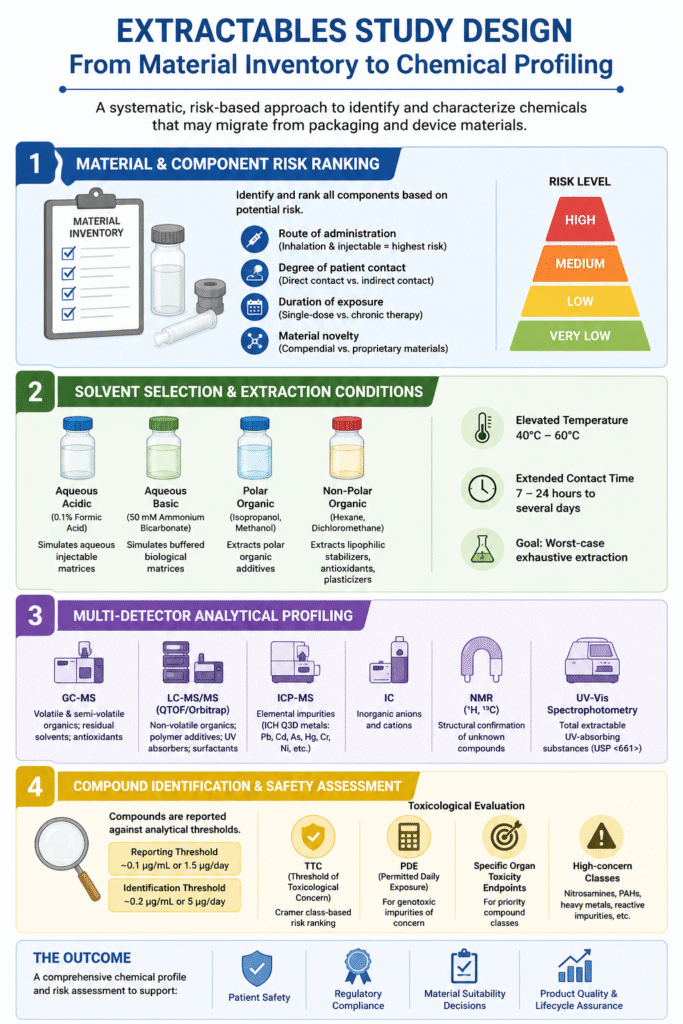
4: Extractables Study Design: From Material Inventory to Chemical Profiling
A well-designed extractables study begins with a complete material inventory and risk ranking, followed by systematic extraction under controlled conditions. The goal is to generate a comprehensive chemical profile — not merely to detect target analytes.
Step 1 — Material and Component Risk Ranking
Before any laboratory work begins, all components are ranked by:
- Route of administration (inhalation and injectable formulations carry the highest risk)
- Degree of patient contact (direct contact vs. indirect contact)
- Duration of exposure (single-dose vs. chronic therapy)
- Material novelty (well-characterized USP/EP compendial materials vs. proprietary polymers)
Step 2 — Solvent Selection and Extraction Conditions
Solvents are selected to represent the polarity extremes of the drug formulation and to achieve worst-case exhaustive extraction. Scientific justification for solvents used in extractables studies helps ensure exhaustive extraction while maintaining relevance to real-world product exposure. A typical extractables study employs:
- Aqueous acidic (e.g., 0.1% formic acid in water) — simulates aqueous injectable matrices
- Aqueous basic (e.g., 50 mM ammonium bicarbonate) — simulates buffered biological matrices
- Polar organic (e.g., isopropanol, methanol) — extracts polar organic additives
- Non-polar organic (e.g., hexane, dichloromethane) — extracts lipophilic stabilizers, antioxidants, plasticizers
Elevated temperatures (40°C–60°C) and extended contact times (7–24 hours to several days) are applied to ensure exhaustive extraction.
Step 3 — Multi-Detector Analytical Profiling
Extractables profiling requires a broad-spectrum analytical platform, not a single targeted method. ResolveMass employs an orthogonal analytical suite including:
| Analytical Technique | Compound Classes Detected |
|---|---|
| GC-MS (Headspace and Direct Injection) | Volatile and semi-volatile organics; residual solvents; antioxidants |
| LC-MS/MS (QTOF/Orbitrap) | Non-volatile organics; polymer additives; UV absorbers; surfactants |
| ICP-MS | Elemental impurities (ICH Q3D metals: Pb, Cd, As, Hg, Cr, Ni, etc.) |
| IC (Ion Chromatography) | Inorganic anions and cations |
| NMR (1H, 13C) | Structural confirmation of unknown compounds |
| UV-Vis Spectrophotometry | Total extractable UV-absorbing substances (USP <661>) |
Step 4 — Compound Identification and Safety Assessment
IdentifiedIdentified compounds are reported against the applicable analytical thresholds and subjected to toxicological evaluation. In addition to TTC-based assessments, certain compounds may require dedicated extractables and leachables carcinogenicity testing, particularly when structural alerts or genotoxic concerns are identified. Compounds identified above threshold are subject to toxicological evaluation using:
- TTC (Threshold of Toxicological Concern) — Cramer class-based risk ranking for compounds without specific toxicological data
- Permitted Daily Exposure (PDE) calculations — for genotoxic impurities of concern
- Specific organ toxicity endpoints — for priority compound classes (nitrosamines, polycyclic aromatic hydrocarbons, heavy metals)
5: Leachables Monitoring in Stability Studies
Leachables monitoring is performed in the actual drug product or a validated surrogate matrix, under the same stability conditions used for formal shelf-life studies. Leachables data must be available at the time of regulatory submission.
Study Design Considerations
- Real-time stability — samples at 25°C/60% RH (or as indicated by ICH Q1A) for the intended shelf life
- Accelerated stability — samples at 40°C/75% RH for a minimum of 6 months; useful for early development risk assessment
- Stressed conditions — light exposure (ICH Q1B), freeze-thaw cycling, mechanical stress — relevant for biologics in PFS systems
Critical Leachable Classes of Concern
- Nitrosamines — nitrosamine drug substance-related impurities (NDSRIs) are a current FDA/EMA priority. Packaging-related nitrosamine leachables originating from elastomeric closures and manufacturing additives are receiving increased regulatory scrutiny.
- 2-Ethylhexanoic acid (2-EHA) — a well-documented leachable from rubber closures; subject to PDE limits
- Antioxidants and their degradation products — BHT, Irganox, and their oxidized/reduced metabolites from polyolefin films and stoppers
- Plasticizers — DEHP and alternative phthalates from PVC IV bags; di(2-ethylhexyl) adipate (DEHA)
- Silicone oils — from prefilled syringes; can form visible particles and interact with protein biologics
- Tungsten residues — from the tungsten pin used in glass syringe barrel forming; known to cause protein aggregation
These compounds are frequently evaluated as part of broader E&L testing for drug safety in NDA and ANDA submissions.
6: The Connection Between Container Closure Integrity and E&L Outcomes
Container closure integrity (CCI) directly influences leachables outcomes. A container closure system that fails to maintain a hermetic seal can introduce atmospheric oxygen and moisture, promoting oxidative degradation of both the drug product and extractable compounds. Several FDA extractables and leachables case studies have demonstrated how packaging-related failures can significantly impact product quality and patient safety.
Key CCI test methods used in conjunction with E&L programs include:
- Vacuum decay and headspace gas analysis (USP <1207>) for parenteral vials and ampoules
- High-voltage leak detection (HVLD) for aqueous injectables in glass and plastic containers
- Dye ingress / microbial ingress methods for sterility risk assessment
- Laser-based headspace O₂/CO₂ analysis for oxygen-sensitive biologics and peptide injectables
An integrated CCI and E&L program ensures that the container’s physical integrity and chemical compatibility are evaluated together — as they must be for a complete regulatory package.
Conclusion:
Extractables and leachables testing for container closure systems sits at the intersection of analytical chemistry, toxicology, and regulatory science. A robust E&L program is not a checkbox exercise — it is a scientifically integrated investigation that protects patients, supports regulatory approval, and provides meaningful insight into the chemical compatibility of every material in contact with your drug product.
The growing importance of Extractables and Leachables in Biologics and ATMPs is driving new analytical approaches across the industry. Likewise, Extractables and Leachables in Emerging Biologics and Advanced Therapies present unique challenges associated with novel materials, delivery devices, and highly sensitive therapeutic products.
As global submissions increase, sponsors should understand the differences between E&L Testing in the USA vs Europe and remain informed about evolving regulatory expectations. Many organizations also benefit from Outsourcing Extractables and Leachables Testing Laboratories in the United States to access specialized instrumentation, experienced toxicologists, and regulatory expertise.
ResolveMass Laboratories Inc. has the analytical infrastructure, regulatory knowledge, and formulation science expertise to serve as your trusted E&L testing partner — from early-stage development through post-approval change management.
Frequently Asked Questions:
Extractables and Leachables (E&L) testing should ideally begin during the early stages of pharmaceutical development, once candidate packaging and container closure components have been selected. Early extractables assessments help identify potential risks before formulation, stability, and regulatory studies are finalized. Initiating E&L evaluations during development can prevent costly reformulations, packaging changes, and regulatory delays later in the product lifecycle.
No. Compliance with pharmacopeial standards such as USP or European Pharmacopoeia (EP) does not automatically exempt materials from E&L testing. While compendial certification demonstrates that a material meets certain quality requirements, it does not guarantee that the material will not release extractables or leachables into a specific drug product. Regulatory agencies generally expect a product-specific risk assessment to determine whether additional E&L studies are necessary.
Nitrosamines are treated as high-priority compounds due to their potential carcinogenic risk. A comprehensive E&L program includes risk assessments to identify packaging materials, rubber components, manufacturing additives, or processing aids that could contribute nitrosamine formation. If a risk is identified, highly sensitive analytical methods such as LC-MS/MS or GC-MS/MS are developed to detect and quantify nitrosamines at very low levels. The results are then evaluated against applicable regulatory acceptable intake limits and safety thresholds.
Elemental impurities originating from glass containers, elastomeric closures, coatings, pigments, or manufacturing processes are typically analyzed using highly sensitive elemental analysis techniques. The most widely used method is Inductively Coupled Plasma Mass Spectrometry (ICP-MS) due to its excellent sensitivity and ability to simultaneously quantify multiple trace elements. Depending on the study requirements, additional techniques such as ICP-OES (Inductively Coupled Plasma Optical Emission Spectroscopy) or Atomic Absorption Spectroscopy (AAS) may also be used. These methods help ensure compliance with regulatory expectations for elemental impurity control and patient safety.
Reference
- Ramamoorthy S, Chong NS, Hotha KK. Strengthening extractable & leachable study submissions: best practices to avoid regulatory deficiencies. American Journal of Analytical Chemistry. 2024;15(12):368-94.https://www.researchgate.net/profile/Subathra-Ramamoorthy-2/publication/387503864_Strengthening_Extractable_Leachable_Study_Submissions_Best_Practices_to_Avoid_Regulatory_Deficiencies/links/678dbc981ec9f9589f51a2bb/Strengthening-Extractable-Leachable-Study-Submissions-Best-Practices-to-Avoid-Regulatory-Deficiencies.pdf
- Smith EJ, Paskiet DM, Tullo EJ. The management of extractables and leachables in pharmaceutical products. InParenteral Medications, Fourth Edition 2019 Jul 19 (pp. 535-573). CRC Press.https://www.taylorfrancis.com/chapters/edit/10.1201/9780429201400-29/management-extractables-leachables-pharmaceutical-products-edward-smith-diane-paskiet-erica-tullo
- Rushing W. Developing a Phase-Appropriate Extractables & Leachables Program.https://cdnmedia.eurofins.com/corporate-eurofins/media/12146638/9420_early-phase-el_web.pdf
- Smith EJ, Paskiet DM. 10 The management of extractables and leachables in pharmaceutical products. Pharmaceutical Dosage Forms-Parenteral Medications: Volume 3: Regulations, Validation and the Future. 2016 Apr 19;3:175.https://books.google.com/books?hl=en&lr=&id=Q0m3BgAAQBAJ&oi=fnd&pg=PA175&dq=Extractables+and+Leachables+(E%26L)+Testing+for+Container+Closure+Integrity+Programs&ots=3BMj0TbIGk&sig=mrJDRYpbeEamSvYmLA2tAwDtYno
- Scatena A, Toth S, Chenevert K. Exploring Extractable and Leachable Testing Strategies for Parenterals [Internet].https://www.ondrugdelivery.com/wp-content/uploads/2024/01/156_2024_Jan_PFS_Gateway_Analytical.pdf
About the Author


